Is the MicroStrategy Model Failing? Imitator Holding 30,000 Bitcoins Sees Pre-IPO Investors Backing Out

marsbitPubblicato 2026-07-13Pubblicato ultima volta 2026-07-13

Introduzione

"The 'Bitcoin Treasury' model is facing a critical test. BSTR Holdings, a company founded by Adam Back and holding 30,021 Bitcoin, has called off its planned merger with SPAC Cantor Equity Partners I. The deal, which would have taken it public, fell apart as the attached private investment (PIPE) financing collapsed. This failure highlights a core vulnerability of the 'Bitcoin accumulation company' strategy popularized by MicroStrategy. The model relies on a key metric: mNAV, or the premium of a company's stock market value over the value of its Bitcoin holdings. This premium fuels a cycle where companies issue shares at a premium, use the cash to buy more Bitcoin, and theoretically increase the Bitcoin per share for investors. However, with Bitcoin's price down roughly 49% from its late-2024 peak, this premium has evaporated across the sector. Companies like American Bitcoin and Metaplanet are also under severe pressure. For BSTR, the lack of premium meant investors were unwilling to fund the original deal structure at the proposed terms. The companies are now renegotiating. The next SEC filing detailing any new agreement will be a crucial indicator. It will show if the model can be repriced for a low-premium environment by preserving Bitcoin holdings and investor commitments, or if it requires significantly diluting shareholders and scaling back ambitions. The outcome is a public stress test for the entire 'Bitcoin treasury' investment thesis."

Author: Claude, Deep Tide TechFlow

Deep Tide Introduction: On July 8, BSTR, the bitcoin treasury company of Blockstream co-founder Adam Back, and SPAC company Cantor Equity Partners I (Nasdaq: CEPO) jointly announced they would not complete the merger as per the original agreement dated July 2025, and the private placement (PIPE) tied to the transaction is no longer required to be completed. The special shareholder meeting originally scheduled for July 10 is postponed indefinitely. This deal was supposed to bring 30,021 bitcoins and up to $1.5 billion in cash PIPE funding to the public market. Bitcoin is currently around $64,000, nearly halved from its all-time high of $126,000 in October last year. With the stock price premium that fueled the 'bitcoin-holding company' model gone, whether this financing machine can restart depends on the next SEC filing.

Adam Back, inventor of Hashcash, holds 30,000 bitcoins but cannot raise money in the capital markets.

On July 8, Cantor Equity Partners I filed an 8-K form with the SEC, disclosing it and BSTR Holdings were discussing a revised transaction structure and terms to 'better reflect current market conditions.' The most critical sentence in the filing is: both parties will not complete the transaction under the original merger agreement dated July 16, 2025, and the private placement tied to this transaction is no longer required to be completed.

A company announcement issued the same day added two points: the special shareholder meeting originally scheduled for July 10 is postponed indefinitely; public shares for which redemption requests have been submitted will be returned and not redeemed.

Bitcoin hasn't crashed; what has crashed is the financing structure built to buy it.

The Original Scale: 30,000 Bitcoins

BSTR's selling point from the start was scale.

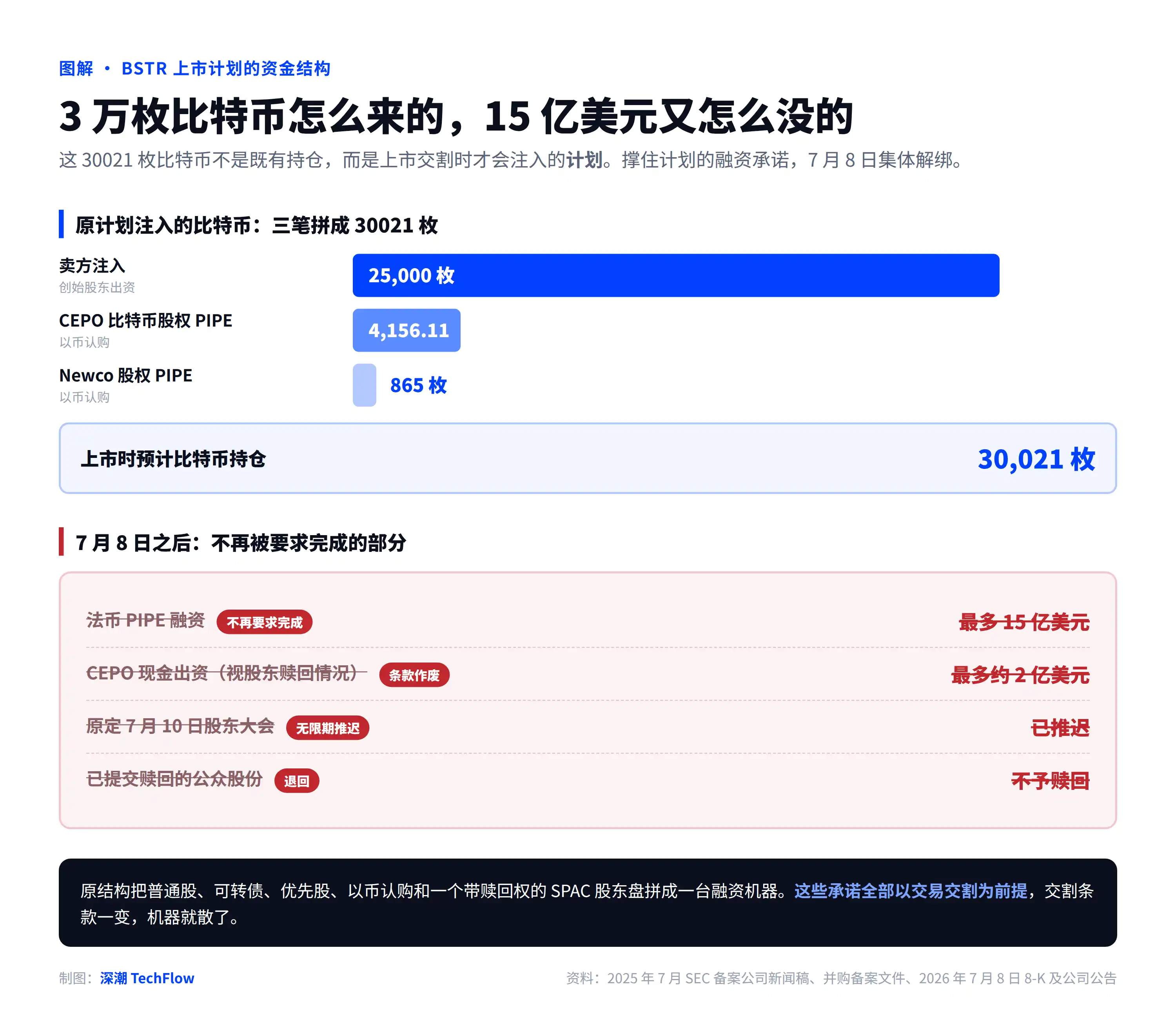
According to a company press release submitted to the SEC in July 2025, BSTR expected its balance sheet upon listing to include 30,021 bitcoins, plus up to $1.5 billion in cash PIPE financing, 5,021 bitcoins for an in-kind PIPE, 25,000 bitcoins from founding shareholders, and up to approximately $200 million in cash from Cantor Equity Partners I (depending on shareholder redemptions).

The number 30,021 is not a single block; detailed merger documents break it into three parts: 25,000 from sellers, 4,156.11 from the CEPO bitcoin equity PIPE, and 865 from the Newco equity PIPE. Additionally, there were cash equity, convertible notes, preferred stock, and bitcoin-denominated subscription commitments, all contingent on the successful closing of the transaction.

These commitments were the true load-bearing walls. They turned a pile of bitcoin into a financing machine for the public markets: common stock, convertible notes, preferred stock, bitcoin subscriptions, plus a SPAC shareholder base with redemption rights—five funding sources pieced together.

Adam Back himself served as CEO of BSTR, and the transaction narrative revolved around 'Bitcoin per share' rather than simply passive holding.

After the July 8 announcement said the private placement didn't have to be completed, the question became whether new terms could bring these funds back.
The Engine is Stock Premium, Not Bitcoin

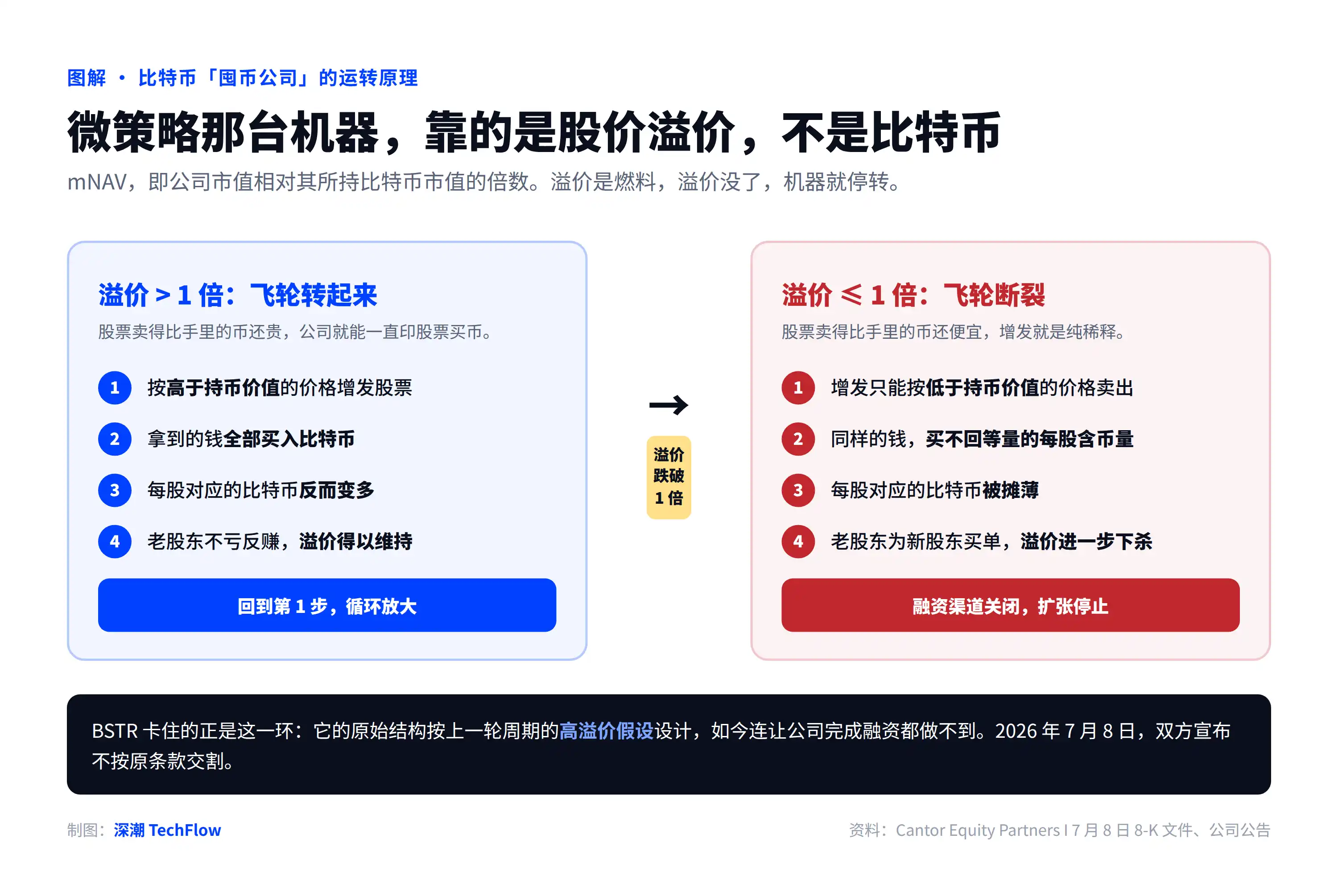
The operating logic of the 'bitcoin-holding company' model is actually separate from whether bitcoin rises.

The key metric is mNAV, meaning the company's stock market capitalization relative to the market value of the bitcoin it holds. A company with a market cap double its bitcoin holdings has an mNAV of 2. This premium is the fuel for the entire machine: the company issues shares at a price above net asset value, uses the money to buy more bitcoin, the bitcoin per share actually increases, shareholders profit rather than lose, and the cycle repeats. MicroStrategy (now Strategy) was built by rolling this cycle.

Once the premium converges to 1x or even falls below 1x, this cycle breaks. Issuing shares to buy bitcoin no longer increases bitcoin per share but dilutes existing shareholders. The machine stops.

This is precisely BSTR's problem. The original structure was designed based on premium assumptions from the last cycle, and those assumptions are no longer something anyone is willing to pay for. So this isn't about 'whether the stock can maintain its premium after listing,' but rather that the premium assumption cannot even get the company to complete its financing.
The Entire Sector is Under Pressure

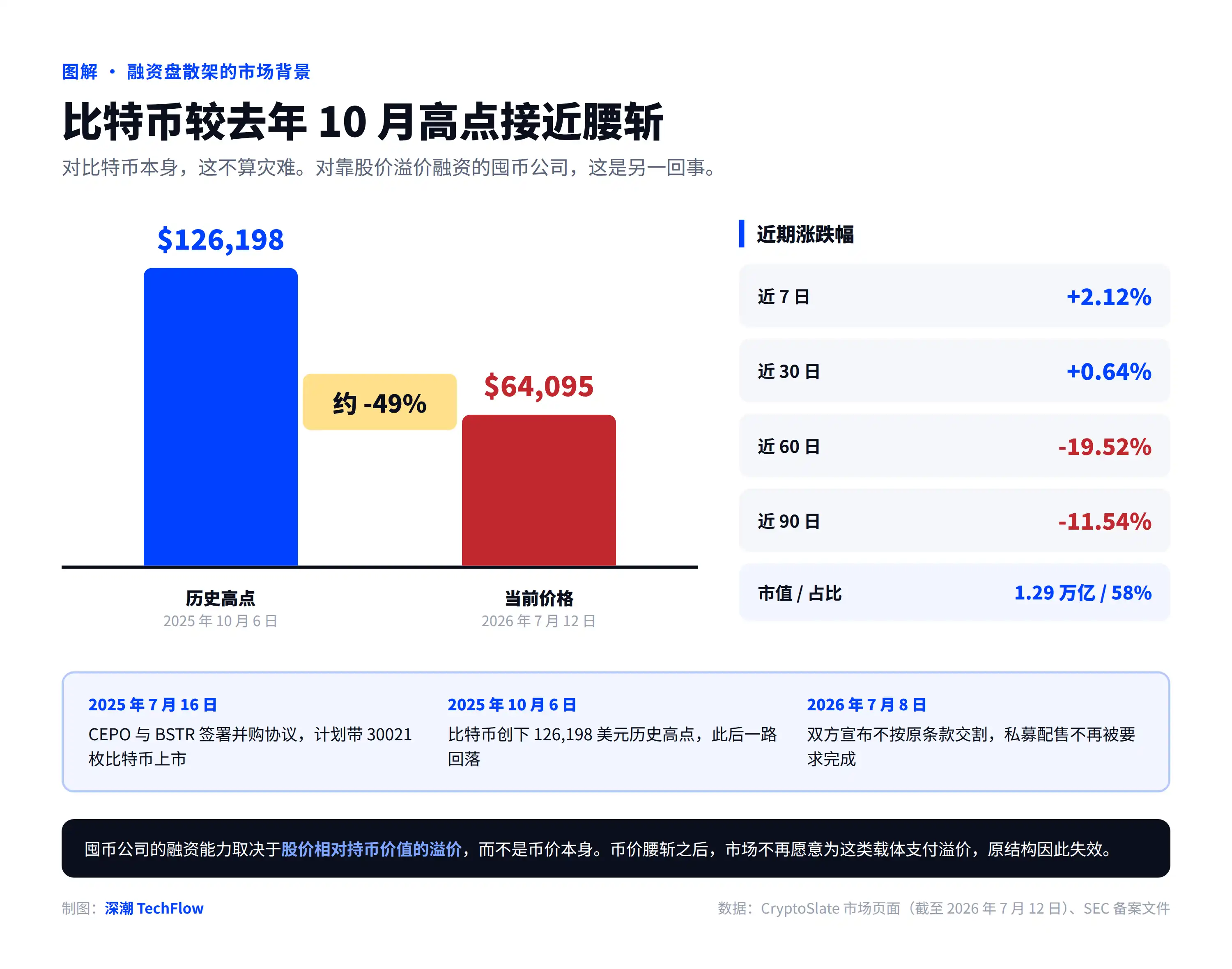
Bitcoin was quoted around $64,000 on July 12, with a market cap of about $1.27 trillion, accounting for roughly 58% of the crypto market. This price has fallen about 49% from the all-time high of $126,200 set on October 6 last year, down about 19.5% over the past 60 days.

For bitcoin itself, this is not a disaster. For bitcoin-holding companies relying on premium financing, it's another story.

Other news from the same week serves as a reference. American Bitcoin, involving Eric Trump, was forced to implement a 1-for-15 reverse stock split to maintain Nasdaq's minimum bid price requirement; it holds about 8,000 bitcoins. Strategy's preferred stock fell below par value in June. Metaplanet's stock price is already below the value of its bitcoin holdings. In early July, another US bitcoin-holding company liquidated its entire bitcoin holdings under debt and Nasdaq compliance pressures.

Meanwhile, money is flowing elsewhere. AI computing company CoreWeave just completed a $20 billion financing round.
The Next SEC Filing is the Real Verdict

Cantor and BSTR are still negotiating; the original terms are void.

If the two parties reach a new agreement, a new SEC filing will amend or supplement the registration statement and proxy materials. That filing will answer three questions: how much of the 30,021 bitcoin scale remains, how much of the original PIPE commitments remain, and at what price investors are now willing to put in money.

According to market data cited by TFTC, CEPO's stock price is currently around $10.50, close to its trust value. This position itself is a signal: the market is not assigning any premium to this transaction.

The risk factors listed in the July 8 filing are almost a negotiation checklist: public shareholder redemptions, public float percentage, liquidity, exchange listing, bitcoin price volatility, competition, regulatory uncertainty, and difficulty in expanding bitcoin accumulation and treasury operations.

For readers holding bitcoin-holding stocks, the implications are twofold:

If the new agreement preserves the 30,000 bitcoin scale, retains substantial investor commitments, and does not heavily transfer costs to new shareholders, it means this model can be repriced in a low-premium environment without dying.

If the new terms reduce the bitcoin holding scale, increase funding costs, weaken investor protections, or rely more on dilution to raise money, it means the next batch of bitcoin-holding companies can no longer feast on the premium红利 left by the last cycle. Those buying such stocks are essentially paying for someone else's restructuring.

BSTR is now a public stress test for the entire sector. The test results will be written in the next SEC filing.


Crypto di tendenza

Domande pertinenti

QWhat was the core reason behind the failure of the original merger and PIPE financing deal for BSTR Holdings?

AThe original financing structure, based on assumptions of a significant premium to the company's net asset value (the 'mNAV' multiple), failed to attract investors in the current market. The 'premium' that fuels the 'Bitcoin hoarding company' model had vanished, making the deal unattractive. Investors were no longer willing to pay the expected price.

QWhat is the 'mNAV' multiple and why is it crucial for companies like BSTR and MicroStrategy?

AThe 'mNAV' (Market-to-Net Asset Value) multiple is the ratio of a company's market capitalization to the market value of the Bitcoin it holds. A premium (mNAV > 1) is crucial as it allows these companies to issue new shares at a price above their underlying Bitcoin value. The proceeds are used to buy more Bitcoin, increasing the Bitcoin-per-share metric for all shareholders. This self-reinforcing cycle is the core engine of their business model.

QWhat are the two possible interpretations for investors depending on the new terms BSTR negotiates?

A1. If the new terms preserve the 30,000 Bitcoin scale, retain substantial investor commitments, and don't heavily transfer costs to new shareholders, it signals the model can be re-priced and survive in a low-premium environment. 2. If the terms reduce the Bitcoin holdings, increase financing costs, weaken investor protections, or rely heavily on shareholder dilution, it signifies that future 'hoarding companies' can no longer benefit from past-cycle premiums. Buying such stock would mean investors are essentially paying for the company's restructuring.

QAccording to the article, what broader market trends are putting pressure on the 'Bitcoin hoarding company' sector?

AThe entire sector is under pressure as the premium (mNAV multiple) has collapsed across the board. Examples include American Bitcoin resorting to a reverse stock split, MicroStrategy's (Strategy) preferred shares trading below par, Metaplanet's stock trading below its Bitcoin holdings value, and another unnamed U.S. company liquidating its Bitcoin treasury due to debt and compliance pressures. Meanwhile, capital is flowing to other sectors like AI (e.g., CoreWeave's $20B funding round).

QWhat key information will be revealed in BSTR's next major SEC filing?

AThe next significant SEC filing, which would contain a revised or amended registration statement, will reveal: 1) How much of the originally planned 30,021 Bitcoin scale remains, 2) How many of the original PIPE financing commitments are still in place, and 3) What price or terms investors are now demanding to provide capital. This document will serve as the verdict on whether the model can be restructured successfully.

Letture associate

8000 BTC Hard to Sustain Stock Price, Can Reverse Stock Split Save American Bitcoin?

American Bitcoin Corp., a company tied to Eric Trump, faces a paradox: its Bitcoin holdings have grown to 8,000 BTC, yet its stock price remains under severe pressure. To maintain its Nasdaq listing, the company executed a 1-for-15 reverse stock split, which raises the per-share price but does not change overall market valuation. The company's strategy combines mining operations—producing BTC at a reported cost of $36,200—with treasury accumulation. While this allows for below-market asset acquisition, fundamental challenges persist. Q1 2026 results showed a net loss of $81.8 million and significant digital asset impairment losses of $117.2 million, despite mining revenue. The reverse split carries risks: it may not attract new investors, could be viewed negatively by the market, and might reduce liquidity. Furthermore, the company's unchanged authorized share capital leaves room for future equity issuance, creating dilution concerns for current shareholders. The core question for investors is whether owning the stock offers superior value compared to holding Bitcoin directly. The company's test will be proving its mining-based, low-cost accumulation model can sustainably grow per-share Bitcoin holdings without excessive dilution. Its performance is a case study for the crypto treasury sector, where asset growth alone may not support valuation if market confidence falters.

Foresight News6 min fa

8000 BTC Hard to Sustain Stock Price, Can Reverse Stock Split Save American Bitcoin?

Foresight News6 min fa

Tokenized Equity Is Unbundling Venture Capital's One-Stop-Shop Financing Business

Tokenized Equity Splits VC's One-Stop Financing Business The article explores how tokenizing company shares on the blockchain fundamentally reshapes the venture capital model. Traditionally, a VC's term sheet is a bundled service providing capital, valuation, curation/signaling, network access, governance, and implied follow-on funding. Tokenized equity, where shares are natively issued and registered on-chain, enables the unbundling of these services. Securitize exemplified this by listing on the NYSE while simultaneously issuing its native stock tokens on Solana and Avalanche. This creates continuous liquidity and price discovery, allowing startups to source services separately. Market-based platforms can handle funding and valuation; specialized service providers manage cap tables, token vesting, and programmable governance; and key individuals or smaller funds can offer brand credibility and network access. While this unbundling commoditizes transactional and administrative functions, core VC value persists in areas resistant to digitization: deep value judgment, strategic guidance, and using personal reputation to attract talent, customers, and future investors. Just as record labels survived by focusing on A&R (artist discovery) after music distribution was digitized, VCs will evolve to specialize in the nuanced, human-centric aspects of startup building. Founders gain the freedom to choose which services to source from the market versus which to obtain from trusted partners, fundamentally changing early-stage decision-making.

Foresight News1 h fa

Tokenized Equity Is Unbundling Venture Capital's One-Stop-Shop Financing Business

Foresight News1 h fa

Trading

Spot

Articoli Popolari

Cosa è BITCOIN

Comprendere HarryPotterObamaSonic10Inu (ERC-20) e la sua posizione nel mondo delle criptovalute Negli ultimi anni, il mercato delle criptovalute ha assistito a un aumento della popolarità delle meme coin, catturando l'interesse non solo dei trader, ma anche di coloro che cercano coinvolgimento comunitario e valore di intrattenimento. Tra questi token unici c'è HarryPotterObamaSonic10Inu (ERC-20), un progetto intrigante che mescola riferimenti culturali nel tessuto delle criptovalute. Questo articolo esplora gli aspetti chiave di HarryPotterObamaSonic10Inu, analizzando i suoi meccanismi, l'etica guidata dalla comunità e il suo coinvolgimento con il panorama crittografico più ampio. Che cos'è HarryPotterObamaSonic10Inu (ERC-20)? Come suggerisce il suo nome, HarryPotterObamaSonic10Inu è una meme coin costruita sulla blockchain di Ethereum, classificata secondo lo standard ERC-20. A differenza delle criptovalute tradizionali che possono enfatizzare l'utilità pratica o il potenziale investimento, questo token prospera grazie al valore di intrattenimento e alla forza della sua comunità. Il progetto mira a creare un ambiente in cui gli utenti coinvolti possono riunirsi, condividere idee e partecipare ad attività ispirate a diversi fenomeni culturali. Una caratteristica notevole di HarryPotterObamaSonic10Inu è la zero tassa sulle transazioni. Questo elemento allettante tende a incoraggiare il trading e il coinvolgimento della comunità, privo di costi aggiuntivi che possono scoraggiare i trader di piccole dimensioni. L'offerta totale della moneta è fissata a un miliardo di token, un numero che segna la sua intenzione di mantenere una circolazione sostanziale all'interno della comunità. Creatore di HarryPotterObamaSonic10Inu (ERC-20) Le origini di HarryPotterObamaSonic10Inu sono avvolte in un certo mistero; i dettagli sul creatore rimangono sconosciuti. Lo sviluppo di questo token non presenta un team identificabile o un piano esplicito, cosa non rara nel settore delle meme coin. Invece, il progetto è emerso organicamente, con il suo progresso fortemente dipendente dall'entusiasmo e dalla partecipazione della sua comunità. Investitori di HarryPotterObamaSonic10Inu (ERC-20) Per quanto riguarda investimenti esterni e finanziamenti, HarryPotterObamaSonic10Inu rimane ambiguo. Il token non elenca alcuna fondazione di investimento conosciuta o un sostegno organizzativo significativo. Invece, la linfa vitale del progetto è la sua comunità di base, che informa la sua crescita e sostenibilità attraverso azioni collettive e coinvolgimento nello spazio crittografico. Come funziona HarryPotterObamaSonic10Inu (ERC-20)? In quanto meme coin, HarryPotterObamaSonic10Inu opera principalmente al di fuori delle strutture tradizionali che governano spesso il valore degli asset. Ci sono diversi aspetti distintivi che definiscono il funzionamento del progetto: Transazioni senza tasse: Senza costi fiscali sulle transazioni, gli utenti possono comprare e vendere liberamente il token senza preoccuparsi di costi nascosti. Coinvolgimento della comunità: Il progetto prospera sull'interazione della comunità, sfruttando le piattaforme social per creare entusiasmo e facilitare il coinvolgimento. Discussioni, condivisione di contenuti e coinvolgimento sono elementi cruciali che aiutano ad espandere la sua portata e a favorire la lealtà tra i sostenitori. Nessuna utilità pratica: Va notato che HarryPotterObamaSonic10Inu non offre un'utilità concreta all'interno dell'ecosistema finanziario. Piuttosto, è classificato come un token principalmente per attività di intrattenimento e comunitarie. Riferimento culturale: Il token incorpora astutamente elementi della cultura pop per attirare interesse, collegandosi a appassionati di meme e seguaci delle criptovalute. HarryPotterObamaSonic10Inu esemplifica come le meme coin operino in modo diverso rispetto ai progetti di criptovalute più tradizionali, entrando nel mercato come costrutti sociali innovativi piuttosto che come asset utilitari. Cronologia di HarryPotterObamaSonic10Inu (ERC-20) La storia di HarryPotterObamaSonic10Inu è segnata da diversi traguardi notevoli: Creazione: Il token è emerso da un meme virale, catturando l'immaginazione di molti appassionati di criptovalute. Le date di creazione specifiche non sono disponibili, sottolineando la sua crescita organica. Inserimento negli scambi: HarryPotterObamaSonic10Inu ha fatto il suo ingresso in vari scambi, consentendo un accesso e un trading più facili da parte della comunità. Iniziative di coinvolgimento della comunità: Attività in corso volte a migliorare l'interazione della comunità, comprese gare, campagne sui social media e generazione di contenuti da parte di fan e sostenitori. Piani di espansione futura: La tabella di marcia del progetto include il lancio di una collezione NFT, merchandising e un sito di eCommerce relativo ai suoi temi culturali, coinvolgendo ulteriormente la comunità e cercando di aggiungere più dimensioni al suo ecosistema. Punti chiave su HarryPotterObamaSonic10Inu (ERC-20) Natura guidata dalla comunità: Il progetto dà priorità al contributo collettivo e alla creatività, garantendo che il coinvolgimento degli utenti sia al centro del suo sviluppo. Classificazione come meme coin: Rappresenta l'epitome delle criptovalute basate sull'intrattenimento, distinguendosi dai veicoli d'investimento tradizionali. Nessuna affiliazione diretta con Bitcoin: Nonostante la somiglianza nel nome del ticker, HarryPotterObamaSonic10Inu è distintivo e non ha alcuna relazione con Bitcoin o altre criptovalute consolidate. Focus sulla collaborazione: HarryPotterObamaSonic10Inu è progettato per creare uno spazio per la collaborazione e la condivisione di storie tra i suoi detentori, fornendo un canale per la creatività e il legame comunitario. Prospettive future: L'ambizione di espandersi oltre il suo presupposto iniziale verso NFT e merchandising delinea un percorso per il progetto per potenzialmente entrare in strade più mainstream all'interno della cultura digitale. Poiché le meme coin continuano a catturare l'immaginazione della comunità crittografica, HarryPotterObamaSonic10Inu (ERC-20) si distingue per i suoi legami culturali e il suo approccio centrato sulla comunità. Anche se potrebbe non adattarsi al modello tipico di un token orientato all'utilità, la sua essenza risiede nella gioia e nella camaraderia coltivate tra i suoi sostenitori, evidenziando la natura in evoluzione delle criptovalute in un'epoca sempre più digitale. Con la continuazione dello sviluppo del progetto, sarà importante osservare come le dinamiche della comunità influenzano la sua traiettoria nel panorama in continuo cambiamento della tecnologia blockchain.

1.8k Totale visualizzazioniPubblicato il 2024.04.01Aggiornato il 2024.12.03

Cosa è BITCOIN

Come comprare BTC

Benvenuto in HTX.com! Abbiamo reso l'acquisto di Bitcoin (BTC) semplice e conveniente. Segui la nostra guida passo passo per intraprendere il tuo viaggio nel mondo delle criptovalute.Step 1: Crea il tuo Account HTXUsa la tua email o numero di telefono per registrarti il tuo account gratuito su HTX. Vivi un'esperienza facile e sblocca tutte le funzionalità,Crea il mio accountStep 2: Vai in Acquista crypto e seleziona il tuo metodo di pagamentoCarta di credito/debito: utilizza la tua Visa o Mastercard per acquistare immediatamente BitcoinBTC.Bilancio: Usa i fondi dal bilancio del tuo account HTX per fare trading senza problemi.Terze parti: abbiamo aggiunto metodi di pagamento molto utilizzati come Google Pay e Apple Pay per maggiore comodità.P2P: Fai trading direttamente con altri utenti HTX.Over-the-Counter (OTC): Offriamo servizi su misura e tassi di cambio competitivi per i trader.Step 3: Conserva Bitcoin (BTC)Dopo aver acquistato Bitcoin (BTC), conserva nel tuo account HTX. In alternativa, puoi inviare tramite trasferimento blockchain o scambiare per altre criptovalute.Step 4: Scambia Bitcoin (BTC)Scambia facilmente Bitcoin (BTC) nel mercato spot di HTX. Accedi al tuo account, seleziona la tua coppia di trading, esegui le tue operazioni e monitora in tempo reale. Offriamo un'esperienza user-friendly sia per chi ha appena iniziato che per i trader più esperti.

4.1k Totale visualizzazioniPubblicato il 2024.12.12Aggiornato il 2026.06.02

Come comprare BTC

Cosa è $BITCOIN

ORO DIGITALE ($BITCOIN): Un'Analisi Completa Introduzione all'ORO DIGITALE ($BITCOIN) L'ORO DIGITALE ($BITCOIN) è un progetto basato su blockchain che opera sulla rete Solana, con l'obiettivo di combinare le caratteristiche dei metalli preziosi tradizionali con l'innovazione delle tecnologie decentralizzate. Sebbene condivida un nome con Bitcoin, spesso definito “oro digitale” a causa della sua percezione come riserva di valore, l'ORO DIGITALE è un token separato progettato per creare un ecosistema unico all'interno del panorama Web3. Il suo obiettivo è posizionarsi come un asset digitale alternativo valido, anche se i dettagli riguardanti le sue applicazioni e funzionalità sono ancora in fase di sviluppo. Cos'è l'ORO DIGITALE ($BITCOIN)? L'ORO DIGITALE ($BITCOIN) è un token di criptovaluta esplicitamente progettato per l'uso sulla blockchain di Solana. A differenza di Bitcoin, che fornisce un ruolo di stoccaggio di valore ampiamente riconosciuto, questo token sembra concentrarsi su applicazioni e caratteristiche più ampie. Aspetti notevoli includono: Infrastruttura Blockchain: Il token è costruito sulla blockchain di Solana, nota per la sua capacità di gestire transazioni ad alta velocità e a basso costo. Dinamiche di Offerta: L'ORO DIGITALE ha un'offerta massima fissata a 100 quadrilioni di token (100P $BITCOIN), sebbene i dettagli riguardanti la sua offerta circolante siano attualmente non divulgati. Utilità: Sebbene le funzionalità precise non siano esplicitamente delineate, ci sono indicazioni che il token potrebbe essere utilizzato per varie applicazioni, potenzialmente coinvolgendo applicazioni decentralizzate (dApp) o strategie di tokenizzazione degli asset. Chi è il Creatore dell'ORO DIGITALE ($BITCOIN)? Attualmente, l'identità dei creatori e del team di sviluppo dietro l'ORO DIGITALE ($BITCOIN) rimane sconosciuta. Questa situazione è tipica tra molti progetti innovativi nel settore blockchain, in particolare quelli allineati con la finanza decentralizzata e i fenomeni delle meme coin. Sebbene tale anonimato possa favorire una cultura guidata dalla comunità, intensifica le preoccupazioni riguardo alla governance e alla responsabilità. Chi sono gli Investitori dell'ORO DIGITALE ($BITCOIN)? Le informazioni disponibili indicano che l'ORO DIGITALE ($BITCOIN) non ha alcun sostenitore istituzionale noto o investimenti di venture capital prominenti. Il progetto sembra operare su un modello peer-to-peer incentrato sul supporto e sull'adozione della comunità piuttosto che su percorsi di finanziamento tradizionali. La sua attività e liquidità si trovano principalmente su exchange decentralizzati (DEX), come PumpSwap, piuttosto che su piattaforme di trading centralizzate consolidate, evidenziando ulteriormente il suo approccio di base. Come Funziona l'ORO DIGITALE ($BITCOIN) Le meccaniche operative dell'ORO DIGITALE ($BITCOIN) possono essere elaborate in base al suo design blockchain e alle caratteristiche della rete: Meccanismo di Consenso: Sfruttando il proof-of-history (PoH) unico di Solana combinato con un modello di proof-of-stake (PoS), il progetto garantisce una validazione efficiente delle transazioni contribuendo all'alta performance della rete. Tokenomics: Sebbene meccanismi deflazionistici specifici non siano stati dettagliati ampiamente, l'ampia offerta massima di token implica che potrebbe soddisfare microtransazioni o casi d'uso di nicchia che devono ancora essere definiti. Interoperabilità: Esiste il potenziale per l'integrazione con l'ecosistema più ampio di Solana, inclusi vari piattaforme di finanza decentralizzata (DeFi). Tuttavia, i dettagli riguardanti integrazioni specifiche rimangono non specificati. Cronologia degli Eventi Chiave Ecco una cronologia che evidenzia traguardi significativi riguardanti l'ORO DIGITALE ($BITCOIN): 2023: Il dispiegamento iniziale del token avviene sulla blockchain di Solana, contrassegnato dal suo indirizzo di contratto. 2024: L'ORO DIGITALE guadagna visibilità poiché diventa disponibile per il trading su exchange decentralizzati come PumpSwap, consentendo agli utenti di scambiarlo contro SOL. 2025: Il progetto assiste a un'attività di trading sporadica e a un potenziale interesse per impegni guidati dalla comunità, sebbene non siano state documentate partnership significative o avanzamenti tecnici fino ad ora. Analisi Critica Punti di Forza Scalabilità: L'infrastruttura sottostante di Solana supporta alti volumi di transazioni, il che potrebbe migliorare l'utilità di $BITCOIN in vari scenari di transazione. Accessibilità: Il potenziale basso prezzo di trading per token potrebbe attrarre investitori al dettaglio, facilitando una partecipazione più ampia grazie a opportunità di proprietà frazionata. Rischi Mancanza di Trasparenza: L'assenza di sostenitori, sviluppatori o di un processo di audit pubblicamente noti potrebbe generare scetticismo riguardo alla sostenibilità e all'affidabilità del progetto. Volatilità del Mercato: L'attività di trading è fortemente dipendente dal comportamento speculativo, il che può comportare una significativa volatilità dei prezzi e incertezze per gli investitori. Conclusione L'ORO DIGITALE ($BITCOIN) emerge come un progetto intrigante ma ambiguo all'interno dell'evolvente ecosistema di Solana. Sebbene tenti di sfruttare la narrativa dell'“oro digitale”, la sua partenza dal ruolo consolidato di Bitcoin come riserva di valore sottolinea la necessità di una chiara differenziazione della sua utilità e struttura di governance. L'accettazione e l'adozione future dipenderanno probabilmente dall'affrontare l'attuale opacità e dalla definizione più esplicita delle sue strategie operative ed economiche. Nota: Questo rapporto comprende informazioni sintetizzate disponibili a ottobre 2023, e potrebbero essersi verificati sviluppi oltre il periodo di ricerca.

137 Totale visualizzazioniPubblicato il 2025.05.13Aggiornato il 2025.05.13

Cosa è $BITCOIN

Discussioni

Benvenuto nella Community HTX. Qui puoi rimanere informato sugli ultimi sviluppi della piattaforma e accedere ad approfondimenti esperti sul mercato. Le opinioni degli utenti sul prezzo di BTC BTC sono presentate come di seguito.

活动图片