Hook Narrative Recreates Wealth Opportunities, How to Seize the Next One?

marsbitPubblicato 2026-05-09Pubblicato ultima volta 2026-05-09

Introduzione

The V4 Hook narrative is creating new wealth opportunities in the crypto space, as seen with projects like SATO, uPEG, and Slonks. These projects, built on Uniswap V4's customizable "hook" feature, have rapidly gained significant value and mainstream attention. SATO demonstrated new economic models, uPEG bridged DeFi and NFT communities with a compelling backstory, and Slonks introduced an innovative "AI-misinterpreted art" concept and tokenomics. To identify the next potential opportunity, key figures to follow include Uniswap founders, core developers like saucepoint, and influential figures like OpenSea's Adam Hollander. Essential resources are HookRank.io for discovering new hooks, the Uniswap Foundation's weekly Builder Updates, DEX screeners for on-chain activity, and NFT marketplace trending pages. The narrative's next phase may involve short-term "bug-fix" forks of successful projects like SATO, medium-term development of composable "meta-hooks" that combine multiple functions, and long-term growth centered on Unichain. Future hooks could expand into audio generation, prediction markets, or time-based mechanics, pushing the boundaries of what's possible within a liquidity pool.

If people in your group chats aren't discussing $SATO, $uPEG, and Slonks yet, you might need to find some new groups.

When Slonks launched, its mint price was less than 0.004 ETH, equivalent to under 70 RMB. Six days later, its floor price rose to 0.123 ETH, a 60x increase. uPEG, priced at $982 per unit, went from 0 to a market cap of $34.44 million in two weeks. When SATO's market cap dropped below $3 million, someone directly bought the bottom through the on-chain bonding curve, opening a position of 260,000 SATO in one go. Its market cap later surged to $40 million, resulting in a floating profit of $360,000.

These are not your typical memecoin wealth narratives. They all point to the same sector: Uniswap V4 Hook. In just two and a half weeks, these three projects dragged the entire V4 hook sector from being an "internal toy for DeFi geeks" into the mainstream spotlight. Related reading: "Bull Market Bets on New Coins, Could the 'Hook' Concept Be the Sector to Start the Bull Run?"

For retail investors who didn't get in early on $SATO, $uPEG, and Slonks, how can we seize the next potential wealth opportunity? Before discussing that, we need to briefly review how the V4 Hook narrative caught fire.

How Did the V4 Hook Narrative Catch Fire?

Before V3, Uniswap was a money exchange counter. You swap ETH for USDC, the price follows x*y=k, done. After V4, the "hook" was embedded into the swap lifecycle, allowing anyone to insert their own code at the moment before or after a swap, or when adding liquidity.

In fact, Uniswap v4 was launched as early as January 30th of last year. But it wasn't until the recent emergence of projects like $SATO, $uPEG, and Slonks that hooks sparked widespread discussion among the retail player community.

SATO was the first among these three to gain traction, launching around mid-April, roughly a week before uPEG. But it didn't have KOLs to ignite it, nor heavyweights like Adam Hollander endorsing it. Its spread was closer to the degen circles. Keywords like "pure on-chain", "fair launch", "no team allocation", and "contract runs itself" directly attracted V4 geeks and bonding curve veterans.

The real explosion point for the V4 Hook narrative was Unipeg (UPEG). The name "Unipeg" was born with a strong commemorative meaning for Uniswap, giving it inherent narrative and attention from the start.

In 2019, Hayden Adams posted a blog titled "Uniswap Birthday Blog—V0", where he recalled that when naming the Uniswap protocol, he originally wanted to call it "Unipeg", a combination of Unicorn and Pegasus. But Vitalik took a look and said, "Unipeg? That sounds more like Uniswap." So Hayden settled on Uniswap.
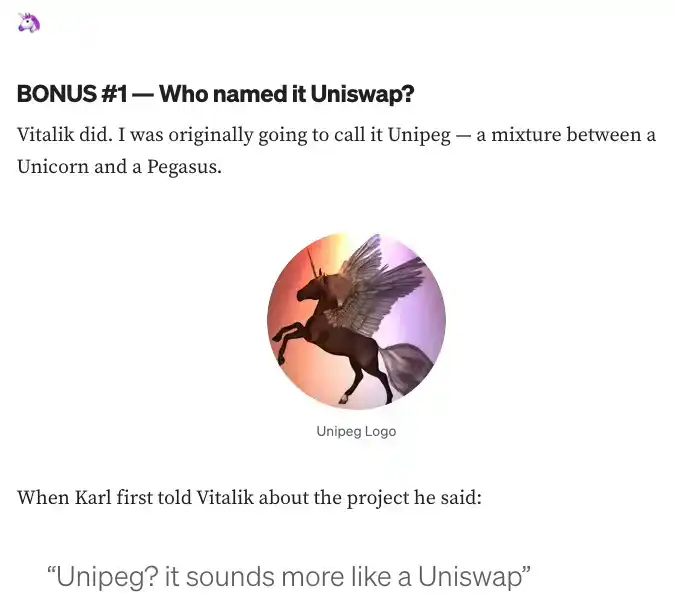
"Uniswap" replaced "Unipeg" and became the name of the $70 billion DeFi blue-chip.

Eight years later, in April 2026, an anonymous developer (Twitter handle @unipegv4, rumored to be related to the 0xHadrian blog) picked up this discarded name and gave it new meaning: Uni + JPEG = uPEG. The NFT circle has long jokingly called pictures "JPEGs". Since this thing was born in a Uniswap pool, it's Uniswap's JPEG.

This story itself is viral material. It perfectly merges four narratives into one name: Hayden's personal anecdote, Vitalik's offhand remark, NFT circle lingo, and V4's new mechanism.

The "uPEG" story is easy to tell and spread. It attracted OpenSea CMO Adam Hollander, who tweeted on April 25th: "Interested in this concept, buying a little to try it out."
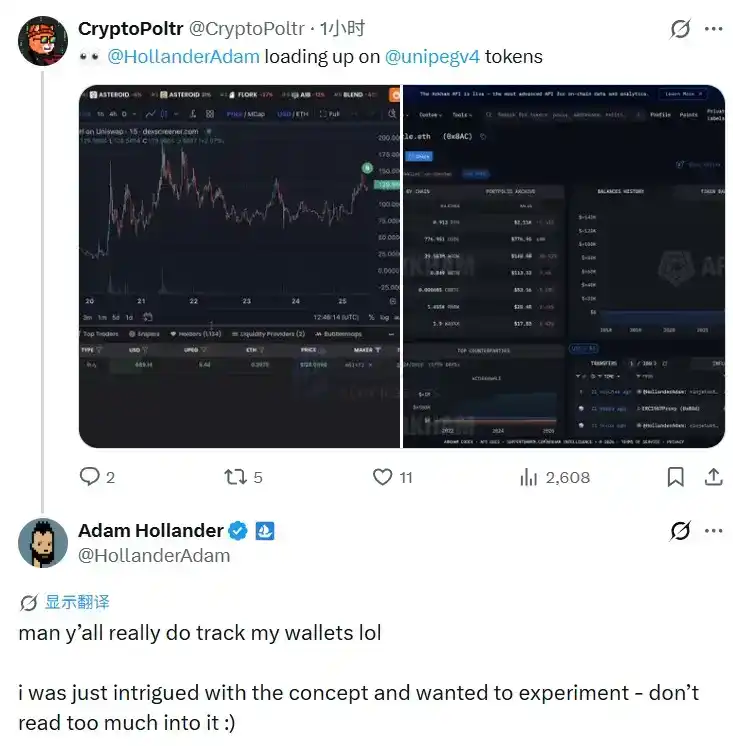
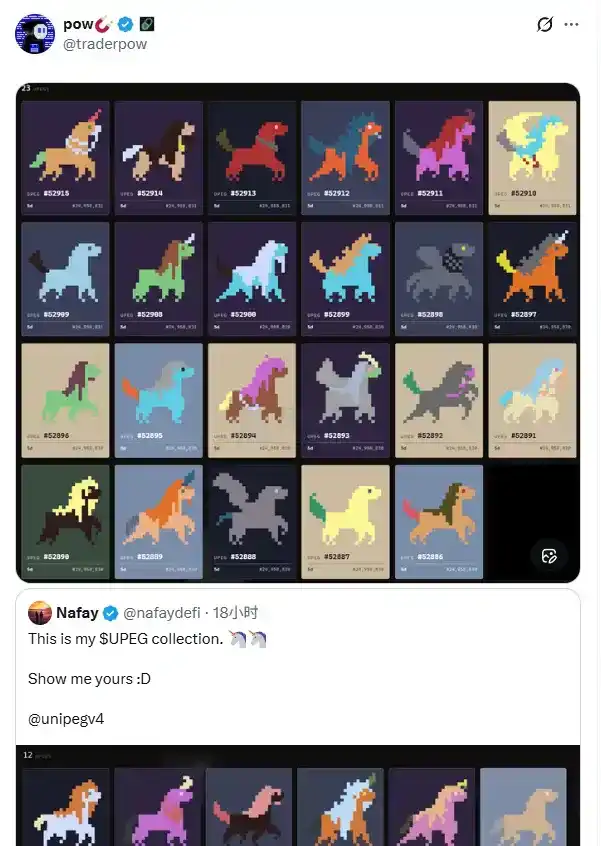
That night, "uPEG" tripled in price. Then Uniswap team member niko followed up, and Ouroboros co-founder Nafay and meme coin KOL pow also posted their uPEG holdings on X. In two weeks, uPEG went from 0 to a $34.44 million market cap, with a unit price of $982. Related reading: "Market Cap Breaks $23 Million, Hitting New Highs, What's the Magic of the New Picture Gem Unipeg?"
Following uPEG, "Slonks" launched on May 1st.

Developer Hirsch did something that sounds counterintuitive: he directly embedded an AI image generation model (only 214KB, about the size of a low-resolution phone wallpaper) into an Ethereum smart contract. This model's task was to replicate 10,000 CryptoPunks.

But a 214KB model can't remember 10,000 faces. With 576 pixels per image, the model would misdraw about 24 pixels on average, roughly a 4% distortion rate. Only 32 out of 10,000 were perfectly replicated; the rest were all "warped punks."
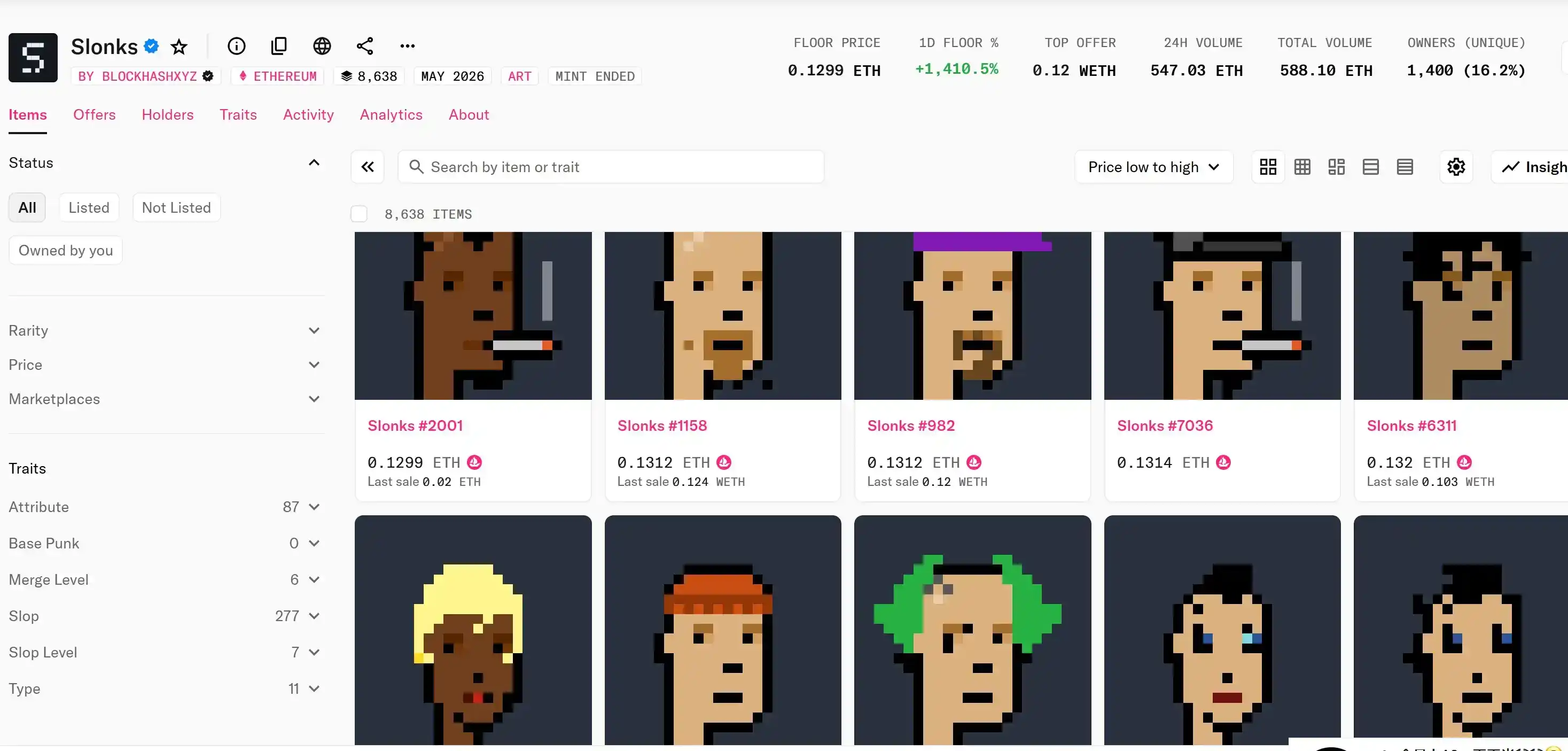
Hirsch called these misdrawn pixels "slop." Then he tweeted the project's philosophy: "The slop is not a bug. It is the medium."

The entire economic model is built on "the more mistakes, the more valuable." Two Slonks of the same level can be merged, burning one to upgrade another; the new image's slop only increases. Any Slonk can be sent to the void to mint the future $SLOP token (not officially launched yet) at a 1:1 ratio based on its slop count. Every action is completed through a V4 hook, verifiable on-chain.

Slonks wasn't an immediate hit. In its first few days, it was almost ignored under the spotlight of uPEG's $30 million market cap. The floor price hovered around 0.005 ETH, with little discussion on OpenSea. It wasn't until NFT circle veterans like 798 took to X, one after another, turning "misdrawing is art" into a shareable meme, coupled with further smart money moves on-chain, subsequent promotion by KOLs and media, and OpenSea's homepage trending section distributing traffic for it, that Slonks saw a 60x increase in 5 days.

But the significance of SATO lies in its foundational proof that "V4 hooks can create new economic models." This was the prerequisite for the emergence of uPEG and Slonks later.

uPEG's significance was translating the DeFi concept of V4 hooks for the NFT community. Retail investors suddenly realized hooks weren't just toys for DeFi geeks; they could create things they also wanted to buy.

Slonks built upon the attention dividend created by uPEG, crafting an even stronger story hook and an interesting economic model, further propelling the V4 Hook narrative.

What to Focus on to Seize the Next Opportunity?

For the foreign V4 Hook inner circle, our editors mainly recommend following these users:

1. Hayden Adams (@haydenzadams), Founder of Uniswap. Importance goes without saying.

2. saucepoint (@saucepoint), The "hook godfather" of the Uniswap Foundation, author of v4-template. Almost all hook projects start from his template code.

3. Uniswap official (@Uniswap) and Uniswap Foundation (@UniswapFND). The weekly Builder Update (Wednesday or Thursday) is the most important official signal source for the sector.

4. niko (@niko_eth), Member of Uniswap Labs team. You could say he was a key baton in the first wave of KOL relays for uPEG.

5. horsefacts (@horsefacts_eth), One of the earliest V4 hook builders, a technical bellwether.

6. Adam Hollander (@AdamHollander), CMO of OpenSea. His deeper background is as an early ecosystem driver for Hashmasks and Pudgy Penguins, a key translator bridging this wave from DeFi to NFT circles.

7. Project official accounts: uPEG official (@unipegv4), Unimon official (@unimonapp), Slonks official account, SATO official (@Satothedog). See who they follow and interact with; it often helps unearth the next hook project that hasn't been highlighted yet.

Besides that, we can also pay attention to some websites related to V4 hooks and Uniswap:

1. HookRank.io is currently the cleanest V4 hook explorer, with 1300+ hooks listed, sorted by TVL/Volume/Fees, featuring "New" and "Trending" tags. This is the first stop to see hooks that have seen rising data but haven't been mentioned on Twitter yet.

2. HookAtlas.com is a directory of hook projects with descriptions, suitable for mapping.

3. Uniswap Foundation Builder Update is published on the blog . The Foundation releases one every Wednesday or Thursday. Any core user following the Uniswap ecosystem won't miss the hottest narratives.
4. Unichain Infinite Hackathon competition. Award-winning projects are almost always seeds; we can focus on core projects on Unichain.

5. Dune Uniswap V4 Tracker. Shows total hook count, TVL distribution, chain volume distribution.

6. Dexscreener needs little introduction, a commonly used charting site for trading, useful for monitoring newly created V4 pairs, an early signal source for projects not yet ignited by KOLs. For example, when uPEG's holder addresses jumped from 200 to 4000+ within 24 hours, that slope itself was a signal.

7. OpenSea + Magic Eden Trending lists. Slonks appeared on OpenSea Trending the day after launch, something ordinary NFT projects need weeks of marketing to achieve. Meanwhile, on May 8th, Slonks's daily trading volume of 575 ETH surpassed CryptoPunks' 129 ETH. Any new project's daily volume exceeding CryptoPunks' during the same period is a sector-level signal.

8. The awesome-uniswap-hooks GitHub project. All experimental hook projects are registered here, suitable for discovering early-stage projects with "interesting designs" that don't yet have tokens.

The Next Stage of the V4 Hook Narrative

Here's our (irresponsible) speculation. If the V4 Hook narrative doesn't immediately fizzle out, it will likely progress along three lines in order of time: short-term is SATO's bug fix plays, medium-term is hook composability, and long-term is Unichain becoming the center of the entire sector.

First, the short-term SATO bug fix plays, which you can see discussed in various group chats today.

The reason SATO spawned a "fix play" like sat1 lies in its hook contract. Any V4 hook that wants to replace Uniswap's standard pricing must maintain its own ledger of "how much money is in the pool" to calculate its own curve formula. But Uniswap's PoolManager also maintains a ledger of the real balance. Two ledgers exist simultaneously, requiring synchronization with each swap. If the sync logic isn't written rigorously, the two numbers will drift apart. In hook engineering circles, this is called dual-state drift.

Drift creates arbitrage opportunities. At some point, the hook internally thinks 1 SATO should be worth X ETH, but the pool's actual reserves show Y ETH. Whoever spots this difference first gets to exploit it. Those two addresses with $360k floating profit weren't buying market sentiment; they were buying an accounting loophole in the contract.

sat1 packages itself as "one curve, single state," using only one ledger, no drift. The engineering fix is reasonable, but narratively, it's calculated—it tells retail "SATO has a bug, I'm the correct version," aiming to capture legitimacy.

This playbook isn't new to V4. Bitcoin ecosystem had ORDI, SATS, 1000SATS; ERC-404 era had Pandora, DN404, ERC-404 V2; pump.fun era had BankrFun, ClankerFun. Every later entrant claimed to "fix the previous one's problems."

The essence of a bugfix play isn't technical repair; it's narrative usurpation. It doesn't even need to actually fix anything; it just needs the consensus on Twitter that "the original has a bug," and liquidity will shift from the original to the new one.

V4 hooks have lowered the cost of this script to an unprecedented level. Hooks are open-source; fork one, change three lines of code, and deploy. Every successful hook project comes with its own fork generator. SATO/sat1 is the first template pair; uPEG2, Slinks will follow—it's inevitable.

In the medium term, we can look forward to hook composability.

Currently in V4, a pool can only have one hook attached. But people are already working on "meta-hooks," where one hook internally calls multiple sub-hooks, enabling combined behaviors.

Once this works, it means uPEG's image generation + Slonks's NFT-token conversion + SATO's bonding curve could all exist simultaneously in the same pool. One swap could trigger image generation, rewrite the pricing curve, and mint an NFT all at once.

Possible directions are numerous: swap triggers music or audio generation (replace SVG with MIDI; audio spreads more easily than images); swap as identity or reputation system (each swap updates soul-bound points); prediction market hook (treat swap as a betting action, Polymarket model running within LPs); time-based hook (lower sell tax the longer you hold); cross-collection fusion gameplay (use hooks to fuse Pudgy Penguin and Azuki into new forms, most feasible between CC0 projects).

Domande pertinenti

QWhat are $SATO, $uPEG, and Slonks, and why have they recently gained attention in the cryptocurrency community?

A$SATO, $uPEG, and Slonks are projects built on the Uniswap V4 Hook infrastructure. They have gained significant attention because they leveraged the new V4 Hook mechanism to create novel economic models and narratives, resulting in dramatic price increases and bringing the previously niche 'DeFi geek' Hook concept into the mainstream crypto discussion.

QHow did the $uPEG project's name and backstory contribute to its viral growth?

AThe $uPEG project's name and backstory were crucial to its viral growth. The name 'Unipeg' was Uniswap founder Hayden Adams's original, unused name for the protocol, based on 'Unicorn' and 'Pegasus.' The project revived this name with a new meaning: Uni + JPEG (a common slang for NFTs). This story combined a piece of crypto folklore, Vitalik's anecdote, NFT culture, and the new V4 mechanism into a highly shareable and compelling narrative, attracting key influencers like Adam Hollander.

QWhat are some key Twitter accounts recommended for tracking the V4 Hook narrative and finding early-stage projects?

AKey Twitter accounts include: Hayden Adams (Uniswap founder), saucepoint (hook 'godfather'), Uniswap and Uniswap Foundation (official updates), niko (Uniswap Labs team member), horsefacts (early builder), Adam Hollander (OpenSea CMO), and the official accounts of successful projects like @unipegv4, @unimonapp, @Satothedog, and Slonks. Following who they interact with can reveal new projects.

QWhat tools and websites can be used to discover and analyze emerging V4 Hook projects?

ARecommended tools include: HookRank.io (a V4 hook explorer ranked by TVL/Volume), HookAtlas.com (a project directory), the Uniswap Foundation Builder Update blog, the Unichain Infinite Hackathon, Dune's Uniswap V4 Tracker dashboard, Dexscreener (for new trading pairs), OpenSea/Magic Eden Trending pages (for NFT-based hooks), and the awesome-uniswap-hooks GitHub repository for early-stage experimental projects.

QAccording to the article, what is the likely short-term and medium-term development path for the V4 Hook narrative?

AIn the short term, the narrative is likely to see 'bug fix' forks like sat1 for SATO, where new projects claim to fix flaws in original successful projects to capture their liquidity and narrative. In the medium term, the focus will shift to the composability of hooks, where 'meta-hooks' could combine functionalities (like image generation, bonding curves, and NFT minting) into a single pool, enabling more complex and interactive DeFi/NFT applications.

Letture associate

Undercover in Crypto for 8 Years, 5 Jobs: The Revolution and Scam in My Eyes

"Undercover in Crypto for 8 Years, 5 Jobs: The Revolution and the Scam I Saw" In 2017, the author entered crypto believing it would revolutionize everything: replacing fiat, disintermediating finance, and shifting power to users. Eight years later, almost none of that has happened as predicted. The author worked at Circle, Messari, Coinbase, and Crossmint, witnessing the asset class grow from under $10B to over $4T, through multiple speculative bubbles and a near-systemic crisis. The journey began with the 2017-18 ICO frenzy, an "internet bubble 2.0" fueled by Ethereum. The promised "decentralized Uber" never materialized; instead, it was an era of greed, fraud, and rampant speculation where founders cashed out early. In the 2018-19 hangover, the focus shifted. The seeds of crypto's next phase were planted: stablecoins (like USDC) for borderless dollars and DeFi (decentralized finance) for rebuilding financial primitives like lending and trading on-chain. The COVID-19 pandemic and massive monetary stimulus triggered "DeFi Summer" in 2020-21. DeFi's value soared 250x to $180B, but it resembled a high-stakes game for mercenary traders with "food-themed" tokens. A new bubble formed around NFTs, with digital art selling for millions. The 2022 "crypto winter" mirrored the 2008 financial crisis. The collapse of the algorithmic stablecoin Terra (UST) triggered a chain reaction, bringing down hedge funds (Three Arrows Capital) and lending platforms (Celsius, Voyager). The final blow was the implosion of FTX and Sam Bankman-Fried, who had misused customer funds. This was crypto's "Lehman Moment." After the crash, the Biden administration's hostile regulatory crackdown under the SEC pushed innovation toward the legally safest, most absurd path: meme coins. The 2024 meme coin mania peaked at $150B before imploding. This political pressure, however, mobilized the industry. Donald Trump capitalized, promising a crypto-friendly stance, which many credit for helping him win the 2024 election. Trump's victory marked a turning point. A pro-crypto SEC chair took over, the "GENIUS Act" provided clear stablecoin rules in 2025, and institutional adoption accelerated. Circle (maker of USDC) IPO'd, and traditional giants like MoneyGram began using stablecoins for cross-border payments via firms like Crossmint. Looking back, the predicted consumer revolution (decentralized Uber) didn't happen. Instead, crypto built the plumbing for a new internet financial system. Each boom/bust cycle refined the infrastructure for global, 24/7 finance accessible to anyone online. The $300B+ stablecoin market, settling tens of trillions annually and creating demand for U.S. debt, is now a strategic U.S. priority. The future lies in convergence, not replacement. Crypto will be the backend, invisible to most users. The next frontier is integration with AI, where autonomous agents will use crypto wallets and stablecoins to transact. The result will be a global financial system equally accessible in New York or Nigeria, paving the way for countless new innovations.

marsbit27 min fa

Undercover in Crypto for 8 Years, 5 Jobs: The Revolution and Scam in My Eyes

marsbit27 min fa

AI Relay Stations: The Hidden Pitfalls Behind Low Costs, How to Screen and Avoid Them?

AI Relay Stations: The Hidden Risks Behind Low Costs and How to Avoid Pitfalls AI relay stations are becoming a popular gateway to various models, offering lower prices, a wider selection, and a unified interface for tools like Claude Code and Cursor. However, their appeal masks significant risks. Users may unknowingly surrender prompts, code, business documents, customer data, and even full project contexts. The demand is driven by genuine needs: cost savings compared to expensive official APIs (e.g., GPT, Claude), easier access amid regional restrictions, and the push from AI-powered development tools. But not everyone needs a relay station. Light users should exhaust free official quotas first. Heavy users, like developers, can adopt a layered approach, using top models for critical tasks and cheaper local models for routine work. If a relay station is necessary, follow a careful selection and usage protocol: 1. **Verify First:** Test model authenticity, latency, and stability before purchasing credits. Check the quality of provided documentation. 2. **Isolate Configuration:** Use unique API keys for each service, manage them via environment variables, and set usage limits to control costs and potential damage from leaks. 3. **Classify Your Data:** Develop a habit of data grading before sending requests. Only send non-sensitive, public information directly. Desensitize semi-sensitive data (e.g., internal documents) by removing names and specifics. Never send highly sensitive data like passwords, private keys, or confidential customer information. 4. **Handle AI Coding Tools Separately:** Tools like Cursor can send extensive project context (file contents, directory structures, error logs). Use relay stations only for independent, non-core code tasks. For sensitive projects, switch back to official APIs or local models. 5. **Monitor and Prepare an Exit:** Regularly check billing statements, follow platform updates and community feedback, and always have a backup provider. Ensure your setup uses standard OpenAI-compatible APIs for easy migration. Ultimately, relay stations are tools, not default solutions. Their value lies in solving access needs at a controlled cost, but maintaining that control requires proactive risk management through verification, isolation, data classification, and continuous monitoring.

marsbit31 min fa

AI Relay Stations: The Hidden Pitfalls Behind Low Costs, How to Screen and Avoid Them?

marsbit31 min fa

US Stock Registration Giant Acquired by Cryptocurrency Exchange, Accelerating Stock Tokenization

Bullish (NYSE: BLSH), a crypto asset trading platform, announced a $4.2 billion acquisition of Equiniti, a major Wall Street transfer agent serving nearly 3,000 public companies. This move aims to accelerate stock tokenization by securing a critical, regulated piece of financial infrastructure that maintains official shareholder records and handles dividends. The deal signals intensifying competition in the tokenization race. True "native" on-chain securities require a licensed transfer agent for legal ownership registration—a bottleneck Bullish now aims to solve. The acquisition positions Bullish to bridge traditional equity markets with blockchain, leveraging Equiniti's extensive client network and compliance credentials. This follows recent key developments: ICE (NYSE's parent) plans a new tokenized securities platform, and the SEC approved Nasdaq's tokenized stock pilot. Bullish's strategy is to establish a neutral, cross-platform infrastructure ahead of these initiatives. The combined company expects high growth from its tokenization business, targeting the vast U.S. equity market. The narrative is shifting from "crypto vs. Wall Street" to convergence, where legacy infrastructure is upgraded onto blockchain rails. The next 18 months will be crucial for observing the rollout of NYSE's platform, Bullish-Equiniti integration, and the broader adoption of tokenized securities by institutions.

marsbit54 min fa

US Stock Registration Giant Acquired by Cryptocurrency Exchange, Accelerating Stock Tokenization

marsbit54 min fa

Plummeting Around 12%, Duan Yongping's Bottom-Fishing CoreWeave Turns into a Fierce Battlefield Between Bulls and Bears

On May 8th, AI cloud computing provider CoreWeave (CRWV) plunged 11.4% following its Q1 2026 earnings report, intensifying the polarized market view on the stock. While revenue doubled year-over-year to $2.08B and its Remaining Performance Obligations (RPO) surged to nearly $100B, its net loss also widened to $740M. The key trigger was a weaker-than-expected Q2 revenue forecast, coupled with rising costs that compressed adjusted operating margin to just 1%. The bull thesis centers on CoreWeave's massive order backlog, deep strategic ties with NVIDIA as a key customer and investor, and client diversification with major names like Anthropic and Meta. Supporters point to its 'hyperscale' status and over $20B in recent financing. Bears highlight the "growth at all costs" model: despite soaring revenue, losses are expanding, capital expenditures are massive (~$6.8B in Q1), and total debt has ballooned to around $25B. Significant insider selling by executives adds to skepticism. This contrast is embodied by investor Duan Yongping (known as "China's Buffett"), who initiated a small, exploratory position (~0.12% of his portfolio) in Q4 2025 near the stock's lows, viewing it as a speculative bet on the AI infrastructure chain. The upcoming Q2 report is seen as a critical test for management's promise of a profit margin rebound. CoreWeave remains a battleground stock where long-term narrative clashes with near-term financial reality.

marsbit1 h fa

Plummeting Around 12%, Duan Yongping's Bottom-Fishing CoreWeave Turns into a Fierce Battlefield Between Bulls and Bears

marsbit1 h fa

Trading

Spot
Futures

Articoli Popolari

Come comprare ONE

Benvenuto in HTX.com! Abbiamo reso l'acquisto di Harmony (ONE) semplice e conveniente. Segui la nostra guida passo passo per intraprendere il tuo viaggio nel mondo delle criptovalute.Step 1: Crea il tuo Account HTXUsa la tua email o numero di telefono per registrarti il tuo account gratuito su HTX. Vivi un'esperienza facile e sblocca tutte le funzionalità,Crea il mio accountStep 2: Vai in Acquista crypto e seleziona il tuo metodo di pagamentoCarta di credito/debito: utilizza la tua Visa o Mastercard per acquistare immediatamente HarmonyONE.Bilancio: Usa i fondi dal bilancio del tuo account HTX per fare trading senza problemi.Terze parti: abbiamo aggiunto metodi di pagamento molto utilizzati come Google Pay e Apple Pay per maggiore comodità.P2P: Fai trading direttamente con altri utenti HTX.Over-the-Counter (OTC): Offriamo servizi su misura e tassi di cambio competitivi per i trader.Step 3: Conserva Harmony (ONE)Dopo aver acquistato Harmony (ONE), conserva nel tuo account HTX. In alternativa, puoi inviare tramite trasferimento blockchain o scambiare per altre criptovalute.Step 4: Scambia Harmony (ONE)Scambia facilmente Harmony (ONE) nel mercato spot di HTX. Accedi al tuo account, seleziona la tua coppia di trading, esegui le tue operazioni e monitora in tempo reale. Offriamo un'esperienza user-friendly sia per chi ha appena iniziato che per i trader più esperti.

280 Totale visualizzazioniPubblicato il 2024.12.12Aggiornato il 2025.03.21

Come comprare ONE

Discussioni

Benvenuto nella Community HTX. Qui puoi rimanere informato sugli ultimi sviluppi della piattaforma e accedere ad approfondimenti esperti sul mercato. Le opinioni degli utenti sul prezzo di ONE ONE sono presentate come di seguito.

活动图片