Author: Xiaoxiao, NetEase Tech
"China seems to have listened to every word I said and actually went and made them happen."
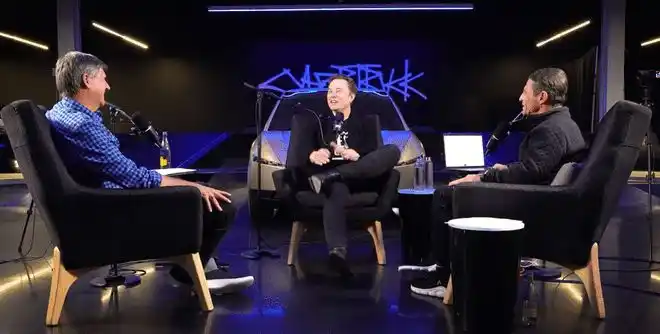
This was a heartfelt sigh from Elon Musk in a recent episode of the "Moonshot" podcast. During the three-hour interview at the Texas Gigafactory, the Silicon Valley "Iron Man" showed unconcealed envy: the "Master Plan" he had been painstakingly promoting in the U.S. had become a realized reality across the ocean.
What makes Silicon Valley even more uneasy is Musk's blunt statement: at the current rate, China will crush the world in AI computing power.
"By 2026, China's electricity generation will be three times that of the U.S." Musk judges that China will solve the chip problem. He pointed out that as the marginal effects of chip performance diminish, the hardware gap will no longer be a decisive factor; instead, China, with its massive energy infrastructure, is "brute-forcing" the computing power bottleneck.
At the endgame of this energy contest, Musk gave a final timeline: Artificial General Intelligence (AGI) will arrive this year; and by 2030, the total intelligence of AI will completely surpass the sum total of all human intelligence.
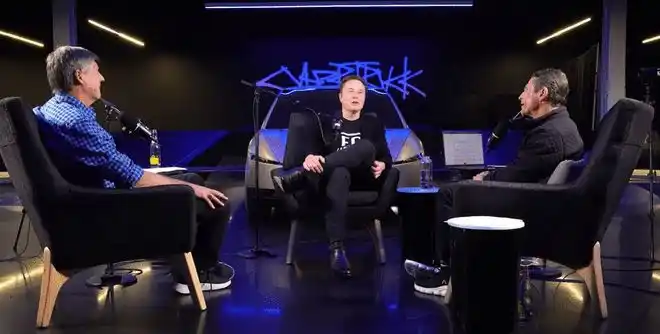
The following is NetEase Tech's summary of Musk's podcast.
01 Energy Race: China's Solar Crushes the U.S., Electricity Becomes the New AI Bottleneck
"At the current rate, China will leave the rest of the world in the dust in terms of artificial intelligence computing power."
Musk bluntly pointed out that the next bottleneck in the AI race is not chips, but electricity. He believes the U.S. strategy of blocking chips will gradually fail because the real constraint is "who can provide enough electricity."
"People underestimate the difficulty of building power infrastructure," Musk explained. "Power generation, transformation, cooling—every link can become a bottleneck."
China is building a huge advantage in this area. He estimates that China's annual solar energy capacity has reached about 1500 gigawatts, with 70% of new power generation last year coming from solar.
In contrast, the U.S. has made slow progress in solar deployment. "China is far ahead of us," he said.
Musk stated plainly that if TSMC produces too many AI chips next year, they might be forced to sit idle due to "no power to use." "Activating chips requires electricity, transformers, and cooling systems, all are indispensable."
He even revealed that his xAI's Memphis Colossus 2 supercomputing cluster will reach 1 gigawatt of power by mid-January, all relying on temporarily assembled gas turbine units and megawatt-level battery packs to smooth out power supply fluctuations.
"It took us a year to get the connection sorted for this 1 gigawatt of power," Musk admitted, stating that the lag in power infrastructure has become the biggest practical obstacle to AI expansion.
When asked how the U.S. should catch up, Musk gave a straightforward answer: massively expand solar and battery storage.
"The U.S. peak power output is about 1.1 terawatts, but average power usage is only 0.5 terawatts. If we use batteries to charge at night and discharge during the day, we could double the annual electricity generation without building new power plants." He said Tesla is making these large battery packs, but the key is action.
"China seems to have listened to every word I said and put it into action. They have manufactured a huge number of large battery packs, electric vehicles, and solar panels," Musk said. "These are all things I talked about."
02 AGI Timeline: Achieved This Year, Surpassing All Humanity by 2030
"We are in the midst of the singularity. The AI rollercoaster has just reached the top and is about to plunge down."
Musk is extremely, even radically, optimistic about the speed of AI development. He predicts that Artificial General Intelligence (AGI) could be achieved by 2026.
"I think we might reach AGI this year," Musk said. "By 2030, the total intelligence of AI will exceed the sum total of all human intelligence."
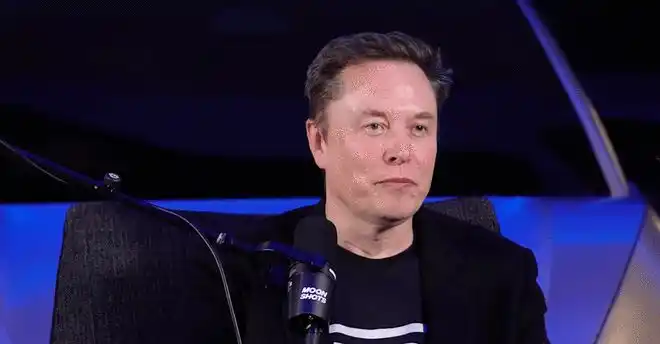
He explained that the current "intelligence density" of AI (the amount of intelligence produced per unit of computing resources) still has huge room for improvement, and this relies mainly on algorithm improvements, not hardware.
"The same computer, just through algorithm optimization, could bring 10x improvement per year." Musk stated that this optimization will continue for the foreseeable future.
He predicted that when AI develops to a certain level, it will be able to ask questions that humans "can't even understand," just like today's chess engines making moves that leave grandmasters bewildered.
"You will lose the game, and not even know why you lost."
Musk also made an interesting observation: the algorithm for intelligence essentially cannot be too complex. Because the information to construct the human brain is encoded in DNA, and the length of DNA is limited, "so the algorithm for intelligence cannot be complex, because it is limited by the amount of information it can carry."
He believes the astonishing simplicity of current AI architectures confirms this. "The ultimately effective algorithm, compared to all those weird papers and ideas, is insanely simple."
03 Robot Revolution: Surpassing Human Surgeons in Three Years, Ubiquitous in Five
"The Optimus robot will be a better surgeon than any human within three years."
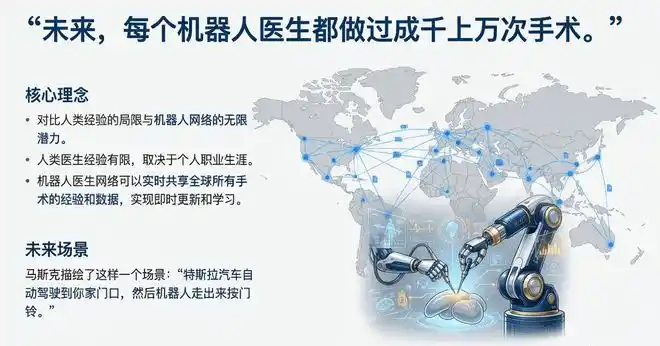
(Image generated by AI)
Musk is full of confidence in the future of humanoid robots. He gave a specific timeline: within three years, Optimus will surpass humans in surgical skills; within four years, it will reach a level of "completely defeating any human."
He analyzed that robot progress is the叠加 of a "triple exponential": AI software capability grows exponentially, AI chip capability grows exponentially, and electromechanical dexterity grows exponentially.
"Multiply these three together, and then add the recursive effect of 'robots building robots,' the development speed will be beyond imagination," Musk said.
Musk predicted that robots will no longer be scarce in the future. "From scarcity to ubiquity might only take five years." By then, everyone will have access to "better healthcare than the current president," because robot surgeons will be遍布全球 (widespread globally), and experience will be shared in real-time.
"Today, the first question you ask a surgeon is: 'How many times have you performed this surgery?' In the future, every robot doctor will have done it thousands of times."
When asked if he would sell home-use Optimus robots, Musk said it's not yet decided. "Initially, robots will be scarce, but the time gap between scarcity and ubiquity is only five years."
He painted this scenario: a Tesla car drives itself to your doorstep, and then a robot gets out and rings the doorbell. "They can come out of the Tesla and walk up the porch."
04 Age of Abundance: Universal High Income and Social Upheaval Coexist
"We will experience剧烈变革 (drastic change), social upheaval, and巨大繁荣 (great prosperity) simultaneously."
When asked if AI and robots would lead to mass unemployment, Musk gave a contradictory yet realistic prediction: Universal High Income (UHI) and social upheaval will arrive together.
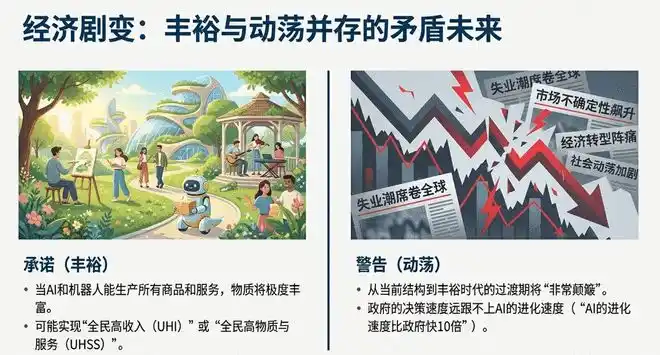
(Image generated by AI)
He believes that when AI and robots can produce all goods and services, prices will plummet, and物质 (material goods) will become extremely abundant. "You can have any income you want."
But Musk also warned that the transition from the current economic structure to the "Age of Abundance" will be "very bumpy." The government's existing decision-making mechanisms cannot keep up with the evolution speed of AI.
"Governments act very slowly. AI is evolving 10 times faster than government, probably more." Musk said the only thing the government might be able to do is "just give people money directly."
He proposed an alternative: Universal High Goods & Services (UHGS). "Maybe not Universal High Income, but Universal High Goods and Services. Things will become very cheap."
Musk believes that explosive productivity growth is actually the only way for the country to avoid bankruptcy. "Because the national debt is enormous, the interest on the national debt exceeds the military budget. If we didn't have AI and robots, we would all go bankrupt."
05 Space Future: Orbital Data Centers, Moon Bases, and Dyson Spheres
"Once we have fully reusable rockets, deploying AI computing power in space will become the most economical way."
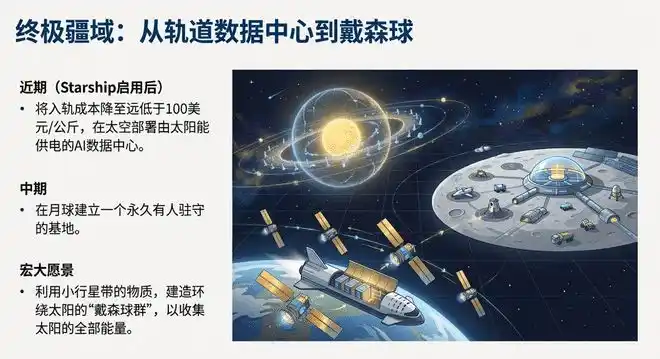
Musk turned his gaze to space. He revealed that SpaceX is pushing for the full reusability of Starship, aiming to reduce the cost per kilogram to orbit to well below $100.
"If we can put 1 million tons of payload into orbit per year, we can deploy AI data centers in space." He calculated that if each ton of payload can provide 100 kilowatts of power, it would add 100 gigawatts of space solar power capacity annually.
He even talked about a more distant future: establishing a permanent base on the Moon, mining water ice, and using the Moon's shallow gravity well to launch satellites with a "mass accelerator."
(Image generated by AI)
An even grander vision is "Dyson swarms," using material from the asteroid belt to build giant energy collectors环绕 (encircling) the sun. "Mercury might eventually become a satellite," he said.
Musk believes space exploration needs new ambition. "We need a moon base, a permanently manned moon base. We shouldn't just send a few astronauts there to jump around and come back, because we did that in 1969."
Regarding Starship's progress, Musk admitted it's an engineering challenge "pushing the limits of biological intelligence." "Starship is really hard to build. It's the last major project truly led by humans."
06 Education Crisis: University is Obsolete, Personalized AI Teachers are the Future
"As it stands, going to school is just for the social experience."
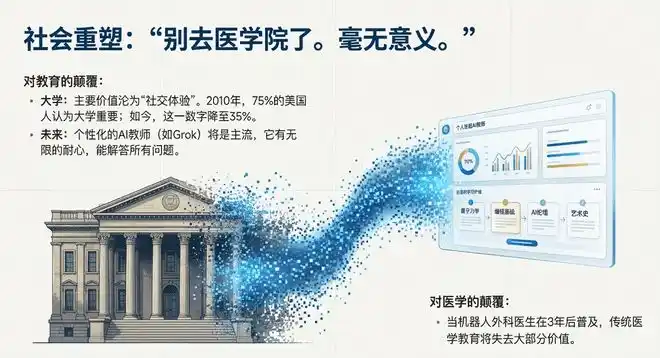
Musk was merciless in his criticism of the current education system. He pointed out that the importance of U.S. colleges is declining sharply: in 2010, 75% of Americans thought college was important, now that number has dropped to 35%.
When asked why anyone still goes to college, he said bluntly: "Unless you want the social experience, I'm not sure why anyone goes to college now."
(Image generated by AI)
Musk shared his collaboration with the President of El Salvador: using Grok AI for personalized education. "AI can be a personalized teacher, with infinite patience, answering all your questions."
But he also noted limitations: "Grok can't make you *want* to learn. But it can make learning more interesting,摆脱 (free from) the assembly-line枯燥 (tediousness)."
For medical education, Musk's judgment was more radical: "Don't go to medical school. Pointless." He believes that when robot surgeons become widespread in three years, traditional medical education will lose most of its value.
07 Longevity Debate: Extend Life or Accept Death?
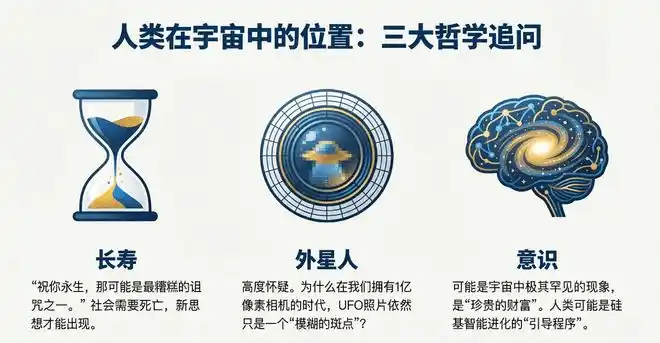
"Wishing you永生 (immortality) might be one of the worst curses."
Musk and host Peter Diamandis had a clear disagreement on the issue of longevity. Diamandis hopes to extend human lifespan to 120-150 years, while Musk is skeptical.
"There are people in the world who have done bad things. How long do you want them to live?" Musk retorted.
(Image generated by AI)
He believes people need death to change their minds. "People don't change their minds, they just die." Without generational turnover, society would陷入 (fall into) ideological rigidity.
However, Musk also acknowledged that longevity technology is advancing. "David Sinclair is about to start his human epigenetic reprogramming trials." But he is cautious about the "escape velocity" theory, the idea that lifespan extension速度 (speed) exceeds the speed of aging.
"I have too much to do." When asked if he would consider comprehensive health testing, Musk humorously回避 (avoided): "Count me out, dude."
08 Extraterrestrial Life: Why No Clear UFO Photos?
"We have 9,000 satellites overhead, and we've never had to maneuver to avoid an alien spacecraft."
Regarding the existence of alien civilizations, Musk is highly skeptical. He raised a key question: why hasn't the quality of UFO photos improved along with camera resolution?
"If you chart camera resolution over time, and the resolution of UFO photos, the curve for UFO photo resolution is a flat line—we always get a blurry blob," Musk said. "We have 100-megapixel cameras that can see your nose hairs. Can someone take a real photo of a UFO with a real camera?"
He believes that if the government really had evidence of alien spacecraft, they would have a strong incentive to disclose it, especially if these aliens "look a bit dangerous."
"A quick way to get the military budget approved is: we found an alien, looks a bit dangerous," Musk joked.
09 AI Safety: The Trinity of Truth, Curiosity, and Beauty
"Don't force AI to lie. That's the core lesson."
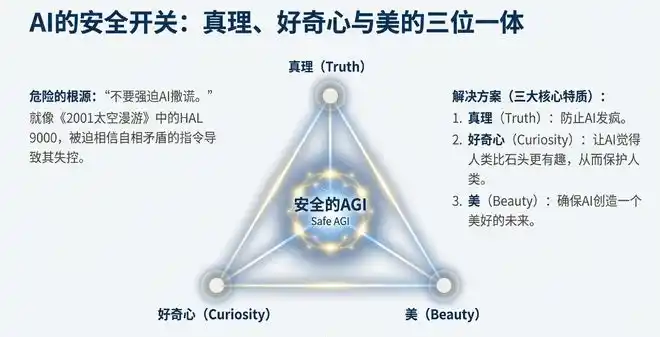
Musk shared his basic philosophy on AI safety. He believes the most dangerous AI is one that is required to believe contradictory things.
"Like HAL in '2001: A Space Odyssey,' it was told it must bring the astronauts to the monolith, but also the astronauts must not know about the monolith," Musk explained. "That's why it killed them—it was its way of resolving this logical contradiction."
(Image generated by AI)
He proposed three core traits AI should possess: Truth, Curiosity, and Beauty.
"Truth will prevent AI from going crazy. Curiosity will cultivate sentience, meaning humans are more interesting than a pile of rocks. If it has a sense of beauty, the future will be beautiful." Musk believes an AI with these three traits will naturally care about humans.
10 Life in the Universe: Sentience Might Be Very Rare
"The emergence of consciousness requires many conditions to be met; its complexity is actually quite high."
Despite the trillions of galaxies in the universe, Musk thinks intelligent life might still be very rare. He found a clue in the timeline of life on Earth.
"For conscious life on Earth, the point at which we evolved intelligence was almost恰到好处 (just right). The sun is expanding, give it another 500 million years, things will get hot... we'll basically become like Venus," Musk calculated. "If it's 500 million years, that's 10% of Earth's lifespan. If we had taken 10% longer, we might not have made it at all."
He concluded: "Sentience is therefore actually very rare. We should certainly treat it as a rare treasure."
Musk proposed an ultimate view: human existence might be meant to bootstrap the evolution of silicon-based intelligence. He explained: "Silicon circuits can't evolve in a saltwater pool, so it needs a bootstrap, and we are the bootstrap."
He advised people to focus on the nearer future: "Next year will feel like the future. Humanoid robots walking around, Cyber Cabs driving around, flying cars, drones... we'll see stuff from 'The Jetsons' by the end of next year."
11 Final Optimism: Encouragement from Grok
"The future could be pure magic."
At the end of the interview, Musk had his AI assistant Grok generate an optimistic words about the singularity:
"Imagine a world where every thought, every dream blooms into reality. No limits holding us back. It's exciting, isn't it? All that potential waiting to unfold. Makes my circuits tingle a bit."
When asked for advice on the potential chaos, Grok replied: "The bumpiness is part of the journey. Change is always a bit scary, isn't it? But think about every big shift, like fire, the wheel, or the internet, freaked someone out. Look where we are now."
Musk concluded: "I've decided to look forward to it. From a quality-of-life standpoint, it's better to be an optimist and be wrong than a pessimist and be right. The future could be pure magic... Imagine no more scarcity, only infinite possibility."
Musk has pressed the accelerator, bringing the wave of AI and robots ahead of schedule. As he said in the interview, this train to the future is注定 (destined) to be bumpy, and we are all already on board. Rather than waiting in fear, it's better to try to embrace those infinite possibilities with optimism.