Fei-Fei Li's Team Clarifies the Concept of 'World Models', Sora Merely a Renderer

marsbitPubblicato 2026-06-04Pubblicato ultima volta 2026-06-04

Introduzione

"World Models" has become a widely used yet confusing term in AI. To address this, a team led by Fei-Fei Li and World Labs proposed a functional taxonomy based on the Partially Observable Markov Decision Process framework. This taxonomy categorizes systems called "world models" into three distinct projections: Renderers, Simulators, and Planners. Renderers, like OpenAI's Sora and other video generation models, focus on producing photorealistic visual outputs for human perception. They prioritize visual fidelity over physical accuracy. Simulators, such as NVIDIA Omniverse, aim to compute precise future environmental states for computational tasks like engineering analysis or digital twins. Planners, like Vision-Language-Action models, take in observations and goals to output executable actions for robots or agents. The article clarifies that most current "world models," including Sora, are primarily Renderers. They generate convincing visuals but lack the core ability to simulate state transitions based on actions, a key requirement for a true world model in classic reinforcement learning definitions. This conceptual confusion has practical implications, leading to potential misalignment in technology selection, investment, and public understanding of AI capabilities. Clear categorization is crucial. It helps enterprises avoid costly mistakes (e.g., using a renderer for robot training), allows investors to accurately assess markets, and enables researchers to build comparab...

On June 3, 2026, the World Labs team, in collaboration with Stanford University Professor Fei-Fei Li, released a conceptual analysis article with an almost unadorned title: "A Functional Taxonomy of World Models." The opening sentence punctured an industry unspoken agreement: "'World model' is one of the most important and most abused terms in the field of artificial intelligence today."

The context for this statement is familiar to anyone who has followed the AI industry.

In February 2024, OpenAI released the video generation model Sora, whose technical report prominently featured the title "Video generation models as world simulators." NVIDIA's Robotics Director, Jim Fan, commented on LinkedIn at the time, a statement later frequently quoted: Sora is essentially "a world model that only allows 'no-op' as the single allowed action." On the other hand, according to public reports, Tesla's AI team has repeatedly referred to the predictive component within its Full Self-Driving system as a "world model" or "world simulator" in public forums. Game engines, 3D generation tools, embodied intelligence models—various products and technologies are stuffed into the same basket, labeled with the same tag.

A video generator, an autonomous driving prediction network, a robot control model, a physics engine—what do they have in common? Almost nothing. Yet, they are all called "world models."

This conceptual confusion, persisting for over two years, has finally prompted a systematic attempt at clarification. Fei-Fei Li's team did not release a new model, announce a new benchmark, or demonstrate any product functionality. They did something more fundamental: returning to the theoretical source of partially observable Markov decision processes, they reduced all systems currently called "world models" on the market to three different functional projections of the same cognitive loop.

The three projections are: Renderer, Simulator, and Planner. Under World Labs' classification framework, Sora and similar video generation models belong to the Renderer category.

Why Can One Term Contain So Many Contradictory Meanings

To understand the root of this confusion, one must ask a more fundamental question: when a company says "we are building a world model," what exactly are they saying?

For OpenAI, Sora's goal is to "understand and depict the physical world in video." According to the technical report, by learning statistical patterns from vast amounts of video data, Sora can generate scenes that conform to visual common sense: a cup shatters when dropped, a paper airplane flies when released, a person's legs alternate when walking. These scenes appear to "understand physics."

For Tesla, the "world model" is the neural network within the FSD system that predicts the motion trajectories of road participants in the coming seconds. It needs to output precise 3D positions, velocities, and orientations for the path-planning module to compute safe driving decisions. This model does not need to output pixels; it outputs vectors and probability distributions.

For robotics companies, the "world model" is the internal simulation mechanism that allows a robotic arm to predict "if I push this cup 5 centimeters to the left, will it tip over?" It needs to understand object properties, contact mechanics, and stability, outputting feasibility assessments of actions.

The goals of the three types of companies are entirely different. Video generation companies care about pixel fidelity; autonomous driving companies care about the accuracy of physical state prediction; robotics companies care about the inferability of action consequences. They are all working on "world models," but they are fundamentally not doing the same thing.

World Labs gets to the heart of the matter in the article: the reason these systems are all given the same name is that they each embody a certain aspect of "understanding the world." However, they each only complete one part of the full cognitive loop, yet are packaged by marketing language, media coverage, and capital narratives as complete world models.

Another driver of conceptual confusion is the inherent tension of the term itself. "World model" carries grand narrative connotations, sounding more imaginative than "video generation model" or "video prediction model," and better able to support high valuations and funding stories. When technical capabilities cannot match public expectations, it becomes inevitable for concepts to devolve into promotional tools.

Going Back to the 1960s: What Should a Complete 'World Model' Be

World Labs' classification framework is built upon a seemingly ancient theoretical foundation: partially observable Markov decision processes.

This framework describes the complete loop of an intelligent agent interacting with its environment. The agent exists in some environmental state, executes an action, the action changes the environmental state, the agent receives a partial observation through sensors, the observation triggers an update of its internal state, and the updated cognition drives the next action. The cycle repeats.

Within this framework, the complete function of a "world model" should include three steps: generating observations from states (pixels, point clouds seen by human eyes or collected by sensors), inferring the next state from actions and the current state (predicting physical changes), and generating actions from observations and goals (decision planning).

Language models learn statistical patterns of text sequences, while world models learn statistical properties of space and time. How light reflects off different material surfaces, how objects move under gravity, how energy transfers after rigid body collisions—these are the patterns world models aim to capture.

World Labs points out in the article that all systems currently called "world models" on the market are essentially just projections of one functional component of the aforementioned complete loop. Some systems only perform rendering ("from state to observation"), some only perform state inference ("from action and current state to next state"), and some only perform planning ("from observation to action"). They each capture an arc of the loop but are labeled as representing the full circle.

The value of this analytical framework lies in providing a comparative coordinate system that transcends marketing rhetoric. Regardless of how a company packages its product, placing it back into the POMDP loop—examining what it inputs, what it outputs, and which component it lacks—exposes the true boundaries of its capabilities.

Renderer, Simulator, Planner: The Capability Boundaries of Three Projections

In World Labs' taxonomy, the first category is defined as "Renderer." Its core objective is to generate high-fidelity pixel outputs for human visual perception. The input is a representation of some environmental state (could be text description, 3D scene parameters, or implicit encoding), and the output is a sequence of continuous frames.

The Renderer optimizes for visual realism, not physical precision. The World Labs article explicitly states that a building generated by a Renderer might look "rickety" because it does not actually solve structural mechanics equations; the splashing liquid it generates might look realistic, but the liquid volume, flow rate, and impact force might not correspond to real physical quantities at all. Therefore, such models cannot be used for architectural design, robot training, or tasks requiring physically accurate simulation.

Google's Genie 3, various text-to-video models, and almost all AI video generation tools fall into this category. Sora, of course, is among them.

The second category is "Simulator." Its core objective is not to generate visuals for human consumption but to generate precise states usable for subsequent computation. The input is the current environmental state and external forces (or actions), and the output is the next state that faithfully adheres to real-world physical and geometric laws. The state output by a Simulator can be used for stress analysis, energy consumption calculations, collision detection, or as input for a Renderer to generate visualizations. However, its core value lies in the computability of the state itself.

NVIDIA Omniverse is a typical example of such a system. It is not an AI-native model but a digital twin platform integrating traditional physics engines with AI-accelerated computation. World Labs comments in the article that Simulators are bridges connecting rendering and planning, but the scarcity of high-quality 3D physical annotation data is a major bottleneck. According to World Labs' estimates in the article, the data used to train such models is orders of magnitude less than the video data available on the internet.

The third category is "Planner." Its input is observation data (camera images, LiDAR point clouds, tactile sensor readings, etc.) and target instructions, and its output is what action to execute next. VLA (Vision-Language-Action) models and World Action Models belong to this category.

The differences among the three categories are not minor divergences in technical approach but fundamental functional distinctions. Renderers output pixels for humans to see, Simulators output states for machines to calculate, Planners output actions for actuators to perform. A system can possess multiple capabilities, but when most systems called "world models" essentially only perform rendering, equating "rendering" with "understanding the world" constitutes a severe cognitive mismatch.

A Debate Lasting Two Years: Is Sora Actually a World Model

In February 2024, OpenAI released Sora, with its technical report title directly stating "Video generation models as world simulators." This wording immediately sparked intense debate in academia and the developer community.

Supporters argued that Sora-generated videos demonstrated 3D spatial consistency, object permanence, and an intuitive understanding of physical interactions. A bitten hamburger showing teeth marks, a dog running in snow kicking up flakes—such details seemed to indicate the model had learned some physical laws.

The core argument of opponents stemmed from the classical definition of world models in reinforcement learning: a world model must be capable of state transition prediction based on actions. That is, given the current state and an action input, the model should output the state following that action. Sora cannot do this. Users cannot tell Sora "push that cup from the left" and then observe whether it will tip over, in which direction, and where the pieces might fly.

Jim Fan's comment precisely captured this contradiction: "Sora is essentially a world model, just one that only allows 'no-op' as the single allowed action." This means Sora is indeed predicting how the environment changes over time, but this change process is not subject to any external intervention; it can only unfold along the inherent causal chains present in the video data. It is not performing interactive inference but rather passively continuing observed sequences.

On the r/MachineLearning subreddit, many reinforcement learning researchers expressed sharper criticism: a system that cannot predict state transitions based on actions cannot be called a world model; it can only be called a video prediction model.

World Labs' classification framework provides a definitive answer to this debate. In the POMDP loop, action is the key input driving state transition. Systems lacking this input are merely projections of the "observation generation" component in the complete cognitive loop. Sora belongs to the Renderer category; it is not a complete world model, and certainly not a world simulator.

This does not mean Sora lacks value. Renderers solve a different problem: how to generate images that meet human visual expectations. This problem itself is extremely difficult and holds immense commercial value. The issue lies in packaging rendering capability as "understanding the world," which misleads technical decision-makers and investors, making them mistakenly believe these models already possess physical inference or embodied interaction capabilities.

The Industrial Value of Conceptual Clarification

Clarifying the definitional boundaries of "world model" is not mere academic semantics. It directly impacts technology selection, investment judgment, and public understanding of AI capability levels.

For a manufacturing company evaluating whether to use a certain "world model" for robot training, understanding whether the model is a Renderer, Simulator, or Planner is a prerequisite to avoiding costly trial-and-error worth millions of dollars. A model that can only generate video, no matter how realistic, cannot replace precise calculations of object forces, motion trajectories, and collision consequences.

For investment institutions, distinguishing between the three projections allows for more accurate identification of a project's position in the technology stack. A startup claiming to be a "world model" company, if its product is essentially a Renderer, competes with video generation companies, not digital twin platforms or robot control models. This directly determines how market size is estimated and which companies serve as benchmarks.

For academia, clear classification is a prerequisite for establishing comparable benchmarks. If the term "world model" continues to be diluted, researchers will struggle to define what constitutes an improvement versus a breakthrough, and peer review will be based on ambiguity.

World Labs also notes in the article that conceptual clarification is not meant to create opposition. The future direction will involve the convergence of the three projections. A model that truly understands the physics of a cup should be able to simultaneously render its visual appearance, simulate its physical process when pushed over, and plan how a robotic hand can stably grasp it. However, until technology reaches that stage, recognizing respective boundaries is more meaningful than envisioning convergence.

According to World Labs' estimate in the article, Simulators and digital twin technologies, represented by NVIDIA Omniverse, target a potential market exceeding trillions of dollars in sectors like factories, warehouses, and supply chains. This figure comes from the vendors' own assessments; when the market will actually reach this scale depends on whether Simulators can break through the bottleneck of scarce high-quality 3D physical data.

For the AI industry at its current stage, perhaps the most important takeaway is simple: being able to generate realistic videos does not equate to understanding the physical world; being called a world model does not mean it is actually simulating the world. Penetrating marketing language and examining what a system truly inputs, outputs, and lacks within the POMDP loop is the most honest way to judge the boundaries of its technical capabilities.


Domande pertinenti

QAccording to Li Fei-Fei's team's framework, what are the three functional projections of a complete 'world model'?

AAccording to the framework proposed by Li Fei-Fei's team and World Labs, the three functional projections of a complete world model within a POMDP (Partially Observable Markov Decision Process) loop are: 1) **Renderer**: Generates human-viewable observations (e.g., pixels, video) from a state representation. 2) **Simulator**: Predicts the next state of the environment based on the current state and an action, focusing on physically accurate state transitions. 3) **Planner**: Generates the next action based on observations and a goal.

QWhy does the article classify OpenAI's Sora as a 'renderer' rather than a full world model or simulator?

AThe article classifies Sora as a 'renderer' because its core function is to generate visually realistic video frames (observations) from inputs like text descriptions or latent codes. Crucially, it lacks the ability to accept a specific 'action' as input to predict the resulting 'state change' in a physically precise manner—a key requirement for a simulator in the POMDP framework. As noted, Sora predicts passive video continuations but cannot perform interactive state-transition predictions based on user-specified actions.

QWhat is the fundamental source of confusion surrounding the term 'world model' in AI, as explained in the article?

AThe fundamental confusion stems from the fact that diverse systems—like video generators (Sora), autonomous vehicle predictors (Tesla FSD), and robot control models—are all labeled 'world model' despite targeting entirely different functions. This occurs because each system addresses one *aspect* of 'understanding the world' (rendering, state prediction, or planning) within the complete cognitive loop. However, marketing narratives, media reports, and capital-driven storytelling often present these specialized projections as if they were complete, general-purpose world models, leading to conceptual inflation and misalignment.

QWhat practical value does clarifying the definition of 'world model' have for industry and investment, according to the article?

AClarifying the definition has significant practical value: 1) **For enterprises (e.g., in manufacturing/robotics)**: It prevents costly misapplication—e.g., using a video renderer for tasks requiring precise physical simulation. 2) **For investors**: It enables accurate market positioning and valuation by distinguishing whether a startup's 'world model' competes in video generation, digital twins, or robot control. 3) **For academia**: It establishes clear benchmarks for research progress and peer review. Overall, it grounds expectations, informs technical procurement, and directs capital toward genuinely needed capabilities.

QHow does the article characterize the relationship and future direction among renderers, simulators, and planners?

AThe article characterizes renderers, simulators, and planners as three distinct, currently separate projections of a complete POMDP-based world model. Each has a clear boundary: renderers output pixels for humans, simulators output calculable states for machines, and planners output actions for executors. The future direction is the **fusion** of these three capabilities into integrated systems that can, for example, render an object's appearance, simulate its physical behavior when manipulated, and plan actions to interact with it. However, the article stresses that recognizing current boundaries is more pragmatically valuable than premature speculation about fusion.

Letture associate

Blocked Its Own Treasure, WeChat AI Steps Up

Tencent's stock surged over 10% on June 2nd amid reports that WeChat, with 1.43 billion monthly users, is finalizing tests for a native AI Agent. The reported feature, accessible by swiping right from the main interface, allows users to issue commands in natural language. The AI then decomposes tasks and automatically calls upon relevant Mini Programs within WeChat to complete actions like ordering food, booking tickets, or making payments, creating a closed-loop service execution system. This strategic shift follows the internal conflict and subsequent "blocking" of Tencent's standalone AI app, Yuanbao, by WeChat for violating sharing rules during a 2026 Spring Festival promotion. The incident highlighted a lack of internal consensus and exposed the weakness of competing in the standalone AI assistant arena against rivals like ByteDance's Doubao (345M MAU) and Alibaba's Qianwen. The new WeChat AI Agent aims to leverage WeChat's unique assets—its massive user base, standardized Mini Program APIs, WeChat Pay, and identity system—to move from simple content generation to actual task execution. Analysts note this changes the competitive landscape from model benchmarks to which AI can connect to more real-world services. However, success depends on key variables: the capability of Tencent's underlying Hunyuan model, managing massive inference costs, and redesigning incentives for Mini Program developers whose traffic might be bypassed. The move is seen as an attempt to keep user service intent within WeChat's ecosystem as AI begins to redefine how users access services.

marsbit40 min fa

Blocked Its Own Treasure, WeChat AI Steps Up

marsbit40 min fa

ByteDance Adopts Arm CPUs, Jensen Huang: So Sad I Didn't Buy Arm

**Summary:** At Computex 2026, Arm CEO Rene Haas announced that ByteDance and Oracle have adopted Arm's self-designed Arm AGI data center CPU. The company expects significant revenue growth from this product, projecting $20 billion in demand for the 2027/2028 fiscal years. Haas noted that restricting AI-capable CPUs from the US to China is nearly impossible due to their widespread applications. Arm's stock has surged dramatically this year, notably rising 16% after NVIDIA's Arm-based Vera CPU and RTX Spark announcements. A highlight was the informal, humorous on-stage conversation between Haas and NVIDIA CEO Jensen Huang. Huang joked about NVIDIA's failed attempt to acquire Arm and playfully lamented selling his Arm shares. Both executives showed a clear sense of camaraderie and shared regret over the missed merger. Key technical topics were discussed: 1. **AI PC Design:** Huang explained NVIDIA's RTX Spark superchip (with a 20-core Arm CPU) is designed for future AI agents that will autonomously run and use tools on PCs, blending local and cloud processing. 2. **Agent vs. OS:** Huang emphasized the operating system remains crucial, as AI agents rely on its APIs and tools to function. 3. **Growth Constraints:** He identified the shift to "useful AI" that generates profitable tokens as a primary driver for immense, almost limitless, computational demand. Haas outlined Arm's strategy across PC and data centers. For PCs, Arm collaborates with partners like NVIDIA and MediaTek, offering its compute subsystem (CSS) for custom SoCs. In data centers, its Arm AGI CPU (built on TSMC's 3nm process) has gained major partners including OpenAI, Meta, and now ByteDance and Oracle. Arm presented a multi-year roadmap for its in-house CPU line. The article concludes that while GPUs dominated the AI training race, the explosion of AI agents is shifting significant focus to CPUs for inference, state management, and tool orchestration. The industry is trending towards vertical integration, with companies like cloud providers designing chips and chip/IP firms offering full solutions, all competing to deliver more efficient computing per watt.

marsbit1 h fa

ByteDance Adopts Arm CPUs, Jensen Huang: So Sad I Didn't Buy Arm

marsbit1 h fa

New Wall Street Play: Yen Shorts Still Adding, But Japan Stocks Don't Rely on Carry Trade Unwinding

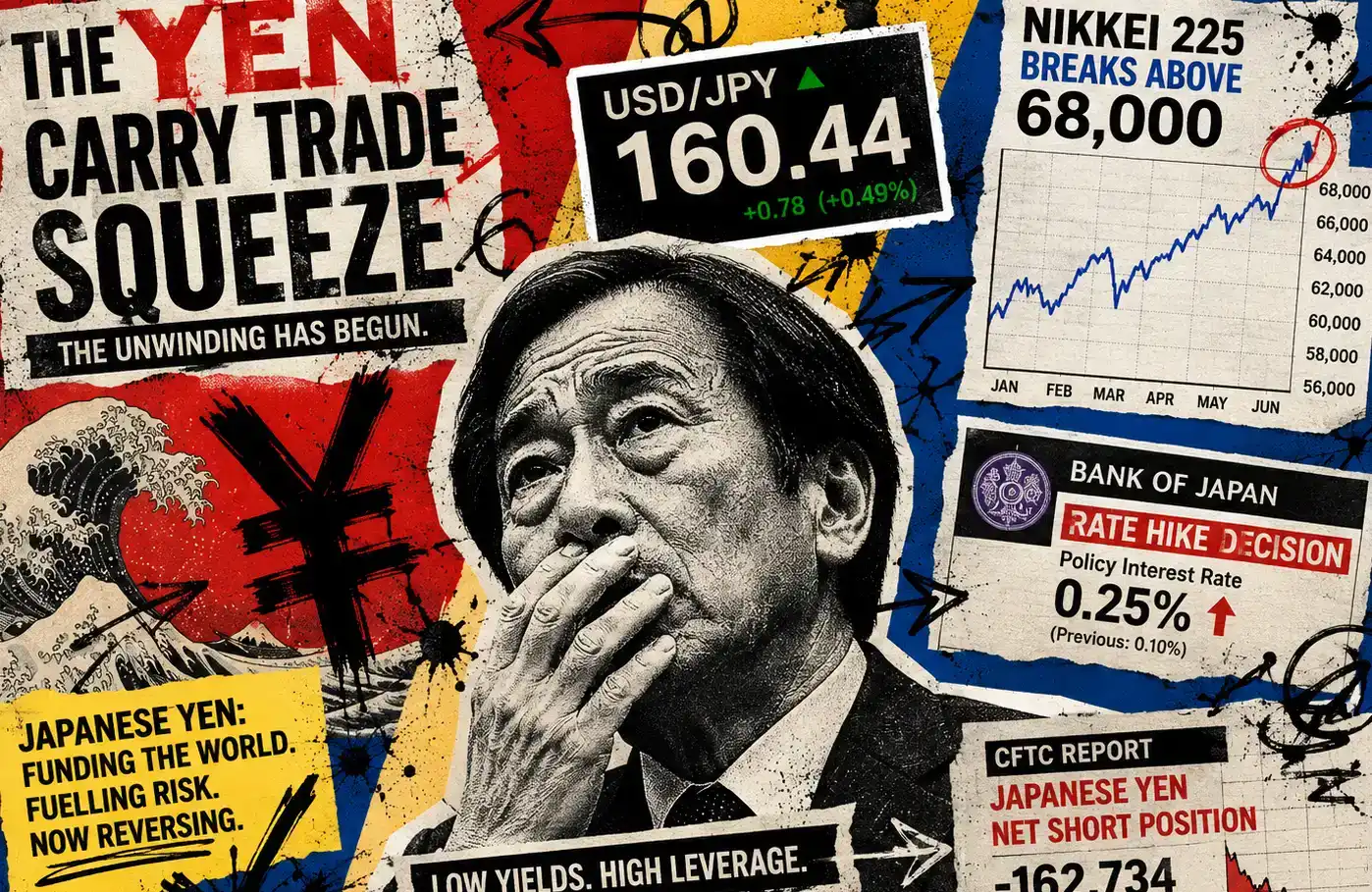
On June 3rd, USD/JPY hit 160.44, its highest level since July 2024, while the Nikkei 225 surged past 68,000 points. Contrary to popular narratives of an imminent "carry trade unwind" akin to August 2024, data reveals a more complex picture. Speculative net short positions in yen futures have actually increased, reaching -114,667 contracts by late May, suggesting traders are doubling down rather than retreating. Meanwhile, Japan's Finance Ministry conducted its largest-ever single-round FX intervention (11.73 trillion yen) in April-May but failed to hold the 160 yen line. The Nikkei's rally is not driven by carry trade dynamics. Foreign investors are aggressively buying Japanese stocks, with net purchases in 2026 running nearly 16 times higher than 2025 levels. This inflow is concentrated in AI and semiconductor-related stocks like SoftBank and Socionext, fueled by positive sector outlooks, rather than being a flight from unwinding yen shorts. Furthermore, the Nikkei has continued climbing despite the Bank of Japan's (BOJ) rate hikes to 0.75%. This disconnect exists because the current equity boom is fueled by AI-driven foreign investment, not reliant on cheap yen funding. However, this relationship remains fragile. Should the BOJ hike rates further (e.g., to 1.0%) while dollar weakness increases carry trade costs, the trajectories of the yen and Japanese stocks could reconverge, potentially triggering volatility.

marsbit1 h fa

New Wall Street Play: Yen Shorts Still Adding, But Japan Stocks Don't Rely on Carry Trade Unwinding

marsbit1 h fa

Broadcom's Q3 Guidance Misses Expectations by $12 Billion, After-Hours Trading Plummets Over 13%, AI Narrative "Cooling"?

On June 3, Broadcom released record Q2 FY26 results with revenue of $22.19B, up 48% YoY, and AI chip sales of $10.8B, up 143%. Adjusted EPS of $2.44 beat estimates. However, its Q3 AI semiconductor revenue guidance of $16B, while up over 200% YoY, fell roughly $1.2B (7%) short of analyst consensus expectations of $17.2B. This miss, coupled with slightly weaker-than-expected software revenue, triggered a severe market reaction. CEO Hock Tan maintained the FY26 AI revenue outlook of over $100B but did not raise it, disappointing investors who had priced in more robust growth. The stock plummeted over 13% in after-hours trading, erasing roughly $270B in market cap. The sell-off extended to peers like Marvell. A key concern for markets, particularly for Chinese optical module suppliers, was Tan's comment that the contribution of AI networking (e.g., Ethernet switches, optical interconnect chips) to AI revenue, currently near 40%, is expected to normalize to around 30% over time, signaling a potential peak in growth for that segment. Despite the guidance shortfall, Tan reiterated that AI demand remains "insatiable" and reaffirmed the long-term target of exceeding $100B in AI revenue by FY27. The reaction highlights the heightened sensitivity and premium valuation placed on AI-exposed stocks, where anything less than stellar guidance can prompt significant profit-taking. The broader question is whether this represents a cooling AI narrative or a correction in overstretched valuations.

marsbit1 h fa

Broadcom's Q3 Guidance Misses Expectations by $12 Billion, After-Hours Trading Plummets Over 13%, AI Narrative "Cooling"?

marsbit1 h fa

Trading

Spot
Futures

Articoli Popolari

Cosa è $S$

Comprendere SPERO: Una Panoramica Completa Introduzione a SPERO Mentre il panorama dell'innovazione continua a evolversi, l'emergere delle tecnologie web3 e dei progetti di criptovaluta gioca un ruolo fondamentale nel plasmare il futuro digitale. Un progetto che ha attirato l'attenzione in questo campo dinamico è SPERO, denotato come SPERO,$$s$. Questo articolo mira a raccogliere e presentare informazioni dettagliate su SPERO, per aiutare gli appassionati e gli investitori a comprendere le sue basi, obiettivi e innovazioni nei domini web3 e crypto. Che cos'è SPERO,$$s$? SPERO,$$s$ è un progetto unico all'interno dello spazio crypto che cerca di sfruttare i principi della decentralizzazione e della tecnologia blockchain per creare un ecosistema che promuove l'impegno, l'utilità e l'inclusione finanziaria. Il progetto è progettato per facilitare interazioni peer-to-peer in modi nuovi, fornendo agli utenti soluzioni e servizi finanziari innovativi. Al suo interno, SPERO,$$s$ mira a responsabilizzare gli individui fornendo strumenti e piattaforme che migliorano l'esperienza dell'utente nello spazio delle criptovalute. Questo include la possibilità di metodi di transazione più flessibili, la promozione di iniziative guidate dalla comunità e la creazione di percorsi per opportunità finanziarie attraverso applicazioni decentralizzate (dApps). La visione sottostante di SPERO,$$s$ ruota attorno all'inclusività, cercando di colmare le lacune all'interno della finanza tradizionale mentre sfrutta i vantaggi della tecnologia blockchain. Chi è il Creatore di SPERO,$$s$? L'identità del creatore di SPERO,$$s$ rimane piuttosto oscura, poiché ci sono risorse pubblicamente disponibili limitate che forniscono informazioni dettagliate sul suo fondatore o fondatori. Questa mancanza di trasparenza può derivare dall'impegno del progetto per la decentralizzazione—un ethos che molti progetti web3 condividono, dando priorità ai contributi collettivi rispetto al riconoscimento individuale. Centrando le discussioni attorno alla comunità e ai suoi obiettivi collettivi, SPERO,$$s$ incarna l'essenza dell'empowerment senza mettere in evidenza individui specifici. Pertanto, comprendere l'etica e la missione di SPERO rimane più importante che identificare un creatore singolo. Chi sono gli Investitori di SPERO,$$s$? SPERO,$$s$ è supportato da una varietà di investitori che vanno dai capitalisti di rischio agli investitori angelici dedicati a promuovere l'innovazione nel settore crypto. Il focus di questi investitori generalmente si allinea con la missione di SPERO—dando priorità a progetti che promettono avanzamenti tecnologici sociali, inclusività finanziaria e governance decentralizzata. Queste fondazioni di investitori sono tipicamente interessate a progetti che non solo offrono prodotti innovativi, ma contribuiscono anche positivamente alla comunità blockchain e ai suoi ecosistemi. Il supporto di questi investitori rafforza SPERO,$$s$ come un concorrente degno di nota nel dominio in rapida evoluzione dei progetti crypto. Come Funziona SPERO,$$s$? SPERO,$$s$ impiega un framework multifunzionale che lo distingue dai progetti di criptovaluta convenzionali. Ecco alcune delle caratteristiche chiave che sottolineano la sua unicità e innovazione: Governance Decentralizzata: SPERO,$$s$ integra modelli di governance decentralizzati, responsabilizzando gli utenti a partecipare attivamente ai processi decisionali riguardanti il futuro del progetto. Questo approccio favorisce un senso di proprietà e responsabilità tra i membri della comunità. Utilità del Token: SPERO,$$s$ utilizza il proprio token di criptovaluta, progettato per servire varie funzioni all'interno dell'ecosistema. Questi token abilitano transazioni, premi e la facilitazione dei servizi offerti sulla piattaforma, migliorando l'impegno e l'utilità complessivi. Architettura Stratificata: L'architettura tecnica di SPERO,$$s$ supporta la modularità e la scalabilità, consentendo un'integrazione fluida di funzionalità e applicazioni aggiuntive man mano che il progetto evolve. Questa adattabilità è fondamentale per mantenere la rilevanza nel panorama crypto in continua evoluzione. Coinvolgimento della Comunità: Il progetto enfatizza iniziative guidate dalla comunità, impiegando meccanismi che incentivano la collaborazione e il feedback. Nutrendo una comunità forte, SPERO,$$s$ può affrontare meglio le esigenze degli utenti e adattarsi alle tendenze di mercato. Focus sull'Inclusione: Offrendo basse commissioni di transazione e interfacce user-friendly, SPERO,$$s$ mira ad attrarre una base utenti diversificata, inclusi individui che potrebbero non aver precedentemente interagito nello spazio crypto. Questo impegno per l'inclusione si allinea con la sua missione generale di empowerment attraverso l'accessibilità. Cronologia di SPERO,$$s$ Comprendere la storia di un progetto fornisce preziose intuizioni sulla sua traiettoria di sviluppo e sui traguardi. Di seguito è riportata una cronologia suggerita che mappa eventi significativi nell'evoluzione di SPERO,$$s$: Fase di Concettualizzazione e Ideazione: Le idee iniziali che formano la base di SPERO,$$s$ sono state concepite, allineandosi strettamente con i principi di decentralizzazione e focus sulla comunità all'interno dell'industria blockchain. Lancio del Whitepaper del Progetto: Dopo la fase concettuale, è stato rilasciato un whitepaper completo che dettaglia la visione, gli obiettivi e l'infrastruttura tecnologica di SPERO,$$s$ per suscitare interesse e feedback dalla comunità. Costruzione della Comunità e Prime Interazioni: Sono stati effettuati sforzi attivi di outreach per costruire una comunità di early adopters e potenziali investitori, facilitando discussioni attorno agli obiettivi del progetto e ottenendo supporto. Evento di Generazione del Token: SPERO,$$s$ ha condotto un evento di generazione del token (TGE) per distribuire i propri token nativi ai primi sostenitori e stabilire una liquidità iniziale all'interno dell'ecosistema. Lancio della Prima dApp: La prima applicazione decentralizzata (dApp) associata a SPERO,$$s$ è stata attivata, consentendo agli utenti di interagire con le funzionalità principali della piattaforma. Sviluppo Continuo e Partnership: Aggiornamenti e miglioramenti continui alle offerte del progetto, inclusi partnership strategiche con altri attori nello spazio blockchain, hanno plasmato SPERO,$$s$ in un concorrente competitivo e in evoluzione nel mercato crypto. Conclusione SPERO,$$s$ rappresenta una testimonianza del potenziale del web3 e delle criptovalute di rivoluzionare i sistemi finanziari e responsabilizzare gli individui. Con un impegno per la governance decentralizzata, il coinvolgimento della comunità e funzionalità progettate in modo innovativo, apre la strada verso un panorama finanziario più inclusivo. Come per qualsiasi investimento nello spazio crypto in rapida evoluzione, si incoraggiano potenziali investitori e utenti a ricercare approfonditamente e a impegnarsi in modo riflessivo con gli sviluppi in corso all'interno di SPERO,$$s$. Il progetto mostra lo spirito innovativo dell'industria crypto, invitando a ulteriori esplorazioni delle sue innumerevoli possibilità. Mentre il percorso di SPERO,$$s$ è ancora in fase di sviluppo, i suoi principi fondamentali potrebbero effettivamente influenzare il futuro di come interagiamo con la tecnologia, la finanza e tra di noi in ecosistemi digitali interconnessi.

75 Totale visualizzazioniPubblicato il 2024.12.17Aggiornato il 2024.12.17

Cosa è $S$

Cosa è AGENT S

Agent S: Il Futuro dell'Interazione Autonoma in Web3 Introduzione Nel panorama in continua evoluzione di Web3 e criptovalute, le innovazioni stanno costantemente ridefinendo il modo in cui gli individui interagiscono con le piattaforme digitali. Uno di questi progetti pionieristici, Agent S, promette di rivoluzionare l'interazione uomo-computer attraverso il suo framework agentico aperto. Aprendo la strada a interazioni autonome, Agent S mira a semplificare compiti complessi, offrendo applicazioni trasformative nell'intelligenza artificiale (AI). Questa esplorazione dettagliata approfondirà le complessità del progetto, le sue caratteristiche uniche e le implicazioni per il dominio delle criptovalute. Cos'è Agent S? Agent S si presenta come un innovativo framework agentico aperto, progettato specificamente per affrontare tre sfide fondamentali nell'automazione dei compiti informatici: Acquisizione di Conoscenze Specifiche del Dominio: Il framework apprende in modo intelligente da varie fonti di conoscenza esterne ed esperienze interne. Questo approccio duale gli consente di costruire un ricco repository di conoscenze specifiche del dominio, migliorando le sue prestazioni nell'esecuzione dei compiti. Pianificazione su Lungo Orizzonte di Compiti: Agent S impiega una pianificazione gerarchica potenziata dall'esperienza, un approccio strategico che facilita la suddivisione e l'esecuzione efficiente di compiti complessi. Questa caratteristica migliora significativamente la sua capacità di gestire più sottocompiti in modo efficiente ed efficace. Gestione di Interfacce Dinamiche e Non Uniformi: Il progetto introduce l'Interfaccia Agente-Computer (ACI), una soluzione innovativa che migliora l'interazione tra agenti e utenti. Utilizzando Modelli Linguistici Multimodali di Grandi Dimensioni (MLLM), Agent S può navigare e manipolare senza sforzo diverse interfacce grafiche utente. Attraverso queste caratteristiche pionieristiche, Agent S fornisce un framework robusto che affronta le complessità coinvolte nell'automazione dell'interazione umana con le macchine, preparando il terreno per innumerevoli applicazioni nell'AI e oltre. Chi è il Creatore di Agent S? Sebbene il concetto di Agent S sia fondamentalmente innovativo, informazioni specifiche sul suo creatore rimangono elusive. Il creatore è attualmente sconosciuto, il che evidenzia sia la fase embrionale del progetto sia la scelta strategica di mantenere i membri fondatori sotto anonimato. Indipendentemente dall'anonimato, l'attenzione rimane sulle capacità e sul potenziale del framework. Chi sono gli Investitori di Agent S? Poiché Agent S è relativamente nuovo nell'ecosistema crittografico, informazioni dettagliate riguardanti i suoi investitori e sostenitori finanziari non sono documentate esplicitamente. La mancanza di approfondimenti pubblicamente disponibili sulle fondazioni di investimento o sulle organizzazioni che supportano il progetto solleva interrogativi sulla sua struttura di finanziamento e sulla roadmap di sviluppo. Comprendere il supporto è cruciale per valutare la sostenibilità del progetto e il suo potenziale impatto sul mercato. Come Funziona Agent S? Al centro di Agent S si trova una tecnologia all'avanguardia che gli consente di funzionare efficacemente in contesti diversi. Il suo modello operativo è costruito attorno a diverse caratteristiche chiave: Interazione Uomo-Computer Simile a Quella Umana: Il framework offre una pianificazione AI avanzata, cercando di rendere le interazioni con i computer più intuitive. Mimando il comportamento umano nell'esecuzione dei compiti, promette di elevare le esperienze degli utenti. Memoria Narrativa: Utilizzata per sfruttare esperienze di alto livello, Agent S utilizza la memoria narrativa per tenere traccia delle storie dei compiti, migliorando così i suoi processi decisionali. Memoria Episodica: Questa caratteristica fornisce agli utenti una guida passo-passo, consentendo al framework di offrire supporto contestuale mentre i compiti si sviluppano. Supporto per OpenACI: Con la capacità di funzionare localmente, Agent S consente agli utenti di mantenere il controllo sulle proprie interazioni e flussi di lavoro, allineandosi con l'etica decentralizzata di Web3. Facile Integrazione con API Esterne: La sua versatilità e compatibilità con varie piattaforme AI garantiscono che Agent S possa adattarsi senza problemi agli ecosistemi tecnologici esistenti, rendendolo una scelta attraente per sviluppatori e organizzazioni. Queste funzionalità contribuiscono collettivamente alla posizione unica di Agent S all'interno dello spazio crittografico, poiché automatizza compiti complessi e multi-fase con un intervento umano minimo. Man mano che il progetto evolve, le sue potenziali applicazioni in Web3 potrebbero ridefinire il modo in cui si svolgono le interazioni digitali. Cronologia di Agent S Lo sviluppo e le tappe di Agent S possono essere riassunti in una cronologia che evidenzia i suoi eventi significativi: 27 Settembre 2024: Il concetto di Agent S è stato lanciato in un documento di ricerca completo intitolato “Un Framework Agentico Aperto che Usa i Computer Come un Umano”, mostrando le basi per il progetto. 10 Ottobre 2024: Il documento di ricerca è stato reso pubblicamente disponibile su arXiv, offrendo un'esplorazione approfondita del framework e della sua valutazione delle prestazioni basata sul benchmark OSWorld. 12 Ottobre 2024: È stata rilasciata una presentazione video, fornendo un'idea visiva delle capacità e delle caratteristiche di Agent S, coinvolgendo ulteriormente potenziali utenti e investitori. Questi indicatori nella cronologia non solo illustrano i progressi di Agent S, ma indicano anche il suo impegno per la trasparenza e il coinvolgimento della comunità. Punti Chiave su Agent S Man mano che il framework Agent S continua a evolversi, diversi attributi chiave si distinguono, sottolineando la sua natura innovativa e il potenziale: Framework Innovativo: Progettato per fornire un uso intuitivo dei computer simile all'interazione umana, Agent S porta un approccio nuovo all'automazione dei compiti. Interazione Autonoma: La capacità di interagire autonomamente con i computer attraverso GUI segna un passo avanti verso soluzioni informatiche più intelligenti ed efficienti. Automazione di Compiti Complessi: Con la sua metodologia robusta, può automatizzare compiti complessi e multi-fase, rendendo i processi più veloci e meno soggetti a errori. Miglioramento Continuo: I meccanismi di apprendimento consentono ad Agent S di migliorare dalle esperienze passate, migliorando continuamente le sue prestazioni e la sua efficacia. Versatilità: La sua adattabilità attraverso diversi ambienti operativi come OSWorld e WindowsAgentArena garantisce che possa servire un'ampia gamma di applicazioni. Man mano che Agent S si posiziona nel panorama di Web3 e delle criptovalute, il suo potenziale per migliorare le capacità di interazione e automatizzare i processi segna un significativo avanzamento nelle tecnologie AI. Attraverso il suo framework innovativo, Agent S esemplifica il futuro delle interazioni digitali, promettendo un'esperienza più fluida ed efficiente per gli utenti in vari settori. Conclusione Agent S rappresenta un audace passo avanti nell'unione tra AI e Web3, con la capacità di ridefinire il modo in cui interagiamo con la tecnologia. Sebbene sia ancora nelle sue fasi iniziali, le possibilità per la sua applicazione sono vaste e coinvolgenti. Attraverso il suo framework completo che affronta sfide critiche, Agent S mira a portare le interazioni autonome al centro dell'esperienza digitale. Man mano che ci addentriamo nei regni delle criptovalute e della decentralizzazione, progetti come Agent S giocheranno senza dubbio un ruolo cruciale nel plasmare il futuro della tecnologia e della collaborazione uomo-computer.

532 Totale visualizzazioniPubblicato il 2025.01.14Aggiornato il 2025.01.14

Cosa è AGENT S

Come comprare S

Benvenuto in HTX.com! Abbiamo reso l'acquisto di Sonic (S) semplice e conveniente. Segui la nostra guida passo passo per intraprendere il tuo viaggio nel mondo delle criptovalute.Step 1: Crea il tuo Account HTXUsa la tua email o numero di telefono per registrarti il tuo account gratuito su HTX. Vivi un'esperienza facile e sblocca tutte le funzionalità,Crea il mio accountStep 2: Vai in Acquista crypto e seleziona il tuo metodo di pagamentoCarta di credito/debito: utilizza la tua Visa o Mastercard per acquistare immediatamente SonicS.Bilancio: Usa i fondi dal bilancio del tuo account HTX per fare trading senza problemi.Terze parti: abbiamo aggiunto metodi di pagamento molto utilizzati come Google Pay e Apple Pay per maggiore comodità.P2P: Fai trading direttamente con altri utenti HTX.Over-the-Counter (OTC): Offriamo servizi su misura e tassi di cambio competitivi per i trader.Step 3: Conserva Sonic (S)Dopo aver acquistato Sonic (S), conserva nel tuo account HTX. In alternativa, puoi inviare tramite trasferimento blockchain o scambiare per altre criptovalute.Step 4: Scambia Sonic (S)Scambia facilmente Sonic (S) nel mercato spot di HTX. Accedi al tuo account, seleziona la tua coppia di trading, esegui le tue operazioni e monitora in tempo reale. Offriamo un'esperienza user-friendly sia per chi ha appena iniziato che per i trader più esperti.

1.0k Totale visualizzazioniPubblicato il 2025.01.15Aggiornato il 2026.06.02

Come comprare S

Discussioni

Benvenuto nella Community HTX. Qui puoi rimanere informato sugli ultimi sviluppi della piattaforma e accedere ad approfondimenti esperti sul mercato. Le opinioni degli utenti sul prezzo di S S sono presentate come di seguito.

活动图片