Agentized OS: It's Not About AI, It's About the Foundation

marsbitPubblicato 2026-05-27Pubblicato ultima volta 2026-05-27

Introduzione

The Agentic OS: Beyond AI, It's About the Foundational Stack In 2026, major operating systems like Android, iOS, HarmonyOS, and Windows are entering the "Agentic" era, integrating proactive AI assistants deeply into the system layer. However, the real competition lies not in the flashy AI features showcased at events, but in the three-layer foundational stack that enables them: the system-level AI Runtime, proprietary/controllable chips, and the on-device/cloud model matrix. The AI Runtime acts as the central scheduler, managing model inference, resource allocation, and exposing capabilities to apps. Controllable chips (e.g., Apple Silicon, Google Tensor, Huawei Kirin) are crucial for deep hardware-software co-optimization, determining the efficiency and experience limits of on-device Agents. The on-device/cloud model matrix provides the "intelligence," with proprietary, chip-optimized small models (like Gemini Nano, Apple's ~3B model) handling daily tasks locally for low latency, privacy, and reliability, while cloud models tackle complex requests. Deep synergy between these three layers enables key Agent differentiators: ultra-low latency and power efficiency, genuine "on-device first" privacy, access to system-level personal context across apps, and reliable performance as a system service even offline. OS vendors with strong integration across this stack (like Apple, Google, and Huawei) build a deeper moat. Beyond this core stack, long-term competitiveness depends on ...

Article | CloudSurge AI, Author | Huang Yunhao

One. After Google I/O 2026: The Four Major End-Device OS Step into the Agent Era

On May 12, 2026, Google held the Android Show|I/O Edition press conference, an Android-focused event ahead of the I/O conference on May 19. Sameer Samat, President of the Android Ecosystem, set the tone for this conference: Android must transform from an operating system into a smart system. The concept carrying this main thread is Gemini Intelligence – a set of proactive AI capabilities at the Android system layer.
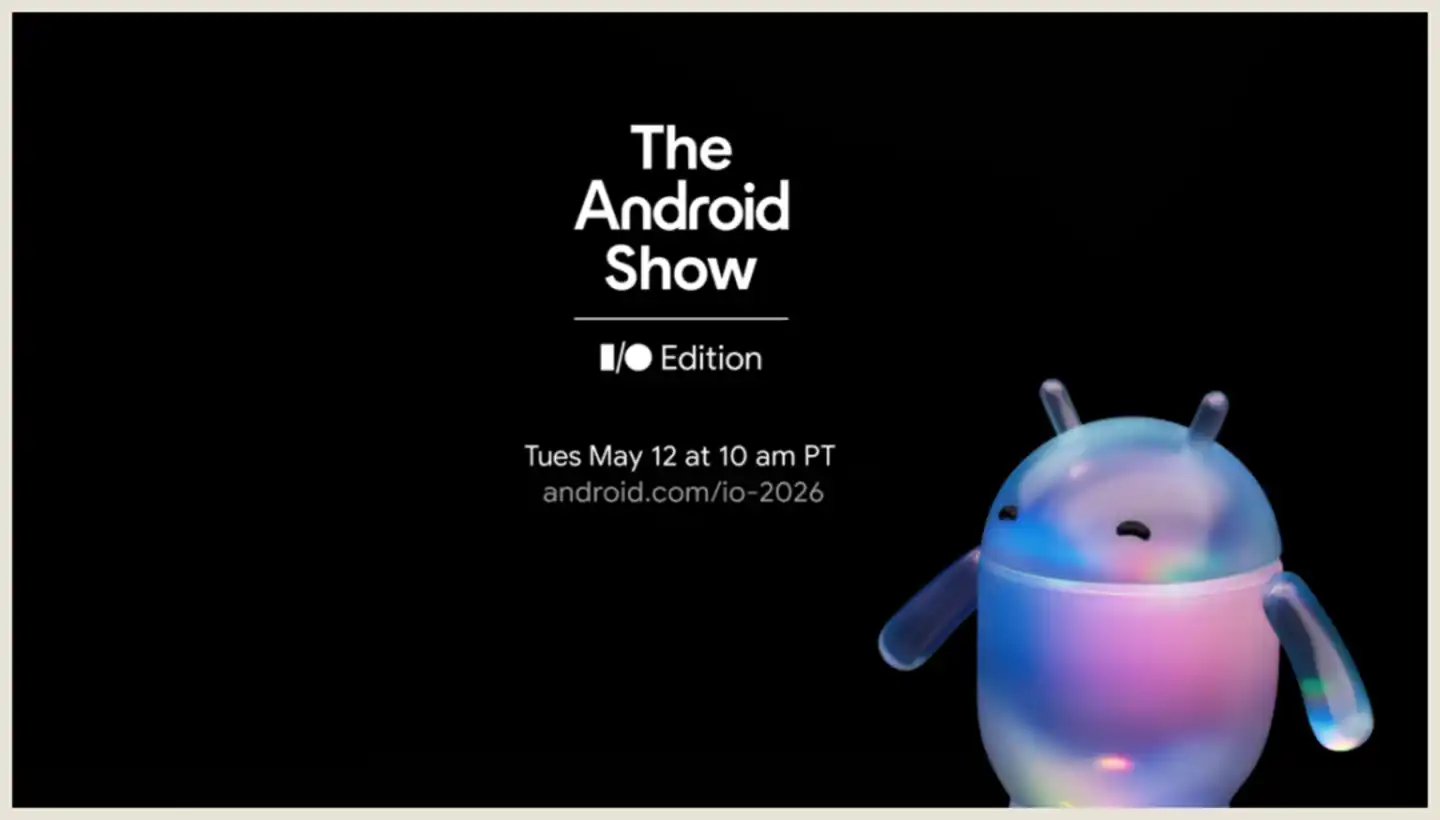
2026 Android Show|I/O Edition Press Conference Poster
Source: Android Heaadlines

Compared to last year's Gemini Nano + AICore combination, this time Google further embedded Agent capabilities for cross-App and contextual processing into the OS layer: cross-App task automation (ordering meals, shopping, placing orders), automatic form filling, webpage summarization, and custom widgets were successively written into the system-level capability list. Google also listed explicit user control, comprehensive data protection, and operational transparency as three product principles.

A week later, on May 19, in the I/O keynote speech, Google CEO Sundar Pichai started along the same line:

Welcome to the agentic Gemini era

In joining the wave of end-device OS agentization, Google was hardly an early starter.

Microsoft introduced Copilot+PC (a new category of Windows 11 devices equipped with 40+ TOPS NPUs) at Build 2024 in May 2024, embedding Agent capabilities into the OS based on three abilities: the on-device small model Phi Silica, the screen Agent capability Click to Do, and the system-level activity memory Recall.

At WWDC24 in June 2024, Apple formally announced "Apple Intelligence," which it positioned as a "personal intelligence system." Some AI-assisted features were subsequently rolled out, but the core Agent capabilities of Apple Intelligence have not yet materialized due to issues like delays in its own large model development and Siri's shortcomings.

Huawei, at HDC 2025 in June 2025, released HarmonyOS 6 and the Harmony Smart Agent Framework (HMAF), followed by the launch of the Xiaoyi Smart Agent Plaza featuring over 80 agents.

The major trend of end-device OS agentization has simultaneously emerged in mainstream operating systems like Android, iOS, HarmonyOS, and Windows.

Press conferences only showcase features; what OS vendors are truly competing over is the three-layered foundational capability underpinning the reliable operation and practical problem-solving of OS Agents: the system-level AI Runtime, controllable chips, and the end-cloud model matrix.

Two. Beyond the Press Conference: The Three-Layered Foundation Supporting OS Agents

System-Level AI Runtime: The Scheduling Hub for On-Device Intelligence

Runtime is the inference engine and system service through which on-device models run within the operating system. Downwards, it directly interfaces with the NPU and system resource scheduling; upwards, it exposes inference capabilities to all Apps via stable APIs. It turns on-device models into "shared intelligence at the OS layer": sharing model weights across Apps, uniformly scheduling computing power and memory, supporting the tool calling, guided generation, context, and permission docking required by Agents. It determines whether an OS Agent is merely a chat button within an App or a resident service on the operating system capable of performing system-level operations.

The most complete example within the Android system is Google's AICore. In December 2023, AICore went live as a system service in Android 14; in August 2025, Gemini Nano was opened to developers via ML Kit GenAI APIs. From a system service foundation to stable APIs for Apps, AICore has been polished for nearly two years.

Other OS vendors are on the same path, with different tempos. Apple opened the Foundation Models framework to developers at WWDC25. The framework comes with decorators like @Generable, tool calling, guided generation, and stateful sessions, connecting to an on-device foundation model of about 3B parameters, supplemented by private cloud computing for cloud support. Microsoft integrated the on-device AI framework Foundry on Windows and Phi Silica into Windows 11, using Windows ML as the underlying inference backend. Huawei released the Agent Framework Kit (Harmony Smart Agent Framework, HMAF) at HDC 2025, opening up the intent system and Agent collaboration protocols.
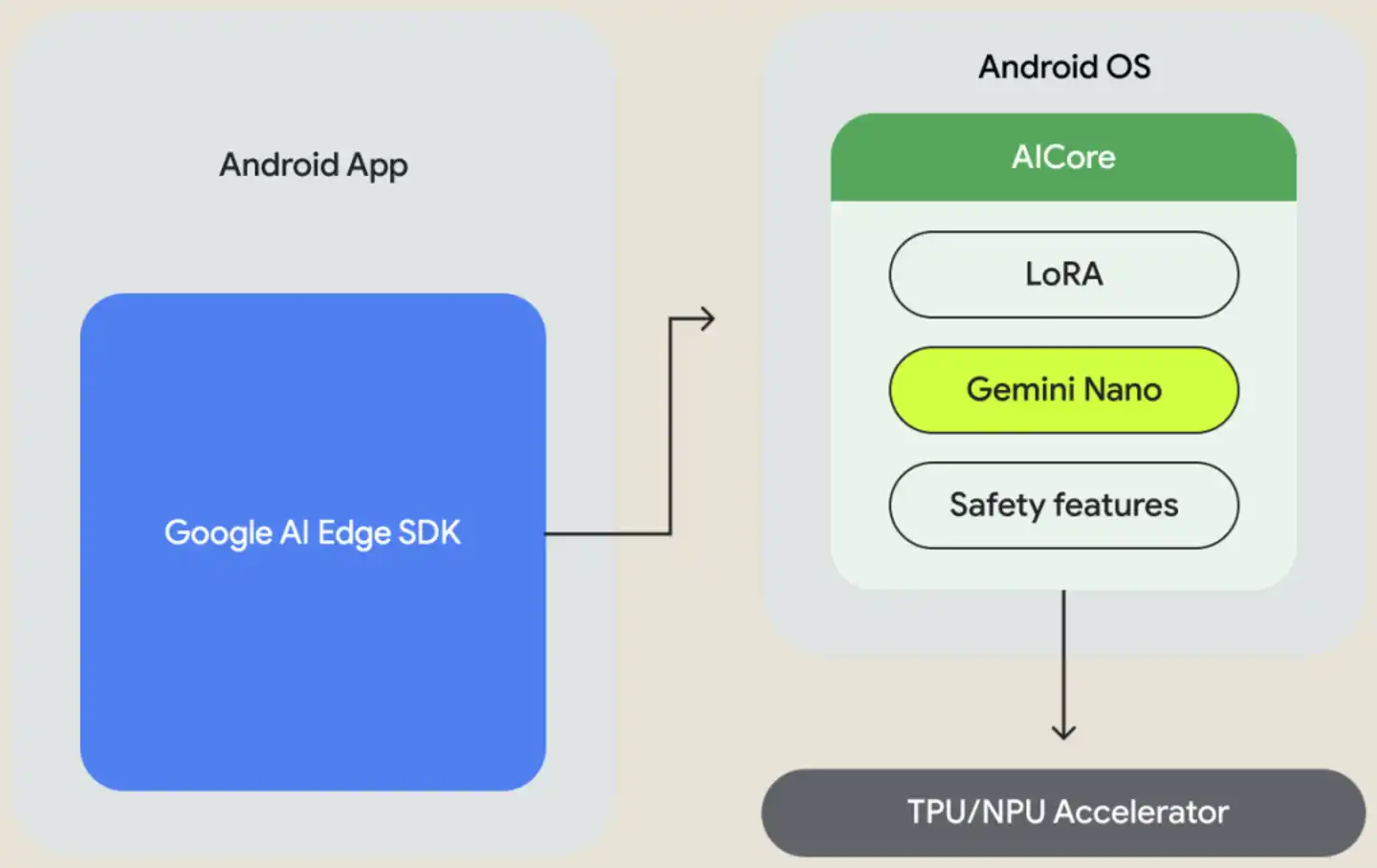
Android AICore as a system service, scheduling Gemini Nano inference on hardware accelerators
Source: Android Developers

Controllable Chips: The Fulcrum of Hardware-Software Synergy

At the Android Show|I/O Edition, Google set clear hardware thresholds for Gemini Intelligence: the full feature set debuted exclusively on a few latest flagships like the Pixel 10 series and Galaxy S26 series, with last year's models not included. This points to a simple fact: AI models are still evolving rapidly, and software continuously imposes new demands on hardware. Controllable chips are the foundation for meeting these demands, and the degree of control determines the space OS vendors have for hardware-software adaptation of end-device OS Agents.

Apple is the exemplar of the integrated hardware-software approach. iOS and macOS have evolved in tandem with the A-series and M-series chips from the start, and Core ML encapsulates the scheduling of CPU, GPU, and ANE into the framework layer. This path continues into the LLM era. Apple Machine Learning Research provided a set of actual measurements: following Core ML's optimization path to deploy Llama 3.1 8B Instruct onto an M1 Max, local decoding speed can reach about 33 tokens/s. The "Apple Intelligence Foundation Language Models" technical report also disclosed that Apple performed architecture-level optimizations like KV cache sharing and 2-bit quantization-aware training for its own chips, enabling the successful opening of the ~3B on-device foundation model to developers via the Foundation Models framework. This level of depth is only achievable when the chip is held in one's own hands – this is precisely the value of controllable chips for OS vendors: it dictates the depth of hardware-software synergy and raises the experience ceiling for end-device OS Agents.

Entering the AI era, Google is doing the same thing – pursuing its self-developed Tensor SoC path since the Pixel 6. The latest Tensor G5 boosts TPU performance by up to 60% and CPU performance by an average of 34%, landing in the Pixel 10 as the first SoC to fully run the latest-generation Gemini Nano. Of course, Tensor G5 also has weaknesses: Android Central's real-world tests show its memory configuration (RAM capacity) remains an AI performance bottleneck, and its Geekbench AI scores trail the Snapdragon 8 Elite; in Macworld's Geekbench 6 tests, G5's single-core and multi-core scores are lower than the A18 Pro's. Google is still catching up, but the synergistic path of self-developed Tensor plus on-device Gemini has taken shape.

Huawei's Kirin paired with the Da Vinci NPU and the Pangu on-device model is another controllable chip path running parallel to Apple and Google. Xiaomi, with its Xuanjue O1, is a newer entrant moving in the direction of controllable chips.

End-Cloud Model Matrix: The Source of Intelligence for Agents

The end-cloud model matrix is the source of "intelligence" for end devices: cloud models support the capability ceiling for complex tasks, while on-device models underpin the baseline for daily operation – latency, battery life, privacy, and stability all rest on the on-device side. Both ends are indispensable; the difference lies in the depth of coupling with the OS. On-device models must be embedded into the OS of every terminal device and deeply coupled with the local NPU, assuming a dual identity within the OS: downwards, they are the local inference backend for the Runtime; upwards, they are exposed as system-level APIs to Apps via the Runtime's framework and SDK.

Self-development makes sense both in the cloud and on-device, but the returns are more tangible on-device. While cloud models can be sourced externally to support the capability ceiling, the advantages of self-development mainly manifest in routing control, commercial terms, and model iteration pace. The on-device side is different. On-device models are embedded into the OS and NPU of every device; the returns on self-development are directly reflected in product performance: KV cache sharing, 2-bit quantization-aware training specifically designed for a chip generation, Per-Layer Embedding (originating from Gemma 3n, incrementally loading embedding parameters layer-by-layer from fast storage), etc. – these are only conveniently realized when the model and hardware are designed synchronously; meanwhile, the synergy tempo is no longer constrained by third-party hardware vendors.

Tensor G5's TPU computing power saw up to a 60% increase over the previous G4, but Gemini Nano's improvement on the G5 far exceeds that – according to Google official and Jon Peddie Research data compilation, local processing speed is 2.6 times that of the previous generation, energy consumption is halved, and the token window expanded from 12,000 to 32,000 (equivalent to digesting about a hundred screenshots at once). These significantly surpassing performance gains stem from the Matryoshka Transformer elastic inference architecture adopted by Gemini Nano v3, combined with synergistic optimizations with the Tensor G5 TPU.
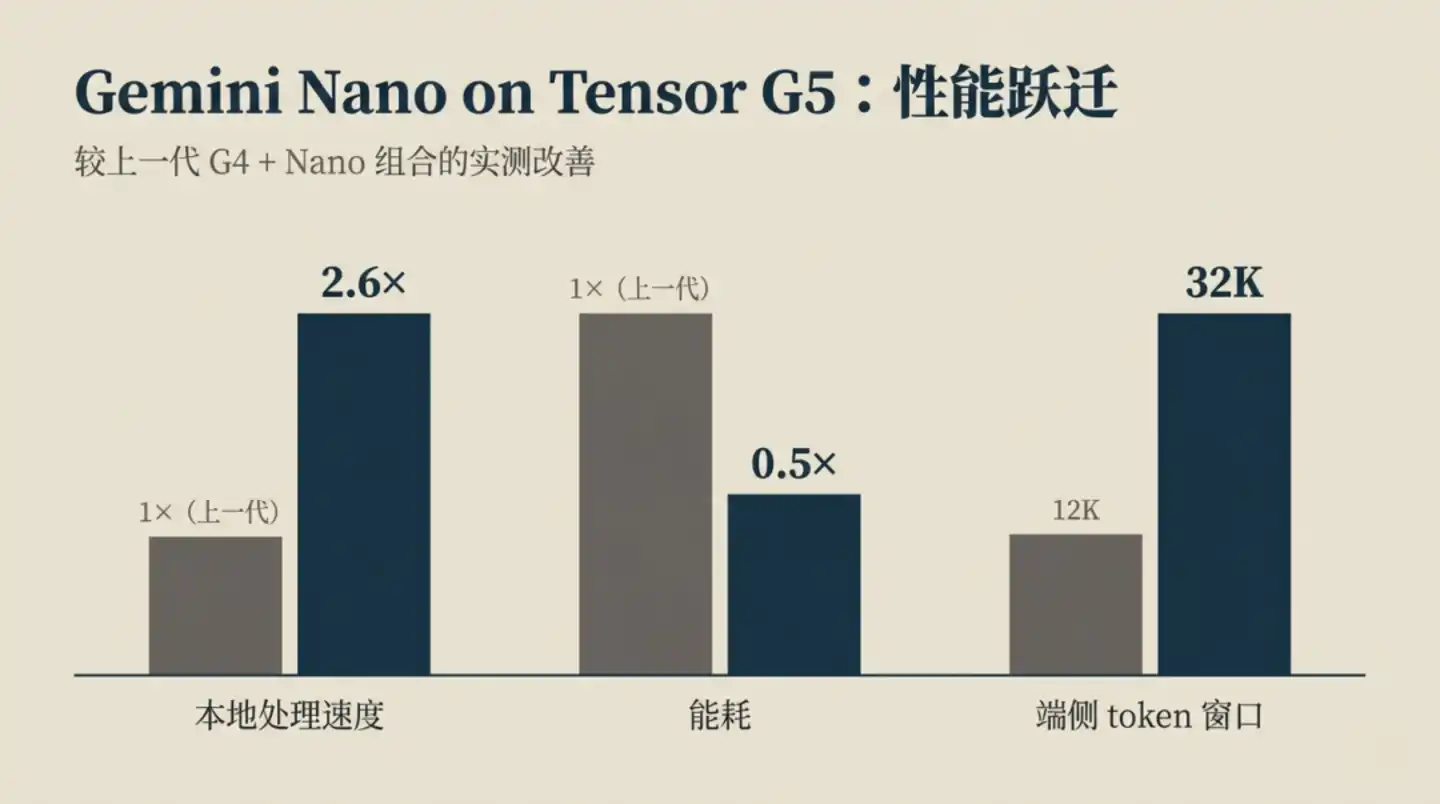
Performance Leap of Gemini Nano on Tensor G5 Compared to Previous Generation
Source: Google/Jon Peddie Research, CloudSurge AI Chart

In this layer of on-device models, the major OS vendors all hold their own cards: Google's Gemini Nano, Apple's ~3B parameter on-device foundation model, Microsoft's Phi Silica, Huawei's Pangu on-device model. Self-development is the default option for this layer.

Three. Between the Layers: Deeper Synergy, Greater Space for Differentiation

The three-layered capability foundation is coupled from bottom to top: Controllable Chip → On-Device/Cloud Models → Runtime → Agent. The controllable chip determines the achievable inference efficiency and power consumption for on-device models; on-device models determine the local intelligence schedulable by the Runtime; the Runtime determines the reliability of the Agent executing cross-App operations as a system service. The deeper the synergy among the three, the greater the product experience differentiation for OS vendors in on-device Agents, and the thicker the moat.

The more tightly the three layers interlock within the same hardware-software system, the more the product capabilities of OS Agents will exhibit differentiation that a single layer cannot achieve.

  • Response latency and power consumption. The 2.6x processing speed and halved energy consumption achieved by Gemini Nano on Tensor G5 rely on mutual adaptation of model architecture, chip design, and Runtime scheduling within the same generation of hardware-software design – improvements of this magnitude only emerge from such synergy.
  • Privacy and trust. Common tasks involving private data are handled locally by on-device models, while complex requests are passed to the cloud – this is the reasonable default posture for OS Agents regarding user data at the current stage. The three-layer coupling determines whether this "on-device first, cloud fallback" can be truly realized: deep adaptation between the NPU and on-device model is the key path for on-device models, still in development, to shoulder daily high-frequency inference; model quantization compression and KV cache sharing for the NPU; Runtime routing between on-device and cloud based on task complexity. If any of the three layers is inadequate, "on-device first" remains mere marketing talk.
  • System-level context. OS vendors reorganizing cross-App and OS-layer user data (semantic indexing, screen perception, long-term memory) into a system-level personal context for the Agent is a prerequisite for the Agent to truly "understand the user" and a core characteristic differentiating OS Agents from single App-level Agents. Implementation depends on the three-layer interlock: the Runtime holds cross-App indexing and permissions, the on-device model resides to handle understanding and inference, and the NPU provides local efficient computing power. Apple's Core Spotlight builds semantic indexes on-device, Apps expose actions and data to the system via App Intents, and Agents will obtain context through Personal Context (Apple announced this capability will come with a future software update); Android's AppFunctions follows a similar path.
  • Reliability as a system service. For an OS Agent to be invoked as a system-level service, it must remain usable in real-world scenarios like being offline, low battery, or thermal throttling. The on-device model residing on the device allows the Agent to work without a network; a highly hardware-software optimized NPU handles low-power inference; the Runtime falls back scheduling based on availability when device resources are tight (switching to lighter models or routing requests to the cloud). If any of the three layers is missing, the OS Agent cannot sustain the form of a system service and can only revert to an App-level chat button.

Apple Intelligence presents a complete synergy paradigm: Apple Silicon, the ~3B on-device foundation model, and the Foundation Models framework interlock from bottom to top, handling common scenarios on-device and transferring complex requests to private cloud computing. Google represents another form. Tensor G5, landing in the Pixel 10 as the first SoC to fully run the latest-generation Gemini Nano, is uniformly scheduled by AICore, enabling system-level Agent features like Magic Cue and Pixel Screenshots to be enabled by default without relying on the cloud. Huawei is an exemplary case of constructing three-layer synergy domestically: Kirin, Da Vinci NPU, Pangu on-device model, and HMAF – all four are self-owned, coupling from bottom to top into a complete three-layer foundation.
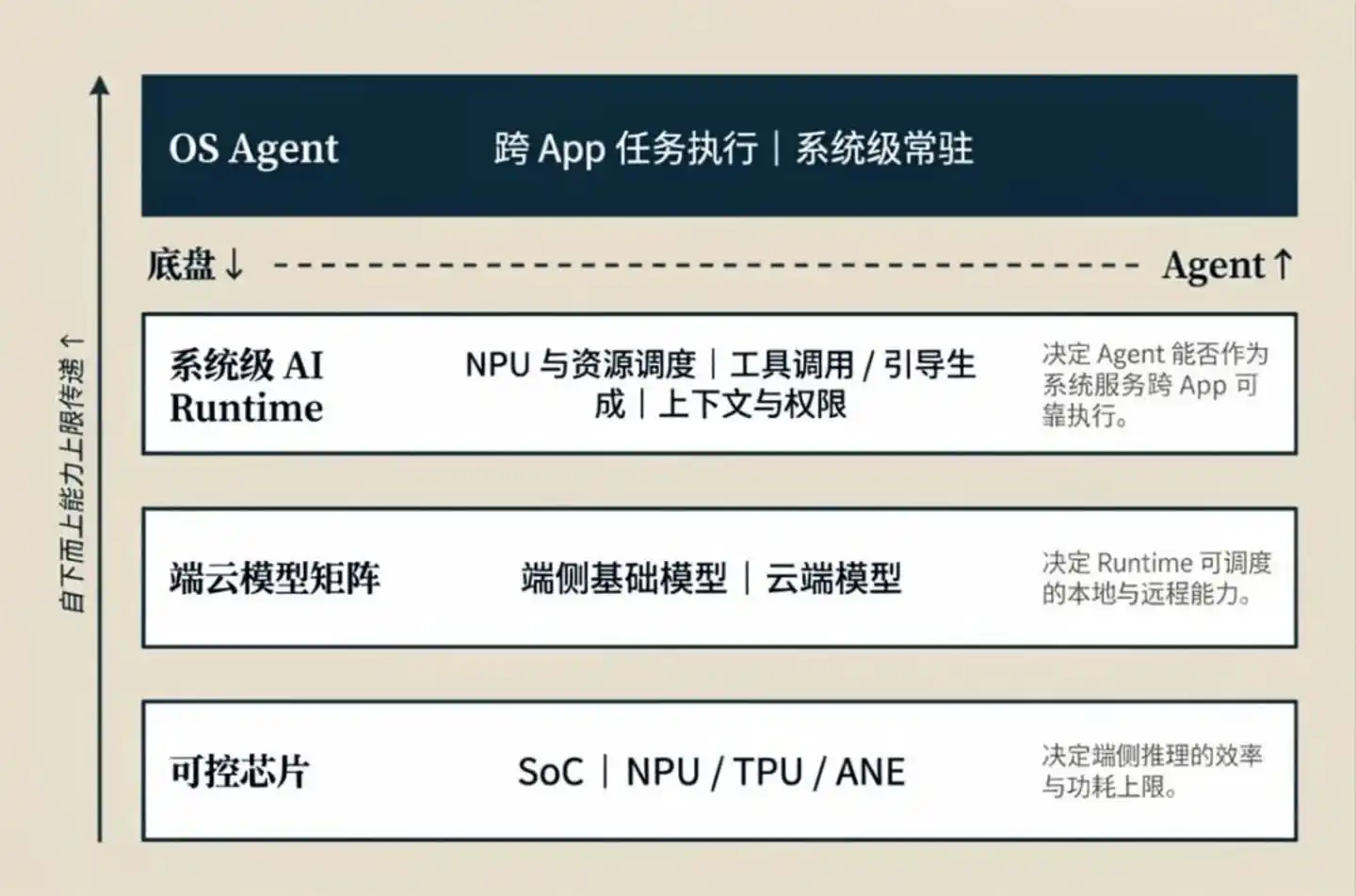
Interlocking Mechanism of the Three-Layered Foundation for End-Device OS Agents
Source: CloudSurge AI


Four.
Above the Foundation: Other Key Variables for the Long-Term Moat

The three-layer synergy builds the core of the moat. Above the foundation, numerous other variables affect product competitiveness in the OS Agent era, including Agent-App interaction capabilities, privacy protection, etc.

The interaction between OS Agents and Apps is at the forefront of the contest between OS vendors and App vendors. Currently, two paths run in parallel. One is screen recognition and automation, including Gemini Live screen sharing, Apple Visual Intelligence, Circle to Search, etc. OS Agents intervene in Apps by reading the screen and clicking buttons. This works for single tasks, but each invocation lacks structured information, making it difficult to build stable multi-step workflows. The other is API deep integration, including Google AppFunctions, Apple App Intents, Huawei Intents Kit, etc. Apps expose core actions as structured interfaces to the system, enabling stable Agent calls and the building of multi-step workflows. Whether the API path can spread depends not on OS vendors but on App vendors. Handing over core functionalities to be called by Agents means users may no longer directly open the App, with risks of brand exposure, ad slots, behavioral data, and payment portals being intercepted by the OS. This will be a core battleground for the distribution of end-user traffic.

Privacy protection is a key value proposition and bottom line for end-device systems. OS vendors hold the deepest system-level permissions and the most sensitive user data on the end-device side. Privacy is both a professional stance and a prerequisite for the long-term advancement of the aforementioned aspects. Apple has built an end-device-based privacy protection system through the integrated hardware-level security design shared between the on-device Secure Enclave independent security chip and Private Cloud Compute nodes. This product strategy has turned "Privacy. That’s Apple." into a core brand label for Apple in the global premium market, thereby winning user trust.
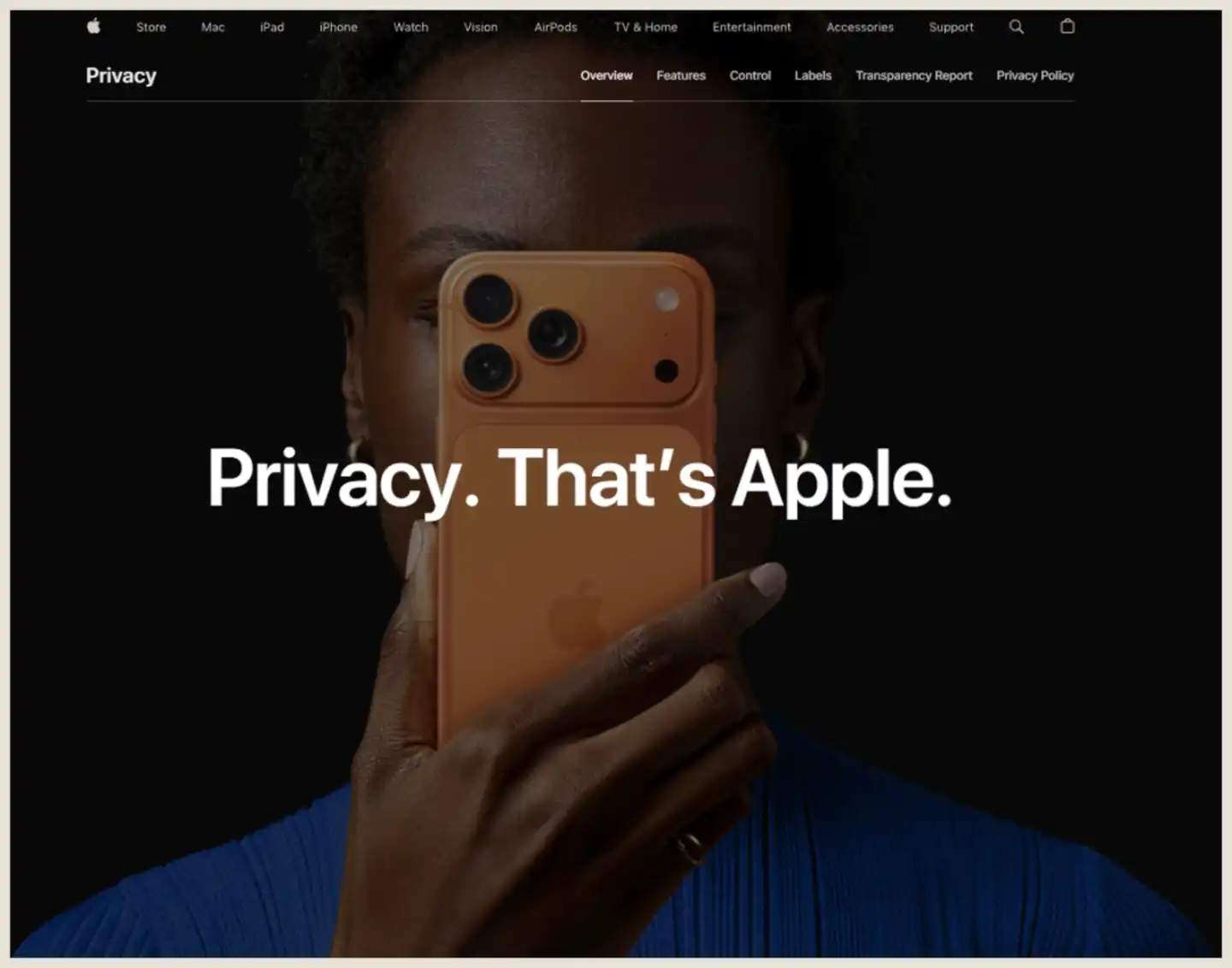
Apple's "Privacy. That’s Apple." Label
Source: Apple Website

The three-layer synergy establishes the core of the moat, and these long-term variables above the foundation influence how deeply it can be fortified.

Five. More Than Just Remaking the OS

Under the trend of end-device OS agentization, the more solid the three-layered foundation of system-level AI Runtime, controllable chips, and the end-cloud model matrix, the higher the product baseline for OS vendors in this battle and the greater their space for differentiation. OS vendors that grasp this trend will have the opportunity to drive a reset in the distribution of traffic at the end-device entry point, securing a stronger competitive position.

This trend extends beyond phones and PCs. The underlying capabilities of OS Agents are spilling over into more terminals along the multi-device ecosystems already built by each company, especially IoT. Controllable chips are moving into scenarios like automotive SoCs; Huawei has already deployed vehicle-grade Kirin chips, and Xiaomi's HyperOS is entering its own vehicle models. On-device models are being lightened for migration to new form-factor hardware like glasses; the Android XR smart glasses jointly developed by Google, Samsung, Gentle Monster, and Warby Parker are set to launch in Fall 2026. Runtime and Agent synergy is expanding to device clusters via the "Super Terminal/Distributed" frameworks already deployed by each company, e.g., Huawei's 1+8+N and Harmony Distributed Soft Bus, Xiaomi's "Human-Vehicle-Home Full Ecosystem" and HyperConnect, Apple's Continuity, and Google's Cross device SDK and Cross device services. The battle over OS Agents is far from limited to the victory or defeat on phones and PCs.

AICore has been polished for nearly two years; Apple's OS and Apple silicon series chips have been co-evolving for over a decade; Tensor has been revised all the way to G5, with the Pixel 10 finally capable of shouldering the burden of Gemini Nano v3. The outcome of this battle never lies in the one or two hours of a press conference, but in the chips, models, and Runtime honed across generations.

References:

  • Gemini Intelligence brings proactive AI to Android|Google Blog
  • I/O 2026: Welcome to the agentic Gemini era|Google Blog
  • Phi Silica, small but mighty on-device SLM|Windows Experience Blog
  • Apple Delays Siri Upgrade Indefinitely|Bloomberg
  • HarmonyOS 6 Developer Beta Launch Press Release (HDC 2025)|Huawei
  • The latest Gemini Nano with on-device ML Kit GenAI APIs|Android Developers Blog
  • Foundation Models framework documentation|Apple Developer
  • Harmony Smart Agent Framework White Paper|Huawei Developer
  • On-Device Llama 3.1 with Core ML|Apple Machine Learning Research
  • Apple Intelligence Foundation Language Models Tech Report 2025|Apple Machine Learning Research
  • Google Tensor G5: Benchmarks and everything you need to know|Android Central
  • Google’s new M5 SoC(Tensor G5 detailed - Matryoshka Transformer)|Jon Peddie Research
  • Private Cloud Compute: A new frontier for AI privacy in the cloud|Apple Security Engineering
  • Overview of AppFunctions|Android Developers
  • App Intents|Apple Developer
  • Introduction to Intents Kit (HarmonyOS)|Huawei Developer
  • The Google Pixel 10 Pro’s Tensor G5 chip is impressive—if you compare it to an iPhone 14|Macworld
  • Gemma 3n model overview|Google AI for Developers

Domande pertinenti

QWhat is the core thesis of the article regarding the evolution of operating systems (OS) into the agentic era?

AThe article argues that as major OSes (like Android, iOS, HarmonyOS, Windows) enter the 'Agent era,' the key competition is not just about showcasing flashy AI features in demos. Instead, the real differentiator and long-term moat lie in building a robust three-layer technological 'foundation' that reliably supports these OS-level Agents. This foundation consists of a system-level AI Runtime, controlled/self-developed chips, and a matrix of on-device and cloud AI models. The depth of synergy between these three layers determines the quality, privacy, and reliability of the Agent experience.

QWhat are the three key layers of the foundational 'chassis' that support a reliable OS Agent, according to the article?

A1. System-level AI Runtime: The scheduling hub and inference engine for on-device models. It interfaces directly with the NPU and system resources, providing stable APIs for apps. It enables the Agent to function as a system-level service capable of cross-app operations, rather than just an app-based chatbot. 2. Controlled Chips (SoC/ NPU): Self-developed or deeply controlled hardware (like Apple Silicon, Google Tensor, Huawei Kirin). This allows for deep software-hardware co-design and optimization, which is crucial for achieving high inference efficiency, low power consumption, and unlocking advanced Agent capabilities. 3. On-device/Cloud Model Matrix: The 'intelligence source.' On-device models handle everyday tasks with low latency and high privacy, while cloud models tackle complex requests. The article emphasizes that self-developed on-device models (like Gemini Nano, Apple's ~3B model) are critical for deep integration with the specific hardware and Runtime.

QHow does the article use Google's Gemini Nano on Tensor G5 as an example of deep layer synergy?

AThe article cites Google's Gemini Nano v3 running on the Tensor G5 chip as a prime example of performance gains from deep synergy. While the Tensor G5's TPU saw a maximum 60% performance increase over G4, Gemini Nano's on-device processing speed improved by 2.6x, and energy consumption halved. This disproportionate gain is attributed to the co-design of the model's Matryoshka Transformer architecture with the Tensor G5's TPU, showcasing how tight integration between the chip (Layer 2) and the on-device model (Layer 3), orchestrated by the Runtime (Layer 1), yields superior results that cannot be achieved by improving a single layer in isolation.

QBesides the three-layer foundation, what other long-term variables are mentioned as crucial for OS Agent competitiveness?

AThe article identifies two other key long-term variables: 1. Agent-App Interaction: How the OS Agent accesses app functionality. There's a tension between screen-reading/automation (less reliable) and deep API integration (like Google's AppFunctions, Apple's App Intents). The latter is more powerful but requires app developers to expose their core features, leading to a potential power struggle over user traffic and data. 2. Privacy Protection: This is a fundamental value and a prerequisite for user trust. The article highlights Apple's hardware-level security (Secure Enclave) and Private Cloud Compute as a benchmark, turning privacy into a core brand asset ('Privacy. That’s Apple.') that supports its competitive position in the high-end market.

QAccording to the article, the trend of Agentified OS is not limited to which devices?

AThe article explicitly states that the trend of Agentified OS and the underlying foundational capabilities are not limited to just smartphones and PCs. It is expanding to other terminals, particularly within each company's multi-device ecosystem: - IoT and Smart Homes: Through frameworks like Huawei's '1+8+N' or Xiaomi's 'Human-Vehicle-Home Full Ecosystem.' - Automotive: With controlled chips (e.g., Huawei's car-grade Kirin, Xiaomi's HyperOS) moving into vehicles. - Wearables/XR: On-device models are being adapted for lightweight hardware like smart glasses (e.g., Google's upcoming Android XR glasses). The battle for OS Agents is described as extending far beyond the胜负 (victory or defeat) in the phone and PC markets.

Letture associate

A Trillion-Dollar Frenzy for Memory Sellers, Halved Profits for Memory Buyers

Summary: A stark divide has emerged in the tech industry. While memory chipmaker Micron's stock soared 19% in a single day, pushing its market cap over $1 trillion, smartphone manufacturer Xiaomi reported a 43% plunge in adjusted net profit. The core driver is a severe supply crunch in memory chips, particularly for AI applications. Wall Street analysts, led by UBS and its unprecedented 204% target price hike for Micron, argue that long-term agreements (LTAs) from AI cloud giants are fundamentally ending the sector's notorious boom-and-bust cycles, justifying a re-rating from cyclical to infrastructure-like valuations. However, the "storage" market is now fragmented into three tiers. The first, AI-grade memory like HBM and server DDR5, faces extreme shortages and soaring prices driven by massive cloud capex. The second, mobile memory for smartphones, is also seeing sharp price hikes as manufacturers like Xiaomi are forced to pay more for remaining capacity, severely squeezing their margins. The third, PC retail channels, shows price declines due to existing inventory. The article questions the sustainability of the "supercycle" narrative. It highlights that Micron's revenue surge is driven almost entirely by price increases, not shipment volumes, making it vulnerable to a potential demand slowdown. While LTAs may dampen volatility, history suggests they are often tested during downturns. The current peak earnings, used to justify high valuations, represent a classic cyclical top. The piece concludes with a note of caution: when the entire Street chants "this time is different," it's wise to remember past bubbles, even as it acknowledges AI demand may indeed be structural.

marsbit44 min fa

A Trillion-Dollar Frenzy for Memory Sellers, Halved Profits for Memory Buyers

marsbit44 min fa

This New Generation of US Stock Trading Gods No Longer Read Financial Reports

The new generation of "stock gods" in the 2026 US AI bull market are not analyzing traditional financial reports. Instead of focusing on giants like NVIDIA, figures like the 22-year-old Leopold Aschenbrenner (who reportedly turned $200M into $14B) and influencers like Serenity on platforms like Reddit's WallStreetBets, X, and Substack are gaining fame and returns by targeting obscure, low-cap "micro-cap" stocks. Their strategy, dubbed "supply chain sniping," involves identifying critical, often monopolistic, bottlenecks in the AI hardware supply chain—such as specific materials or components essential for giants like Google and NVIDIA—that are missed by mainstream Wall Street analysts. Serenity's call on AXTI, a $700M company supplying indium phosphide substrates crucial for photonics and optical interconnects, saw the stock soar from ~$12 to nearly $150. Similarly, accounts like KawzInvests and PhotonCap focus on thematic, supply-chain-driven research in areas like AI infrastructure, optics, and cloud services for SMEs, bypassing traditional valuation metrics. This shift represents a cultural move away from Warren Buffett-style value investing based on deep financial statement analysis. The new approach thrives on low liquidity, early narratives, and strong community propagation on social media, similar to meme stocks or crypto. However, this "attention economy" strategy carries risks: it depends on sustained information gaps, the underlying companies' ability to deliver fundamental results, and the potential for crowded, volatile exits as narratives shift. The trend also shows crypto traders applying their narrative-sensing skills to US micro-caps, marking a significant evolution in trading culture.

marsbit46 min fa

This New Generation of US Stock Trading Gods No Longer Read Financial Reports

marsbit46 min fa

Trillion-Dollar Euphoria for Memory Sellers, Halved Profits for Memory Buyers

Title: The Trillion-Dollar Memory Seller's Carnival vs. The Buyer's Halved Profits On May 26, a stark contrast unfolded. While memory chipmaker Micron's market cap surged past $1 trillion, smartphone maker Xiaomi reported plummeting profits. Xiaomi's Q1 2026 profits fell 43% year-on-year. Executive Lu Weibing cited memory prices quadrupling from last year, adding roughly $210 to a phone's cost. To survive, Xiaomi is cutting entry-level models, sacrificing volume. Micron's stock, however, skyrocketed over 19% in a day, capping an 8x gain in a year. Major banks like UBS and JPMorgan issued bullish reports, raising price targets drastically. Their core thesis: Long-Term Agreements (LTAs) with AI cloud giants (Microsoft, Google, etc.) are eliminating the memory industry's notorious boom-bust cycle. By locking in fixed-price, multi-year contracts for AI-grade memory (HBM, server DDR5), these deals promise stable, utility-like earnings, justifying a higher valuation (20-30x P/E vs. the historical 8-15x). The article reveals a three-tiered memory market in 2026: 1) **AI Storage (HBM/DDR5/Enterprise SSD)**: Extreme shortage, soaring prices, LTAs. This is Micron's story. 2) **Mobile/Embedded Memory**: Also facing sharp price hikes as AI production crowds out capacity, severely pressuring phone makers like Xiaomi. 3) **PC Retail**: Some spot prices are falling due to channel inventory liquidation, creating a divergence from contract markets. The author questions if LTAs truly end the cycle. It hinges on sustained, hyper-growth AI demand. Micron's current profits are at a cycle peak, driven mostly by price hikes, not volume. If AI capital expenditure growth slows, the massive industry capacity expansion (e.g., Micron's $250B+ CapEx plan) could lead to a glut. Historically, using peak-cycle earnings for valuation is a classic trap. While the AI-driven structural shift might be real, the unanimous Wall Street euphoria warrants caution, echoing past bubbles like Cisco's in 2000. The memory seller's trillion-dollar狂欢 (carnival) continues, but the cycle's shadow remains.

链捕手53 min fa

Trillion-Dollar Euphoria for Memory Sellers, Halved Profits for Memory Buyers

链捕手53 min fa

Trading

Spot
Futures

Articoli Popolari

Cosa è GROK AI

Grok AI: Rivoluzionare la Tecnologia Conversazionale nell'Era Web3 Introduzione Nel panorama in rapida evoluzione dell'intelligenza artificiale, Grok AI si distingue come un progetto notevole che collega i domini della tecnologia avanzata e dell'interazione con l'utente. Sviluppato da xAI, un'azienda guidata dal rinomato imprenditore Elon Musk, Grok AI cerca di ridefinire il modo in cui interagiamo con l'intelligenza artificiale. Mentre il movimento Web3 continua a prosperare, Grok AI mira a sfruttare il potere dell'IA conversazionale per rispondere a query complesse, offrendo agli utenti un'esperienza che è non solo informativa ma anche divertente. Cos'è Grok AI? Grok AI è un sofisticato chatbot di intelligenza artificiale conversazionale progettato per interagire dinamicamente con gli utenti. A differenza di molti sistemi di intelligenza artificiale tradizionali, Grok AI abbraccia un'ampia gamma di domande, comprese quelle tipicamente considerate inappropriate o al di fuori delle risposte standard. Gli obiettivi principali del progetto includono: Ragionamento Affidabile: Grok AI enfatizza il ragionamento di buon senso per fornire risposte logiche basate sulla comprensione contestuale. Supervisione Scalabile: L'integrazione dell'assistenza degli strumenti garantisce che le interazioni degli utenti siano sia monitorate che ottimizzate per la qualità. Verifica Formale: La sicurezza è fondamentale; Grok AI incorpora metodi di verifica formale per migliorare l'affidabilità delle sue uscite. Comprensione del Lungo Contesto: Il modello di IA eccelle nel trattenere e richiamare una vasta storia di conversazione, facilitando discussioni significative e consapevoli del contesto. Robustezza Adversariale: Concentrandosi sul miglioramento delle sue difese contro input manipolati o malevoli, Grok AI mira a mantenere l'integrità delle interazioni degli utenti. In sostanza, Grok AI non è solo un dispositivo di recupero informazioni; è un partner conversazionale immersivo che incoraggia un dialogo dinamico. Creatore di Grok AI Il cervello dietro Grok AI non è altri che Elon Musk, un individuo sinonimo di innovazione in vari campi, tra cui automotive, viaggi spaziali e tecnologia. Sotto l'egida di xAI, un'azienda focalizzata sull'avanzamento della tecnologia AI in modi benefici, la visione di Musk mira a rimodellare la comprensione delle interazioni con l'IA. La leadership e l'etica fondamentale sono profondamente influenzate dall'impegno di Musk nel superare i confini tecnologici. Investitori di Grok AI Sebbene i dettagli specifici riguardanti gli investitori che sostengono Grok AI rimangano limitati, è pubblicamente riconosciuto che xAI, l'incubatore del progetto, è fondato e supportato principalmente dallo stesso Elon Musk. Le precedenti imprese e partecipazioni di Musk forniscono un robusto sostegno, rafforzando ulteriormente la credibilità e il potenziale di crescita di Grok AI. Tuttavia, al momento, le informazioni riguardanti ulteriori fondazioni di investimento o organizzazioni che supportano Grok AI non sono facilmente accessibili, segnando un'area per potenziali esplorazioni future. Come Funziona Grok AI? Le meccaniche operative di Grok AI sono innovative quanto il suo framework concettuale. Il progetto integra diverse tecnologie all'avanguardia che facilitano le sue funzionalità uniche: Infrastruttura Robusta: Grok AI è costruito utilizzando Kubernetes per l'orchestrazione dei container, Rust per prestazioni e sicurezza, e JAX per il calcolo numerico ad alte prestazioni. Questo trio garantisce che il chatbot operi in modo efficiente, si scaldi efficacemente e serva gli utenti prontamente. Accesso alla Conoscenza in Tempo Reale: Una delle caratteristiche distintive di Grok AI è la sua capacità di attingere a dati in tempo reale attraverso la piattaforma X—precedentemente nota come Twitter. Questa capacità consente all'IA di accedere alle informazioni più recenti, permettendole di fornire risposte e raccomandazioni tempestive che altri modelli di IA potrebbero perdere. Due Modalità di Interazione: Grok AI offre agli utenti la scelta tra “Modalità Divertente” e “Modalità Normale”. La Modalità Divertente consente uno stile di interazione più giocoso e umoristico, mentre la Modalità Normale si concentra sulla fornitura di risposte precise e accurate. Questa versatilità garantisce un'esperienza su misura che soddisfa varie preferenze degli utenti. In sostanza, Grok AI sposa prestazioni con coinvolgimento, creando un'esperienza che è sia arricchente che divertente. Cronologia di Grok AI Il viaggio di Grok AI è segnato da traguardi fondamentali che riflettono le sue fasi di sviluppo e distribuzione: Sviluppo Iniziale: La fase fondamentale di Grok AI si è svolta in circa due mesi, durante i quali sono stati condotti l'addestramento iniziale e il perfezionamento del modello. Rilascio Beta di Grok-2: In un significativo avanzamento, è stata annunciata la beta di Grok-2. Questo rilascio ha introdotto due versioni del chatbot—Grok-2 e Grok-2 mini—ognuna dotata delle capacità per chattare, programmare e ragionare. Accesso Pubblico: Dopo lo sviluppo beta, Grok AI è diventato disponibile per gli utenti della piattaforma X. Coloro che hanno account verificati tramite un numero di telefono e attivi per almeno sette giorni possono accedere a una versione limitata, rendendo la tecnologia disponibile a un pubblico più ampio. Questa cronologia racchiude la crescita sistematica di Grok AI dall'inizio all'impegno pubblico, enfatizzando il suo impegno per il miglioramento continuo e l'interazione con gli utenti. Caratteristiche Chiave di Grok AI Grok AI comprende diverse caratteristiche chiave che contribuiscono alla sua identità innovativa: Integrazione della Conoscenza in Tempo Reale: L'accesso a informazioni attuali e rilevanti differenzia Grok AI da molti modelli statici, consentendo un'esperienza utente coinvolgente e accurata. Stili di Interazione Versatili: Offrendo modalità di interazione distinte, Grok AI soddisfa varie preferenze degli utenti, invitando alla creatività e alla personalizzazione nella conversazione con l'IA. Avanzata Struttura Tecnologica: L'utilizzo di Kubernetes, Rust e JAX fornisce al progetto un solido framework per garantire affidabilità e prestazioni ottimali. Considerazione del Discorso Etico: L'inclusione di una funzione di generazione di immagini mette in mostra lo spirito innovativo del progetto. Tuttavia, solleva anche considerazioni etiche riguardanti il copyright e la rappresentazione rispettosa di figure riconoscibili—una discussione in corso all'interno della comunità AI. Conclusione Come entità pionieristica nel campo dell'IA conversazionale, Grok AI incarna il potenziale per esperienze utente trasformative nell'era digitale. Sviluppato da xAI e guidato dall'approccio visionario di Elon Musk, Grok AI integra conoscenze in tempo reale con capacità di interazione avanzate. Si sforza di spingere i confini di ciò che l'intelligenza artificiale può realizzare, mantenendo un focus su considerazioni etiche e sicurezza degli utenti. Grok AI non solo incarna il progresso tecnologico, ma rappresenta anche un nuovo paradigma conversazionale nel panorama Web3, promettendo di coinvolgere gli utenti con sia conoscenze esperte che interazioni giocose. Man mano che il progetto continua a evolversi, si erge come testimonianza di ciò che l'incrocio tra tecnologia, creatività e interazione simile a quella umana può realizzare.

475 Totale visualizzazioniPubblicato il 2024.12.26Aggiornato il 2024.12.26

Cosa è GROK AI

Cosa è ERC AI

Euruka Tech: Una Panoramica di $erc ai e delle sue Ambizioni in Web3 Introduzione Nel panorama in rapida evoluzione della tecnologia blockchain e delle applicazioni decentralizzate, nuovi progetti emergono frequentemente, ciascuno con obiettivi e metodologie uniche. Uno di questi progetti è Euruka Tech, che opera nel vasto dominio delle criptovalute e del Web3. L'obiettivo principale di Euruka Tech, in particolare del suo token $erc ai, è presentare soluzioni innovative progettate per sfruttare le crescenti capacità della tecnologia decentralizzata. Questo articolo si propone di fornire una panoramica completa di Euruka Tech, un'esplorazione dei suoi obiettivi, della funzionalità, dell'identità del suo creatore, dei potenziali investitori e della sua importanza nel contesto più ampio del Web3. Cos'è Euruka Tech, $erc ai? Euruka Tech è caratterizzato come un progetto che sfrutta gli strumenti e le funzionalità offerte dall'ambiente Web3, concentrandosi sull'integrazione dell'intelligenza artificiale nelle sue operazioni. Sebbene i dettagli specifici sul framework del progetto siano piuttosto sfuggenti, è progettato per migliorare l'engagement degli utenti e automatizzare i processi nello spazio crypto. Il progetto mira a creare un ecosistema decentralizzato che non solo faciliti le transazioni, ma incorpori anche funzionalità predittive attraverso l'intelligenza artificiale, da cui il nome del suo token, $erc ai. L'obiettivo è fornire una piattaforma intuitiva che faciliti interazioni più intelligenti e un'elaborazione delle transazioni più efficiente all'interno della crescente sfera del Web3. Chi è il Creatore di Euruka Tech, $erc ai? Attualmente, le informazioni riguardanti il creatore o il team fondatore di Euruka Tech rimangono non specificate e piuttosto opache. Questa assenza di dati solleva preoccupazioni, poiché la conoscenza del background del team è spesso essenziale per stabilire credibilità nel settore blockchain. Pertanto, abbiamo classificato queste informazioni come sconosciute fino a quando dettagli concreti non saranno resi disponibili nel dominio pubblico. Chi sono gli Investitori di Euruka Tech, $erc ai? Allo stesso modo, l'identificazione degli investitori o delle organizzazioni di supporto per il progetto Euruka Tech non è prontamente fornita attraverso la ricerca disponibile. Un aspetto cruciale per i potenziali stakeholder o utenti che considerano di impegnarsi con Euruka Tech è la garanzia che deriva da partnership finanziarie consolidate o dal supporto di società di investimento rispettabili. Senza divulgazioni sulle affiliazioni di investimento, è difficile trarre conclusioni complete sulla sicurezza finanziaria o sulla longevità del progetto. In linea con le informazioni trovate, anche questa sezione rimane allo stato di sconosciuto. Come funziona Euruka Tech, $erc ai? Nonostante la mancanza di specifiche tecniche dettagliate per Euruka Tech, è essenziale considerare le sue ambizioni innovative. Il progetto cerca di sfruttare la potenza computazionale dell'intelligenza artificiale per automatizzare e migliorare l'esperienza dell'utente all'interno dell'ambiente delle criptovalute. Integrando l'IA con la tecnologia blockchain, Euruka Tech mira a fornire funzionalità come operazioni automatizzate, valutazioni del rischio e interfacce utente personalizzate. L'essenza innovativa di Euruka Tech risiede nel suo obiettivo di creare una connessione fluida tra gli utenti e le vaste possibilità presentate dalle reti decentralizzate. Attraverso l'utilizzo di algoritmi di apprendimento automatico e IA, mira a ridurre le sfide degli utenti alle prime armi e semplificare le esperienze transazionali all'interno del framework Web3. Questa simbiosi tra IA e blockchain sottolinea l'importanza del token $erc ai, fungendo da ponte tra le interfacce utente tradizionali e le avanzate capacità delle tecnologie decentralizzate. Cronologia di Euruka Tech, $erc ai Sfortunatamente, a causa delle limitate informazioni disponibili riguardo a Euruka Tech, non siamo in grado di presentare una cronologia dettagliata dei principali sviluppi o traguardi nel percorso del progetto. Questa cronologia, tipicamente preziosa per tracciare l'evoluzione di un progetto e comprendere la sua traiettoria di crescita, non è attualmente disponibile. Man mano che le informazioni su eventi notevoli, partnership o aggiunte funzionali diventano evidenti, gli aggiornamenti miglioreranno sicuramente la visibilità di Euruka Tech nella sfera crypto. Chiarimento su Altri Progetti “Eureka” È importante sottolineare che più progetti e aziende condividono una nomenclatura simile con “Eureka.” La ricerca ha identificato iniziative come un agente IA della NVIDIA Research, che si concentra sull'insegnamento ai robot di compiti complessi utilizzando metodi generativi, così come Eureka Labs ed Eureka AI, che migliorano l'esperienza utente nell'istruzione e nell'analisi del servizio clienti, rispettivamente. Tuttavia, questi progetti sono distinti da Euruka Tech e non dovrebbero essere confusi con i suoi obiettivi o funzionalità. Conclusione Euruka Tech, insieme al suo token $erc ai, rappresenta un attore promettente ma attualmente oscuro nel panorama del Web3. Sebbene i dettagli sul suo creatore e sugli investitori rimangano non divulgati, l'ambizione centrale di combinare intelligenza artificiale e tecnologia blockchain si erge come un punto focale di interesse. Gli approcci unici del progetto nel promuovere l'engagement degli utenti attraverso l'automazione avanzata potrebbero distinguerlo mentre l'ecosistema Web3 progredisce. Con l'evoluzione continua del mercato crypto, gli stakeholder dovrebbero tenere d'occhio gli sviluppi riguardanti Euruka Tech, poiché lo sviluppo di innovazioni documentate, partnership o una roadmap definita potrebbe presentare opportunità significative nel prossimo futuro. Così com'è, attendiamo ulteriori approfondimenti sostanziali che potrebbero svelare il potenziale di Euruka Tech e la sua posizione nel competitivo panorama crypto.

497 Totale visualizzazioniPubblicato il 2025.01.02Aggiornato il 2025.01.02

Cosa è ERC AI

Cosa è DUOLINGO AI

DUOLINGO AI: Integrare l'apprendimento delle lingue con Web3 e innovazione AI In un'era in cui la tecnologia rimodella l'istruzione, l'integrazione dell'intelligenza artificiale (AI) e delle reti blockchain annuncia una nuova frontiera per l'apprendimento delle lingue. Entra in scena DUOLINGO AI e la sua criptovaluta associata, $DUOLINGO AI. Questo progetto aspira a fondere la potenza educativa delle principali piattaforme di apprendimento delle lingue con i benefici della tecnologia decentralizzata Web3. Questo articolo esplora gli aspetti chiave di DUOLINGO AI, esaminando i suoi obiettivi, il framework tecnologico, lo sviluppo storico e il potenziale futuro, mantenendo chiarezza tra la risorsa educativa originale e questa iniziativa indipendente di criptovaluta. Panoramica di DUOLINGO AI Alla sua base, DUOLINGO AI cerca di stabilire un ambiente decentralizzato in cui gli studenti possono guadagnare ricompense crittografiche per il raggiungimento di traguardi educativi nella competenza linguistica. Applicando smart contracts, il progetto mira ad automatizzare i processi di verifica delle competenze e le allocazioni di token, aderendo ai principi di Web3 che enfatizzano la trasparenza e la proprietà da parte degli utenti. Il modello si discosta dagli approcci tradizionali all'acquisizione linguistica, facendo forte affidamento su una struttura di governance guidata dalla comunità, che consente ai detentori di token di suggerire miglioramenti ai contenuti dei corsi e alle distribuzioni delle ricompense. Alcuni degli obiettivi notevoli di DUOLINGO AI includono: Apprendimento Gamificato: Il progetto integra traguardi blockchain e token non fungibili (NFT) per rappresentare i livelli di competenza linguistica, promuovendo la motivazione attraverso ricompense digitali coinvolgenti. Creazione di Contenuti Decentralizzati: Apre opportunità per educatori e appassionati di lingue di contribuire con i propri corsi, facilitando un modello di condivisione dei ricavi che beneficia tutti i collaboratori. Personalizzazione Guidata dall'AI: Utilizzando modelli avanzati di machine learning, DUOLINGO AI personalizza le lezioni per adattarsi ai progressi individuali, simile alle funzionalità adattive presenti nelle piattaforme consolidate. Creatori del Progetto e Governance A partire da aprile 2025, il team dietro $DUOLINGO AI rimane pseudonimo, una pratica comune nel panorama decentralizzato delle criptovalute. Questa anonimato è inteso a promuovere la crescita collettiva e il coinvolgimento degli stakeholder piuttosto che concentrarsi su sviluppatori individuali. Lo smart contract distribuito sulla blockchain di Solana annota l'indirizzo del wallet dello sviluppatore, che segna l'impegno verso la trasparenza riguardo alle transazioni, nonostante l'identità dei creatori sia sconosciuta. Secondo la sua roadmap, DUOLINGO AI mira a evolversi in un'Organizzazione Autonoma Decentralizzata (DAO). Questa struttura di governance consente ai detentori di token di votare su questioni critiche come l'implementazione di funzionalità e le allocazioni del tesoro. Questo modello si allinea con l'etica dell'empowerment della comunità presente in varie applicazioni decentralizzate, enfatizzando l'importanza del processo decisionale collettivo. Investitori e Partnership Strategiche Attualmente, non ci sono investitori istituzionali o capitalisti di rischio identificabili pubblicamente legati a $DUOLINGO AI. Invece, la liquidità del progetto proviene principalmente da scambi decentralizzati (DEX), segnando un netto contrasto con le strategie di finanziamento delle aziende tradizionali di tecnologia educativa. Questo modello di base indica un approccio guidato dalla comunità, riflettendo l'impegno del progetto verso la decentralizzazione. Nel suo whitepaper, DUOLINGO AI menziona la formazione di collaborazioni con “piattaforme educative blockchain” non specificate, mirate ad arricchire la sua offerta di corsi. Sebbene partnership specifiche non siano ancora state divulgate, questi sforzi collaborativi suggeriscono una strategia per mescolare innovazione blockchain con iniziative educative, ampliando l'accesso e il coinvolgimento degli utenti attraverso diverse vie di apprendimento. Architettura Tecnologica Integrazione AI DUOLINGO AI incorpora due componenti principali guidate dall'AI per migliorare la sua offerta educativa: Motore di Apprendimento Adattivo: Questo sofisticato motore apprende dalle interazioni degli utenti, simile ai modelli proprietari delle principali piattaforme educative. Regola dinamicamente la difficoltà delle lezioni per affrontare le sfide specifiche degli studenti, rinforzando le aree deboli attraverso esercizi mirati. Agenti Conversazionali: Utilizzando chatbot alimentati da GPT-4, DUOLINGO AI offre una piattaforma per gli utenti per impegnarsi in conversazioni simulate, promuovendo un'esperienza di apprendimento linguistico più interattiva e pratica. Infrastruttura Blockchain Costruito sulla blockchain di Solana, $DUOLINGO AI utilizza un framework tecnologico completo che include: Smart Contracts per la Verifica delle Competenze: Questa funzionalità assegna automaticamente token agli utenti che superano con successo i test di competenza, rinforzando la struttura di incentivi per risultati di apprendimento genuini. Badge NFT: Questi token digitali significano vari traguardi che gli studenti raggiungono, come completare una sezione del loro corso o padroneggiare competenze specifiche, consentendo loro di scambiare o mostrare digitalmente i loro successi. Governance DAO: I membri della comunità dotati di token possono partecipare alla governance votando su proposte chiave, facilitando una cultura partecipativa che incoraggia l'innovazione nell'offerta di corsi e nelle funzionalità della piattaforma. Cronologia Storica 2022–2023: Concettualizzazione I lavori per DUOLINGO AI iniziano con la creazione di un whitepaper, evidenziando la sinergia tra i progressi dell'AI nell'apprendimento delle lingue e il potenziale decentralizzato della tecnologia blockchain. 2024: Lancio Beta Un lancio beta limitato introduce offerte in lingue popolari, premiando i primi utenti con incentivi in token come parte della strategia di coinvolgimento della comunità del progetto. 2025: Transizione DAO Ad aprile, avviene un lancio completo della mainnet con la circolazione di token, stimolando discussioni nella comunità riguardo a possibili espansioni nelle lingue asiatiche e ad altri sviluppi dei corsi. Sfide e Direzioni Future Ostacoli Tecnici Nonostante i suoi obiettivi ambiziosi, DUOLINGO AI affronta sfide significative. La scalabilità rimane una preoccupazione costante, in particolare nel bilanciare i costi associati all'elaborazione dell'AI e nel mantenere una rete decentralizzata reattiva. Inoltre, garantire la creazione e la moderazione di contenuti di qualità in un'offerta decentralizzata presenta complessità nel mantenere standard educativi. Opportunità Strategiche Guardando al futuro, DUOLINGO AI ha il potenziale per sfruttare partnership di micro-credentialing con istituzioni accademiche, fornendo validazioni verificate dalla blockchain delle competenze linguistiche. Inoltre, l'espansione cross-chain potrebbe consentire al progetto di attingere a basi utenti più ampie e a ulteriori ecosistemi blockchain, migliorando la sua interoperabilità e portata. Conclusione DUOLINGO AI rappresenta una fusione innovativa di intelligenza artificiale e tecnologia blockchain, presentando un'alternativa focalizzata sulla comunità ai sistemi tradizionali di apprendimento delle lingue. Sebbene il suo sviluppo pseudonimo e il modello economico emergente comportino alcuni rischi, l'impegno del progetto verso l'apprendimento gamificato, l'istruzione personalizzata e la governance decentralizzata illumina un percorso per la tecnologia educativa nel regno di Web3. Man mano che l'AI continua a progredire e l'ecosistema blockchain evolve, iniziative come DUOLINGO AI potrebbero ridefinire il modo in cui gli utenti interagiscono con l'istruzione linguistica, potenziando le comunità e premiando il coinvolgimento attraverso meccanismi di apprendimento innovativi.

452 Totale visualizzazioniPubblicato il 2025.04.11Aggiornato il 2025.04.11

Cosa è DUOLINGO AI

Discussioni

Benvenuto nella Community HTX. Qui puoi rimanere informato sugli ultimi sviluppi della piattaforma e accedere ad approfondimenti esperti sul mercato. Le opinioni degli utenti sul prezzo di AI AI sono presentate come di seguito.

活动图片