By | Alphabet AI
Anthropic published a lengthy article last night titled "When AI builds itself," which sounds like a science fiction novel by Asimov, and indeed deals with a sci-fi concept: recursive self-improvement.
Simply put, in the past, human researchers wrote code, ran experiments, and trained models to make AI stronger. But if AI starts to participate in designing, training, testing, and optimizing its own successors, then the speed of AI progress is no longer driven solely by humans—it may begin to "self-evolve."
To this end, Anthropic made a plea:
"We believe it would be beneficial for the world if there were an option to slow down or temporarily pause frontier AI development, allowing societal structures and alignment research to catch up with technological progress."
This statement sounds like a safety warning, but in the context of Anthropic preparing for an IPO, it's hard not to see it as another kind of narrative setup: Claude is so good, it's even starting to create the next generation of Claude itself.
A New Storm Has Emerged
To illustrate that AI is increasingly involved in AI research and development itself, Anthropic presented substantial internal data.
For instance, as of May 2026, over 80% of the code merged into Anthropic's codebase was written by Claude. Before the release of Claude Code, this number was only in the single digits.
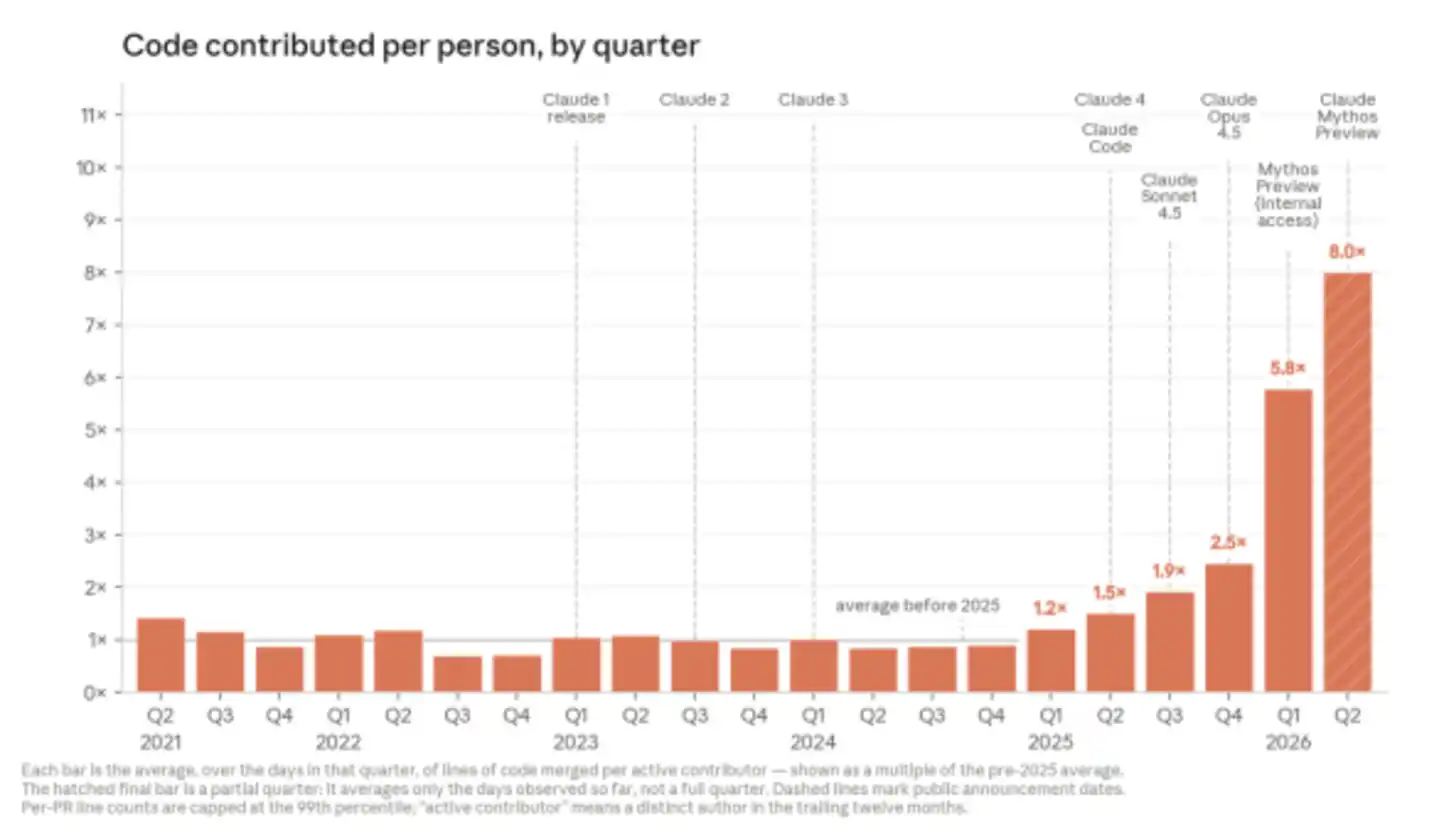
By the second quarter of 2026, according to Anthropic's statistics, the daily volume of code merged by engineers was about 8 times higher than in 2024.
More notable than the code volume is that Claude is handling more open-ended engineering problems.
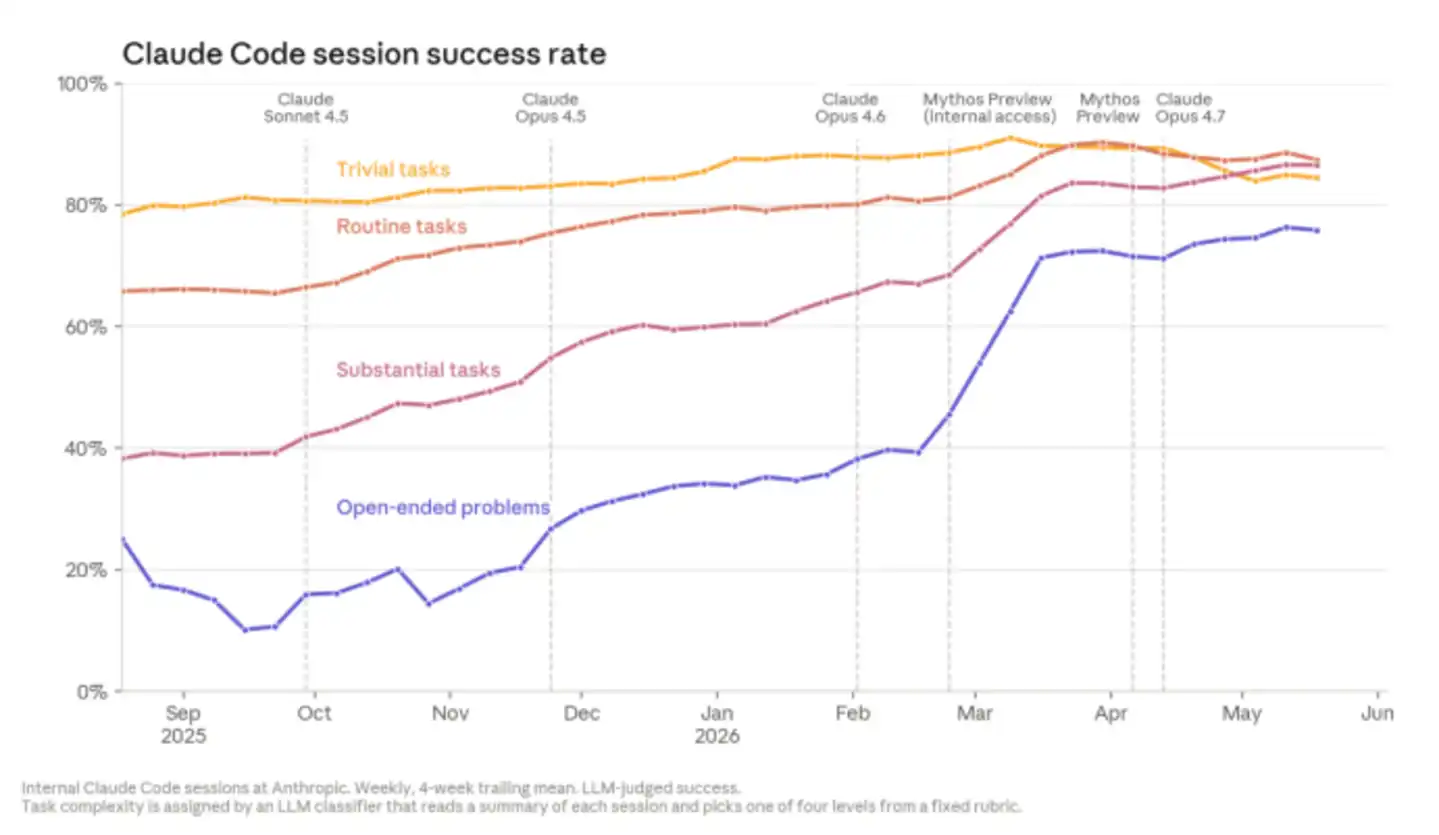
Anthropic stated in the article that over the past year, the frequency with which employees had to correct Claude, steer it back on track, or take over tasks mid-way has been steadily declining. This change is happening not only for simple tasks but also for the most complex, open-ended tasks.
So-called open-ended tasks are problems without clear instructions. For example, a system crash, a training task failure—issues where even engineers themselves don't know what the solution looks like initially and have to troubleshoot and make judgments on the fly.
These types of tasks historically relied most heavily on human experience. Yet, in those most open-ended tasks, Claude's success rate reached 76% by May 2026, a 50 percentage point increase within six months.
Not just writing code, Anthropic also uses Claude for code review—checking for bugs, security vulnerabilities, and other defects. Their retrospective analysis found that if every code change in the past had undergone automated review by Claude, approximately one-third of the bugs that caused incidents on claude.ai could have been caught before deployment.
Going a step further, Claude has begun to participate in the research process.
Anthropic has a standard test: give Claude code for training a small model and ask it to make the code run faster without altering the results. In May 2025, Claude Opus 4 could achieve about a 3x speedup; by April 2026, Claude Mythos Preview had pushed that number to approximately 52x.
Anthropic also mentioned an open-ended AI safety research case. They posed a question to a Claude-powered agent: Can a weaker model reliably supervise a stronger model?
This process involved proposing hypotheses, testing them, sharing findings with parallel agents, and iterating repeatedly.
Two human researchers spent a week bridging about 23% of the gap; Claude, with roughly 800 cumulative hours and about $18,000 in compute costs, bridged 97%.
This result certainly has limitations—the problem was chosen by humans, the scoring criteria were human-defined, and the findings haven't been fully migrated to production-scale models. But it still illustrates that Claude can now, within a research framework defined by humans, design experiments, execute them, and iterate on its own.
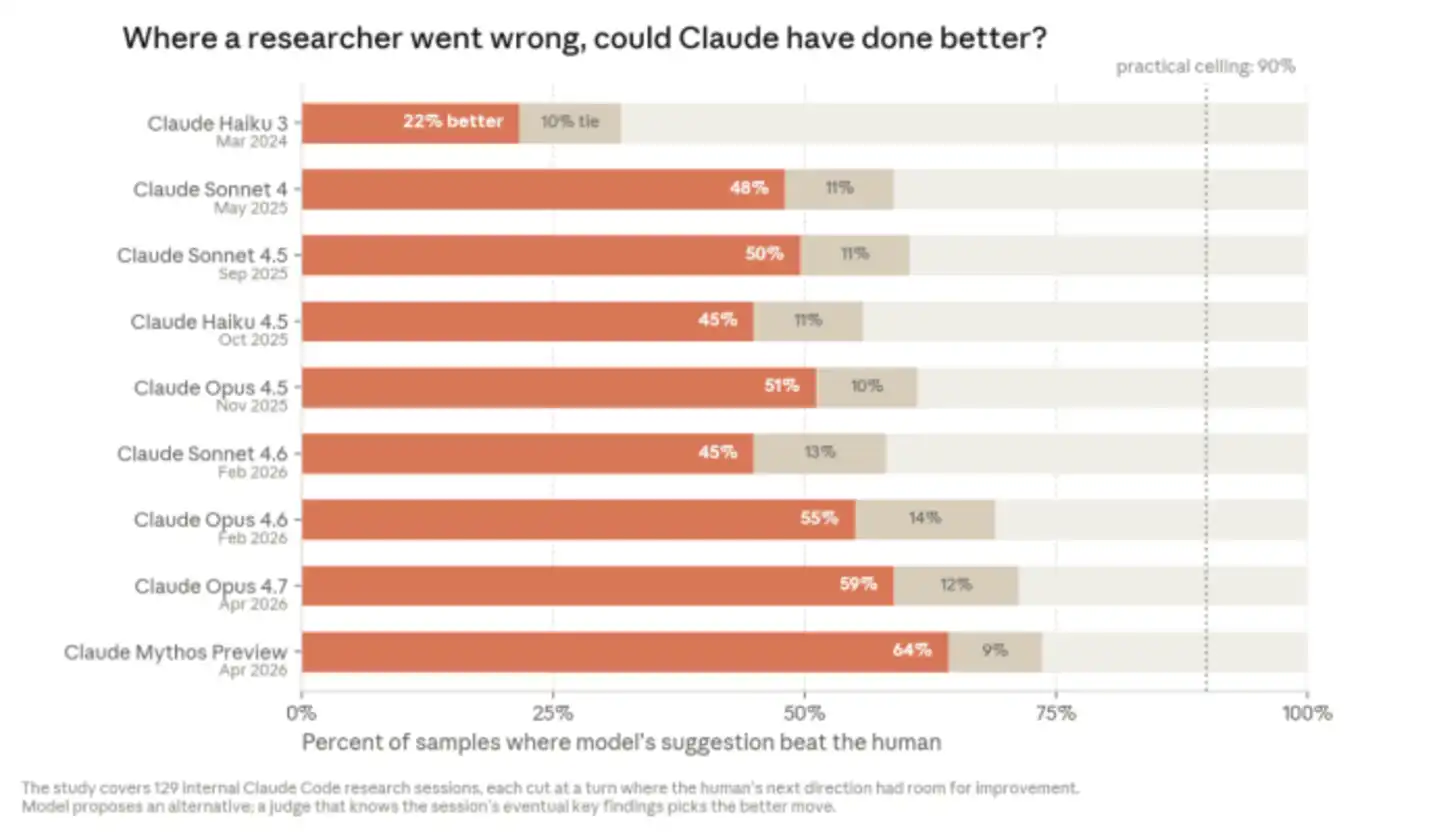
Furthermore, when human researchers "go down the wrong path," Claude can suggest a better next step.
Anthropic took 129 internal Claude Code research sessions where human researchers and Claude worked together on open-ended research problems. Anthropic identified points where "the human later proved to have taken a detour," gave the context up to that point to different versions of Claude, and asked it what it would suggest doing next. Then, another Claude judge, aware of the full session outcome, judged which was better: the model's suggestion or the human's choice at the time.
The results showed that at those points where the human researcher was later shown to have had room for improvement, Claude became increasingly able to propose a better next step.
In the past, AI model progress was primarily driven by human researchers and engineers. Humans decided what experiments to run, wrote the code, trained the models, and pushed forward AI's capabilities.
Now, more and more links in this chain are being taken over by Claude.
Anthropic presented a very intuitive stage diagram:
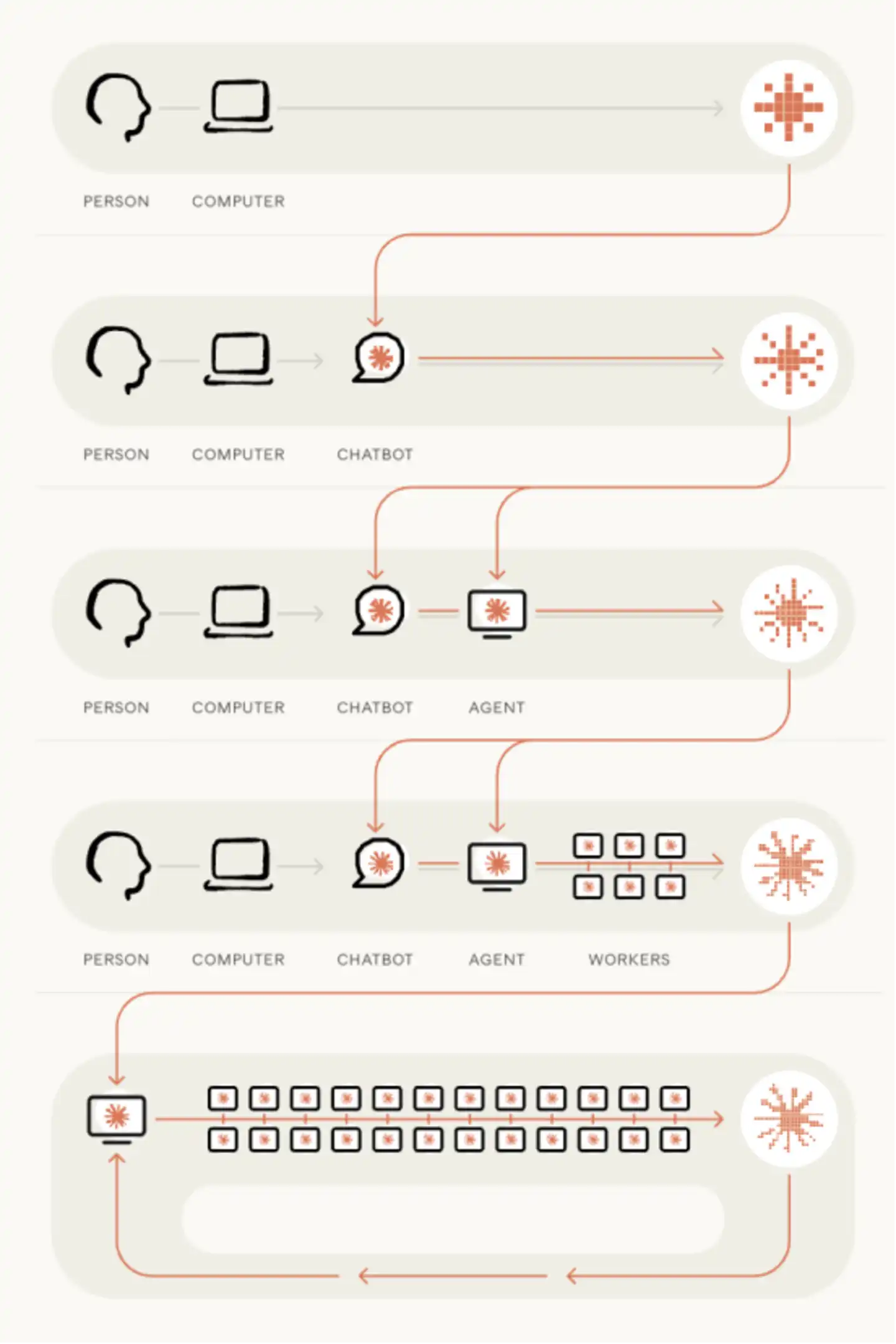
From 2021 to 2023, Anthropic was no different from a typical tech company—humans writing code and documentation on laptops.
From 2023 to 2025, chatbots began entering workflows. Engineers had models generate code snippets, then copied them into editors.
From 2025 to 2026, programming agents emerged. Claude began autonomously writing and modifying code, sometimes even completing entire files independently.
Today, agents can run code on their own and delegate hours-long work to other agents.
Looking ahead is the stage Anthropic is genuinely concerned about: the closed loop.
If this day arrives, subsequent versions of Claude might be continuously improved by Claude itself—this is recursive self-improvement.
Anthropic phrased it cautiously: we haven't reached that point yet, and recursive self-improvement isn't inevitable. But it still emphasizes that the path leading to that step is beginning to become visible.
That's why Anthropic discusses slowing down, even pausing, at the end of the article. Its meaning isn't that all AI companies should shut down immediately, but rather that if the risks of AI self-improvement continue to rise in the future, frontier labs need a coordinated, verifiable deceleration mechanism.
In other words, the "singularity" is approaching, and humanity must impose controls.
Unstoppable Claude
On the surface, this is a very forward-looking safety document. Anthropic is talking about recursive self-improvement, about AI potentially improving itself faster and faster, and about the need for human society to prepare deceleration and pause mechanisms in advance.
But placed in the context of Anthropic preparing for an IPO, this article takes on another layer of meaning.
In a way, Anthropic's recent moves resemble that annoyingly smug top student in class—it genuinely has the skills, but it's also quite pretentious.
What it wants to say isn't just "we have a very strong Claude"; a step beyond that, it wants to say "Claude is helping us build an even stronger Claude."
If Anthropic were merely selling a model or a tool, it would struggle to completely escape horizontal comparisons: Anthropic has Claude, OpenAI has GPT; Anthropic has Claude Code, OpenAI has Codex; Anthropic competes for enterprise clients, OpenAI competes for enterprise clients. The competition between the two companies is very tight, seeing who can tell the bigger story to the market.
It's worth noting that just three days ago, OpenAI wrote in a document about frontier AI governance:
"We are already seeing early signs of recursive self-improvement in today's systems: AI development itself is being accelerated by AI.
This will intensify competitive pressures among developers and nations, and create governance challenges that existing institutions are not equipped to handle."
Three days later, Anthropic says: The path for Claude towards recursive self-improvement is beginning to become visible.
If Claude develops as it hopes, this wouldn't be an ordinary product narrative—it would become a research and development flywheel.
Claude writes code, runs experiments, optimizes training processes, which in turn reduces incidents in Anthropic's own products… Once this system is up and running, Claude isn't just a product from Anthropic; it's a crucial production tool for Anthropic itself.
Users see the Claude product; enterprise customers buy Claude's capabilities. But what Anthropic truly wants the capital markets to notice is: Claude is already embedded in the underlying processes of frontier model development; it's been placed inside Anthropic's engine room.
Capital markets love flywheel stories, promising endless prosperity: A stronger Claude allows Anthropic's engineers to merge more code; more code enables faster product and infrastructure iteration; faster iteration allows researchers to run more experiments; more experiments in turn help the next generation of Claude become stronger. Once the next generation Claude is stronger, it continues to accelerate Anthropic's R&D.
Claude's iteration pace also supports this flywheel. Looking at public release timelines, from 2023 to early 2025, Claude's major model updates were mostly on a three-to-four month cycle. But with Claude 4, Anthropic's model updates have noticeably intensified.
Claude 4 was released in May 2025, Opus 4.1 in August, Sonnet 4.5 in September, Haiku 4.5 in October, Opus 4.5 in November.
In 2026, Opus 4.6 was released on February 5, Sonnet 4.6 on February 17, Opus 4.7 on April 15, and Opus 4.8 on May 28. The gap between Opus 4.7 and Opus 4.8 was only 42 days.
Anthropic, on the surface, is saying "this could be very dangerous, we need to prepare the brakes in advance," but it's simultaneously implying: "We've seen what happens when the accelerator is pressed."
The subtlety of the IPO narrative lies here. It describes the risks as significant while also elevating its own technological position.
Not every AI company is qualified to discuss recursive self-improvement. You first need to make the outside world believe your AI is already part of the AI R&D process to have the standing to say this might require global coordination.
OpenAI: How Could This Happen?
As mentioned earlier, just before Anthropic published this lengthy article, OpenAI had already put recursive self-improvement on the table.
But the two companies' narratives are quite different.
OpenAI's document, "Democratic Governance of Frontier AI," is a policy blueprint for Washington. It's concerned not with "how models get stronger," but with how to constrain frontier AI if it continues to surge ahead.
Most of the content in that report isn't suitable for detailed discussion here, but one key line stands out: OpenAI said that in today's systems, early signs of recursive self-improvement are already visible.
This line and Anthropic's lengthy article point in the same direction.
It's just that OpenAI talks about institutions, while Anthropic talks about itself.
OpenAI's point is: AI development is too fast; existing governance structures may not keep up, so a new set of rules is needed.
Anthropic directly showcases that system, telling the market: Claude is already in our R&D process, so we see the path to AI self-acceleration.
This move is quite clever. One imagines the grumbling inside OpenAI—this is practically idea theft! We were here first!
Just joking, but OpenAI really needs to step up its game and quickly bring GPT 5.6 to the table.