Earning Millions Per Day, Why Can't It Save PUMP's Bearish Downtrend?

Foresight NewsPubblicato 2026-07-15Pubblicato ultima volta 2026-07-15

Introduzione

Despite generating millions in daily revenue, the native token of Solana-based memecoin launchpad Pump.fun, PUMP, is struggling amidst a major token unlock and a bear market. On July 14, 2026, 8.25% of the total supply (825 billion tokens worth ~$131.35M) was unlocked for teams, advisors, and private investors, representing roughly 20% of the pre-unlock circulating supply. This event tests PUMP's core value mechanism: using 50% of net protocol fees to buy back and permanently burn tokens, a reduction from the initial 100% policy. While Pump.fun is one of Web3's most profitable applications, with ~$94.17k in average daily revenue over 90 days, the token's price has fallen significantly from its peak. Analysts point to the halved buyback pressure, ongoing legal challenges in the US labeling the platform an "illegal digital casino," and PUMP's inherent volatility and "casino gene" as key factors deterring institutional investment and weakening price support against the unlock sell-pressure. The token's long-term trajectory is seen as dependent not on this single unlock event, but on Pump.fun's ability to sustain its high revenue, which fuels the token's buyback-and-burn scarcity model.


Author: Ma He, Foresight News


On July 14, 2026, the native token PUMP of Pump.fun experienced its first large cliff unlock after TGE. According to cross-verification from Tokenomist, on-chain monitoring, and multiple data platforms, the theoretical maximum number of tokens unlocked on that day was 82.5 billion, accounting for 8.25% of the total supply (1 trillion tokens), valued at approximately $131.35 million (calculated at the price of about $0.00159 at the time), equivalent to about 20.23% of the circulating supply before the unlock.


This was the first unlock for two major allocation categories: team/advisors and private investors, with private investors unlocking 32.5 billion tokens, and the team and advisors unlocking 50 billion tokens.
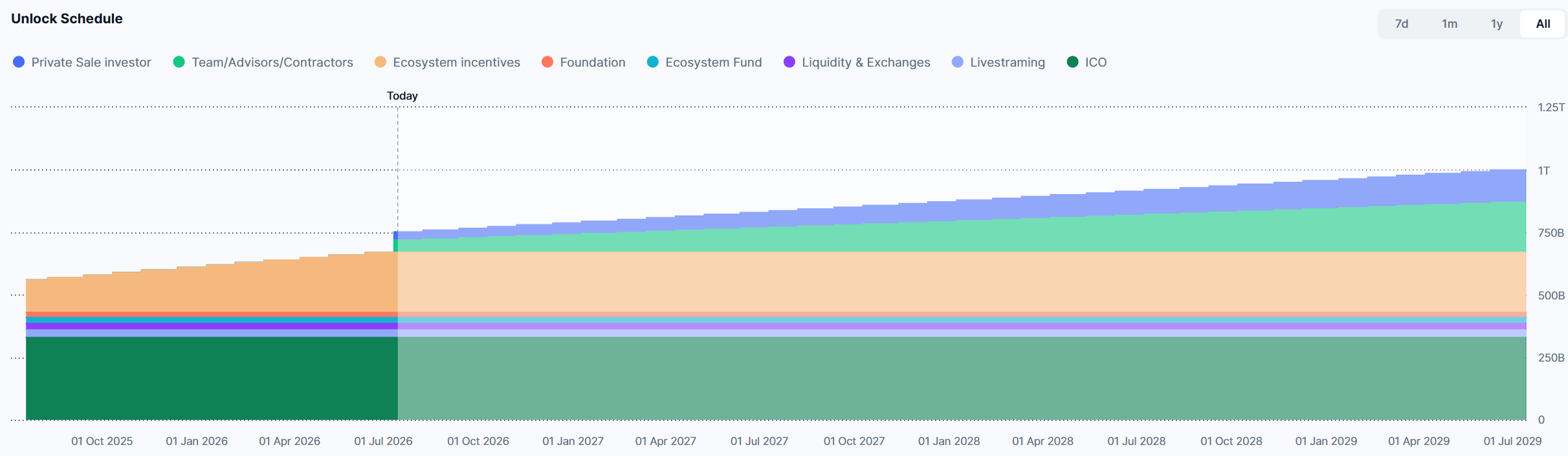


In the early hours of July 15, according to on-chain tracking data from Arkham, 57.279 billion tokens were unlocked and distributed to 121 wallets. PUMP's current market cap is approximately $650 million, with an FDV of about $1.6 billion.


Earning $20 Million Monthly, $940,000 Daily


This event occurred against the backdrop where Pump.fun has become one of the most profitable applications on Solana and even in the entire Web3 ecosystem. Over the past 30 days, the platform's protocol revenue reached $24.52 million (DefiLlama data), second only to Hyperliquid's $43.93 million and higher than Polymarket's $22 million. Cumulative revenue has exceeded $1.05 billion, with over 12 million tokens issued.


Even in a deep bear market environment, Pump.fun's weekly revenue currently remains around $5 million.
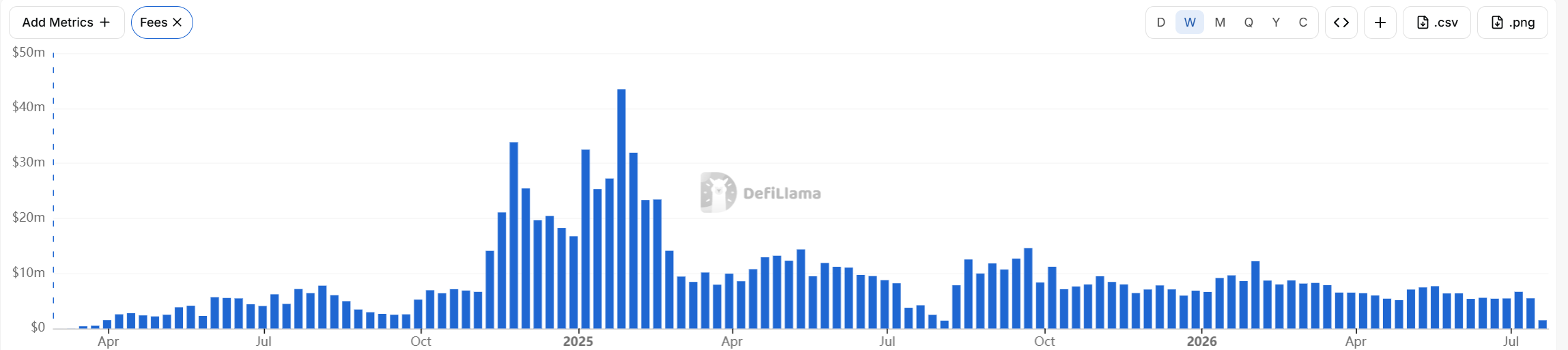


However, such substantial revenue does not seem to have created a positive cycle for its token price. PUMP has fallen from a peak of $0.008980 to around $0.001628, where it has been fluctuating.


What is the real issue?


The core value capture mechanism of Pump.fun is the use of protocol fees to buy back and permanently burn PUMP tokens. According to its official platform data, its annualized revenue currently stands at $343.71 million, with an average daily revenue of $941,700 over the past 90 days. The cumulative buyback and burn amount has reached $408.15 million, with the cumulative number of tokens burned accounting for 15.029% of the total supply.
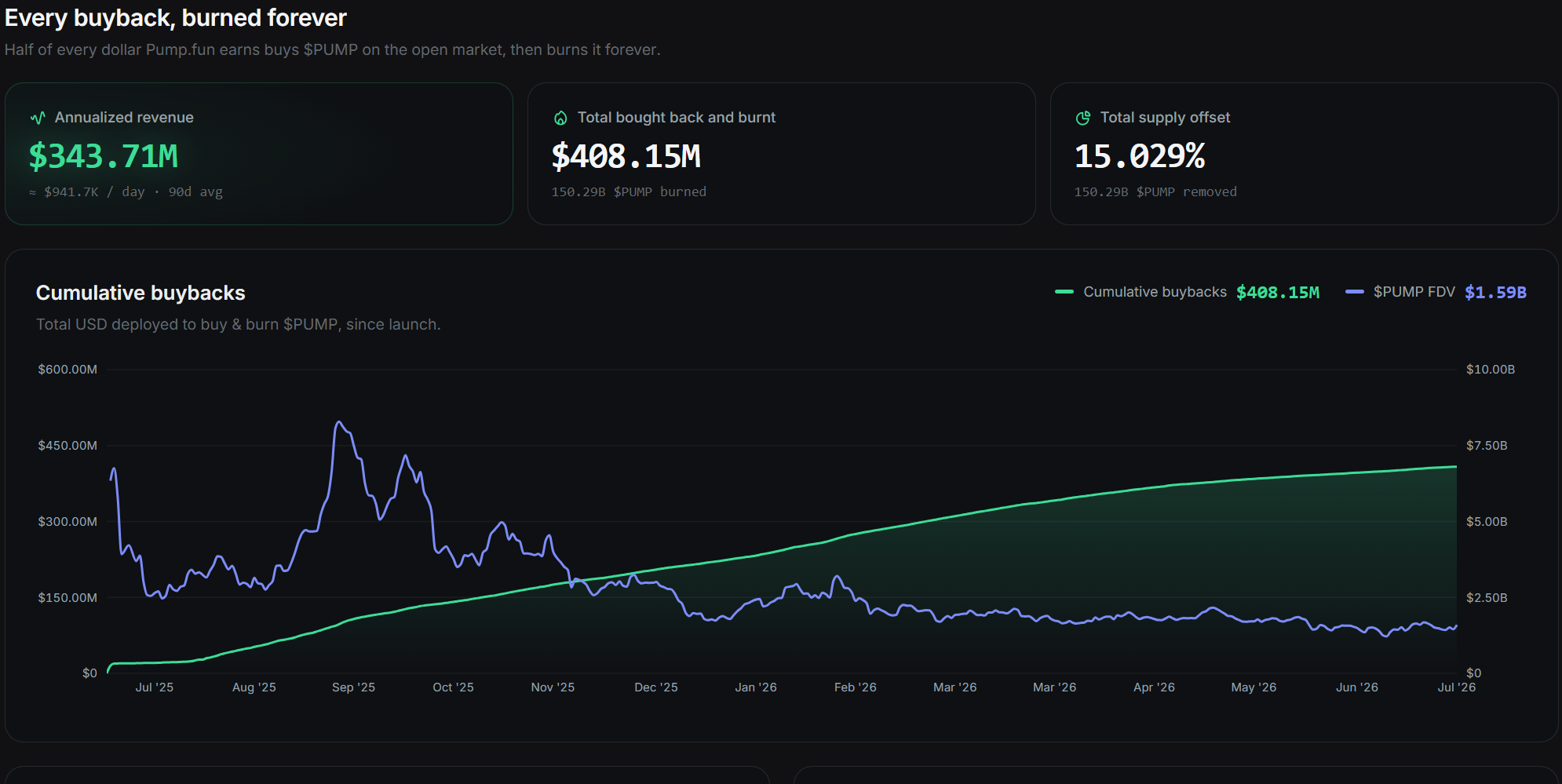


Pump started after its TGE in July 2025: Initially, 100% of net protocol fees (revenue from bonding curve, PumpSwap, Terminal cross-chain, etc., minus referral fees and cashback) were used to buy back and burn PUMP on the open market.


Adjusted on April 28, 2026: Switched to programmatically locking 50% of net revenue for buyback and burn, lasting one year; the other half is used for recruitment, marketing, and product development. All repurchased tokens are permanently burned, not locked. This constitutes PUMP's core flywheel, distinguishing it from most meme or platform tokens—the more profitable the platform, the scarcer the token supply.


However, the scale and duration of the buyback have sparked significant controversy. PUMP now allocates only 50% of net revenue for buyback and burn, a sharp reduction from the previous 100%, leading to a dramatic drop in buying support. Compared to HYPE, which uses nearly 99% of fees for buyback, and Lighter, which recently started using all revenue for buyback and burn, PUMP's buyback appears insufficient given a similar revenue scale, making it difficult to offset unlocking selling pressure, and consequently, the price remains weak.


Additionally, Pump.fun is currently facing a class-action lawsuit. U.S. plaintiffs have characterized it as an "illegal digital casino." Under such intense compliance pressure, cutting the buyback by 50% and reallocating significant funds to the treasury for hiring a "$5 million salary Chief Legal Officer" represents the team sacrificing the interests of secondary token holders to fund compliance costs for their own political risk mitigation.


Furthermore, after the one-year period ends, whether the buyback will continue remains a huge question mark.


A deeper reason lies in PUMP's "casino DNA." It is essentially a Meme launch platform, filled with PVP gambling and casino culture, characterized by extreme volatility, lowbrow narratives, and almost zero willingness from institutional funds to buy or HODL long-term. Compliance risks, reputational pressures, and a lack of real utility keep mainstream capital at bay. Relying solely on retail and speculative funds to support the price, any major unlock inevitably reveals weak liquidity and buying capacity.


Can the Market and Buyback Absorb the Massive Selling Pressure?


On-chain observations show that on the day of the unlock and the following day, some distribution wallets have already seen transfers. While this hasn't triggered a crash, short-term volatility and liquidity tests are inevitable. Moreover, PUMP's utility remains relatively weak (primarily for ecosystem incentives and potential governance). The market views it more as a "revenue-sharing certificate" rather than a strictly utility token, which amplifies sensitivity to selling pressure in a bearish market sentiment.


Compared to similar high-revenue protocols: Hyperliquid has higher monthly revenue but a market cap of nearly $15 billion (about 20+ times that of PUMP); Polymarket has similar revenue but hasn't issued a token, with a funding valuation already at the $15 billion level. The sustainable revenue capabilities of these two have been proven, while Pump.fun's revenue could sharply decline if the market turns bearish and meme coins wither.


However, this unlock is not a "one-time death sentence." The team and investors have a three-year vesting period, meaning tokens are not all sold immediately. Historical experience shows that some project teams and early investors may choose to hold or sell slowly to maintain reputation and long-term interests. Meanwhile, tokens unlocked for ecosystem incentives and the foundation can be used for growth rather than purely for selling pressure. Pump.fun has expanded from a single launchpad to include PumpSwap, multi-chain support, livestreaming, etc., forming a more complete ecosystem. As its native token, PUMP directly benefits from platform expansion.


The 82.5 billion token unlock is the real stress test for PUMP transitioning from the "100% buyback honeymoon phase" to a "sustainable but more restrained" stage. In the short term (weeks to 1-2 months), the struggle between selling pressure and buyback intensity will determine price volatility. If the market can absorb it well without liquidity drying up, it might even strengthen the narrative of high-revenue protocol tokens.


Long-term, what determines PUMP's fate is not a single unlock event, but whether Pump.fun can consistently generate revenue as a core infrastructure for the meme economy. As long as the revenue flywheel keeps turning, buybacks and burns will continue to compress supply. Conversely, any significant drop in revenue would make future unlocks a real burden.


Crypto di tendenza

Domande pertinenti

QDespite Pump.fun's high daily revenue, why is its native token PUMP struggling in the bear market?

APUMP is struggling due to a combination of factors: a recent massive token unlock (8.25% of total supply) creating significant sell pressure, a reduction in the protocol's revenue share used for buyback-and-burn from 100% to 50%, which weakened buy-side support, inherent "casino" characteristics and regulatory risks that deter institutional investment, and a relatively weak token utility primarily as a revenue-sharing certificate.

QWhat was the scale of the recent PUMP token unlock, and who received the tokens?

AOn July 14, 2026, a total of 825 billion PUMP tokens (8.25% of the total 1 trillion supply) were unlocked, valued at approximately $131.35 million. This consisted of 325 billion tokens for private sale investors and 500 billion tokens for the team and advisors. Chain data shows 572.79 billion tokens were distributed to 121 wallets.

QHow has Pump.fun's token buyback-and-burn mechanism changed, and what is the criticism?

AInitially, Pump.fun used 100% of its net protocol revenue to buy back and burn PUMP tokens. On April 28, 2026, this was changed to allocate only 50% of net revenue to programmatic buyback-and-burn for one year, with the other 50% going to treasury for hiring, marketing, and development. Critics argue this halving of buyback support is insufficient to counteract sell pressure from unlocks, especially when compared to protocols like Hyperliquid and Lighter that commit nearly all revenue to buybacks.

QWhat are the main compliance and reputation challenges facing Pump.fun and PUMP?

APump.fun is facing a class-action lawsuit in the U.S. where plaintiffs have labeled it an "illegal digital casino." This creates significant regulatory risk and reputational pressure. The platform's core business revolves around meme coin launches, which is associated with high volatility, speculative PVP trading, and "casino culture." This deters mainstream institutional capital, leaving the token reliant on retail and speculative funds, which are more fragile during sell-offs.

QWhat is the long-term key factor that will determine PUMP's price fate according to the article?

AThe long-term determinant of PUMP's price is not a single token unlock event, but whether Pump.fun can sustain its high revenue generation as a core infrastructure for the meme economy. As long as the revenue flywheel keeps turning, the ongoing buyback-and-burn will continuously reduce token supply. Conversely, any significant drop in platform revenue would make future token unlocks a much heavier burden on the price.

Letture associate

From Being Ignored to the Venture Capital Queen Investing: Has AI Revived This Ultra-Niche Sector?

From obscurity to receiving investment from the "queen of venture capital," AI has revitalized the ultra-niche social networking track. In recent years, the social networking sector experienced a deep freeze in venture capital, with high-profile projects like the video social app "Huayin" (founded by a former WeChat core team member) and the offline-online dating app "Single's Tavern" ultimately failing. These failures underscored the immense difficulty of challenging WeChat's dominance in熟人社交 (close-contact social networking) and the general lack of scalable monetization paths for niche concepts like metaverse, female-only, or Muslim community apps. However, a shift emerged in 2025. "Liangpei," an AI-powered matchmaking company, secured a $2 million angel round from Today Capital, led by renowned investor Xu Xin. Its approach uses AI conversational profiling to create detailed user matches and charges only upon successful connections. Similarly, projects like "Pixel Rhythm" (reportedly focused on AI-assisted content creation for Gen Z overseas) and "Moobius" (AI-native group chat) signal a new trend. The investment logic has fundamentally changed. Instead of pursuing broad, traffic-driven "platform dreams" to compete with giants like WeChat, Douyin, or Soul, the new wave focuses on using AI as a tool to solve specific, high-pain-point problems for targeted, niche user segments. The path to viability now lies in achieving healthy cash flow by solving a concrete problem rather than chasing massive scale.

marsbit42 min fa

From Being Ignored to the Venture Capital Queen Investing: Has AI Revived This Ultra-Niche Sector?

marsbit42 min fa

From TrueFi to Elara: Why the Next Stop for On-Chain Finance is Liquidity Infrastructure?

From TrueFi to Elara: Why On-Chain Finance's Next Stage is Liquidity Infrastructure? The article analyzes the evolving focus in decentralized finance, shifting from narrative-driven expansion to robust, operationally sound infrastructure. The author, drawing from experience at TrueFi and building Elara, argues that early DeFi incorrectly assumed technological superiority alone would force adoption. Instead, financial systems evolve through workflow compatibility. Traditional finance prioritizes stability and predictability, creating intentional "viscosity" (friction) through controls, which slows execution but ensures durability. Crypto-native systems minimized friction for rapid experimentation and iteration but often lacked operational safeguards, leading to reflexive liquidity that can disintegrate under stress. The core insight is that sustainable on-chain finance cannot rely solely on isolated products like RWA lending or token incentives. The real opportunity lies in a coordinated financial architecture for liquidity management, collateral coordination, and capital deployment. Elara is presented as an example of this next-generation "programmable treasury infrastructure"—a yield-bearing, dollar-pegged collateral asset designed for capital efficiency and operational flexibility within fragmented digital markets. A key architectural decision separates liquidity from yield generation, allowing the collateral to remain liquid and programmable while accruing value. The funding environment has also shifted. Investors now prioritize operational proof—working systems, integrations, and controls—over visionary narratives. Competitive advantage comes from building systems that endure under real market conditions, not just launching quickly. Ultimately, the path forward is not a sudden replacement of traditional finance but a selective hybridization. Lasting infrastructure will combine the iterative speed of digital assets with the control architecture of traditional finance. Systems like Elara are built to operate efficiently in today's low-viscosity crypto markets while embedding the operational discipline—compliance, reporting, risk management—required to eventually support institutional capital as it gradually integrates with on-chain settlement rails. The focus is not on who launches first, but on who can build infrastructure capable of managing both high-speed digital-native liquidity and the slower, more deliberate flow of institutional capital.

marsbit52 min fa

From TrueFi to Elara: Why the Next Stop for On-Chain Finance is Liquidity Infrastructure?

marsbit52 min fa

Trading

Spot

Articoli Popolari

Come comprare PUMP

Benvenuto in HTX.com! Abbiamo reso l'acquisto di Pump.fun (PUMP) semplice e conveniente. Segui la nostra guida passo passo per intraprendere il tuo viaggio nel mondo delle criptovalute.Step 1: Crea il tuo Account HTXUsa la tua email o numero di telefono per registrarti il tuo account gratuito su HTX. Vivi un'esperienza facile e sblocca tutte le funzionalità,Crea il mio accountStep 2: Vai in Acquista crypto e seleziona il tuo metodo di pagamentoCarta di credito/debito: utilizza la tua Visa o Mastercard per acquistare immediatamente Pump.funPUMP.Bilancio: Usa i fondi dal bilancio del tuo account HTX per fare trading senza problemi.Terze parti: abbiamo aggiunto metodi di pagamento molto utilizzati come Google Pay e Apple Pay per maggiore comodità.P2P: Fai trading direttamente con altri utenti HTX.Over-the-Counter (OTC): Offriamo servizi su misura e tassi di cambio competitivi per i trader.Step 3: Conserva Pump.fun (PUMP)Dopo aver acquistato Pump.fun (PUMP), conserva nel tuo account HTX. In alternativa, puoi inviare tramite trasferimento blockchain o scambiare per altre criptovalute.Step 4: Scambia Pump.fun (PUMP)Scambia facilmente Pump.fun (PUMP) nel mercato spot di HTX. Accedi al tuo account, seleziona la tua coppia di trading, esegui le tue operazioni e monitora in tempo reale. Offriamo un'esperienza user-friendly sia per chi ha appena iniziato che per i trader più esperti.

341 Totale visualizzazioniPubblicato il 2024.12.12Aggiornato il 2026.07.09

Come comprare PUMP

Discussioni

Benvenuto nella Community HTX. Qui puoi rimanere informato sugli ultimi sviluppi della piattaforma e accedere ad approfondimenti esperti sul mercato. Le opinioni degli utenti sul prezzo di PUMP PUMP sono presentate come di seguito.

活动图片