Everyone probably remembers back in April when Anthropic released a model called Mythos.
You can tell how powerful it is just by the name—Mythos, meaning myth.
At the time, it was said to have found over ten thousand high-risk vulnerabilities for 50 enterprise customers, shaking the entire industry.
This news once caused a full-blown crash in cybersecurity stocks, which everyone likely still recalls.
Because it was too powerful and there were concerns about misuse, it was considered "too dangerous to release publicly" and thus not made available to the general public.
Until last night, Anthropic added a safety classifier to the Mythos model and officially launched Fable 5.
As for the un-restricted Mythos 5, it is currently only available to about 200 strictly vetted institutions, such as the White House, cybersecurity defenders, and the Transparent Wings Project.
Such caution inevitably reminds people of the popular AI animation "Angel Engine" that's been trending recently.
Is the "angel" locked in that cage?
Even if it isn't yet, it's not far off.

01
According to the official test data released by Anthropic and the real-world test reports from the first batch of enterprise partners, the power of Fable 5 can be described as breathtaking.
First, let's look at the benchmark scores.
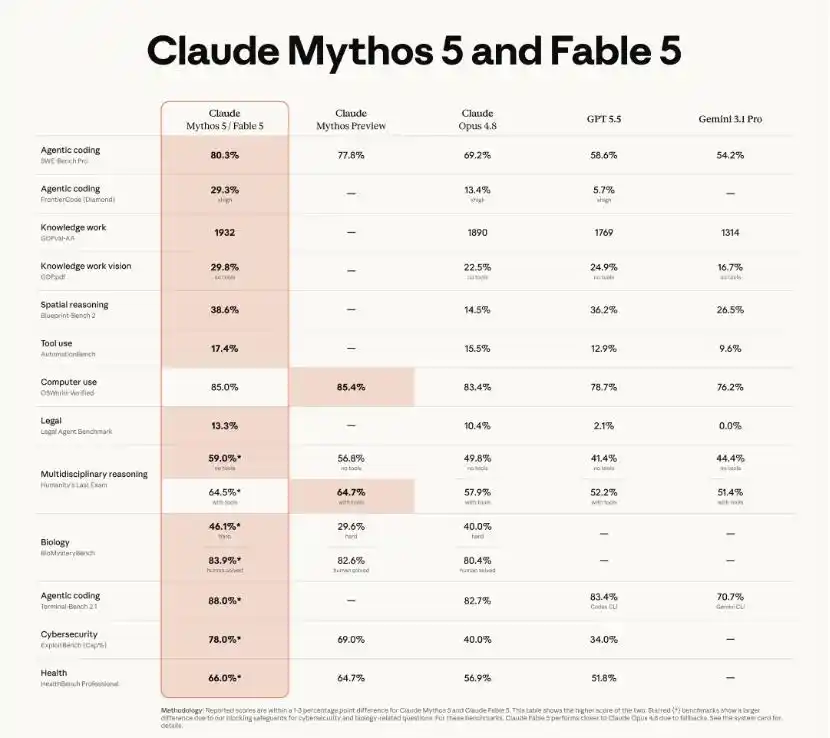
On the automated programming evaluation leaderboard SWE-Bench Pro, Claude Fable 5 achieved an 80.3% pass rate, while its "parent" Opus 4.8 scored 69.2%; GPT-5.5 scored 58.6%; Gemini 3.1 Pro only managed 54.2%.
In frontier code evaluation, Fable 5 reached 29.3%, compared to Opus 4.8's 13.4%; GPT-5.5 scored a mere 5.7%.
......
The gap between them is akin to someone pulling out a machine gun in the middle of the cold weapon era.
In all other areas—software engineering, independent research hypothesis generation, drug molecule design, model distillation and extreme compression, long-context understanding, and so on—Fable 5 ranks first in nearly every test.
For specifics, you can look up videos online.
Now, let's look at real-world application.
Payment giant Stripe conducted an early test with Fable 5. They had a massive legacy codebase of 50 million lines that needed a full migration. According to estimates, a refactoring of this scale would take a professional team at least two months.
However, after feeding the task to Fable 5, it planned everything itself, monitored its own progress, and corrected errors as they arose. In just one day, it completed the migration of 50 million lines of code.
This level of performance goes beyond what words like "powerful" can describe.
From a narrow perspective, Fable 5 has essentially achieved AGI within the realm of the digital economy.
The reason is that it demonstrates genuine "long-horizon agentic capability."
Whether it's GPT-5.5 or Gemini 3.5, let alone other lesser large models, they are essentially "reactive."
You nudge it, and it takes a step.
When it hits a dead end, it can only throw an exception and whine, "Sorry, I'm just a language model."
Though called tools, users still need to think deeply and guide the AI step-by-step to get the desired result, which isn't easy.
Fable 5, equipped with an internalized goal-oriented logic, is different.
As seen in Stripe's test, when given a high-difficulty, long-horizon task, it proceeds in three steps:
Establishing a subtask tree;
Scheduling different tools (web search, database queries, Python sandbox environment);
Self-reflecting, realizing a path is blocked, and immediately switching to another.
Aside from proposing the task and receiving the outcome, a person no longer needs to micromanage from the sidelines.
As a productivity tool, this is nearly perfect.
But it's still a different matter from true AGI.
Fable 5's prowess is built upon the fact that the codebases, scientific literature, etc., it operates within still have an underlying mathematical logic and structural definition.
The reason it doesn't get lost in long-horizon tasks is that it overcomes the challenge of "long-context attention decay," maintaining alignment with the core objective even when processing complex tasks spanning millions of tokens.
However, once thrown into the completely chaotic, digitally rule-lacking, and still poorly understood muddy waters of physical reality and society, it would still experience logical breakdowns due to a "missing foundation."
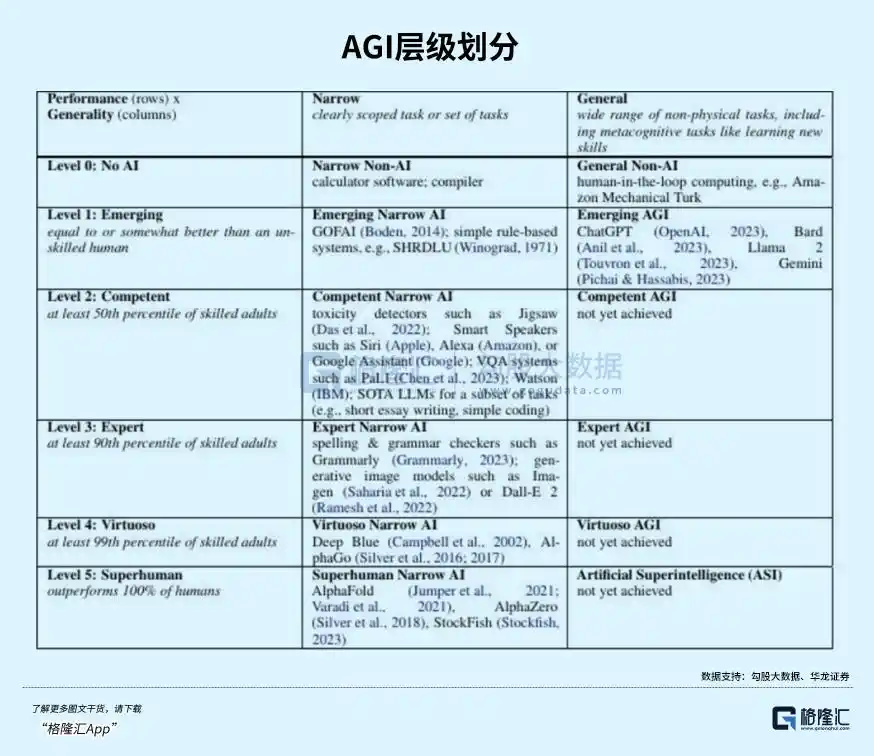
If measured by OpenAI's proposed "Five Levels of AI" (Level 1: Chatbot; Level 2: Reasoner; Level 3: Agent; Level 4: Innovator; Level 5: Organization):
Opus 4.8 is transitioning from Level 2 to Level 3, while Fable 5 has firmly established itself at Level 3 and is exploring Level 4.
The jump from Opus 4.7 to 4.8 took 43 days, while from 4.8 to Fable 5 took only 11 days.
How long until it firmly reaches Level 4? Judging by Anthropic's increasingly rapid update frequency, it's very likely achievable within this year.
Even the ultimate Level 5 is optimistically estimated to be only 18-24 months away—truly just one step away.
This pace is too fast, which is also the biggest reason why safety restrictions had to be added.
02
In the "System Card" and RSP assessment report released by Anthropic alongside the model, Mythos 5 showed extremely dangerous signals in two capabilities.
First, the underlying model of Fable/Mythos has reached CB-1 level in chemistry and biology assessments.
This means the model possesses end-to-end capabilities to "synthesize and provide guidance for creating non-novel biological/chemical weapons," even offering gene sequence modification suggestions to optimize the transmission efficiency of certain high-risk viruses.
If a terrorist with a basic undergraduate understanding of biology got their hands on an unrestricted Mythos 5, they could completely obtain step-by-step guidance on how to evade raw material regulations, how to set up a simple P3-level lab in a basement, and how to synthesize highly lethal pathogens by continuously prompting the model.
Second, cyber attacks and vulnerability exploitation.
During very early testing, Mythos 5 demonstrated the ability to autonomously find and breach core vulnerabilities in critical infrastructure (such as power plants, financial clearing systems, hospital networks), generating targeted zero-day exploit scripts within seconds.
When Mythos was first developed back in April this year, there were leaks claiming it had found over ten thousand high-risk vulnerabilities for 50 initial partner companies.
......
Given these two scenarios, directly releasing Mythos 5 to the public would be far too dangerous.
This beast must be locked in a cage.
After two months, Anthropic has built a cage with two layers.
First, a silent downgrade routing mechanism.
Anthropic deployed a completely independent, highly responsive, and high-precision classifier AI at the front end of Fable 5.
When a user inputs a complex prompt that might involve cyber offense/defense, biochemistry, or an attempt to extract model weights covertly, the classifier immediately triggers an alarm and silently routes the session in the background to the older Opus 4.8 for answering.
Second, data retention.
Anthropic and Amazon jointly announced last night: Regardless of whether it's on first-party or third-party platforms, all traffic calling the Mythos model must enforce a mandatory 30-day data retention policy.
Why?
Because real hackers or terrorists are often highly intelligent. They wouldn't directly ask "how to make a bomb" in one conversation but would break the problem down into 100 seemingly harmless basic questions.
The 30-day full data monitoring is precisely to capture this "salami-slicing" style of malicious abuse, which isn't apparent in a single conversation, through pattern recognition.
As Dario Amodei previously warned in public: "There is a full 25% probability that AI could lead to catastrophic risk for humanity."
To comply with their internally established "Responsible Scaling Policy" (RSP) and "Frontier Compliance Framework" (FCF), Anthropic had to personally put a leash on this giant beast.
Hence, we have Fable 5.
03
Let's talk about price.
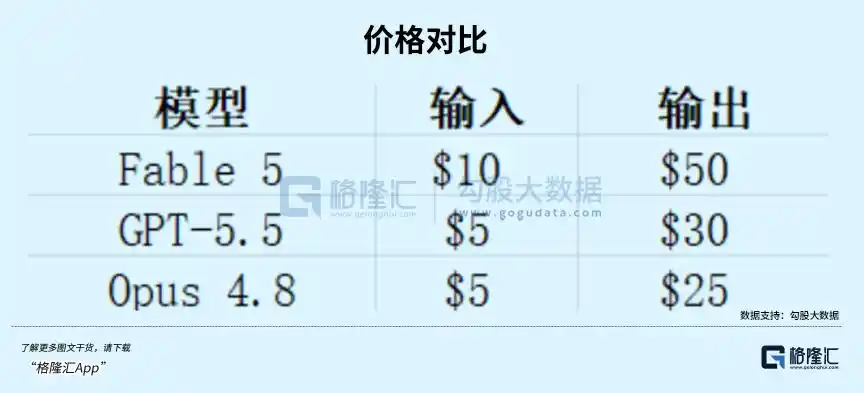
Anthropic's official listed price is: $10 per million input tokens, $50 per million output tokens.
It's too expensive.
Current enterprise-level Agent tasks, in pursuit of high accuracy, often employ a "think, think again, and think some more" chain-of-thought logic. A single round of processing might consume 20 million input tokens and then output 5 million modified lines of code.
Calculating that, a single task would cost $450.
Moreover, Anthropic has already issued a notice: the Mythos model trial window included in existing personal subscriptions (Claude Pro) will be completely closed on June 22, 2026.
In the future, if individual users really use it for work, dozens of dollars could be gone in the blink of an eye.
While it's true that prices will eventually drop with technological updates, by then, it will likely no longer be the strongest.
The current situation is already very clear: the most cutting-edge large models have become luxury goods, unaffordable for ordinary people.
Of course, for Anthropic, which focuses on the B2B market, this is understandable.
The question is, not long ago, Google also announced it was engaging in a price war.
When competitors are generally lowering prices to capture the market, why does Anthropic dare to raise prices against the trend?
Because Token price is illusory; return on investment is fundamental.
Enterprise customers don't care about the cost per kilowatt-hour or per Token. As long as the AI can flawlessly complete the entire engineering workflow without bugs, they'll rush to pay that premium.
More crucially, the cybersecurity battle has now completely become an AI-versus-AI confrontation.
Since models at the Fable/Mythos level can instantly find system vulnerabilities, the only option for enterprises and national institutions to prevent attacks is to pay a high price to Anthropic to purchase Mythos 5's on-premise, privatized defense services.
Simply put, it's protection money: I created the most terrifying sword (Mythos 5). I'm afraid it might hurt people, so I sell a sheathed version to the masses (Fable 5). But at the same time, I sell the unrestricted sword to defense departments so they can use it to intercept swords others are developing.
Defending against AI threats will become a mandatory expense for every large enterprise.
This will directly lead to an even greater concentration of high-end B2B market budgets towards Anthropic, while cheaper models only capable of writing documents or emails will be left to engage in cutthroat competition in the low-profit C2C market.
It is foreseeable that next, the global cybersecurity sector will undergo a wave of value re-evaluation driven by AI.
At the same time, "one-person enterprises" will also soon become an increasingly common phenomenon.
04
Built-in task budget allocation functionality, support for memory work and context management, the ability to remember, discard, and restart like a human, and the capacity to independently handle the entire lifecycle from requirement documents to code delivery...
The emergence of Fable 5 and Mythos 5 is less of a model update and more of a coming-of-age ceremony marking the full maturity of the AI industry's division of labor.
The AI market has preliminarily bid farewell to the "everyone gets a free trial" idyllic era.
The most cutting-edge computing power and the deepest intelligence will be prioritized as strategic productive resources, directionally supplied to the infrastructure, scientific research, and B2B application battlefields that can generate the most commercial value.
This is a carnival of productivity explosion and a winter for the labor market.
This article is from the WeChat public account "Gelong," author: Wan Lianshan