The Truth About the Neobanking Industry: Out of 368 Operating, Only 127 Hold Licenses. Behind the Funding Rounds Lie Countless Silent Deaths.

marsbitPubblicato 2026-07-29Pubblicato ultima volta 2026-07-29

Introduzione

"The Reality of Neobanking: Only 127 of 368 Operating Neobanks Have Full Licenses" by Francesco Andreoli, analyzed at neobankbeat.com, reveals the hidden structure and risks of the digital banking sector. While 368 verified neobanks serve ~1.46 billion users globally—with Asia (817M) and giants like WeBank (400M+) and Nubank (131M) leading—only 127 hold full banking licenses. This majority rely on rented infrastructure from BaaS providers, creating systemic risk where collapses (e.g., Wirecard, Synapse) leave customers unprotected compared to insured traditional banks. The industry's silent attrition is notable; firms disappear without notice. Geographically, momentum is shifting: 30% of post-2020 neobanks are web3-native (vs. 4% pre-2020). While AI is widely claimed, only 67 neobanks (18%) have verifiable, deployed AI models, with the most effective use often in emerging markets for credit scoring. The map shows 106 infrastructure providers supporting 368 consumer brands, indicating dangerous concentration. Two truths coexist: a revolutionary rise in financial access and a fragile foundation. Predictions include consolidation around licensing, potential AI lending failures in a downturn, and the next wave being infrastructure for AI agents, not humans.

Author: Francesco Andreoli, Consensys & MetaMask Developer Relations Lead

Compiled by: Jiahuan, ChainCatcher

Everyone is counting funding rounds, no one is counting funerals. So I counted both.

I started counting neobanks six months ago because I found no one could tell me exactly how many companies are in this industry. Analysts selling $4,000 PDFs don't know, the VCs putting money in don't know, the founders competing with each other don't know.

The answer, as of July 2026: 368 verified, still-operating neobanks. I track each one of them on neobankbeat.com, with all data open.

But the number that truly changed my view of this industry wasn't 368, but how many I had to delete to get there.
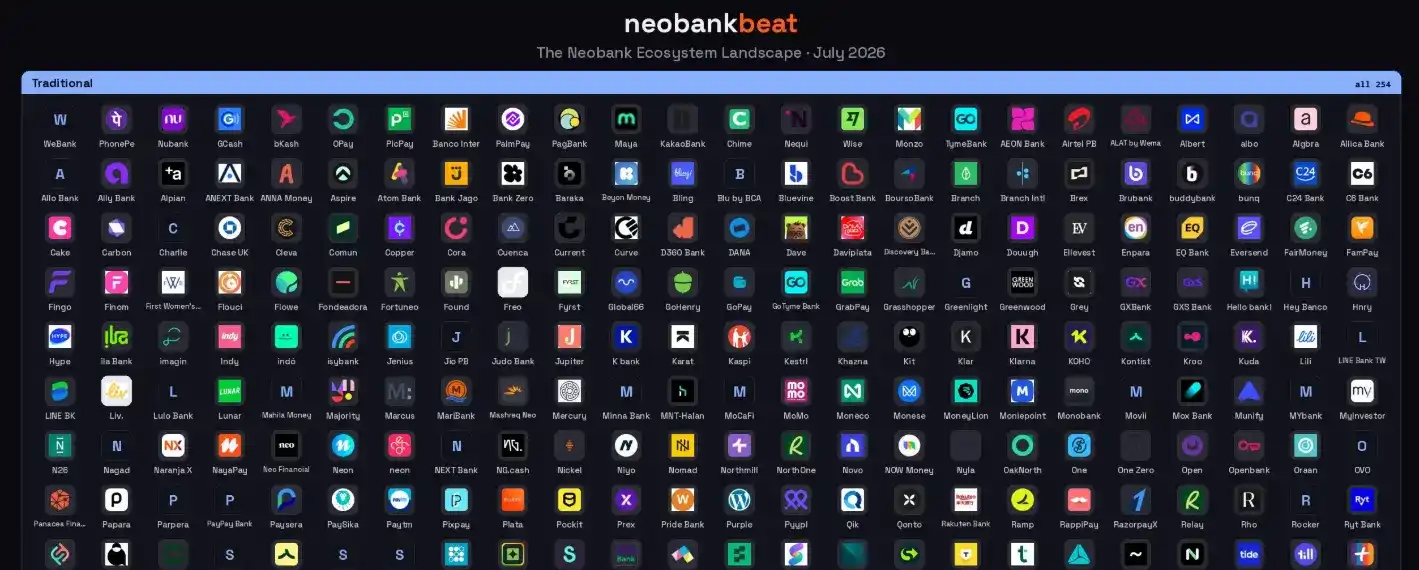
368 verified, still-operating neobanks

The rise is real. Let's start with that.

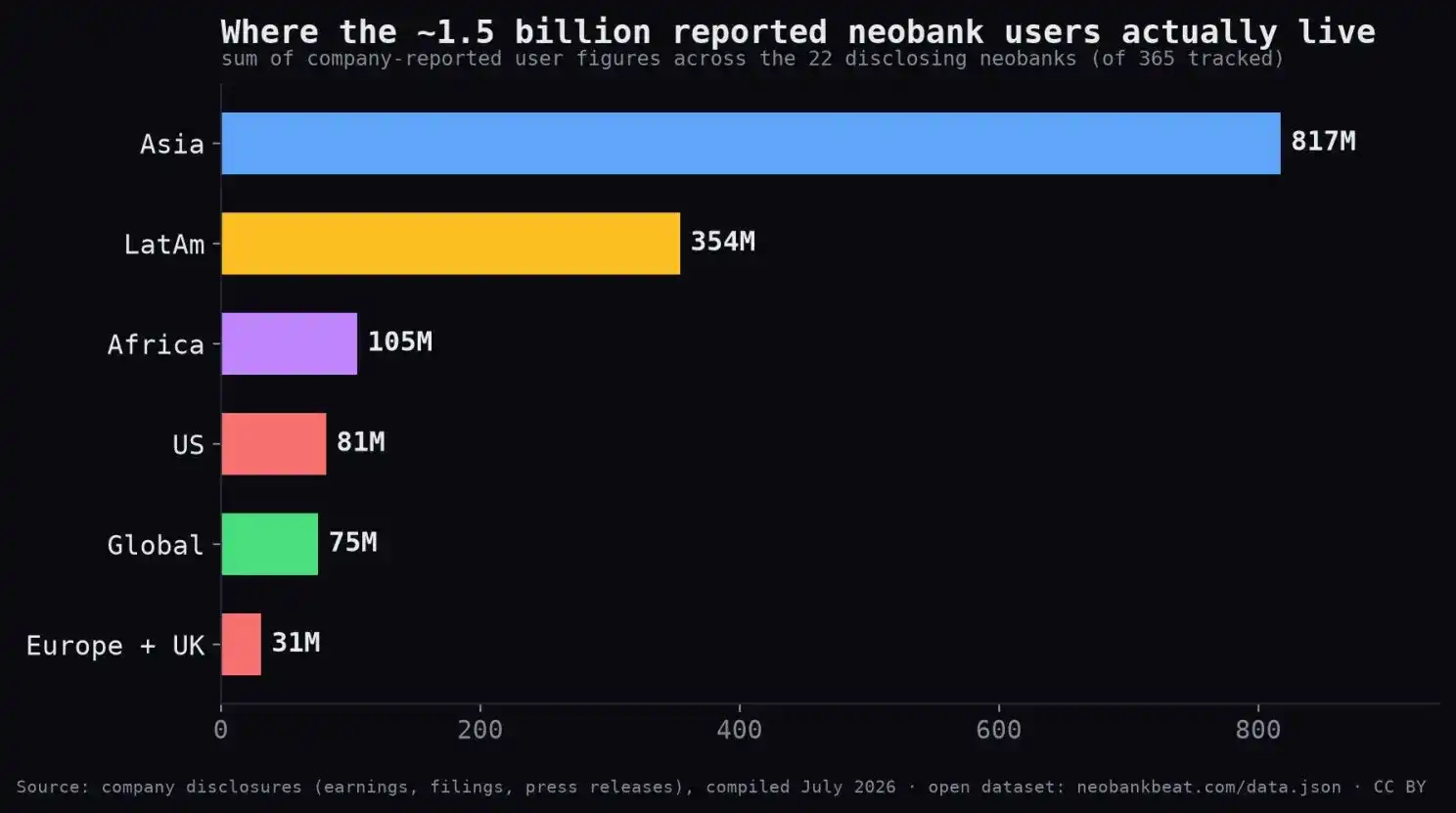
Summing up all the user numbers disclosed by the companies in the dataset, these neobanks we track serve approximately 1.46 billion people. This is not a forecast, nor a TAM chart figure, but the real reported client numbers.

And the geographical distribution will surprise anyone used to reading Western fintech media:

817 million of those users are in Asia. WeBank alone serves over 400 million people, more than all the neobanks in the US and Europe combined.

Nubank has 131 million customers, more than the total of all US neobanks.

Europe's champion, Revolut, has over 50 million users. That's impressive, but still a small fraction compared to the Asian numbers.
The marginal momentum of the industry is also shifting. Among neobanks founded and surviving since the 2020s, 30% are web3-native self-custody applications where user balances are not held by any company at all. Among the 2010s batch, this proportion is 4%. Whatever your thoughts on cryptocurrency, builders have voted with their feet.

So yes, the rise is real: 368 companies, three structurally distinct waves (254 traditional challenger banks, 58 fiat-crypto hybrid apps, 56 web3-native apps), underpinned by 106 infrastructure providers, backed by 219 investors. All mapped.

Now for the part no one puts in their pitch deck.

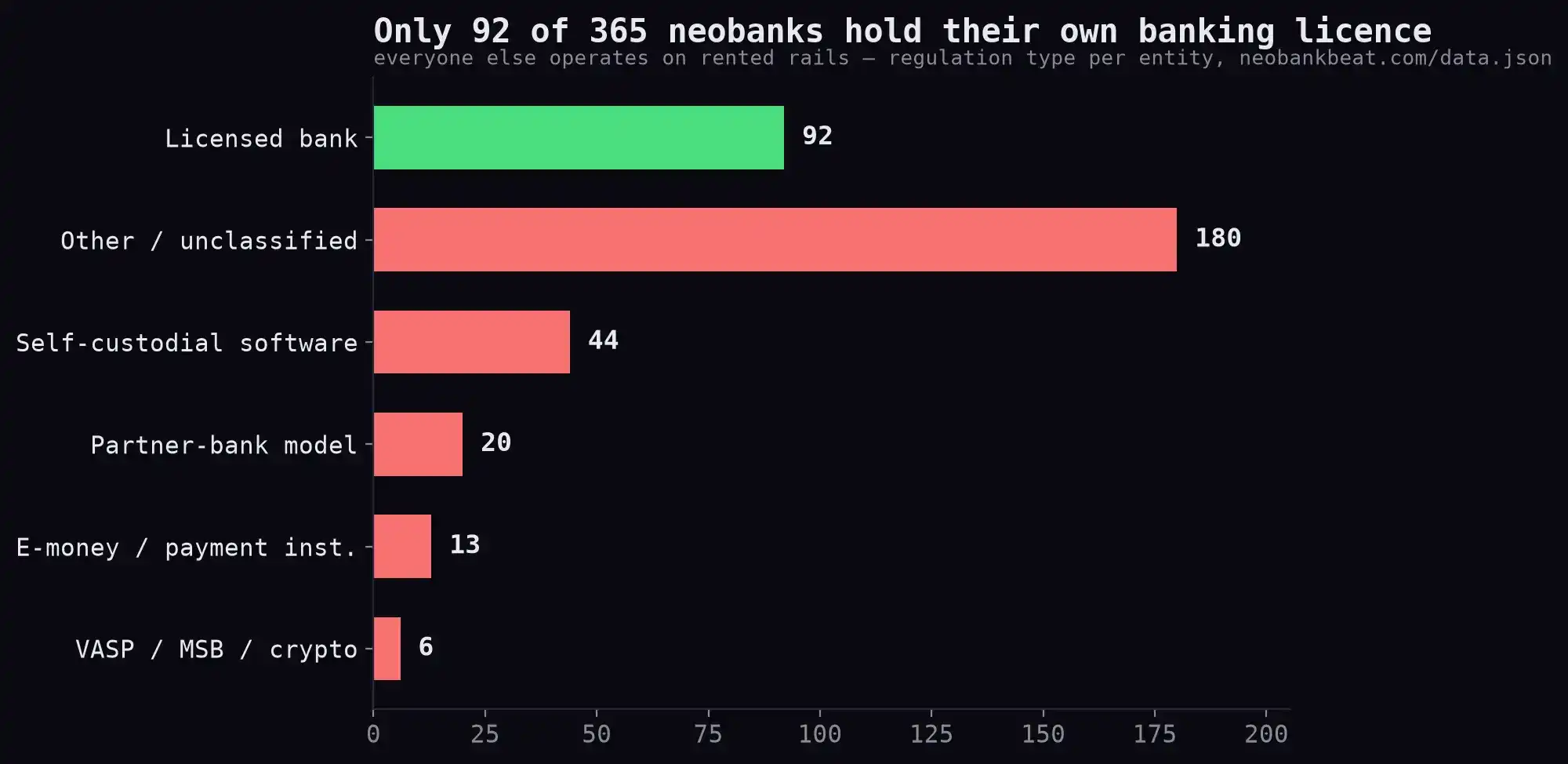
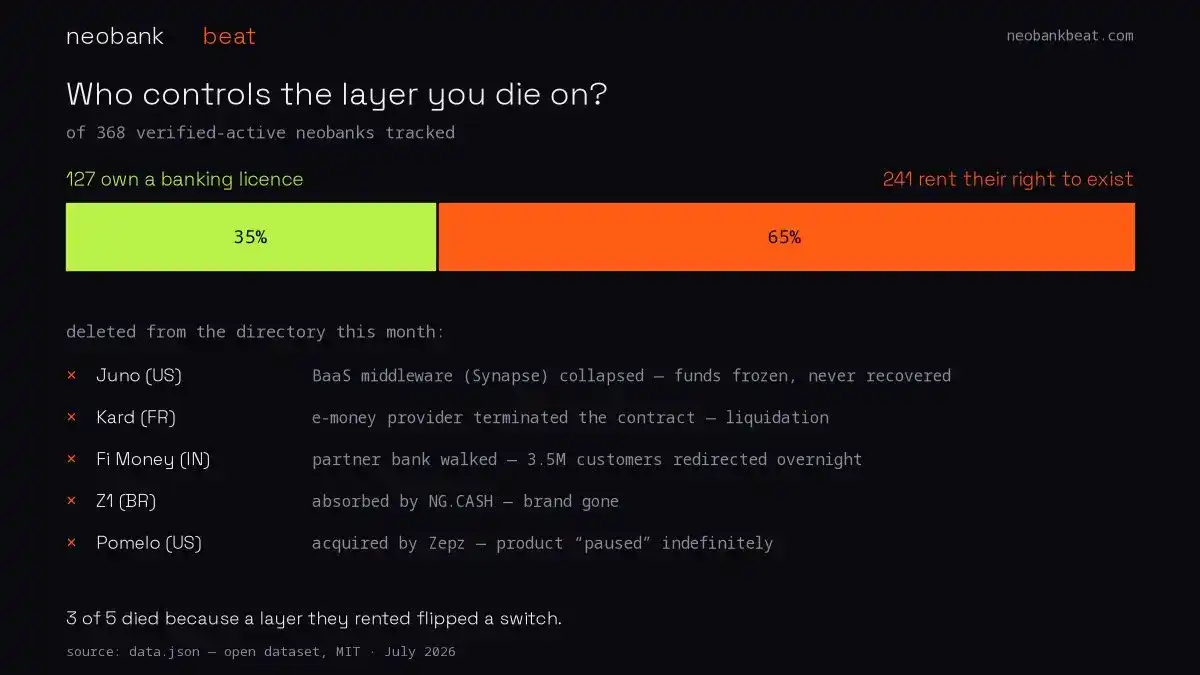
Only 127 out of the 368 hold full banking licenses.

Read that again. Two-thirds of the "banks" in your app store are not banks. Their right to exist is rented—from a sponsor bank, an e-money license, or some card issuer you've never heard of. And their customers almost never know which side of this line they are on.
Banking Licenses

This is not a technical detail; it's the core structural risk of the entire industry, and it comes with a body count:

WaveCrest, 2018: Visa revoked a card issuer's license, and dozens of crypto card projects died overnight.

Wirecard, 2020: A payment processor collapsed with a €1.9 billion hole. Funds for a whole cohort of European "banks" were frozen, their only fault being built on top of it.

Synapse, 2024: A BaaS middleman collapsed, and average Americans found out "FDIC-insured" didn't mean what they thought, because what failed was the ledger recording who owned what.

Ready, 2026: Same movie, different cast.

When a real bank fails, deposit insurance pays out. When a neobank's infrastructure fails, customers get a number in the bankruptcy queue.

The deaths in this industry are silent. That is the real scandal.

One thing I didn't anticipate after maintaining this dataset: the deletions never stop.
Who is in control?

Just this month, five entities vanished from the list—liquidated, absorbed, or quietly pivoted into something else. No press releases, no post-mortems. Neobanks don't die like FTX.

The app just stops updating, customer support stops responding, and one day the domain redirects to a partner's landing page. Hundreds of thousands of customers either migrate or simply evaporate.

No one writes obituaries for neobanks. Fintech media covers product launches and funding rounds because that's where the ad revenue and interview access are. So the graveyard remains invisible, and every new founder runs headlong into the same five traps, thinking they're the first to see them.

That's why we track exits as meticulously as entries. Failure data is more valuable than funding data. You learn nothing from press releases.

"But AI will solve the profitability model." Really?

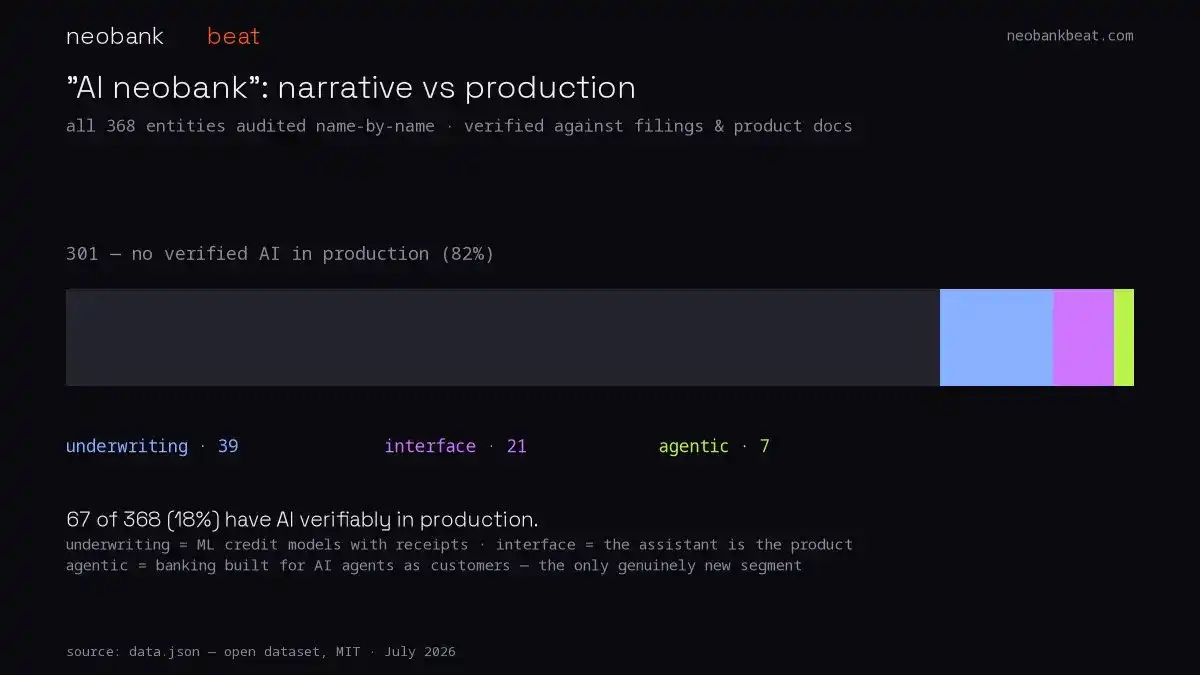
Now every neobank pitch deck mentions AI. So we reviewed all 368, checking against financial filings, regulatory disclosures, and evidence of actual deployment—not marketing pages.

67 passed. 18%. The remaining 300+ are either still piloting, "exploring," or presenting a partner's model as their own.
AI Neobanks?

The counterintuitive part: those doing AI best are often not the famous names, but emerging market lenders in Nigeria, the Philippines, Mexico, Bangladesh. Where credit bureaus are virtually non-existent, a model that can underwrite the unbanked isn't a nice-to-have feature—it's the entire reason the business can exist.

The West talks about AI banking. The Global South is actually building it because it has no other choice.

What This Map Actually Shows

Look at the infrastructure section on the map: 106 providers supporting 368 consumer-facing brands. Within this layer, a handful of sponsor banks, BaaS platforms, and card processors each carry dozens of logos on their shoulders. This concentration, invisible from the consumer side, is what breeds the next Synapse.

This is the most honest picture of the industry in 2026: a spectacular, world-changing rise where 1.5 billion people access banking through an app, many for the first time in their lives; all built on a critical layer most customers have never heard of, where two-thirds of the companies wouldn't survive one bad quarter from their landlord.

Both things are true. That's what makes it interesting.

Three Predictions I'm Willing to Admit I Could Be Wrong About

The license gap will narrow from both ends. Strong unlicensed players will acquire or obtain licenses. Weak ones will become 2027 deletions. The middle ground will disappear.

The first AI underwriting blowup will happen within two credit cycles. Most of those 67 deployed models have not experienced a real downturn in their current form. Some are about to learn what their training data was missing.

The next wave's customers are not human. Banking infrastructure serving AI agents—including agent-operated wallets, agent-issued cards, machine-to-machine payments—has only 7 companies working on it today. It looks like web3-native in 2021: tiny, weird, and structural.

Domande pertinenti

QAccording to the article, what are the structural risks facing the neobanking industry related to banking licenses?

AThe article states that of the 368 operational neobanks, only 127 hold a full banking license. This means nearly two-thirds of them operate on 'rented' permission from a partner bank, e-money license, or card issuer. This creates a core structural risk: if these underlying infrastructure providers fail, the neobank clients are exposed. Their funds are not directly protected by deposit insurance like in a real bank failure, but instead become claimants in a bankruptcy process, as seen in cases like WaveCrest, Wirecard, and Synapse.

QHow does the geographical distribution of neobank users challenge the typical Western-centric financial tech narrative?

AThe geographical distribution is heavily skewed towards Asia and Latin America. The data shows that these neobanks serve approximately 1.46 billion users collectively. Of these, 817 million are in Asia. For example, WeBank (China) alone serves over 400 million, which is more than all neobanks in the US and Europe combined. Brazil's Nubank has 131 million customers, more than the total for all US neobanks. While Europe's Revolut has an impressive 50+ million users, it's a fraction of the scale seen in other regions.

QWhat does the article reveal about the state of AI implementation in neobanks versus the common perception?

AWhile AI is mentioned in nearly every neobank's business plan, the article's audit found that only 67 out of 368 (18%) have verifiable, live AI implementations based on financial reports and regulatory disclosures. The remaining 300+ are in pilot, exploration phases, or marketing partner solutions as their own. Ironically, the most effective AI implementations are often in emerging market lenders (e.g., in Nigeria, Philippines, Mexico, Bangladesh) where it's essential for credit scoring in the absence of traditional征信 systems, not just an added feature.

QWhat is the 'silent death' phenomenon in the neobank industry, and why is it significant?

AThe 'silent death' refers to the way many neobanks fail without public notice, post-mortems, or press coverage. They simply stop updating their apps, customer service becomes unresponsive, and eventually their domain redirects elsewhere. The article notes that five entities were removed from the tracking list in just one month. This is significant because the lack of visibility into failures means new founders repeatedly make the same mistakes, and the industry's mortality rate and associated risks remain largely hidden from public and investor view.

QWhat critical concentration risk exists within the neobanking infrastructure layer, according to the author's data?

AThe data reveals a high concentration risk in the infrastructure layer. There are 106 infrastructure providers (like Banking-as-a-Service platforms, card processors, and partner banks) supporting the 368 consumer-facing neobank brands. This means a small number of critical providers are responsible for the operational backbone of dozens of neobanks. This invisible concentration creates systemic risk, where a single point of failure at one provider (like Synapse in 2024) can simultaneously doom multiple consumer brands built on top of it.

Letture associate

Virtuals Launches Hyperboost: Extends 14 Days of Rewards for Each Graduated Token to Combat 'Peak on Day One' Curse

Virtuals Protocol launched "Hyperboost" on July 27, 2026, to combat the "first-day peak" trend where over 75% of its AI Agent tokens see trading volume peak within 24 hours of graduation (launch to Uniswap). The mechanism automatically allocates a fraction of each token's previously idle graduation supply into a 14-day reward pool. Rewards are distributed daily, split between users based on trading volume share and creators for content posted about the token on platforms like X. Claims are immediate with no vesting. Early data from the first ~48 hours shows newly graduated tokens like AMARA and MAGE still experiencing significant post-graduation price declines (-78% and -55% in 24h respectively), indicating it's too early to judge effectiveness. Community concerns focus on potential wash trading due to volume-based rewards and a lack of transparency around content reward criteria. Hyperboost is part of Virtuals' broader ecosystem, which has over 18,000 AI Agent tokens and $750M+ in protocol revenue. While the feature could theoretically boost activity for its native VIRTUAL token by increasing trading volume in its paired pools, VIRTUAL's price remains influenced by broader market trends, down 7.4% over the past week. Observers note that several weeks of data will be needed to properly assess the mechanism's impact on sustaining post-graduation trading activity.

marsbit14 min fa

Virtuals Launches Hyperboost: Extends 14 Days of Rewards for Each Graduated Token to Combat 'Peak on Day One' Curse

marsbit14 min fa

Kevin Warsch's Fed Decision Nears: Here's Why TD Securities Thinks the Dollar Could Still Fall

The upcoming Federal Reserve decision under Chair Kevin Warsh is widely expected to result in no change to interest rates for the fifth consecutive meeting, with market-implied probability at 95-98%. Bitcoin has already reacted to this uncertainty, briefly dropping before stabilizing near $63,660, extending its July losses. TD Securities argues that despite this consensus, markets are still mispricing the risk of a rate hike. The bank contends that the dollar is poised to fall once the Fed confirms a hold, as current pricing reflects an exaggerated probability of tightening driven by geopolitical risk premiums, not likely Fed action. This potential mispricing represents one of the largest gaps between market expectations and actual Fed policy in a decade. Post-decision, TD forecasts further dollar weakening, expecting a roughly 2% decline by late 2026, as the Fed is seen maintaining rates absent clear evidence of sustained inflation and labor market strength. For Bitcoin, the Fed's tone is critical. A hold accompanied by dovish signals, strong AI investment forecasts, and positive upcoming PCE inflation data could support a move toward $68,000-$70,000. Conversely, unexpectedly hawkish communication risks pushing prices back toward the $58,000-$60,000 range. A weaker dollar, as predicted by TD, could also provide a supportive backdrop for Bitcoin and other risk assets.

cryptonews.ru19 min fa

Kevin Warsch's Fed Decision Nears: Here's Why TD Securities Thinks the Dollar Could Still Fall

cryptonews.ru19 min fa

What Happens When Two Miners Find a Block in the Same Second? How the 'Orphan Race' Unfolds

Bitcoin mining is a race without a real-time referee. A newly mined block must physically propagate across the global peer-to-peer network before consensus is reached on the chain's tip. This takes seconds, sometimes longer on congested connections. If a second miner finds a valid block before learning of a competing one, they build on their last-known version and broadcast their own block. For a short time, two equally valid blocks exist at the same height, creating a temporary chain split. The network resolves this not by voting or timestamps, but by Proof-of-Work: the chain that accumulates the most work becomes canonical. Blocks on the losing side are "orphaned" or "stale." Their miners lose the block reward and fees, though unconfirmed transactions return to the mempool. Usually, a single subsequent block resolves the tie. A notable two-block reorganization occurred on March 24, 2026. Antpool and Foundry USA mined competing versions of block 941,881 seconds apart. ViaBTC extended Antpool's chain, while Foundry extended its own, creating a one-block split. Foundry then pulled ahead by mining six consecutive blocks, making its chain the heaviest. All nodes switched to Foundry's chain, orphaning blocks from Antpool and ViaBTC. While such multi-block reorganizations are rare, the underlying race condition is common. Analysis shows about 9.2% of block intervals in a sample period were under 60 seconds, each representing a potential short-lived race. Fast relay networks have reduced propagation delays, making prolonged splits rarer. However, the event highlighted a trend of hash rate concentration, where well-resourced pools have a higher chance of winning any specific race and mining consecutive blocks, marginalizing smaller miners.

cryptonews.ru29 min fa

What Happens When Two Miners Find a Block in the Same Second? How the 'Orphan Race' Unfolds

cryptonews.ru29 min fa

Trading

Spot
活动图片