How Likely is it for TradeXYZ to Go Solo from Hyperliquid?

marsbitPubblicato 2026-08-03Pubblicato ultima volta 2026-08-03

Introduzione

The article analyzes the possibility of TradeXYZ, a dominant project on Hyperliquid's HIP-3 real-world asset (RWA) perpetual contracts market, splitting off to build its own independent trading platform. With TradeXYZ commanding over 90% of HIP-3 volume and over 35% of Hyperliquid's total open interest, its leverage and influence are significant. The primary motive for a split is seen as capturing the underlying protocol fees, of which TradeXYZ currently receives only half. However, several factors strongly discourage such a move. First, replicating Hyperliquid's high-performance infrastructure would be challenging and could degrade TradeXYZ's product quality. Second, Hyperliquid serves as a crucial distribution channel, with most users accessing TradeXYZ's liquidity through its frontend. Third, the close, trusting relationship between the founders of both projects makes a hostile "betrayal" unlikely. The conclusion is that a split would likely result in a lose-lose scenario. Hyperliquid would lose its main growth narrative and see its valuation impacted, while TradeXYZ would face immense technical hurdles, lose its primary user channel, and damage its reputation. Instead of a full separation, the more probable path is for TradeXYZ to negotiate better terms while deepening integration, focusing on enhancing its own brand and user ownership.

Author | Golem, Odaily Planet Daily

As TradeXYZ's business scale continues to expand, and it consistently occupies over 90% of the Hyperliquid HIP-3 market share, recent community discussions about the possibility of TradeXYZ breaking away from Hyperliquid to independently build its own trading platform have been intensifying.

Former Messari researcher Sam posted on the X platform, stating that as an investor bullish on HYPE due to the explosion of the RWA perpetual contract market, one should ask themselves three questions: First, if TradeXYZ leaves Hyperliquid and launches its own exchange, where will users go to trade; Second, what impact would TradeXYZ launching its own stock/token have on HYPE's valuation; Third, how high is the probability of the above two scenarios actually happening.

This post garnered over 470,000 views in just a few days. The reason for the rapid rise in discussion around this question is essentially that more and more market participants are beginning to realize that within the cooperative relationship between TradeXYZ and Hyperliquid, the value contribution of both parties is changing, with TradeXYZ gradually accumulating stronger market influence and bargaining power compared to Hyperliquid.

In business collaborations, once one party gradually gains more resources and market voice, and the distribution of benefits between the two becomes significantly skewed, "betrayal" often occurs.

A recent example comes from the AI industry. Cursor was once the largest programming AI Coding tool on the market, built on the underlying Claude model from Anthropic. They were a "golden duo" in terms of cooperation, until Anthropic made a betrayal—launching Claude Code, a direct competitor to Cursor. By mid-2026, Claude Code's ARR officially surpassed Cursor's, pushing it off the table.

The blockchain industry also has similar examples. When a single product becomes large, it often breaks away from its original infrastructure to build its own chain ecosystem, such as Uniswap, dYdX, etc. This cycle's hottest project, Polymarket, has also been rumored multiple times to be leaving the existing Polygon infrastructure to build independent infrastructure.

Returning to the current question, how likely is it for TradeXYZ to leave Hyperliquid and go its own way? If this situation were to actually happen, what impact would it have on both Hyperliquid and TradeXYZ? Odaily Planet Daily will provide a brief analysis in this article.

Is Going Solo Inevitable?

A phenomenon exists in the blockchain industry where projects start and grow on a public chain or infrastructure, and then later choose to build their own independent infrastructure (L2 or independent L1) for reasons of performance, control, underlying fee capture, or a bigger narrative for financing. TradeXYZ has indeed grown large enough now.

According to flowscan data, as of now, the total trading volume on Hyperliquid HIP-3 exceeds $469.62 billion, with TradeXYZ contributing over $437.4 billion, accounting for 93%; as of the time of writing, the total open interest (OI) on Hyperliquid HIP-3 reached $3.9 billion, with TradeXYZ contributing over $3.8 billion, accounting for 99.7%.
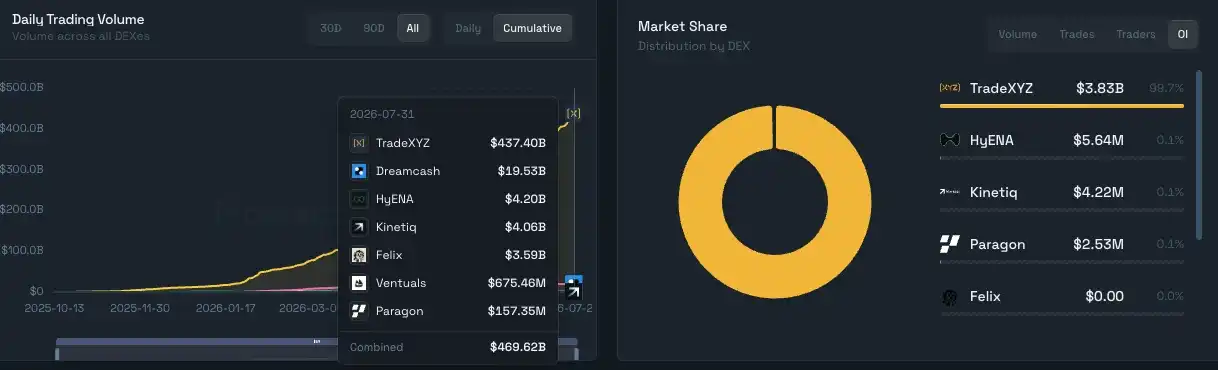
Total Hyperliquid HIP-3 Trading Volume and TradeXYZ's Share

The combined market share of the remaining trading platforms doesn't even reach 10%. The HIP-3 market has formed a massive Matthew Effect. Looking at it this way, it's not an exaggeration to say that the Hyperliquid HIP-3 market is completely dominated by TradeXYZ. The narrative premium that RWA on-chain contracts development has brought to Hyperliquid is, in essence, the narrative premium that TradeXYZ has brought to Hyperliquid.

Whether from a valuation or protocol revenue perspective, TradeXYZ has long been far from optional for Hyperliquid. Instead, it plays a crucial role in carrying the banner in the current situation where the crypto market is sluggish and trading volume for crypto derivatives like Bitcoin is shrinking.

According to official data, the HIP-3 share of Hyperliquid's total trading volume has reached 71.92%, setting a new historical high. Based on TradeXYZ's dominant position in HIP-3, this means that TradeXYZ's contributed trading volume accounts for over 70% of Hyperliquid's total trading volume; the HIP-3 share of Hyperliquid's total OI reaches 36%, which similarly means that TradeXYZ's contributed OI accounts for over 35% of Hyperliquid's total OI.
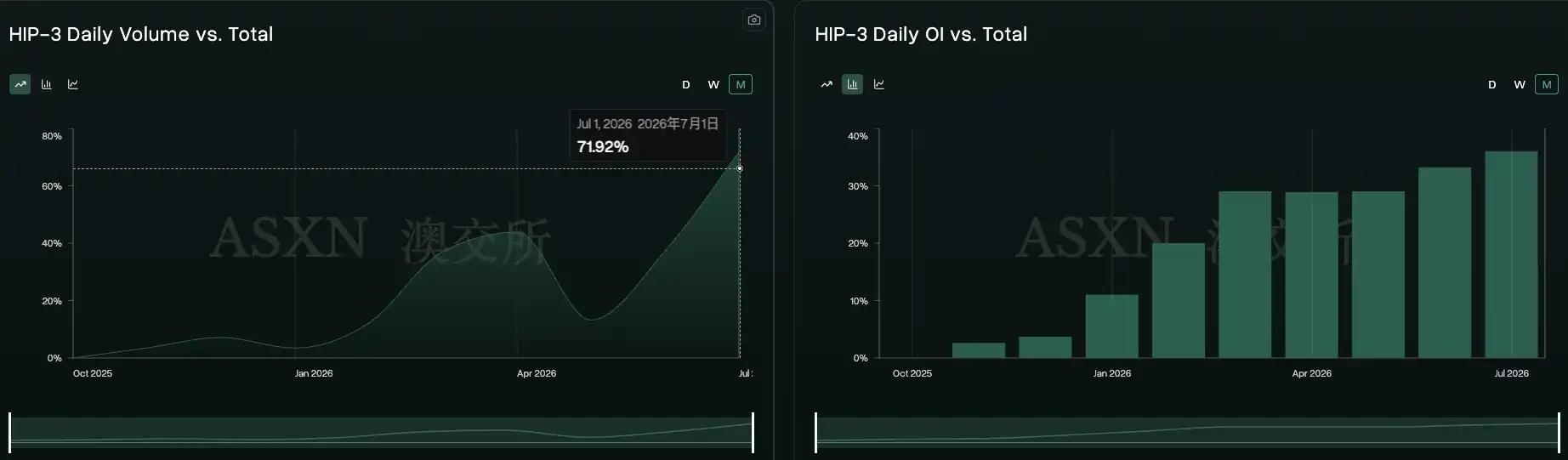
HIP-3's Share of Hyperliquid's Total Trading Volume and Total OI

Therefore, TradeXYZ has already grown into a behemoth capable of influencing traditional financial markets, leveraging Hyperliquid's infrastructure. Now, within its cooperative relationship with Hyperliquid, its leverage, influence, and voice are also beginning to dominate. So, should the grown child go its own way? Under what triggering factors might TradeXYZ choose to build its own infrastructure?

Setting aside unpredictable capital operation factors like financing and token issuance, and looking purely from a practical business perspective, if TradeXYZ truly chooses to go solo, the most likely reason would be to capture the underlying transaction fees.

In Hyperliquid's HIP-3 market, the trading fee split between TradeXYZ and Hyperliquid is a fixed 50/50. Furthermore, because the standard trading fee for HIP-3 assets is twice that of the core perp market, Hyperliquid's actual protocol fee per HIP-3 transaction is the same as from the core perp market.

According to statistics, as of the time of writing, TradeXYZ has generated close to $50 million in total fee revenue. Under the stipulated split ratio for HIP-3, TradeXYZ can take at most $25 million.
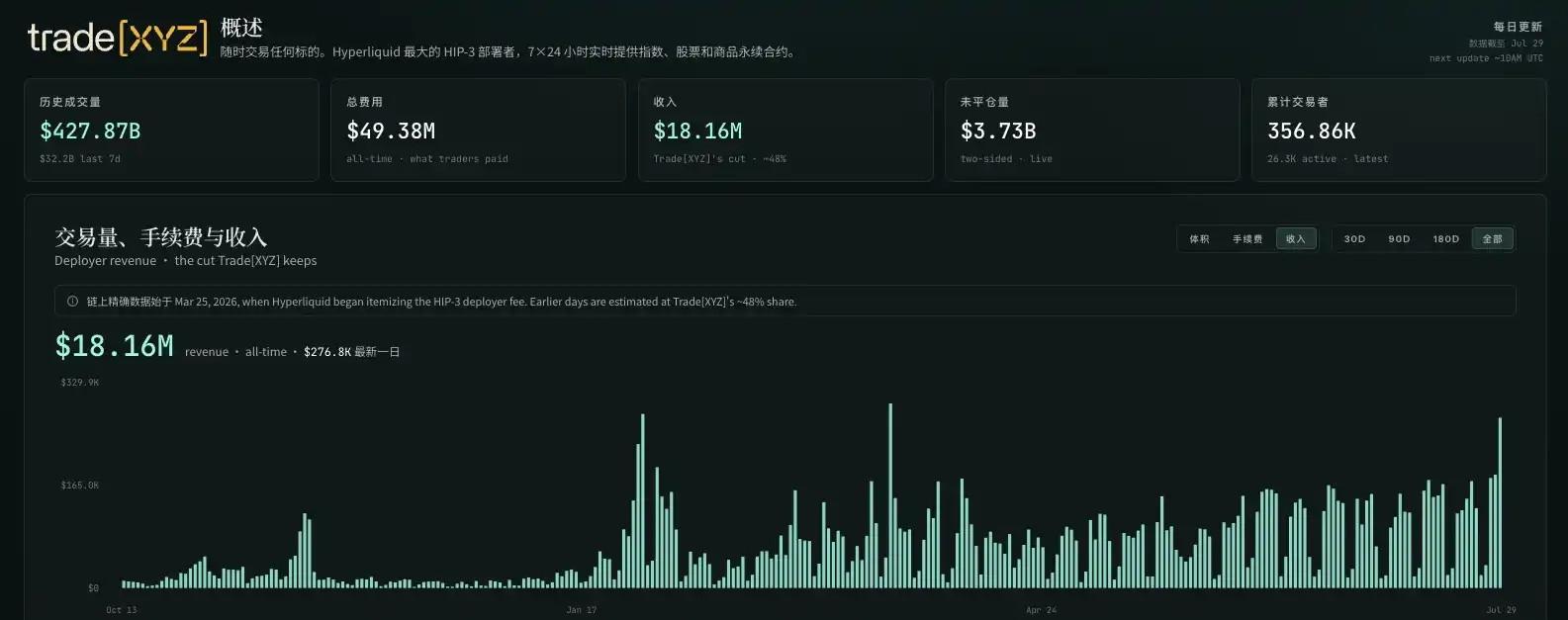
Fees Generated by TradeXYZ

It's hard to imagine that a project which has created over $400 billion in trading volume has a total revenue less than one ten-thousandth of its total volume. Giving away nearly half of its revenue is unbearable for most projects. Given TradeXYZ's current leverage and influence over Hyperliquid, it is entirely possible for it to negotiate with Hyperliquid to change the revenue split to 70/30 or higher. If a satisfactory agreement cannot be reached, TradeXYZ is very likely to embark on the path of going solo.

Why Wouldn't TradeXYZ Leave?

Of course, going solo has its appeal for TradeXYZ, but there are also constraints.

The first constraint is Hyperliquid's powerful performance. TradeXYZ's perpetual contracts are deployed on Hyperliquid's HIP-3 platform, where matching, order types, funds, liquidation, and automatic deleveraging are all managed by HyperCore. Technically, TradeXYZ only manages oracle prices, mark prices, external prices, and related components.

If TradeXYZ chooses to go solo, they would need to assemble their own team to build the underlying infrastructure. This itself is not a difficult problem, but building an L1 with performance as powerful as Hyperliquid's in a short time is a challenge. Even TradeXYZ founder Shoku himself has admitted the excellence of the Hyperliquid team. In March 2024, Shoku posted on X, saying he wasn't sure how big Hyperliquid could ultimately become as an L1 in terms of traditional metrics like TVL and trading volume, but he was completely certain that the quality and rigor of Hyperliquid's on-chain products and dApps would have no rivals across the entire crypto space.

These rivals naturally include himself. If the infrastructure TradeXYZ builds upon going solo cannot compete with Hyperliquid, it would negatively impact its product experience and the narrative of providing price discovery earlier than traditional financial markets.

The second constraint is that channels and distribution are also crucial. Why is Circle willing to give away over 50% of USDC's savings interest to Coinbase? The reason is that Coinbase has indeed made tremendous contributions to the market distribution and promotion of USDC. According to Coinbase's latest Q2 financial report, over 30% of circulating USDC is stored on Coinbase. Whoever controls the channels and distribution controls everything. This rule also applies between TradeXYZ and Hyperliquid.

In essence, Hyperliquid's frontend is just one interface to access TradeXYZ's liquidity markets, but it's not the only way. Users can currently also access TradeXYZ's liquidity markets directly through the TradeXYZ official website, and the trading interface is highly similar to Hyperliquid's. To further facilitate users, TradeXYZ's internal accounts are even interoperable with Hyperliquid's, meaning that connecting the same wallet on the TradeXYZ website allows direct use of any balance from Hyperliquid.
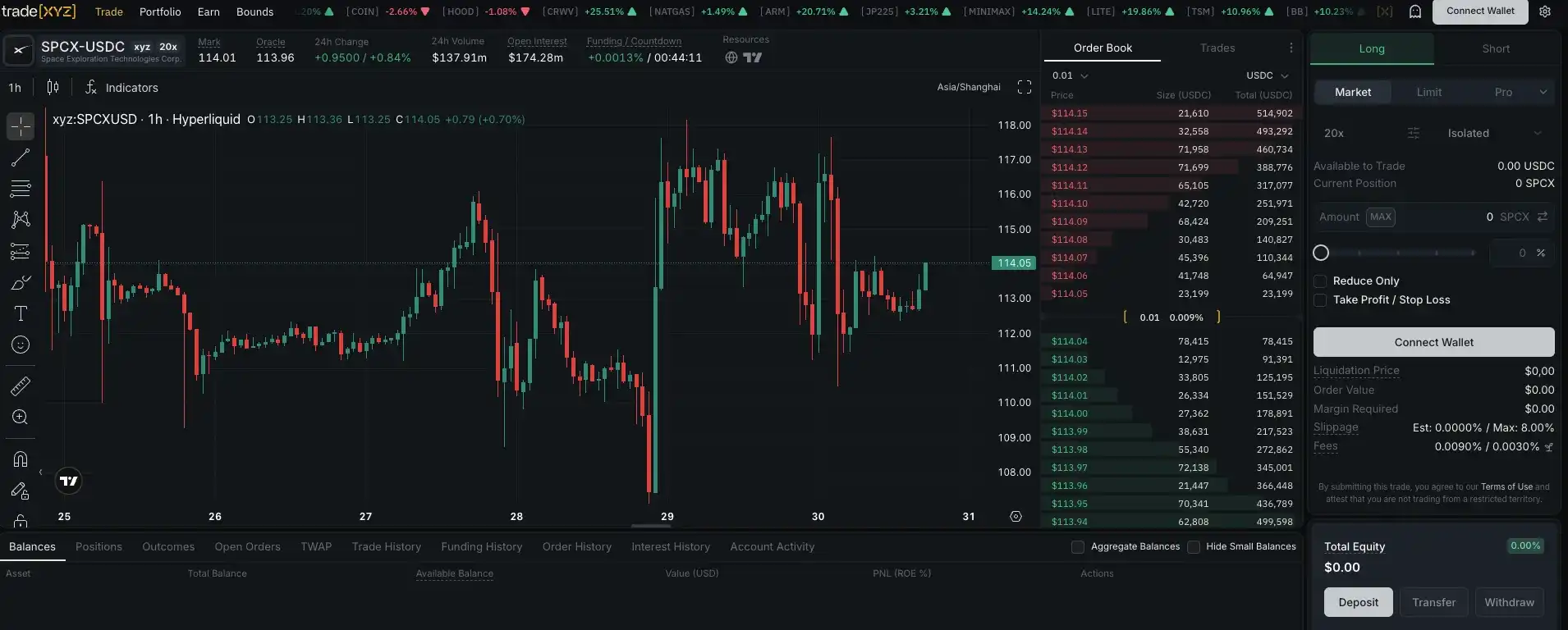
TradeXYZ's Own Trading Frontend

Nevertheless, among TradeXYZ's over 350,000 trading users, most still access TradeXYZ's liquidity markets through Hyperliquid's frontend. This is a user habit cultivated over time and is not easy to change. There might even be a certain proportion of trading users who don't even distinguish between TradeXYZ and Hyperliquid, simply trusting the Hyperliquid brand and passively choosing to trade TradeXYZ's products.

Therefore, Hyperliquid not only provides technical support for TradeXYZ but is also the main channel for distributing TradeXYZ's liquidity. The cost and time of building infrastructure can be calculated, but the value lost from losing a channel is immeasurable.

The third constraint is the inherent trust and "childhood friendship" between the founders of the two projects. Solana's well-known KOL Ansem believes the possibility of TradeXYZ going solo is almost zero, reasoning that tradexyz and Hyperliquid are the most compatible teams in the cryptocurrency space. "The two founders show no signs of greed and are both very smart. I believe they can choose a development path that is most beneficial for both teams."

This statement is not without merit. Shoku was one of the earliest investors to bet on Hyperliquid. As early as 2023, Shoku connected with Jeff and began contributing to the Hyperliquid ecosystem. In 2024, he developed the Hyperliquid Bitcoin cross-chain bridge, Unit. He once told friends that Hyperliquid was one of the few exciting things in the crypto world.

All signs indicate that Shoku deeply admires Hyperliquid and Jeff. From a personal relationship perspective, the likelihood of a "betrayal" is low.

If TradeXYZ Goes Solo, the Result is Lose-Lose

If we are to discuss this topic thoroughly, this article shouldn't end here. We should also discuss a low-probability event: what would the outcome be if TradeXYZ truly broke away from Hyperliquid and went solo? The answer I deduced is a lose-lose situation.

Because in the current state, TradeXYZ and Hyperliquid have a win-win situation. If TradeXYZ splits, the enormous uncertainty will harm both parties. After TradeXYZ goes solo, Hyperliquid could certainly support other HIP-3 market participants, but it would turn from a collaborator with TradeXYZ into a competitor. This wouldn't have too much impact on Hyperliquid's revenue because over 70% of Hyperliquid's main revenue still comes from the core Perp market; the HIP-3 market only accounts for a small portion. The biggest impact would be on its valuation.

First, after TradeXYZ migrates, Hyperliquid's total trading volume would decrease by over 50%, and HYPE might also be halved. This is because Hyperliquid would no longer be the leading on-chain RWA perpetual contract trading platform. Instead, it would be redefined as a crypto derivatives trading platform that has lost its biggest growth driver and narrative foundation.

TradeXYZ itself wouldn't fare much better. Both infrastructure and user habits would need to be cultivated from scratch. The aforementioned performance and channel issues become the biggest constraints on TradeXYZ's development. Moreover, such a betrayal could very likely trigger public controversy, further damaging TradeXYZ's credibility.

Additionally, TradeXYZ and Hyperliquid are not just competing with each other; the entire RWA trading market has other competitors. "When the snipe and the clam grapple, the fisherman profits." Hyperliquid would need time to cultivate new HIP-3 markets, and TradeXYZ would need time to build its infrastructure. By the time they look back, the market gap would have already been filled by other competitors.

In summary, although TradeXYZ is becoming increasingly important to Hyperliquid, going solo is clearly irrational. Even if TradeXYZ wants to increase profitability, the best approach might be to gradually shift focus towards its own issuance and user ownership while preserving the advantages of its existing integration with Hyperliquid.


Crypto di tendenza

Domande pertinenti

QAccording to the article, what is the primary reason that could drive TradeXYZ to consider building its own infrastructure, separate from Hyperliquid?

AThe primary reason is to capture the underlying transaction fees. Currently, TradeXYZ shares fees 50/50 with Hyperliquid. The article states that if TradeXYZ cannot renegotiate this split, it might choose to go independent to retain more of the significant revenue it generates.

QWhat are the two main constraints or challenges mentioned that might prevent TradeXYZ from leaving Hyperliquid?

AThe two main constraints are: 1) The powerful performance of Hyperliquid's infrastructure, which would be difficult and time-consuming to replicate. 2) Hyperliquid acts as the primary distribution channel and front-end for TradeXYZ's users, and changing established user habits is challenging.

QWhat does the article suggest would be the consequence for Hyperliquid's valuation (HYPE token) if TradeXYZ were to leave?

AThe article suggests that HYPE's price could potentially be halved ('face a 50% drop'). Hyperliquid would lose its status as the leading on-chain RWA perpetual platform, and its main growth narrative would be undermined, leading to a significant revaluation.

QWhat analogy from the AI industry is used in the article to illustrate the risk of a 'backstabbing' in a business partnership?

AThe article uses the example of Anthropic and Cursor. Cursor, a leading AI coding tool, initially used Anthropic's Claude model. However, Anthropic later launched a direct competitor, Claude Code, which eventually surpassed Cursor in revenue, effectively pushing it out of the market.

QWhat is the overall conclusion of the article regarding the likelihood and outcome of TradeXYZ going independent?

AThe article concludes that while the discussion is relevant due to TradeXYZ's growing influence, an independent move is seen as irrational and would likely result in a lose-lose scenario for both parties. It suggests the best path for TradeXYZ is to focus on enhancing its own distribution and user ownership while maintaining the current beneficial integration with Hyperliquid.

Letture associate

Annual Salary of Millions Competing for Electricians, Meta Rushes to Open Its Own Technical School

The AI boom is facing an unexpected bottleneck: a severe shortage of skilled construction workers and electricians. As tech giants like Meta, OpenAI, and Alphabet race to build massive data centers—such as OpenAI's $16 billion "Stargate" project—they are hitting a critical labor wall. The U.S. needs an estimated 130,000 more electricians, 240,000 construction workers, and 150,000 supervisors by 2030 for AI infrastructure alone, but tens of thousands of electrician jobs go unfilled each year. While AI companies offer high premiums, with electricians earning up to $280,000 annually, worker scarcity still causes massive losses—delays on a single project can cost $14.2 million per month. The complexity of building AI data centers, which require immense power (equivalent to powering hundreds of thousands of homes), sophisticated electrical systems, and advanced liquid cooling solutions, demands highly skilled technicians who are in short supply. To combat this, companies are investing heavily in training. Meta has committed $115 million to a free training school offering tuition, housing, and stipends, targeting 5,000 new workers. OpenAI is partnering with unions to secure skilled labor. These efforts are paying off, with a significant rise in Gen Z interest in trade schools over college. However, the power demands are staggering. AI data centers are driving a rapid surge in electricity consumption, projected to account for up to 12% of U.S. power use by 2028 and raising costs for consumers. Furthermore, the construction boom is project-based, leading to a potential future glut of trained workers once building peaks, which could depress wages industry-wide. The race for AI supremacy now depends as much on skilled hands as on advanced chips.

marsbit23 min fa

Annual Salary of Millions Competing for Electricians, Meta Rushes to Open Its Own Technical School

marsbit23 min fa

OpenAI No Longer Sells Its Most Expensive Model for Profit

OpenAI is shifting its business strategy away from promoting its most expensive, flagship models for every task. Recent price cuts—80% for GPT-5.6 Luna and 20% for Terra—signal a deeper change: the company now actively advises users that many tasks don't require the most powerful model. Instead, OpenAI recommends a tiered approach: use the high-end GPT-5.6 Sol for complex planning and analysis, then delegate execution to cheaper models like Luna. This mirrors moves by Anthropic, which recently launched Claude Opus 5 at half the price of its top model, Fable 5. Both companies are de-emphasizing flagship models as primary revenue drivers, using them instead for brand prestige and technological showcases. The industry is entering a "mass-market" phase, similar to automotive, where high-volume, cost-effective models handle daily operations and drive scale. OpenAI's price reductions are partly enabled by AI models themselves optimizing underlying code and infrastructure, creating a self-reinforcing cycle of efficiency gains and cost reduction. Competition is shifting from "who is smartest" to "who offers the best value." The goal is no longer selling individual models but fostering widespread API adoption and ecosystem lock-in. By making AI calls cheap and ubiquitous, companies like OpenAI aim to become the indispensable, utility-like infrastructure powering automated workflows—the "water and electricity" of software, quietly embedded everywhere.

marsbit23 min fa

OpenAI No Longer Sells Its Most Expensive Model for Profit

marsbit23 min fa

Will the Fed Definitely Raise Interest Rates in September? How Will Crypto and U.S. Stocks Withstand the Pressure?

The market's expectation for a September Fed rate hike surged dramatically in early August, jumping from under 50% to over 80% within a week. This shift followed a contentious July FOMC meeting, where a 9-3 vote to hold rates revealed growing dissent from hawkish members advocating for an immediate hike to combat persistent inflation. The primary catalyst for this repricing is rising oil prices, driven by renewed geopolitical tensions around the Strait of Hormuz, which threaten global supply. Energy costs directly influence inflation metrics, making the upcoming July CPI report (due August 12th) a critical data point. If it shows inflation reaccelerating, the probability of a September hike will solidify. For Bitcoin and crypto assets, this is typically bearish news. Bitcoin continues to behave as a high-beta, liquidity-sensitive risk asset. A rate hike raises the opportunity cost of holding non-yielding assets and could drive capital toward money markets, pressuring crypto prices in the short term. However, historical patterns suggest that if a hike is perceived as the end of a tightening cycle rather than the start, any negative price impact may be brief. U.S. stocks, particularly crypto-linked equities like Coinbase and growth-oriented tech stocks, are also vulnerable. Higher rates increase discount rates in valuation models, putting pressure on high-multiple companies. This coincides with a pivotal tech earnings season where investor focus has shifted from massive AI capital expenditure to tangible revenue and cash flow generation. Companies with negative cash flow and weak growth narratives could face heightened volatility if borrowing costs rise in September. In summary, a September Fed hike has evolved into a mainstream market scenario. Key factors to watch are oil prices, the July CPI report, and Fed communications, which will determine the final decision and its impact on volatile crypto and equity markets.

marsbit34 min fa

Will the Fed Definitely Raise Interest Rates in September? How Will Crypto and U.S. Stocks Withstand the Pressure?

marsbit34 min fa

Trading

Spot

Articoli Popolari

Cosa è $S$

Comprendere SPERO: Una Panoramica Completa Introduzione a SPERO Mentre il panorama dell'innovazione continua a evolversi, l'emergere delle tecnologie web3 e dei progetti di criptovaluta gioca un ruolo fondamentale nel plasmare il futuro digitale. Un progetto che ha attirato l'attenzione in questo campo dinamico è SPERO, denotato come SPERO,$$s$. Questo articolo mira a raccogliere e presentare informazioni dettagliate su SPERO, per aiutare gli appassionati e gli investitori a comprendere le sue basi, obiettivi e innovazioni nei domini web3 e crypto. Che cos'è SPERO,$$s$? SPERO,$$s$ è un progetto unico all'interno dello spazio crypto che cerca di sfruttare i principi della decentralizzazione e della tecnologia blockchain per creare un ecosistema che promuove l'impegno, l'utilità e l'inclusione finanziaria. Il progetto è progettato per facilitare interazioni peer-to-peer in modi nuovi, fornendo agli utenti soluzioni e servizi finanziari innovativi. Al suo interno, SPERO,$$s$ mira a responsabilizzare gli individui fornendo strumenti e piattaforme che migliorano l'esperienza dell'utente nello spazio delle criptovalute. Questo include la possibilità di metodi di transazione più flessibili, la promozione di iniziative guidate dalla comunità e la creazione di percorsi per opportunità finanziarie attraverso applicazioni decentralizzate (dApps). La visione sottostante di SPERO,$$s$ ruota attorno all'inclusività, cercando di colmare le lacune all'interno della finanza tradizionale mentre sfrutta i vantaggi della tecnologia blockchain. Chi è il Creatore di SPERO,$$s$? L'identità del creatore di SPERO,$$s$ rimane piuttosto oscura, poiché ci sono risorse pubblicamente disponibili limitate che forniscono informazioni dettagliate sul suo fondatore o fondatori. Questa mancanza di trasparenza può derivare dall'impegno del progetto per la decentralizzazione—un ethos che molti progetti web3 condividono, dando priorità ai contributi collettivi rispetto al riconoscimento individuale. Centrando le discussioni attorno alla comunità e ai suoi obiettivi collettivi, SPERO,$$s$ incarna l'essenza dell'empowerment senza mettere in evidenza individui specifici. Pertanto, comprendere l'etica e la missione di SPERO rimane più importante che identificare un creatore singolo. Chi sono gli Investitori di SPERO,$$s$? SPERO,$$s$ è supportato da una varietà di investitori che vanno dai capitalisti di rischio agli investitori angelici dedicati a promuovere l'innovazione nel settore crypto. Il focus di questi investitori generalmente si allinea con la missione di SPERO—dando priorità a progetti che promettono avanzamenti tecnologici sociali, inclusività finanziaria e governance decentralizzata. Queste fondazioni di investitori sono tipicamente interessate a progetti che non solo offrono prodotti innovativi, ma contribuiscono anche positivamente alla comunità blockchain e ai suoi ecosistemi. Il supporto di questi investitori rafforza SPERO,$$s$ come un concorrente degno di nota nel dominio in rapida evoluzione dei progetti crypto. Come Funziona SPERO,$$s$? SPERO,$$s$ impiega un framework multifunzionale che lo distingue dai progetti di criptovaluta convenzionali. Ecco alcune delle caratteristiche chiave che sottolineano la sua unicità e innovazione: Governance Decentralizzata: SPERO,$$s$ integra modelli di governance decentralizzati, responsabilizzando gli utenti a partecipare attivamente ai processi decisionali riguardanti il futuro del progetto. Questo approccio favorisce un senso di proprietà e responsabilità tra i membri della comunità. Utilità del Token: SPERO,$$s$ utilizza il proprio token di criptovaluta, progettato per servire varie funzioni all'interno dell'ecosistema. Questi token abilitano transazioni, premi e la facilitazione dei servizi offerti sulla piattaforma, migliorando l'impegno e l'utilità complessivi. Architettura Stratificata: L'architettura tecnica di SPERO,$$s$ supporta la modularità e la scalabilità, consentendo un'integrazione fluida di funzionalità e applicazioni aggiuntive man mano che il progetto evolve. Questa adattabilità è fondamentale per mantenere la rilevanza nel panorama crypto in continua evoluzione. Coinvolgimento della Comunità: Il progetto enfatizza iniziative guidate dalla comunità, impiegando meccanismi che incentivano la collaborazione e il feedback. Nutrendo una comunità forte, SPERO,$$s$ può affrontare meglio le esigenze degli utenti e adattarsi alle tendenze di mercato. Focus sull'Inclusione: Offrendo basse commissioni di transazione e interfacce user-friendly, SPERO,$$s$ mira ad attrarre una base utenti diversificata, inclusi individui che potrebbero non aver precedentemente interagito nello spazio crypto. Questo impegno per l'inclusione si allinea con la sua missione generale di empowerment attraverso l'accessibilità. Cronologia di SPERO,$$s$ Comprendere la storia di un progetto fornisce preziose intuizioni sulla sua traiettoria di sviluppo e sui traguardi. Di seguito è riportata una cronologia suggerita che mappa eventi significativi nell'evoluzione di SPERO,$$s$: Fase di Concettualizzazione e Ideazione: Le idee iniziali che formano la base di SPERO,$$s$ sono state concepite, allineandosi strettamente con i principi di decentralizzazione e focus sulla comunità all'interno dell'industria blockchain. Lancio del Whitepaper del Progetto: Dopo la fase concettuale, è stato rilasciato un whitepaper completo che dettaglia la visione, gli obiettivi e l'infrastruttura tecnologica di SPERO,$$s$ per suscitare interesse e feedback dalla comunità. Costruzione della Comunità e Prime Interazioni: Sono stati effettuati sforzi attivi di outreach per costruire una comunità di early adopters e potenziali investitori, facilitando discussioni attorno agli obiettivi del progetto e ottenendo supporto. Evento di Generazione del Token: SPERO,$$s$ ha condotto un evento di generazione del token (TGE) per distribuire i propri token nativi ai primi sostenitori e stabilire una liquidità iniziale all'interno dell'ecosistema. Lancio della Prima dApp: La prima applicazione decentralizzata (dApp) associata a SPERO,$$s$ è stata attivata, consentendo agli utenti di interagire con le funzionalità principali della piattaforma. Sviluppo Continuo e Partnership: Aggiornamenti e miglioramenti continui alle offerte del progetto, inclusi partnership strategiche con altri attori nello spazio blockchain, hanno plasmato SPERO,$$s$ in un concorrente competitivo e in evoluzione nel mercato crypto. Conclusione SPERO,$$s$ rappresenta una testimonianza del potenziale del web3 e delle criptovalute di rivoluzionare i sistemi finanziari e responsabilizzare gli individui. Con un impegno per la governance decentralizzata, il coinvolgimento della comunità e funzionalità progettate in modo innovativo, apre la strada verso un panorama finanziario più inclusivo. Come per qualsiasi investimento nello spazio crypto in rapida evoluzione, si incoraggiano potenziali investitori e utenti a ricercare approfonditamente e a impegnarsi in modo riflessivo con gli sviluppi in corso all'interno di SPERO,$$s$. Il progetto mostra lo spirito innovativo dell'industria crypto, invitando a ulteriori esplorazioni delle sue innumerevoli possibilità. Mentre il percorso di SPERO,$$s$ è ancora in fase di sviluppo, i suoi principi fondamentali potrebbero effettivamente influenzare il futuro di come interagiamo con la tecnologia, la finanza e tra di noi in ecosistemi digitali interconnessi.

215 Totale visualizzazioniPubblicato il 2024.12.17Aggiornato il 2024.12.17

Cosa è $S$

Cosa è AGENT S

Agent S: Il Futuro dell'Interazione Autonoma in Web3 Introduzione Nel panorama in continua evoluzione di Web3 e criptovalute, le innovazioni stanno costantemente ridefinendo il modo in cui gli individui interagiscono con le piattaforme digitali. Uno di questi progetti pionieristici, Agent S, promette di rivoluzionare l'interazione uomo-computer attraverso il suo framework agentico aperto. Aprendo la strada a interazioni autonome, Agent S mira a semplificare compiti complessi, offrendo applicazioni trasformative nell'intelligenza artificiale (AI). Questa esplorazione dettagliata approfondirà le complessità del progetto, le sue caratteristiche uniche e le implicazioni per il dominio delle criptovalute. Cos'è Agent S? Agent S si presenta come un innovativo framework agentico aperto, progettato specificamente per affrontare tre sfide fondamentali nell'automazione dei compiti informatici: Acquisizione di Conoscenze Specifiche del Dominio: Il framework apprende in modo intelligente da varie fonti di conoscenza esterne ed esperienze interne. Questo approccio duale gli consente di costruire un ricco repository di conoscenze specifiche del dominio, migliorando le sue prestazioni nell'esecuzione dei compiti. Pianificazione su Lungo Orizzonte di Compiti: Agent S impiega una pianificazione gerarchica potenziata dall'esperienza, un approccio strategico che facilita la suddivisione e l'esecuzione efficiente di compiti complessi. Questa caratteristica migliora significativamente la sua capacità di gestire più sottocompiti in modo efficiente ed efficace. Gestione di Interfacce Dinamiche e Non Uniformi: Il progetto introduce l'Interfaccia Agente-Computer (ACI), una soluzione innovativa che migliora l'interazione tra agenti e utenti. Utilizzando Modelli Linguistici Multimodali di Grandi Dimensioni (MLLM), Agent S può navigare e manipolare senza sforzo diverse interfacce grafiche utente. Attraverso queste caratteristiche pionieristiche, Agent S fornisce un framework robusto che affronta le complessità coinvolte nell'automazione dell'interazione umana con le macchine, preparando il terreno per innumerevoli applicazioni nell'AI e oltre. Chi è il Creatore di Agent S? Sebbene il concetto di Agent S sia fondamentalmente innovativo, informazioni specifiche sul suo creatore rimangono elusive. Il creatore è attualmente sconosciuto, il che evidenzia sia la fase embrionale del progetto sia la scelta strategica di mantenere i membri fondatori sotto anonimato. Indipendentemente dall'anonimato, l'attenzione rimane sulle capacità e sul potenziale del framework. Chi sono gli Investitori di Agent S? Poiché Agent S è relativamente nuovo nell'ecosistema crittografico, informazioni dettagliate riguardanti i suoi investitori e sostenitori finanziari non sono documentate esplicitamente. La mancanza di approfondimenti pubblicamente disponibili sulle fondazioni di investimento o sulle organizzazioni che supportano il progetto solleva interrogativi sulla sua struttura di finanziamento e sulla roadmap di sviluppo. Comprendere il supporto è cruciale per valutare la sostenibilità del progetto e il suo potenziale impatto sul mercato. Come Funziona Agent S? Al centro di Agent S si trova una tecnologia all'avanguardia che gli consente di funzionare efficacemente in contesti diversi. Il suo modello operativo è costruito attorno a diverse caratteristiche chiave: Interazione Uomo-Computer Simile a Quella Umana: Il framework offre una pianificazione AI avanzata, cercando di rendere le interazioni con i computer più intuitive. Mimando il comportamento umano nell'esecuzione dei compiti, promette di elevare le esperienze degli utenti. Memoria Narrativa: Utilizzata per sfruttare esperienze di alto livello, Agent S utilizza la memoria narrativa per tenere traccia delle storie dei compiti, migliorando così i suoi processi decisionali. Memoria Episodica: Questa caratteristica fornisce agli utenti una guida passo-passo, consentendo al framework di offrire supporto contestuale mentre i compiti si sviluppano. Supporto per OpenACI: Con la capacità di funzionare localmente, Agent S consente agli utenti di mantenere il controllo sulle proprie interazioni e flussi di lavoro, allineandosi con l'etica decentralizzata di Web3. Facile Integrazione con API Esterne: La sua versatilità e compatibilità con varie piattaforme AI garantiscono che Agent S possa adattarsi senza problemi agli ecosistemi tecnologici esistenti, rendendolo una scelta attraente per sviluppatori e organizzazioni. Queste funzionalità contribuiscono collettivamente alla posizione unica di Agent S all'interno dello spazio crittografico, poiché automatizza compiti complessi e multi-fase con un intervento umano minimo. Man mano che il progetto evolve, le sue potenziali applicazioni in Web3 potrebbero ridefinire il modo in cui si svolgono le interazioni digitali. Cronologia di Agent S Lo sviluppo e le tappe di Agent S possono essere riassunti in una cronologia che evidenzia i suoi eventi significativi: 27 Settembre 2024: Il concetto di Agent S è stato lanciato in un documento di ricerca completo intitolato “Un Framework Agentico Aperto che Usa i Computer Come un Umano”, mostrando le basi per il progetto. 10 Ottobre 2024: Il documento di ricerca è stato reso pubblicamente disponibile su arXiv, offrendo un'esplorazione approfondita del framework e della sua valutazione delle prestazioni basata sul benchmark OSWorld. 12 Ottobre 2024: È stata rilasciata una presentazione video, fornendo un'idea visiva delle capacità e delle caratteristiche di Agent S, coinvolgendo ulteriormente potenziali utenti e investitori. Questi indicatori nella cronologia non solo illustrano i progressi di Agent S, ma indicano anche il suo impegno per la trasparenza e il coinvolgimento della comunità. Punti Chiave su Agent S Man mano che il framework Agent S continua a evolversi, diversi attributi chiave si distinguono, sottolineando la sua natura innovativa e il potenziale: Framework Innovativo: Progettato per fornire un uso intuitivo dei computer simile all'interazione umana, Agent S porta un approccio nuovo all'automazione dei compiti. Interazione Autonoma: La capacità di interagire autonomamente con i computer attraverso GUI segna un passo avanti verso soluzioni informatiche più intelligenti ed efficienti. Automazione di Compiti Complessi: Con la sua metodologia robusta, può automatizzare compiti complessi e multi-fase, rendendo i processi più veloci e meno soggetti a errori. Miglioramento Continuo: I meccanismi di apprendimento consentono ad Agent S di migliorare dalle esperienze passate, migliorando continuamente le sue prestazioni e la sua efficacia. Versatilità: La sua adattabilità attraverso diversi ambienti operativi come OSWorld e WindowsAgentArena garantisce che possa servire un'ampia gamma di applicazioni. Man mano che Agent S si posiziona nel panorama di Web3 e delle criptovalute, il suo potenziale per migliorare le capacità di interazione e automatizzare i processi segna un significativo avanzamento nelle tecnologie AI. Attraverso il suo framework innovativo, Agent S esemplifica il futuro delle interazioni digitali, promettendo un'esperienza più fluida ed efficiente per gli utenti in vari settori. Conclusione Agent S rappresenta un audace passo avanti nell'unione tra AI e Web3, con la capacità di ridefinire il modo in cui interagiamo con la tecnologia. Sebbene sia ancora nelle sue fasi iniziali, le possibilità per la sua applicazione sono vaste e coinvolgenti. Attraverso il suo framework completo che affronta sfide critiche, Agent S mira a portare le interazioni autonome al centro dell'esperienza digitale. Man mano che ci addentriamo nei regni delle criptovalute e della decentralizzazione, progetti come Agent S giocheranno senza dubbio un ruolo cruciale nel plasmare il futuro della tecnologia e della collaborazione uomo-computer.

672 Totale visualizzazioniPubblicato il 2025.01.14Aggiornato il 2025.01.14

Cosa è AGENT S

Come comprare S

Benvenuto in HTX.com! Abbiamo reso l'acquisto di Sonic (S) semplice e conveniente. Segui la nostra guida passo passo per intraprendere il tuo viaggio nel mondo delle criptovalute.Step 1: Crea il tuo Account HTXUsa la tua email o numero di telefono per registrarti il tuo account gratuito su HTX. Vivi un'esperienza facile e sblocca tutte le funzionalità,Crea il mio accountStep 2: Vai in Acquista crypto e seleziona il tuo metodo di pagamentoCarta di credito/debito: utilizza la tua Visa o Mastercard per acquistare immediatamente SonicS.Bilancio: Usa i fondi dal bilancio del tuo account HTX per fare trading senza problemi.Terze parti: abbiamo aggiunto metodi di pagamento molto utilizzati come Google Pay e Apple Pay per maggiore comodità.P2P: Fai trading direttamente con altri utenti HTX.Over-the-Counter (OTC): Offriamo servizi su misura e tassi di cambio competitivi per i trader.Step 3: Conserva Sonic (S)Dopo aver acquistato Sonic (S), conserva nel tuo account HTX. In alternativa, puoi inviare tramite trasferimento blockchain o scambiare per altre criptovalute.Step 4: Scambia Sonic (S)Scambia facilmente Sonic (S) nel mercato spot di HTX. Accedi al tuo account, seleziona la tua coppia di trading, esegui le tue operazioni e monitora in tempo reale. Offriamo un'esperienza user-friendly sia per chi ha appena iniziato che per i trader più esperti.

1.3k Totale visualizzazioniPubblicato il 2025.01.15Aggiornato il 2026.06.02

Come comprare S

Discussioni

Benvenuto nella Community HTX. Qui puoi rimanere informato sugli ultimi sviluppi della piattaforma e accedere ad approfondimenti esperti sul mercato. Le opinioni degli utenti sul prezzo di S S sono presentate come di seguito.

活动图片












