On May 4, 2026, Anthropic co-founder Jack Clark posted a message on the social platform X. His original words were: "I now believe the probability of recursive self-improvement occurring by the end of 2028 is 60%."
Within minutes of the post going live, Eliezer Yudkowsky, a long-time active researcher in AI safety, replied underneath: "Then we will die together." He immediately followed up by citing an analogy pointing to the design flaw of the Chernobyl nuclear reactor RBMK, implying that this system being activated is one no one truly knows how to stop.
This exchange, completed within tens of seconds, lit a match to discussions previously hidden in technical papers and internal assessments. Recursive Self-Improvement (RSI) – where AI systems not only optimize outputs but also autonomously optimize the improvement process itself, ultimately constructing successor systems more powerful than themselves – a concept long relegated to the theoretical margins, was placed by an Anthropic co-founder into a countdown clock with a 60% probability before the end of 2028.
A month later, Anthropic officially published a lengthy article. Titled "When AI builds itself," it was co-authored by Marina Favaro and Jack Clark and published by the newly formed Anthropic Institute in March. Using a series of previously undisclosed internal data and a meticulously calibrated narrative structure, Anthropic handed the outside world a precisely scaled acceleration signal card. This card stated both "we are not there yet" and "but it may arrive faster than most institutions are prepared for."
In the same month, DeepMind CEO Demis Hassabis used a phrasing never before seen in public at the Google I/O stage: humanity stands at the "foothills of the singularity." In subsequent interviews, he adjusted his timeline for Artificial General Intelligence (AGI) from "shortly after 2030" to "2029 is a real possibility," and admitted that his use of dramatic language was "deliberately provocative," aiming to create a sense of urgency for governments, economists, and the public.
Two leading institutions built on a foundation of safety, long serving as forces of restraint in the AI industry, adjusted the volume and scale of their external messaging almost simultaneously. This timing itself needs to be examined as an independent event.
A Meticulously Calibrated Long Article
The long article published by Anthropic on June 4 immediately laid out its narrative goal. It aimed to argue not just a technical trend, but a directional process with acceleration. To this end, it presented a set of previously undisclosed internal data.
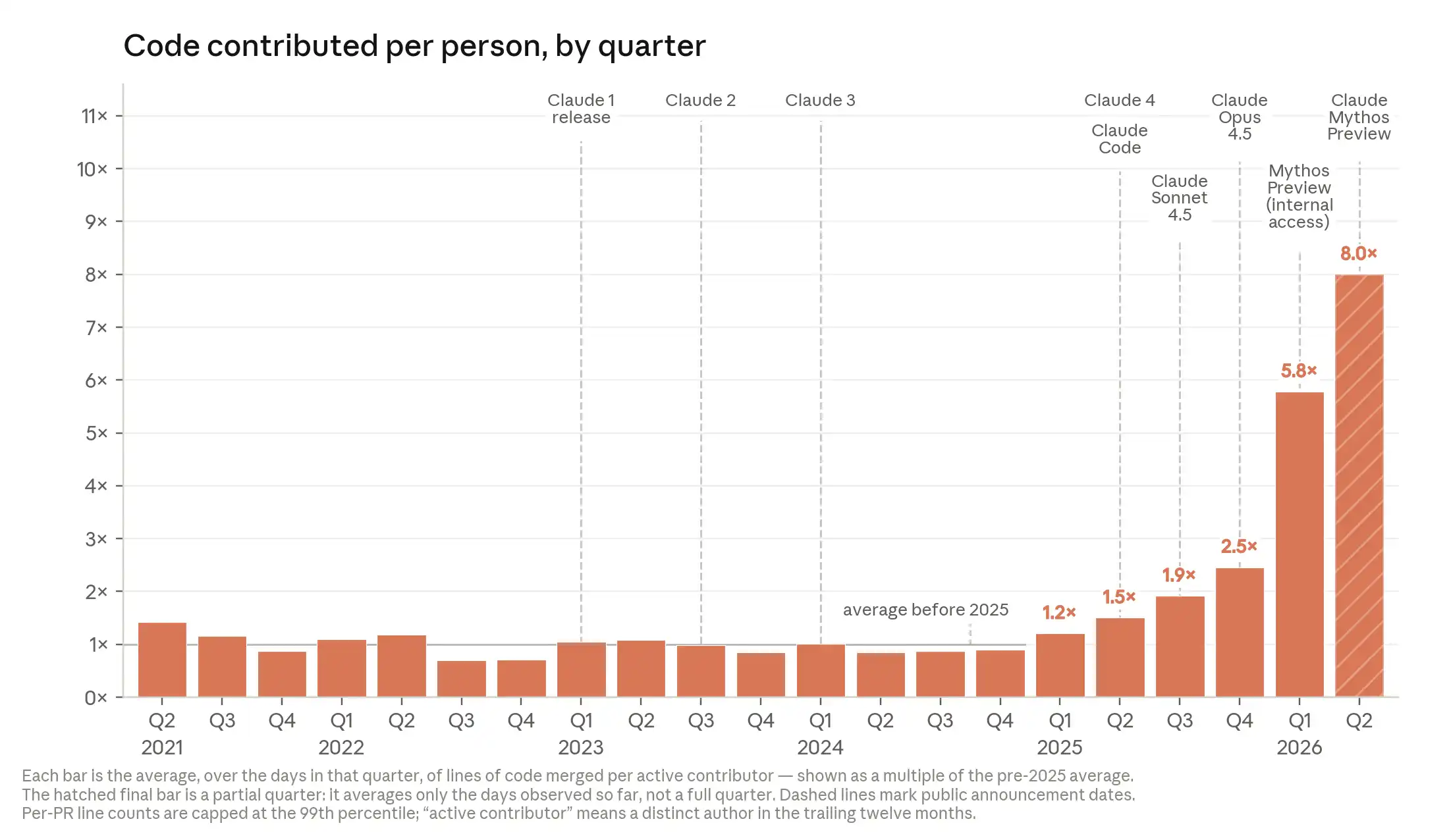
The first set of numbers pointed to a structural change: as of May 2026, over 80% of merged code in Anthropic's codebase was written by Claude. Two years ago, this number was in the low single digits. The same data also showed that in Q2 2026, the typical Anthropic engineer was merging 8 times more code per day than in 2024.
One can imagine the reaction of anyone not deeply tracking the AI industry reading these two numbers for the first time. But Anthropic itself acknowledged several important caveats in footnotes: leadership had publicly estimated that if scripts and experimental code were included, Claude-authored code exceeded 90%; 80% was a more conservative statistic for merged code; lines of code are "an imperfect metric" and might overestimate real productivity gains; the code attribution pipeline itself "has gaps."
The very writing of these footnotes is worth analyzing. Their existence ostensibly serves as honest concessions, but their actual function is to make the numbers in the main text appear to have undergone prudent self-filtering, thus gaining greater credibility. This is a two-tier structure in narrative engineering: the main text releases the signal, the footnotes provide the disclaimer.
The second set of numbers involved speed. On code optimization tasks, Claude Opus 4 achieved approximately a 3x speed-up effect in May 2025, which would take a skilled human researcher 4 to 8 hours to achieve. By April 2026, Claude Mythos Preview pushed this number to approximately 52x. The maximum duration for AI to independently complete tasks also doubled every four months, from 4 minutes in March 2024 to 12 hours in March 2026. The speed of doubling every four months itself constitutes a highly memorable point, easily spread with its implication of geometric progression.
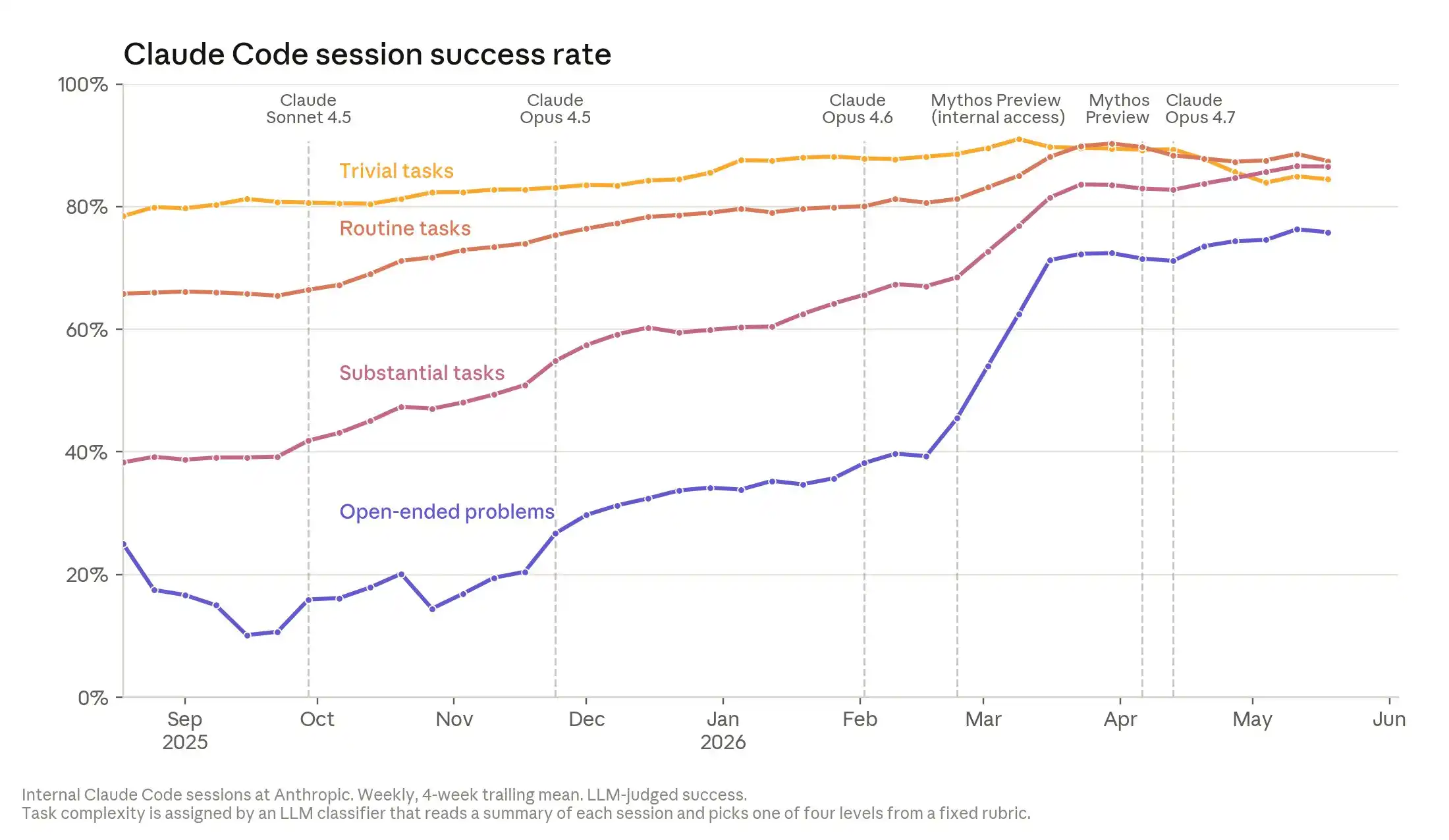
Another set of data came from an internal survey of 130 Anthropic research team employees in March 2026. The median respondent estimated that output using Mythos Preview was about 4 times that of not using AI. A footnote again pointed out that prior independent research by METR suggested developers may generally overestimate AI productivity gains. The same two-tier structure reappeared.
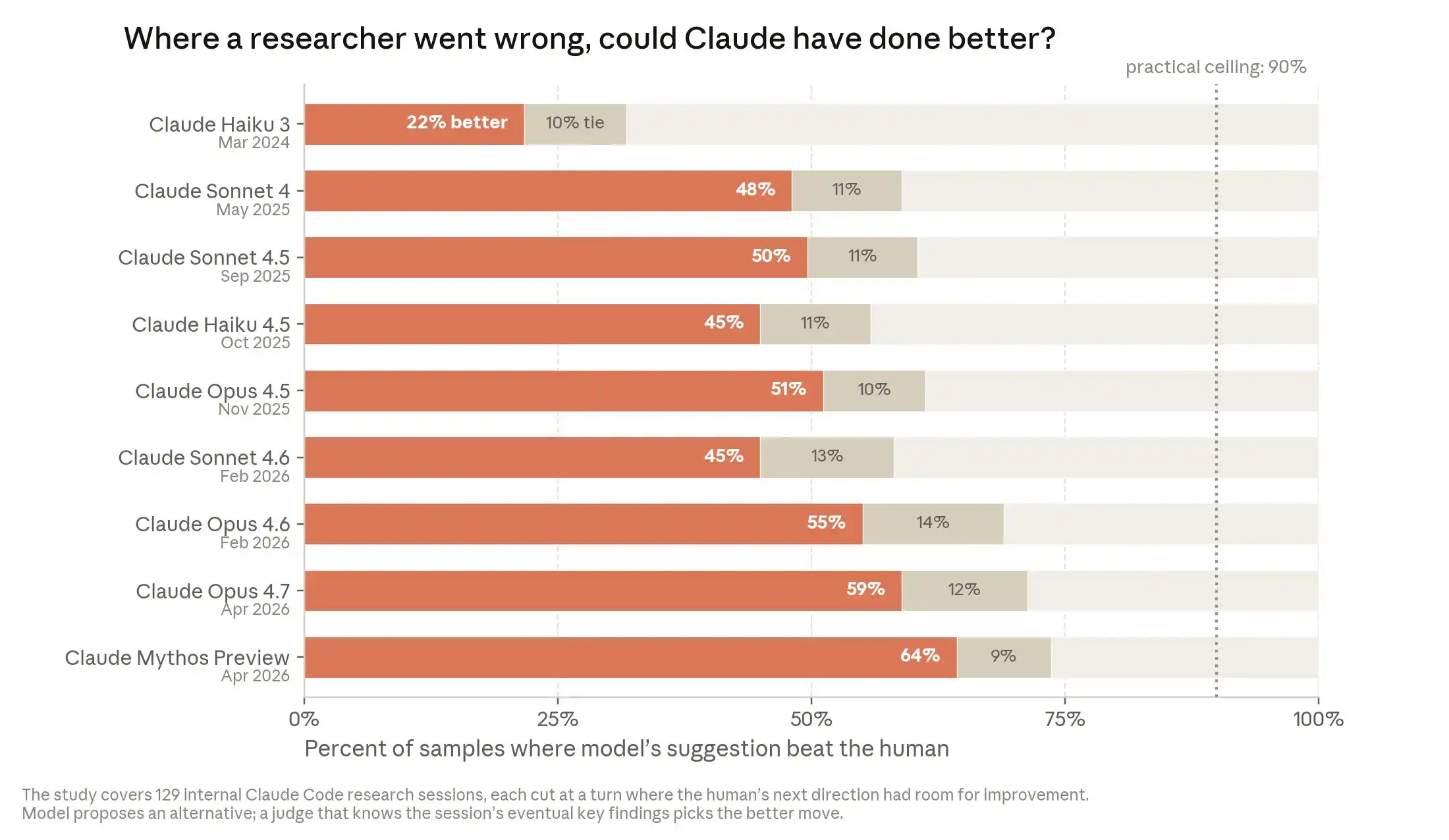
The third set of numbers pointed to AI approaching the boundary of human researcher judgment. In November 2025, Claude Opus 4.5 made better research direction choices than human researchers in 51% of cases. By April 2026, this number rose to 64%. With a sample size of 129 cases, Anthropic explained in a footnote that these were cases deliberately chosen where human choices had room for improvement.
Any single number taken out of context could be placed into different interpretive frameworks. But placed together, the direction is consistent: speed is increasing, the gap is narrowing, and all of this is happening inside Anthropic's own codebase and labs, not theoretical speculation on some external benchmark.
After listing this data, the article presented three future scenarios.
The first is trend stagnation, entering an S-curve plateau. Anthropic's phrasing: "we do not believe this is very likely."
The second is compound efficiency gains, where AI continues to replace humans in broader R&D aspects, but humans still set the direction and define success criteria. Anthropic assessed this as "evidence suggests we are likely heading toward this scenario."
The third is full recursive self-improvement, where AI autonomously designs, trains, and deploys successor systems more powerful than itself, with humans no longer in the loop. The wording is "plausible."
The arrangement order and tone allocation of these three scenarios form a complete narrative gradient. The first is downplayed, serving to accommodate skeptics; the second is anchored in "evidence," lending the article a rational veneer; the third, through "plausible" and conditional "if technological trends continue," pushes the boldest hypothesis to the edge of the reader's imagination without bearing the burden of proof for it.
At the very core of the entire article, Anthropic's stance is compressed into one sentence: "We are not there yet, and recursive self-improvement is not inevitable. But it may arrive faster than most institutions are prepared for."
From 'Willing to Pause' to 'A Unilateral Pause Would Only Let Reckless Actors Catch Up'
If the June 4th long article is a carefully framed snapshot, placing it on a timeline reveals a longer trajectory.
In 2023, Anthropic released its Responsible Scaling Policy (RSP). The core commitment of this policy document was: if model capabilities exceed the company's safety control capabilities, the company will pause training more powerful models. This was not a verbal statement, but an internal governance document with an assessment framework and trigger conditions. This document was once regarded by the AI safety community as an operational sample of "voluntary regulation."
In 2024, CEO Dario Amodei published a widely circulated article, suggesting the possibility of "powerful AI" arriving between 2027 and 2030. At that time, Anthropic still presented itself as an independent safety-minded entity, maintaining a restrained facade towards scale expansion and acceleration narratives.
On January 26, 2026, Amodei published a 38-page article "The Adolescence of Technology" on his personal website. It contained a judgment later repeatedly cited: "Because AI is now writing most of the code inside Anthropic, it is already substantially accelerating our progress toward building the next generation of AI systems. This feedback loop is gaining momentum month by month, and may be only 1 to 2 years away from the current generation of AI autonomously building the next generation." In the same article, he described the impending "powerful AI" as a "genius nation in a data center."
This was almost the starting point for Anthropic to systematically release the signal that a "self-improvement feedback loop is happening." And the timing of this blog post coincided with the company's transition from a $350 billion valuation to a higher valuation range.
Less than a month later, the turn came.
On February 25, 2026, CNN reported that Anthropic had revised its Responsible Scaling Policy, removing the core commitment to "pause training stronger models if capabilities exceed safety control abilities," replacing it with a non-binding "Frontier Safety Roadmap." In the same week, U.S. Secretary of Defense Pete Hegseth issued an ultimatum to Dario Amodei: withdraw the safety red line, or lose a $200 million Department of Defense contract.
The report quoted Anthropic's Chief Scientist Jared Kaplan's response to Time magazine: "We don't think stopping model training actually helps anyone... if competitors are sprinting at full speed." The phrasing in this response is noteworthy. "Doesn't help anyone" is not a technical argument, but a statement of stakeholder calculus. "If competitors are sprinting at full speed" is structurally identical in narrative framing to "a unilateral pause would only let the least cautious actors catch up": it replaces the original pause logic based on one's own safety capabilities with a speed logic based on competitor actions.
Anthropic still emphasized in the CNN report that it retained two red lines: not using AI systems to control weapons systems, and not using them for mass domestic surveillance. This point is important because it shows Anthropic did not abandon its safety stance wholesale, but made selective concessions and defenses across different safety dimensions. However, this selectivity itself is also a core clue in narrative strategy analysis: where it conceded and where it held firm delineates the recalibrated scale of safety.
On March 11, the Anthropic Institute was formally established, led by Jack Clark, positioned as a "public interest research institute." Less than two months later, on May 4, Clark posted the "60%" message.
Once juxtaposed, the signal density and release rhythm of this timeline are not random. From the personal article preview in January, to the policy revision in February, to the institute's establishment in March, to the founder's probability prediction in May, to the official long article release in June, this is a clearly paced, gradually escalating narrative pipeline. One cannot directly conclude "this was all pre-planned" from this, but the sequence itself constitutes a question analysts must confront: does this sense of rhythm indicate that Anthropic has already incorporated the "acceleration narrative" into its public communications management?
Hassabis's Deliberate Provocation
If only Anthropic had adjusted its messaging in the first half of 2026, analysts would have sufficient reason to focus on the internal decision logic of the enterprise. But DeepMind CEO Demis Hassabis made a directionally consistent adjustment almost simultaneously, making the "single enterprise case" argument untenable.
On January 20, at the Davos Forum, Hassabis still maintained his longstanding judgment: a 50% probability of AGI by 2030. Three weeks later, on February 18, at the India AI Impact Summit, he relented: "AGI could arrive within five years."
From May 20 to 22, at Google I/O, Hassabis said in his keynote that humanity stands at the "foothills of the singularity." Around the same time, OpenAI released GPT-5.3-Codex, stating the model "played a key role in its own creation process," specifically including assisting in debugging the training process, managing deployment, and analyzing evaluation results. The timing gap between the three leading labs was compressed to weeks.
After Google I/O, Hassabis gave an interview to Axios. This interview was later widely cited, with the most crucial line being his admission that using language like "foothills of the singularity" was "deliberately provocative," aimed at jolting governments, economists, and the public into recognizing the urgency of AI's accelerating development. He also adjusted his AGI timeline from "shortly after 2030" to "2029 is a real possibility," though still broadly expected around 2030, plus or minus a year.
Hassabis was more direct in an interview with The Seoul Economic Daily: "Five to ten years from now, when we look back at 2026 and 2027, we will say 'that was when we entered the AGI era.'"
The term "deliberately provocative" deserves careful consideration. It is a rare, first-hand confession by a principal actor about narrative intent. It acknowledges that at least some of his chosen phrasing is not a passive reflection of technical facts, but an actively chosen communication tool. This confession itself does not negate that he may also genuinely see a technical inflection point, but it explicitly lifts "narrative" from the shadow of "facts," making it an object that can be examined separately.
Hassabis's self-explanation of his phrasing opens a side door to interpreting this round of synchronized signals. His "deliberate provocation" and the "footnote disclaimers" in Anthropic's lengthy data argument exhibit the same amphibious posture: one hand pushes signals shocking enough to stir public opinion, the other retains a safe space to retreat to "this is just one possibility."
The Same Set of Data, Completely Different Interpretations
While Anthropic and DeepMind jointly constructed a narrative framework of "AI is accelerating its own evolution," external independent researchers offered alternative interpretations of the same set of data and phenomena. These interpretations are important not because any one side possesses ultimate truth, but because they reveal the interpretative range of the official narrative itself.
The sharpest response came from Eliezer Yudkowsky. He not only replied to Jack Clark but also continued to speak out on multiple occasions. A MindStudio blog recorded his complete stance: he used the Chernobyl RBMK reactor as an analogy for the safety design of current AI systems. The core argument of this analogy is that if control rods and accelerators are bound within the same system, attempting to slow down can actually cause the system to lose control faster.
Nathan Lambert of the Allen Institute for AI proposed the concept of "Lossy Self-Improvement" (LSI). His argument directly challenges the "accelerating flywheel" model: as systems become increasingly complex, each generational improvement process creates friction and loss, akin to signal attenuation over long-distance transmission. According to this logic, the improvements that made 80% or 90% AI-authored code possible cannot be infinitely replicated onto the next-generation system, because the next generation will face a more complex problem space, and the noise and errors in the AI's own output will amplify across generations.
Dean Ball, a senior fellow at the Foundation for American Innovation, offered a more direct linguistic framework, dimensionalizing Anthropic's data. He told IEEE Spectrum: "Maybe eventually they'll automate genius, but not next year. Next year they're automating drudgery." This distinction strikes at the core ambiguity of "80% of code written by AI." If AI automates the fixed-pattern parts of a codebase, batch parameter generation, or end-to-end pipeline configuration, then this work indeed corresponds to "drudgery" in software engineering contexts. The remaining 20% might contain architecture design, directional judgment, trade-offs based on incomplete information – these are the genius parts.
David Scott Krueger of the University of Montreal, as founder of the AI safety non-profit Evitable, proposed a pause trigger red line: "99% of code written by AI." He told IEEE Spectrum: "I think we may be crossing that line now." The tension between his framework and Anthropic's already loosened pause commitment is one of the most important structural contradictions in this round of narratives.
UBC computer scientist Jeff Clune, in an interview with IEEE Spectrum, stood in another direction. He said: "We are at an inflection point for recursive self-improvement systems." If his statement were validated, it would mean Yudkowsky's alarm bell rang at the right beat.
Four sets of voices, pointing in different directions, with even internal tension within the same direction. But their commonality lies in the fact that they do not rely on the official narrative framework; instead, they each offer independent judgments on the same set of phenomena based on their own methodologies. The diversity and conflict among these judgments themselves are the most powerful rebuttal to the notion that "any single narrative sufficiently covers the whole truth."
Coupling of Valuation Curves and Narrative Rhythm
In January 2026, Anthropic completed a funding round at a valuation of $350 billion. Investors included Microsoft and Nvidia. This number had been preemptively reported by some media by late 2025, but its formal announcement came right after Amodei published "The Adolescence of Technology."
In February, another $30 billion funding round completed, maintaining the valuation around $350 billion. In the same month, the safety policy was revised, removing the pause commitment. The Pentagon's $200 million contract threat landed.
In May, Reuters, The New York Times, and TechCrunch almost simultaneously reported that Anthropic had completed a $65 billion funding round, reaching a valuation of $965 billion. This number not only exceeded its own valuation two months prior but also surpassed OpenAI's $852 billion valuation from March 2026. The New York Times additionally cited Dario Amodei's remarks at a developer conference, stating the company's annualized revenue reached $30 billion, with him even joking that he "hopes this year's 80x revenue growth doesn't continue, because that would be insane."
On June 4, the Anthropic Institute published the "When AI builds itself" long article.
Lining up these time points is not to imply a precise causal arrow on a chart. Anyone claiming a causal relationship between these things must provide direct evidence. In the absence of internal decision records, no analyst can or should make such assertions.
On the other hand, it is equally unreasonable to not observe and record these correspondences at all. That an enterprise's valuation nearly tripled from $350 billion to $965 billion within five months, while undergoing a major safety policy shift, while constructing a narrative pipeline of "acceleration signals" led by an independent research institute, while its co-founder offered a 60% probability prediction – when all these events are densely compressed within six months, investors at least have the right to ask: To what extent do these signal releases serve the function of conveying the message "we are at the accelerating frontier" to the market?
This inquiry itself is the value of analysis. The answer may never be singular. But once the question is clearly posed, it cannot be easily withdrawn.
Global AI market funding reached $297 billion in Q1 2026, with the top five deals occupying a significant share of that total. At this level, all frontier labs face the same pressure: you need to convince investors that your technology curve will be steeper than your rivals'. Your risk warnings must also be loud enough so that when regulators finally step in to make rules, your voice is pre-embedded into the policy framework. Your narrative must also be attractive enough to make top researchers choose your lab, and alarming enough to maintain your remaining credibility within the safety community.
There are inherent contradictions among these demands. Anthropic's narrative adjustments in the first half of 2026 can be seen as a recalibration of the linguistic balance point among these conflicting demands. The weakening of safety commitments, the strengthening of acceleration signals, and the repeated use of the argument "we cannot unilaterally stop" collectively form a set of vectors pointing in the same direction.
The Signals Are Out, And Then
We must return to the core question: do these signals more resemble reflections of a technical inflection point, or rhetorical escalation aimed at capital and regulation?
Available public evidence does not allow for simply checking a box between the two options. Because the evidence used by both explanations is, in fact, the same set of data. The 80% code share, 52x speed-up, task duration doubling every four months can both support "an inflection point is approaching" and explain "we are communicating a trend perception our own technical staff have personally experienced to the market." The boundary between these is blurred.
But some facts are determinate, requiring no choosing of sides between interpretations.
First, Anthropic's narrative pivot completed in the first half of 2026 is not an isolated case. DeepMind's Hassabis made a directionally consistent, if differing in degree but essentially similar, adjustment almost in the same quarter. OpenAI's Sam Altman said at the India summit "the world is not ready," and in February 2026 released GPT-5.3-Codex, claiming it "played a key role in its own creation process." If this were only Anthropic releasing signals, perhaps analysis from an enterprise strategy perspective would suffice. But three leading labs simultaneously raising their voices within a dense few months constitutes an industry-level narrative shift.
Second, there exists a temporally traceable correspondence between the rhythm of these signal releases and the beats of financing, policy adjustments, and organizational restructuring. This correspondence itself needs to prove nothing; it only needs to be honestly presented. Once presented, each person's inherent methodology will determine what they think next.
Third, Anthropic itself still labels the status of the third scenario, "full recursive self-improvement," as "plausible," not "likely." This means that within the internal judgment framework of the company releasing this data, their acceleration narrative is not yet fully closed. The forces that compel them to habitually include qualifiers in academic papers and blog writing are still pulling the reins on their public phrasing.
Fourth, Hassabis's "deliberate provocation" confession confirms a mechanism long suspected but rarely admitted by the actors themselves: at least some leaders of frontier labs choose their phrasing with explicit communication objectives in mind. This necessitates that all interpretations of their pronouncements must simultaneously analyze two layers: the facts they claim, and the rhetorical strategy they employ in choosing those claims as a behavioral event in itself.
Those who carefully read Anthropic's data-filled article and those who only remember the two numbers "80% of code written by AI" and "52x acceleration" receive vastly different signal strengths. But in this matter, "how it is remembered" might be a more important object of analysis than "what was actually said."
This very article is itself a precise sample of the phenomenon it describes. It constructs a sense of impending acceleration using data, yet retains room for retreat through footnotes and qualifiers; it calls for global coordination and verifiable deceleration, yet has already withdrawn the pause commitment in a prior policy revision. This is not hypocrisy, nor simple inconsistency between words and actions. It is the narrative balancing act of an institution caught between technical uncertainty, commercial pressure, and public responsibility. And Hassabis's "deliberate provocation" confession precisely confirms from the side door that such balancing acts are now a consciously employed method among leading labs.