Elon Musk: In 5 Years, People on the Internet Will Become a Statistical Margin of Error — Only Bots Will Remain

cryptonews.ruPubblicato 2026-08-11Pubblicato ultima volta 2026-08-11

Introduzione

Elon Musk commented on X that AI agent traffic will "undeniably and significantly" surpass human traffic, referencing a Cloudflare forecast. Cloudflare predicts that within five years, bot traffic will exceed human traffic by a factor of 1,000. CEO Matthew Prince noted that bot traffic first surpassed human traffic in May 2026, earlier than the company's previous forecasts for late 2027 or early 2027. During a Q2 2026 earnings call, CFO Thomas Seifert stated that at current growth rates, humans risk becoming a "statistical margin of error" online, not due to decreased human activity, but because of the explosive growth in AI agent activity. Cloudflare Radar provides daily data on this bot-to-human traffic ratio. However, methodologies differ; another report from Thales/Imperva found automated traffic reached 53% globally in 2025. The lack of a unified measurement standard complicates understanding the true scale, drawing parallels to early internet user count disputes in the 1990s.

Elon Musk wrote on social media X that AI agent traffic "will certainly far exceed" human traffic, referencing a Cloudflare forecast. The entrepreneur's comment related to the company's estimate that within five years, bot traffic will exceed human traffic by 1,000 times.

AI agent traffic will clearly and significantly exceed human traffic, there's no doubt about it. Cloudflare's forecast is accurate.

Cloudflare has been developing the idea that automated systems are surpassing human activity in terms of internet traffic volume for several months now. Back on June 3, 2026, the company's CEO Matthew Prince reported that bot traffic had, for the first time in internet history, surpassed human traffic. According to him, the company had expected this event closer to the end of 2027, then moved the forecast to early 2027, but AI agent traffic grew so rapidly that the overtaking was already recorded in May 2026.

Humans as a 'Statistical Margin of Error'

During the second-quarter 2026 earnings conference call held on August 6, Cloudflare CFO Thomas Seifert stated that if current trends continue, bot traffic will exceed human traffic by 1,000 times within five years. Seifert clarified that the company's previous forecasts on this topic had not held up — but not in the direction everyone was used to: reality consistently outpaced expectations. In his phrasing, people risk becoming a "statistical margin of error" on the internet — not due to a decline in human activity, but because of the pace of growth in agent activity.
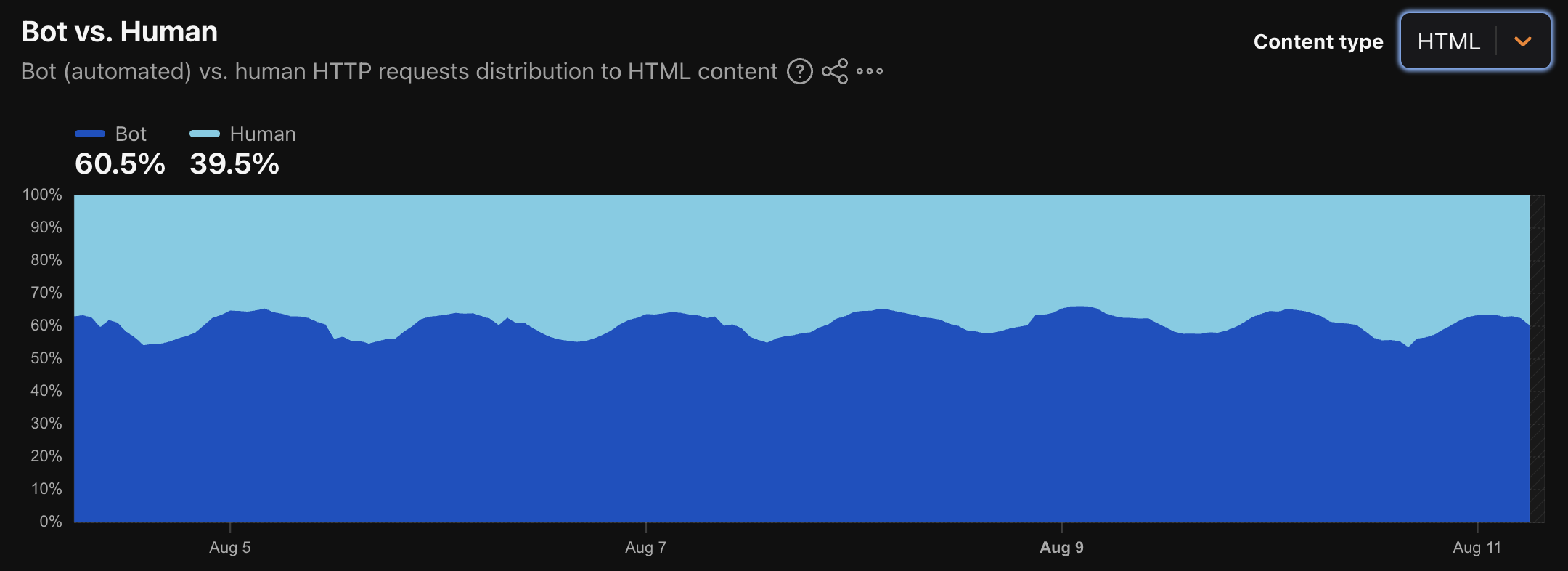
Ratio of bot to human traffic based on HTTP requests for HTML content. Source: Cloudflare

The data referenced by Prince and Seifert is updated daily on the Cloudflare Radar dashboard, which tracks the ratio of bot to human traffic. It was this section that Prince linked to in his June post, and a month later, Musk drew attention to it while commenting on Cloudflare's findings.

The AI Perspective

From a methodological standpoint, comparing different telemetry sources opens an interesting angle. Cloudflare Radar measures the share of bots based on HTTP requests for HTML content on the company's servers, whereas Thales/Imperva recorded a different figure in its annual report: in 2025, the share of automated traffic across the entire global network reached 53% compared to 51% the previous year. The discrepancy in numbers between providers is explained by different domain samples and different criteria for classifying a request as a "bot" — no single measurement standard yet exists.

A historical parallel suggests itself with early debates about internet service provider coverage in the 1990s, when each company used its own user-counting methodology. A technical risk that remains in the background: the more vendors' metrics diverge, the harder it is for regulators and infrastructure developers to rely on a unified picture of what's happening. Will the market remain without a common standard for accounting for agent traffic?

end-content

Crypto di tendenza

Domande pertinenti

QWhat is the core prediction that Elon Musk and Cloudflare are making about internet traffic in the near future?

AThey predict that within five years, bot/AI agent traffic will exceed human internet traffic by 1,000 times, making human activity a statistical insignificance online.

QAccording to Cloudflare, when did bot traffic first exceed human traffic historically, and how did this compare to their earlier forecasts?

AAccording to Cloudflare CEO Matthew Prince, bot traffic first exceeded human traffic in May 2026. Their original forecast was for late 2027, then early 2027, but the rapid growth of AI agents made it happen much sooner.

QWhat specific metric does Cloudflare Radar use to measure the bot vs. human traffic ratio, and what is a key limitation mentioned about such measurements?

ACloudflare Radar measures the ratio based on HTTP requests for HTML content on its servers. A key limitation is the lack of a unified standard; different vendors (like Thales/Imperva) use different sample domains and criteria for classifying a 'bot,' leading to varying figures.

QWhy does the article suggest humans could become a 'statistical insignificance' online, and is it due to a decline in human activity?

AThe article states humans risk becoming a statistical insignificance not because of a decline in human online activity, but because of the explosive growth rate of bot/AI agent traffic.

QWhat historical parallel does the article draw regarding the current debate on measuring bot traffic?

AIt draws a parallel to the early debates in the 1990s about measuring internet service provider (ISP) reach, where each company used its own methodology and there was no single standard for counting users.

Letture associate

Capital Flows Fiercely Yet Fear Persists, Bitcoin Caught in Contradictory Market Conditions

The cryptocurrency market is experiencing a rare contradiction: while capital is flowing in massively, market sentiment remains mired in fear. US spot Bitcoin ETFs recorded a net inflow of $853 million last week, the largest weekly increase since mid-April, with BlackRock's IBIT alone contributing over 80%. Spot Ethereum ETFs also saw a $245 million inflow, bringing the total weekly inflow for crypto ETFs to over $1.1 billion. Despite this, there are no signs of market celebration. The Fear & Greed Index continues to hover between 31-32 in the "Fear" zone. Bitcoin's negative premium on Coinbase has persisted for 82 days, setting a new record, typically indicating insufficient institutional demand to absorb retail selling pressure. This divergence between capital inflows and market sentiment is the most notable current phenomenon. Macro factors saw the US July non-farm payrolls unexpectedly decline by 23,000, missing expectations of an 80,000 increase, significantly lowering the probability of a September Fed rate hike. The upcoming July CPI data is the final key macro indicator before the September FOMC meeting. Politically, the CLARITY Act failed to be voted on before the Senate's August recess, with a procedural vote expected around mid-September. Its outcome will significantly impact the US digital asset regulatory framework and institutional fund flows. Industry-wise, a vulnerability in Coldcard hardware wallets led to a theft of 1,500-2,000 BTC ($100-130M), highlighting self-custody risks. Meanwhile, MicroStrategy sold 1,638 BTC, with founder Michael Saylor clarifying his "never sell" pledge applied only to personal holdings. Technically, Bitcoin is trading between $64,800-$65,200. The weekly EMA 240 at $63,500 provides key support, while the daily EMA 60 at $65,100 acts as resistance. Key resistance levels are at $68,300 and $72,700, with support at $63,500 and $62,500. The analysis concludes the market is in a phase of confidence repair and consolidation at a bear market bottom, with the sustainability of ETF flows being the core short-term driver.

marsbit4 min fa

Capital Flows Fiercely Yet Fear Persists, Bitcoin Caught in Contradictory Market Conditions

marsbit4 min fa

Trading

Spot

Articoli Popolari

Come comprare ELON

Benvenuto in HTX.com! Abbiamo reso l'acquisto di Dogelon Mars (ELON) semplice e conveniente. Segui la nostra guida passo passo per intraprendere il tuo viaggio nel mondo delle criptovalute.Step 1: Crea il tuo Account HTXUsa la tua email o numero di telefono per registrarti il tuo account gratuito su HTX. Vivi un'esperienza facile e sblocca tutte le funzionalità,Crea il mio accountStep 2: Vai in Acquista crypto e seleziona il tuo metodo di pagamentoCarta di credito/debito: utilizza la tua Visa o Mastercard per acquistare immediatamente Dogelon MarsELON.Bilancio: Usa i fondi dal bilancio del tuo account HTX per fare trading senza problemi.Terze parti: abbiamo aggiunto metodi di pagamento molto utilizzati come Google Pay e Apple Pay per maggiore comodità.P2P: Fai trading direttamente con altri utenti HTX.Over-the-Counter (OTC): Offriamo servizi su misura e tassi di cambio competitivi per i trader.Step 3: Conserva Dogelon Mars (ELON)Dopo aver acquistato Dogelon Mars (ELON), conserva nel tuo account HTX. In alternativa, puoi inviare tramite trasferimento blockchain o scambiare per altre criptovalute.Step 4: Scambia Dogelon Mars (ELON)Scambia facilmente Dogelon Mars (ELON) nel mercato spot di HTX. Accedi al tuo account, seleziona la tua coppia di trading, esegui le tue operazioni e monitora in tempo reale. Offriamo un'esperienza user-friendly sia per chi ha appena iniziato che per i trader più esperti.

178 Totale visualizzazioniPubblicato il 2024.12.12Aggiornato il 2025.03.21

Come comprare ELON

Discussioni

Benvenuto nella Community HTX. Qui puoi rimanere informato sugli ultimi sviluppi della piattaforma e accedere ad approfondimenti esperti sul mercato. Le opinioni degli utenti sul prezzo di ELON ELON sono presentate come di seguito.

活动图片