ETFs Are Just the Ticket: The True Institutionalization of Bitcoin Is Happening Where You Can't See It

marsbitPubblicato 2026-06-15Pubblicato ultima volta 2026-06-15

Introduzione

Beyond the Bitcoin ETF spotlight, a deeper institutionalization is underway, leveraging Bitcoin as a foundational financial primitive. Institutions are using Bitcoin for purposes long reserved for assets like U.S. Treasuries and gold: as collateral for loans, insurance reserves, and the backbone of rated bonds. Examples include a Barbados-based insurer capitalizing with $40M in Bitcoin reserves and Ledn's $188M securitization of Bitcoin-backed loans, which received the first-ever investment-grade rating (BBB-) from S&P for a digital asset-backed security. This structure was stress-tested during a 27% price drop in early 2026, triggering automatic liquidations that functioned as designed but revealed the systemic risk of synchronized selling across leveraged positions. Infrastructure is evolving to support this, with platforms like Anchorage Digital's Atlas network enabling secure, institutional-grade settlement and collateral management. Strategies like basis trades and corporate treasuries (exemplified by companies like MicroStrategy issuing billions in equity and debt to fund Bitcoin acquisitions) further integrate Bitcoin into financial mechanics. While ETFs solved "how to own" Bitcoin, these developments answer "what to do with it," embedding the asset into the working machinery of finance—as collateral upon which loans, derivatives, and structured products are built. The real, enduring institutional shift is happening in these largely invisible plumbing and financing ...

Author: Andjela Radmilac

Compiled by: Deep Tide TechFlow

Deep Tide TechFlow Introduction: ETFs only solve "how to buy Bitcoin," but few have noticed that Wall Street is already using it to do what U.S. Treasuries and gold have done for years: collateralizing loans, insurance reserves, and rating bonds. The liquidation wave in February proved this system can withstand pressure but also exposed the fatal flaw of a collective stampede in the leverage chain.

Everyone knows about ETFs, but almost no one knows that while ETFs are capturing all the attention, dozens of institutional products built around Bitcoin are quietly emerging—from a $40 million insurance reserve in Barbados to S&P-rated bonds being sold to Wall Street investors by Jefferies.

ETFs answered only one question: how ordinary investors and institutions can hold Bitcoin within a regulated wrapper. The products in this article answer a different, arguably more important question: once you own Bitcoin, what can you do with it?

The answer: exactly what the financial industry has always done with U.S. Treasuries and gold. You can use it as collateral to borrow money, post it as margin for trades, backstop insurance policies as reserves, or build a corporate balance sheet on top of it.

Assets capable of doing all these things simultaneously are sometimes called financial primitives, a fancy term for "building blocks": things that are widely accepted and easily valued, upon which the rest of the financial system can stack loans, bonds, and derivatives. Treasuries earned this status because everyone agrees on their value and how to seize them if a trade goes wrong.

Bitcoin is now undergoing the same test. Early results explain why some of the biggest players in this market genuinely don't care whether the price goes up or down.

Insurance Reserves, Consumer Credit, and the First Rated Bitcoin Bond

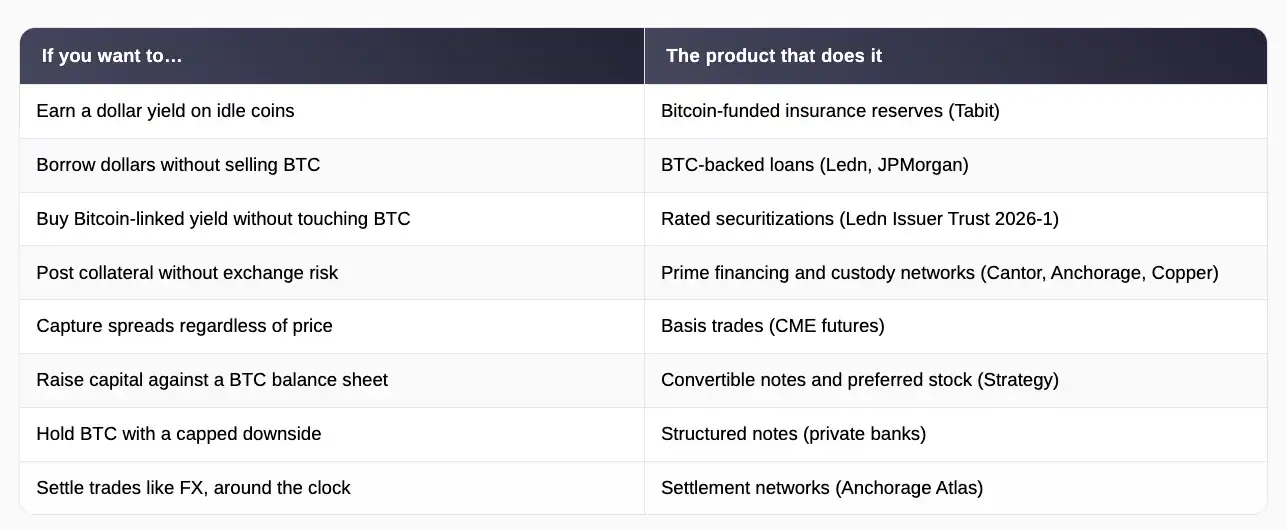
In March 2025, Tabit Insurance, a Barbados-licensed insurer founded by former Bittrex executives, capitalized a property and casualty insurance entity with $40 million funded entirely by Bitcoin.

Essentially, Bitcoin holders surrendered their holdings to back real insurance policies covering storm damage and lawsuits against company directors. In return, they earned a near 10% dollar-denominated yield. Policies and premiums remained in dollars, so clients never touched cryptocurrency, while Bitcoin served as the reserve to pay claims if problems arose.

Tabit holds a Class 2 license from the Barbados Financial Services Commission and is structured as a segregated accounts company. This means each investor fund pool is legally isolated from others, so losses in one account don't drain capital from another.

Regulators and auditors can also check the reserves on the blockchain in real-time, providing more transparency than traditional insurers offer in their quarterly reports. CEO Stephen Stonberg noted that the entire global reinsurance industry runs on roughly $800 billion in capital, while Bitcoin is a multi-trillion-dollar asset class. Thus, even a small portion of this wealth flowing into underwriting would be felt across the entire industry.

While insurance reserves are indeed an unexpected use case for Bitcoin, lending is where things get serious. Bitcoin-collateralized loans work in a straightforward way: you pledge your coins to a lender, receive dollars, and when you repay, you get your coins back.

Holders do this because selling triggers taxable gains and ends their exposure to future price appreciation, while borrowing against coins gives them cash without relinquishing any holdings.

Transaction volume across platforms reached about $2 billion in 2025. Toronto-based Ledn alone reported issuing over $9.5 billion since 2018. Major banks like JPMorgan Chase have also launched similar products for their own clients.

In February 2026, this lending business entered the mainstream bond market. Ledn completed a $188 million securitization, meaning it bundled 5,441 loans into a pool and sold bonds whose interest payments come from borrower repayments.

The bonds were split into two tranches: $160 million in senior notes that get paid first, rated BBB- by S&P Global Ratings (an investment-grade rating, the first ever assigned to a digital asset-backed security), and $28 million in riskier subordinate notes rated B-, which absorb first losses in exchange for higher yields.

By crypto standards, the underlying numbers are conservative. The 2,914 U.S. borrowers in the pool owe $199.1 million but have pledged around 4,079 BTC, worth $356.9 million. This translates to a loan-to-value ratio of 55.8%, meaning they pledged nearly $2 worth of Bitcoin for every $1 borrowed.

Ledn CEO Adam Reeds stated that this structure creates a "direct pipeline" between Bitcoin holders seeking liquidity and the world's deepest pools of institutional capital. Bitwise's European Head of Research, Andre Dragosch, added that the deal proves traditional finance now views Bitcoin as legitimate, even pristine, collateral.

The structure was almost immediately stress-tested, revealing both the model's strength and its fragility. Bitcoin fell about 27% from mid-January to February 2026, pushing up the loan-to-value ratio across the pool and triggering margin calls—automatic demands for borrowers to either add more collateral or watch the lender sell it.

Ledn eventually liquidated roughly a quarter of the loans originally intended for the deal. The sale still went through, partly because these automatic liquidations worked exactly as designed, and Ledn never suffered a loss when selling collateral due to default.

The perverse consequence to remember: when many lenders run the same triggers on the same volatile asset, a sharp price drop forces them to sell simultaneously, and this selling further depresses the price, triggering more sales. The system passed its first real test, but it also revealed where it would break under sufficient stress.

Collateral Networks, Carry Trades, and Corporate Balance Sheets

Beneath these products, the market's fundamental mechanics are being rebuilt to resemble currency and bond markets more closely, where the entity holding your assets, the platform you trade on, and the system settling the trades are three separate things.

Anchorage Digital, which operates the only federally chartered crypto bank in the U.S., launched its Atlas settlement network in April 2024. This allows institutions to settle trades directly with each other without parking funds in custody accounts or pre-funding exchanges.

By March 2026, Atlas had connected nearly 600 participants, four times the number from a year earlier, processed hundreds of billions in settlements, and expanded to managing collateral. This means the bank now monitors loan positions, issues margin calls, and handles liquidations on behalf of lenders.

Cantor Fitzgerald chose Anchorage and Copper.co to play this role for its global Bitcoin financing business in March 2025. Copper's ClearLoop system lets trading firms lock their coins in custody while still trading across multiple exchanges, so a repeat of the FTX collapse wouldn't take client assets.

All of this makes posting Bitcoin as margin as routine and safe as posting Treasuries—a prerequisite for the expansion of everything else mentioned in this article.

A significant portion of the institutional capital flowing through these mechanisms has absolutely no view on Bitcoin's price. The basis trade has been one of the most popular institutional strategies since the ETF launch, exploiting the fact that Bitcoin futures typically trade slightly above the spot price: funds buy spot Bitcoin or ETF shares while simultaneously selling futures contracts at a higher price, profiting from the spread regardless of where the price goes next, as gains on one leg offset losses on the other.

After ETFs gave funds an easy way to hold the spot side, hedge funds built record short positions in CME futures, where open interest climbed from around 30,000 contracts in early 2024 to a peak near 45,000 in November of that year.

This trade became large enough that its unwinding can now move the market on its own. CME open interest fell below $10 billion in April 2026 as these paired positions closed, mechanically selling pressure and depressing prices regardless of anyone's sentiment.

CME continues to build for this crowd, adding 24/7 trading in May 2026 and launching Bitcoin volatility index futures in June, allowing institutions to bet on or hedge the severity of price swings rather than its direction.

Corporate treasuries take this idea the furthest. As of late May 2026, MicroStrategy holds 843,738 BTC. The company has issued $6.7 billion in convertible notes (bonds convertible to stock if the share price rises), plus $15.5 billion in preferred stock across five different instruments—securities paying fixed dividends that sit between debt and common stock—to fund its aggressive BTC purchases.

In 2025 alone, it raised $25.3 billion, making it the largest U.S. equity issuer that year, accounting for about 8% of all issuance. It markets its preferred securities as "digital credit," a full-fledged fixed-income product line whose dividends are ultimately serviced by the Bitcoin balance sheet.

Shareholders effectively get leveraged Bitcoin exposure through the stock; dividend investors get double-digit yields backed by the coins. From Tokyo-listed Metaplanet to Semler Scientific, imitators are copying Michael Saylor's risk playbook.

Private banks run parallel assembly lines for wealthy clients, packaging structured notes that cap the downside of Bitcoin exposure in exchange for giving up some upside, allowing conservative portfolios to hold an asset that would otherwise be too volatile for them.
This brings us full circle to the opening paradox.

ETFs answered how institutions can own Bitcoin. The products described in this article answer what they own it for. An asset that simultaneously capitalizes Caribbean reinsurers, backs investment-grade bonds, posts margin for CME derivatives, and services preferred stock dividends has moved far beyond speculative adoption and into the working machinery of finance.

Historians of this market may ultimately see ETFs as the visible first layer of institutionalization, while the lasting change happened in the plumbing of funding and settlement systems, where Bitcoin is doing the work Treasuries and gold have done for generations: serving as collateral upon which everything else is built.

The risks are real, as proven by the February liquidation wave, and they grow with leverage. But the direction seems set. Bitcoin's most important institutional role may never appear on a fund flows chart because it is becoming part of the machinery itself.

Domande pertinenti

QAccording to the article, what is a key limitation of Bitcoin ETFs, and what more fundamental change is occurring behind the scenes?

AThe key limitation of Bitcoin ETFs is that they only solve the problem of 'how to buy Bitcoin' in a regulated wrapper for institutions and ordinary investors. The more fundamental change happening behind the scenes is Bitcoin's evolution into a 'financial primitive,' where it is increasingly used within the financial system's plumbing for purposes like collateral for loans, insurance reserves, and backing rated bonds, similar to the roles of U.S. Treasuries and gold.

QWhat was the significance of the $188 million securitization deal led by Ledn in February 2026, as mentioned in the article?

AThe $188 million securitization deal led by Ledn was significant because it packaged 5,441 Bitcoin-backed loans into bonds that were sold to institutional investors. Crucially, S&P Global Ratings assigned an investment-grade rating of BBB- to the senior tranche of these bonds. This marked the first time a security backed by digital assets ever received an investment-grade rating, signaling traditional finance's growing acceptance of Bitcoin as legitimate collateral.

QThe article describes how Bitcoin's use as collateral poses a systemic risk. What specific event in February 2026 highlighted this vulnerability, and how did it manifest?

AThe vulnerability was highlighted in February 2026 when Bitcoin's price fell by approximately 27%. This drop increased the loan-to-value ratios across many lending platforms, triggering widespread margin calls. The systemic risk manifested as a 'collective stampede,' where many lenders were forced to liquidate collateral (sell Bitcoin) simultaneously to cover loans. These automated sales further depressed the price, potentially triggering more liquidations in a vicious cycle, exposing the fragility of highly leveraged systems built on volatile collateral.

QBeyond lending and bonds, what are two other institutional use cases for Bitcoin described in the article, and how do they function?

ATwo other institutional use cases described are: 1) Insurance Reserves: Companies like Tabit Insurance use a pool of Bitcoin as capital to back traditional property and casualty insurance policies. Policyholders pay premiums in dollars, and Bitcoin acts as the reserve to pay claims if needed, offering investors a yield. 2) Corporate Treasury Strategy: Companies like Strategy (and followers like Metaplanet) use their balance sheets to hold Bitcoin, financing purchases by issuing corporate debt (e.g., convertible notes, preferred shares). This allows shareholders to get leveraged Bitcoin exposure and fixed-income investors to earn yields ultimately serviced by the Bitcoin holdings.

QWhat infrastructure development, mentioned in the article, is crucial for enabling Bitcoin to be used as routine collateral like U.S. Treasuries?

AThe development of new settlement and collateral management networks is crucial. Specifically, the article highlights Anchorage Digital's Atlas network and Copper's ClearLoop system. These platforms allow institutions to settle trades directly with each other and manage collateral (like monitoring loans and issuing margin calls) without having to pre-fund exchange accounts. This separation of custody, trading, and settlement makes using Bitcoin as collateral safer and more routine, mirroring the infrastructure of traditional bond and money markets.

Letture associate

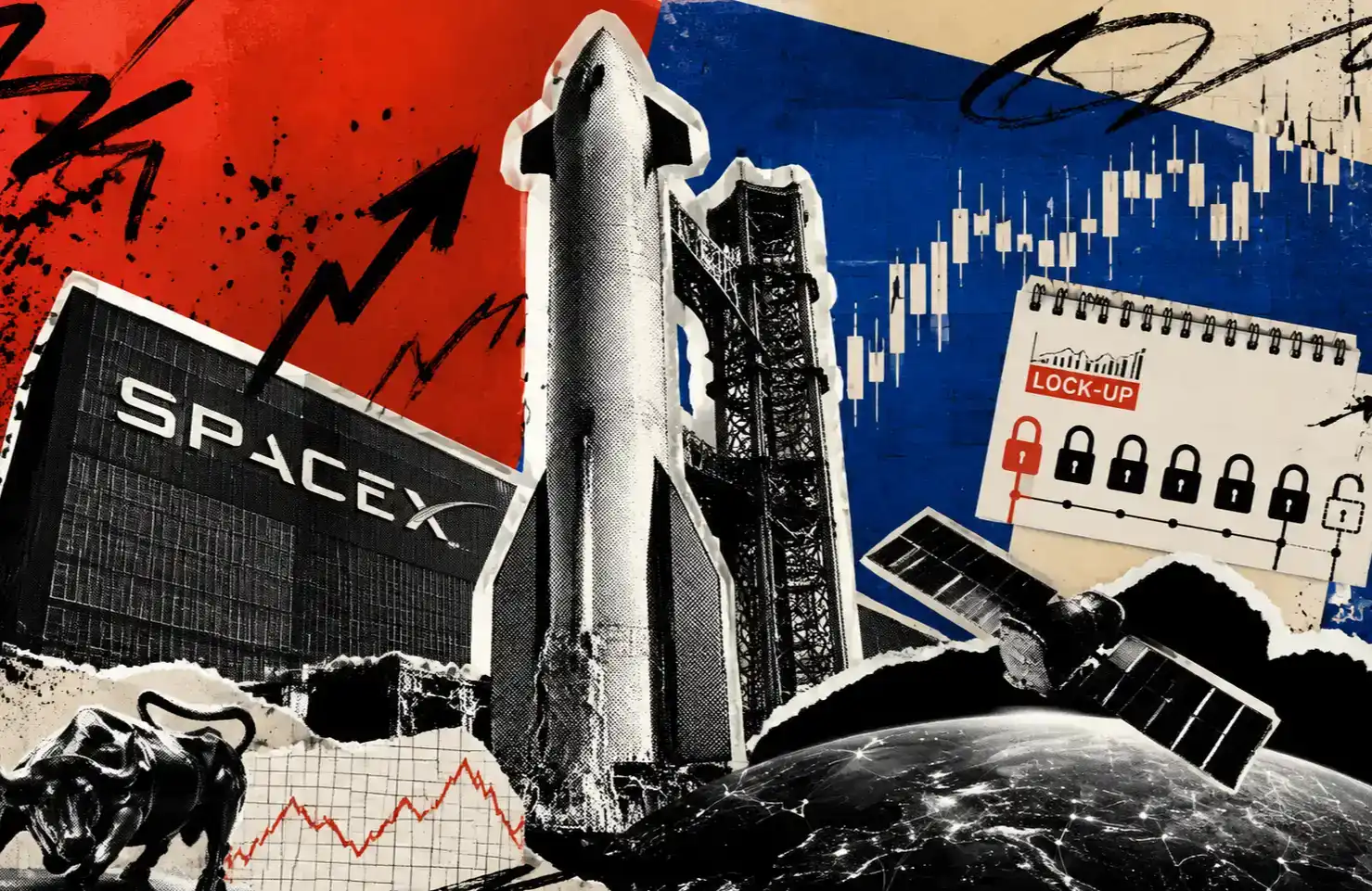
How Will the Price Move Before SpaceX's Next Share Unlock?

TL;DR Investors buying SPCX after SpaceX's IPO are not simply investing in a typical tech stock. It’s a high-valuation asset driven by Musk's narrative, Starlink, and space transport potential, but with a key twist: a very small initial float of ~4% has led to significant post-listing price appreciation. The current price action reflects a timing gap. Before the first lock-up expiration (estimated around August, subject to official confirmation), scarcity and high demand could continue to push prices up. Short-term bulls focus on low float, FOMO, and potential index inclusion. However, bears point to the supply dynamics that will change post-lockup. Existing shareholders still hold over 95% of shares, which will be released in stages starting from the first unlock window. This introduces future selling pressure from low-cost holders. The upcoming Q2 earnings report is a critical catalyst before the unlock. It will test whether the company's fundamentals can justify the current ~$2.1T valuation. Strong results could support the pre-unlock momentum, while weak figures could amplify concerns about future supply. The trading thesis is shifting from immediate scarcity ("can't buy enough") to evaluating future absorption capacity ("who will buy when more supply hits"). The path ahead hinges on the specifics of the unlock schedule, Q2 earnings performance, and whether anticipated passive index buying materializes.

marsbit20 min fa

How Will the Price Move Before SpaceX's Next Share Unlock?

marsbit20 min fa

Bitcoin Short-Term Bullish Structure Validated, HYPE Low-Entry Window Opens | Guest Analysis

**Market Analysis Summary (Week of June 2026)** **Overall Market Context:** The market environment is exceptionally complex, with the unexpected US-Iran agreement and the reopening of the Strait of Hormuz triggering a global asset repricing and significant volatility. This heightened noise underscores the importance of a structured analytical framework. **Bitcoin (BTC) Analysis & Strategy:** * **Current Status:** The price has climbed above $65,000, currently in a rebound phase (segment 38-39) following a complex 12-segment correction from the May high of $82,850. * **Key Levels:** * **Primary Resistance:** $69,500–$70,500. A successful breakout above $65,000 targets this zone. * **Primary Support:** $65,000 (immediate), followed by $59,000–$60,000 and $55,000. * **Weekly Outlook & Strategy:** The focus is on the confirmation of the $65,000 level. * **Bullish Scenario (Hold $65K):** A move toward the $69.5K–$70.5K resistance zone is anticipated, which is a potential area for initiating medium-term short positions. * **Bearish Scenario (Break below $65K):** A retest of the $60,000–$62,000 support range is likely. * **Medium-Term Strategy:** Currently neutral. Plan to establish short positions (up to 60% allocation) either in the $69.5K–$70.5K resistance zone upon signs of rejection, or on a confirmed breakdown below $65,000 and further below $59K–$60K. * **Short-Term Strategy:** Utilize 30% capital for scalping opportunities based on support/resistance levels, using 30/60-minute charts. **HYPE Analysis & Strategy:** * **Current Status:** The price has stabilized around $52 after a four-segment decline from the June high of $75.87 and is now in a rebound (segment 50-51). * **Key Levels:** * **Primary Resistance:** $62.50–$64.57. Watch for potential rejection here to form a lower high. * **Primary Support:** $52–$55.50, followed by $47–$49. * **Weekly Outlook & Strategy:** Adopt a "buy on dips, avoid chasing rallies" approach. * **Core View:** Monitor the price action and potential formation of a lower high ("endpoint 51") in the $62.50–$64.57 resistance zone. * **Short-Term Strategy:** Consider light long positions (max 30% allocation) if the price finds support and shows reversal signals in the $52–$54.50 or deeper $47–$49 support zones, confirmed by proprietary quantitative bottom signals. **Trade Review:** Last week's HYPE short-term long trade, executed based on proprietary "Price Difference" and "Momentum" model signals, yielded a profit of approximately 11.88%. The entry was near $54.39 and exit near $60.85. **Risk Management Reminder:** Always set an initial stop-loss upon entry. Move stop-loss to breakeven at +1% profit, then trail it upwards to lock in gains as the trade progresses. *Disclaimer: All analysis, models, and strategies are based on personal technical analysis for educational purposes only, not investment advice. The market carries inherent risk.*

Odaily星球日报25 min fa

Bitcoin Short-Term Bullish Structure Validated, HYPE Low-Entry Window Opens | Guest Analysis

Odaily星球日报25 min fa

Bitcoin Short-Term Bullish Structure Validated, HYPE Accumulation Window Opens | Guest Analysis

**Bitcoin and HYPE Market Analysis: Short-Term Outlook and Trading Strategies** This market analysis examines Bitcoin (BTC) and HYPE amid volatile conditions, providing short-term outlooks and specific trading strategies. **Key Outlooks:** * **Bitcoin (BTC):** Focus is on whether BTC's recent move above $65,000 holds. A successful breakout could lead to a test of the $69,500-$70,500 resistance zone, where medium-term short positions are considered. A failure, breaking below $65,000, may trigger a decline towards the $59,000-$60,000 support area. * **HYPE:** The token completed a four-wave correction and is now rebounding. The key resistance zone is $62.5-$64.57. The trading strategy is "buy on dips," looking for entry opportunities near the $52-$54.5 or deeper $47-$49 support zones, pending confirmation from proprietary models. **BTC Trading Strategy:** * **Medium-term:** Primarily looking to establish short positions (up to 60% allocated capital) if price rallies to the $69,500-$70,500 resistance area and shows signs of reversal. Alternative plans involve initiating shorts on a breakdown below $65,000. * **Short-term:** Allocate up to 30% capital for intraday "spread" trades based on support/resistance levels on 30/60-minute charts. **HYPE Trading Strategy:** * **Short-term:** Adopt a dip-buying approach. Consider light long positions (under 30% capital) when price tests key support levels ($52-$54.5 or $47-$49) and shows stabilization, confirmed by proprietary "Price Spread" and "Momentum Quant" models. **Trade Recap:** The analysis reviews a successful HYPE long trade from the previous week, executed at ~$54.39 and closed at ~$60.85 for an ~11.88% gain, based on signals from the aforementioned models. **Risk Management Emphasis:** The article stresses strict capital allocation (under 30-60%), immediate initial stop-loss placement, and a trailing stop-loss protocol to lock in profits as trades move favorably. ***Disclaimer:** All analysis, models, and strategies are for educational purposes based on technical analysis, not investment advice. Markets are volatile; trade with caution.*

marsbit27 min fa

Bitcoin Short-Term Bullish Structure Validated, HYPE Accumulation Window Opens | Guest Analysis

marsbit27 min fa

Trading

Spot
Futures

Articoli Popolari

Cosa è BITCOIN

Comprendere HarryPotterObamaSonic10Inu (ERC-20) e la sua posizione nel mondo delle criptovalute Negli ultimi anni, il mercato delle criptovalute ha assistito a un aumento della popolarità delle meme coin, catturando l'interesse non solo dei trader, ma anche di coloro che cercano coinvolgimento comunitario e valore di intrattenimento. Tra questi token unici c'è HarryPotterObamaSonic10Inu (ERC-20), un progetto intrigante che mescola riferimenti culturali nel tessuto delle criptovalute. Questo articolo esplora gli aspetti chiave di HarryPotterObamaSonic10Inu, analizzando i suoi meccanismi, l'etica guidata dalla comunità e il suo coinvolgimento con il panorama crittografico più ampio. Che cos'è HarryPotterObamaSonic10Inu (ERC-20)? Come suggerisce il suo nome, HarryPotterObamaSonic10Inu è una meme coin costruita sulla blockchain di Ethereum, classificata secondo lo standard ERC-20. A differenza delle criptovalute tradizionali che possono enfatizzare l'utilità pratica o il potenziale investimento, questo token prospera grazie al valore di intrattenimento e alla forza della sua comunità. Il progetto mira a creare un ambiente in cui gli utenti coinvolti possono riunirsi, condividere idee e partecipare ad attività ispirate a diversi fenomeni culturali. Una caratteristica notevole di HarryPotterObamaSonic10Inu è la zero tassa sulle transazioni. Questo elemento allettante tende a incoraggiare il trading e il coinvolgimento della comunità, privo di costi aggiuntivi che possono scoraggiare i trader di piccole dimensioni. L'offerta totale della moneta è fissata a un miliardo di token, un numero che segna la sua intenzione di mantenere una circolazione sostanziale all'interno della comunità. Creatore di HarryPotterObamaSonic10Inu (ERC-20) Le origini di HarryPotterObamaSonic10Inu sono avvolte in un certo mistero; i dettagli sul creatore rimangono sconosciuti. Lo sviluppo di questo token non presenta un team identificabile o un piano esplicito, cosa non rara nel settore delle meme coin. Invece, il progetto è emerso organicamente, con il suo progresso fortemente dipendente dall'entusiasmo e dalla partecipazione della sua comunità. Investitori di HarryPotterObamaSonic10Inu (ERC-20) Per quanto riguarda investimenti esterni e finanziamenti, HarryPotterObamaSonic10Inu rimane ambiguo. Il token non elenca alcuna fondazione di investimento conosciuta o un sostegno organizzativo significativo. Invece, la linfa vitale del progetto è la sua comunità di base, che informa la sua crescita e sostenibilità attraverso azioni collettive e coinvolgimento nello spazio crittografico. Come funziona HarryPotterObamaSonic10Inu (ERC-20)? In quanto meme coin, HarryPotterObamaSonic10Inu opera principalmente al di fuori delle strutture tradizionali che governano spesso il valore degli asset. Ci sono diversi aspetti distintivi che definiscono il funzionamento del progetto: Transazioni senza tasse: Senza costi fiscali sulle transazioni, gli utenti possono comprare e vendere liberamente il token senza preoccuparsi di costi nascosti. Coinvolgimento della comunità: Il progetto prospera sull'interazione della comunità, sfruttando le piattaforme social per creare entusiasmo e facilitare il coinvolgimento. Discussioni, condivisione di contenuti e coinvolgimento sono elementi cruciali che aiutano ad espandere la sua portata e a favorire la lealtà tra i sostenitori. Nessuna utilità pratica: Va notato che HarryPotterObamaSonic10Inu non offre un'utilità concreta all'interno dell'ecosistema finanziario. Piuttosto, è classificato come un token principalmente per attività di intrattenimento e comunitarie. Riferimento culturale: Il token incorpora astutamente elementi della cultura pop per attirare interesse, collegandosi a appassionati di meme e seguaci delle criptovalute. HarryPotterObamaSonic10Inu esemplifica come le meme coin operino in modo diverso rispetto ai progetti di criptovalute più tradizionali, entrando nel mercato come costrutti sociali innovativi piuttosto che come asset utilitari. Cronologia di HarryPotterObamaSonic10Inu (ERC-20) La storia di HarryPotterObamaSonic10Inu è segnata da diversi traguardi notevoli: Creazione: Il token è emerso da un meme virale, catturando l'immaginazione di molti appassionati di criptovalute. Le date di creazione specifiche non sono disponibili, sottolineando la sua crescita organica. Inserimento negli scambi: HarryPotterObamaSonic10Inu ha fatto il suo ingresso in vari scambi, consentendo un accesso e un trading più facili da parte della comunità. Iniziative di coinvolgimento della comunità: Attività in corso volte a migliorare l'interazione della comunità, comprese gare, campagne sui social media e generazione di contenuti da parte di fan e sostenitori. Piani di espansione futura: La tabella di marcia del progetto include il lancio di una collezione NFT, merchandising e un sito di eCommerce relativo ai suoi temi culturali, coinvolgendo ulteriormente la comunità e cercando di aggiungere più dimensioni al suo ecosistema. Punti chiave su HarryPotterObamaSonic10Inu (ERC-20) Natura guidata dalla comunità: Il progetto dà priorità al contributo collettivo e alla creatività, garantendo che il coinvolgimento degli utenti sia al centro del suo sviluppo. Classificazione come meme coin: Rappresenta l'epitome delle criptovalute basate sull'intrattenimento, distinguendosi dai veicoli d'investimento tradizionali. Nessuna affiliazione diretta con Bitcoin: Nonostante la somiglianza nel nome del ticker, HarryPotterObamaSonic10Inu è distintivo e non ha alcuna relazione con Bitcoin o altre criptovalute consolidate. Focus sulla collaborazione: HarryPotterObamaSonic10Inu è progettato per creare uno spazio per la collaborazione e la condivisione di storie tra i suoi detentori, fornendo un canale per la creatività e il legame comunitario. Prospettive future: L'ambizione di espandersi oltre il suo presupposto iniziale verso NFT e merchandising delinea un percorso per il progetto per potenzialmente entrare in strade più mainstream all'interno della cultura digitale. Poiché le meme coin continuano a catturare l'immaginazione della comunità crittografica, HarryPotterObamaSonic10Inu (ERC-20) si distingue per i suoi legami culturali e il suo approccio centrato sulla comunità. Anche se potrebbe non adattarsi al modello tipico di un token orientato all'utilità, la sua essenza risiede nella gioia e nella camaraderia coltivate tra i suoi sostenitori, evidenziando la natura in evoluzione delle criptovalute in un'epoca sempre più digitale. Con la continuazione dello sviluppo del progetto, sarà importante osservare come le dinamiche della comunità influenzano la sua traiettoria nel panorama in continuo cambiamento della tecnologia blockchain.

1.7k Totale visualizzazioniPubblicato il 2024.04.01Aggiornato il 2024.12.03

Cosa è BITCOIN

Come comprare BTC

Benvenuto in HTX.com! Abbiamo reso l'acquisto di Bitcoin (BTC) semplice e conveniente. Segui la nostra guida passo passo per intraprendere il tuo viaggio nel mondo delle criptovalute.Step 1: Crea il tuo Account HTXUsa la tua email o numero di telefono per registrarti il tuo account gratuito su HTX. Vivi un'esperienza facile e sblocca tutte le funzionalità,Crea il mio accountStep 2: Vai in Acquista crypto e seleziona il tuo metodo di pagamentoCarta di credito/debito: utilizza la tua Visa o Mastercard per acquistare immediatamente BitcoinBTC.Bilancio: Usa i fondi dal bilancio del tuo account HTX per fare trading senza problemi.Terze parti: abbiamo aggiunto metodi di pagamento molto utilizzati come Google Pay e Apple Pay per maggiore comodità.P2P: Fai trading direttamente con altri utenti HTX.Over-the-Counter (OTC): Offriamo servizi su misura e tassi di cambio competitivi per i trader.Step 3: Conserva Bitcoin (BTC)Dopo aver acquistato Bitcoin (BTC), conserva nel tuo account HTX. In alternativa, puoi inviare tramite trasferimento blockchain o scambiare per altre criptovalute.Step 4: Scambia Bitcoin (BTC)Scambia facilmente Bitcoin (BTC) nel mercato spot di HTX. Accedi al tuo account, seleziona la tua coppia di trading, esegui le tue operazioni e monitora in tempo reale. Offriamo un'esperienza user-friendly sia per chi ha appena iniziato che per i trader più esperti.

4.0k Totale visualizzazioniPubblicato il 2024.12.12Aggiornato il 2026.06.02

Come comprare BTC

Cosa è $BITCOIN

ORO DIGITALE ($BITCOIN): Un'Analisi Completa Introduzione all'ORO DIGITALE ($BITCOIN) L'ORO DIGITALE ($BITCOIN) è un progetto basato su blockchain che opera sulla rete Solana, con l'obiettivo di combinare le caratteristiche dei metalli preziosi tradizionali con l'innovazione delle tecnologie decentralizzate. Sebbene condivida un nome con Bitcoin, spesso definito “oro digitale” a causa della sua percezione come riserva di valore, l'ORO DIGITALE è un token separato progettato per creare un ecosistema unico all'interno del panorama Web3. Il suo obiettivo è posizionarsi come un asset digitale alternativo valido, anche se i dettagli riguardanti le sue applicazioni e funzionalità sono ancora in fase di sviluppo. Cos'è l'ORO DIGITALE ($BITCOIN)? L'ORO DIGITALE ($BITCOIN) è un token di criptovaluta esplicitamente progettato per l'uso sulla blockchain di Solana. A differenza di Bitcoin, che fornisce un ruolo di stoccaggio di valore ampiamente riconosciuto, questo token sembra concentrarsi su applicazioni e caratteristiche più ampie. Aspetti notevoli includono: Infrastruttura Blockchain: Il token è costruito sulla blockchain di Solana, nota per la sua capacità di gestire transazioni ad alta velocità e a basso costo. Dinamiche di Offerta: L'ORO DIGITALE ha un'offerta massima fissata a 100 quadrilioni di token (100P $BITCOIN), sebbene i dettagli riguardanti la sua offerta circolante siano attualmente non divulgati. Utilità: Sebbene le funzionalità precise non siano esplicitamente delineate, ci sono indicazioni che il token potrebbe essere utilizzato per varie applicazioni, potenzialmente coinvolgendo applicazioni decentralizzate (dApp) o strategie di tokenizzazione degli asset. Chi è il Creatore dell'ORO DIGITALE ($BITCOIN)? Attualmente, l'identità dei creatori e del team di sviluppo dietro l'ORO DIGITALE ($BITCOIN) rimane sconosciuta. Questa situazione è tipica tra molti progetti innovativi nel settore blockchain, in particolare quelli allineati con la finanza decentralizzata e i fenomeni delle meme coin. Sebbene tale anonimato possa favorire una cultura guidata dalla comunità, intensifica le preoccupazioni riguardo alla governance e alla responsabilità. Chi sono gli Investitori dell'ORO DIGITALE ($BITCOIN)? Le informazioni disponibili indicano che l'ORO DIGITALE ($BITCOIN) non ha alcun sostenitore istituzionale noto o investimenti di venture capital prominenti. Il progetto sembra operare su un modello peer-to-peer incentrato sul supporto e sull'adozione della comunità piuttosto che su percorsi di finanziamento tradizionali. La sua attività e liquidità si trovano principalmente su exchange decentralizzati (DEX), come PumpSwap, piuttosto che su piattaforme di trading centralizzate consolidate, evidenziando ulteriormente il suo approccio di base. Come Funziona l'ORO DIGITALE ($BITCOIN) Le meccaniche operative dell'ORO DIGITALE ($BITCOIN) possono essere elaborate in base al suo design blockchain e alle caratteristiche della rete: Meccanismo di Consenso: Sfruttando il proof-of-history (PoH) unico di Solana combinato con un modello di proof-of-stake (PoS), il progetto garantisce una validazione efficiente delle transazioni contribuendo all'alta performance della rete. Tokenomics: Sebbene meccanismi deflazionistici specifici non siano stati dettagliati ampiamente, l'ampia offerta massima di token implica che potrebbe soddisfare microtransazioni o casi d'uso di nicchia che devono ancora essere definiti. Interoperabilità: Esiste il potenziale per l'integrazione con l'ecosistema più ampio di Solana, inclusi vari piattaforme di finanza decentralizzata (DeFi). Tuttavia, i dettagli riguardanti integrazioni specifiche rimangono non specificati. Cronologia degli Eventi Chiave Ecco una cronologia che evidenzia traguardi significativi riguardanti l'ORO DIGITALE ($BITCOIN): 2023: Il dispiegamento iniziale del token avviene sulla blockchain di Solana, contrassegnato dal suo indirizzo di contratto. 2024: L'ORO DIGITALE guadagna visibilità poiché diventa disponibile per il trading su exchange decentralizzati come PumpSwap, consentendo agli utenti di scambiarlo contro SOL. 2025: Il progetto assiste a un'attività di trading sporadica e a un potenziale interesse per impegni guidati dalla comunità, sebbene non siano state documentate partnership significative o avanzamenti tecnici fino ad ora. Analisi Critica Punti di Forza Scalabilità: L'infrastruttura sottostante di Solana supporta alti volumi di transazioni, il che potrebbe migliorare l'utilità di $BITCOIN in vari scenari di transazione. Accessibilità: Il potenziale basso prezzo di trading per token potrebbe attrarre investitori al dettaglio, facilitando una partecipazione più ampia grazie a opportunità di proprietà frazionata. Rischi Mancanza di Trasparenza: L'assenza di sostenitori, sviluppatori o di un processo di audit pubblicamente noti potrebbe generare scetticismo riguardo alla sostenibilità e all'affidabilità del progetto. Volatilità del Mercato: L'attività di trading è fortemente dipendente dal comportamento speculativo, il che può comportare una significativa volatilità dei prezzi e incertezze per gli investitori. Conclusione L'ORO DIGITALE ($BITCOIN) emerge come un progetto intrigante ma ambiguo all'interno dell'evolvente ecosistema di Solana. Sebbene tenti di sfruttare la narrativa dell'“oro digitale”, la sua partenza dal ruolo consolidato di Bitcoin come riserva di valore sottolinea la necessità di una chiara differenziazione della sua utilità e struttura di governance. L'accettazione e l'adozione future dipenderanno probabilmente dall'affrontare l'attuale opacità e dalla definizione più esplicita delle sue strategie operative ed economiche. Nota: Questo rapporto comprende informazioni sintetizzate disponibili a ottobre 2023, e potrebbero essersi verificati sviluppi oltre il periodo di ricerca.

99 Totale visualizzazioniPubblicato il 2025.05.13Aggiornato il 2025.05.13

Cosa è $BITCOIN

Discussioni

Benvenuto nella Community HTX. Qui puoi rimanere informato sugli ultimi sviluppi della piattaforma e accedere ad approfondimenti esperti sul mercato. Le opinioni degli utenti sul prezzo di BTC BTC sono presentate come di seguito.

活动图片