Ethereum Is Retracing the Path of the Internet and Linux: No One Yields, and the Neutral Party Ultimately Prevails

marsbitPubblicato 2026-06-22Pubblicato ultima volta 2026-06-22

Introduzione

This article argues that Ethereum is following the historical path of open, neutral systems like the Internet and Linux, which eventually triumphed over proprietary, centrally-controlled alternatives. Major financial institutions like JPMorgan, Stripe, and Circle are building their own proprietary blockchains or networks (e.g., Tempo, Arc), but will never agree to build on a competitor's controlled infrastructure. This creates the perfect opportunity for Ethereum as the only neutral, credibly neutral settlement layer that no single entity controls. The piece draws parallels to the 1990s, when experts like Bill Gates predicted proprietary networks (from Microsoft, Oracle) would win over the open Internet, and when Sun Microsystems' Unix lost to the open-source "bazaar" development model of Linux. This model, described in Eric Raymond's "The Cathedral and the Bazaar," thrives on permissionless innovation where countless contributors improve the system, outpacing any centralized competitor. Ethereum embodies this through its decentralized development, broad validator distribution, and credible neutrality—rules that are transparent, equally applied, hard to change, and open to all. This has attracted over a million developers and major institutions like Coinbase, BlackRock, and JPMorgan, who choose Ethereum for its security, ecosystem, and sovereignty (the inability of any single party to change the rules). While proprietary chains offer initial speed and control, they inherit ...

Author: Etherealize

Compiled by: Deep Tide TechFlow

Deep Tide Introduction: Stripe wants everyone to use Tempo, JPMorgan wants to push its own chain, Circle intends to launch Arc—giants will never build on a rival's infrastructure. This is precisely Ethereum's opportunity: when everyone refuses to submit to a company-controlled foundation, the only choice is a neutral layer that no one controls.

Ethereum is replaying the history of the Internet and Linux.

"Stripe wants everything to happen on Tempo, but JPMorgan wants everything on the JPMorgan chain, Circle wants everything on Arc, and so on. They will never reach an agreement. Major players will never agree to build on another major player's infrastructure. This is why Ethereum is the only option. It is the only way forward—as the neutral infrastructure everyone can accept."

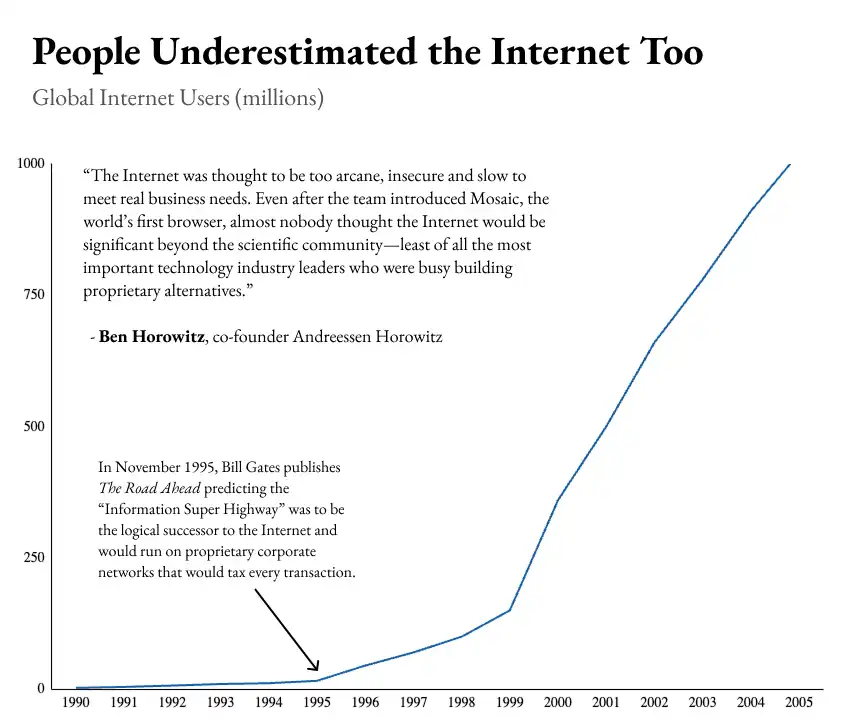
In 1995, most of the technology elite were convinced the Internet would lose out to proprietary corporate networks. They were wrong, and today's critics of Ethereum are likely to be wrong for similar reasons. The most famous example is Bill Gates, who predicted in his book *The Road Ahead* that the future of digital commerce would not run on the open Internet but on proprietary networks owned by companies like Microsoft and Oracle. This was once the consensus. As a16z co-founder Ben Horowitz wrote: "Almost no one thought the Internet would have a significant impact outside of scientific circles—the greatest skeptics were precisely the most important technology industry leaders busy building proprietary alternatives." Linux went through the same thing. Throughout the late 1990s, Sun Microsystems dominated the high-end Unix server market, but by the early 2000s, it lost most of its business to open-source Linux running on cheap generic hardware.
The same pattern is playing out today in financial infrastructure. Companies perceive opportunities and threats, racing to build proprietary blockchains within their controlled walled gardens. For a while, proprietary versions appear to be winning—they are faster, have better user experiences, and boast large business development teams. Then they are slowly swallowed by an open, credibly neutral alternative, because no company can keep up with the pace of permissionless innovation forever, and no serious participant will build on infrastructure controlled by a competitor.

In his 1997 essay "The Cathedral and the Bazaar," Linux contributor Eric Raymond attempted to explain why open, permissionless infrastructure tends to win in the long run. Since Fred Brooks' *The Mythical Man-Month*, the accepted wisdom was that software had to be built by small, tightly managed teams under a single architect because communication costs increase quadratically. However, Raymond saw thousands of contributors (most of whom had never met) working simultaneously on different parts of the Linux kernel, surpassing multibillion-dollar companies. If traditional software was carefully crafted like a "cathedral," then the "bazaar" was Raymond's description of the chaotic, public, distributed development model accidentally discovered by Linus Torvalds—he gave away the kernel source code for free and accepted patches from anyone willing to submit. The guiding philosophy, in Raymond's words, was "release early, release often, delegate everything you can, and be open to the point of promiscuity," resulting in an operating system that ran most of the web by the early 2000s.

Raymond's explanation was that the bazaar avoids the quadratic communication cost problem because contributors do not coordinate directly with each other. They coordinate through patches and releases with the codebase, with maintainers integrating their work into a medium that everyone then coordinates around. As he put it, "The principle behind Brooks's law has not been repealed, but its effects can be swamped by other non-linear factors in the presence of a large developer population and cheap communication."

Another mechanism Raymond identified is that the bazaar eliminates the distinction between users and developers. In the cathedral, users are customers reporting bugs to a service desk. In the bazaar, users are co-developers reporting bugs by fixing them or describing them with enough technical detail for others to fix. Raymond explained that in the open-source community, "every problem is transparent to someone." Collective collaboration surpasses any centralized competitor:

"The Linux world in many ways behaves like a free market or ecosystem, a collection of self-interested agents trying to maximize utility, a process that produces a self-correcting spontaneous order more delicate and efficient than any centralized planning."

You can see this happening on Ethereum. Fabian Vogelsteller wrote the ERC-20 standard, now used by every stablecoin because he found no clean way to support tokens while building a wallet—each token had a different interface. The ERC-721 standard for NFTs came from the people making CryptoKitties. Uniswap, now the largest decentralized exchange of its kind in the world, originated from a blog post by Vitalik Buterin, built by mechanical engineer Hayden Adams with no financial background. None of them needed permission to improve the network. As Sun Microsystems co-founder Bill Joy said, "No matter who you are, most of the smartest people work for someone else." In a permissionless system, innovation can come from anywhere.

The difference between the bazaar and the cathedral is that the integration layer in the bazaar is thin, public, and based on credibility rather than authority. Coordinators like Linus Torvalds or Vitalik Buterin lead because contributors choose to follow, and contributors choose to follow because the coordinator's decisions can be inspected, criticized, and forked if necessary. The Internet has thin centralized integration in the form of the IETF and IANA. Wikipedia has its editorial process. Every project that gains a sustained advantage from permissionless innovation combines truly open contribution with structured integration, preventing the chaos critics fear. And the integration layer must operate through credibility, not coercion, or it fails.

The bazaar also requires a foundation that no one can capture. If Torvalds tried to privatize the kernel, contributors would fork the project and continue elsewhere. Raymond developed this idea in *Homesteading the Noosphere*, arguing that open source had developed a property rights theory similar to Locke's theory of land ownership: developers establish ownership by homesteading a project (writing the initial code), maintain it through continued contribution, and can transfer it through legitimate inheritance. The credibility of open licenses is the formal mechanism; the norms of the Internet noosphere are the social mechanism. Take away either, and contributors will go work elsewhere, where their contributions won't be appropriated.

In the Ethereum community, Vitalik Buterin formalized this requirement as "credible neutrality." A coordination mechanism is credibly neutral when the rules are transparent, apply equally to all participants, are difficult to change, and participation is open to anyone willing to abide by the rules. These four properties are extracted from systems that can attract contributions at scale. The Internet, Linux, and Wikipedia all have versions of these four properties. Proprietary networks, walled gardens, and corporate blockchains do not.

Over a sufficiently long time horizon, credibly neutral systems usually win. Open networks replaced proprietary ones; Linux replaced proprietary Unix; Wikipedia replaced Encarta and the Encyclopædia Britannica. Each time, proprietary alternatives had real advantages—focused products, more capital, customer support teams, professional marketing and business development teams—and each time, those advantages eroded as the open ecosystem matured and network effects reversed. Once an open alternative crosses the threshold in accumulated contributions, tools, and credibility of not changing the rules, closed systems can almost never compete.

The same pattern is now playing out at every layer of financial infrastructure. SWIFT, Visa, and Mastercard, and today's consortium chains pitched to institutions, are different products with different histories, but structurally they are the same bet: centrally controlled infrastructure with a potential landlord. For forty years, SWIFT was a neutral pipeline owned by its member banks, until the U.S. pressured it to cut off Iranian banks in 2012 and several Russian banks in 2022. Despite corporate governance and Belgian registration, SWIFT ultimately answers to the U.S., and the rest of the world took note. China accelerated CIPS, Russia built SPFS, India expanded UPI, Brazil's Pix became the backbone of BRICS Pay. Visa and Mastercard started as bank cooperatives too, then became toll booths charging merchants 1.5–3.5% per transaction. The consortium chains being pitched today (like Canton, Tempo, Arc) have the same flaw: a landlord whose interests may diverge from those building on it.

"The original vision of consortium blockchains—5 banks or big companies getting together to create their own chain—has basically failed," explained Vitalik Buterin. "It ends up inheriting most of the disadvantages of centralization and most of the disadvantages of decentralization at the same time." As he describes it, the problem is that the first few banks feel like equal founders, but the twentieth bank is just joining something competitors already control. You bear all the engineering costs of a distributed system but get none of the benefits of openness, composability, and credible neutrality—the very things that make blockchains worth building in the first place.

The wreckage confirms his point. Between 2017 and 2019, several major banking consortia set out to rebuild trade finance on blockchain. We.trade, backed by a dozen banks including HSBC and Deutsche Bank, went bankrupt in 2022. Marco Polo signed up over thirty banks, liquidated a year later. Contour shut down months after. The Australian Securities Exchange spent six years and roughly A$250 million on a permissioned ledger built by Digital Asset (the company behind Canton today), abandoning the project in 2022. Meanwhile, Ethereum, controlled by no one, has never gone down in its 10+ year history, only grown.

This is why developers choose Ethereum. According to Electric Capital, over one million developers have contributed to the Ethereum ecosystem over its lifetime, with about 232,000 active in the past year alone. No other chain comes close. Part of this is a plain flywheel effect: tools, standards, and job opportunities are on Ethereum, so people learn to build there, attracting more tools and jobs. But developers and institutions also specifically choose Ethereum for its superior decentralization and credible neutrality. For example, last year Robinhood chose to build an L2 on Ethereum instead of its own L1; the company's head of crypto, Johann Kerbrat, explained the rationale:

"You see a lot of companies now building their own L1s. We were excited about the idea of controlling everything you want to build, but creating a truly, properly decentralized chain's security is extremely difficult, and Ethereum basically gives you that for free. When you look at some of the new L1s being created, they aren't really decentralized, nor really secure. At the end of the day, it's basically a fancy database that's a bit slower than an actual database, so we really don't see the value."

Erik Voorhees, founder of Venice AI (a privacy-first AI inference platform with over 3 million users and tens of millions in ARR), laid out a similar rationale a few days ago. When asked why Venice is building on Coinbase's Ethereum L2 Base, Erik replied: "This wasn't even a question for us; the Ethereum ecosystem is the more authentic, more resilient, more robust ecosystem across all smart contract platforms."

The most important property of a blockchain is sovereignty. Bitcoin was revolutionary because it was the world's first sovereign computer platform. Before Bitcoin, all computer platforms belonged to individuals, companies, or governments, which had to obey the will of their owners and the rules of their jurisdiction. But sovereignty obeys only its own rules, and no single entity could impose rules on Bitcoin. Kings and queens were once sovereigns, then nation-states, and now, for the first time, a computer platform can be sovereign. This is why decentralization is so revered in crypto; it is the means to achieve sovereignty. A platform with ten validators obeys the rules of those ten. But a platform like Ethereum, with hundreds of thousands of independent validators spread across every major jurisdiction, multiple independent client implementations, and a foundation that explicitly renounces governance power, has crossed a threshold where no party can credibly claim ownership. Sovereignty is the property that allows a global financial system to build on Ethereum without any participant worrying that another participant, a government, or the foundation will change the rules to their detriment.

Ethereum's lead in sovereignty and credible neutrality comes largely from path dependency that other blockchains cannot replicate. Ethereum launched in 2015 with PoW, ran for seven years, and transitioned to PoS in 2022. During this time, network ownership was distributed through a public crowdfunding in 2014 and GPU mining kept deliberately accessible to consumer-grade hardware. The result was broad token distribution, with no single entity controlling a meaningful share of the network (a key factor for PoS network sovereignty). Modern consortium chains launch as venture capital rounds with concentrated insider allocations, giving a few participants outsized control over the chain's consensus. Competitors can copy the architecture but not the history.

Since then, Ethereum's lead has only compounded. The platform's sovereignty and credible neutrality attract developers. Developers attract more developers because the libraries, tools, and hiring pools already existing on Ethereum make building there easier than anywhere else. Applications attract liquidity and tokenized assets, which in turn attract institutions. Each layer reinforces the others, and competitors trying to enter have to build all layers at once while Ethereum continues to compound.
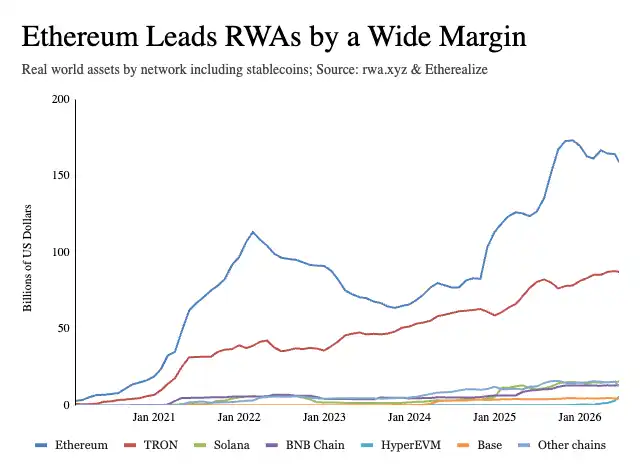
The most established players in the field have already chosen Ethereum. Coinbase and Robinhood chose Ethereum for their L2s. BlackRock and JPMorgan launched their tokenized money market funds BUIDL and MONY on Ethereum. Major DeFi protocols, including Aave, Maker/Sky, Maple, and Uniswap, are primarily on Ethereum. The largest stablecoin issuers settle on Ethereum. According to Token Terminal's Q1 2026 Ethereum Report, Ethereum holds 79% of active DeFi loans, 62% of stablecoins, 73% of tokenized funds, and 84% of tokenized commodities among the top five chains.

Applications are also permissionless, further reinforcing Ethereum's advantages. For example, Uniswap's permissionless listing process allows thousands of long-tail assets to find price discovery and liquidity that no centralized exchange would provide. Aave's lending markets are open and composable, enabling an entire ecosystem of specialized vaults and risk managers to emerge atop its liquidity, extending Aave's reach far beyond what the core team could build alone. Closed systems need gatekeepers to anticipate every use case in advance; open systems do not.

The strongest objection to the "permissionless wins" view is not technical; it's that finance might be the one place where corporate-owned networks are a feature, not a bug. When payments fail or assets end up where they shouldn't, regulators want someone to be accountable. When lawyers show up, "no one in charge" sounds less like an advantage and more like liability. But this objection confuses two things that exist at different layers. Accountability exists at the application layer, not the settlement layer. For instance, token standards like ERC-3643 embed KYC, identity verification, and jurisdictional transfer restrictions directly into a token's smart contract, allowing issuers to whitelist wallets, restrict transfers, and freeze or claw back assets. Privacy works the same way; zero-knowledge cryptography lets institutions settle on public chains while keeping transaction details confidential. On consortium chains, the only people who see your data are you and your closest competitors.

Early on, the Internet was considered too unsafe for real commerce. Then HTTPS made the open web secure enough that nearly all commerce moved onto it, and the issue was never raised again. Skeptics weren't wrong about the early state. They just incorrectly assumed the open web couldn't close the gap.

The banks and fintechs building their own chains today are thinking what AOL and Microsoft thought in the early days of the Internet: build something open, but inside your own walled garden so you can collect rent. But that never works because the walls that give you control are the same walls that block innovation.

A better model is Netscape. Netscape didn't try to own the web; it built the browser that brought the world onto the web. Riding the explosive growth of the open web, it became one of the most important companies of its era. Ethereum's credible neutrality is almost impossible to replicate, and it's already positioned to become the settlement layer for global finance. The winning strategy is to build on permissionless infrastructure, not compete with it.

Disclosure: This analysis is published by Etherealize, an organization focused on institutional Ethereum adoption. The author and Etherealize may hold positions in ETH and other digital assets discussed. This is not investment advice.

Crypto di tendenza

Domande pertinenti

QAccording to the article, what historical pattern is Ethereum currently repeating, and why?

AEthereum is currently repeating the historical pattern of the internet and Linux. In both cases, proprietary, company-controlled systems initially appeared to have advantages (like being faster or having better marketing), but were eventually overtaken by open, credibly neutral, and permissionless alternatives. This happens because no single company can match the pace of permissionless innovation, and serious participants refuse to build on infrastructure controlled by a competitor, creating an opportunity for a neutral layer like Ethereum.

QWhat is the 'Cathedral and the Bazaar' analogy from the article, and how does it apply to Ethereum?

AThe 'Cathedral and the Bazaar' analogy contrasts two software development models. The 'Cathedral' represents traditional, proprietary software built by small, tightly managed teams. The 'Bazaar' describes the open, chaotic, distributed development model of projects like Linux and Ethereum, where contributions come from a global pool of developers without central coordination. The article states that this 'Bazaar' model, characterized by 'release early, release often,' enables open systems to out-innovate and eventually surpass closed systems, just as Ethereum's permissionless ecosystem has done.

QWhat does Vitalik Buterin mean by 'credible neutrality' and why is it crucial for a platform like Ethereum?

AVitalik Buterin defines 'credible neutrality' by four attributes: transparent rules, rules that apply equally to all participants, rules that are difficult to change, and participation open to anyone willing to follow the rules. This is crucial because it ensures no single entity can control or change the system to benefit themselves at the expense of others. This neutrality is what attracts developers, institutions, and capital, as they can build on Ethereum without fear of a competitor or government changing the foundational rules against them.

QWhy have several major bank-led consortium blockchain projects failed, according to the article?

AMajor bank-led consortium blockchain projects (like We.trade, Marco Polo, Contour) have failed because they inherit 'most of the downsides of centralization and most of the downsides of decentralization.' While the first few members feel like equal founders, later joiners are essentially joining a system already controlled by competitors. These projects bear the engineering costs of a distributed system but fail to gain the key benefits of openness, composability, and credible neutrality that make blockchain technology valuable in the first place.

QHow does the article address the concern about accountability and regulation on a 'neutral' platform like Ethereum?

AThe article argues that the concern about accountability is addressed by separating the settlement layer from the application layer. Accountability exists at the application layer, not the base settlement layer. For example, token standards like ERC-3643 allow issuers to embed KYC, identity verification, and transfer restrictions directly into the token's smart contract. Similarly, zero-knowledge cryptography enables confidential transactions on public chains. This is analogous to how HTTPS made the open internet secure enough for commerce, addressing early security concerns without sacrificing openness.

Letture associate

Soaring Export Data for Memory Chips, Market Is Redefining the Valuation Anchor for Memory Stocks

Korean storage export data for the first 20 days of June shows substantial year-on-year increases in both value and price-per-kilogram for categories like DRAM, NAND, and SSDs. This signals a potential shift beyond simple demand recovery, indicating rising prices and a product mix shift towards higher-value items, possibly influenced by AI infrastructure needs. A key point is that the surge in price-per-kilogram is not simply a uniform chip price hike. It reflects a combination of actual price increases and, more importantly, an export structure increasingly dominated by high-value-density products like HBM (High-Bandwidth Memory) and advanced DRAM, which are critical for AI servers. This suggests AI-driven demand may be spilling over from just HBM into broader memory markets. SK Hynix stands to benefit directly due to its leading HBM position. For Samsung and Micron, the implication is potential for greater margin elasticity if the tightness in high-end memory spreads to enterprise SSD and NAND prices. However, the storage sector remains cyclical. Risks include supply expansion, inventory changes, and potential slowdowns in broader AI capital expenditure. Ultimately, while the strong export data supports upward revisions for storage company earnings and fuels discussion of an "AI infrastructure bottleneck premium," a definitive valuation shift from a cyclical to a structural story depends on upcoming quarterly reports. Investors need confirmation from SK Hynix, Samsung, and Micron that improvements in average selling prices, product mix, and, crucially,毛利率 are sustained over multiple quarters.

marsbit23 min fa

Soaring Export Data for Memory Chips, Market Is Redefining the Valuation Anchor for Memory Stocks

marsbit23 min fa

Why Does SpaceX Have Such a High Valuation Ceiling? The Answer Lies in Musk's Business Blueprint

SpaceX achieved a record-breaking IPO on June 12, 2026, with its market cap surging past $2.1 trillion. This valuation reflects its central role within Elon Musk's expansive, interconnected technological ecosystem. The article details how four core components form a synergistic closed-loop system: 1) **The "Brain" (xAI & Orbital Compute):** xAI provides AI models and massive ground/space-based supercomputing for simulation and decision-making across the system. 2) **The "Neural Logistics Core" (Starlink & Starship):** Starlink's low-latency satellite network enables global data transmission, while Starship's low-cost, reusable launch capacity aims to make large-scale space deployment economically viable. 3) **The "Physical Body" (Tesla & Optimus):** Tesla's manufacturing prowess and energy products support hardware production and power, pivoting toward mass-producing the Optimus humanoid robot for terrestrial and potential space-based labor. 4) **The "Human Interface" (Neuralink & X):** Neuralink seeks direct brain-computer communication, and the X platform provides real-time societal data. Together, these elements create three reinforcing "flywheels": manufacturing/logistics, data-driven iteration, and energy/compute/network synergy. This integrated approach promises lower costs, faster innovation cycles, and potential infrastructure-as-a-service offerings. However, it also concentrates technical, regulatory, and corporate governance risks. Ultimately, SpaceX's high valuation stems from its position as the indispensable infrastructural backbone—handling space transport, global communications, and future orbital computing—tying together Musk's entire vision for a self-reinforcing technological empire.

marsbit27 min fa

Why Does SpaceX Have Such a High Valuation Ceiling? The Answer Lies in Musk's Business Blueprint

marsbit27 min fa

Snap, Unprofitable for Nine Years, and a Decade-Long AR Obsession Without Return

Snap's AR Obsession: A Decade of Betting Against the Odds On June 16, Snap CEO Evan Spiegel unveiled the new AR glasses, Specs, priced at $2,195, causing the company's stock (SNAP) to plummet nearly 10%. The launch was met with intense criticism online, with investors questioning why a consistently unprofitable company would stake its future on an expensive product its core young user base can't afford. Snapchat, known for pioneering features like ephemeral Stories and popular AR lenses (like the iconic dog filter), has a history of innovation often copied by rivals like Instagram and Meta. Despite this, it has struggled to translate first-mover advantage into commercial success. Since its 2017 IPO, Snap has reported annual net losses, with a Q1 2026 loss of $89 million. Its stock is down 94% from its 2021 peak, hampered by iOS privacy changes, competition, and a young demographic less attractive to major advertisers. In this challenging context, Spiegel is doubling down on AR. He calls 2026 a "crucible moment," having recently laid off 16% of staff while reportedly investing over $3.5 billion cumulatively in its AR glasses line over nearly a decade. The new Specs represent a significant leap from the 2016 camera-focused Spectacles, offering true AR overlays, gesture control, and standalone operation. However, at $2,195, it faces tough comparisons. While more advanced than Meta's $799 Ray-Ban smart glasses, critics point to its heavier weight, short battery life, and features largely replicable by a smartphone. Facing pressure from investors to cut losses on the Specs project, Spiegel has refused, framing it as essential to Snap's long-term vision. The company finds itself in a paradoxical position: cutting costs while heavily funding a decade-long, unproven bet. Some see Specs as an awkward but necessary step in AR's evolution, akin to early mobile phones. Whether Spiegel is a visionary outlier or a gambler destined to fail remains an open question, highlighting the tension between long-term ambition and short-term market demands.

marsbit49 min fa

Snap, Unprofitable for Nine Years, and a Decade-Long AR Obsession Without Return

marsbit49 min fa

Annualized Revenue Exceeds $20 Billion, Kalshi Aims to Become the First Prediction Platform IPO?

Kalshi, a leading U.S. prediction markets platform, is reportedly in early, informal discussions for an Initial Public Offering (IPO). The company's annualized revenue now exceeds $2 billion, fueled by its dominance of over 90% of the domestic prediction market activity. This growth stems from a surge in trading volume—reaching a total of $52.7 billion—and an increase in fee rates, largely driven by sports event contracts like the NBA playoffs and the 2026 FIFA World Cup. Monthly active users are approximately 2 million. Kalshi recently raised $1 billion in a funding round led by Coatue Management, valuing the company at $22 billion. It has also expanded its offerings to include Bitcoin perpetual contracts and plans to launch a dedicated trading platform, Kalshi Pro. However, Kalshi's path to an IPO faces significant regulatory hurdles. The core risk involves jurisdictional conflicts, as multiple U.S. states are challenging its operations under local gambling laws. For instance, Arizona has filed criminal charges against the platform, while states like Kentucky have filed lawsuits. Kalshi and the Commodity Futures Trading Commission (CFTC) argue that its event contracts fall under exclusive federal jurisdiction as "swaps." The outcomes of these ongoing legal battles could critically impact Kalshi's core revenue and its IPO timeline. Analysts suggest that while an IPO could theoretically occur by late 2026, a more likely timeframe is late 2027 or 2028, contingent on resolving legal issues and favorable market conditions. If successful, its fundraising could significantly exceed $1 billion, given its current valuation and revenue multiple.

Foresight News1 h fa

Annualized Revenue Exceeds $20 Billion, Kalshi Aims to Become the First Prediction Platform IPO?

Foresight News1 h fa

Trading

Spot
Futures

Articoli Popolari

Cosa è ETH 3.0

ETH3.0 e $eth 3.0: Un'Analisi Approfondita del Futuro di Ethereum Introduzione Nel panorama in rapida evoluzione delle criptovalute e della tecnologia blockchain, ETH3.0, spesso indicato come $eth 3.0, è emerso come un argomento di considerevole interesse e speculazione. Il termine comprende due concetti principali che warrantono chiarimenti: Ethereum 3.0: Questo rappresenta un potenziale futuro aggiornamento volto ad aumentare le capacità dell'attuale blockchain di Ethereum, concentrandosi principalmente sul miglioramento della scalabilità e delle prestazioni. ETH3.0 Meme Token: Questo progetto di criptovaluta distinto cerca di sfruttare la blockchain di Ethereum per creare un ecosistema incentrato sui meme, promuovendo il coinvolgimento all'interno della comunità delle criptovalute. Comprendere questi aspetti di ETH3.0 è essenziale non solo per gli appassionati di criptovalute, ma anche per coloro che osservano tendenze tecnologiche più ampie nello spazio digitale. Che cos'è ETH3.0? Ethereum 3.0 Ethereum 3.0 è pubblicizzato come un aggiornamento proposto per la rete Ethereum già stabilita, che è stata la spina dorsale di molte applicazioni decentralizzate (dApps) e contratti smart sin dalla sua nascita. I miglioramenti previsti si concentrano principalmente sulla scalabilità, integrando tecnologie avanzate come lo sharding e le prove a conoscenza zero (zk-proofs). Queste innovazioni tecnologiche mirano a facilitare un numero senza precedenti di transazioni al secondo (TPS), potenzialmente raggiungendo milioni, affrontando così una delle limitazioni più significative della tecnologia blockchain attuale. Il miglioramento non è meramente tecnico, ma anche strategico; è volto a preparare la rete Ethereum per un'adozione e un'utilità diffuse in un futuro contrassegnato da un aumento della domanda di soluzioni decentralizzate. ETH3.0 Meme Token Al contrario di Ethereum 3.0, l'ETH3.0 Meme Token si avventura in un dominio più leggero e giocoso, combinando la cultura dei meme di internet con la dinamica delle criptovalute. Questo progetto consente agli utenti di acquistare, vendere e scambiare meme sulla blockchain di Ethereum, fornendo una piattaforma che promuove il coinvolgimento della comunità attraverso la creatività e interessi condivisi. L'ETH3.0 Meme Token mira a dimostrare come la tecnologia blockchain possa intersecarsi con la cultura digitale, creando casi d'uso che siano sia divertenti che finanziariamente praticabili. Chi è il Creatore di ETH3.0? Ethereum 3.0 L'iniziativa verso Ethereum 3.0 è principalmente propulsa da un consorzio di sviluppatori e ricercatori all'interno della comunità di Ethereum, tra cui Justin Drake. Conosciuto per le sue intuizioni e contributi all'evoluzione di Ethereum, Drake è stato una figura di spicco nelle discussioni riguardanti la transizione di Ethereum verso un nuovo livello di consenso, chiamato “Beam Chain.” Questo approccio collaborativo allo sviluppo significa che Ethereum 3.0 non è il prodotto di un creatore singolo, ma piuttosto una manifestazione di ingegno collettivo focalizzato sul progresso della tecnologia blockchain. ETH3.0 Meme Token I dettagli riguardanti il creatore dell'ETH3.0 Meme Token sono attualmente non rintracciabili. La natura dei token meme conduce spesso a una struttura più decentralizzata e guidata dalla comunità, il che potrebbe spiegare la mancanza di attribuzione specifica. Questo si allinea con l'etica della comunità crypto più ampia, dove l'innovazione spesso nasce da sforzi collaborativi piuttosto che individuali. Chi sono gli Investitori di ETH3.0? Ethereum 3.0 Il supporto per Ethereum 3.0 proviene principalmente dalla Ethereum Foundation insieme a una comunità entusiasta di sviluppatori e investitori. Questa associazione fondamentale fornisce un considerevole grado di legittimità e migliora le prospettive di implementazione di successo poiché sfrutta la fiducia e la credibilità costruite nel corso degli anni di operazioni della rete. Nel clima in rapida evoluzione delle criptovalute, il supporto della comunità gioca un ruolo cruciale nello sviluppo e nell'adozione, posizionando Ethereum 3.0 come un serio contenditore per i futuri progressi della blockchain. ETH3.0 Meme Token Sebbene le fonti attualmente disponibili non forniscano informazioni esplicite riguardo ai fondamenti o alle organizzazioni di investimento che sostengono l'ETH3.0 Meme Token, ciò è indicativo del modello di finanziamento tipico per i token meme, che spesso si basa sul supporto di base e sul coinvolgimento della comunità. Gli investitori in tali progetti sono tipicamente individui motivati dal potenziale per innovazioni guidate dalla comunità e dallo spirito di cooperazione trovato all'interno della comunità crypto. Come Funziona ETH3.0? Ethereum 3.0 Le caratteristiche distintive dell'Ethereum 3.0 risiedono nella sua proposta di implementazione della tecnologia di sharding e zk-proof. Lo sharding è un metodo di partizionamento della blockchain in pezzi più piccoli e gestibili o “shard,” che possono elaborare transazioni in modo concorrente piuttosto che sequenziale. Questa decentralizzazione dell'elaborazione aiuta a prevenire la congestione e garantisce che la rete rimanga reattiva anche sotto un carico pesante. La tecnologia delle prove a conoscenza zero (zk-proof) contribuisce con un ulteriore livello di sofisticazione consentendo la validazione delle transazioni senza rivelare i dati sottostanti coinvolti. Questo aspetto non solo migliora la privacy, ma aumenta anche l'efficienza complessiva della rete. Si parla anche di incorporare una macchina virtuale Ethereum a conoscenza zero (zkEVM) in questo aggiornamento, amplificando ulteriormente le capacità e l'utilità della rete. ETH3.0 Meme Token L'ETH3.0 Meme Token si distingue capitalizzando sulla popolarità della cultura dei meme. Stabilisce un mercato per gli utenti che desiderano partecipare al trading di meme, non solo per divertimento, ma anche per potenziale guadagno economico. Integrando funzioni come lo staking, la fornitura di liquidità e meccanismi di governance, il progetto promuove un ambiente che incentiva l'interazione e la partecipazione della comunità. Offrendo una miscela unica di intrattenimento e opportunità economica, l'ETH3.0 Meme Token mira ad attrarre un pubblico variegato, che va dagli appassionati di crypto ai semplici intenditori di meme. Timeline di ETH3.0 Ethereum 3.0 11 Novembre 2024: Justin Drake accenna al prossimo aggiornamento ETH 3.0, incentrato sui miglioramenti della scalabilità. Questo annuncio segna l'inizio delle discussioni formali riguardo l'architettura futura di Ethereum. 12 Novembre 2024: La proposta attesa per Ethereum 3.0 dovrebbe essere svelata a Devcon a Bangkok, preparando il terreno per un feedback più ampio della comunità e potenziali passi successivi nello sviluppo. ETH3.0 Meme Token 21 Marzo 2024: L'ETH3.0 Meme Token viene ufficialmente elencato su CoinMarketCap, segnando il suo ingresso nel dominio pubblico delle criptovalute e aumentando la visibilità per il suo ecosistema basato sui meme. Punti Chiave In conclusione, Ethereum 3.0 rappresenta una significativa evoluzione all'interno della rete Ethereum, concentrandosi sul superamento delle limitazioni riguardanti scalabilità e prestazioni attraverso tecnologie avanzate. I suoi aggiornamenti proposti riflettono un approccio proattivo alle future esigenze e usabilità. D'altra parte, l'ETH3.0 Meme Token incarna l'essenza della cultura guidata dalla comunità nello spazio delle criptovalute, sfruttando la cultura dei meme per creare piattaforme coinvolgenti che incoraggiano la creatività e la partecipazione degli utenti. Comprendere gli scopi e le funzionalità distinte di ETH3.0 e $eth 3.0 è fondamentale per chiunque sia interessato ai continui sviluppi nello spazio crypto. Con entrambe le iniziative che tracciano percorsi unici, esse sottolineano collettivamente la natura dinamica e multifacetica dell'innovazione blockchain.

185 Totale visualizzazioniPubblicato il 2024.04.04Aggiornato il 2024.12.03

Cosa è ETH 3.0

Cosa è ETHEREUM

HarryPotterTrumpHomerSimpson777Inu: Panoramica di un Progetto Crypto Web3 Introduzione Nel mondo in rapida evoluzione delle criptovalute e della finanza decentralizzata, progetti innovativi emergono frequentemente, catturando l'interesse della comunità degli investitori e degli appassionati di crypto. Uno di questi progetti è HarryPotterTrumpHomerSimpson777Inu, una criptovaluta che si trova all'incrocio tra cultura popolare e tecnologia blockchain. Questo token guidato dalla comunità mescola personaggi e figure politiche ben noti, con l'obiettivo di creare una piattaforma coinvolgente e promuovere un'adozione diffusa. Che cos'è HarryPotterTrumpHomerSimpson777Inu? HarryPotterTrumpHomerSimpson777Inu è un token costruito sulla blockchain di Ethereum, progettato per essere accessibile e divertente per un pubblico diversificato. L'unicità di questo progetto deriva dal suo approccio tematico, che intreccia elementi di fantasia, politica e intrattenimento. Sfruttando il fascino nostalgico di personaggi amati, il progetto cerca di creare un'esperienza di criptovaluta coinvolgente, incoraggiando il coinvolgimento e la partecipazione della comunità. L'obiettivo principale di HarryPotterTrumpHomerSimpson777Inu è stabilire un token che risuoni con gli utenti a livello personale, promuovendo sia il divertimento che il coinvolgimento nell'ambito crypto. Questo branding distintivo mira ad attrarre individui che in precedenza potrebbero non essersi interessati alle criptovalute, facilitando un nuovo punto di ingresso per utenti potenziali. Creatore di HarryPotterTrumpHomerSimpson777Inu L'identità del creatore dietro HarryPotterTrumpHomerSimpson777Inu rimane sconosciuta. Questa non è una pratica rara nel dominio delle criptovalute, dove l'anonimato è spesso preferito dai fondatori come mezzo di protezione della privacy e promozione di un ethos decentralizzato. Questa oscurità non diminuisce il valore del progetto; al contrario, riflette una tendenza più ampia all'interno del settore, dove molti progetti di successo sono emersi da origini anonime. Investitori di HarryPotterTrumpHomerSimpson777Inu Le informazioni pubbliche riguardo agli investitori di HarryPotterTrumpHomerSimpson777Inu sono limitate. La natura del progetto, incentrata sul coinvolgimento della comunità, suggerisce una dipendenza da investimenti di piccole dimensioni da parte di singoli appassionati piuttosto che da sostegni sostanziali da fondazioni di investimento consolidate o corporation. Questo livello di trasparenza nel finanziamento è tipico di molti progetti di criptovaluta guidati dalla comunità, dove il supporto spesso proviene da movimenti di base piuttosto che da investitori istituzionali. Come Funziona HarryPotterTrumpHomerSimpson777Inu? Operando sulla blockchain di Ethereum, HarryPotterTrumpHomerSimpson777Inu sfrutta la sua solida infrastruttura per facilitare transazioni e promuovere interazioni tra gli utenti all'interno della comunità. Ciò che distingue questo progetto è il suo posizionamento tematico: canalizzando il carisma di personaggi iconici provenienti da diversi ambiti culturali, crea un'identità di marca distintiva. Questo approccio non solo attrae gli utenti, ma coltiva anche una comunità fedele attorno al token. Le meccaniche operative del progetto si concentrano sul coinvolgimento della comunità. Adotta un modello decentralizzato che incoraggia la partecipazione, consentendo agli utenti di interagire attraverso vari canali mentre promuovono lo scambio di idee e esperienze. Inoltre, il progetto abbraccia i principi del Web3, privilegiando la sovranità degli utenti e la decentralizzazione, che sono i pilastri del futuro di Internet. Timeline di HarryPotterTrumpHomerSimpson777Inu La storia di HarryPotterTrumpHomerSimpson777Inu è segnata da diversi eventi decisivi: 12 agosto 2023: L'inizio di HarryPotterTrumpHomerSimpson777Inu, segnando il suo ingresso nell'ecosistema delle criptovalute. Fase di Sviluppo: Un periodo focalizzato sulla costruzione di una strategia completa per stimolare la crescita guidata dalla comunità e il coinvolgimento degli utenti. Listing sugli Scambi: Sebbene i dettagli specifici di listing non siano stati divulgati, il progetto è stato reso accessibile su vari scambi di criptovalute, migliorando la sua visibilità nel mercato. Coinvolgimento della Comunità: Sforzi continui per coinvolgere attivamente la comunità, stabilendo canali di dialogo e promuovendo la partecipazione attraverso varie attività, tra cui concorsi, discussioni e votazioni comunitarie. Aspetti Chiave di HarryPotterTrumpHomerSimpson777Inu Focus sulla Comunità Un tratto distintivo di HarryPotterTrumpHomerSimpson777Inu è la sua forte enfasi sul coinvolgimento della comunità. Il progetto incoraggia attivamente gli utenti a partecipare a discussioni, condividere idee e contribuire all'evoluzione del progetto. Questa interazione coltiva un senso di appartenenza e di ownership tra i membri della comunità, essenziale per la sostenibilità a lungo termine del token. Utilizzo della Blockchain di Ethereum La scelta di costruire sulla blockchain di Ethereum consente a HarryPotterTrumpHomerSimpson777Inu di sfruttare le sue caratteristiche di sicurezza ben consolidate e architettura decentralizzata. Questa base garantisce affidabilità per le transazioni e fornisce un framework affidabile su cui sviluppare varie funzionalità. Approccio Tematico Unico Fusione di elementi della cultura pop nella sua identità, HarryPotterTrumpHomerSimpson777Inu crea una narrazione coinvolgente che lo differenzia da altre criptovalute. L'amalgama di personaggi e temi genera riconoscimento e intrigo immediati, rendendo il token relazionabile a un'ampia gamma di utenti potenziali. Anonimato nello Sviluppo Il creatore anonimo del progetto rimane una caratteristica ricorrente in molte iniziative di criptovaluta. Questo aspetto evidenzia un ethos di decentralizzazione, introducendo anche un livello di mistero che potrebbe affascinare un segmento della comunità crypto, attirando l'attenzione sul progetto e invitando l'impegno da parte di utenti che supportano l'idea di un'iniziativa decentralizzata e gestita dalla comunità. Conclusione HarryPotterTrumpHomerSimpson777Inu si presenta come un'aggiunta distintiva al panorama delle criptovalute, combinando il fascino della cultura popolare con le meccaniche innovative della tecnologia blockchain. Sebbene i dettagli riguardanti il creatore e gli investitori specifici rimangano non divulgati, il focus del progetto sulla comunità e il suo approccio tematico lo contraddistinguono come un potenziale attore influente nel contesto del Web3 e delle criptovalute. Man mano che l'ecosistema delle criptovalute continua ad espandersi, iniziative come HarryPotterTrumpHomerSimpson777Inu ci ricordano le molteplici modalità in cui la blockchain può connettere le comunità globali attraverso narrazioni e valori condivisi.

955 Totale visualizzazioniPubblicato il 2024.04.06Aggiornato il 2024.12.03

Cosa è ETHEREUM

Come comprare ETH

Benvenuto in HTX.com! Abbiamo reso l'acquisto di Ethereum (ETH) semplice e conveniente. Segui la nostra guida passo passo per intraprendere il tuo viaggio nel mondo delle criptovalute.Step 1: Crea il tuo Account HTXUsa la tua email o numero di telefono per registrarti il tuo account gratuito su HTX. Vivi un'esperienza facile e sblocca tutte le funzionalità,Crea il mio accountStep 2: Vai in Acquista crypto e seleziona il tuo metodo di pagamentoCarta di credito/debito: utilizza la tua Visa o Mastercard per acquistare immediatamente EthereumETH.Bilancio: Usa i fondi dal bilancio del tuo account HTX per fare trading senza problemi.Terze parti: abbiamo aggiunto metodi di pagamento molto utilizzati come Google Pay e Apple Pay per maggiore comodità.P2P: Fai trading direttamente con altri utenti HTX.Over-the-Counter (OTC): Offriamo servizi su misura e tassi di cambio competitivi per i trader.Step 3: Conserva Ethereum (ETH)Dopo aver acquistato Ethereum (ETH), conserva nel tuo account HTX. In alternativa, puoi inviare tramite trasferimento blockchain o scambiare per altre criptovalute.Step 4: Scambia Ethereum (ETH)Scambia facilmente Ethereum (ETH) nel mercato spot di HTX. Accedi al tuo account, seleziona la tua coppia di trading, esegui le tue operazioni e monitora in tempo reale. Offriamo un'esperienza user-friendly sia per chi ha appena iniziato che per i trader più esperti.

2.9k Totale visualizzazioniPubblicato il 2024.12.10Aggiornato il 2026.06.02

Come comprare ETH

Discussioni

Benvenuto nella Community HTX. Qui puoi rimanere informato sugli ultimi sviluppi della piattaforma e accedere ad approfondimenti esperti sul mercato. Le opinioni degli utenti sul prezzo di ETH ETH sono presentate come di seguito.

活动图片