Domestic First Explosion-Proof Certification, World's First Fueling Brain Solution: How Did They Secure Two 'Firsts'?

marsbitPubblicato 2026-06-26Pubblicato ultima volta 2026-06-26

Introduzione

China's embodied AI sector is booming, with over ¥37 billion in funding this year. The focus has shifted decisively to real-world application, particularly in hazardous, repetitive tasks humans should avoid. A key, often prohibitive, barrier to entry for robots in environments like gas stations and oil fields is obtaining explosion-proof certification, requiring meticulous hardware and circuit design from the ground up. The article explores three main application areas. At gas stations, the challenge lies in executing a long, precise sequence of actions (opening caps, handling the fuel nozzle) with millimeter accuracy across diverse car models. For facility inspections, robots need sustained autonomous patrols combined with real-time anomaly detection and response. Port scenarios introduce the complexity of multi-robot coordination. Addressing the core challenge of long-horizon tasks, the piece highlights a technical breakthrough: a "world model"-driven approach. This enables predictive planning, allowing the AI to visualize the desired end-state (e.g., nozzle returned, cap closed) and work backward to synthesize intermediate visual frames. This "imagination" of the task trajectory, as implemented in the H-GAR architecture, guides action generation, significantly reducing cumulative error in multi-step operations. The three-step H-GAR process involves generating a coarse action draft, synthesizing target-conditioned observation frames, and then refining actions based on vis...

According to statistics, the total financing in the domestic embodied intelligence field this year has exceeded 37 billion yuan.

The Ministry of Industry and Information Technology and the State-owned Assets Supervision and Administration Commission jointly launched the 'Humanoid Robots and Embodied Intelligence Real-World Training Special Action', with China National Radio News directly labeling this year as the 'critical year for commercialization and implementation'. Funding from the primary market and narratives from the secondary market are all pointing in the same direction: implementation, implementation, implementation.

But here comes the question: How should embodied intelligence be implemented?

A widely accepted viewpoint is that embodied intelligence should tackle tasks that humans cannot do and replace humans in performing high-risk, heavy, repetitive jobs that people don't want to do and shouldn't be doing.

On June 22nd, the 4th China International Supply Chain Expo (CISCE) opened in Beijing, featuring a dedicated artificial intelligence zone for the first time.

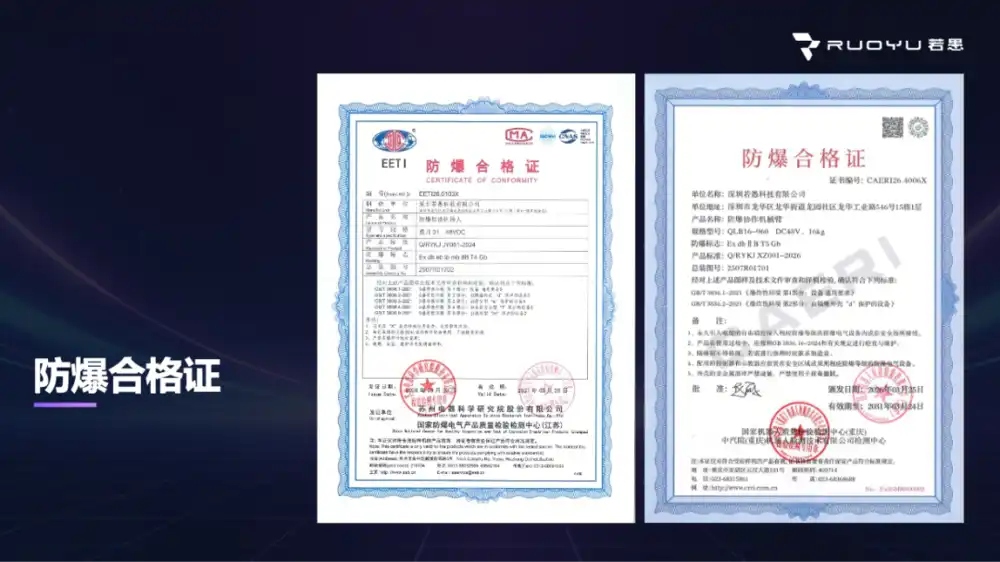
However, ideas are one thing; for robots to truly 'enter' these scenarios, the first barrier is enough to deter most companies: explosion-proof certification.

In flammable and explosive environments such as gas stations, oil and gas stations, and chemical plants, robots themselves absolutely must not become potential ignition sources. This imposes extremely stringent requirements on the hardware's design from the very beginning. For example: the circuit level must adopt an intrinsically safe design, limiting loop energy to ensure it cannot ignite environmental gases even in case of a fault; mechanical structures must meet flameproof requirements to withstand internal explosions without damaging the housing; all connection points must be made increased-safety to prevent spark risks during normal operation; key components must also be isolated from hazardous contact through encapsulation, etc.
Where Can Embodied Intelligence Go

The challenge for robots in this scenario lies in the 'coherence of fine operations.' After the customer places an order, the robot must sequentially perform over ten actions: opening the outer cover, unscrewing the inner cap, detaching the nozzle from the pump, aiming and inserting it into the fuel filler neck, waiting for the tank to fill, removing the nozzle, hanging it back on the pump, closing the inner cap, and closing the outer cover. The tolerance for each action is only a few millimeters; getting stuck at any step means the entire chain is interrupted. Moreover, different vehicle models have vastly different fuel tank locations, cover structures, and opening methods. A robot cannot rely on fixed programs to handle all situations.

The pain points of station patrol inspections are entirely different from those of gas stations. Gas stations test fine operation, while station patrols test the comprehensive capability of 'long-duration autonomous patrolling + multi-type anomaly recognition + on-site immediate response.' Inspectors walk fixed routes daily—a job that is dull, dangerous, and requires extremely high concentration. The error rate of humans increases significantly after several hours of continuous inspection.

Port Scenario: Exploring Multi-Robot Collaboration

The most unique aspect of this scenario is that it naturally requires multiple robots to collaborate.

Currently, most embodied intelligence system architectures are 'pipeline-style,' where the vision module is responsible for seeing, the language module for understanding, and the action module for execution.

This architecture might handle simple tasks with short sequences and low interference, but once faced with scenarios requiring dozens of consecutive steps, highly dynamic environments, and extremely low fault tolerance, even minor deviations at any intermediate step propagate like dominoes. Traditional pipeline architectures are almost incapable of ensuring end-to-end stability in the face of tasks at this scale.

World Model-Driven Predictive Capability

In the gas station scenario, the task chain faced by embodied intelligence is extremely long: guiding the vehicle, identifying the fuel tank location, opening the outer cover, opening the inner cap, retrieving the nozzle, aligning with the filler neck, inserting, fueling, removing, returning the nozzle, closing the inner cap, closing the outer cover. Minor deviations at any step propagate backward.

This capability is particularly crucial in long-sequence tasks. Refueling is not a simple 'grasp-and-place' operation; it's an entire chain of actions with causal relationships. The world model enables embodied intelligence to possess the forward-looking ability of 'looking three steps ahead before taking one.'

To understand with a metaphor: When an experienced driver refuels, regardless of how smoothly the fuel cap opens, their mind always knows the final state to achieve, adjusting every intermediate step toward that end state. It shifts embodied intelligence from 'linear execution' to 'goal-state alignment.'

First, generate the target observation. After receiving the task instruction and the current camera feed, the system first predicts 'what the world should look like after the task is completed.' For example, after a refueling task, the nozzle should be returned and the fuel cap closed. This predicted 'final-state image' becomes the target observation, providing a clear semantic anchor for all subsequent reasoning processes.

Second, synthesize intermediate transition frames. With the goal established, the system then infers the visual states that should occur in between. If the starting point is 'fuel cap closed' and the endpoint is 'nozzle returned, fuel cap closed,' then intermediate states like 'fuel cap opened,' 'nozzle retrieved,' 'nozzle inserted into filler neck' need to appear sequentially. These synthesized intermediate observation frames provide stepwise-aligned visual references for action generation.

This mechanism allows the robot to have a complete visual imagination of the entire task process before acting. Subsequent action planning revolves around this 'imagined trajectory,' significantly reducing cumulative deviation during long-sequence execution.
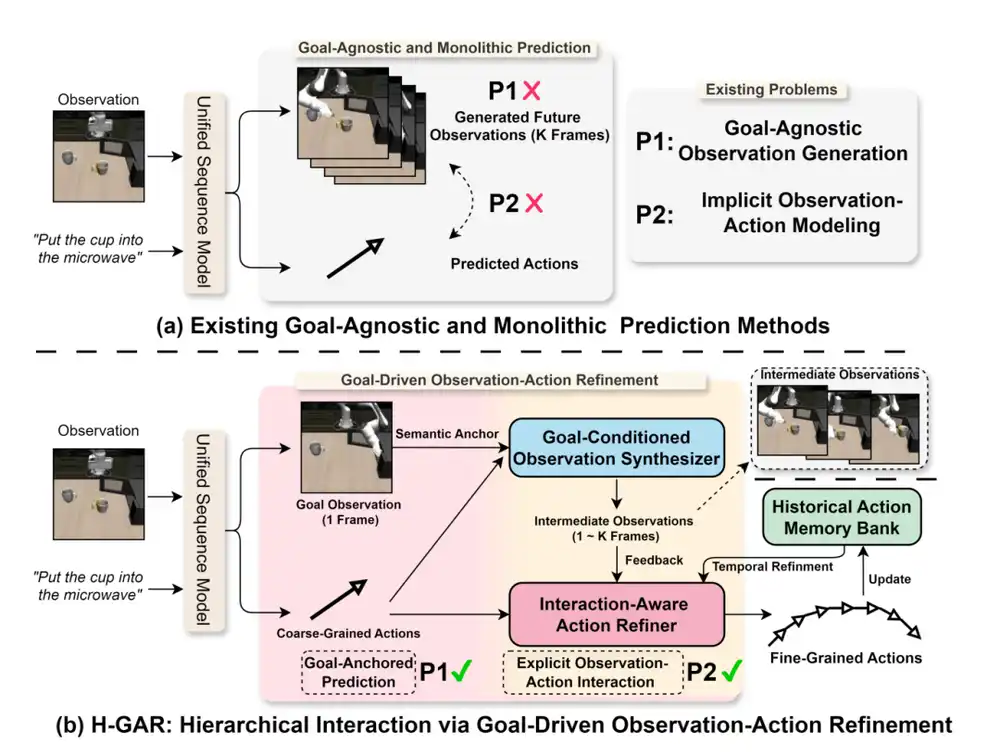
(a) Existing methods typically employ a goal-agnostic, holistic prediction paradigm. (b) H-GAR introduces a Goal-conditioned Observation Synthesizer and an Interaction-Aware Action Refiner, thereby achieving goal-anchored prediction and explicitly modeling the interaction between observations and actions.

Specifically, the workflow of H-GAR is divided into three steps:
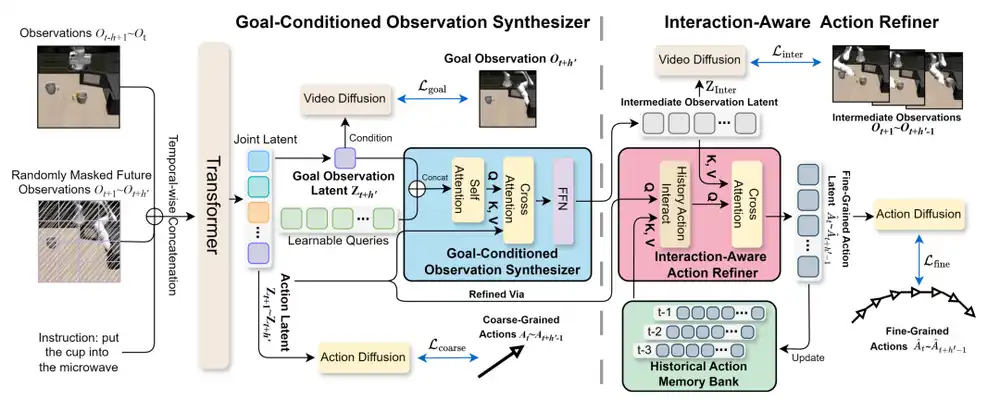
H-GAR Architecture Diagram

  • Step 1: Coarse-grained action draft. Based on historical frames and task instructions, the system first generates a set of coarse action sequences. These actions describe a 'rough path' from the current state to the goal, similar to a human driver's rough mental plan before refueling, knowing roughly which steps to take—the preparation before execution.

  • Step 2: Goal-conditioned Observation Synthesis (GOS module). After obtaining the coarse actions, the system synthesizes intermediate visual frames guided by the target observation. The key here is that the synthesized frames are not generated arbitrarily but are constrained by both the final goal state and the coarse actions. This ensures the intermediate transition frames align with both action logic and the final goal.

  • Step 3: Interaction-Aware Action Refinement (IAAR module). The final step refines the coarse actions into fine-grained executable commands. IAAR refines actions using feedback from two directions: first, the visual context provided by intermediate observation frames, aligning actions with the actual scene; second, a historical action memory library, which records previously executed fine-grained actions, ensuring the currently generated actions maintain temporal consistency with the historical trajectory. When the memory library exceeds its capacity threshold, the system employs a similarity-based eviction strategy, merging the most similar adjacent actions to preserve memory diversity.

  • Paper address: https://arxiv.org/pdf/2511.17079

Unexpected events are almost the norm in real-world scenarios. The fuel cap might not open at the right angle, the customer might park slightly off the expected position, or there might even be obstructions around the filler neck. An action that succeeds 99 times out of 100 in the lab might see its success rate drop by 30% when deployed in outdoor, real environments.

Epilogue: Unity of Knowledge and Action

Guiding embodied intelligence into specialized scenarios is an endeavor that requires a long-termist mindset.

To enter specialized industries, mechanical structure design must consider safety from the ground up, requiring the capability to develop the embodied platform itself. To execute tasks in special environments, an embodied brain is indispensable. The deep coupling of brain and platform has moved beyond being a plus; it is the entry requirement.

As the embodied intelligence industry collectively stands at the crossroads of commercialization and implementation, those players who have first established the closed loop of 'brain-platform-data' will most likely gain a competitive edge in the upcoming race.

This article is from the WeChat official account: 机器之心 , Editor: Cold Cat, Author: Focus on Embodied Intelligence, Original Title: 'Domestic First Explosion-Proof Certification, World's First Fueling Brain Solution: How Did They Secure Two 'Firsts'?'


Crypto di tendenza

Domande pertinenti

QWhat are the main obstacles for embodied intelligence robots to enter high-risk scenarios like gas stations and chemical plants?

AThe main obstacles include passing the stringent explosion-proof certification. This requires the robot's hardware to be designed with intrinsic safety from the start, limiting circuit energy, ensuring the mechanical structure can withstand internal explosions without damaging the shell, and implementing safety measures for all connection points to prevent spark risks in normal operation.

QHow does the 'world model' improve the performance of embodied intelligence in long-sequence tasks like refueling?

AThe world model endows embodied intelligence with predictive capabilities, allowing it to 'think a few steps ahead'. It first generates a visual prediction of the 'final state' after task completion. It then synthesizes intermediate visual frames leading to that state. This provides a visual roadmap, enabling the system to plan actions around this imagined trajectory, which reduces cumulative errors in long, complex action sequences.

QWhat is the three-step workflow of the H-GAR architecture described in the article?

AThe H-GAR (Hierarchical Goal-conditioned Anticipatory Reasoning) architecture's three-step workflow is: 1) Coarse-grained Action Draft: Generating a rough action sequence based on history and the task. 2) Goal-conditioned Observation Synthesis (GOS): Synthesizing intermediate visual frames guided by the final goal and the coarse actions. 3) Interaction-Aware Action Refinement (IAAR): Refining the coarse actions into executable commands using feedback from the synthesized frames and a historical action memory bank to ensure consistency.

QWhat are the key challenges for embodied intelligence in port scenarios according to the article?

AThe key challenge in port scenarios is the need for multi-robot collaboration. Unlike simpler tasks, port operations naturally require multiple robots to work together efficiently, which is a more complex problem than single-robot operations explored in most current systems.

QWhy does the article suggest that deep integration of 'brain' and 'body' is crucial for embodied intelligence in special industries?

ADeep integration of the AI 'brain' (control/planning system) and the physical 'body' (robotic hardware) is an essential entry requirement, not just an advantage. To operate safely in hazardous environments, the mechanical design must inherently consider safety from the ground up, and the AI must be deeply coupled with this specific hardware to execute tasks reliably in those unique, challenging conditions.

Letture associate

Stablecoins Becoming the Next Policy Challenge for the Fed's Walsh Version

Fed Governor Christopher Waller's speech at the June 22 conference on the U.S. dollar's international role signifies a notable policy shift: stablecoins like USDT and USDC are now being formally considered as potential channels for transmitting U.S. dollar liquidity globally. With their combined market cap surpassing $250 billion and high transaction volumes, these digital assets are moving from the periphery of crypto policy to the core of monetary system research. The key concern for policymakers is how stablecoin flows interact with traditional dollar infrastructure. Their growth could affect bank deposits, demand for short-term Treasury securities (like T-bills), and global access to dollars, depending on whether demand originates overseas or substitutes for domestic bank balances. Issuers' reserve management—holding assets in banks, money market funds, or Treasuries—links stablecoin activity directly to these core markets. The Fed's research agenda now examines whether stablecoins, by combining payment and balance-holding functions on digital rails, could complicate monetary policy implementation or transmit liquidity stress to banks. While current Treasury holdings by issuers are under 1% of the total market, their concentrated demand could marginally impact yields, especially during periods of stress. Consequently, stablecoins are evolving from mere crypto trading tools into a private-layer dollar transmission system with public policy implications, prompting closer regulatory scrutiny of their reserve robustness, redemption mechanisms, and systemic integration.

marsbit57 min fa

Stablecoins Becoming the Next Policy Challenge for the Fed's Walsh Version

marsbit57 min fa

A 380% Soar, Shenzhen’s 100-Billion-Yuan IPO Rings the Bell

HKC Holdings, a major Chinese display panel manufacturer, has successfully listed on the Shenzhen Stock Exchange's main board. The company's shares surged over 380% on its debut, pushing its market capitalization to around 350 billion yuan (formerly reaching 500 billion yuan). Founded by Wang Zhiyong in Shenzhen's Huaqiangbei electronics market nearly three decades ago, HKC evolved from assembling monitors to becoming a global top-tier supplier of semiconductor display panels for TVs, monitors, and smartphones. The IPO marks a significant milestone for HKC and its backers. The company's growth into the capital-intensive panel manufacturing sector was supported through partnerships with state-owned capital from regions like Chongqing, Mianyang, and Chuzhou. Its shareholder list also includes BOE Technology's investment arm. In recent years, HKC reported strong financials, with core panel business contributing over 70% of revenue and clients including Samsung, TCL, and Xiaomi. This listing is seen as part of a broader trend in Shenzhen's evolving tech landscape. Beyond established giants, the city is nurturing clusters of leading companies in specialized sectors like robotics—exemplified by the "Shenzhen Robot Valley"—and storage chips, where a group of firms dubbed the "Storage Five Tigers" has achieved a combined trillion-yuan market valuation. Shenzhen's strategic focus on emerging industries such as AI terminals, low-altitude economy, and humanoid robotics aims to build new industrial depth and foster the next generation of tech champions.

marsbit1 h fa

A 380% Soar, Shenzhen’s 100-Billion-Yuan IPO Rings the Bell

marsbit1 h fa

Trading

Spot
Futures

Articoli Popolari

Cosa è $S$

Comprendere SPERO: Una Panoramica Completa Introduzione a SPERO Mentre il panorama dell'innovazione continua a evolversi, l'emergere delle tecnologie web3 e dei progetti di criptovaluta gioca un ruolo fondamentale nel plasmare il futuro digitale. Un progetto che ha attirato l'attenzione in questo campo dinamico è SPERO, denotato come SPERO,$$s$. Questo articolo mira a raccogliere e presentare informazioni dettagliate su SPERO, per aiutare gli appassionati e gli investitori a comprendere le sue basi, obiettivi e innovazioni nei domini web3 e crypto. Che cos'è SPERO,$$s$? SPERO,$$s$ è un progetto unico all'interno dello spazio crypto che cerca di sfruttare i principi della decentralizzazione e della tecnologia blockchain per creare un ecosistema che promuove l'impegno, l'utilità e l'inclusione finanziaria. Il progetto è progettato per facilitare interazioni peer-to-peer in modi nuovi, fornendo agli utenti soluzioni e servizi finanziari innovativi. Al suo interno, SPERO,$$s$ mira a responsabilizzare gli individui fornendo strumenti e piattaforme che migliorano l'esperienza dell'utente nello spazio delle criptovalute. Questo include la possibilità di metodi di transazione più flessibili, la promozione di iniziative guidate dalla comunità e la creazione di percorsi per opportunità finanziarie attraverso applicazioni decentralizzate (dApps). La visione sottostante di SPERO,$$s$ ruota attorno all'inclusività, cercando di colmare le lacune all'interno della finanza tradizionale mentre sfrutta i vantaggi della tecnologia blockchain. Chi è il Creatore di SPERO,$$s$? L'identità del creatore di SPERO,$$s$ rimane piuttosto oscura, poiché ci sono risorse pubblicamente disponibili limitate che forniscono informazioni dettagliate sul suo fondatore o fondatori. Questa mancanza di trasparenza può derivare dall'impegno del progetto per la decentralizzazione—un ethos che molti progetti web3 condividono, dando priorità ai contributi collettivi rispetto al riconoscimento individuale. Centrando le discussioni attorno alla comunità e ai suoi obiettivi collettivi, SPERO,$$s$ incarna l'essenza dell'empowerment senza mettere in evidenza individui specifici. Pertanto, comprendere l'etica e la missione di SPERO rimane più importante che identificare un creatore singolo. Chi sono gli Investitori di SPERO,$$s$? SPERO,$$s$ è supportato da una varietà di investitori che vanno dai capitalisti di rischio agli investitori angelici dedicati a promuovere l'innovazione nel settore crypto. Il focus di questi investitori generalmente si allinea con la missione di SPERO—dando priorità a progetti che promettono avanzamenti tecnologici sociali, inclusività finanziaria e governance decentralizzata. Queste fondazioni di investitori sono tipicamente interessate a progetti che non solo offrono prodotti innovativi, ma contribuiscono anche positivamente alla comunità blockchain e ai suoi ecosistemi. Il supporto di questi investitori rafforza SPERO,$$s$ come un concorrente degno di nota nel dominio in rapida evoluzione dei progetti crypto. Come Funziona SPERO,$$s$? SPERO,$$s$ impiega un framework multifunzionale che lo distingue dai progetti di criptovaluta convenzionali. Ecco alcune delle caratteristiche chiave che sottolineano la sua unicità e innovazione: Governance Decentralizzata: SPERO,$$s$ integra modelli di governance decentralizzati, responsabilizzando gli utenti a partecipare attivamente ai processi decisionali riguardanti il futuro del progetto. Questo approccio favorisce un senso di proprietà e responsabilità tra i membri della comunità. Utilità del Token: SPERO,$$s$ utilizza il proprio token di criptovaluta, progettato per servire varie funzioni all'interno dell'ecosistema. Questi token abilitano transazioni, premi e la facilitazione dei servizi offerti sulla piattaforma, migliorando l'impegno e l'utilità complessivi. Architettura Stratificata: L'architettura tecnica di SPERO,$$s$ supporta la modularità e la scalabilità, consentendo un'integrazione fluida di funzionalità e applicazioni aggiuntive man mano che il progetto evolve. Questa adattabilità è fondamentale per mantenere la rilevanza nel panorama crypto in continua evoluzione. Coinvolgimento della Comunità: Il progetto enfatizza iniziative guidate dalla comunità, impiegando meccanismi che incentivano la collaborazione e il feedback. Nutrendo una comunità forte, SPERO,$$s$ può affrontare meglio le esigenze degli utenti e adattarsi alle tendenze di mercato. Focus sull'Inclusione: Offrendo basse commissioni di transazione e interfacce user-friendly, SPERO,$$s$ mira ad attrarre una base utenti diversificata, inclusi individui che potrebbero non aver precedentemente interagito nello spazio crypto. Questo impegno per l'inclusione si allinea con la sua missione generale di empowerment attraverso l'accessibilità. Cronologia di SPERO,$$s$ Comprendere la storia di un progetto fornisce preziose intuizioni sulla sua traiettoria di sviluppo e sui traguardi. Di seguito è riportata una cronologia suggerita che mappa eventi significativi nell'evoluzione di SPERO,$$s$: Fase di Concettualizzazione e Ideazione: Le idee iniziali che formano la base di SPERO,$$s$ sono state concepite, allineandosi strettamente con i principi di decentralizzazione e focus sulla comunità all'interno dell'industria blockchain. Lancio del Whitepaper del Progetto: Dopo la fase concettuale, è stato rilasciato un whitepaper completo che dettaglia la visione, gli obiettivi e l'infrastruttura tecnologica di SPERO,$$s$ per suscitare interesse e feedback dalla comunità. Costruzione della Comunità e Prime Interazioni: Sono stati effettuati sforzi attivi di outreach per costruire una comunità di early adopters e potenziali investitori, facilitando discussioni attorno agli obiettivi del progetto e ottenendo supporto. Evento di Generazione del Token: SPERO,$$s$ ha condotto un evento di generazione del token (TGE) per distribuire i propri token nativi ai primi sostenitori e stabilire una liquidità iniziale all'interno dell'ecosistema. Lancio della Prima dApp: La prima applicazione decentralizzata (dApp) associata a SPERO,$$s$ è stata attivata, consentendo agli utenti di interagire con le funzionalità principali della piattaforma. Sviluppo Continuo e Partnership: Aggiornamenti e miglioramenti continui alle offerte del progetto, inclusi partnership strategiche con altri attori nello spazio blockchain, hanno plasmato SPERO,$$s$ in un concorrente competitivo e in evoluzione nel mercato crypto. Conclusione SPERO,$$s$ rappresenta una testimonianza del potenziale del web3 e delle criptovalute di rivoluzionare i sistemi finanziari e responsabilizzare gli individui. Con un impegno per la governance decentralizzata, il coinvolgimento della comunità e funzionalità progettate in modo innovativo, apre la strada verso un panorama finanziario più inclusivo. Come per qualsiasi investimento nello spazio crypto in rapida evoluzione, si incoraggiano potenziali investitori e utenti a ricercare approfonditamente e a impegnarsi in modo riflessivo con gli sviluppi in corso all'interno di SPERO,$$s$. Il progetto mostra lo spirito innovativo dell'industria crypto, invitando a ulteriori esplorazioni delle sue innumerevoli possibilità. Mentre il percorso di SPERO,$$s$ è ancora in fase di sviluppo, i suoi principi fondamentali potrebbero effettivamente influenzare il futuro di come interagiamo con la tecnologia, la finanza e tra di noi in ecosistemi digitali interconnessi.

91 Totale visualizzazioniPubblicato il 2024.12.17Aggiornato il 2024.12.17

Cosa è $S$

Cosa è AGENT S

Agent S: Il Futuro dell'Interazione Autonoma in Web3 Introduzione Nel panorama in continua evoluzione di Web3 e criptovalute, le innovazioni stanno costantemente ridefinendo il modo in cui gli individui interagiscono con le piattaforme digitali. Uno di questi progetti pionieristici, Agent S, promette di rivoluzionare l'interazione uomo-computer attraverso il suo framework agentico aperto. Aprendo la strada a interazioni autonome, Agent S mira a semplificare compiti complessi, offrendo applicazioni trasformative nell'intelligenza artificiale (AI). Questa esplorazione dettagliata approfondirà le complessità del progetto, le sue caratteristiche uniche e le implicazioni per il dominio delle criptovalute. Cos'è Agent S? Agent S si presenta come un innovativo framework agentico aperto, progettato specificamente per affrontare tre sfide fondamentali nell'automazione dei compiti informatici: Acquisizione di Conoscenze Specifiche del Dominio: Il framework apprende in modo intelligente da varie fonti di conoscenza esterne ed esperienze interne. Questo approccio duale gli consente di costruire un ricco repository di conoscenze specifiche del dominio, migliorando le sue prestazioni nell'esecuzione dei compiti. Pianificazione su Lungo Orizzonte di Compiti: Agent S impiega una pianificazione gerarchica potenziata dall'esperienza, un approccio strategico che facilita la suddivisione e l'esecuzione efficiente di compiti complessi. Questa caratteristica migliora significativamente la sua capacità di gestire più sottocompiti in modo efficiente ed efficace. Gestione di Interfacce Dinamiche e Non Uniformi: Il progetto introduce l'Interfaccia Agente-Computer (ACI), una soluzione innovativa che migliora l'interazione tra agenti e utenti. Utilizzando Modelli Linguistici Multimodali di Grandi Dimensioni (MLLM), Agent S può navigare e manipolare senza sforzo diverse interfacce grafiche utente. Attraverso queste caratteristiche pionieristiche, Agent S fornisce un framework robusto che affronta le complessità coinvolte nell'automazione dell'interazione umana con le macchine, preparando il terreno per innumerevoli applicazioni nell'AI e oltre. Chi è il Creatore di Agent S? Sebbene il concetto di Agent S sia fondamentalmente innovativo, informazioni specifiche sul suo creatore rimangono elusive. Il creatore è attualmente sconosciuto, il che evidenzia sia la fase embrionale del progetto sia la scelta strategica di mantenere i membri fondatori sotto anonimato. Indipendentemente dall'anonimato, l'attenzione rimane sulle capacità e sul potenziale del framework. Chi sono gli Investitori di Agent S? Poiché Agent S è relativamente nuovo nell'ecosistema crittografico, informazioni dettagliate riguardanti i suoi investitori e sostenitori finanziari non sono documentate esplicitamente. La mancanza di approfondimenti pubblicamente disponibili sulle fondazioni di investimento o sulle organizzazioni che supportano il progetto solleva interrogativi sulla sua struttura di finanziamento e sulla roadmap di sviluppo. Comprendere il supporto è cruciale per valutare la sostenibilità del progetto e il suo potenziale impatto sul mercato. Come Funziona Agent S? Al centro di Agent S si trova una tecnologia all'avanguardia che gli consente di funzionare efficacemente in contesti diversi. Il suo modello operativo è costruito attorno a diverse caratteristiche chiave: Interazione Uomo-Computer Simile a Quella Umana: Il framework offre una pianificazione AI avanzata, cercando di rendere le interazioni con i computer più intuitive. Mimando il comportamento umano nell'esecuzione dei compiti, promette di elevare le esperienze degli utenti. Memoria Narrativa: Utilizzata per sfruttare esperienze di alto livello, Agent S utilizza la memoria narrativa per tenere traccia delle storie dei compiti, migliorando così i suoi processi decisionali. Memoria Episodica: Questa caratteristica fornisce agli utenti una guida passo-passo, consentendo al framework di offrire supporto contestuale mentre i compiti si sviluppano. Supporto per OpenACI: Con la capacità di funzionare localmente, Agent S consente agli utenti di mantenere il controllo sulle proprie interazioni e flussi di lavoro, allineandosi con l'etica decentralizzata di Web3. Facile Integrazione con API Esterne: La sua versatilità e compatibilità con varie piattaforme AI garantiscono che Agent S possa adattarsi senza problemi agli ecosistemi tecnologici esistenti, rendendolo una scelta attraente per sviluppatori e organizzazioni. Queste funzionalità contribuiscono collettivamente alla posizione unica di Agent S all'interno dello spazio crittografico, poiché automatizza compiti complessi e multi-fase con un intervento umano minimo. Man mano che il progetto evolve, le sue potenziali applicazioni in Web3 potrebbero ridefinire il modo in cui si svolgono le interazioni digitali. Cronologia di Agent S Lo sviluppo e le tappe di Agent S possono essere riassunti in una cronologia che evidenzia i suoi eventi significativi: 27 Settembre 2024: Il concetto di Agent S è stato lanciato in un documento di ricerca completo intitolato “Un Framework Agentico Aperto che Usa i Computer Come un Umano”, mostrando le basi per il progetto. 10 Ottobre 2024: Il documento di ricerca è stato reso pubblicamente disponibile su arXiv, offrendo un'esplorazione approfondita del framework e della sua valutazione delle prestazioni basata sul benchmark OSWorld. 12 Ottobre 2024: È stata rilasciata una presentazione video, fornendo un'idea visiva delle capacità e delle caratteristiche di Agent S, coinvolgendo ulteriormente potenziali utenti e investitori. Questi indicatori nella cronologia non solo illustrano i progressi di Agent S, ma indicano anche il suo impegno per la trasparenza e il coinvolgimento della comunità. Punti Chiave su Agent S Man mano che il framework Agent S continua a evolversi, diversi attributi chiave si distinguono, sottolineando la sua natura innovativa e il potenziale: Framework Innovativo: Progettato per fornire un uso intuitivo dei computer simile all'interazione umana, Agent S porta un approccio nuovo all'automazione dei compiti. Interazione Autonoma: La capacità di interagire autonomamente con i computer attraverso GUI segna un passo avanti verso soluzioni informatiche più intelligenti ed efficienti. Automazione di Compiti Complessi: Con la sua metodologia robusta, può automatizzare compiti complessi e multi-fase, rendendo i processi più veloci e meno soggetti a errori. Miglioramento Continuo: I meccanismi di apprendimento consentono ad Agent S di migliorare dalle esperienze passate, migliorando continuamente le sue prestazioni e la sua efficacia. Versatilità: La sua adattabilità attraverso diversi ambienti operativi come OSWorld e WindowsAgentArena garantisce che possa servire un'ampia gamma di applicazioni. Man mano che Agent S si posiziona nel panorama di Web3 e delle criptovalute, il suo potenziale per migliorare le capacità di interazione e automatizzare i processi segna un significativo avanzamento nelle tecnologie AI. Attraverso il suo framework innovativo, Agent S esemplifica il futuro delle interazioni digitali, promettendo un'esperienza più fluida ed efficiente per gli utenti in vari settori. Conclusione Agent S rappresenta un audace passo avanti nell'unione tra AI e Web3, con la capacità di ridefinire il modo in cui interagiamo con la tecnologia. Sebbene sia ancora nelle sue fasi iniziali, le possibilità per la sua applicazione sono vaste e coinvolgenti. Attraverso il suo framework completo che affronta sfide critiche, Agent S mira a portare le interazioni autonome al centro dell'esperienza digitale. Man mano che ci addentriamo nei regni delle criptovalute e della decentralizzazione, progetti come Agent S giocheranno senza dubbio un ruolo cruciale nel plasmare il futuro della tecnologia e della collaborazione uomo-computer.

556 Totale visualizzazioniPubblicato il 2025.01.14Aggiornato il 2025.01.14

Cosa è AGENT S

Come comprare S

Benvenuto in HTX.com! Abbiamo reso l'acquisto di Sonic (S) semplice e conveniente. Segui la nostra guida passo passo per intraprendere il tuo viaggio nel mondo delle criptovalute.Step 1: Crea il tuo Account HTXUsa la tua email o numero di telefono per registrarti il tuo account gratuito su HTX. Vivi un'esperienza facile e sblocca tutte le funzionalità,Crea il mio accountStep 2: Vai in Acquista crypto e seleziona il tuo metodo di pagamentoCarta di credito/debito: utilizza la tua Visa o Mastercard per acquistare immediatamente SonicS.Bilancio: Usa i fondi dal bilancio del tuo account HTX per fare trading senza problemi.Terze parti: abbiamo aggiunto metodi di pagamento molto utilizzati come Google Pay e Apple Pay per maggiore comodità.P2P: Fai trading direttamente con altri utenti HTX.Over-the-Counter (OTC): Offriamo servizi su misura e tassi di cambio competitivi per i trader.Step 3: Conserva Sonic (S)Dopo aver acquistato Sonic (S), conserva nel tuo account HTX. In alternativa, puoi inviare tramite trasferimento blockchain o scambiare per altre criptovalute.Step 4: Scambia Sonic (S)Scambia facilmente Sonic (S) nel mercato spot di HTX. Accedi al tuo account, seleziona la tua coppia di trading, esegui le tue operazioni e monitora in tempo reale. Offriamo un'esperienza user-friendly sia per chi ha appena iniziato che per i trader più esperti.

1.1k Totale visualizzazioniPubblicato il 2025.01.15Aggiornato il 2026.06.02

Come comprare S

Discussioni

Benvenuto nella Community HTX. Qui puoi rimanere informato sugli ultimi sviluppi della piattaforma e accedere ad approfondimenti esperti sul mercato. Le opinioni degli utenti sul prezzo di S S sono presentate come di seguito.

活动图片