Loss Exceeds $7.5 Million: Analysis of the Honeypot Attack Targeting MEV Bot and Tracking of Stolen Funds

marsbitPubblicato 2026-06-22Pubblicato ultima volta 2026-06-22

Introduzione

On June 21, Jaredfromsubway.eth, one of Ethereum's most active MEV bots, suffered a sophisticated honeypot attack, losing over $7.5 million in crypto assets. Attackers deployed a complex contract system, including a coordinator, trigger, and fake token/pair contracts, to exploit the bot's arbitrage logic. The core attack trick involved baiting the bot with transactions: small trades appeared normal and consumed token approvals, while larger trades preserved these approvals by using fake swaps. This left the bot with large, unused approvals for assets like USDC, USDT, and WETH. The attacker then drained these approvals in a final step. The stolen funds—$2.87M USDC, $2.04M USDT, and 1,474 WETH—were consolidated and partially laundered through Tornado Cash. This incident highlights that MEV bots must not rely solely on simulated profits for security. Extra caution is required with unfamiliar contracts or custom wrappers in arbitrage paths, and post-transaction allowance checks are strongly recommended.

On June 21, Jaredfromsubway.eth, one of the most active MEV Bots on the Ethereum network, fell victim to a meticulously orchestrated "honeypot attack," resulting in the loss of over $7.5 million worth of crypto assets. The following is Beosin Security Team's analysis of this attack and tracking of the stolen fund flow.

Attack Process Analysis

Attack Contract Family

- Coordinator Contract (0xb84db016324e8f2bfdd8dd9c260338aee0a8df52): Responsible for recording whether the current block is in an 'armed' state and, in the final stage, cyclically calling sub-contracts to drain funds.
- Trigger Contract (0x4de8c729a064ff6087cc84a4152969349e4feb98): Responsible for setting the state of fake trading pairs within the same block, making the arbitrage path appear executable.
- Sub-contract / Fake Token Contract: Disguised as a normal ERC-20 token, used to obtain genuine approvals.
- Hub Contract: Responsible for paying out a small amount of real profit, making the MEV Bot believe the opportunity is profitable.
- Ring V2 Pair: Fake Uniswap v2 trading pair.
- Fake Intermediate Token Contract: Used to construct multi-hop arbitrage paths, such as fCAP, fUSDC.

The Key to the Attack: Deceiving Approvals

By analyzing on-chain transactions, the attacker constructed multiple sets of bait transactions:

- Large USDC: The bot profited about 36.997120 USDC, but left behind an approval for 20 USDC.
- Large USDT: The bot profited about 37.053440 USDT, but left behind an approval for 20 USDT.
- Large WETH: The bot profited about 0.0179 WETH, but left behind an approval for 16 WETH.
- Small transactions behaved normally, with the approval consumed within the same transaction to reduce suspicion.

In small transactions, after the bot authorized a real token allowance, the sub-contract would immediately transfer the real tokens away. The approval was consumed, appearing completely normal.

In large transactions, however, the sub-contract would not call `transferFrom` to move the real tokens. Instead, it would directly mint fake tokens via the fake trading pair. The bot thought it had completed the normal pre-swap steps, but the real token approval remained intact.

This is the core of the entire attack: small transactions normally consume approvals, while large transactions preserve them.

Attack Procedure

Taking the attack transaction targeting USDC as an example:

(1) The attacker calls the coordinator to set the current block as 'armed'.
(2) The attacker calls the trigger to update the state of multiple fake Ring V2 pairs.
(3) The MEV Bot detects the arbitrage opportunity and executes the transaction.

The internal process of the MEV Bot transaction is roughly as follows:

(1) The MEV Bot contract approves a large USDC allowance to a specific sub-contract.
(2) The MEV Bot calls the `wrapTo`/`wrap` function of the sub-contract.
(3) Because the current state is 'armed', the sub-contract does not consume real USDC. Instead, it mints fake tokens to the pair, and the USDC approval is preserved.
(4) The MEV Bot continues by calling the `swap` function on the fake pair.
(5) The second-hop pair sends the tokens to the MEV Bot.
(6) The hub contract pays a small amount of real USDC profit to the MEV Bot.
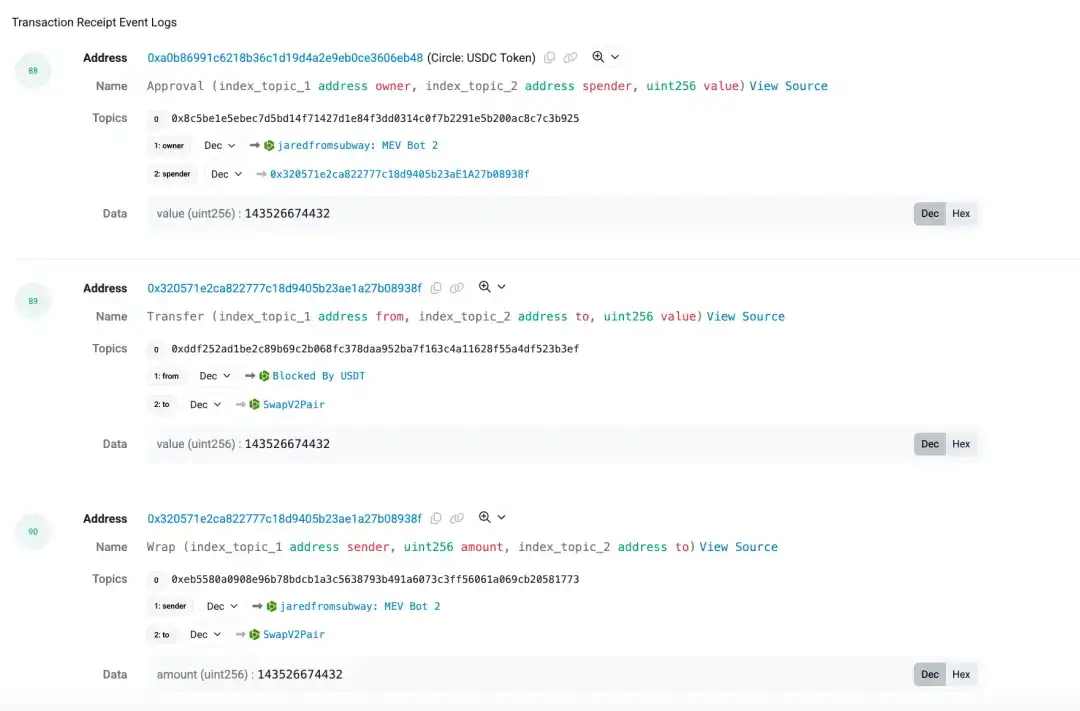
approval example

tx hash: 0x0121e07a916c06eea3e7daf11893f3f0b95b9e1684124545ae14c32aee6029bb

The result seen by the MEV Bot: A successful arbitrage transaction yielding real USDC profit. However, the USDC approval was retained by the sub-contract.
This process was repeated for USDC, USDT, and WETH, ultimately accumulating numerous approvals.

The attack transaction hash is:

0x2be8704f5a59b69e0b71f64aefdb99eb0e8ae9fb3926147c581910d71bcf3e65

The attacker calls the `drain loop` function of the coordinator contract. The calldata contains 66 sub-contract addresses and the MEV Bot contract address. For any sub-contract to which the MEV Bot contract had previously left an allowance, that sub-contract could directly transfer the corresponding real tokens to the attacker.

Final Result:

- The entire 20 USDC large allowance was drained.
- The entire 16 WETH large allowance was drained.
- Part of the USDT allowance still exists, but the USDT balance is insufficient.

Fund Flow Analysis

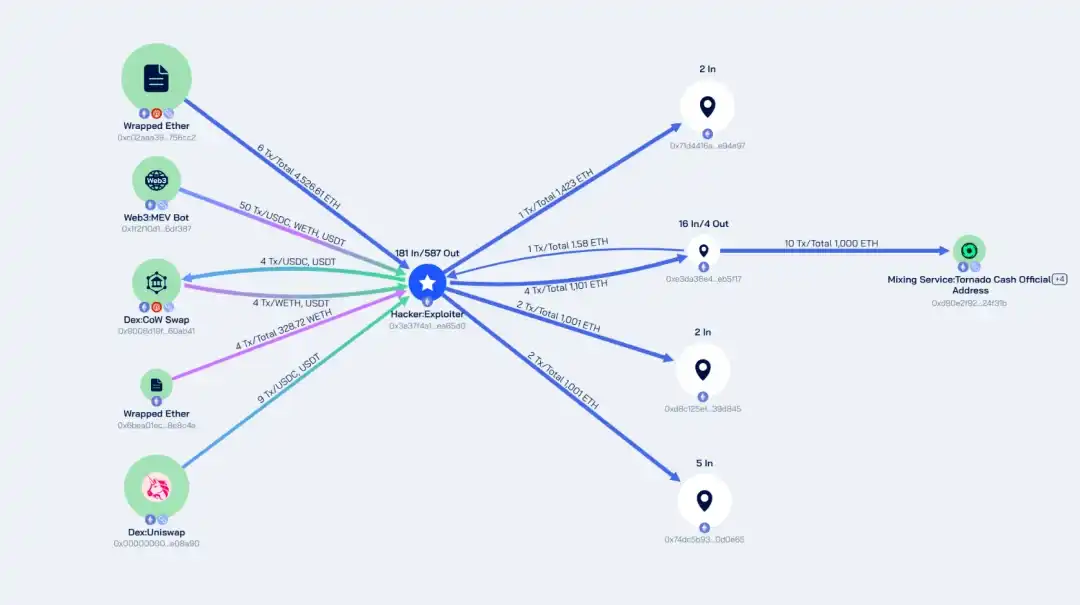
After succeeding, the attacker's address (0x3e37f4A10d771Ba9dE44b6d301410b1BEdeA65d0) received $2.87M USDC, $2.04M USDT, and 1,474 WETH. Subsequently, the attacker exchanged the stablecoins for ETH and transferred it to the following 4 addresses:

- 0xe3Da36E4bd1a5738fa5D6Ef4F0e4dF40bDeB5f17 (approx. 1,000 ETH)
- 0x74Dc5b93586D248D5Aec64b3586736FF0A0D0e65 (1,001 ETH)
- 0xd8C125efCBc99408eC8723E9BBd81d1E8D39D845 (1,001 ETH)
- 0x71d4416A7A85e08a5Fe7227Ca3B44Fc639e94e97 (1,423 ETH)

Among these, 0xe3Da3 has transferred 1,000 ETH to Tornado Cash. The ETH at the other three addresses has not seen further movement. The fund flow chart is shown below:
Conclusion

This attack demonstrates a highly sophisticated method: instead of directly attacking contract code, the attacker, based on the business logic of MEV Bots, constructed corresponding arbitrage scenarios to mislead the MEV Bot into making seemingly harmless approvals, and then transferred its assets. For arbitrage bots and MEV Bots, relying solely on simulated profits to judge the safety of a route is insufficient. Especially when an arbitrage path involves unfamiliar contracts, fake tokens, or custom wrappers, caution is essential. Consider enforcing checks on allowance changes after transactions.

View Original Article

Crypto di tendenza

Domande pertinenti

QWhat was the total loss suffered by the MEV bot Jaredfromsubway.eth in the honeypot attack on June 21st?

AThe total loss exceeded 7.5 million US dollars worth of crypto assets.

QWhat was the core mechanism used in the honeypot attack to exploit the MEV bot?

AThe core mechanism was deceiving the bot into granting excessive token approvals (allowances). Small, normal-looking trades consumed the approval, while larger trades left the approval intact. The attacker later exploited these retained approvals to drain the bot's funds.

QWhich specific real-world assets (tokens) did the MEV bot lose in this attack?

AThe bot lost USDC, USDT, and WETH. Specifically, it lost $2.87M USDC, $2.04M USDT, and 1,474 WETH (which was later converted to more ETH).

QWhat was one of the final destination addresses for the stolen ETH, as mentioned in the fund flow analysis?

AOne of the final destinations was the privacy mixer Tornado Cash, where 1,000 ETH from address 0xe3Da36E4bd1a5738fa5D6Ef4F0e4dF40bDeB5f17 was sent.

QWhat key security recommendation does the article provide for MEV bots and arbitrage robots to prevent similar attacks?

AThe article recommends that MEV bots should not rely solely on simulated profits to judge the safety of a route. They should be cautious with unfamiliar contracts, fake tokens, or custom wrappers in an arbitrage path. Furthermore, they should consider implementing mandatory checks for allowance changes after a transaction.

Letture associate

Report Interpretation: J.P. Morgan Details Micron's Pre-Earnings Sentiment, Current Hardware Sector Dynamics

Morgan Stanley analyst Joshua Meyers' report (June 21, 2026) highlights key trends in the hardware and semiconductor sector ahead of Micron's earnings. The core takeaways are: 1. **Micron & Memory:** Memory remains a high-conviction long theme, driven by strong AI demand and rising ASPs. However, investor focus is shifting to the sustainability of Micron's >80% gross margins and the specifics of potential new long-term supply agreements (SCAs). 2. **Hardware Supply Chain:** AI-related demand for servers, networking, and storage remains robust, but company performance is diverging. Celestica (CLS) shows improved margin confidence, Western Digital and Seagate benefit from pricing, Fabrinet (FN) sees predictable AI optics growth, and Teradyne (TER) anticipates a new Google customer. 3. **AI Capex & WFE Forecasts:** JPMorgan increased its Wafer Fab Equipment (WFE) market growth forecasts to 28% in 2026 and 29% in 2027. AI infrastructure financing is evolving, with higher project-level debt reducing constraints on capex expansion. The report signals that while the AI-driven hardware cycle is strong, the market is entering a phase focused on execution verification (e.g., Micron's SCA details, Fabrinet's ramp with Amazon) and valuation sustainability. Key near-term signals include Micron's guidance, Arista Networks' outlook, and the pace of demand normalization post potential tariff-related pull-ins.

marsbit1 h fa

Report Interpretation: J.P. Morgan Details Micron's Pre-Earnings Sentiment, Current Hardware Sector Dynamics

marsbit1 h fa

Research Report Analysis: The Fed's New Chair's Debut – New Leader, But Same Script?

Report Analysis: Federal Reserve's New Chair Debut – A New Captain, But the Same Script? Morgan Stanley's chief global economist Seth B. Carpenter analyzes the first FOMC meeting under new Fed Chair Kevin Warsh in a June 21 report. Warsh deliberately avoided providing forward guidance on interest rates, aligning with his philosophy. However, market expectations for a rate hike this year were reinforced. Key signals lie elsewhere: inflation may fall more than expected, and quantitative tightening (QT) could be more aggressive than anticipated. The FOMC's "dot plot" suggests only one rate hike in 2026. Carpenter argues that if inflation undershoots forecasts, the logic for even a single hike weakens, especially as projections indicate potential rate cuts in 2027. On QT, Warsh's stance is clear. Carpenter notes that measures like halving the Treasury's account balance could shrink the Fed's balance sheet by around $500 billion with minimal market impact. Combined with adjustments to reserve interest and liquidity rules, the ultimate QT scale may exceed expectations, though its market effect might be less disruptive unless the Fed actively sells Mortgage-Backed Securities (MBS). While Warsh initiated a review of the Fed's policy framework, the 2% inflation target remains intact for now. The report concludes that the market may be overestimating the significance of reduced forward guidance and the near-term rate hike risk, while potentially underestimating the scope and manageable nature of the coming balance sheet reduction. The key debates will hinge on upcoming core PCE data, the specifics of the QT path, and the framework review's findings.

marsbit1 h fa

Research Report Analysis: The Fed's New Chair's Debut – New Leader, But Same Script?

marsbit1 h fa

Critical Game Week: BTC Retracement Confirmation vs. HYPE Support Battle | Guest Analysis

This weekly analysis outlines a critical juncture for BTC and HYPE markets, focusing on key price level confirmations. **BTC Analysis:** BTC is at a pivotal point after a five-wave rally from the June 5th low of $59,100. The price has broken below a short-term rising channel's lower boundary, with the current move seen as a pullback to test this breakdown. Failure to reclaim this level could lead to a retest of the $59,000-$60,000 support zone. The core scenario hinges on this channel retest outcome. * **Key Levels:** Resistance at $64,500-$65,000 (channel boundary) and $69,500-$70,500. Support at $59,000-$60,000 and $55,000. * **Strategy:** A core bearish stance is maintained (20% short from last week), with short-term plans for tactical trades. Three detailed contingency plans (A/B/C) are provided for short positions on resistance tests or breakdowns, emphasizing strict stop-loss discipline. **HYPE Analysis:** HYPE shows strong momentum but is currently in a corrective phase after hitting a new high of $76.94. The price is retesting the crucial $64-$66 support area. * **Key Levels:** Resistance near $77 and $80-$82. Support at $64-$66 and $52-$54. * **Strategy:** The short-term approach is "buy on dips, avoid chasing rallies." A long position is considered only if clear stabilization signals appear at the $64-$66 or deeper $52-$54 support zones, with tight risk controls. **General Risk Management:** A standardized trailing stop-loss protocol is emphasized: set initial stop, breakeven at +1% profit, then trail stops upward to lock in gains. *Disclaimer: All analysis is presented as a personal trading framework, not investment advice. Market conditions are complex and require dynamic adjustment.*

marsbit1 h fa

Critical Game Week: BTC Retracement Confirmation vs. HYPE Support Battle | Guest Analysis

marsbit1 h fa

Research Report Interpretation: Citi Attends AWS Summit, Bullish on Cloud Business Acceleration but Data Governance Remains Key Variable

Citi analyst Tyler Radke's team attended the AWS New York Summit (June 17-18), engaging with over 10 clients and partners. In a June 19 report, they highlighted the summit's focus on scaling agent AI for enterprise deployment. Citi maintains a "Buy" rating on Amazon, forecasting AWS revenue growth to accelerate to 37% in FY27 from 30% in FY26, noting this estimate may be conservative. Key takeaways: 1. **AWS Strategy Shift:** AWS is moving from proof-of-concepts to scalable deployment. New offerings like AWS Context (building enterprise knowledge graphs), Amazon Quick (cross-application AI assistant), and security tool Continuum address core enterprise pain points for AI adoption. 2. **Data Infrastructure Beneficiaries:** Data infrastructure companies like Snowflake, Elastic, Oracle, and ClickHouse are seen as direct beneficiaries of scaling AI workloads, as evidenced by strong growth and use cases presented. 3. **Critical Role of Data Governance:** As AI agents scale from hundreds to thousands, effective data governance becomes the key variable for deploying AI in core business processes. AWS Context represents AWS's strategic extension from providing compute/models to offering a data governance infrastructure layer. The report emphasizes that without solving data governance, AI will remain confined to pilot projects. The investment thesis focuses on AWS revenue acceleration and data infrastructure vendors' growth, while monitoring signals like AWS's quarterly revenue growth, Bedrock AgentCore task volume, and pricing impacts on companies like Elastic.

marsbit1 h fa

Research Report Interpretation: Citi Attends AWS Summit, Bullish on Cloud Business Acceleration but Data Governance Remains Key Variable

marsbit1 h fa

Trading

Spot
Futures

Articoli Popolari

Cosa è ETH 3.0

ETH3.0 e $eth 3.0: Un'Analisi Approfondita del Futuro di Ethereum Introduzione Nel panorama in rapida evoluzione delle criptovalute e della tecnologia blockchain, ETH3.0, spesso indicato come $eth 3.0, è emerso come un argomento di considerevole interesse e speculazione. Il termine comprende due concetti principali che warrantono chiarimenti: Ethereum 3.0: Questo rappresenta un potenziale futuro aggiornamento volto ad aumentare le capacità dell'attuale blockchain di Ethereum, concentrandosi principalmente sul miglioramento della scalabilità e delle prestazioni. ETH3.0 Meme Token: Questo progetto di criptovaluta distinto cerca di sfruttare la blockchain di Ethereum per creare un ecosistema incentrato sui meme, promuovendo il coinvolgimento all'interno della comunità delle criptovalute. Comprendere questi aspetti di ETH3.0 è essenziale non solo per gli appassionati di criptovalute, ma anche per coloro che osservano tendenze tecnologiche più ampie nello spazio digitale. Che cos'è ETH3.0? Ethereum 3.0 Ethereum 3.0 è pubblicizzato come un aggiornamento proposto per la rete Ethereum già stabilita, che è stata la spina dorsale di molte applicazioni decentralizzate (dApps) e contratti smart sin dalla sua nascita. I miglioramenti previsti si concentrano principalmente sulla scalabilità, integrando tecnologie avanzate come lo sharding e le prove a conoscenza zero (zk-proofs). Queste innovazioni tecnologiche mirano a facilitare un numero senza precedenti di transazioni al secondo (TPS), potenzialmente raggiungendo milioni, affrontando così una delle limitazioni più significative della tecnologia blockchain attuale. Il miglioramento non è meramente tecnico, ma anche strategico; è volto a preparare la rete Ethereum per un'adozione e un'utilità diffuse in un futuro contrassegnato da un aumento della domanda di soluzioni decentralizzate. ETH3.0 Meme Token Al contrario di Ethereum 3.0, l'ETH3.0 Meme Token si avventura in un dominio più leggero e giocoso, combinando la cultura dei meme di internet con la dinamica delle criptovalute. Questo progetto consente agli utenti di acquistare, vendere e scambiare meme sulla blockchain di Ethereum, fornendo una piattaforma che promuove il coinvolgimento della comunità attraverso la creatività e interessi condivisi. L'ETH3.0 Meme Token mira a dimostrare come la tecnologia blockchain possa intersecarsi con la cultura digitale, creando casi d'uso che siano sia divertenti che finanziariamente praticabili. Chi è il Creatore di ETH3.0? Ethereum 3.0 L'iniziativa verso Ethereum 3.0 è principalmente propulsa da un consorzio di sviluppatori e ricercatori all'interno della comunità di Ethereum, tra cui Justin Drake. Conosciuto per le sue intuizioni e contributi all'evoluzione di Ethereum, Drake è stato una figura di spicco nelle discussioni riguardanti la transizione di Ethereum verso un nuovo livello di consenso, chiamato “Beam Chain.” Questo approccio collaborativo allo sviluppo significa che Ethereum 3.0 non è il prodotto di un creatore singolo, ma piuttosto una manifestazione di ingegno collettivo focalizzato sul progresso della tecnologia blockchain. ETH3.0 Meme Token I dettagli riguardanti il creatore dell'ETH3.0 Meme Token sono attualmente non rintracciabili. La natura dei token meme conduce spesso a una struttura più decentralizzata e guidata dalla comunità, il che potrebbe spiegare la mancanza di attribuzione specifica. Questo si allinea con l'etica della comunità crypto più ampia, dove l'innovazione spesso nasce da sforzi collaborativi piuttosto che individuali. Chi sono gli Investitori di ETH3.0? Ethereum 3.0 Il supporto per Ethereum 3.0 proviene principalmente dalla Ethereum Foundation insieme a una comunità entusiasta di sviluppatori e investitori. Questa associazione fondamentale fornisce un considerevole grado di legittimità e migliora le prospettive di implementazione di successo poiché sfrutta la fiducia e la credibilità costruite nel corso degli anni di operazioni della rete. Nel clima in rapida evoluzione delle criptovalute, il supporto della comunità gioca un ruolo cruciale nello sviluppo e nell'adozione, posizionando Ethereum 3.0 come un serio contenditore per i futuri progressi della blockchain. ETH3.0 Meme Token Sebbene le fonti attualmente disponibili non forniscano informazioni esplicite riguardo ai fondamenti o alle organizzazioni di investimento che sostengono l'ETH3.0 Meme Token, ciò è indicativo del modello di finanziamento tipico per i token meme, che spesso si basa sul supporto di base e sul coinvolgimento della comunità. Gli investitori in tali progetti sono tipicamente individui motivati dal potenziale per innovazioni guidate dalla comunità e dallo spirito di cooperazione trovato all'interno della comunità crypto. Come Funziona ETH3.0? Ethereum 3.0 Le caratteristiche distintive dell'Ethereum 3.0 risiedono nella sua proposta di implementazione della tecnologia di sharding e zk-proof. Lo sharding è un metodo di partizionamento della blockchain in pezzi più piccoli e gestibili o “shard,” che possono elaborare transazioni in modo concorrente piuttosto che sequenziale. Questa decentralizzazione dell'elaborazione aiuta a prevenire la congestione e garantisce che la rete rimanga reattiva anche sotto un carico pesante. La tecnologia delle prove a conoscenza zero (zk-proof) contribuisce con un ulteriore livello di sofisticazione consentendo la validazione delle transazioni senza rivelare i dati sottostanti coinvolti. Questo aspetto non solo migliora la privacy, ma aumenta anche l'efficienza complessiva della rete. Si parla anche di incorporare una macchina virtuale Ethereum a conoscenza zero (zkEVM) in questo aggiornamento, amplificando ulteriormente le capacità e l'utilità della rete. ETH3.0 Meme Token L'ETH3.0 Meme Token si distingue capitalizzando sulla popolarità della cultura dei meme. Stabilisce un mercato per gli utenti che desiderano partecipare al trading di meme, non solo per divertimento, ma anche per potenziale guadagno economico. Integrando funzioni come lo staking, la fornitura di liquidità e meccanismi di governance, il progetto promuove un ambiente che incentiva l'interazione e la partecipazione della comunità. Offrendo una miscela unica di intrattenimento e opportunità economica, l'ETH3.0 Meme Token mira ad attrarre un pubblico variegato, che va dagli appassionati di crypto ai semplici intenditori di meme. Timeline di ETH3.0 Ethereum 3.0 11 Novembre 2024: Justin Drake accenna al prossimo aggiornamento ETH 3.0, incentrato sui miglioramenti della scalabilità. Questo annuncio segna l'inizio delle discussioni formali riguardo l'architettura futura di Ethereum. 12 Novembre 2024: La proposta attesa per Ethereum 3.0 dovrebbe essere svelata a Devcon a Bangkok, preparando il terreno per un feedback più ampio della comunità e potenziali passi successivi nello sviluppo. ETH3.0 Meme Token 21 Marzo 2024: L'ETH3.0 Meme Token viene ufficialmente elencato su CoinMarketCap, segnando il suo ingresso nel dominio pubblico delle criptovalute e aumentando la visibilità per il suo ecosistema basato sui meme. Punti Chiave In conclusione, Ethereum 3.0 rappresenta una significativa evoluzione all'interno della rete Ethereum, concentrandosi sul superamento delle limitazioni riguardanti scalabilità e prestazioni attraverso tecnologie avanzate. I suoi aggiornamenti proposti riflettono un approccio proattivo alle future esigenze e usabilità. D'altra parte, l'ETH3.0 Meme Token incarna l'essenza della cultura guidata dalla comunità nello spazio delle criptovalute, sfruttando la cultura dei meme per creare piattaforme coinvolgenti che incoraggiano la creatività e la partecipazione degli utenti. Comprendere gli scopi e le funzionalità distinte di ETH3.0 e $eth 3.0 è fondamentale per chiunque sia interessato ai continui sviluppi nello spazio crypto. Con entrambe le iniziative che tracciano percorsi unici, esse sottolineano collettivamente la natura dinamica e multifacetica dell'innovazione blockchain.

186 Totale visualizzazioniPubblicato il 2024.04.04Aggiornato il 2024.12.03

Cosa è ETH 3.0

Cosa è ETHEREUM

HarryPotterTrumpHomerSimpson777Inu: Panoramica di un Progetto Crypto Web3 Introduzione Nel mondo in rapida evoluzione delle criptovalute e della finanza decentralizzata, progetti innovativi emergono frequentemente, catturando l'interesse della comunità degli investitori e degli appassionati di crypto. Uno di questi progetti è HarryPotterTrumpHomerSimpson777Inu, una criptovaluta che si trova all'incrocio tra cultura popolare e tecnologia blockchain. Questo token guidato dalla comunità mescola personaggi e figure politiche ben noti, con l'obiettivo di creare una piattaforma coinvolgente e promuovere un'adozione diffusa. Che cos'è HarryPotterTrumpHomerSimpson777Inu? HarryPotterTrumpHomerSimpson777Inu è un token costruito sulla blockchain di Ethereum, progettato per essere accessibile e divertente per un pubblico diversificato. L'unicità di questo progetto deriva dal suo approccio tematico, che intreccia elementi di fantasia, politica e intrattenimento. Sfruttando il fascino nostalgico di personaggi amati, il progetto cerca di creare un'esperienza di criptovaluta coinvolgente, incoraggiando il coinvolgimento e la partecipazione della comunità. L'obiettivo principale di HarryPotterTrumpHomerSimpson777Inu è stabilire un token che risuoni con gli utenti a livello personale, promuovendo sia il divertimento che il coinvolgimento nell'ambito crypto. Questo branding distintivo mira ad attrarre individui che in precedenza potrebbero non essersi interessati alle criptovalute, facilitando un nuovo punto di ingresso per utenti potenziali. Creatore di HarryPotterTrumpHomerSimpson777Inu L'identità del creatore dietro HarryPotterTrumpHomerSimpson777Inu rimane sconosciuta. Questa non è una pratica rara nel dominio delle criptovalute, dove l'anonimato è spesso preferito dai fondatori come mezzo di protezione della privacy e promozione di un ethos decentralizzato. Questa oscurità non diminuisce il valore del progetto; al contrario, riflette una tendenza più ampia all'interno del settore, dove molti progetti di successo sono emersi da origini anonime. Investitori di HarryPotterTrumpHomerSimpson777Inu Le informazioni pubbliche riguardo agli investitori di HarryPotterTrumpHomerSimpson777Inu sono limitate. La natura del progetto, incentrata sul coinvolgimento della comunità, suggerisce una dipendenza da investimenti di piccole dimensioni da parte di singoli appassionati piuttosto che da sostegni sostanziali da fondazioni di investimento consolidate o corporation. Questo livello di trasparenza nel finanziamento è tipico di molti progetti di criptovaluta guidati dalla comunità, dove il supporto spesso proviene da movimenti di base piuttosto che da investitori istituzionali. Come Funziona HarryPotterTrumpHomerSimpson777Inu? Operando sulla blockchain di Ethereum, HarryPotterTrumpHomerSimpson777Inu sfrutta la sua solida infrastruttura per facilitare transazioni e promuovere interazioni tra gli utenti all'interno della comunità. Ciò che distingue questo progetto è il suo posizionamento tematico: canalizzando il carisma di personaggi iconici provenienti da diversi ambiti culturali, crea un'identità di marca distintiva. Questo approccio non solo attrae gli utenti, ma coltiva anche una comunità fedele attorno al token. Le meccaniche operative del progetto si concentrano sul coinvolgimento della comunità. Adotta un modello decentralizzato che incoraggia la partecipazione, consentendo agli utenti di interagire attraverso vari canali mentre promuovono lo scambio di idee e esperienze. Inoltre, il progetto abbraccia i principi del Web3, privilegiando la sovranità degli utenti e la decentralizzazione, che sono i pilastri del futuro di Internet. Timeline di HarryPotterTrumpHomerSimpson777Inu La storia di HarryPotterTrumpHomerSimpson777Inu è segnata da diversi eventi decisivi: 12 agosto 2023: L'inizio di HarryPotterTrumpHomerSimpson777Inu, segnando il suo ingresso nell'ecosistema delle criptovalute. Fase di Sviluppo: Un periodo focalizzato sulla costruzione di una strategia completa per stimolare la crescita guidata dalla comunità e il coinvolgimento degli utenti. Listing sugli Scambi: Sebbene i dettagli specifici di listing non siano stati divulgati, il progetto è stato reso accessibile su vari scambi di criptovalute, migliorando la sua visibilità nel mercato. Coinvolgimento della Comunità: Sforzi continui per coinvolgere attivamente la comunità, stabilendo canali di dialogo e promuovendo la partecipazione attraverso varie attività, tra cui concorsi, discussioni e votazioni comunitarie. Aspetti Chiave di HarryPotterTrumpHomerSimpson777Inu Focus sulla Comunità Un tratto distintivo di HarryPotterTrumpHomerSimpson777Inu è la sua forte enfasi sul coinvolgimento della comunità. Il progetto incoraggia attivamente gli utenti a partecipare a discussioni, condividere idee e contribuire all'evoluzione del progetto. Questa interazione coltiva un senso di appartenenza e di ownership tra i membri della comunità, essenziale per la sostenibilità a lungo termine del token. Utilizzo della Blockchain di Ethereum La scelta di costruire sulla blockchain di Ethereum consente a HarryPotterTrumpHomerSimpson777Inu di sfruttare le sue caratteristiche di sicurezza ben consolidate e architettura decentralizzata. Questa base garantisce affidabilità per le transazioni e fornisce un framework affidabile su cui sviluppare varie funzionalità. Approccio Tematico Unico Fusione di elementi della cultura pop nella sua identità, HarryPotterTrumpHomerSimpson777Inu crea una narrazione coinvolgente che lo differenzia da altre criptovalute. L'amalgama di personaggi e temi genera riconoscimento e intrigo immediati, rendendo il token relazionabile a un'ampia gamma di utenti potenziali. Anonimato nello Sviluppo Il creatore anonimo del progetto rimane una caratteristica ricorrente in molte iniziative di criptovaluta. Questo aspetto evidenzia un ethos di decentralizzazione, introducendo anche un livello di mistero che potrebbe affascinare un segmento della comunità crypto, attirando l'attenzione sul progetto e invitando l'impegno da parte di utenti che supportano l'idea di un'iniziativa decentralizzata e gestita dalla comunità. Conclusione HarryPotterTrumpHomerSimpson777Inu si presenta come un'aggiunta distintiva al panorama delle criptovalute, combinando il fascino della cultura popolare con le meccaniche innovative della tecnologia blockchain. Sebbene i dettagli riguardanti il creatore e gli investitori specifici rimangano non divulgati, il focus del progetto sulla comunità e il suo approccio tematico lo contraddistinguono come un potenziale attore influente nel contesto del Web3 e delle criptovalute. Man mano che l'ecosistema delle criptovalute continua ad espandersi, iniziative come HarryPotterTrumpHomerSimpson777Inu ci ricordano le molteplici modalità in cui la blockchain può connettere le comunità globali attraverso narrazioni e valori condivisi.

956 Totale visualizzazioniPubblicato il 2024.04.06Aggiornato il 2024.12.03

Cosa è ETHEREUM

Come comprare ETH

Benvenuto in HTX.com! Abbiamo reso l'acquisto di Ethereum (ETH) semplice e conveniente. Segui la nostra guida passo passo per intraprendere il tuo viaggio nel mondo delle criptovalute.Step 1: Crea il tuo Account HTXUsa la tua email o numero di telefono per registrarti il tuo account gratuito su HTX. Vivi un'esperienza facile e sblocca tutte le funzionalità,Crea il mio accountStep 2: Vai in Acquista crypto e seleziona il tuo metodo di pagamentoCarta di credito/debito: utilizza la tua Visa o Mastercard per acquistare immediatamente EthereumETH.Bilancio: Usa i fondi dal bilancio del tuo account HTX per fare trading senza problemi.Terze parti: abbiamo aggiunto metodi di pagamento molto utilizzati come Google Pay e Apple Pay per maggiore comodità.P2P: Fai trading direttamente con altri utenti HTX.Over-the-Counter (OTC): Offriamo servizi su misura e tassi di cambio competitivi per i trader.Step 3: Conserva Ethereum (ETH)Dopo aver acquistato Ethereum (ETH), conserva nel tuo account HTX. In alternativa, puoi inviare tramite trasferimento blockchain o scambiare per altre criptovalute.Step 4: Scambia Ethereum (ETH)Scambia facilmente Ethereum (ETH) nel mercato spot di HTX. Accedi al tuo account, seleziona la tua coppia di trading, esegui le tue operazioni e monitora in tempo reale. Offriamo un'esperienza user-friendly sia per chi ha appena iniziato che per i trader più esperti.

2.9k Totale visualizzazioniPubblicato il 2024.12.10Aggiornato il 2026.06.02

Come comprare ETH

Discussioni

Benvenuto nella Community HTX. Qui puoi rimanere informato sugli ultimi sviluppi della piattaforma e accedere ad approfondimenti esperti sul mercato. Le opinioni degli utenti sul prezzo di ETH ETH sono presentate come di seguito.

活动图片