Douyin blogger 'Li Yien' has found his traffic password. Before commenting on the stock market each day, he must first shout a slogan: "As I always say, time will prove optical modules and computing power." After shouting it for over a year, the likes on his individual videos have climbed from two or three thousand to forty or fifty thousand, with netizens flooding the comment section to ask just one thing: Is it too late to 'stand in the light' now?
The three characters that string together netizens' anxiety are 'Yi Zhong Tian'. It's not the scholar from the 'Lecture Room' program, but a nickname given by the A-share market to three leading optical module companies: New Yisheng, Zhongji Innolight, and Tianfu Communication, taking one character from each name. From the low point in April 2025, New Yisheng has risen 16 times, Zhongji Innolight 17 times, and Tianfu Communication 10 times. Those who bought in early have made a killing.
But as the story reached June 2026, the plot took a turn. On June 5th, 'Yi Zhong Tian' collectively plummeted, with Zhongji Innolight alone falling nearly 8% in a single day. On June 11th, New Yisheng approached a limit-down during the session, and the CPO (Co-Packaged Optics) concept began to correct. Those fleeing for the exits and those swarming to buy the dip completed the handover amidst massive trading volume.
The story of wealth creation has already been worn thin. The real question that no one has seriously answered is another one: If you could only choose one of the three, which is the most worthwhile? In this article, we won't discuss 'whether it's still time to get on board', we'll only dissect one question. Among Yi Zhong Tian, who offers the best value?
For this round of the optical module market, no one looks at current P/E ratios anymore.
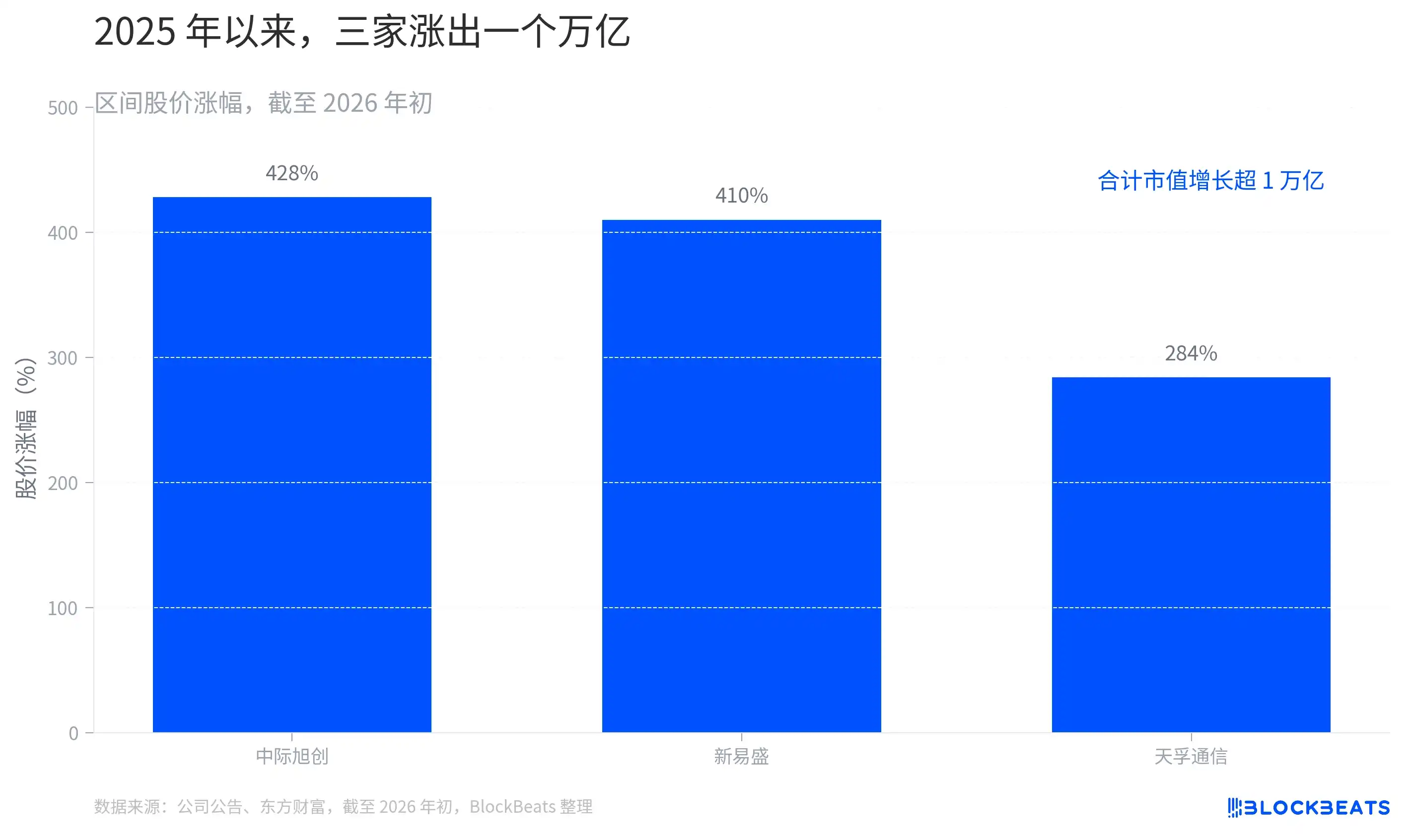
The reason is simple: when a company's profits are still growing at triple-digit rates, calculating the P/E ratio based on the profits of the past twelve months yields a meaningless number. The market's pricing anchor has shifted from 'how much it earns this year' to 'how much it can earn in 2026 and 2027'. By early 2026, the three companies' stock price gains since 2025 were: Zhongji Innolight 428%, New Yisheng 410%, and Tianfu Communication 284%, with their combined market cap increase exceeding one trillion yuan. This one trillion is buying not the present, but the expectations for the next two to three years.
Therefore, 'value' here isn't 'which stock price is lower', but must be measured with three rulers. The first is the PEG ratio, which is the forward P/E divided by the growth rate, measuring 'how much you pay for the same growth'. The second is profit quality, measuring how 'clean' the earned money is and how high the gross margin is. The third is the premium/discount for certainty, measuring how much extra the market is willing to pay for 'stability' and how much it discounts for 'uncertainty'.
Applying these three rulers yields three completely different answers from the three companies. One is the numerical value king. One is expensive but stable certainty. One is the most expensive certainty.
New Yisheng: The Numerical Value King, But Cheap Has Its Reasons
Let's look at the numerically cheapest one first.
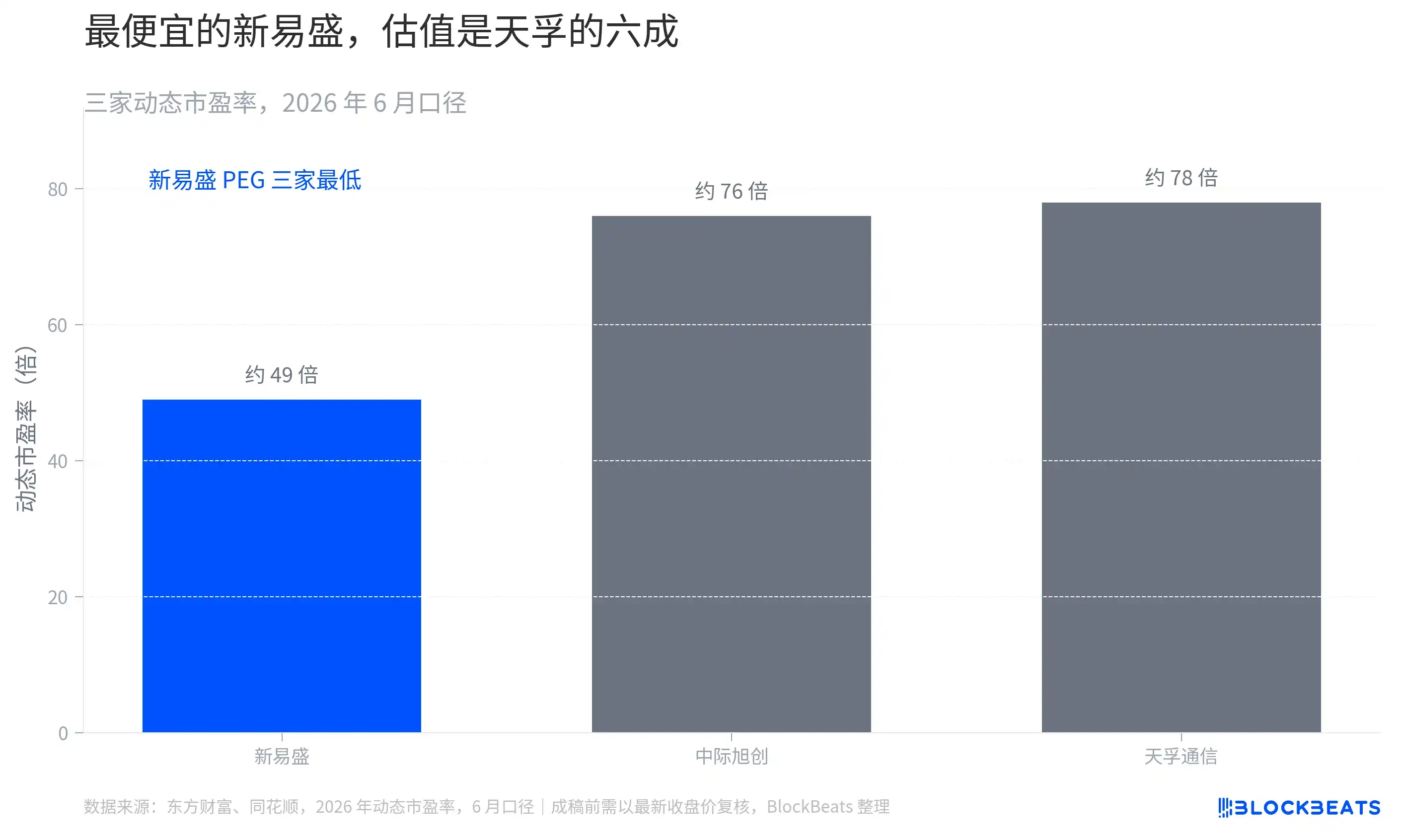
Based on PEG, New Yisheng is the most cost-effective of the three. Its year-on-year net profit growth rate for 2025 was close to 2.5 times, significantly higher than Zhongji Innolight's reported range of 89.5% to 128% for the same period. Its fourth-quarter net profit still grew 39% quarter-on-quarter, with 1.6T products ramping up ahead of schedule. Despite such fierce growth, its valuation is the lowest. Based on the institutional consensus forecast for 2026 net profit, its forward P/E is only about 22.8x, corresponding to a PEG of about 0.30, the lowest among the three. You pay the least for each unit of growth from New Yisheng.
Not only is it cheap, but the money it earns is also the 'cleanest'. In its 2025 performance, New Yisheng's non-recurring gains and losses were only 33 million yuan, and its gross margin remained above 47%, relying on cost advantages from vertical integration. In terms of profit quality, it even surpasses the larger-scaled Zhongji Innolight.
The story up to this point makes New Yisheng look like a dark horse undervalued by the market. But this is precisely where you can't stop at the surface. Its cheapness is a discount, not a windfall.
The market doesn't discount a high-growth company for no reason. What's being discounted for New Yisheng are several real risk points. High customer concentration, with performance heavily reliant on a few major clients. Overseas revenue accounts for 78%, directly exposing it to the tail risks of tariffs and trade restrictions. And the most critical point: can the explosive power of a 'dark horse' be sustained? In terms of long-term technology narrative and forward-looking layout, the story it tells isn't as solid as Zhongji Innolight's. The low P/E ratio the market gives it is essentially a discount for 'sustainability'.
This discount is being partially repaired. In 2026, New Yisheng's stock price has risen over 79% year-to-date and has begun planning for a Hong Kong listing. Capital is voting with its feet, pulling it from 'untrusted dark horse' towards 're-priced leader'. Cheap, but the cheapness is narrowing.
So what about the expensive one? Where does its stability lie?
Zhongji Innolight: Expensive Certainty
Zhongji Innolight's value proposition isn't in being cheap, but in certainty.
A single comparison makes it clear. In the first quarter of 2026, Zhongji Innolight's single-quarter revenue was 19.496 billion yuan, with a net profit of 5.735 billion yuan. One quarter's net profit surpassed the total for its entire year of 2024. During the same period, the gross margin for its optical communication transceiver modules increased from 34.65% in 2024 to 42.61%, a rise of nearly 8 percentage points. Scale is growing, and profitability efficiency is also growing. This is the posture of a leader.
Supporting this certainty are market share and technological generation gaps. Zhongji Innolight secured over half of Nvidia's 800G optical module procurement. For the 1.6T generation, with the first-mover advantage of completing Nvidia's validation early, the market expects it to capture 50% to 60% share. In last year's Q3 earnings conference call, company executives laid out the timeline clearly: "In the third quarter of this year, key customers began deploying 1.6T and continued to increase orders... it is expected that other key customers will also deploy 1.6T on a large scale from 2026 to 2027." To handle these orders, the company is securing chips and expanding production capacity, building out both domestically and overseas.
The cost is that it's the most expensive. Zhongji Innolight's trailing P/E once reached 73 to 74 times, over 40% higher than New Yisheng's. What you're paying for is a premium for 'leader barriers + technological leadership'. This premium suits those who value certainty more and can afford the high price.
But certainty doesn't mean no risk, and its risks lean more towards 'black swan' nature. On June 8, 2026 (US time), Zhongji Innolight was added by the US Department of Defense to the "1260H List". The company urgently responded, stating this designation did not conform to objective facts, that the company is neither a military enterprise nor a civil-military integration enterprise, that it has not had a substantive impact on operations, and that orders, production, and supply chains were all normal. Responses aside, for a company with overseas revenue accounting for as high as 86.8%, geopolitics is the real sword hanging over its head. It doesn't affect fundamentals, but it can slash valuations by a chunk on any trading day.
After dissecting the two module manufacturers, one remains that isn't even at the same table.
Tianfu Communication: The Most Expensive Certainty, Betting on the Next-Generation Architecture
What makes Tianfu Communication special? It doesn't sell modules; it sells the 'water'.
A supply chain analogy is most intuitive. If Zhongji Innolight and New Yisheng are restaurants directly facing diners, Tianfu Communication is the supplier to the restaurants. It sells core components like optical engines and optical devices to downstream optical module manufacturers, who then assemble them into complete modules for shipment. It doesn't directly receive orders from cloud providers, but every high-end optical module contains its components.
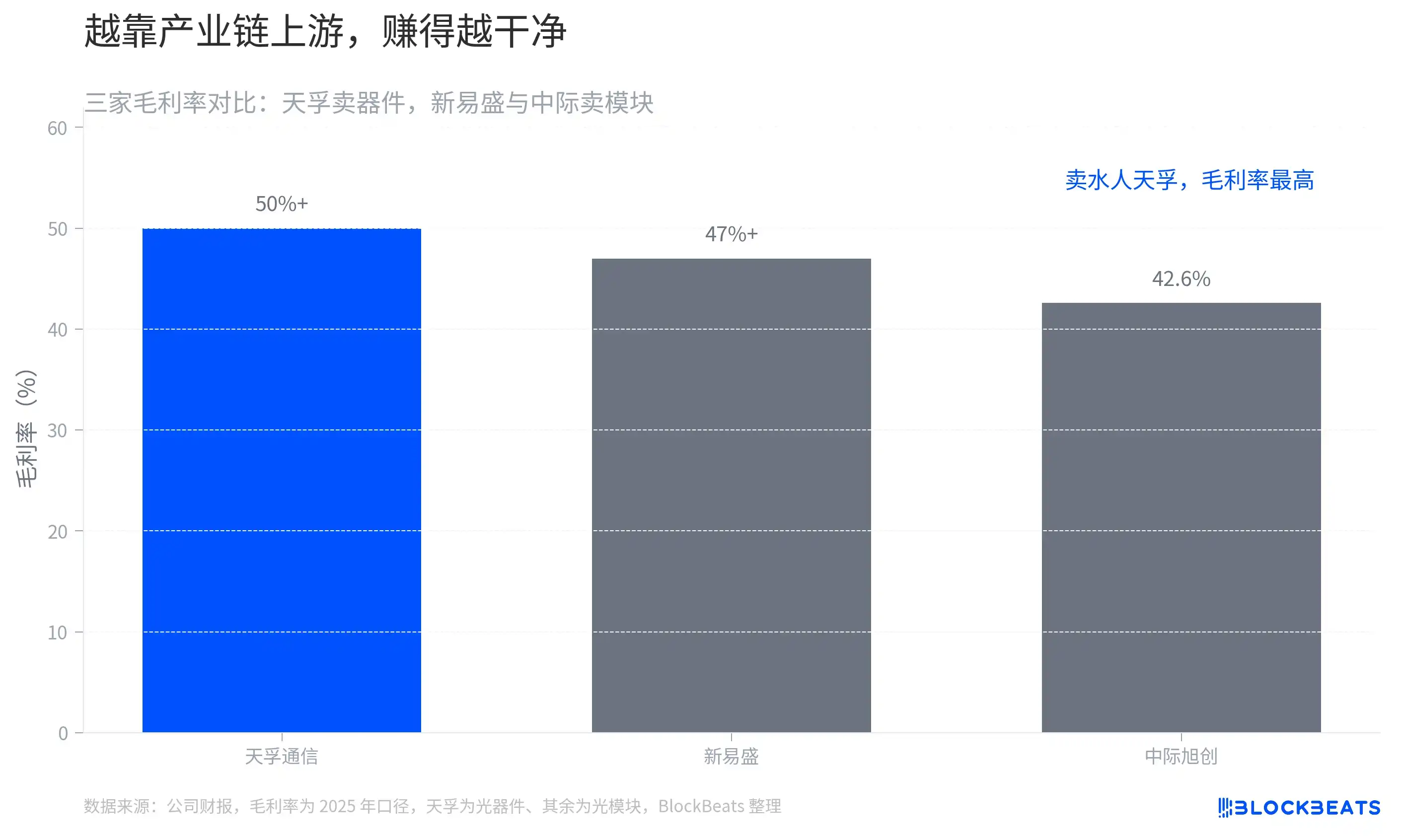
Being upstream gives it the highest gross margin among the three, consistently maintained above 50%, and its competitive landscape is the clearest. More importantly, it has bet on an extremely certain long-term trend: CPO/NPO architecture. Some institutions estimate that in the value chain of a high-configuration 51.2T switch, Tianfu Communication's combined potential value in FAU (Fiber Array Unit), precision lens, and optical engine packaging segments could reach the magnitude of $7,000 to $10,000.
Compared to the single-digit or tens-of-dollars component output value per machine in the traditional pluggable era, this represents a complete volume-price expansion. Regardless of which downstream module solution cloud providers ultimately choose, as long as data centers continue evolving towards more efficient, energy-saving architectures, the 'water seller' position is secure.
It sounds beautiful. But Tianfu's problem is precisely hidden within the term 'water seller'. It has the least elasticity, the most expensive valuation, and is the most prone to expectation gaps.
Low elasticity because its growth is a stream, not a pulse. Zhongji Innolight and New Yisheng directly consume the pulse-like explosion of AI capital expenditure, with huge earnings elasticity. Tianfu's growth is stable, but gentle. Expensive valuation because the market has priced this certainty sky-high in advance. As of February 10, 2026, its trailing P/E was about 122x, far higher than the other two. And the point about being most prone to expectation gaps was bloodily demonstrated just in Q1 2026. The institutional consensus expected its quarterly net profit to be between 780 to 820 million yuan, but the actual figure was only 490 million yuan. The huge gap resulted from institutions applying the pulse logic of module manufacturers to an optical component company.
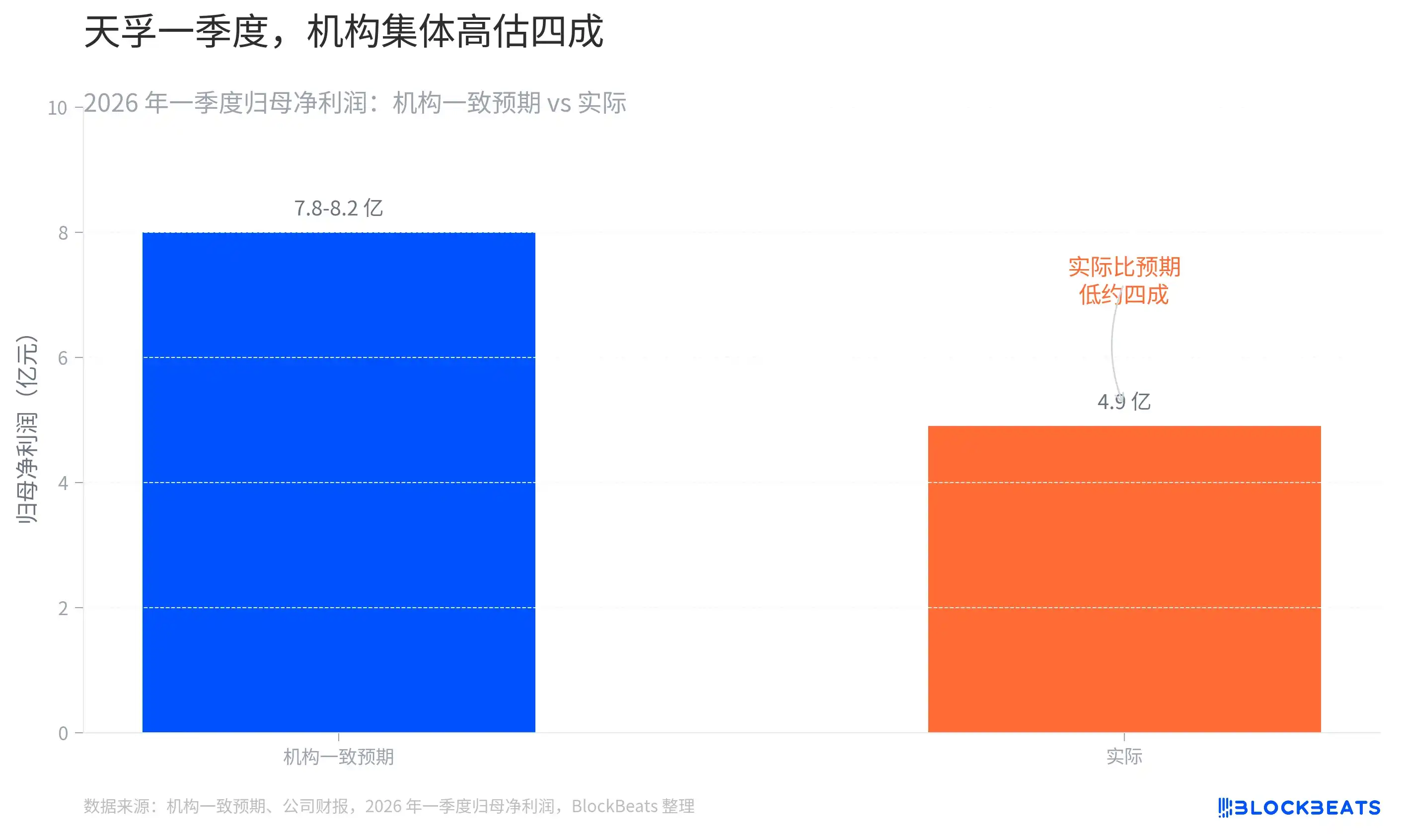
This precisely reminds anyone trying to rank 'Yi Zhong Tian': Tianfu and the other two are not playing the same game. Pricing the engine seller using the logic of the whole-machine seller is itself a misinterpretation.
At this point, the three are dissected. But the 'value' question has another hidden variable no one has factored in.
The Profit Pool Isn't in Their Hands at All
Returning to the card table, ask a tougher question: Is the money 'Yi Zhong Tian' earns actually 'good money'?
The essence of optical modules is system integration. Procuring optical chips, electrical chips, optical components, and then assembling them into a complete module using packaging processes. The barrier isn't in the assembly itself. The real profit pools and moats are concentrated at the two ends of the industry chain: upstream laser chips, and switch chips. What Chinese manufacturers dominate is the middle assembly process.
Therefore, the talk about 'Zhongji crushing Lumentum, Coherent' must be viewed in two layers. In terms of module market share, it holds true. Zhongji Innolight has indeed pressured these two established US players. But in terms of profit quality, it's another story.
Lumentum and Coherent guard precisely the upstream. They hedge against chip shortage risks with vertically integrated laser chip supply, and the advantages of III-V platforms like Indium Phosphide (InP) and Gallium Arsenide (GaAs) in high-power applications remain very real. Moreover, these two are by no means defeated underdogs; they are upstream players recovering rapidly. Lumentum's revenue grew 58% year-on-year in Q1 FY2026, with gross margin rising from 28% to 34%.
Coherent achieved quarterly revenue of $1.81 billion in the same period, a 21% year-on-year increase, with its Datacom & Telecom business already accounting for 75% of total revenue and growing over 40% year-on-year, and its non-GAAP gross margin improved to 39.6%.
An even sharper point follows. The trillion-yuan valuation surge of 'Yi Zhong Tian' bets on this generation's architectural shift to CPO. And CPO离不开 CW (Continuous Wave) light sources and Indium Phosphide substrates, which are precisely the home turf of US manufacturers. Coherent is doubling its InP capacity. Its factory in Sherman, Texas, is the world's most advanced InP production line, specifically ramping up CW laser production for solutions including Nvidia's CPO.
The more 'Yi Zhong Tian' bets on architectural upgrades, the more they are expanding the territory for upstream US chip manufacturers. So, 'Yi Zhong Tian' earns money from assembly and components, while Coherent and Lumentum earn money from chips. The latter is thinner, slower, but more enduring.
This is also why everyone mentions 'Yuanjie high-power lasers' alongside 'Yi Zhong Tian'. Yuanjie Technology represents the effort of domestic laser chip makers to climb up the industry chain. Its 100G EML passed customer validation in 2025 and entered mass production in 2026, and its CW 100mW high-power light source has also achieved batch delivery, with Q1 revenue growing over threefold year-on-year. Only if this layer can truly break through at the critical, richest points like EML and high-power laser chips will the moat of 'Yi Zhong Tian' extend from assembly to chips, and the bond become truly solid. If the climb fails, no matter how high the value, it's just earning hard labor money.
This is the real hidden variable for measuring the long-term value of the three. It's not whose PEG is lower, but whether China's optical module industry can capture the profit pool back from the upstream.
Whether time will prove optical modules and computing power, no one knows. But at least, those standing in the light should first figure out which beam of light they are standing in.