Analysis of the Latest Portfolio Adjustment by the "Top Player" in the U.S. Stock Market: $9 Billion Short on NVIDIA, Shifting Focus to Power and Memory Sectors

marsbitPubblicato 2026-06-20Pubblicato ultima volta 2026-06-20

Introduzione

AI investor Leopold Aschenbrenner has made a significant portfolio shift, taking a $9 billion nominal short position against top AI infrastructure stocks like NVIDIA, ASML, and Oracle. Simultaneously, he is redirecting capital towards what he sees as the next critical bottlenecks in the AI boom: power, memory, and data center networking, alongside private investments in AI model companies like Anthropic. This move is interpreted not as a call that the AI bubble has burst, but as a rotation within the infrastructure stack. The analysis highlights NVIDIA's recent $25 billion bond issuance as a potential signal, questioning why a cash-rich company would seek external debt despite high profits and increased dividends/buybacks. The core investment thesis is that the initial, crowded "picks and shovels" trade in semiconductors is maturing. The next wave of capital is expected to flow into the physical and logistical constraints of AI expansion: electricity supply, memory chip capacity, data center construction, and enabling technologies like optical networking (fiber) for high-bandwidth communication, where copper remains crucial for short distances. Aschenbrenner's substantial (approx. 20% of fund) private stake in Anthropic is noted as a key part of his strategy—investing directly in the "mine" (AI models) rather than just the "shovels." The discussion concludes that while certain segments may be overvalued, the overarching AI infrastructure demand driven by real product usage...

Leopold Aschenbrenner, regarded as one of the world's most aggressive AI investors, has established nominal short positions of approximately $9 billion in public markets against NVIDIA, ASML, and Oracle, while reallocating capital towards deeper layers of AI infrastructure and model assets such as power, memory, data center networks, and companies like Anthropic.

The two hosts believe this does not signal the bursting of the AI bubble, but rather indicates a rotation within infrastructure trades from a "chip-first" approach to one prioritizing "energy, networks, and data center construction." Especially following NVIDIA's recent $25 billion bond financing and the soaring valuation of Anthropic, the market implications of this judgment are rapidly amplifying.

Key Takeaways

Leopold's Core Trading Logic

· "The classic 'selling picks and shovels' trade in AI has become too crowded, and Leopold's recent portfolio changes convey precisely this signal."

· "His judgment is not that AI infrastructure has peaked, but that certain tiers within the infrastructure stack, particularly semiconductors and traditional popular stocks, have become excessively crowded."

· "If the question becomes where the money will flow next, there are two answers. The first and most direct is flow into the next genuine infrastructure bottlenecks, namely power, memory, and data center network segments. The second answer is that mysterious investment exposed just a few weeks ago."

· "His bets have always been very infrastructure-oriented, investing in both these optical companies and power-related companies."

· "If he is cautious on NVIDIA, then capital will move to areas like power and memory; at the same time, he also wants to invest directly in the 'mine' itself, rather than continuing to only buy the 'shovels.' Anthropic is his favorite 'mine.'"

The Signal from NVIDIA's Financing

· "The issue isn't whether NVIDIA will continue to make money, but why a company with extremely high profit margins and already large cash reserves would borrow an additional $25 billion externally."

· "If a company simultaneously engages in massive stock buybacks and significantly increases dividends while also borrowing money in the same month, it's clearly not borrowing due to a cash shortage. A more reasonable explanation is that this is cheap capital, and the financing methods within this AI cycle are undergoing a slight shift."

The Next Wave of AI Infrastructure Benefits

· "The real bottlenecks are no longer just GPUs, but power, memory, data center networks, and the actual capability to build these things."

· "Even if you raise endless amounts of money, you cannot build data centers fast enough, expand memory chip capacity sufficiently, or immediately expand the power grid, transmission lines, and related infrastructure. There aren't enough people on the ground, and permitting, regulation, and various procedures are also hindering progress."

· "Whoever can build the data centers will take the profits."

Optical Modules, Copper, and Fiber Optics

· "As GPU clusters grow larger, copper wires will get hotter, energy losses will increase, and efficiency will suffer. In this scenario, fiber optics become the next upgrade direction."

· "For many high-bandwidth, short-distance transmission scenarios, copper is almost the only material everyone truly wants to use. Only when it becomes unsuitable, such as over long distances or with excessive heat, do they switch to fiber optics. Therefore, the combined market demand for copper and fiber optics is currently very strong."

· "The recent strength in copper futures is essentially because everyone needs it; it's the most critical foundational material for short-distance, high-bandwidth transmission, and fiber optics is the next step."

· "Copper remains the most critical material for short-distance, high-bandwidth transmission, but once distances increase or heat becomes too high, a switch to fiber optics is necessary."

· "The next wave of capital will land on infrastructure companies that don't sound particularly sexy."

Why Energy is the Safest Bet

· "I've always been bullish on energy because, even if AI demand slows, energy itself remains a global necessity, and this demand will only increase."

· "The single trend that continues to rise regardless of the scenario is our demand for energy, electricity, and power. These companies are the ones I am most willing to be long-term long on."

· "The companies I most want to follow are those Jensen is investing in that also intersect with Leopold's logic. So, the company I'm currently closest to tailing is Marvell."

· "The best long-term positions are not necessarily the hottest chip companies, but the power infrastructure companies that are indispensable in any macroeconomic scenario."

Leopold's AI Investment Portfolio

Josh Kale:Leopold Aschenbrenner, this 24-year-old focused on AI investing, is now almost regarded by the market as the world's strongest AI investor. External rumors suggest the nominal size of his fund's positions now exceeds $20 billion. When we looked at Ejaaz's post a month ago, the fund size was only $13.7 billion, essentially doubling every quarter.

This time, we've obtained several significant new changes in his recent investment moves. Last episode, we discussed his portfolio, and the most surprising point then was that he was actually shorting a company almost everyone knows—NVIDIA, the world's highest market cap and hottest AI stock. Many couldn't understand why he placed over $9 billion in short exposure against such a company.

Now we have a new clue that might explain this. NVIDIA is actually raising capital, and through debt issuance. On the surface, this seems illogical. Why would a company of NVIDIA's immense size and extremely high profit margins take on an additional $25 billion in cash from a recently completed financing? Today, we want to combine this with Leopold's portfolio to discuss why he has made so much money, what he's looking at next, and what NVIDIA's financing truly means.

Ejaaz Ahamadeen: First, some background. Leopold Aschenbrenner was a former OpenAI researcher who raised a fund about a year and a half to two years ago. The initial size wasn't large, I recall around $200 million. But judging from his latest 13F filing, the fund's public holdings are now worth $13.7 billion.

So naturally, the market wants to know which positions he's taken, what his core investment logic is, and where his next big trade will land.

To understand this, you must first know that until about a month ago, Leopold was very optimistic about the entire AI sector, particularly bullish on the "selling picks and shovels" logic, i.e., GPU and upstream hardware suppliers like NVIDIA.

But about a month ago, the market discovered he wasn't as bullish on the semiconductor line. He remains bullish on the real bottleneck areas like memory and power, and likely also on new types of cloud providers, but he is notably not bullish on the world's most valuable company, NVIDIA. More specifically, he has placed a total of roughly $9 billion in bearish exposure against several companies seen as core AI infrastructure beneficiaries, including NVIDIA, ASML, and Oracle.

The Logic Behind Shorting NVIDIA

Ejaaz Ahamadeen: When this emerged, many started worrying, thinking the AI bubble might be about to burst. On the surface, NVIDIA's GPUs are still selling massively, and demand hasn't noticeably weakened. So where's the problem?

Later, we dug up several new clues, the most important being that NVIDIA just raised $25 billion externally through bond financing. This means it's not simply using its own cash but adding external leverage. So the question arises: Why would the world's most profitable, highest-margin, strongest-cash-flow company go out and borrow $25 billion?
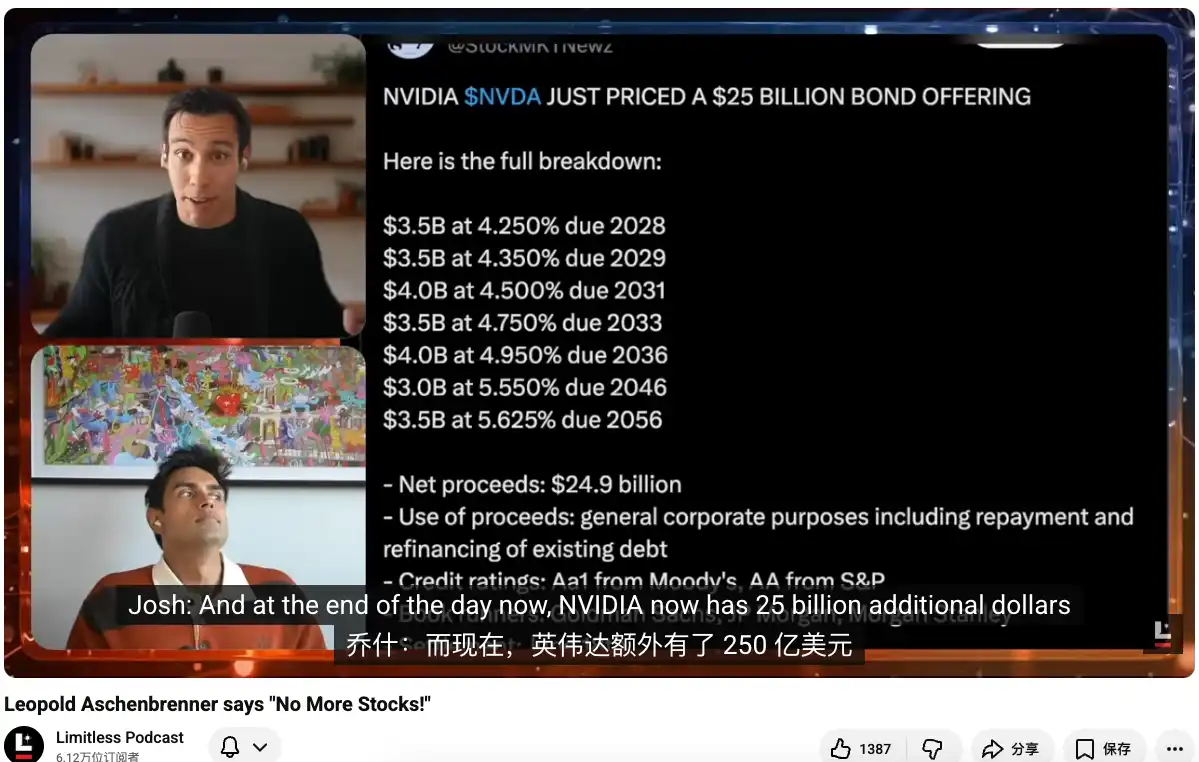
Josh Kale: Furthermore, they initially intended to raise only $20 billion but ended up expanding to $25 billion, with subscriptions exceeding three times the amount. Last episode, when discussing this portfolio, we said not to worry about a bubble just yet because although these companies have massive capital expenditures, their revenues are high enough to theoretically support expansion with their own balance sheets.

But this is NVIDIA's first significant move to finance off its balance sheet since 2021, rather than directly using its cash. I recall it currently has around $12 billion in cash on hand. Putting all this together creates a strange tension: on one side, Leopold is shorting; on the other, NVIDIA, seemingly with infinite cash and profits, is issuing debt. So what's happening?

Breaking Down NVIDIA's Bond Financing

Josh Kale: Ejaaz, can you break down this transaction itself for us? Because this isn't ordinary financing; it's a bond issuance. Ultimately, NVIDIA's balance sheet now has an additional $25 billion, and the interest rates likely appear very low.

Ejaaz Ahamadeen: I'll present both explanations. NVIDIA originally had about $13.7 billion in cash, meaning it could have just spent its own money. So why raise external capital? The simplest analogy is buying a house. Many people choose a mortgage even if they have the full amount because their own capital can be used elsewhere, and if the borrowing cost is low enough, it's actually more economical.

The interest rate environment hasn't been friendly in recent years, but if you're NVIDIA, one of the world's most valuable and sought-after companies, you can borrow on very favorable terms. This $25 billion bond issuance has maturities ranging from 2 to 30 years and can almost be considered very cheap money, with interest rates approaching US Treasury yields.

Moreover, the offering was roughly oversubscribed by 4 times. In other words, there was $85 billion in market demand chasing the $25 billion offering; NVIDIA could practically pick its investors. If you only look at the official statement, NVIDIA's explanation is that this is primarily for financial arrangements, to repay and refinance some existing debt. Google did something very similar a few weeks ago and also in February this year. So you can certainly accept this explanation, viewing it as financial optimization.

But the other side is hard to ignore: Over the past month and a half, NVIDIA, Amazon, Google, and several other hyperscale cloud providers have almost all been increasing external financing. Some via debt, some via equity sales. Leopold's view might not be entirely without merit—could this be a sign of the bubble starting to loosen, the house of cards beginning to wobble? However, if you look solely at the financial structure, it doesn't yet clearly point to danger.

Josh Kale: I see it similarly. $9 billion short on NVIDIA is a truly massive position. But during our research, we saw something else: on May 18th, NVIDIA's board authorized an additional $80 billion for share buybacks and increased the dividend from $0.01 per share to $0.25, a 25-fold increase.

If a company simultaneously engages in massive stock buybacks, significantly increases dividends, and also borrows money in the same month, it's clearly not borrowing due to a cash shortage. A more reasonable explanation is that this is cheap capital, and the financing methods within this AI cycle are undergoing a slight shift. Everyone wants to participate in these capital moves, and NVIDIA realizes borrowing via debt is even cheaper than other financing methods, so it just goes ahead. For now, at least, NVIDIA itself is still doing very well.

Why He Adjusted the Portfolio

Josh Kale: This brings us to another question. What exactly is Leopold thinking? Why has his judgment changed? The stock chart you just showed also indicates NVIDIA's recent performance hasn't been particularly strong, but it's not terrible either. It's still the world's largest company by market cap, nearing $5 trillion, down only about 7% in a month—nothing significant amidst the surge of other AI stocks.
Ejaaz Ahamadeen: I don't think NVIDIA will disappear. Its GPUs, including the CPU product line launched a few weeks ago, I believe will perform very well. AI product demand is currently in exponential surplus, and NVIDIA remains the primary core machine supplier capable of meeting this demand.

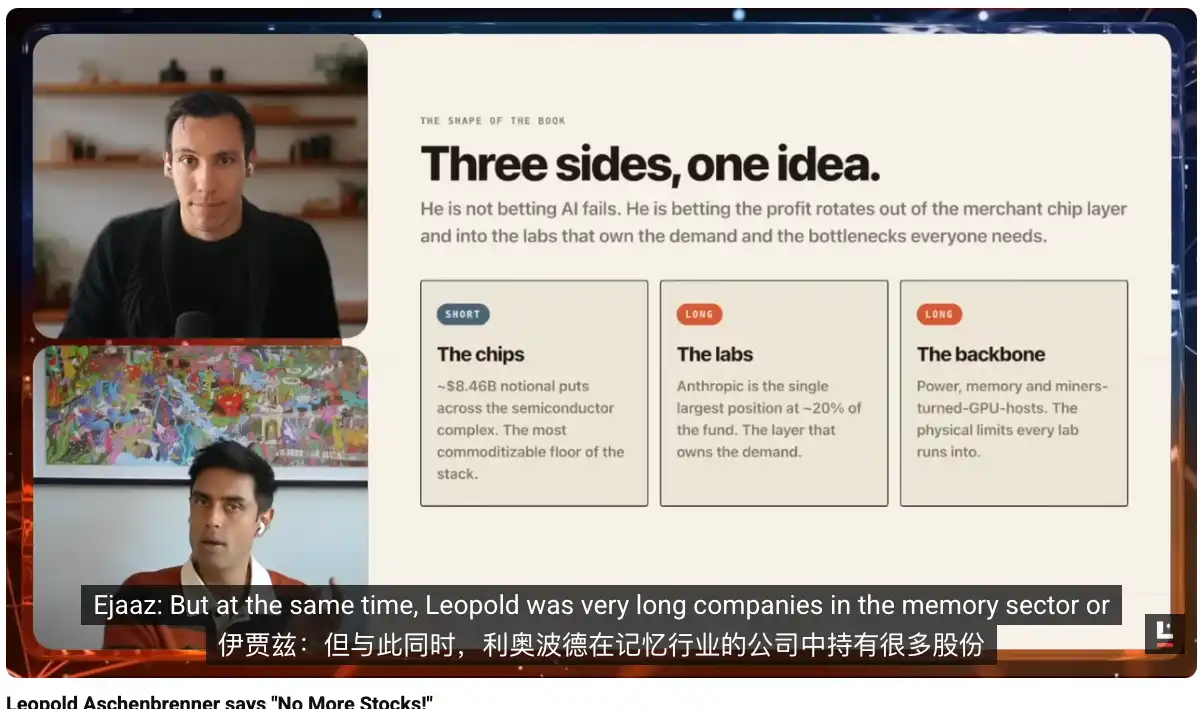
But I do think the classic 'selling picks and shovels' trade in AI has become too crowded, and Leopold's recent portfolio changes convey precisely this signal. Looking at his recent 13F, his bearish exposure is clearly skewed against the semiconductor line, such as NVIDIA, ASML, Oracle, and other infrastructure-level companies.

Yet simultaneously, he is heavily invested in directions like memory, power, and new types of cloud. This indicates his judgment is not that AI infrastructure has peaked, but that certain tiers within the infrastructure stack, particularly semiconductors and traditional popular stocks, have become excessively crowded.

If the question becomes where the money will flow next, there are two answers. The first is the most direct: flow into the next genuine infrastructure bottlenecks, namely power, memory, and data center network segments. The second answer is that mysterious investment exposed just a few weeks ago.

The Unexpectedly Exposed Anthropic Position

Josh Kale: This was the most surprising to me. I only learned about it yesterday from you, and my first reaction was disbelief. Could it be that Leopold's fund, 'Situational Awareness,' has approximately 20% allocated to Anthropic equity? Current external rumors suggest this company constitutes about one-fifth of Leopold's fund. The Wall Street Journal and several other media outlets have reported this, and sources very close to the transaction have confirmed it.

This becomes a completely unexpected card in his portfolio.

Because 13F filings only disclose public market holdings, not private equity, and Anthropic happens to be a large piece of non-public equity. This is also why people have begun to understand why external estimates value his portfolio at $20 billion.
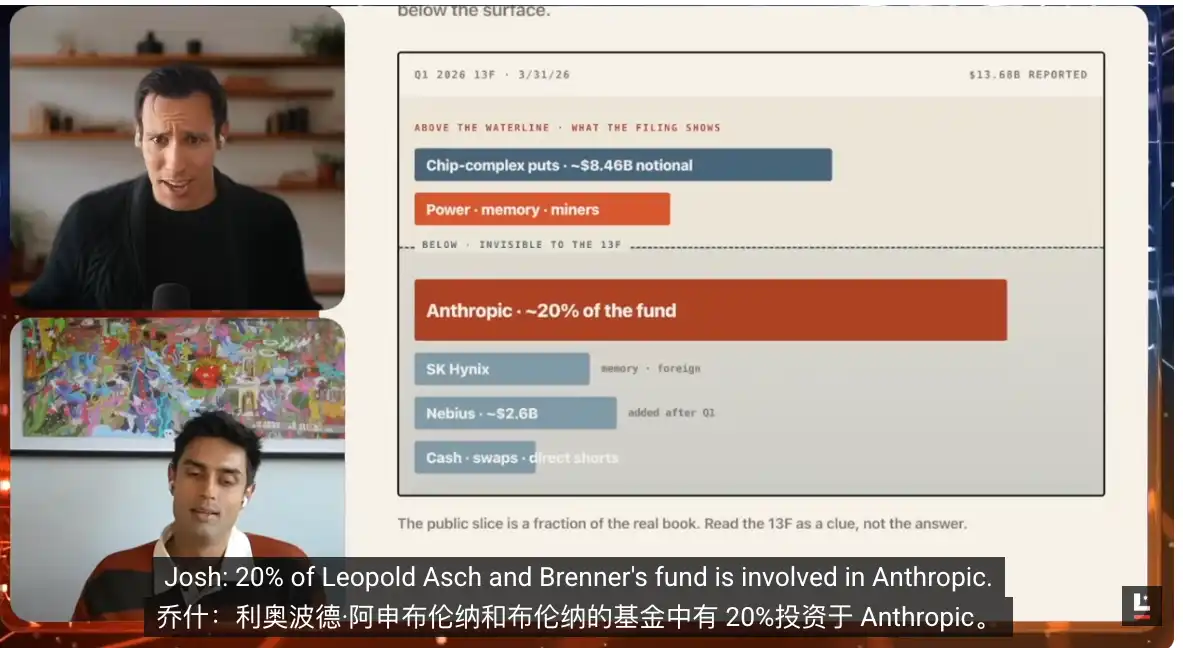
If 20% of the fund is Anthropic, and he invested around early 2025, then the returns on Anthropic over that year have been akin to seven years' worth. This change forces a significant revision in our understanding of his entire investment portfolio.

Ejaaz Ahamadeen: Yes. His first investment in Anthropic via private channels or the fund was around March 2025, when Anthropic's valuation was approximately $60 billion. Now, based on the latest funding round, it's valued at $96.5 billion.

This represents nearly a 15x increase. According to the algorithm presented in our show today, his latest 13F disclosed liquid portfolio value is $13.7 billion. If we add the Anthropic portion reported by The Wall Street Journal, roughly an additional $7 billion, the total fund management size reaches $20 billion.

How exaggerated is this? Bill Ackman, a top investor with three to four decades in the market, runs Pershing Capital at a similar size of around $20 billion. Leopold has been in this game for only a year and a half, he's 24, and has virtually no real investment experience.

Yet he has made some incredibly prescient calls. What's crazy is that he practically wrote all of this out in advance. When he launched the fund a year and a half ago, he published a 65-page AI essay titled 'Situational Awareness,' almost completely laying out the entire logic, including how capital would rotate from semiconductors and certain infrastructure segments to other bottleneck constraints. The market is now developing along these lines, which is truly astonishing.

The Next Wave of Infrastructure Trends

Ejaaz Ahamadeen: So this also tells me where the next money will flow. If he is cautious on NVIDIA, then capital will move to areas like power and memory; at the same time, he also wants to invest directly in the 'mine' itself, rather than continuing to only buy the 'shovels.' Anthropic is his favorite 'mine.'

Josh Kale: This indeed looks like a new trend, and again, he is earlier than most. For the past 12 months, everyone has been searching for AI's bottlenecks—rare metals, memory, RAM, etc.—and the market chased each wave. Those judgments weren't wrong because that wave of gains did happen.

But now, the valuations of directions seen as bottlenecks are gradually becoming rationalized. People already understand these companies' business models, market potential, and future revenues better, so much of the value is already priced in. In the next round, we care more about where the subsequent money will continue to flow.

The direction you mentioned—land, power, enclosures, physical infrastructure—seems correct. Because if we think about what's truly most important for AI, the answer increasingly seems to be physical construction capability. Look at xAI, or more accurately, look at SpaceX, which is now public. Its revenue core isn't rockets themselves but AI infrastructure construction.
Consider its recent deals with Anthropic and Google, which have created value exceeding the combined sum of Starlink, Starship, and the entire satellite business. There is clearly immense demand and value here. So the question becomes, who can actually build these things?

SpaceX is clearly one answer. Last night after hours, its stock was around $230, implying a valuation of about $3.1 trillion. We'll dedicate an episode to SpaceX this week because its recent run is simply too extreme. It just completed the acquisition of Cursor, its valuation has reached $3 trillion, and Elon Musk made more money in one day than Warren Buffett earned in his entire career.

Who Will Capture the Next Round of Profits

Josh Kale: We care about which companies are best at this hardware infrastructure, at developing those 'machines that build machines.' Combining Leopold's direction and the broader trend, we think the next wave of capital will move here. So Ejaaz, in reality, which companies will this rotation land on?

Ejaaz Ahamadeen: Many will be those unsexy-sounding infrastructure companies. A name frequently mentioned recently is Marvell. A few weeks ago at Computex in Taiwan, Jensen Huang directly stated on stage that this would be the next trillion-dollar company.

And just three months before he made that statement, NVIDIA had invested $1.5 billion in Marvell. I'm starting to wonder if this counts as insider trading or market manipulation, because after he said that, the stock rose another 70%.

I think it's easy now to directly claim AI infrastructure has peaked. But if you compare it to historical financial crises, like 2008, that flavor of high leverage, financial engineering, and systemic manipulation hasn't fully emerged this time.

There are two key differences. First, the products these companies are making today are genuinely being purchased. There wasn't such solid real demand during the dot-com bubble or the financial crisis. Second, constrained by physical laws, we can't infinitely add leverage now because the entire system is constrained by manpower and construction capability.

Even if you raise endless amounts of money, you cannot build data centers fast enough, expand memory chip capacity sufficiently, or immediately expand the power grid, transmission lines, and related infrastructure. There aren't enough people on the ground, and permitting, regulation, and various procedures are also hindering progress.

So I actually think this gives investors an advantage. Since you already know the hottest chip and 'pick and shovel' trades are too crowded, then the next money will flow into power, data networks (companies like Astera Labs), and other related segments.

What you really need to think about is when these contracts start to materialize, when these fabs are actually built, when SpaceX rockets can launch AI satellites, and even when they can start using solar energy to train AI models.

The timeline determines the betting rhythm. At least that's the framework I'm investing by, though this is not investment advice. I see it this way because over the past year and a half, we've witnessed firsthand how capital flowed from general AI stocks to semiconductors and infrastructure trades.

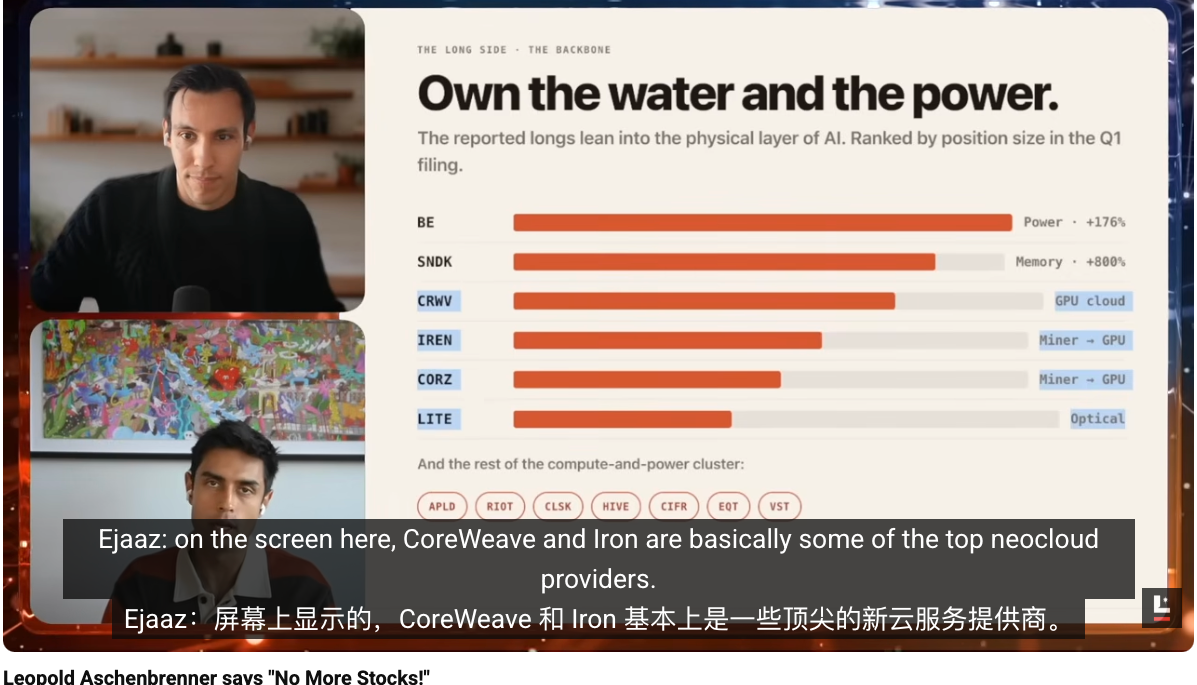
Josh Kale: If you continue looking at this portfolio chart, you'll see this story is clearly written into his holdings structure. By category, what is his largest allocation? Power and energy. Next is memory, followed by cloud and GPU miners—the most tangible infrastructure.

He wants to hold new cloud providers like CoreWeave and also miners who have pivoted to cloud compute. What he wants to own is this physical infrastructure because he believes this is where the real bottlenecks are. As you mentioned, there are many finer details, like the immense difficulty of actual construction, hardware manufacturing, and data center building itself.

If we ask where the biggest bottlenecks are, even permitting might be one. Who is solving these problems? SpaceX wants to move data centers to space, Tesla wants humanoid robots to address labor shortages. But both are far off. In the short to medium term, there exist vast blank opportunities, and this is precisely where Leopold is betting.

The Advantages of Optical Modules and Fiber Optics

Josh Kale: I want to add one detail we didn't expand on earlier. For those wanting to dig deeper and find more alpha, many of his clues lie in optics and deeper layers of the tech stack. Ejaaz, you've been researching this lately. Can you explain his thinking?

Ejaaz Ahamadeen: If you look at the positions on his screen, CoreWeave and Iron are essentially top-tier new cloud service providers. Simply put, they are somewhat like Amazon Web Services, except AWS provides cloud services to internet companies, while these companies provide ready-made GPU infrastructure to AI companies.

They handle setting up GPUs, networks, deployment—all so AI companies don't have to worry about underlying infrastructure and can directly train models and access compute. CoreWeave and Iron have been among his largest concentrated positions since inception and have delivered the highest returns.

Notably, he still holds these two companies among his largest positions today. This also indicates one thing: in his view, this trade is far from over. Furthermore, he has privately invested in Core Scientific, a company that can help unlock CoreWeave's infrastructure supply capacity. In a sense, he's adding another layer of leverage to CoreWeave.

Beyond these, look at companies like Coherent and Lumentum; they are essentially suppliers related to fiber optic and optical connectivity. To explain in the simplest terms, for semiconductors and GPUs to communicate with each other, traditional methods often rely heavily on copper wires.

The issue is, as GPU clusters grow larger, copper wires will get hotter, energy losses will increase, and efficiency will suffer. In this scenario, fiber optics become the next upgrade direction. It enables faster data transfer, is more cost-efficient, and allows companies providing inference and training compute to earn more. So you'll notice his bets have always been very infrastructure-oriented, investing in both these optical companies and power-related companies. It may not sound sexy, but in my view, this is where the money is truly flowing now.

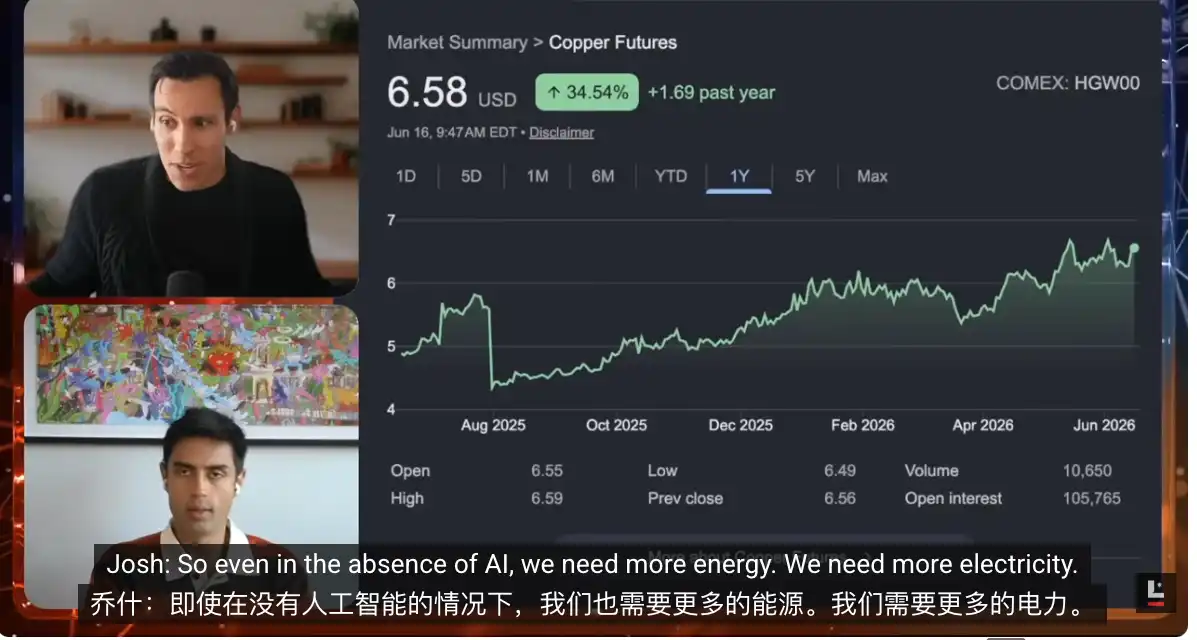
Josh Kale: The copper aspect is also interesting to me because I only recently realized how critical it is for short-distance data transmission. For many high-bandwidth, short-distance transmission scenarios, copper is almost the only material everyone truly wants to use. Only when it becomes unsuitable, such as over long distances or with excessive heat, do they switch to fiber optics. So the combined market demand for copper and fiber optics is currently very strong, which is why observing the copper trade is interesting.

The recent strength in copper futures is essentially because everyone needs it; it's the most critical foundational material for short-distance, high-bandwidth transmission, and fiber optics is the next step.

Thinking at an even more fundamental level, the materials angle has always been interesting. The absolute bottom layer beneath all layers is essentially the raw materials most core to achieving intelligence. Copper is one, lithium is another, and many others. We really should do a dedicated episode on materials. Perhaps Leopold hasn't reached that layer yet, and we might see the next rotation before he does.

Josh Kale: If you keep going down the stack, you could even look directly at copper mines to see how these materials are produced. But returning to the core judgment, I think the next rotation indeed shifts from seemingly smaller bottlenecks to the truly difficult things: hardware and large-scale data center construction.

Whoever can build the data centers will take the profits. We've already seen how much SpaceX is earning due to immense data center demand. Whoever can bring more data centers online faster, provide sufficient power and GPUs, will earn the most. This is essentially what Leopold is betting on now.

Is a Bubble Forming?

Josh Kale: To summarize, we don't believe we are in a bubble-bursting phase yet. Leopold's portfolio seems more like a rotation than a full-scale retreat. So, should we still follow his lead?

Ejaaz Ahamadeen: I admit, when I first saw his 13F, my initial reaction was: this guy is shorting the world's most valuable company with demand booked until 2029? That's outrageous. But now, seeing this financing, I'm starting to think if NVIDIA continues to add external debt in the future, or even potentially sells equity, if this trend persists, then Leopold might be right once again.

If that happens, his fund could ultimately surpass the world's top traders and best investment funds. He has been consistently winning; it's hard not to respect that.

Josh Kale: However, another important point: his life so far has almost always been long-only; he hasn't truly been tested by large-scale selling. We mentioned Bill Ackman earlier—achieving 30x returns and surviving in the market for 30 years are two different things.

If he can maintain this growth trajectory and also learn when to press the sell button, how to manage risk, how to use hedges for protection, that would be even more formidable. We are starting to see the embryonic form of this capability. That $9 billion short isn't achieved by directly shorting $9 billion in cash but through options and leverage, not a one-to-one naked short. Regardless, this is all worth continued observation.

Energy is the Core Bet

Josh Kale: If you had to pick one stock from his entire portfolio that you most want to buy yourself, which would it be?

My own answer is energy stocks. I've always been bullish on energy because, even if AI demand slows, energy itself remains a global necessity, and this demand will only increase.

Even completely ignoring AI, we need more energy, more electricity. Companies like Bloom Energy that can enhance power supply and transmission capacity excite me most because they resemble a hedge-like bet. The single trend that continues to rise regardless of the scenario is our demand for energy, electricity, and power. These companies are the ones I am most willing to be long-term long on.

Ejaaz Ahamadeen: My answer is a bit of a cheat. The companies I most want to follow are those Jensen is investing in that also intersect with Leopold's logic. So the company I'm currently closest to tailing is Marvell. While not a public holding of Leopold's, it aligns very well with his bets on fiber optics and power, and Jensen has already invested $1.5 billion of real money.
I've observed a phenomenon: whenever Jensen invests in a company through NVIDIA, whether it's Intel, CoreWeave, or others, it mostly keeps rising afterward. So my current positioning is roughly here. I also hold some CoreWeave myself because both Jensen and Leopold are extremely bullish on it.

Josh Kale: Marvell is up 270% over the past 6 months. This might genuinely be a good rule of thumb: when influential figures like Jensen, or even someone with enormous sway like Trump, publicly say to buy a certain stock, you probably should take a serious look.

Past instances have repeatedly shown such signals often have substantial realization potential. Whether Intel or Marvell, these cases show that, on one hand, they truly understand what they're talking about, and on the other, they have the ability to influence these companies' outcomes. So this market run is truly insane.

I hope it continues. Based on current evidence, it likely will. At least for now, we remain bullish and optimistic, and will continue making judgments daily based on changes.

Josh Kale: Any final thoughts you want to add regarding Leopold's portfolio update?

Ejaaz Ahamadeen: I'd really like to hear what skeptics think. If after listening to our analysis, you think we're completely wrong or have misinterpreted something, feel free to point it out directly.

Yesterday, I stared at NVIDIA's $25 billion financing news for a long time, intending to find flaws. But if you look purely at financial logic, it does make sense.

Why not borrow this almost risk-free cheap money? Using borrowed money for expansion is clearly more rational than selling your own equity because you retain more future earnings.

Crypto di tendenza

Domande pertinenti

QAccording to the article, what is Leopold Aschenbrenner's core trading logic behind his recent portfolio adjustments?

AHis core logic is a rotation within the AI infrastructure stack. He believes the classic 'pick-and-shovel' trades (like investing in NVIDIA) have become too crowded. Therefore, he is shifting capital towards what he sees as the next true infrastructure bottlenecks: power, memory, and data center networking. He is also moving to invest directly in the 'mines' (AI models like Anthropic) rather than just the 'shovels' (hardware suppliers).

QWhy does the article highlight NVIDIA's recent $25 billion bond offering as a significant signal?

AThe bond offering is significant because NVIDIA, a highly profitable company with substantial cash reserves, is choosing to raise external debt. The hosts interpret this not as a sign of financial need, but as a signal of a subtle shift in financing for the AI boom—accessing cheap capital. This action, coupled with Leopold's massive short position, prompts questions about potential market saturation or a strategic rotation of capital away from the most crowded 'pick-and-shovel' plays.

QWhat are identified as the next major bottlenecks for AI infrastructure, beyond GPUs?

AThe next major bottlenecks identified are power/electricity, memory, data center networking, and the physical ability to build out data center capacity (including land, construction, and regulatory approvals). The article argues that these physical and logistical constraints are becoming more critical than just GPU supply.

QHow does Leopold Aschenbrenner's portfolio reflect his view on the durability of the energy/utilities sector?

AHis portfolio shows a major allocation to energy and power companies. The hosts view this as a highly durable bet because energy demand is a global necessity that will continue to rise regardless of AI market fluctuations. Investing in companies that enhance power generation and transmission is seen as a 'hedged' long-term position that benefits from a secular trend of increasing power consumption.

QWhat is the strategic significance of the materials copper and fiber optics in the context of advancing AI data centers?

ACopper remains the critical material for short-distance, high-bandwidth connections within data center racks due to its cost-effectiveness. However, as GPU clusters grow larger, heat and energy loss from copper wires increase, making them less efficient for longer distances. Fiber optics are positioned as the next upgrade step, offering higher speeds and better efficiency for these scaling demands. Therefore, strong demand is expected for both materials, representing another infrastructure layer for investment.

Letture associate

Ethereum Q1 2026 Report: Fees Decline, Users and Transaction Volume Hit New Highs

Ethereum Q1 2026 Report: Fees Down, Users & Transactions Hit New Highs Token Terminal's Q1 2026 report on Ethereum presents a pivotal development: the network achieved record highs in monthly active users (13.2M, +85.9% YoY), total transactions (200.4M, +81.5% YoY), and throughput (25.78 TPS), while transaction fees on the mainnet plummeted by 47.9% quarter-over-quarter. This shift is attributed to the network's strategic move into a "low fees for scale" phase, exemplified by the Fusaka upgrade which increased data capacity and lowered block space costs, releasing pent-up demand (a manifestation of Jevons's Paradox). The report highlights a core narrative shift for Ethereum: from a DeFi-centric blockchain to a global financial settlement layer. It maintains a dominant position in tokenized assets, holding majority market shares among top chains in stablecoins (61.8%), tokenized funds (73.0%), and tokenized commodities (84.0%). Growth in tokenized funds (+73.1% YoY) and commodities (+325.9% YoY) was particularly strong, driven by institutions like BlackRock and JPMorgan entering the space. Contrasting these usage gains, several USD-denominated value metrics declined in Q1: fully diluted market cap fell 30.3% QoQ, total value locked (TVL) dropped 11.0%, and ecosystem transaction volume decreased 24.0%. The report interprets this as Ethereum prioritizing long-term network expansion and cementing its role as the default settlement layer for finance over short-term fee capture. The commentary from Etherealize argues that, much like the early internet, Ethereum's open, permissionless model is poised to win over closed alternatives as institutional tokenization accelerates.

marsbit32 min fa

Ethereum Q1 2026 Report: Fees Decline, Users and Transaction Volume Hit New Highs

marsbit32 min fa

He Just Raised 2.7 Billion, and Li Fei-Fei Also Invested

Pete Florence, a former senior research scientist at Google DeepMind and a key contributor to the Vision-Language-Action (VLA) model architecture, is deliberately distancing his startup, Generalist AI, from the trendy "world model" label. He argues that the industry should prioritize concrete goals over buzzwords. His goal is to create robots that can perform a vast range of unseen tasks with high speed and success rates, without needing task-specific training data. Recently, his company raised $400 million (¥2.7 billion) at a $2 billion valuation. Notable investors include NVIDIA's NVentures, Bezos Expeditions, NFDG, as well as Xiaomi co-founder Lin Bin, Zoom founder Eric Yuan, and renowned AI scientist Fei-Fei Li. Florence's approach stems from his academic background at MIT under Professor Russ Tedrake, focusing on understanding the physical world. After joining DeepMind, he developed models like Transporter Network and co-created the VLA framework. He left in 2025 to found Generalist AI. The company has launched two models: GEN-0, which demonstrated that scaling laws apply to physical motion, and GEN-1. GEN-1 was trained on over 500,000 hours of physical interaction data collected via a specialized wearable device. It achieves a 99% success rate on precise mechanical tasks like folding boxes and maintains performance three times faster than its predecessor. Florence believes GEN-1 is reaching a commercial utility threshold similar to the GPT-3 inflection point. The substantial funding round, following GEN-1's release, signifies strong investor confidence in Generalist AI's practical, goal-driven path to creating versatile, useful robots, regardless of the "world model" terminology.

marsbit39 min fa

He Just Raised 2.7 Billion, and Li Fei-Fei Also Invested

marsbit39 min fa

Two Legends Lost in Three Days: Is Google's AI Talent Dam Cracking?

In three days, Google lost two AI legends. On June 18, Noam Shazeer, co-author of the seminal "Attention is All You Need" paper and Gemini co-lead, left for OpenAI. Just 48 hours later, John Jumper, 2024 Nobel laureate and AlphaFold lead, departed DeepMind for Anthropic. This follows Andrej Karpathy joining Anthropic in May. These moves highlight a structural trend: top AI talent is concentrating at mission-driven, pre-IPO firms like OpenAI and Anthropic, while Google becomes a primary source. The exodus stems from a core mission mismatch. Google's ad-centric model often subordinates AI research to product and revenue goals, creating friction for pioneers like Shazeer, who returned in 2024 only to leave again. In contrast, OpenAI and Anthropic offer singular focus on pushing AI boundaries, whether towards AGI or safety-aligned models, which deeply appeals to top researchers like Jumper. Financial incentives amplify the pull. With both OpenAI and Anthropic nearing IPO, employees stand to gain immensely from equity, an upside Google's mature stock cannot match. Furthermore, the 2023 merger of Google Brain and DeepMind, intended to consolidate strength, has instead created cultural tension and slowed the path from research to product, as evidenced by Gemini's pace. This talent redistribution is reshaping the AI landscape. While Google retains vast data and compute resources, its true crisis is the quiet, continuous loss of the people who define the field's future. The real moat in AI is not infrastructure, but the concentration of brilliant minds—a battle Google is currently losing.

marsbit2 h fa

Two Legends Lost in Three Days: Is Google's AI Talent Dam Cracking?

marsbit2 h fa

Behind the AI Report Card, Lies a Chinese 'Exam Setter'

Beyond the familiar performance charts like MMLU-Pro and MMMU, which major AI models strive to ace, stands a key "examiner": Chinese-Canadian researcher Wenhu Chen. An assistant professor at the University of Waterloo and founder of TIGERLab, Chen addresses the crucial need for more rigorous AI evaluation. As models like GPT-4 began scoring near-perfect results on older benchmarks like MMLU, it became difficult to distinguish their true capabilities. In response, Chen introduced MMLU-Pro in 2024, featuring harder, more reasoning-focused questions with more answer choices, successfully reintroducing meaningful performance gaps. His work extends to multi-modal evaluation with MMMU and its enhanced version, MMMU-Pro. These benchmarks test a model's ability to understand and reason with complex information from images, charts, and text across diverse academic subjects, exposing the significant challenges even top models face in genuine comprehension. Chen's background in complex QA, table reasoning, and his experience at Google DeepMind on projects like Gemini inform his approach. He understands that effective benchmarks must anticipate how models might "cheat" by memorizing data or avoiding visual analysis. His lab also actively researches video understanding and generation models (e.g., UniVideo, Vamba), ensuring his evaluation work is grounded in practical model-building challenges. Now at Meta's Super Intelligence Lab, Chen continues his focus on multi-modal data and evaluation, representing the deep yet often unseen contributions of Chinese talent in shaping the fundamental tools of the AI industry.

marsbit2 h fa

Behind the AI Report Card, Lies a Chinese 'Exam Setter'

marsbit2 h fa

Trading

Spot
Futures

Articoli Popolari

Cosa è GROK AI

Grok AI: Rivoluzionare la Tecnologia Conversazionale nell'Era Web3 Introduzione Nel panorama in rapida evoluzione dell'intelligenza artificiale, Grok AI si distingue come un progetto notevole che collega i domini della tecnologia avanzata e dell'interazione con l'utente. Sviluppato da xAI, un'azienda guidata dal rinomato imprenditore Elon Musk, Grok AI cerca di ridefinire il modo in cui interagiamo con l'intelligenza artificiale. Mentre il movimento Web3 continua a prosperare, Grok AI mira a sfruttare il potere dell'IA conversazionale per rispondere a query complesse, offrendo agli utenti un'esperienza che è non solo informativa ma anche divertente. Cos'è Grok AI? Grok AI è un sofisticato chatbot di intelligenza artificiale conversazionale progettato per interagire dinamicamente con gli utenti. A differenza di molti sistemi di intelligenza artificiale tradizionali, Grok AI abbraccia un'ampia gamma di domande, comprese quelle tipicamente considerate inappropriate o al di fuori delle risposte standard. Gli obiettivi principali del progetto includono: Ragionamento Affidabile: Grok AI enfatizza il ragionamento di buon senso per fornire risposte logiche basate sulla comprensione contestuale. Supervisione Scalabile: L'integrazione dell'assistenza degli strumenti garantisce che le interazioni degli utenti siano sia monitorate che ottimizzate per la qualità. Verifica Formale: La sicurezza è fondamentale; Grok AI incorpora metodi di verifica formale per migliorare l'affidabilità delle sue uscite. Comprensione del Lungo Contesto: Il modello di IA eccelle nel trattenere e richiamare una vasta storia di conversazione, facilitando discussioni significative e consapevoli del contesto. Robustezza Adversariale: Concentrandosi sul miglioramento delle sue difese contro input manipolati o malevoli, Grok AI mira a mantenere l'integrità delle interazioni degli utenti. In sostanza, Grok AI non è solo un dispositivo di recupero informazioni; è un partner conversazionale immersivo che incoraggia un dialogo dinamico. Creatore di Grok AI Il cervello dietro Grok AI non è altri che Elon Musk, un individuo sinonimo di innovazione in vari campi, tra cui automotive, viaggi spaziali e tecnologia. Sotto l'egida di xAI, un'azienda focalizzata sull'avanzamento della tecnologia AI in modi benefici, la visione di Musk mira a rimodellare la comprensione delle interazioni con l'IA. La leadership e l'etica fondamentale sono profondamente influenzate dall'impegno di Musk nel superare i confini tecnologici. Investitori di Grok AI Sebbene i dettagli specifici riguardanti gli investitori che sostengono Grok AI rimangano limitati, è pubblicamente riconosciuto che xAI, l'incubatore del progetto, è fondato e supportato principalmente dallo stesso Elon Musk. Le precedenti imprese e partecipazioni di Musk forniscono un robusto sostegno, rafforzando ulteriormente la credibilità e il potenziale di crescita di Grok AI. Tuttavia, al momento, le informazioni riguardanti ulteriori fondazioni di investimento o organizzazioni che supportano Grok AI non sono facilmente accessibili, segnando un'area per potenziali esplorazioni future. Come Funziona Grok AI? Le meccaniche operative di Grok AI sono innovative quanto il suo framework concettuale. Il progetto integra diverse tecnologie all'avanguardia che facilitano le sue funzionalità uniche: Infrastruttura Robusta: Grok AI è costruito utilizzando Kubernetes per l'orchestrazione dei container, Rust per prestazioni e sicurezza, e JAX per il calcolo numerico ad alte prestazioni. Questo trio garantisce che il chatbot operi in modo efficiente, si scaldi efficacemente e serva gli utenti prontamente. Accesso alla Conoscenza in Tempo Reale: Una delle caratteristiche distintive di Grok AI è la sua capacità di attingere a dati in tempo reale attraverso la piattaforma X—precedentemente nota come Twitter. Questa capacità consente all'IA di accedere alle informazioni più recenti, permettendole di fornire risposte e raccomandazioni tempestive che altri modelli di IA potrebbero perdere. Due Modalità di Interazione: Grok AI offre agli utenti la scelta tra “Modalità Divertente” e “Modalità Normale”. La Modalità Divertente consente uno stile di interazione più giocoso e umoristico, mentre la Modalità Normale si concentra sulla fornitura di risposte precise e accurate. Questa versatilità garantisce un'esperienza su misura che soddisfa varie preferenze degli utenti. In sostanza, Grok AI sposa prestazioni con coinvolgimento, creando un'esperienza che è sia arricchente che divertente. Cronologia di Grok AI Il viaggio di Grok AI è segnato da traguardi fondamentali che riflettono le sue fasi di sviluppo e distribuzione: Sviluppo Iniziale: La fase fondamentale di Grok AI si è svolta in circa due mesi, durante i quali sono stati condotti l'addestramento iniziale e il perfezionamento del modello. Rilascio Beta di Grok-2: In un significativo avanzamento, è stata annunciata la beta di Grok-2. Questo rilascio ha introdotto due versioni del chatbot—Grok-2 e Grok-2 mini—ognuna dotata delle capacità per chattare, programmare e ragionare. Accesso Pubblico: Dopo lo sviluppo beta, Grok AI è diventato disponibile per gli utenti della piattaforma X. Coloro che hanno account verificati tramite un numero di telefono e attivi per almeno sette giorni possono accedere a una versione limitata, rendendo la tecnologia disponibile a un pubblico più ampio. Questa cronologia racchiude la crescita sistematica di Grok AI dall'inizio all'impegno pubblico, enfatizzando il suo impegno per il miglioramento continuo e l'interazione con gli utenti. Caratteristiche Chiave di Grok AI Grok AI comprende diverse caratteristiche chiave che contribuiscono alla sua identità innovativa: Integrazione della Conoscenza in Tempo Reale: L'accesso a informazioni attuali e rilevanti differenzia Grok AI da molti modelli statici, consentendo un'esperienza utente coinvolgente e accurata. Stili di Interazione Versatili: Offrendo modalità di interazione distinte, Grok AI soddisfa varie preferenze degli utenti, invitando alla creatività e alla personalizzazione nella conversazione con l'IA. Avanzata Struttura Tecnologica: L'utilizzo di Kubernetes, Rust e JAX fornisce al progetto un solido framework per garantire affidabilità e prestazioni ottimali. Considerazione del Discorso Etico: L'inclusione di una funzione di generazione di immagini mette in mostra lo spirito innovativo del progetto. Tuttavia, solleva anche considerazioni etiche riguardanti il copyright e la rappresentazione rispettosa di figure riconoscibili—una discussione in corso all'interno della comunità AI. Conclusione Come entità pionieristica nel campo dell'IA conversazionale, Grok AI incarna il potenziale per esperienze utente trasformative nell'era digitale. Sviluppato da xAI e guidato dall'approccio visionario di Elon Musk, Grok AI integra conoscenze in tempo reale con capacità di interazione avanzate. Si sforza di spingere i confini di ciò che l'intelligenza artificiale può realizzare, mantenendo un focus su considerazioni etiche e sicurezza degli utenti. Grok AI non solo incarna il progresso tecnologico, ma rappresenta anche un nuovo paradigma conversazionale nel panorama Web3, promettendo di coinvolgere gli utenti con sia conoscenze esperte che interazioni giocose. Man mano che il progetto continua a evolversi, si erge come testimonianza di ciò che l'incrocio tra tecnologia, creatività e interazione simile a quella umana può realizzare.

498 Totale visualizzazioniPubblicato il 2024.12.26Aggiornato il 2024.12.26

Cosa è GROK AI

Cosa è ERC AI

Euruka Tech: Una Panoramica di $erc ai e delle sue Ambizioni in Web3 Introduzione Nel panorama in rapida evoluzione della tecnologia blockchain e delle applicazioni decentralizzate, nuovi progetti emergono frequentemente, ciascuno con obiettivi e metodologie uniche. Uno di questi progetti è Euruka Tech, che opera nel vasto dominio delle criptovalute e del Web3. L'obiettivo principale di Euruka Tech, in particolare del suo token $erc ai, è presentare soluzioni innovative progettate per sfruttare le crescenti capacità della tecnologia decentralizzata. Questo articolo si propone di fornire una panoramica completa di Euruka Tech, un'esplorazione dei suoi obiettivi, della funzionalità, dell'identità del suo creatore, dei potenziali investitori e della sua importanza nel contesto più ampio del Web3. Cos'è Euruka Tech, $erc ai? Euruka Tech è caratterizzato come un progetto che sfrutta gli strumenti e le funzionalità offerte dall'ambiente Web3, concentrandosi sull'integrazione dell'intelligenza artificiale nelle sue operazioni. Sebbene i dettagli specifici sul framework del progetto siano piuttosto sfuggenti, è progettato per migliorare l'engagement degli utenti e automatizzare i processi nello spazio crypto. Il progetto mira a creare un ecosistema decentralizzato che non solo faciliti le transazioni, ma incorpori anche funzionalità predittive attraverso l'intelligenza artificiale, da cui il nome del suo token, $erc ai. L'obiettivo è fornire una piattaforma intuitiva che faciliti interazioni più intelligenti e un'elaborazione delle transazioni più efficiente all'interno della crescente sfera del Web3. Chi è il Creatore di Euruka Tech, $erc ai? Attualmente, le informazioni riguardanti il creatore o il team fondatore di Euruka Tech rimangono non specificate e piuttosto opache. Questa assenza di dati solleva preoccupazioni, poiché la conoscenza del background del team è spesso essenziale per stabilire credibilità nel settore blockchain. Pertanto, abbiamo classificato queste informazioni come sconosciute fino a quando dettagli concreti non saranno resi disponibili nel dominio pubblico. Chi sono gli Investitori di Euruka Tech, $erc ai? Allo stesso modo, l'identificazione degli investitori o delle organizzazioni di supporto per il progetto Euruka Tech non è prontamente fornita attraverso la ricerca disponibile. Un aspetto cruciale per i potenziali stakeholder o utenti che considerano di impegnarsi con Euruka Tech è la garanzia che deriva da partnership finanziarie consolidate o dal supporto di società di investimento rispettabili. Senza divulgazioni sulle affiliazioni di investimento, è difficile trarre conclusioni complete sulla sicurezza finanziaria o sulla longevità del progetto. In linea con le informazioni trovate, anche questa sezione rimane allo stato di sconosciuto. Come funziona Euruka Tech, $erc ai? Nonostante la mancanza di specifiche tecniche dettagliate per Euruka Tech, è essenziale considerare le sue ambizioni innovative. Il progetto cerca di sfruttare la potenza computazionale dell'intelligenza artificiale per automatizzare e migliorare l'esperienza dell'utente all'interno dell'ambiente delle criptovalute. Integrando l'IA con la tecnologia blockchain, Euruka Tech mira a fornire funzionalità come operazioni automatizzate, valutazioni del rischio e interfacce utente personalizzate. L'essenza innovativa di Euruka Tech risiede nel suo obiettivo di creare una connessione fluida tra gli utenti e le vaste possibilità presentate dalle reti decentralizzate. Attraverso l'utilizzo di algoritmi di apprendimento automatico e IA, mira a ridurre le sfide degli utenti alle prime armi e semplificare le esperienze transazionali all'interno del framework Web3. Questa simbiosi tra IA e blockchain sottolinea l'importanza del token $erc ai, fungendo da ponte tra le interfacce utente tradizionali e le avanzate capacità delle tecnologie decentralizzate. Cronologia di Euruka Tech, $erc ai Sfortunatamente, a causa delle limitate informazioni disponibili riguardo a Euruka Tech, non siamo in grado di presentare una cronologia dettagliata dei principali sviluppi o traguardi nel percorso del progetto. Questa cronologia, tipicamente preziosa per tracciare l'evoluzione di un progetto e comprendere la sua traiettoria di crescita, non è attualmente disponibile. Man mano che le informazioni su eventi notevoli, partnership o aggiunte funzionali diventano evidenti, gli aggiornamenti miglioreranno sicuramente la visibilità di Euruka Tech nella sfera crypto. Chiarimento su Altri Progetti “Eureka” È importante sottolineare che più progetti e aziende condividono una nomenclatura simile con “Eureka.” La ricerca ha identificato iniziative come un agente IA della NVIDIA Research, che si concentra sull'insegnamento ai robot di compiti complessi utilizzando metodi generativi, così come Eureka Labs ed Eureka AI, che migliorano l'esperienza utente nell'istruzione e nell'analisi del servizio clienti, rispettivamente. Tuttavia, questi progetti sono distinti da Euruka Tech e non dovrebbero essere confusi con i suoi obiettivi o funzionalità. Conclusione Euruka Tech, insieme al suo token $erc ai, rappresenta un attore promettente ma attualmente oscuro nel panorama del Web3. Sebbene i dettagli sul suo creatore e sugli investitori rimangano non divulgati, l'ambizione centrale di combinare intelligenza artificiale e tecnologia blockchain si erge come un punto focale di interesse. Gli approcci unici del progetto nel promuovere l'engagement degli utenti attraverso l'automazione avanzata potrebbero distinguerlo mentre l'ecosistema Web3 progredisce. Con l'evoluzione continua del mercato crypto, gli stakeholder dovrebbero tenere d'occhio gli sviluppi riguardanti Euruka Tech, poiché lo sviluppo di innovazioni documentate, partnership o una roadmap definita potrebbe presentare opportunità significative nel prossimo futuro. Così com'è, attendiamo ulteriori approfondimenti sostanziali che potrebbero svelare il potenziale di Euruka Tech e la sua posizione nel competitivo panorama crypto.

518 Totale visualizzazioniPubblicato il 2025.01.02Aggiornato il 2025.01.02

Cosa è ERC AI

Cosa è DUOLINGO AI

DUOLINGO AI: Integrare l'apprendimento delle lingue con Web3 e innovazione AI In un'era in cui la tecnologia rimodella l'istruzione, l'integrazione dell'intelligenza artificiale (AI) e delle reti blockchain annuncia una nuova frontiera per l'apprendimento delle lingue. Entra in scena DUOLINGO AI e la sua criptovaluta associata, $DUOLINGO AI. Questo progetto aspira a fondere la potenza educativa delle principali piattaforme di apprendimento delle lingue con i benefici della tecnologia decentralizzata Web3. Questo articolo esplora gli aspetti chiave di DUOLINGO AI, esaminando i suoi obiettivi, il framework tecnologico, lo sviluppo storico e il potenziale futuro, mantenendo chiarezza tra la risorsa educativa originale e questa iniziativa indipendente di criptovaluta. Panoramica di DUOLINGO AI Alla sua base, DUOLINGO AI cerca di stabilire un ambiente decentralizzato in cui gli studenti possono guadagnare ricompense crittografiche per il raggiungimento di traguardi educativi nella competenza linguistica. Applicando smart contracts, il progetto mira ad automatizzare i processi di verifica delle competenze e le allocazioni di token, aderendo ai principi di Web3 che enfatizzano la trasparenza e la proprietà da parte degli utenti. Il modello si discosta dagli approcci tradizionali all'acquisizione linguistica, facendo forte affidamento su una struttura di governance guidata dalla comunità, che consente ai detentori di token di suggerire miglioramenti ai contenuti dei corsi e alle distribuzioni delle ricompense. Alcuni degli obiettivi notevoli di DUOLINGO AI includono: Apprendimento Gamificato: Il progetto integra traguardi blockchain e token non fungibili (NFT) per rappresentare i livelli di competenza linguistica, promuovendo la motivazione attraverso ricompense digitali coinvolgenti. Creazione di Contenuti Decentralizzati: Apre opportunità per educatori e appassionati di lingue di contribuire con i propri corsi, facilitando un modello di condivisione dei ricavi che beneficia tutti i collaboratori. Personalizzazione Guidata dall'AI: Utilizzando modelli avanzati di machine learning, DUOLINGO AI personalizza le lezioni per adattarsi ai progressi individuali, simile alle funzionalità adattive presenti nelle piattaforme consolidate. Creatori del Progetto e Governance A partire da aprile 2025, il team dietro $DUOLINGO AI rimane pseudonimo, una pratica comune nel panorama decentralizzato delle criptovalute. Questa anonimato è inteso a promuovere la crescita collettiva e il coinvolgimento degli stakeholder piuttosto che concentrarsi su sviluppatori individuali. Lo smart contract distribuito sulla blockchain di Solana annota l'indirizzo del wallet dello sviluppatore, che segna l'impegno verso la trasparenza riguardo alle transazioni, nonostante l'identità dei creatori sia sconosciuta. Secondo la sua roadmap, DUOLINGO AI mira a evolversi in un'Organizzazione Autonoma Decentralizzata (DAO). Questa struttura di governance consente ai detentori di token di votare su questioni critiche come l'implementazione di funzionalità e le allocazioni del tesoro. Questo modello si allinea con l'etica dell'empowerment della comunità presente in varie applicazioni decentralizzate, enfatizzando l'importanza del processo decisionale collettivo. Investitori e Partnership Strategiche Attualmente, non ci sono investitori istituzionali o capitalisti di rischio identificabili pubblicamente legati a $DUOLINGO AI. Invece, la liquidità del progetto proviene principalmente da scambi decentralizzati (DEX), segnando un netto contrasto con le strategie di finanziamento delle aziende tradizionali di tecnologia educativa. Questo modello di base indica un approccio guidato dalla comunità, riflettendo l'impegno del progetto verso la decentralizzazione. Nel suo whitepaper, DUOLINGO AI menziona la formazione di collaborazioni con “piattaforme educative blockchain” non specificate, mirate ad arricchire la sua offerta di corsi. Sebbene partnership specifiche non siano ancora state divulgate, questi sforzi collaborativi suggeriscono una strategia per mescolare innovazione blockchain con iniziative educative, ampliando l'accesso e il coinvolgimento degli utenti attraverso diverse vie di apprendimento. Architettura Tecnologica Integrazione AI DUOLINGO AI incorpora due componenti principali guidate dall'AI per migliorare la sua offerta educativa: Motore di Apprendimento Adattivo: Questo sofisticato motore apprende dalle interazioni degli utenti, simile ai modelli proprietari delle principali piattaforme educative. Regola dinamicamente la difficoltà delle lezioni per affrontare le sfide specifiche degli studenti, rinforzando le aree deboli attraverso esercizi mirati. Agenti Conversazionali: Utilizzando chatbot alimentati da GPT-4, DUOLINGO AI offre una piattaforma per gli utenti per impegnarsi in conversazioni simulate, promuovendo un'esperienza di apprendimento linguistico più interattiva e pratica. Infrastruttura Blockchain Costruito sulla blockchain di Solana, $DUOLINGO AI utilizza un framework tecnologico completo che include: Smart Contracts per la Verifica delle Competenze: Questa funzionalità assegna automaticamente token agli utenti che superano con successo i test di competenza, rinforzando la struttura di incentivi per risultati di apprendimento genuini. Badge NFT: Questi token digitali significano vari traguardi che gli studenti raggiungono, come completare una sezione del loro corso o padroneggiare competenze specifiche, consentendo loro di scambiare o mostrare digitalmente i loro successi. Governance DAO: I membri della comunità dotati di token possono partecipare alla governance votando su proposte chiave, facilitando una cultura partecipativa che incoraggia l'innovazione nell'offerta di corsi e nelle funzionalità della piattaforma. Cronologia Storica 2022–2023: Concettualizzazione I lavori per DUOLINGO AI iniziano con la creazione di un whitepaper, evidenziando la sinergia tra i progressi dell'AI nell'apprendimento delle lingue e il potenziale decentralizzato della tecnologia blockchain. 2024: Lancio Beta Un lancio beta limitato introduce offerte in lingue popolari, premiando i primi utenti con incentivi in token come parte della strategia di coinvolgimento della comunità del progetto. 2025: Transizione DAO Ad aprile, avviene un lancio completo della mainnet con la circolazione di token, stimolando discussioni nella comunità riguardo a possibili espansioni nelle lingue asiatiche e ad altri sviluppi dei corsi. Sfide e Direzioni Future Ostacoli Tecnici Nonostante i suoi obiettivi ambiziosi, DUOLINGO AI affronta sfide significative. La scalabilità rimane una preoccupazione costante, in particolare nel bilanciare i costi associati all'elaborazione dell'AI e nel mantenere una rete decentralizzata reattiva. Inoltre, garantire la creazione e la moderazione di contenuti di qualità in un'offerta decentralizzata presenta complessità nel mantenere standard educativi. Opportunità Strategiche Guardando al futuro, DUOLINGO AI ha il potenziale per sfruttare partnership di micro-credentialing con istituzioni accademiche, fornendo validazioni verificate dalla blockchain delle competenze linguistiche. Inoltre, l'espansione cross-chain potrebbe consentire al progetto di attingere a basi utenti più ampie e a ulteriori ecosistemi blockchain, migliorando la sua interoperabilità e portata. Conclusione DUOLINGO AI rappresenta una fusione innovativa di intelligenza artificiale e tecnologia blockchain, presentando un'alternativa focalizzata sulla comunità ai sistemi tradizionali di apprendimento delle lingue. Sebbene il suo sviluppo pseudonimo e il modello economico emergente comportino alcuni rischi, l'impegno del progetto verso l'apprendimento gamificato, l'istruzione personalizzata e la governance decentralizzata illumina un percorso per la tecnologia educativa nel regno di Web3. Man mano che l'AI continua a progredire e l'ecosistema blockchain evolve, iniziative come DUOLINGO AI potrebbero ridefinire il modo in cui gli utenti interagiscono con l'istruzione linguistica, potenziando le comunità e premiando il coinvolgimento attraverso meccanismi di apprendimento innovativi.

474 Totale visualizzazioniPubblicato il 2025.04.11Aggiornato il 2025.04.11

Cosa è DUOLINGO AI

Discussioni

Benvenuto nella Community HTX. Qui puoi rimanere informato sugli ultimi sviluppi della piattaforma e accedere ad approfondimenti esperti sul mercato. Le opinioni degli utenti sul prezzo di AI AI sono presentate come di seguito.

活动图片