Why Is DeFi Insurance Unpopular?

Foresight NewsPubblicato 2026-06-23Pubblicato ultima volta 2026-06-23

Introduzione

The article explores the core reasons why DeFi insurance remains largely unutilized despite its potential to eliminate traditional insurance inefficiencies and malicious claim denials through automated smart contracts. Key points include: 1. **Low Adoption & Minimal Payouts:** Leading provider Nexus Mutual has paid only ~$18M in claims since 2019, dwarfed by single hack losses (e.g., Kelp DAO's $292M loss). 2. **High Correlation Risk:** Unlike traditional insurance (e.g., house fires), DeFi risks (oracle failures, bridge hacks) are systemic and can simultaneously impact multiple protocols, threatening to drain entire insurance pools. 3. **Prohibitive Cost vs. Reward:** For many protocols (Aave, Morpho, Compound), insurance premiums (1.5%-6%) consume a significant portion or even all of the native yield (3%-4%), leaving investors with meager returns. In some cases (Maple Finance, Ethena), premiums can even result in net-negative yields. 4. **Inadequate Capacity:** The total DeFi insurance pool (e.g., Nexus Mutual's $81.56M) is minuscule compared to the hundreds of billions in total value locked (TVL), creating a massive supply-demand gap. 5. **Structural Flaws:** The claims assessment model (e.g., Nexus Mutual's member voting) creates a conflict of interest, as voters bear the loss if a claim is paid. There is also no regulatory mandate forcing DeFi protocols to obtain insurance. The industry is adapting by focusing on preventative measures (e.g., bug bounty coverage) a...


Authored by: Thejaswini M A

Compiled by: Luffy, Foresight News


"Insurance is nothing but a scam," is almost a consensus in the market.


People think this way for a reason. Cigna, a U.S. insurance company, developed an algorithm that could directly deny claims without reviewing medical records. UnitedHealth, when the time set by its algorithm expired, directly stopped paying for care, completely disregarding the opinions of attending physicians. The traditional insurance business model has always been: collect client funds first, take a hefty cut, and then set up barriers at every step to impede claims.


Today, bank deposits are insured by the Federal Deposit Insurance Corporation (FDIC), but the coverage limit is only $250,000, a standard that has remained largely unchanged since its establishment in 1934. Brokerage accounts are protected by the Securities Investor Protection Corporation (SIPC) with a limit of $500,000; once account assets exceed this figure, the protection becomes meaningless. The public perception of security is far lower than reality, with coverage limits set entirely at the discretion of insurance companies.


DeFi insurance was supposed to completely solve this pain point: eliminate intermediaries, with payouts automatically executed as long as the smart contract's preset conditions are triggered, completely removing the possibility of malicious claim denials.


But the reality is that almost no one is buying. Insurance premiums would severely erode investment returns, and after deducting premiums, the remaining yield simply cannot match the investment risks users bear.


This article will explain this market situation and why, even though everyone wants to solve the problem, it's difficult to reverse the core root cause of the predicament.


Nexus Mutual is currently the largest DeFi insurance provider. Since its launch in 2019, its total cumulative claims paid amount to just over $18 million.
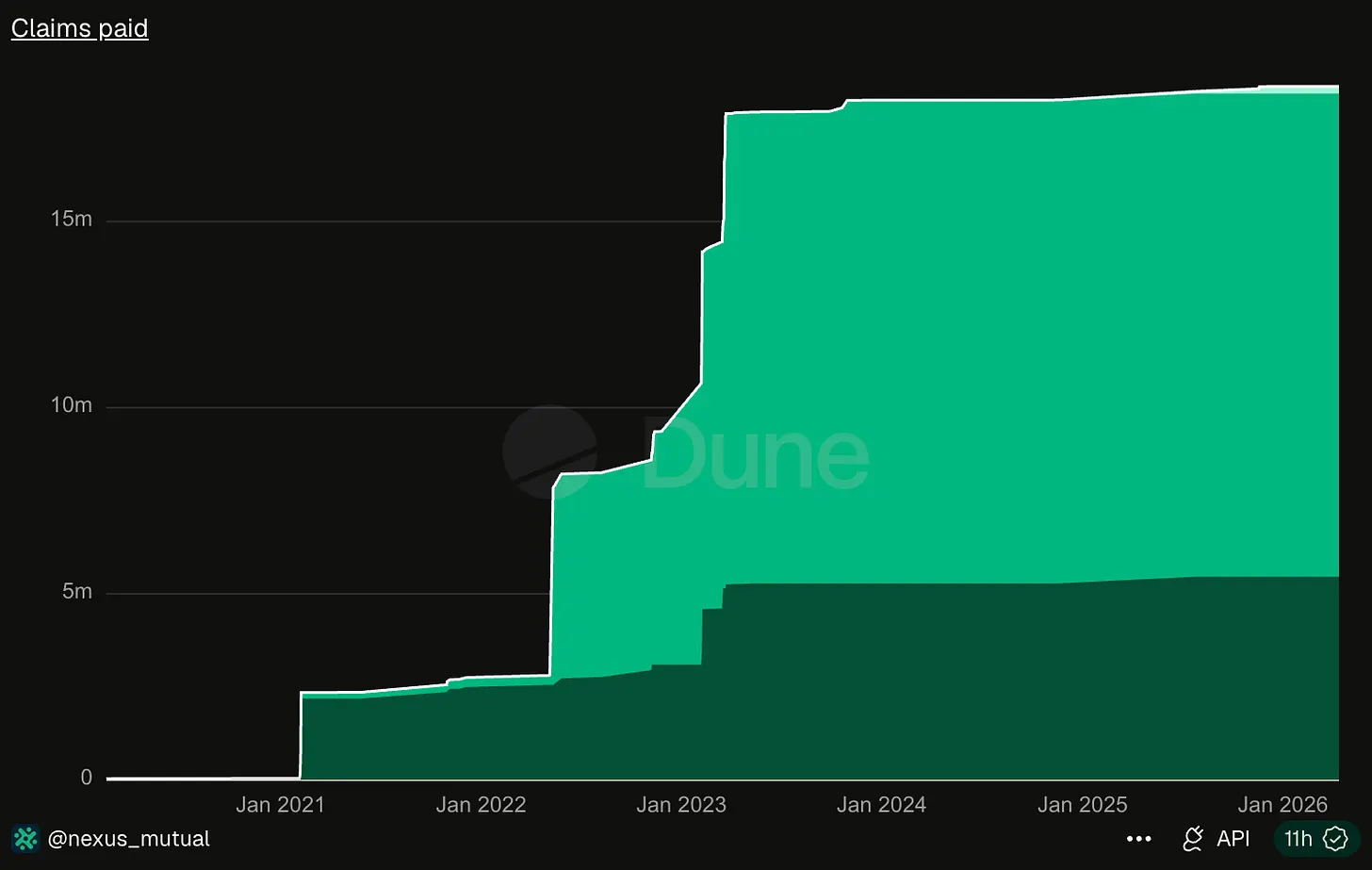

Data source: Dune Analytics


In April 2026, Kelp DAO suffered a hack, resulting in losses of up to $292 million. The amount stolen in this single incident alone is equivalent to 16 times the total claims paid by this leading insurance institution over seven years.


This forms an extreme contrast with the current situation of traditional insurance's frantic claim denials. Traditional insurance collects high premiums but goes to great lengths to obstruct claims; DeFi insurance, however, generates meager premium income because almost no investors are willing to purchase coverage.


The stable operation of traditional insurance relies on the principle of uncorrelated risks. One house catching fire doesn't cause other houses to be damaged. An insurance company can sell policies to 1 million users, and a single fire claim can be covered by the premiums collected from all. However, DeFi lacks this risk isolation mechanism: security incidents like oracle failures or cross-chain bridge vulnerabilities can chain-react, impacting all lending protocols and liquidity pools built on that underlying asset. The USDC de-pegging event in March 2023 affected all protocols that used USDC as collateral on that day. For a DeFi insurance pool, risks are highly correlated. The underwriter can only bet that losses from security incidents are controllable and that the pool's funds are sufficient to cover them.


In March 2023, Euler Finance was hacked for $197 million, and the risk spread rapidly: Angle Protocol lost $17 million due to holding Euler liquidity tokens, Yield Protocol shut down operations urgently, and other platforms like Inverse Finance were also affected.


Once a protocol has a security vulnerability, it often affects multiple projects. A single extreme incident in one day could even directly deplete the entire claim reserve of an insurance pool.


I compiled the current premium rates for Nexus Mutual and InsurAce and compared them to the native annual percentage yield (APY) of the protocols they insure: Aave V3's USDC deposit APY is about 3.14%, while the insurance premium range is 1.5%–2.5%. After deducting premiums, the net yield is only 0.6%–1.6%. Investors bear on-chain security risks only to end up with returns slightly higher than ordinary bank savings.
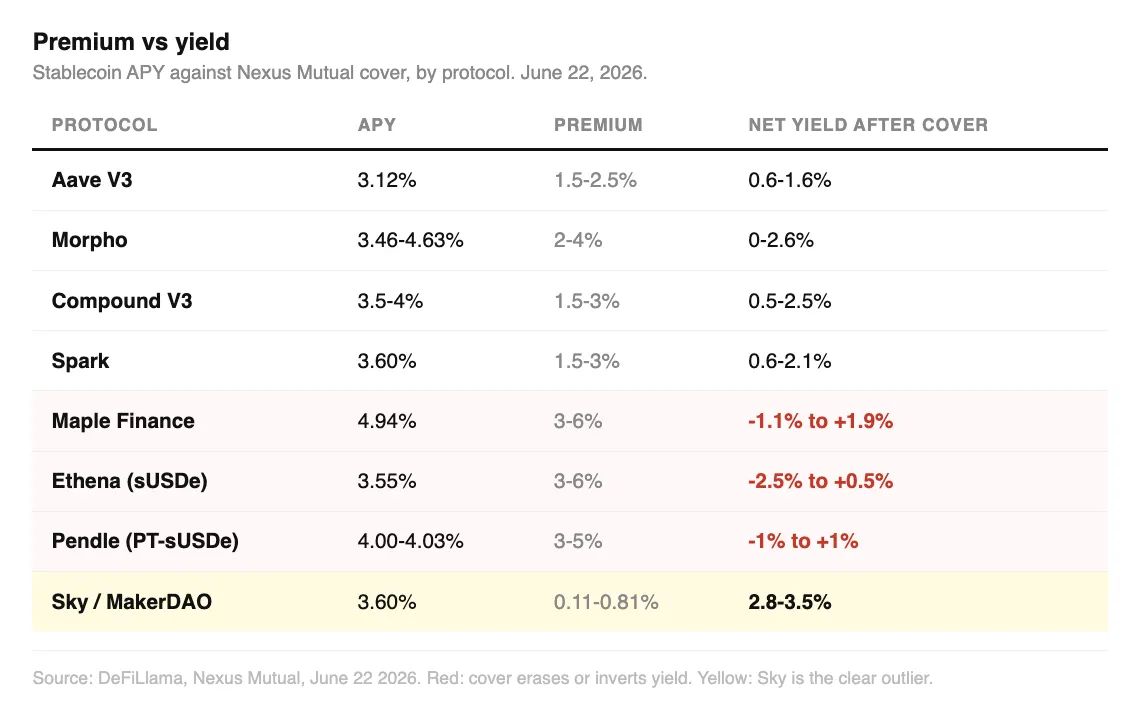


Morpho, Compound, and Spark show similar situations, with native APYs of 3.5%–4%. Premiums consume one-third to half of the yield, leaving minimal profits but with extremely low cost-effectiveness.


Maple Finance's institutional lending pools offer APYs of 4.77%–4.90%, but insurance premiums are as high as 3%–6%. The net yield after insurance ranges from -1.1% to 1.9%. Ethena staking offers APYs of 3.6%–4%, with premiums also at 3%–6%, resulting in net yields of -2.4% to 1%. Purchasing insurance on these two types of platforms can, in extreme cases, lead to losses on the principal for investors.


Only the original MakerDAO (Sky) stands out. Its savings product offers a 3.6% APY, with the lowest insurance premium being only 0.11%. It is widely recognized as the lowest-risk entity within DeFi, retaining a net yield of 2.8%–3.5% after insurance, preserving most of the returns.


Premium pricing strictly corresponds to risk levels, but premiums for emerging platforms are too high, directly consuming the high yields users seek when entering the market.


Crypto investors choose to forgo insurance not out of laziness or recklessness; they understand that in most cases, purchasing insurance equates to zero returns. Even if all DeFi depositors collectively chose full coverage tomorrow, the entire industry could not meet the demand: Nexus Mutual's total pool size is about $81.56 million, and the entire industry's effective coverage capacity is at most a few hundred million dollars. In contrast, the total value locked (TVL) in major protocols amounts to hundreds of billions, a gap of astronomical proportions.


A single large-scale security incident like Kelp DAO would directly drain the vast majority of the industry's insurance reserves.


The historical claims total of $18 million precisely exposes the fragility of the industry's capital pools; the market has never experienced a catastrophic risk event capable of breaching underwriting reserves.


After a user submits a claim to Nexus Mutual, all token-holding members of the platform must vote on whether to pay. Members who vote in favor of paying a claim risk having their own assets directly impaired if the claim ultimately fails to be paid. This mechanism naturally fosters a tendency to deny claims. Traditional insurance employs dedicated underwriters and claims adjusters to balance conflicts, whereas DeFi insurance design merges all responsibilities onto the same group.


Before the 2008 financial crisis, financial risk pricing agencies generally believed a nationwide U.S. housing price collapse was impossible, as they had never experienced it. Insurance giant AIG massively sold risk protection contracts but was completely unable to pay when the market crisis truly erupted.


Before the U.S. government introduced FDIC deposit insurance, ordinary savers had no asset safety net. The Great Depression forced the government to mandate bank insurance, making coverage a hard cost for banks to operate.


In the DeFi space, no one can force protocols like Aave or Morpho to purchase insurance. Smart contract deployment is completely permissionless; there is no entity that can mandate projects to configure risk protection. This also leads to a lack of a safety net to withstand extreme market conditions in the industry.


The three largest claims in Nexus Mutual's history are: the FTX collapse, paid in two installments totaling about $7.3 million; the TribeDAO hack, a $5 million payout; and the Euler Finance hack, a $3.4 million payout. The sum of these three amounts almost equals the platform's total cumulative claims of $18.6 million over seven years.


Now, this mutual insurance platform is shifting towards proactive risk prevention. It has partnered with security audit agencies like Immunefi, Cantina, and Sherlock to launch bug bounty protection products. The protocol only needs to bear 20% of the critical bug bounty cost, with Nexus Mutual covering the rest, pre-funding incentives for white-hat hackers to identify vulnerabilities and avoid theft incidents at the source. Meanwhile, Nexus Mutual is expanding into compliant insurance tranches, attempting to connect crypto risks to reinsurance capital pools and introduce larger external capital to supplement underwriting capacity.


In March 2025, Cantina took a step further by launching an independent native protocol protection product, ensuring users can still receive payouts even if a vulnerability is not discovered early by bounty hunters and the protocol is hacked.


Both of these strategic shifts essentially acknowledge a core reality: on-chain native capital is insufficient to cover on-chain risks. Three fundamental flaws are irreparable: the insurance pool size is too small, risks are highly correlated, and the claim adjudicators and capital providers are the same group.


Nexus Mutual has $81.56 million in Total Value Locked (TVL) according to DeFiLlama, capturing 85% of the DeFi insurance market share. Other players are continuously shrinking: InsurAce peaked at $150 million TVL and is now only $132,000, having completed only one major claim after the UST de-peg in 2022; Sherlock's pool shrank from $60 million to $505,000 within a year; Unslashed Finance has millions of dollars trapped in outdated, un-updated code since late 2024. Other insurance projects have either shut down completely or pivoted to different business models.


A lighthouse warns all ships of hidden reefs but cannot charge passing vessels a fee, making it difficult for anyone to voluntarily fund its construction. The benefits are shared by all, but the cost is borne by the builder alone.


The value of DeFi insurance lies in preventing the spread of chain-reaction liquidation stampedes. Crypto market assets are highly interconnected; only when everyone simultaneously obtains coverage can overall market stability be maintained. But if everyone expects others to buy insurance as a safety net while unwilling to bear the premium cost themselves, ultimately no one will configure insurance, and the risk protection system becomes useless. Protection that no one actively underpins ultimately safeguards no assets.

Crypto di tendenza

Domande pertinenti

QWhat is the core reason why DeFi insurance has low adoption, as explained in the article?

AThe core reason is that insurance premiums heavily erode user yields. After deducting premiums, the net returns often barely exceed or even fall below traditional savings rates, making insurance an unattractive cost for risk-seeking DeFi users.

QHow does the risk profile in DeFi differ from traditional insurance, and why is this a problem?

AIn traditional insurance, risks are largely uncorrelated (e.g., one house fire doesn't affect others). In DeFi, risks are highly correlated—a single oracle failure or bridge hack can impact multiple protocols and their underlying assets simultaneously, threatening to drain an entire insurance pool from one event.

QWhat specific example does the article use to illustrate the insufficiency of DeFi insurance pool sizes?

AThe article cites the Kelp DAO hack in April 2026, which resulted in a loss of $292 million. This single loss was 16 times greater than the total historical claims paid out by Nexus Mutual, the largest DeFi insurer, over seven years (~$18 million).

QWhat is a key structural flaw in the claims process for platforms like Nexus Mutual?

AA key flaw is that the same group of token holders who provide the capital for the insurance pool also vote on whether to pay out claims. Since their own assets are at risk if a claim is approved and paid, the system has a built-in incentive to deny claims.

QWhat fundamental economic dilemma does the 'lighthouse' analogy at the end of the article highlight for DeFi insurance?

AThe 'lighthouse' analogy highlights a public goods dilemma. DeFi insurance provides stability and prevents cascading liquidations for the entire ecosystem (a shared benefit), but the cost is borne individually by those who pay premiums. If everyone relies on others to buy insurance, no one will, and the protective system fails.

Letture associate

Ethereum's Next Stop Glamsterdam: The Core Upgrades You Must Know

The Glamsterdam upgrade, scheduled for late 2026, is a major Ethereum hard fork combining the Amsterdam execution layer and Glasgow consensus layer updates. Its primary goal is not simply increasing throughput but restructuring Ethereum's block production, validation, and resource pricing to enable future scaling. Key technical changes include **EIP-7732 (ePBS)**, which formally enshrines proposer-builder separation into the protocol. This decouples consensus and execution tasks, extending the execution payload propagation window to ~9 seconds. This provides more time for node verification, allowing for safer increases in block capacity (Gas limit) in the future. Another core component is **EIP-7928 (Block-Level Access Lists - BAL)**. It mandates a list of all state accessed within a block, moving this feature from an optional transaction-level (EIP-2930) to a mandatory block-level requirement. This explicit access list enables client optimizations like parallel disk reads and state root computations, paving the way for parallel execution. To manage long-term state growth, **EIP-8037** increases the cost of creating new state (e.g., accounts, storage slots), separating the pricing of permanent database bloat from temporary computation. This allows execution capacity to scale more aggressively without causing state size to explode proportionally. The planned upgrade bundle includes around 10 EIPs categorized into: 1) Core protocol restructuring (ePBS, BAL), 2) Resource pricing adjustments (state costs, calldata costs), and 3) EVM/developer improvements. Several other EIPs, including those potentially improving staker exit liquidity (EIP-8061, EIP-8080), are under consideration. The technical development coincides with significant personnel changes within the Ethereum Foundation's Protocol team. The Foundation's official communications frame this as part of a broader shift towards a "coalition of organizations" working on the Ethereum roadmap, citing new entities like ethlabs and the Ethereum Economic Zone. In summary, Glamsterdam represents a foundational re-engineering of Ethereum's block pipeline and economic model—focusing on ePBS, BAL, and multi-dimensional resource pricing—to prepare the network for sustainable, high-throughput scaling in the years ahead.

Foresight News7 min fa

Ethereum's Next Stop Glamsterdam: The Core Upgrades You Must Know

Foresight News7 min fa

The Ethereum Foundation Has Split?! An In-depth Look at Ethlabs' "Bright Future"

"Ethereum Foundation Splits? Understanding Ethlabs and Its 'Bright Future'" Former Ethereum Foundation members Ansgar Dietrichs, Barnabé Monnot, Caspar Schwarz-Schilling, Josh Rudolf, and Julian Ma have announced the launch of Ethlabs, an independent non-profit research and development lab. Announced on June 22nd, the initiative comes amidst discussions about the need for new organizational structures within the Ethereum ecosystem, a point highlighted by Bankless founder David Hoffman. Ethlabs' mission is to establish Ethereum as the foundational settlement layer for the global economy. The organization positions itself as a bridge connecting frontline developers, applications, and user needs with the core protocol. It aims to translate real-world demands into protocol improvements, industry standards, and deployable products. The founding team brings significant expertise: Dietrichs and Monnot are highly cited researchers in areas like Proposer-Builder Separation (PBS) and MEV, while Schwarz-Schilling, Rudolf, and Ma contribute backgrounds in economic modeling, consensus research, and applied cryptography. Initial supporters include BitMine, a major corporate ETH treasury; Sharplink, another treasury firm; and Consensys founder Joe Lubin in a personal capacity. Community backers include figures like Uniswap's Hayden Adams and Base's Jesse Pollak. The timing coincides with internal Ethereum Foundation discussions about "spinout" projects. While Ethlabs and the Foundation share research interests like MEV mitigation, Ethlabs frames its role not as a competitor but as part of a shift from a "single-core coordination model" to a "multi-R&D entity collaboration model." It views Ethereum as a public project belonging to all builders, with Ethlabs as one node in a broader governance network. Ultimately, Ethlabs represents an organizational evolution within the maturing Ethereum ecosystem. The key question is whether multiple research bodies can collaborate effectively to advance Ethereum as a competitive global settlement infrastructure.

Odaily星球日报11 min fa

The Ethereum Foundation Has Split?! An In-depth Look at Ethlabs' "Bright Future"

Odaily星球日报11 min fa

'Bear' Doomsday Prophecy: AI 'Reaching Its Peak', U.S. Stocks to Top Out Fastest in Q3, Down 30-50%

"A Short Seller's Dire Prediction: AI Boom Fading, US Stocks to Peak by Q3 with 30-50% Decline" Prominent macro investors Jeffrey Gundlach and Felix Zulauf warn that the AI-driven market rally is nearing its end, forecasting a major US stock market correction of 30-50%, potentially beginning as early as Q3. Their analysis points to alarming parallels with historical market tops, citing extreme concentration in the top AI-related stocks within the S&P 500. Zulauf's bearish thesis hinges on unsustainable capital expenditure trends among major cloud companies, negative free cash flow emergence, and soaring semiconductor prices. Gundlach highlights dangerous parallels to the 1999 tech bubble peak. A key divergence from conventional wisdom is Gundlach's view that long-term Treasury yields will not fall meaningfully even during a recession, due to America's structurally out-of-control fiscal deficits and soaring interest costs. He warns this could force the government into yield curve control or even a sovereign debt restructuring. Both investors express severe concerns about the opaque private credit market, drawing parallels to the pre-2008 financial crisis environment. They allege widespread rating inflation, misrepresented credit quality, liquidity illusions, and fraudulent asset valuations within this sector. The analysis links the AI boom and private credit crisis through financing costs. They argue that as AI companies' cash flows weaken and they seek funding, a high and sticky long-term interest rate environment will severely stress lower-rated corporate borrowers, exposing cracks in credit markets. Finally, they predict a regime shift where the US dollar weakens and US equities underperform global markets, marking the end of their long dominance. The stage is set for a significant market reversal.

marsbit18 min fa

'Bear' Doomsday Prophecy: AI 'Reaching Its Peak', U.S. Stocks to Top Out Fastest in Q3, Down 30-50%

marsbit18 min fa

Why Does No One Buy DeFi Insurance?

**Title: Why Isn't DeFi Insurance Being Bought?** DeFi insurance, which promised automated, unbiased payouts via smart contracts, has failed to gain traction. The core issue is economic: high premiums severely erode the yields that attract users to DeFi in the first place. For example, insuring a USDC deposit on Aave V3 could cost 1.5–2.5% of the annual yield, leaving a net return barely above a savings account. For riskier platforms like Maple Finance or Ethena, premiums can even turn net yields negative. Consequently, users often forgo insurance, as it nullifies their profit motive. The market also suffers from structural flaws. First, DeFi risks are highly correlated (e.g., an oracle failure can impact multiple protocols simultaneously), unlike the independent risks in traditional insurance. This makes large-scale events potentially catastrophic for insurers. Second, the total capital in DeFi insurance pools (e.g., Nexus Mutual's ~$81.5M) is minuscule compared to the hundreds of billions in total value locked (TVL), creating a massive capacity gap. A single major hack could drain the entire industry's reserves. Furthermore, the governance model where tokenholders vote on claims creates a conflict of interest, incentivizing them to deny payouts to protect their own funds. As a result, the sector is shrinking. While pioneers like Nexus Mutual are pivoting to preventative measures (bug bounties) and seeking external capital via reinsurance, the fundamental problems remain. DeFi insurance represents a public good—its stability benefits the entire ecosystem—but without a mechanism to share costs, a "tragedy of the commons" ensues where no one is willing to pay, leaving the system vulnerable.

marsbit32 min fa

Why Does No One Buy DeFi Insurance?

marsbit32 min fa

Trading

Spot
Futures

Articoli Popolari

Cosa è DOGE M

Doge Matrix ($doge m): La Nuova Razza di Criptovaluta Guidata dalla Comunità Introduzione Nel panorama in continua evoluzione delle criptovalute, nuovi progetti emergono costantemente, ciascuno con l'obiettivo di catturare l'interesse di investitori ed appassionati. Uno degli ultimi ingressi in questo dominio è Doge Matrix, rappresentato dal simbolo ticker $doge m. Questo progetto ha attirato attenzione grazie alle sue radici nella popolare cultura dei meme che circonda Dogecoin, stabilendo il suo posto all'interno dello spazio web3. Questo articolo mira a fornire un'analisi completa di Doge Matrix, coprendo la sua panoramica, il creatore, gli investitori, la funzionalità, la cronologia e gli aspetti notevoli. Cos'è Doge Matrix ($doge m)? Doge Matrix è un progetto di criptovaluta guidato dalla comunità che apparentemente si basa sull'ampio appeal di Dogecoin, una valuta digitale nota per il suo mascotte Shiba Inu e le sue origini nei meme. Sebbene gli obiettivi generali di Doge Matrix non siano ampiamente definiti, è caratterizzato da un impegno a sfruttare il coinvolgimento e il supporto della comunità. A differenza delle criptovalute tradizionali che spesso enfatizzano l'utilità o il valore intrinseco attraverso tecnologie sottostanti, Doge Matrix si posiziona all'interno di uno spazio che abbraccia il fenomeno culturale delle criptovalute, particolarmente attraente per coloro che risuonano con l'etica degli asset basati sui meme. Attraendo i punti di forza della comunità di Dogecoin, Doge Matrix opera come parte di un ecosistema più ampio, invitando alla partecipazione e all'impegno degli utenti che condividono un interesse per le criptovalute e il panorama digitale. Chi è il Creatore di Doge Matrix ($doge m)? L'identità del creatore di Doge Matrix rimane sconosciuta. Questa mancanza di trasparenza non è un evento raro nello spazio delle criptovalute, dove alcuni progetti vengono lanciati senza rivelare le identità dei loro fondatori. L'assenza di informazioni riguardanti il team fondatore può sollevare domande tra i potenziali investitori sulla responsabilità e la direzione del progetto. Chi sono gli Investitori di Doge Matrix ($doge m)? Al momento, non ci sono informazioni pubblicamente disponibili che dettagliano gli investitori o le fondazioni di investimento che supportano Doge Matrix. Il progetto sembra fare affidamento principalmente sul supporto della comunità piuttosto che su investimenti istituzionali. Questo modello si allinea con la natura guidata dalla comunità dell'iniziativa, favorendo un ambiente in cui la direzione del progetto è plasmata dai suoi partecipanti piuttosto che essere dettata da un selezionato gruppo di finanziatori. Come Funziona Doge Matrix ($doge m)? I dettagli riguardanti i meccanismi operativi di Doge Matrix sono piuttosto vaghi, riflettendo una tendenza più ampia di progetti nello spazio delle meme coin in cui le funzionalità innovative non sono sempre chiaramente articolate. Tuttavia, Doge Matrix sembra essere progettato per sfruttare l'ecosistema esistente delle criptovalute incoraggiando la partecipazione degli utenti mentre attinge ai riferimenti culturali familiari associati a Dogecoin. Le sue potenzialmente uniche caratteristiche derivano dalle interazioni della comunità piuttosto che dai progressi tecnologici, enfatizzando esperienze condivise e collaborazione tra i detentori di token. Sebbene le esatte innovazioni non siano state esplicitamente delineate, il progetto sembra creare uno spazio in cui i membri della comunità possono impegnarsi, condividere idee e promuovere il potenziale del progetto. Cronologia di Doge Matrix ($doge m) Riflettendo sulla cronologia del progetto, emergono eventi notevoli che hanno definito il suo percorso fino ad ora: 25 Novembre 2024: Doge Matrix ha raggiunto il suo valore massimo storico, segnando un traguardo significativo nella sua storia iniziale. 1 Gennaio 2025: Al contrario, Doge Matrix ha toccato il suo valore minimo storico, illustrando la volatilità spesso associata alle criptovalute, specialmente nelle prime fasi del ciclo di vita di un progetto. In Corso: Il progetto continua ad essere attivamente scambiato e supportato dalla sua comunità, sebbene specifici traguardi o obiettivi futuri debbano ancora essere divulgati. Punti Chiave su Doge Matrix ($doge m) Focus sulla Comunità Al centro di Doge Matrix c'è un impegno per il coinvolgimento della comunità. Il progetto prospera sulla premessa della collaborazione e degli obiettivi condivisi tra i suoi membri, enfatizzando l'importanza dello sforzo collettivo. A differenza dei progetti centralizzati che spesso hanno una struttura di leadership definita, Doge Matrix attualmente mostra un approccio più fluido alla governance, dove la voce di ogni membro della comunità conta. Volatilità Il mercato delle criptovalute è noto per la sua volatilità, e Doge Matrix non fa eccezione. La sua storia dei prezzi riflette fluttuazioni significative tra valori alti e bassi, il che è tipico di molte nuove criptovalute ma sottolinea i rischi associati all'investimento in token emergenti. Mancanza di Informazioni Dettagliate Una delle caratteristiche più sorprendenti di Doge Matrix è la scarsità di informazioni dettagliate riguardanti le sue fondamenta tecnologiche e i meccanismi operativi. Questa ambiguità richiede che i potenziali investitori conducano un'accurata due diligence prima di impegnarsi con il progetto. Conclusione In sintesi, Doge Matrix ($doge m) illustra una nuova ondata di progetti di criptovaluta che si basano fortemente sul coinvolgimento della comunità e sulla rilevanza culturale. Sebbene manchi di alcuni dettagli—come una leadership chiara, obiettivi definiti e funzionalità dettagliate—il progetto è riuscito a generare interesse all'interno della comunità crypto, sfruttando l'appello consolidato della cultura dei meme. Come per qualsiasi investimento nello spazio delle criptovalute, comprendere i rischi intrinseci e condurre una ricerca approfondita è essenziale per i potenziali partecipanti. Doge Matrix si erge come un promemoria della natura dinamica, a volte imprevedibile, dell'industria crypto, caratterizzata da un'evoluzione costante e dall'entusiasmo per le iniziative guidate dalla comunità.

393 Totale visualizzazioniPubblicato il 2025.02.03Aggiornato il 2025.02.03

Cosa è DOGE M

Cosa è $M

Comprendere Mantis ($M): Una Nuova Era nell'Interoperabilità Cross-Chain Nel panorama in continua evoluzione del Web3 e delle criptovalute, nuovi progetti si sforzano di offrire soluzioni innovative mirate a migliorare l'esperienza dell'utente e ad ampliare le possibilità funzionali all'interno dell'ecosistema finanziario decentralizzato. Uno di questi progetti che sta attirando attenzione è Mantis ($M), un protocollo pionieristico fondato sui principi dell'interoperabilità cross-chain e dei pagamenti basati sull'intento. Questo articolo esplora gli aspetti essenziali di Mantis, inclusa la sua funzionalità principale, i creatori, il supporto agli investimenti, le caratteristiche innovative e le tappe fondamentali. Che cos'è Mantis ($M)? Mantis è descritto come un protocollo di regolamento dell'intento multi-dominio che semplifica le interazioni cross-chain, consentendo agli utenti di eseguire transazioni finanziarie complesse su varie piattaforme blockchain senza soluzione di continuità. Il protocollo opera attraverso tre livelli principali: Espressione dell'Intento: Gli utenti possono articolare i loro obiettivi di transazione utilizzando un linguaggio naturale facilitato dal DISE LLM, un avanzato modello di linguaggio AI. Ad esempio, un utente potrebbe esprimere il desiderio di scambiare Ethereum (ETH) con Solana (SOL) con una tolleranza di slippage specifica dell'1%. Esecuzione: Questo livello impiega una rete di risolutori che competono per soddisfare gli intenti degli utenti. Le transazioni vengono eseguite utilizzando meccanismi come la Coincidenza dei Desideri (CoWs) e le Aste sul Flusso degli Ordini (OFAs), che garantiscono che le richieste degli utenti siano soddisfatte in modo ottimale. Regolamento: Sfruttando il protocollo di Comunicazione Inter-Blockchain (IBC), Mantis consente transazioni atomic cross-chain, permettendo agli utenti di operare su varie catene supportate, tra cui Ethereum, Solana e Cosmos. Mantis è progettato per introdurre generazione di rendimento nativa per asset inattivi, impiegando prove crittografiche per mantenere l'integrità delle transazioni durante l'intero processo. Creatori e Team di Sviluppo Mantis è stato concepito dalla Composable Foundation, un'organizzazione orientata alla ricerca nota per il suo focus sulle soluzioni di interoperabilità blockchain. Questa fondazione collabora con istituzioni accademiche di prestigio, tra cui l'Università di Harvard e l'Università di Lisbona, contribuendo a sforzi di ricerca e sviluppo estesi che informano l'architettura e la funzionalità di Mantis. L'impegno della Composable Foundation a promuovere l'innovazione nello spazio blockchain posiziona Mantis come una soluzione robusta per la crescente domanda di interoperabilità tra più reti blockchain. Investitori e Supporto Sebbene i dettagli specifici sugli investitori individuali non siano stati resi pubblici, Mantis gode di un sostegno sostanziale da parte di vari enti, tra cui: Sovvenzioni ecosistemiche da catene abilitate IBC, che supportano la crescita e l'integrazione del protocollo all'interno degli ecosistemi finanziari decentralizzati. Partnership strategiche con fornitori di infrastrutture che migliorano le capacità di rete e le strategie di distribuzione di Mantis. Finanziamenti attraverso il tesoro della Composable Foundation, garantendo un supporto finanziario sostenuto per lo sviluppo continuo e i costi operativi. Questi sforzi collaborativi riflettono un consenso tra le parti interessate sull'importanza di migliorare la funzionalità cross-chain e il potenziale utilizzo delle innovazioni infrastrutturali di Mantis. Innovazioni Chiave Mantis si distingue attraverso diverse innovazioni pionieristiche che migliorano la sua funzionalità e utilità: Intenti Agnostici alla Catena: Gli utenti possono avviare transazioni da qualsiasi catena supportata mentre si regolano su un'altra. Questa flessibilità potenzia gli utenti, aumentando l'interazione tra diverse piattaforme. Interfaccia Potenziata dall'AI: L'integrazione del DISE LLM consente agli utenti di condurre operazioni DeFi complesse utilizzando un linguaggio naturale, semplificando così le interazioni e rendendo la tecnologia blockchain accessibile a un pubblico più ampio. Cattura MEV Cross-Domain: Mantis crea un mercato interno per il valore massimamente estraibile (MEV) attraverso competizioni tra risolutori. Questo approccio innovativo consente una maggiore efficienza e estrazione di valore in transazioni complesse. Strato di Regolamento Modulare: Il protocollo supporta vari metodi di verifica, comprese le prove a conoscenza zero e i rollup ottimistici, fornendo un framework versatile che può adattarsi alle tecnologie blockchain emergenti. Cronologia Storica Lo sviluppo di Mantis è contrassegnato da diverse tappe fondamentali che tracciano la sua traiettoria e crescita: | Anno | Tappa | |————|————————————————————————| | 2022 | Sviluppo del concetto iniziale all'interno della divisione di ricerca della Composable Foundation. | | Q3 2024 | Lancio del testnet con capacità di bridging tra Solana ed Ethereum. | | Q1 2025 | Evento di Generazione di Token (TGE) previsto insieme al lancio della mainnet. | | Q2 2025 | Integrazione attesa del DISE LLM e espansione delle capacità cross-chain. | | 2025 H2 | Supporto pianificato per oltre 15 catene attraverso ulteriori aggiornamenti IBC. | Questa cronologia delinea l'evoluzione di Mantis, dalle discussioni concettuali all'implementazione attiva e alle fasi di crescita future. Strategia di Crescita dell'Ecosistema La strategia di Mantis per la crescita dell'ecosistema include diverse iniziative progettate per incoraggiare la partecipazione degli utenti e il coinvolgimento degli sviluppatori: Sistema di Crediti: Gli utenti possono guadagnare crediti del protocollo fornendo liquidità e partecipando a programmi di referral. Questi crediti sono riscattabili per incentivi futuri, promuovendo una comunità utente robusta. Kit di Sviluppo Software Modulare (SDK): Questo toolkit consente agli sviluppatori di creare applicazioni basate su modelli guidati dall'intento utilizzando l'infrastruttura di Mantis, promuovendo così l'innovazione all'interno del suo ecosistema. Modello di Governance: Man mano che il protocollo matura, i detentori di token $M avranno voce in capitolo nella governance del protocollo, consentendo loro di votare su aggiornamenti e modifiche proposti, migliorando così il coinvolgimento della comunità e la decentralizzazione. Mantis rappresenta un significativo avanzamento nel campo dell'architettura cross-chain. Integrando senza soluzione di continuità algoritmi AI avanzati con un robusto framework di regolamento, Mantis cerca di affrontare i problemi di frammentazione all'interno degli ecosistemi multi-chain. Il suo approccio innovativo prioritizza il miglioramento delle esperienze degli utenti, mantenendo i principi fondamentali di decentralizzazione e sicurezza, stabilendo un nuovo standard per l'interoperabilità futura delle tecnologie blockchain. Man mano che Mantis continua il suo percorso di crescita e implementazione, promette di essere un progetto da seguire da vicino nel competitivo panorama del Web3 e della finanza decentralizzata. Con il suo focus sul superamento dei confini e sull'elevazione del coinvolgimento degli utenti, Mantis è destinato a diventare una parte integrante dei futuri sviluppi nel campo delle criptovalute.

51 Totale visualizzazioniPubblicato il 2025.03.18Aggiornato il 2025.03.18

Cosa è $M

Come comprare M

Benvenuto in HTX.com! Abbiamo reso l'acquisto di MemeCore (M) semplice e conveniente. Segui la nostra guida passo passo per intraprendere il tuo viaggio nel mondo delle criptovalute.Step 1: Crea il tuo Account HTXUsa la tua email o numero di telefono per registrarti il tuo account gratuito su HTX. Vivi un'esperienza facile e sblocca tutte le funzionalità,Crea il mio accountStep 2: Vai in Acquista crypto e seleziona il tuo metodo di pagamentoCarta di credito/debito: utilizza la tua Visa o Mastercard per acquistare immediatamente MemeCoreM.Bilancio: Usa i fondi dal bilancio del tuo account HTX per fare trading senza problemi.Terze parti: abbiamo aggiunto metodi di pagamento molto utilizzati come Google Pay e Apple Pay per maggiore comodità.P2P: Fai trading direttamente con altri utenti HTX.Over-the-Counter (OTC): Offriamo servizi su misura e tassi di cambio competitivi per i trader.Step 3: Conserva MemeCore (M)Dopo aver acquistato MemeCore (M), conserva nel tuo account HTX. In alternativa, puoi inviare tramite trasferimento blockchain o scambiare per altre criptovalute.Step 4: Scambia MemeCore (M)Scambia facilmente MemeCore (M) nel mercato spot di HTX. Accedi al tuo account, seleziona la tua coppia di trading, esegui le tue operazioni e monitora in tempo reale. Offriamo un'esperienza user-friendly sia per chi ha appena iniziato che per i trader più esperti.

483 Totale visualizzazioniPubblicato il 2025.07.02Aggiornato il 2026.06.02

Come comprare M

Discussioni

Benvenuto nella Community HTX. Qui puoi rimanere informato sugli ultimi sviluppi della piattaforma e accedere ad approfondimenti esperti sul mercato. Le opinioni degli utenti sul prezzo di M M sono presentate come di seguito.

活动图片