Making a Fortune of $10.32 Million: The World Cup Money-Printing Tactic of a Polymarket Whale

Foresight NewsPubblicato 2026-07-13Pubblicato ultima volta 2026-07-13

Introduzione

**Earning $10.32 Million: A Polymarket Whale's World Cup Profit Strategy** While teams battle for the World Cup trophy, a hidden whale nicknamed "swisstony" has been quietly making a fortune on the prediction market Polymarket. This account, created around July 2025, boasts total profits of $18.62 million, with $10.33 million earned in the past month alone. With a 52.9% win rate, it has placed over 139,600 predictions, averaging about 380 trades per day—indicating it is likely a high-frequency quantitative bot. The account's signature "trash panda" aptly describes its strategy: sifting through vast market data and tiny price discrepancies to build wealth. Its current holdings are heavily concentrated on the France vs. Spain semi-final, including a roughly $160,000 bet against France. Analysis shows two core tactics driving its success: 1. **High-Volume "Anti-Favorite" Bets:** Placing large wagers (often $400k-$1M) against overvalued favorites like Germany or England, buying "No" shares at favorable prices when market-implied win probability is 46%-64%. It has recorded over 17 individual profits exceeding $1 million using this method. 2. **"Lottery-Ticket" Bets on Extreme Long Shots:** Allocating small amounts (thousands of dollars) to buy shares priced as low as 0.2¢-1.2¢ on outcomes deemed nearly impossible. While most of these bets lose, the occasional win—like those with payouts over 100x—generates significant profits (over $100,000 per hit) that boost overall returns...


Written by: Ma He, Foresight News


On the World Cup field, while teams fiercely compete for the championship trophy, a hidden whale has been quietly making a fortune on the prediction market.


An account on Polymarket with the nickname swisstony has a total historical profit of $18.62 million, with nearly $10.33 million earned in the last month alone. The account was first registered around July 2025, a relatively short time ago, but due to its astonishing profits, its profile page views have surged to 922,200.
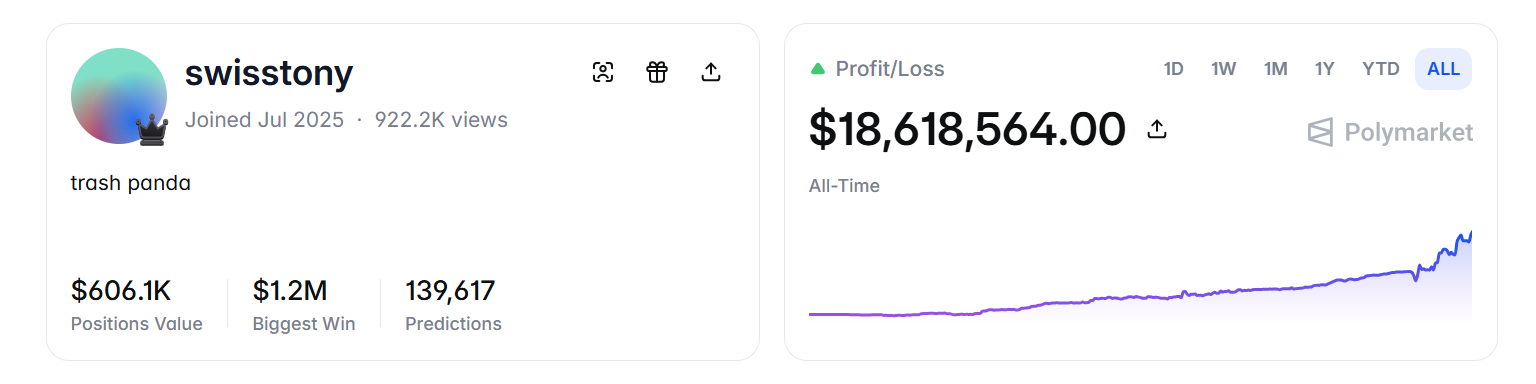


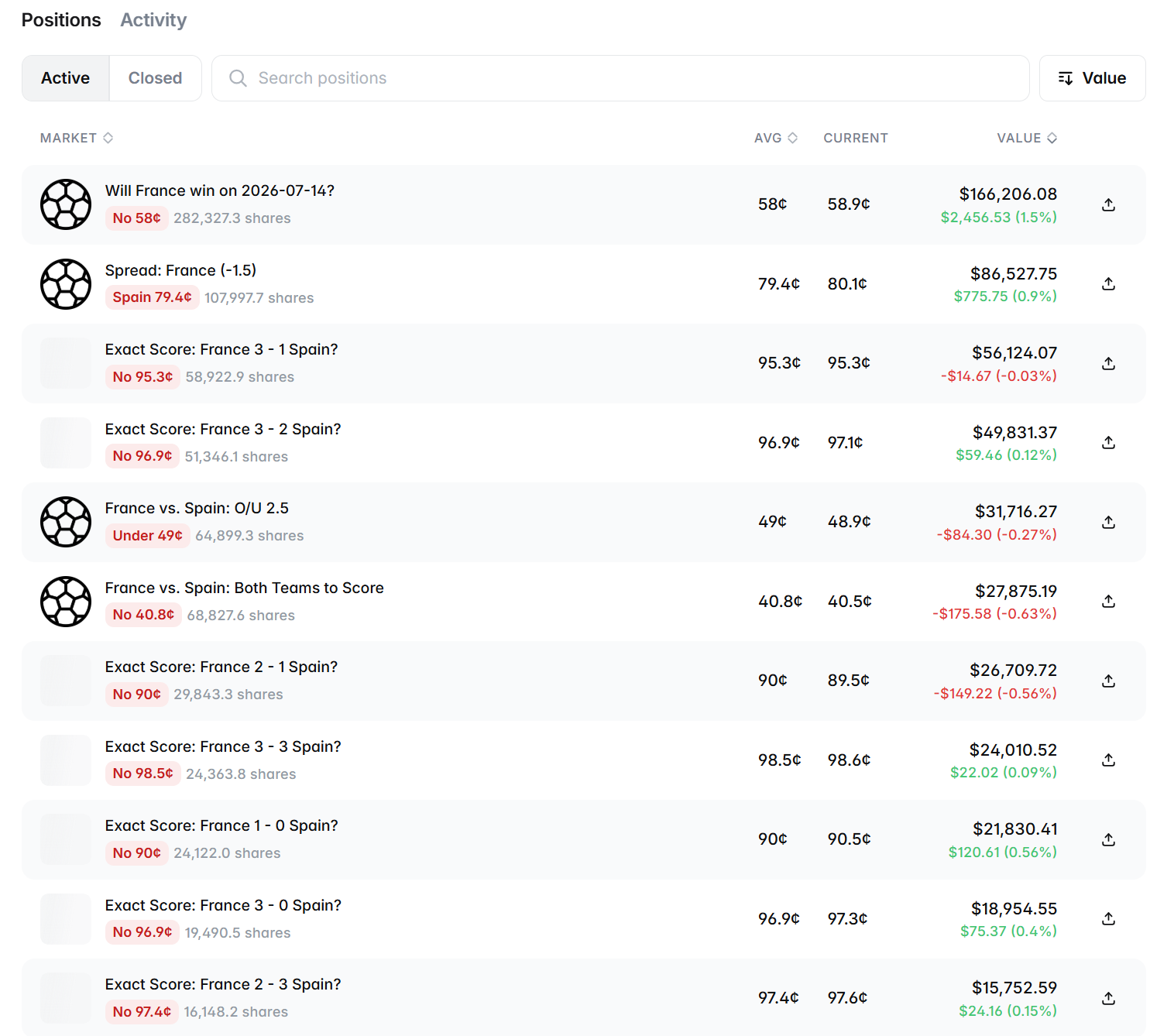
As of July 13, the account has made a total of 139,617 predictions, with its current portfolio valued at approximately $606,100. Notably, its current holdings are almost entirely concentrated on the FIFA World Cup semi-final match between France and Spain on July 14, 2026. This includes a bet of around $160,000 on France losing the match. Additionally, it has placed numerous bets, primarily "NO" positions, on specific score details, aiming for 5%-10% returns.


The account's win rate is maintained around 52.9%, with total trading positions exceeding 245,000 and trading volume reaching hundreds of millions of dollars. These figures place it in the top tier within the overall Polymarket ecosystem. Public research indicates that most retail addresses incur long-term losses, while a few high-frequency, systematic accounts achieve significant positive returns through scaled execution. swisstony's data win rate is not extremely high, but combined with extremely high trading frequency and position management, it amplifies its positive EV (Expected Value) edge.


Since creating the account about a year ago, this address has completed 139,617 prediction operations. On average, this translates to about 380 trades per day, 16 per hour, operating 24/7 without rest. It is highly likely an API-driven, ultra-high-frequency quantitative trading bot.


Its profile description reads "trash panda." In North American culture, raccoons are survival experts known for rummaging through trash bins. This signature perfectly summarizes its core strategy: making money from the vast data garbage and tiny price discrepancies on Polymarket, ultimately building a multi-million dollar empire.


Over 17 Profits Exceeding $1 Million


Looking through the account's profit history, its astonishing aspect is that it has recorded over 17 instances where profits exceeded $1 million. The largest single profit came from a bet on Germany's match on June 25. The whale bet "NO," earning $2,221,241 with a return of 111.67%.
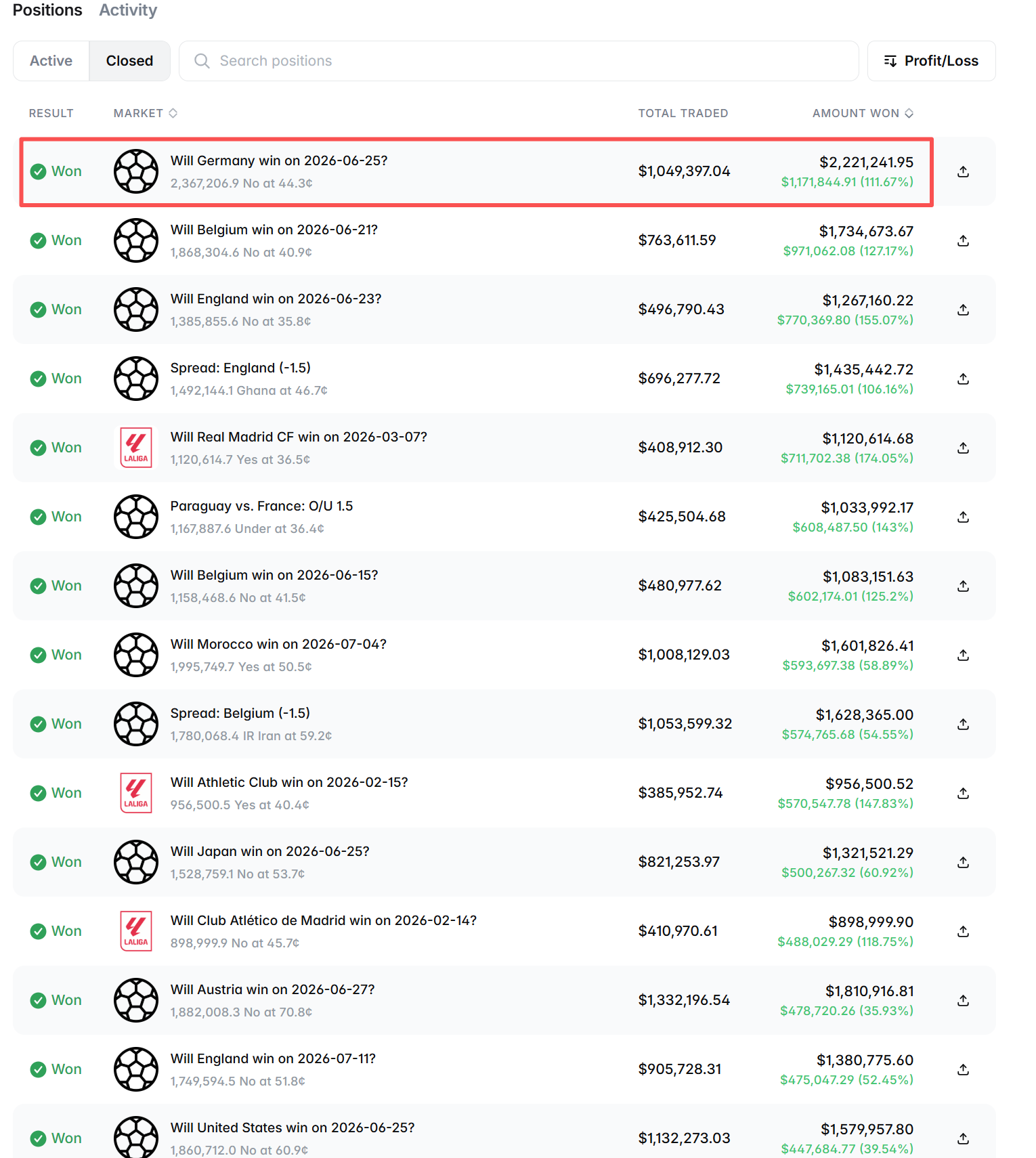


The ROI shown in the screenshot is generally very high, with clear advantages in entry prices. The investment scale is substantial, with single bets often in the $400,000 to $1 million range.


This whale favors placing large "NO" bets (against winning) on strong teams perceived as overvalued by the market: Germany, Paraguay (multiple appearances), England, and Japan. Entry prices mostly ranged from 35.8¢ to 53.7¢, implying market-implied win probabilities for these strong teams between 46% and 64% at the time, but the actual result was that they lost or did not win. This is a classic anti-favorite strategy.


100x Returns


On prediction markets, when events deemed impossible by the market actually occur, the profit returns can be extremely exaggerated. This whale excels not only at winning big with big bets but also demonstrates high skill in winning big with small bets.


Taking the matches in the image as examples, the entry prices were extremely low: 0.2¢ to 1.2¢ (market-implied probability only 0.2% to 1.2%). The invested capital per bet was mostly only a few thousand dollars, yet each contributed profits exceeding $100,000.
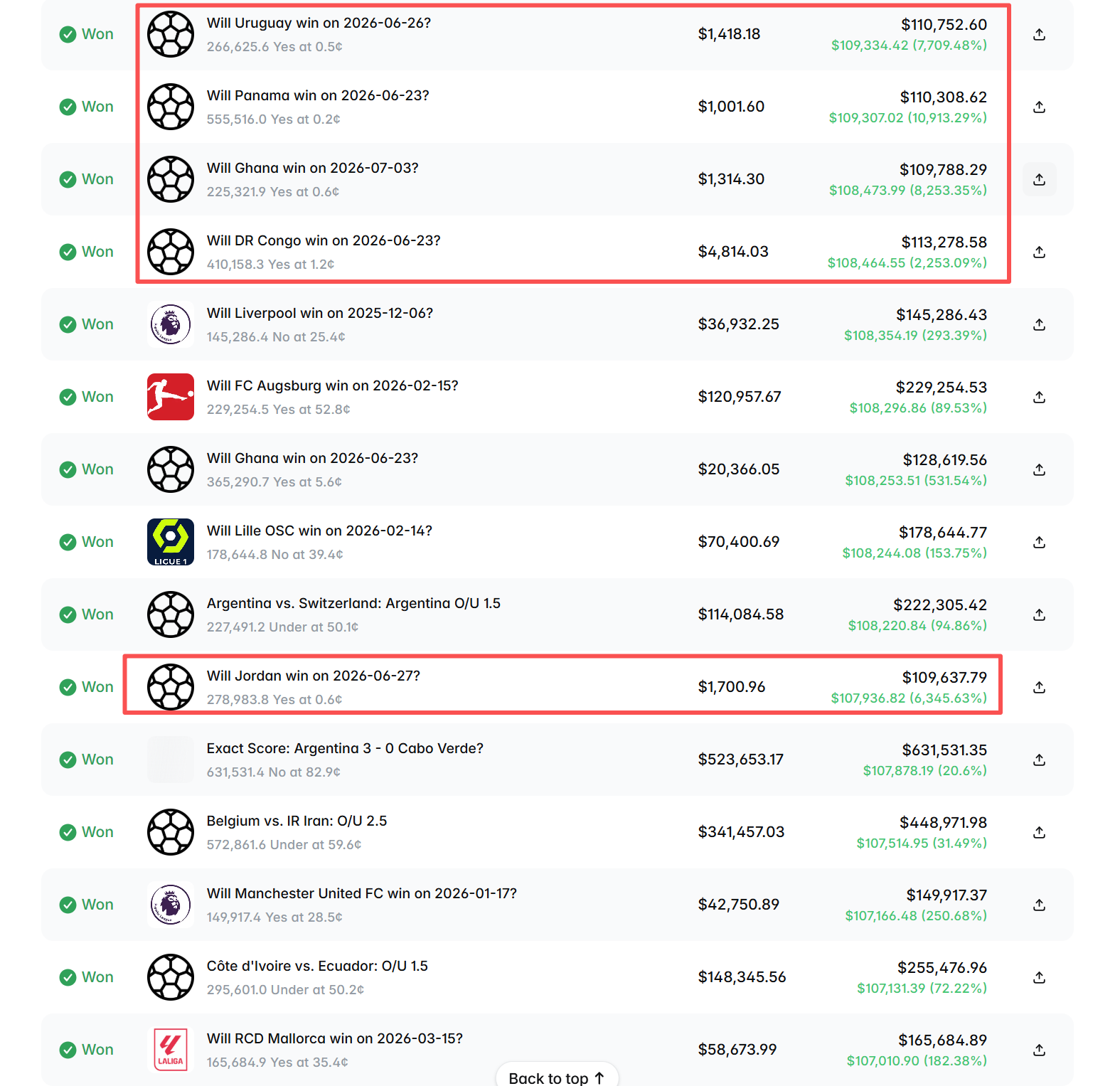


These events, originally considered nearly impossible by the market, actually happened. The account captured high returns with minimal cost.


Deploying small capital on extremely low-probability events is akin to a systematic "lottery ticket" approach. When it hits, it can contribute profits of $100,000+ with very low cost, serving as an excellent supplement to overall profitability. Although the risk capital per trade in such high-multiple trades is low, the win rate is extremely low. Most similar bets would lose all capital.


Even though most such bets will lose (because the probabilities are indeed very low), as long as a few hit occasionally, they can significantly boost total profit without costing too much principal.


Overall, it's highly likely that the account's automated system covers a large number of niche, low-liquidity markets where severe mispricing is more likely to occur. It then executes a dual-track strategy for profitability.


Large capital bets against popular strong teams, and small capital bets on extreme underdogs. The combination of both ensures stable, substantial profits while also enhancing overall returns through high-multiple trades.


Domande pertinenti

QWhat is the total profit and recent one-month profit of the Polymarket account 'swisstony'?

AThe total historical profit of the Polymarket account 'swisstony' is 18.62 million USD, with a recent one-month profit of 10.33 million USD.

QWhat are the key characteristics of 'swisstony's' trading strategy on Polymarket?

A'swisstony' likely uses an API-driven, ultra-high-frequency quantitative trading bot. The strategy is characterized by high transaction frequency (approximately 380 trades per day), a focus on anti-favorite bets against overestimated strong teams, and a dual-track approach combining large, steady bets with small, high-multiplier 'lottery-style' bets on extreme longshots.

QHow many trades has the 'swisstony' account completed, and what does this imply about its operation?

AThe 'swisstony' account has completed 139,617 prediction trades. This implies the operation is highly automated, averaging about 380 trades per day or 16 trades per hour, running continuously.

QWhat is the significance of the 'trash panda' signature in the account's profile?

AIn North American culture, a 'trash panda' (raccoon) is a survival expert that forages in garbage bins. This signature metaphorically summarizes the account's core strategy: profiting from the vast amount of data 'trash' and tiny price discrepancies on Polymarket to build a multi-million dollar empire.

QDescribe the dual-track betting strategy mentioned in the article for generating profits.

AThe dual-track strategy involves two parallel approaches: 1) Using large amounts of capital to place 'No' bets (betting against victory) on overvalued favorite teams, securing stable, substantial profits. 2) Allocating small amounts of capital to place bets on extremely low-probability, high-odds outcomes (like specific match scores), aiming for massive, lottery-like returns when these longshots hit, thereby boosting the overall return rate.

Letture associate

Is the MicroStrategy Model Failing? Imitator Holding 30,000 Bitcoins Sees Pre-IPO Investors Backing Out

"The 'Bitcoin Treasury' model is facing a critical test. BSTR Holdings, a company founded by Adam Back and holding 30,021 Bitcoin, has called off its planned merger with SPAC Cantor Equity Partners I. The deal, which would have taken it public, fell apart as the attached private investment (PIPE) financing collapsed. This failure highlights a core vulnerability of the 'Bitcoin accumulation company' strategy popularized by MicroStrategy. The model relies on a key metric: mNAV, or the premium of a company's stock market value over the value of its Bitcoin holdings. This premium fuels a cycle where companies issue shares at a premium, use the cash to buy more Bitcoin, and theoretically increase the Bitcoin per share for investors. However, with Bitcoin's price down roughly 49% from its late-2024 peak, this premium has evaporated across the sector. Companies like American Bitcoin and Metaplanet are also under severe pressure. For BSTR, the lack of premium meant investors were unwilling to fund the original deal structure at the proposed terms. The companies are now renegotiating. The next SEC filing detailing any new agreement will be a crucial indicator. It will show if the model can be repriced for a low-premium environment by preserving Bitcoin holdings and investor commitments, or if it requires significantly diluting shareholders and scaling back ambitions. The outcome is a public stress test for the entire 'Bitcoin treasury' investment thesis."

marsbit13 min fa

Is the MicroStrategy Model Failing? Imitator Holding 30,000 Bitcoins Sees Pre-IPO Investors Backing Out

marsbit13 min fa

Want Another Bull Market? Bitcoin Needs Trillions in Fresh Capital Inflow

Title: Want Another Bull Run? Bitcoin Needs Trillions in New Capital Bitcoin has fallen 50% from its October 2025 high of $126k, now trading near $63,000. Recent on-chain reports reveal structural differences in this downturn compared to past cycles, extending beyond simple price charts. A key issue is declining capital efficiency. CryptoQuant analysis shows the capital required for price appreciation has surged dramatically. In 2011, $27 billion in net inflows drove a 55,436% gain. From 2018-2021, $36.5 billion fueled a ~2000% rise. This cycle, $69.7 billion in realized cap growth has yielded only a 689% increase. Today, an estimated $101 billion is needed to double the price, versus just $5 million in 2011. The report concludes that triggering a major bull run now likely requires over $1 trillion in new institutional capital, positioning Bitcoin as a core global asset class rather than relying on retail ETF flows. Meanwhile, supply is tightening. K33 Research notes long-term holder supply has hit a record 79% of circulating coins. Dormant bitcoin moving after 2+ years is at its lowest since 2012. Alphractal data confirms this trend, with ~830k BTC recently moving to long-term storage. This scarcity of tradable supply can amplify price moves from any new buying pressure but doesn't guarantee capital inflow. Profitability metrics signal a potential bottom. CryptoQuant's Net Realized Profit/Loss ratio has dropped to -0.35, a 43-month low matching levels seen during the 2022 FTX crash. Historically, such extremes preceded major bull markets in 2015 and 2019. The current price is only 16% above the network's realized price; historically, this has led to average gains of 41% in six months and 81% in one year. Bitcoin is testing key support near $60,000, with analysts noting a potential W-bottom pattern forming. Macro headwinds persist. U.S. spot Bitcoin ETFs saw record monthly outflows of over $4.5 billion in June. Uncertainty around Federal Reserve policy under a potential new chair and mixed economic data add pressure. While European institutional infrastructure is slowly developing (e.g., German banks offering BTC services), this is a demand factor, not an immediate liquidity catalyst. In summary, the market shows signs of bottoming: sell-side pressure is largely exhausted, supply is scarce, and metrics are at historical extremes. However, for a significant bull run akin to past cycles, unprecedented institutional capital—likely exceeding $1 trillion—is required to overcome the new reality of drastically lower capital efficiency. The decisive variable of massive new institutional inflows remains absent.

Foresight News16 min fa

Want Another Bull Market? Bitcoin Needs Trillions in Fresh Capital Inflow

Foresight News16 min fa

The Signal That Has Appeared Before Every BTC Bottom Since 2014, It Was Close This Time

A valuation model tracking Bitcoin for 12 years has been updated. The new model shows a current score of 24.3, placing BTC in the historical bottom 20% range. However, analysis reveals that since 2014, every Bitcoin bear market bottom has seen this score drop *below 20* for a sustained period before turning around. The current cycle's low so far was 21.5 on July 1st. The author explains the model was rebuilt to address a flaw in its historical baseline, making it a more accurate "map" of current value. Two interpretations are offered: either the historically definitive washout has not yet occurred, or this cycle's bottom will be shallower, as each cycle has been less volatile than the last. The author's action plan involves automated buying triggered at specific score levels. A purchase was made at the cycle's cheapest reading (21.5), with more capital allocated for a potential drop below 20. The strategy emphasizes following a pre-written plan over emotion. Additional market context is provided: Bitcoin reclaimed its 200-week moving average, the BTC/Gold ratio is at a 3-year low showing capital preference for gold, and Bitcoin dominance remains high at 59%, indicating no "altcoin season." The summary concludes by noting the model's inconvenient implication—the market looks less like a bottom now—and poses a question to readers: at what score would they deploy their final capital?

marsbit1 h fa

The Signal That Has Appeared Before Every BTC Bottom Since 2014, It Was Close This Time

marsbit1 h fa

Qingyan Jingzhun Raises Hundreds of Millions in Funding, with Investment from National Equipment Manufacturing Giants

Qingyan Precision, a provider of physical AI infrastructure, has secured billions of RMB in Series B financing. The investment round, led by prominent automotive industry funds and notably featuring the state-owned China National Machinery Industry Corp. (Sinomach) fund, underscores a strategic shift in the capital market towards companies with proven industrial application capabilities. The company positions itself as the "engineering foundation for physical AI," specializing in enabling embodied intelligence (like humanoid robots) to operate in complex, real-world industrial environments. Its core offering is the "TsingLoop" multi-modal data engineering pipeline, which captures and standardizes data from physical workspaces (like visual, force, and process parameters) to create reusable data assets. This system supports a "Robot-in-the-Loop" testing framework that validates robotic performance in digital twin simulations and real-world conditions before deployment. Qingyan Precision leverages over eight years of experience and a network of 2000+ industrial sensor nodes across sectors like automotive and mining. This provides a crucial "training ground" for embodied AI models. The founding team combines academic pedigree from Tsinghua University and Stanford with deep industry experience from leading robotics firms. The company's vision is to build "one foundation, one brain, and hundreds of vertical applications," using its data platform and industrial world model to deploy scalable physical intelligence across various industrial tasks.

marsbit1 h fa

Qingyan Jingzhun Raises Hundreds of Millions in Funding, with Investment from National Equipment Manufacturing Giants

marsbit1 h fa

Trading

Spot
活动图片