Just Now, Claude Overhauls Voice, 11 Languages, But No Chinese

marsbitPubblicato 2026-07-24Pubblicato ultima volta 2026-07-24

Introduzione

Just now, both Anthropic and OpenAI announced major upgrades to their voice models. Anthropic significantly enhanced Claude Voice. It now supports the more powerful Opus 4.8 and Sonnet 5 models (not just Haiku), allows switching between them mid-conversation, and seamlessly integrates voice and text chat contexts. Crucially, it can now use tools/connectors during voice conversations to interact with user services like Gmail, Google Calendar, and Slack. Claude Voice now supports 11 languages, but notably excludes Chinese. OpenAI, in contrast, launched a fundamentally new architecture called GPT-Live for ChatGPT Voice. This is a full-duplex model capable of simultaneous listening and speaking, allowing for natural interruptions and real-time verbal feedback. It features a two-tier system: a low-latency front-end model for conversation flow and a backend GPT-5.5 for deep, delegated reasoning. This architecture allows complex tasks to be processed asynchronously without pausing the conversation. OpenAI is bringing this advanced voice model to desktop, launching ChatGPT Voice for macOS and Windows. It features a global hotkey, can read active window content for context (Appshots on macOS), and can verbally command multiple Agents to work simultaneously in the background. The key differences are clear: Claude's voice mode focuses on efficiently managing personal workflows via connected apps but operates in a strict turn-taking manner. OpenAI's GPT-Live aims for a completely nat...

Just now, Anthropic and OpenAI simultaneously released major voice mode upgrades!

On the Claude side, it has upgraded from only running Haiku to the full Opus 4.8 and Sonnet 5 series. It can now access tools like Gmail, Calendar, and Slack during conversations, and has expanded to support 11 languages, but Chinese is not included.

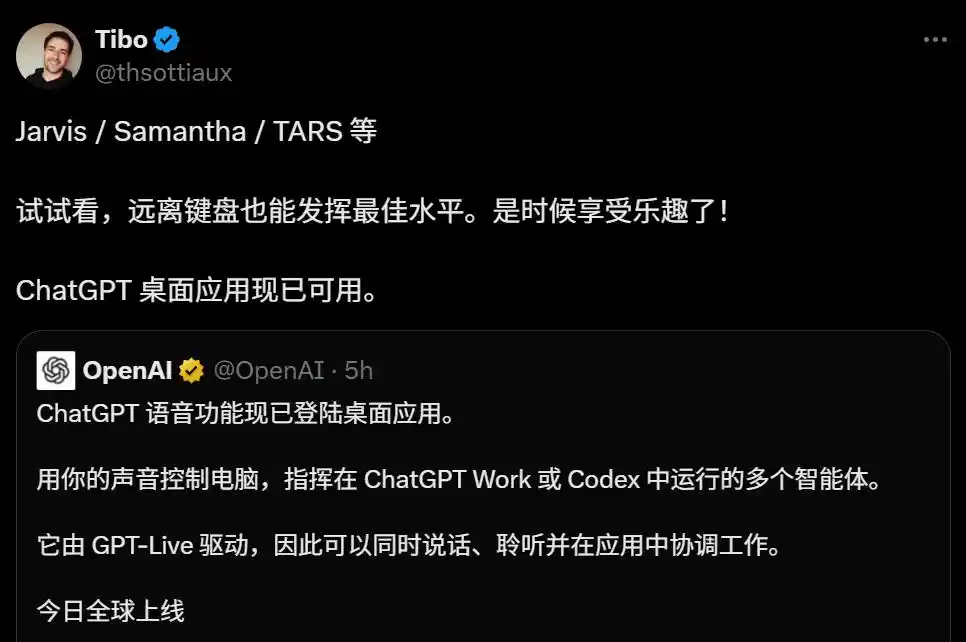
On the OpenAI side, the full-duplex GPT-Live has been directly deployed to macOS and Windows desktops. You can command a whole team of Agents just by speaking, and it supports Chinese.
Claude Voice Major Upgrade

Before this, Claude's voice mode could only run Haiku, the smallest model.

You could chat with it by voice, and it could understand, but it would easily struggle with slightly complex questions.

Now, Opus 4.8 and Sonnet 5 are both available.

You can switch models mid-conversation. The system automatically calls the fastest version of the selected model. Note, it's the fastest version, not the full reasoning version.
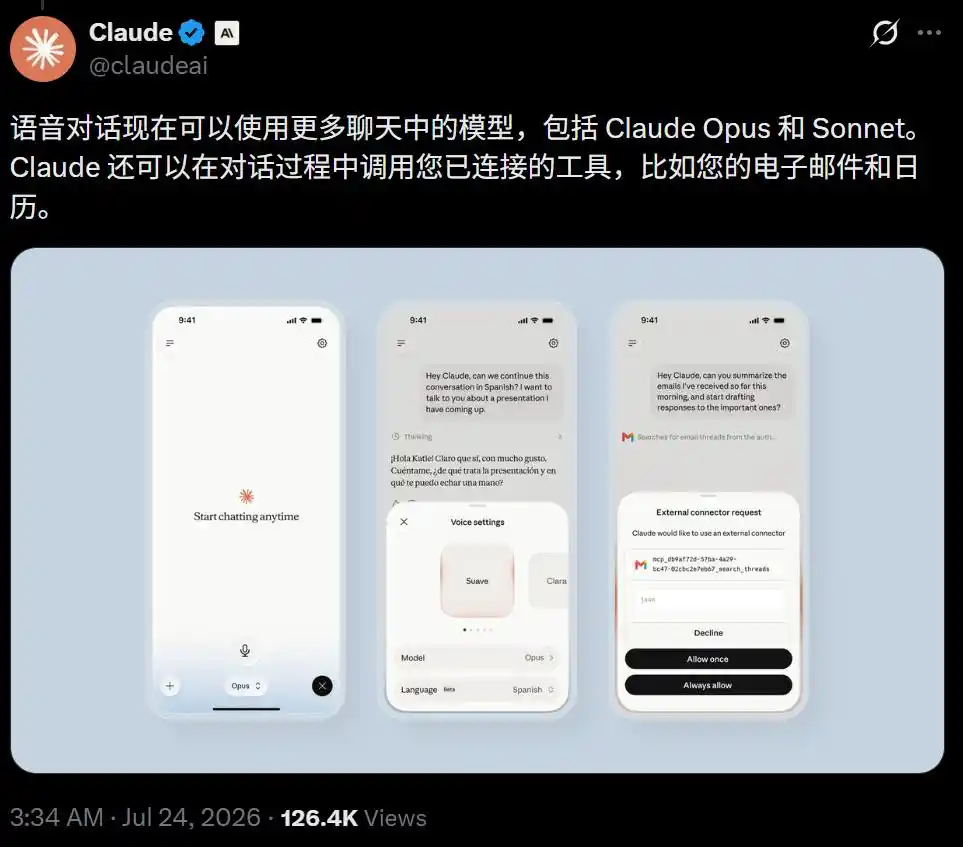
The good news is, voice mode will default to loading the model you last used in text chat, maintaining context seamlessly between text and voice, switching back and forth without interruption.

In terms of interaction, there are two modes: Hands-free continuous listening with automatic replies, and Push-to-talk where you hold to speak and release to end.

Of course, the most important feature is the "Tool Calling".

In voice conversations, Claude can now directly connect to your Gmail, Google Calendar, Slack, Google Docs, Canva.

Say a sentence, and it searches emails, checks your calendar, reads documents, sends messages for you.

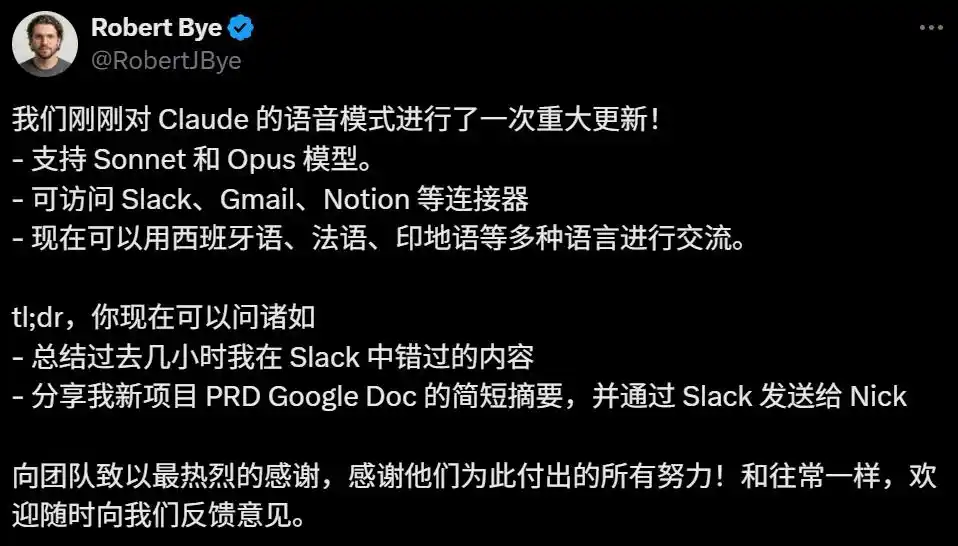
Anthropic's product manager, Robert Bye, gave a few examples:

· Summarize what I missed on Slack in the past few hours.

· Send the summary of the new project PRD to Nick on Slack.

Say it out loud, and the task is done.
Technically, tool calling in voice uses the same Connectors architecture as text chat, not a watered-down version. It will also ask for your permission before each call.

All subscription plans can use it, but free users only get Haiku with 1 connector. The full Opus suite requires a paid plan. Usage is deducted from the regular quota. Public beta rollout across all platforms starts today.

11 Languages, No Chinese

Regarding languages, Claude voice mode now supports 11 languages: English, French, German, Hindi, Indonesian, Italian, Japanese, Korean, Brazilian Portuguese, Latin American Spanish, European Spanish.

Looked from beginning to end, no Chinese.

For these users, typing remains the way.

Furthermore, Claude does not automatically detect the language you are speaking.

You need to actively ask it to switch, for example, "Please speak to me in Japanese," or manually select it in the settings. If not switched, the default is English.

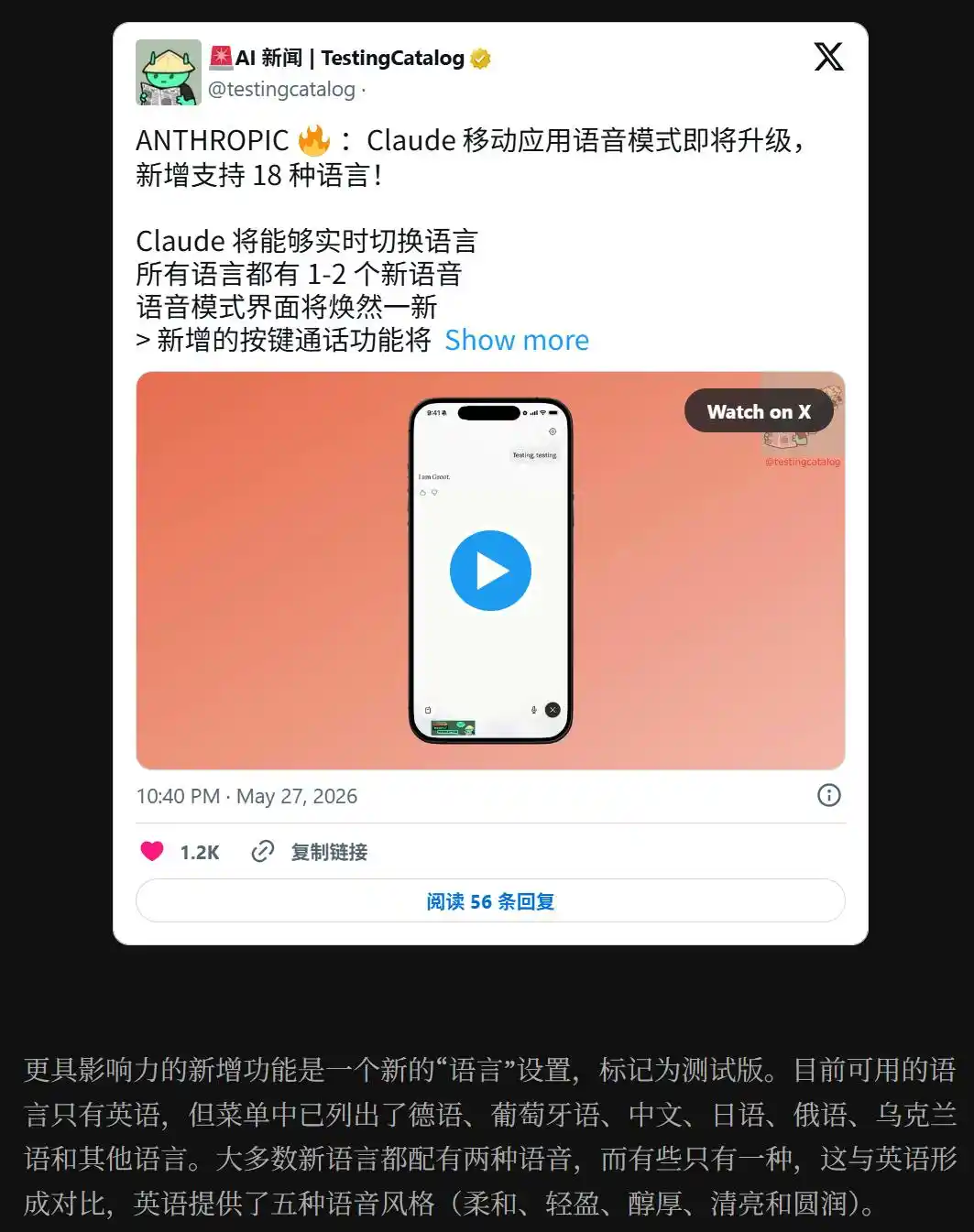
Interestingly, previously, developers found a language list in the Claude App code containing 18 languages, which explicitly included Chinese.

However, 18 became 11, and Chinese was directly cut.
ChatGPT Voice Invades the Desktop

In contrast, ChatGPT's voice has completely changed its underlying architecture.

It uses the GPT-Live model just released on July 8th, a full-duplex voice model.

Full-duplex means the model can simultaneously handle input and output audio streams, making dozens of judgments per second. It can respond without waiting for you to finish speaking.

So GPT-Live will interject with "uh-huh" or "I see" while you're talking, like a real person listening.

Looking deeper, it's based on a two-tier architecture.

The foreground is a lightweight, low-latency voice model responsible for real-time conversation, turn management, interruption response—anything requiring millisecond-level reactions.

The background is GPT-5.5, responsible for complex reasoning, web search, and Agent tasks.

When you ask a question requiring deep thought, GPT-Live asynchronously delegates the task to the background GPT-5.5, then continues talking to you, reporting back when the result is ready.

OpenAI calls this "Delegated Reasoning."
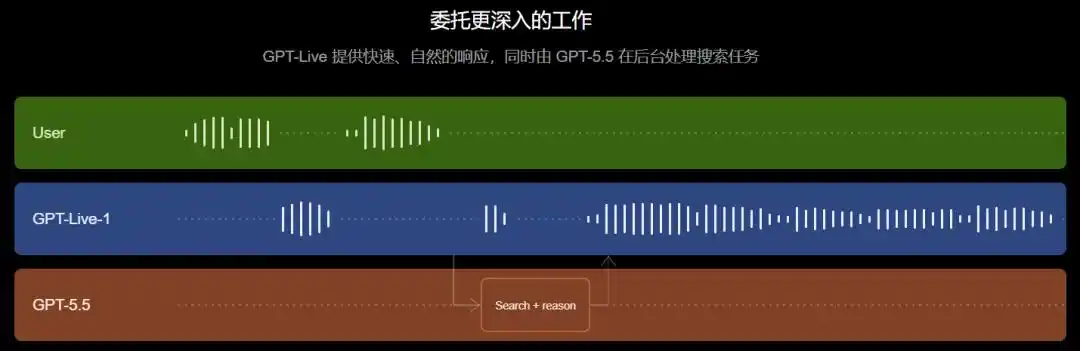
Specifically, OpenAI has completely decoupled conversation latency from reasoning depth. You don't need to wait for the large model to finish thinking before you can continue speaking.

Reasoning depth is adjustable in three levels: Instant (fastest), Medium (moderate reasoning), High (deep reasoning), corresponding to different tiers of GPT-5.5. Free users get GPT-Live-1 mini.

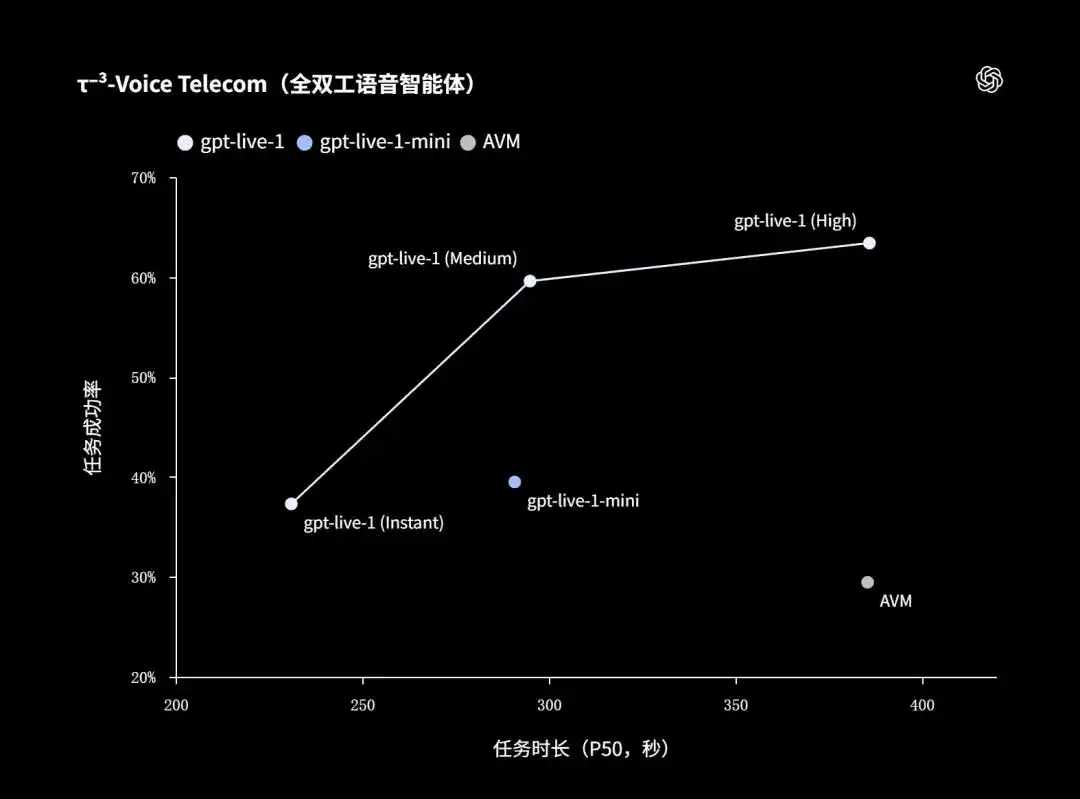
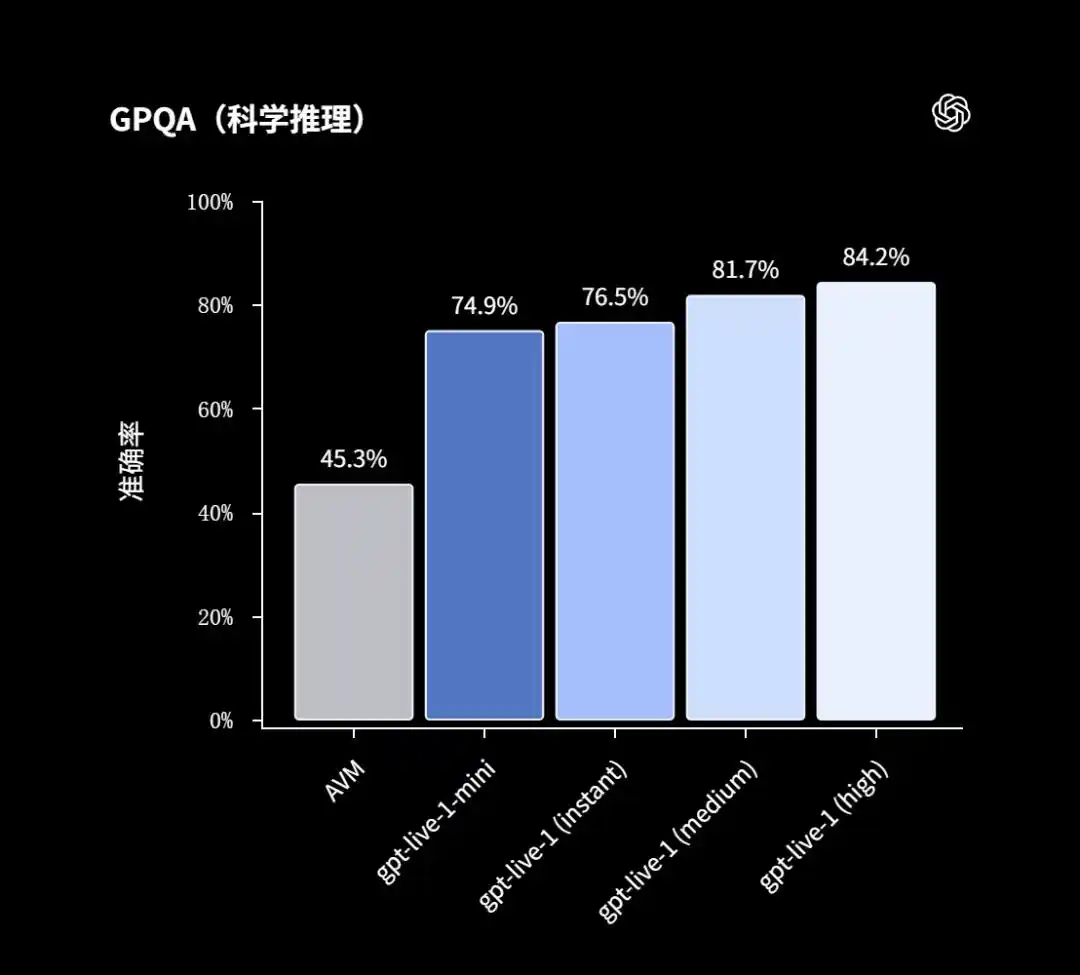
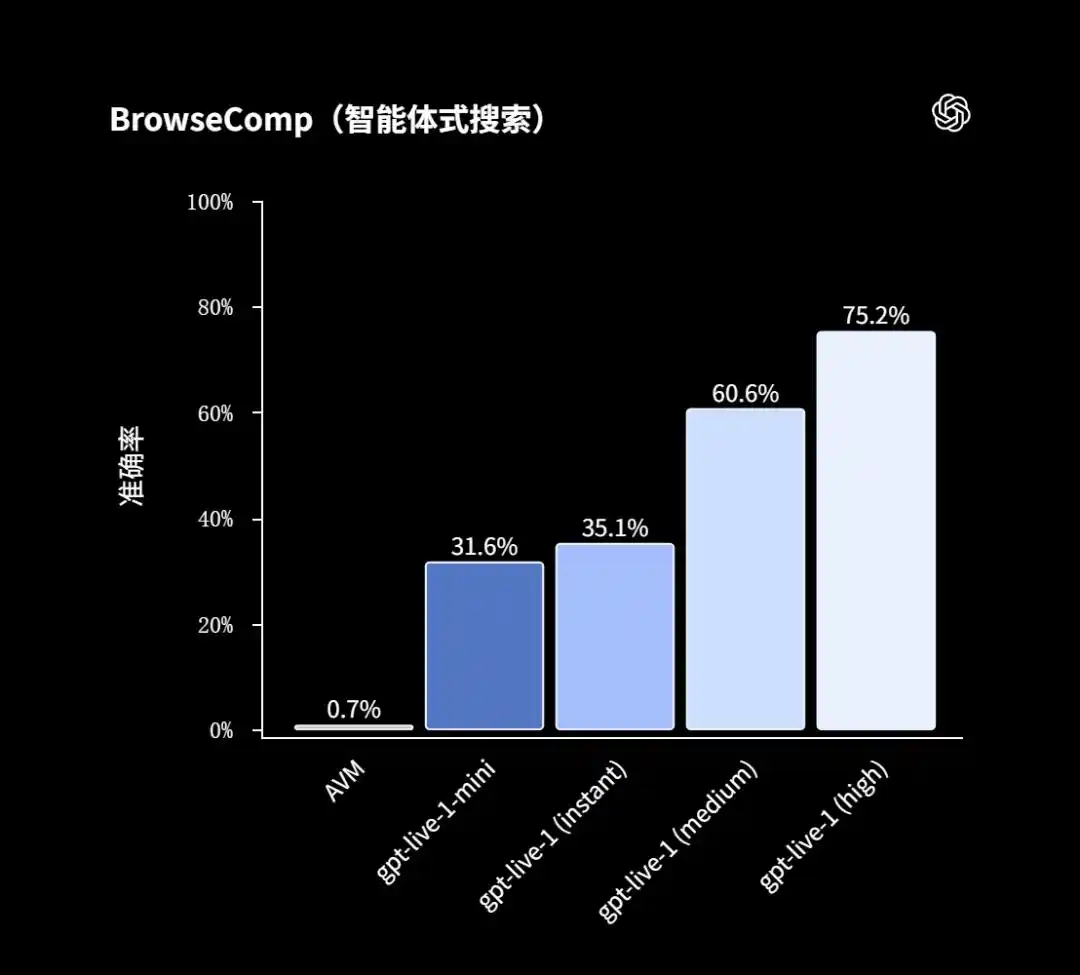
Judging from benchmarks, this delegation architecture really works. Voice mode is finally no longer a "downgraded chat."

GPQA (Expert-level scientific reasoning) jumped from 45.3% to 84.2% compared to the previous advanced voice mode.

BrowseComp (Agent web search capability) soared from 0.7% to 75.2%.

In the τ3-Voice Telecom benchmark simulating real multi-turn telecom customer service scenarios, GPT-Live also comprehensively outperforms.
Talk and Run Multiple Agents Simultaneously

With this foundation, OpenAI directly deployed it to the desktop.

Starting today, ChatGPT Voice officially lands on macOS and Windows desktop.

You can set a global hotkey to instantly invoke ChatGPT Voice from within any application.

On macOS, there's also an Appshots feature. ChatGPT can directly read the content of your currently active window to use as conversation context.

For example, when saying "help me calculate Q3 year-over-year" while looking at Excel, it can see your spreadsheet.
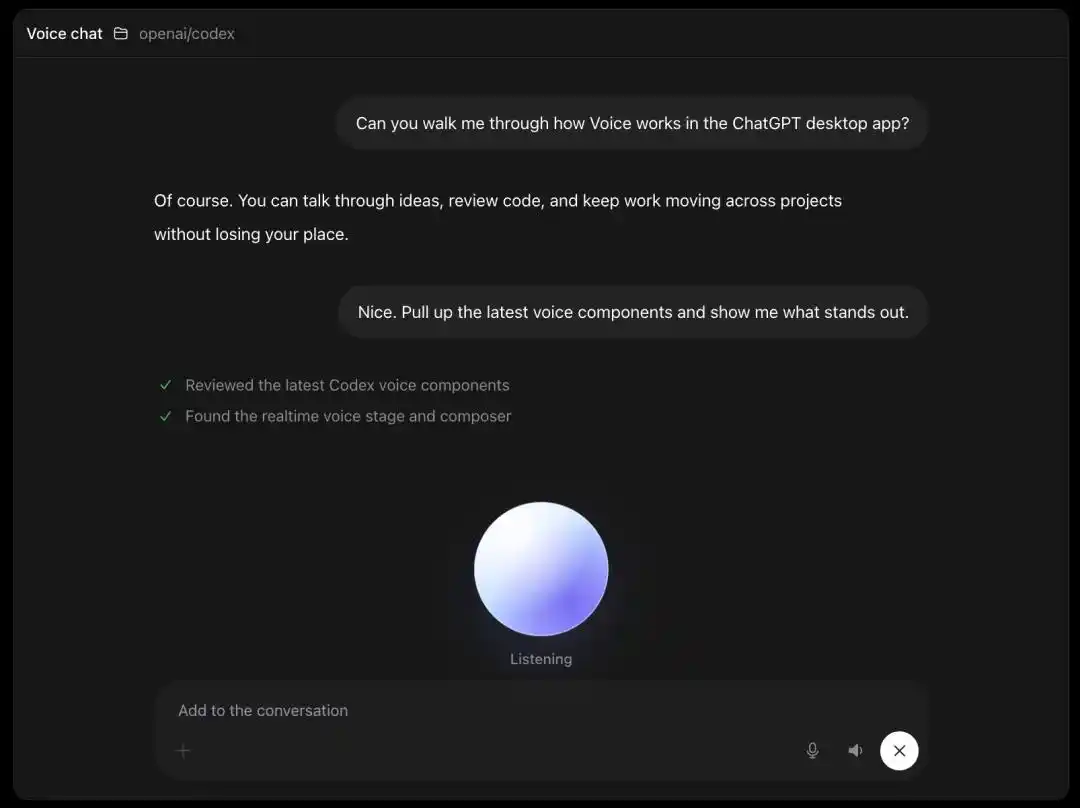
Furthermore, you can use voice to command multiple Agents in ChatGPT Work and Codex to work simultaneously.

Have one Agent write code while another looks up documentation, just by speaking.

GPT-Live talks to you in the foreground while simultaneously launching, monitoring, and switching multiple work threads in the background, no need for you to return to the keyboard.

Currently available for Plus, Pro, Business, Edu, and Enterprise plans.

The Difference You Can Feel in 10 Seconds

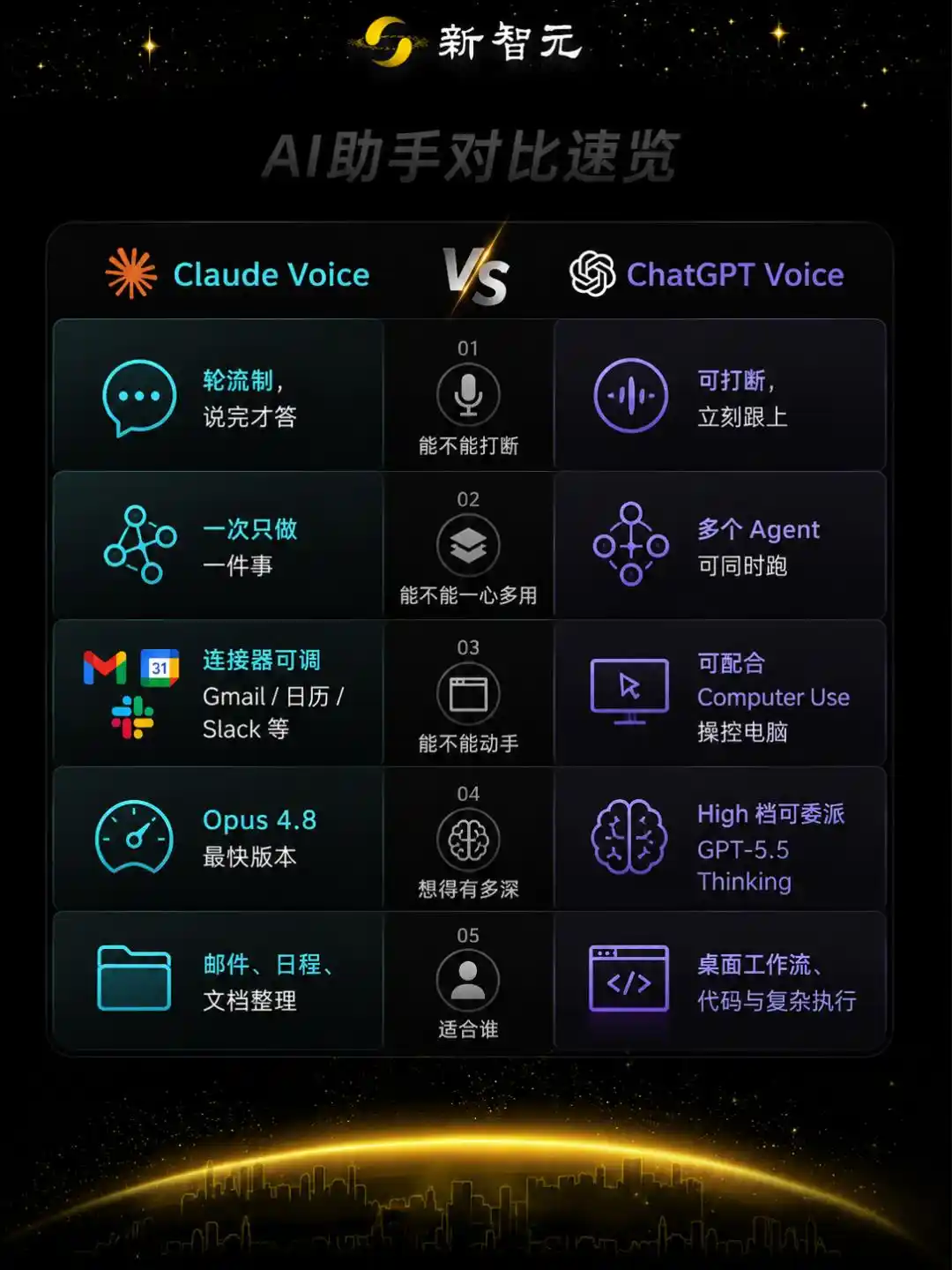
Can it be interrupted?

Claude voice is turn-based. It thinks only after you finish. Want to interrupt? Wait.

GPT-Live can be interrupted. Change your mind mid-sentence, and it stops immediately to follow your new thought. It remembers where you were before the interruption.

Can it multitask?

Claude does only one thing at a time—voice chat.

ChatGPT Voice on desktop can talk to you while simultaneously controlling your computer in the background, directing multiple Agents to do their respective tasks.

"Help me open a PR while checking yesterday's CI logs," both tasks can start running concurrently.

Can it act?

Claude voice can call SaaS tools like Gmail, Calendar via connectors, but it cannot touch your desktop.

ChatGPT Voice on desktop, combined with Computer Use, can directly control your computer. Files, programs, terminal—it can interact with them all.

How deep does it think?

Claude's trump card is Opus 4.8, still one of the strongest models for multi-step reasoning and knowledge synthesis tasks. However, the voice mode runs the fastest version of Opus, not the full-powered reasoning version.

On the GPT-Live side, the High setting can asynchronously delegate to GPT-5.5 Thinking for deep reasoning, actually allowing near-full reasoning capability to be called in voice scenarios.
The Era Where Even the Input Box Isn't Needed

Seeing this, the divergence between the two companies becomes clear.

The turn-based Claude focuses on using your own Gmail, calendar, documents to help you sort out your own stuff.

The full-duplex GPT-Live focuses on feeling like talking to a person. Interruptible, multi-threaded, computer-controlling, making you forget it's an AI.

For non-coders, Claude has a much lower barrier. Have emails to sort, schedules to arrange? Just open your mouth.

OpenAI's path is more exhilarating and geekier. You need to actually have a team of Agents and real tasks for them to do.

As Greg Brockman said, "Compared to voice, typing itself is particularly unnatural."

Those plastic keys that have accompanied humanity for forty years are now officially being pushed into a corner by both OpenAI and Anthropic.

References:

https://x.com/testingcatalog/status/2080401533728940372

https://x.com/OpenAI/status/2080378182469857576

https://x.com/testingcatalog/status/2080385285951521150

https://x.com/claudeai/status/2080376094939603366

https://claude.com/blog/think-through-hard-problems-in-voice-mode

This article is from the WeChat public account "New Zhiyuan," author: ASI Revelation, editor: Moses


Domande pertinenti

QWhat is the core difference between the newly upgraded Claude Voice and ChatGPT's new GPT-Live?

AThe core difference lies in their fundamental interaction architecture. Claude Voice operates on a 'half-duplex' or 'push-to-talk/automated turn-taking' system where users speak, then Claude processes and responds, and it doesn't support natural interruptions. ChatGPT's GPT-Live is a 'full-duplex' model, capable of simultaneously processing input and output, allowing for real-time interruptions, back-channeling (like saying 'uh-huh'), and more human-like conversational flow. Furthermore, GPT-Live can delegate complex reasoning tasks asynchronously to a backend model (GPT-5.5) while maintaining the conversation.

QWhat are the key functionalities of the 'Tool Calling' feature in Claude's new Voice mode?

AClaude's Voice mode 'Tool Calling' allows the AI to connect to and perform actions within various SaaS applications directly through voice commands. Key supported integrations include Google services (Gmail, Calendar, Docs), Slack, and Canva. Users can issue commands like 'Summarize what I missed on Slack in the past few hours' or 'Send the summary of the new project PRD to Nick on Slack.' Before execution, Claude will ask for user permission for each action. This feature is available across all plans, but with limitations on the number of connectors for free users.

QHow does GPT-Live's 'Delegated Reasoning' architecture enhance its performance in voice mode?

AGPT-Live's 'Delegated Reasoning' architecture decouples conversational latency from reasoning depth. It uses a two-tier system: a front-end, low-latency speech model handles real-time dialogue, turn management, and immediate responses. When a complex query requiring deep thought arises, the front-end model asynchronously delegates the reasoning task to the back-end, more powerful GPT-5.5 model. This allows the conversation to continue fluidly without waiting for the deep reasoning to complete, and the result is delivered when ready. This significantly boosts performance on complex benchmarks like GPQA (expert scientific reasoning) and BrowseComp (agentic web search).

QWhat specific desktop integration features does the new ChatGPT Voice offer on macOS and Windows?

AThe new ChatGPT Voice on desktop offers several key integration features: 1) A global hotkey to summon ChatGPT Voice from within any application. 2) On macOS, the 'Appshots' feature allows ChatGPT to see and understand the content of the user's currently active application window (e.g., an Excel spreadsheet) and use it as context for the conversation. 3) Users can verbally command multiple Agents (from ChatGPT Work and Codex) to work simultaneously in the background. 4) With Computer Use capabilities, it can directly manipulate the user's desktop, interacting with files, programs, and terminals.

QWhat languages are supported in Claude's latest Voice mode update, and what is notably absent?

AClaude's latest Voice mode update supports 11 languages: English, French, German, Hindi, Indonesian, Italian, Japanese, Korean, Brazilian Portuguese, Latin American Spanish, and European Spanish. Notably, Chinese (Mandarin) is absent from the supported list. Users must manually switch languages by voice command (e.g., 'Please speak to me in Japanese') or in settings; it does not auto-detect language and defaults to English if not set.

Letture associate

The Verdict in Choi Tae-won's Divorce Case: Revealing the Inheritance Undercurrent Behind SK Hynix's Trillion-Won Empire

SK Group Chairman Chey Tae-won's high-profile divorce case, involving a record 1.38 trillion won settlement, has drawn attention to the succession plans for Korea's second-largest conglomerate, especially its crown jewel, SK hynix. Unlike traditional chaebol scripts centered on the eldest son, Chey's three children from his marriage to former President Roh Tae-woo's daughter, Roh Soh-yeong, are carving distinct, non-traditional paths. Eldest daughter Chey Yun-jung (b. 1989) is seen as the most evident successor. With a scientific and consulting background, she holds executive roles at SK bioscience and SK Inc.'s growth support department, focusing on future strategy and biopharma. Her marriage is to an AI infrastructure entrepreneur, not a traditional business alliance. Second daughter Chey Min-jung (b. 1991) took a unique route, voluntarily serving as a South Korean naval officer, including an anti-piracy deployment. She later worked on policy and strategy for SK hynix in Washington D.C. before co-founding an AI-driven healthcare startup. She married a former U.S. Marine Corps officer, connecting her to U.S. defense and policy circles—networks crucial for a global semiconductor giant. The only son, Chey In-geun (b. 1995), who studied physics like his father, worked briefly at SK E&S before joining McKinsey. Despite fitting the traditional "heir" profile as the eldest son, he remains silent and holds no public position or shares in SK, suggesting the old succession playbook is obsolete. As SK hynix's valuation soars, becoming a geopolitical asset in the AI era, the heirs' legitimacy is no longer automatic. They must prove themselves in fields like AI biotech, global policy, and strategic consulting. Their marriages also reflect new elite networks in tech and defense, not old political alliances. Their inheritance is the complex challenge of navigating a globalized, tech-driven world, not just a corporate throne.

marsbit14 h fa

The Verdict in Choi Tae-won's Divorce Case: Revealing the Inheritance Undercurrent Behind SK Hynix's Trillion-Won Empire

marsbit14 h fa

From OpenSea to OpenRouter: Is Alex Atallah Repeating His 'Exit at the Peak' Playbook?

From OpenSea to OpenRouter: Is Alex Atallah Repeating His "Exit at the Peak" Playbook? According to the Wall Street Journal, payments giant Stripe is in talks to acquire the AI model aggregation platform OpenRouter in a potential deal valuing the company near $100 billion. This would mark founder Alex Atallah's second creation of a company reaching a $100 billion valuation, following his co-founding of NFT marketplace OpenSea. OpenRouter, founded just over three years ago, has grown rapidly by acting as a unified gateway for developers to access over 400 AI models. It currently has about 10 million users and processes over 200 trillion tokens monthly. While the platform's annualized revenue is around $50 million, its valuation has skyrocketed from $1.3 billion in March 2026. The potential acquisition by Stripe, a company OpenRouter's founder once likened it to, represents a major expansion into AI infrastructure for the payments leader. This move echoes Atallah's previous timing with OpenSea, where he departed before the NFT market's significant downturn. For OpenRouter, selling now may be strategic. Despite its scale, its business model—charging a 5-5.5% fee on AI inference calls—faces pressure from competition, open-source models, and potential price wars among model providers, limiting its profitability narrative for an IPO. A key asset for potential acquirers like Stripe is OpenRouter's vast repository of real-world AI usage data, which offers unique insights into model performance and developer preferences that are difficult to replicate. Whether this potential deal signifies a new valuation benchmark for AI infrastructure or another market peak signal remains to be seen.

链捕手14 h fa

From OpenSea to OpenRouter: Is Alex Atallah Repeating His 'Exit at the Peak' Playbook?

链捕手14 h fa

Trading

Spot
活动图片