Reframing Ethereum's Valuation: Why the Fee Model is Wrong, and the 'Treasury Logic' is the Future?

marsbitPubblicato 2026-05-28Pubblicato ultima volta 2026-05-28

Introduzione

"Rethinking Ethereum's Value: The 'Vault Logic' Framework" Traditional valuation models incorrectly treat Ethereum as a company, valuing ETH based on transaction fees ("revenue"). This is flawed. Fees are network friction; a successful network aims to reduce them to zero. Ethereum's average fee has dropped from over $50 in 2021 to around $0.20 today, while transaction volume has tripled. Instead, view Ethereum as a digital vault securing ~$250 billion in on-chain assets (stablecoins, RWAs, L2 bridged funds, wBTC, etc.). Post-merge, Ethereum's security is directly purchased with its own asset: ETH. To attack the network, an attacker must acquire and control staked ETH. Therefore, the vault's security level is intrinsically tied to ETH's market value. Currently, the value of all staked ETH is only ~$72B, protecting ~$250B in assets—a dangerous imbalance. For robust security, the staked ETH securing the network should be valued significantly *higher* than the total value it protects. Applying a conservative security multiplier suggests ETH's fair value should be closer to ~$6,900 (vs. ~$2,070 currently). As on-chain asset value grows into the trillions, ETH's price must rise proportionally to maintain this security budget. Comparisons to free infrastructure like Linux or low-margin utilities like the DTCC are misguided. Their security is provided externally (community, law, banks). Ethereum's security is internal and must be purchased in the open market using ETH. ETH is not...

Author: Tom Dunleavy, Head of Venture Capital at Varys Capital

Compilation: Yuliya, PANews

Editor's Note: The market currently commonly views Ethereum as a traditional enterprise, calculating its price-to-earnings ratio based on the fees it generates and concluding it is overvalued. However, Tom Dunleavy proposes a completely different framework: fees are not revenue but network friction; Ethereum is not a company but a "treasury" safeguarding hundreds of billions of dollars in assets, with ETH itself being the lock. The following is a compilation of the original text:

TLDR

  • Stop focusing on fees to value Ethereum. Fees are a stumbling block; a successful network will inevitably strive to reduce fees to zero. ETH fees have dropped from over $50 at their peak in 2021 to around $0.20 now, while transaction volume has more than tripled. Plummeting fees signify network success, not failure.

  • After transitioning to Proof-of-Stake (PoS), ETH became the lock protecting the asset treasury. To attack Ethereum, you must control the staked ETH. Controlling one-third can paralyze the network; controlling two-thirds can falsify records. Either way, the cost of malicious action is calculated in ETH, and upon acting maliciously, this ETH is directly burned by the system. This tightly binds ETH's value to the network's security. No network operated this way before the staking mechanism existed.

  • Currently, there are about $250 billion in assets on the Ethereum chain (including stablecoins, tokenized assets, L2 network cross-chain funds, etc.), but the total value of staked ETH protecting these assets is only about $72 billion. This is like using a cheap, flimsy lock to protect a safe full of gold bars. Logically, ETH's fair price should be around $6,900 (currently only $2,070). If on-chain assets grow to trillions in the future, ETH's price must rise to tens of thousands to match its security responsibility.

  • Statements like "Ethereum is like the free Linux system" or "like DTCC (Depository Trust & Clearing Corporation)" are incorrect. The security of Linux and DTCC is provided externally (e.g., the open-source community's goodwill or the legal backing of governments and banks). But Ethereum's security is purchased using its own token, ETH. Therefore, ETH must be valuable, while Linux does not need to be.

  • If ETH fails, Crypto will likely fail as well.

Fees Are Not Revenue, But Friction

Last week, Bankless founder David Hoffman said he finally sold all his ETH, causing a stir in the crypto community. While I respect David's decision, I believe the way people evaluate ETH and other PoS public chains is long outdated. I've discussed my new framework with many people on podcasts, but it seems it hasn't sunk in (perhaps due to my explanation), so today I'll lay it all out clearly at once.

New things require new perspectives. Here's introducing a brand new ETH valuation model.

Many view Ethereum as a company, treating the fees collected as its operating revenue. Seeing fees decrease, they think this "company" is failing and the token is overpriced. This is completely backward; once you understand it, you'll never see it that way again.

In reality, fees are like taxes; the higher they are, the less willing people are to use the network. Lower fees encourage more people to participate, leading to more applications and capital on-chain. The data doesn't lie: the fee per transaction has dropped from over $50 in 2021 to around $0.20 now, but transaction volume has hit new highs, more than triple that of 2021, with L2s handling about 85% of transactions now. It's cheaper to use, and more people are using it. A successful settlement network should aim to reduce tolls to zero.
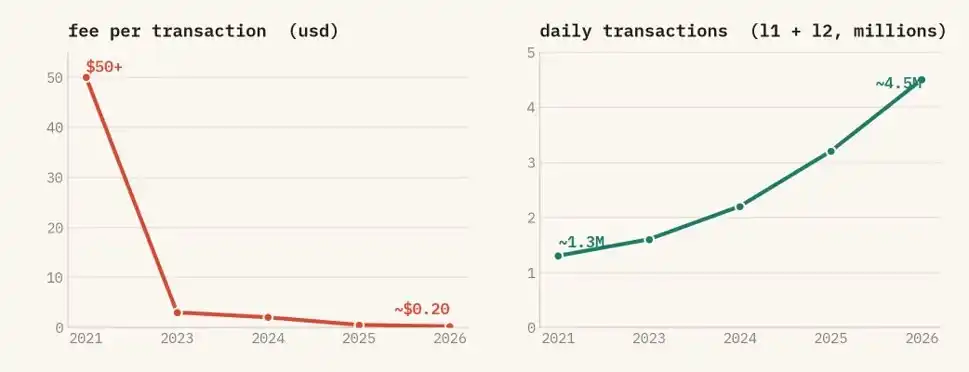
Ethereum's fees have plummeted, yet transaction volume is at a record high. It's become cheaper, and more people are using it. L2s now handle roughly 85% of the throughput.

So, if fees are the wrong metric, what is the right one?

Ethereum Is a Grand Treasury, ETH Is the Lock

Stop viewing Ethereum as a company; think of it as a massive treasury. This treasury holds approximately $160 billion in stablecoins, $20 billion in RWAs (like U.S. Treasuries, money market funds, and private credit), $35 billion in L2 cross-chain assets (with L2 networks inheriting Ethereum's consensus by design). Additionally, there's about $12 billion in wrapped Bitcoin and around $20 billion distributed across DeFi positions, NFTs, and on-chain treasuries. That totals roughly $250 billion in on-chain assets, growing each quarter.

The safety of the treasury depends entirely on that lock. And everyone has miscalculated the value of this lock. On Ethereum, this lock is forged from ETH.

In the old Proof-of-Work (PoW) system, you used mining hardware to secure the network. The lock was bought externally; its cost wasn't tied to the token's value. But now, with staking (PoS), everything has changed. To attack Ethereum now, you must buy and control the staked ETH. The lock is made from the token itself. This means the treasury's security level and the token's market price become one and the same. You can't separate them.

The Current State: A Lock Cheaper Than the Safe

This is the issue the market is ignoring. Today, the total value of all staked ETH protecting Ethereum is only $72 billion. But the assets it protects are worth $250 billion. The money in the safe is worth over twice as much as the lock protecting it.
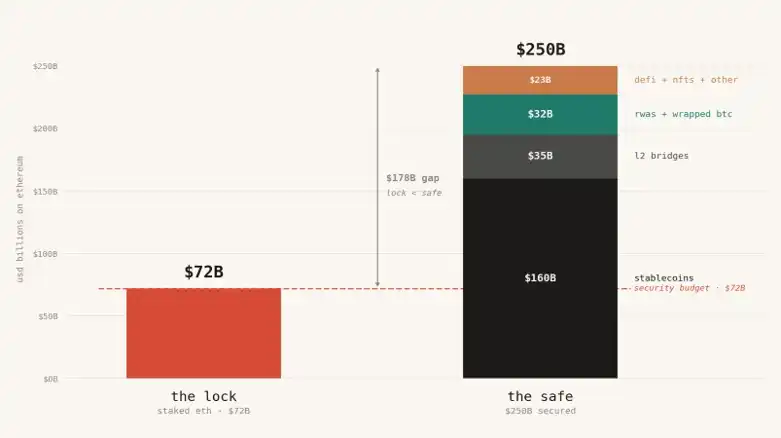
This is extremely dangerous. If what you're protecting is worth more than the cost of attacking it, your treasury is fundamentally insecure. For Ethereum to securely protect this $250 billion, the defensive staked capital must be greater than $250 billion, not less than one-third of it.

Currently, only about 30% of ETH is staked. So, simply to make this 30% stake equal the on-chain assets, ETH's total market capitalization would need to be over three times the on-chain assets (1 divided by 0.30). Currently, ETH's market cap is roughly equal to the assets it protects (around 1x). But by my logic, it should be over 3x. Calculating with the current $250 billion, ETH's fair price should be around $6,900, not the current $2,070. That is, even without a single new dollar entering, based solely on the assets it currently protects, ETH's price should more than triple. This aligns directionally with the model of BitMine Chairman Tom Lee.

"But Circle can freeze USDC, so it doesn't need ETH's protection at all."

Every time I say this, someone jumps in with this rebuttal, but it's fundamentally wrong. Here's why:

People think that if Ethereum is attacked, Circle, the issuer of USDC, can just freeze the attacker's address and reissue the tokens. So those hundreds of billions shouldn't count toward Ethereum's security responsibility.

But consider: Circle's freezing mechanism operates based on smart contracts; it executes on Ethereum and relies on Ethereum's ledger. If Ethereum's consensus is broken, there is no universally agreed-upon honest chain, and the freeze mechanism cannot function.

Furthermore, Circle could have chosen not to use Ethereum, opting for a private database instead. They chose Ethereum precisely for its neutrality, deep liquidity, and compatibility with other projects. Since they enjoy these benefits, the trade-off is: USDC's lifeline is tied to Ethereum's security. You want the benefits, you bear the dependency risk.

Moreover, people always assume the attacker wants to steal USDC. That's not it at all. If Ethereum collapses, that $150+ billion isn't stolen; it becomes trapped on a chain with no consensus, unable to be redeemed, with all loans and trades based on it thrown into chaos. The value of these assets isn't taken by a thief; it's destroyed. And that destroyed value is precisely the important factor for security considerations.

An attacker doesn't even need to steal money to profit. They can short ETH, short the entire ecosystem, or they could simply be a hostile actor profiting from paralyzing the network. The more money on-chain, the greater their incentive to cause destruction. Therefore, our security budget must grow alongside the total on-chain assets, not just guard against the small change a thief might steal.

As long as you put money on Ethereum, you consume its security, regardless of whether you have a "freeze" button. All the money must be counted.

"Ethereum is just Linux" or "Ethereum is DTCC."

Another rebuttal favored by the intellectually inclined.

  • First argument: Ethereum is like the Linux system. It's underlying infrastructure, powering the internet, but as an asset, it's worthless. Open-source infrastructure is a free public good; the money is made by the applications running on top, not the underlying protocol. So ETH will be the same: immensely important, yet utterly worthless.

  • Second argument: Ethereum is like DTCC (Depository Trust & Clearing Corporation), the infrastructure behind almost all U.S. securities transactions. DTCC processed $370 trillion in transactions in 2024, with revenues of about $2.5 billion but profits under $500 million. It's critically important, heavily regulated, but its value is only a tiny fraction of the transaction volume. Infrastructure is cheap; even if you can't live without it, even if Ethereum processes endless future transactions, it will only capture meager utility profits, nothing more.

Both arguments fail in the same place.

The security of Linux and DTCC is borrowed externally. Linux relies on the open-source community, reputation, and decades of code review. DTCC relies on U.S. law, federal regulators, and the backing of major banks with dollars and treasuries. Their security guarantees are outside the system. This is precisely why DTCC can settle massive wealth while capturing almost no value itself. It's a member-owned utility designed to operate at cost; it doesn't need a valuable token because trust is provided by the government and banks.

Ethereum has no such external shelter. No government enforces it. No member banks back it. No law can reverse stolen settlements. The only barrier between Ethereum and an attacker is the market value of the staked ETH used to secure it. Ethereum must purchase security for every block, in the open market, with its own asset.

This is the fundamental difference. Linux is software; no one is required to own a scarce asset to run it. DTCC provides collateral in dollars, external to itself. Ethereum's collateral is ETH, internal to itself. You cannot commoditize it to zero because security is not a line of code; it's a quantum of value that must be locked up and put at risk. Strip ETH of its value, and you haven't built a leaner Linux. You've built a chain with no collateral, one no one would trust with a single dollar.

So, stop comparing Ethereum to Linux or DTCC. You should compare it to the dollars and treasuries backing DTCC. No one values the dollar based on how many fees DTCC earns. You'd evaluate the clearing house's fees separately and evaluate the dollars and treasuries serving as the system's collateral—its monetary base—valued in trillions. ETH is not the clearing house. ETH is the collateral building the clearing house. That's the asset you're buying.

Linux never needed a treasury. Ethereum's security budget *is* a treasury, and it's denominated in ETH.

Looking Ahead and Market Dynamics

Following this line of thought. This model doesn't look at fees or market hype at all. It focuses on one core question: How much money will be settled on Ethereum in the future? To protect that money, how much must ETH be worth?

Stablecoins are poised to break $1 trillion in the coming years. RWA tokenization could reach several trillion by 2030. Add in various on-chain applications, and the assets Ethereum protects could soar from the current $250 billion to several trillion. Maintaining that "over 3x" security ratio constant, you can calculate how high ETH's price must rise as capital grows.
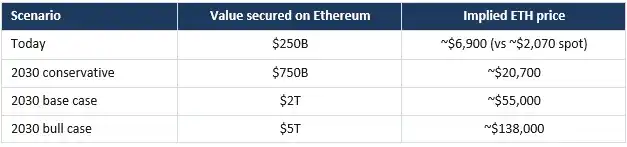
Even if you're more pessimistic and lower the security ratio a bit, it doesn't matter. On-chain capital is growing (that's the variable), and the security ratio (that's the leverage)—no matter how you calculate it, the trend is upward.

"This is blind optimism. The market will never price it this way."

This is the most pertinent rebuttal. Indeed, I'm saying what ETH "should" be worth, not what the market will price it at immediately. There's no forced arbitrage mechanism to close the gap. And my logic of "ETH should rise" has indeed been contradicted by its price performance over the past few years. Let's address each point.

  • About what bridges the gap: Ethereum is not an arbitrage; it's demand for the asset that prices the entire system. As value settles on Ethereum, ETH is used as collateral, paired trading asset, and staked to earn the network's base yield. This demand grows with the activity it supports. Reserve assets aren't priced on revenue; they're priced by how desperately the surrounding system needs to hold them. Gold is worth over $18 trillion without generating any cash flow. ETH is the reserve asset of on-chain finance, and this framework merely measures how large that reserve must be.

  • About the staking multiplier: My mental model treats the staking multiplier as a range, not a fixed target. At the current staking rate, parity (staked ETH equals protected value) is around 3.3x. A reasonable range spans from a lenient 1.7x to a strict 5x, where the cost to attack via a two-thirds stake equals the entire protected value. Price tracks protected value at some multiplier within this band. Fixing it to a specific number undermines rigor; this is also where rational people can disagree without breaking the model.

  • About reflexivity: The model does have more than one equilibrium, and nothing definitively selects the highest one. Today, Ethereum is secure enough with below-threshold coverage because acquiring a one-third stake is illiquid, slashing is brutally punitive, and the social layer can fork out an attacker. This is real. But these defenses determine whether an attack succeeds, not whether coverage is sufficient as risks escalate. Thin coverage may be tolerable when protecting $250 billion. When it involves two or five trillion in regulated institutional capital, coverage is no longer an academic question. The gradient to close the gap increases monotonically with adoption.

Finally, the most contradictory aspect is ETH's price over the past 5 years. Logically it should rise, but it has consistently fallen. I think the main reason is: previously, there wasn't enough money on-chain for people to see security as a major issue. When there was only $50 billion on-chain, nobody worried; when it grew to $175 billion, people started feeling uneasy; when it reaches $1 trillion, the first question large institutions ask before entering will undoubtedly be: "Is this chain secure?" And the answer to that question depends entirely on ETH's price. My model can't predict the exact day it will rise, but it tells you that as on-chain capital grows, this upward pressure will intensify. And "on-chain capital is growing" is a point even bears cannot deny.

Some counter with Bitcoin, saying Bitcoin's security budget is negligible compared to its market cap. But Bitcoin primarily protects itself. Ethereum protects other people's dollars and various assets—a far greater responsibility! And the trend is clear: more ETH is being staked, compliant products are continuously buying ETH, and as on-chain activity grows, the burn mechanism is constantly destroying ETH. All of this corroborates the demand growth I describe.

Those who only focus on fees and cash flow will continue shouting that ETH is overvalued. They've completely reversed cause and effect. On-chain activity comes first, and then security is needed. ETH must be valuable to secure the entire ecosystem. Fees are stumbling blocks you should strive to eliminate, not the chips you use to value ETH.

Domande pertinenti

QAccording to the article, why is it wrong to value Ethereum based on transaction fees?

AThe article argues that viewing transaction fees as revenue, akin to a company's income, is a flawed approach. Instead, fees are considered 'friction' or a 'tax' on the network. A successful settlement network aims to minimize this friction to encourage usage, not maximize it. The data shows that while average transaction fees have dropped significantly since 2021, transaction volume has tripled, indicating success, not failure.

QWhat is the central metaphor used to describe Ethereum's role and ETH's value in the new valuation framework?

AThe central metaphor is that Ethereum is a 'vault' or 'treasury' securing valuable assets, and ETH is the 'lock' on that vault. The security of the entire network is intrinsically linked to the market value of the staked ETH, which acts as the collateral that must be controlled or attacked to compromise the system.

QHow does the author justify the claim that Ethereum's current security budget (staked ETH value) is insufficient?

AThe author compares the total value of assets secured on Ethereum (estimated at $250 billion, including stablecoins, RWAs, L2 bridged funds, etc.) to the total value of staked ETH securing it (approximately $72 billion). This creates a dangerous imbalance where the 'lock' is cheaper than the contents of the 'vault.' For the network to be adequately secure, the defensive capital (staked ETH value) should be a multiple of the total value it protects.

QWhy does the author argue that comparing Ethereum to Linux or the DTCC is fundamentally incorrect?

AThe author states that both Linux and the DTCC derive their security and trust from external sources (open-source community reputation/government backing and legal/regulatory frameworks with bank guarantees, respectively). Ethereum has no such external backing; its only security is the market value of the staked ETH itself. Therefore, ETH cannot be commoditized to zero value because the network must 'buy' its security in the open market using its native asset.

QWhat is the primary driver for ETH's future price appreciation according to the 'treasury logic' framework presented?

AThe primary driver is the projected growth in the total value of assets settled and secured on the Ethereum network (e.g., stablecoins reaching trillions, tokenized RWAs). As this protected value increases, the market value of ETH must rise proportionally to maintain a sufficient security budget (the 'lock' must be valuable enough to protect the growing 'vault'). This creates a direct, non-speculative link between on-chain economic activity and ETH's valuation.

Letture associate

a16z: RWA Has Passed the Proof of Concept, but the Real Challenges Are Just Beginning

a16z highlights that the tokenized real-world asset (RWA) market, excluding stablecoins, has grown tenfold in under two years to roughly $340 billion. This surge is primarily driven by US Treasury bonds and gold, offering investors yield on idle stablecoins and providing institutions with more efficient settlement and collateral flows. However, the core insight is that most tokenized assets today are simply digital certificates for off-chain holdings—used for ownership and transfer but not deeply integrated into DeFi as composable financial building blocks. For instance, only about 5% of tokenized bonds ($8B) are actively used in DeFi protocols. Smaller categories like reinsurance tokens show much higher DeFi utilization (84%), indicating they were designed for on-chain composability from the start. The market remains concentrated, with US Treasuries and commodities comprising two-thirds of the total. Gold dominates the commodities segment. While Ethereum holds over half the market, activity is spreading across multiple chains like BNB Chain and Solana. Predictions for the market's future size vary widely (from $2 trillion to over $30 trillion by 2030/2034), reflecting different definitions of what constitutes tokenization. All agree on significant growth. The current market is minuscule compared to traditional finance (e.g., tokenized bonds are 0.01% of the global bond market). The key takeaway is that the initial "proof-of-concept" phase for moving familiar assets on-chain is proving successful. The next, harder challenge is moving more complex financial instruments onto blockchains and enabling true on-chain composability, where these assets become programmable components within a native digital financial system, rather than just digitized records.

marsbit28 min fa

a16z: RWA Has Passed the Proof of Concept, but the Real Challenges Are Just Beginning

marsbit28 min fa

The Wind of 'Proactive' AI Blows into Silicon Valley: Hark Secures $700 Million in Funding

Hark, an AI startup founded in late 2025, has raised $700 million in Series A funding at a $6 billion valuation. Led by Parkway Venture Capital with participation from NVIDIA, AMD Ventures, Intel Capital, Qualcomm Ventures, and Salesforce Ventures, the company aims to develop next-generation human-computer interfaces using a combination of proprietary foundational models and custom-built AI-native hardware. Founded by serial entrepreneur Brett Adcock, Hark envisions a system of multimodal devices equipped with agentic capabilities, end-to-end voice models, and personalized memory. This "active" AI approach seeks to move beyond passive chatbots, creating collaborative companions that anticipate needs and interact naturally within the real world. Adcock's experience with Figure, a humanoid robotics company, informs this hardware-focused venture. The article argues that while current AI is powerful, it remains confined to screens and traditional interfaces like chat. The next paradigm shift requires dedicated hardware that is always-on, possesses persistent memory, and enables intuitive interaction, potentially rivaling the impact of the iPhone. Hark is assembling a team with talent from Apple, Meta, Google, and Tesla to tackle this complex engineering challenge across models, hardware, and interaction design. Finally, the piece suggests Chinese startups may have an advantage in this "active" AI hardware space due to strong manufacturing ecosystems, a vast domestic market, and supportive government policies, framing the competition as one that requires integrated progress in models, operating systems, and devices.

marsbit33 min fa

The Wind of 'Proactive' AI Blows into Silicon Valley: Hark Secures $700 Million in Funding

marsbit33 min fa

Competitors Going Public, Kimi Can't Sit Still

Competitors Go Public, Kimi Feels the Pressure Yue Zhi An Mian (Moonshot AI), the company behind the AI assistant Kimi, has begun dismantling its VIE and red-chip structure, clearing a key obstacle for a potential Hong Kong IPO. This marks a significant shift from six months ago when founder Yang Zhilin stated the company was in "no hurry" to list. The move comes as rivals like Zhipu AI and MiniMax have successfully listed on the Hong Kong Stock Exchange in early 2026, experiencing massive surges in market value. This has reset valuation logic for AI companies, turning "going public" from an end goal into a competitive necessity. Analysts suggest Kimi is both seizing a favorable market window and responding to competitive pressure. Kimi's valuation has skyrocketed from around $3 billion at its 2023 founding to over $20 billion by May 2026. Capital is betting on its potential as a future AI platform and gateway, though some caution this "emotional valuation" depends on sustained technological leadership and successful commercialization. Traditionally focused on core model R&D over user growth, Kimi has recently pivoted strategy. While its monthly active users declined through 2025, it shifted focus to Agent development and reducing marketing spend. The release of its K2.5 model in early 2026 reportedly generated substantial revenue, with annual recurring revenue reaching $200 million by April, driven by subscriptions and API services. A $2 billion D-round financing in May signaled investor approval of this commercial shift. However, listing will bring new pressures. Experts predict a listed Kimi would face stricter scrutiny on financial controls, compliance, and R&D efficiency. The narrative must evolve from pure technological breakthroughs to demonstrating clear commercialization paths, sustainable income, and a defensible valuation, balancing model superiority with business performance.

marsbit52 min fa

Competitors Going Public, Kimi Can't Sit Still

marsbit52 min fa

Trading

Spot
Futures

Articoli Popolari

Cosa è ETH 3.0

ETH3.0 e $eth 3.0: Un'Analisi Approfondita del Futuro di Ethereum Introduzione Nel panorama in rapida evoluzione delle criptovalute e della tecnologia blockchain, ETH3.0, spesso indicato come $eth 3.0, è emerso come un argomento di considerevole interesse e speculazione. Il termine comprende due concetti principali che warrantono chiarimenti: Ethereum 3.0: Questo rappresenta un potenziale futuro aggiornamento volto ad aumentare le capacità dell'attuale blockchain di Ethereum, concentrandosi principalmente sul miglioramento della scalabilità e delle prestazioni. ETH3.0 Meme Token: Questo progetto di criptovaluta distinto cerca di sfruttare la blockchain di Ethereum per creare un ecosistema incentrato sui meme, promuovendo il coinvolgimento all'interno della comunità delle criptovalute. Comprendere questi aspetti di ETH3.0 è essenziale non solo per gli appassionati di criptovalute, ma anche per coloro che osservano tendenze tecnologiche più ampie nello spazio digitale. Che cos'è ETH3.0? Ethereum 3.0 Ethereum 3.0 è pubblicizzato come un aggiornamento proposto per la rete Ethereum già stabilita, che è stata la spina dorsale di molte applicazioni decentralizzate (dApps) e contratti smart sin dalla sua nascita. I miglioramenti previsti si concentrano principalmente sulla scalabilità, integrando tecnologie avanzate come lo sharding e le prove a conoscenza zero (zk-proofs). Queste innovazioni tecnologiche mirano a facilitare un numero senza precedenti di transazioni al secondo (TPS), potenzialmente raggiungendo milioni, affrontando così una delle limitazioni più significative della tecnologia blockchain attuale. Il miglioramento non è meramente tecnico, ma anche strategico; è volto a preparare la rete Ethereum per un'adozione e un'utilità diffuse in un futuro contrassegnato da un aumento della domanda di soluzioni decentralizzate. ETH3.0 Meme Token Al contrario di Ethereum 3.0, l'ETH3.0 Meme Token si avventura in un dominio più leggero e giocoso, combinando la cultura dei meme di internet con la dinamica delle criptovalute. Questo progetto consente agli utenti di acquistare, vendere e scambiare meme sulla blockchain di Ethereum, fornendo una piattaforma che promuove il coinvolgimento della comunità attraverso la creatività e interessi condivisi. L'ETH3.0 Meme Token mira a dimostrare come la tecnologia blockchain possa intersecarsi con la cultura digitale, creando casi d'uso che siano sia divertenti che finanziariamente praticabili. Chi è il Creatore di ETH3.0? Ethereum 3.0 L'iniziativa verso Ethereum 3.0 è principalmente propulsa da un consorzio di sviluppatori e ricercatori all'interno della comunità di Ethereum, tra cui Justin Drake. Conosciuto per le sue intuizioni e contributi all'evoluzione di Ethereum, Drake è stato una figura di spicco nelle discussioni riguardanti la transizione di Ethereum verso un nuovo livello di consenso, chiamato “Beam Chain.” Questo approccio collaborativo allo sviluppo significa che Ethereum 3.0 non è il prodotto di un creatore singolo, ma piuttosto una manifestazione di ingegno collettivo focalizzato sul progresso della tecnologia blockchain. ETH3.0 Meme Token I dettagli riguardanti il creatore dell'ETH3.0 Meme Token sono attualmente non rintracciabili. La natura dei token meme conduce spesso a una struttura più decentralizzata e guidata dalla comunità, il che potrebbe spiegare la mancanza di attribuzione specifica. Questo si allinea con l'etica della comunità crypto più ampia, dove l'innovazione spesso nasce da sforzi collaborativi piuttosto che individuali. Chi sono gli Investitori di ETH3.0? Ethereum 3.0 Il supporto per Ethereum 3.0 proviene principalmente dalla Ethereum Foundation insieme a una comunità entusiasta di sviluppatori e investitori. Questa associazione fondamentale fornisce un considerevole grado di legittimità e migliora le prospettive di implementazione di successo poiché sfrutta la fiducia e la credibilità costruite nel corso degli anni di operazioni della rete. Nel clima in rapida evoluzione delle criptovalute, il supporto della comunità gioca un ruolo cruciale nello sviluppo e nell'adozione, posizionando Ethereum 3.0 come un serio contenditore per i futuri progressi della blockchain. ETH3.0 Meme Token Sebbene le fonti attualmente disponibili non forniscano informazioni esplicite riguardo ai fondamenti o alle organizzazioni di investimento che sostengono l'ETH3.0 Meme Token, ciò è indicativo del modello di finanziamento tipico per i token meme, che spesso si basa sul supporto di base e sul coinvolgimento della comunità. Gli investitori in tali progetti sono tipicamente individui motivati dal potenziale per innovazioni guidate dalla comunità e dallo spirito di cooperazione trovato all'interno della comunità crypto. Come Funziona ETH3.0? Ethereum 3.0 Le caratteristiche distintive dell'Ethereum 3.0 risiedono nella sua proposta di implementazione della tecnologia di sharding e zk-proof. Lo sharding è un metodo di partizionamento della blockchain in pezzi più piccoli e gestibili o “shard,” che possono elaborare transazioni in modo concorrente piuttosto che sequenziale. Questa decentralizzazione dell'elaborazione aiuta a prevenire la congestione e garantisce che la rete rimanga reattiva anche sotto un carico pesante. La tecnologia delle prove a conoscenza zero (zk-proof) contribuisce con un ulteriore livello di sofisticazione consentendo la validazione delle transazioni senza rivelare i dati sottostanti coinvolti. Questo aspetto non solo migliora la privacy, ma aumenta anche l'efficienza complessiva della rete. Si parla anche di incorporare una macchina virtuale Ethereum a conoscenza zero (zkEVM) in questo aggiornamento, amplificando ulteriormente le capacità e l'utilità della rete. ETH3.0 Meme Token L'ETH3.0 Meme Token si distingue capitalizzando sulla popolarità della cultura dei meme. Stabilisce un mercato per gli utenti che desiderano partecipare al trading di meme, non solo per divertimento, ma anche per potenziale guadagno economico. Integrando funzioni come lo staking, la fornitura di liquidità e meccanismi di governance, il progetto promuove un ambiente che incentiva l'interazione e la partecipazione della comunità. Offrendo una miscela unica di intrattenimento e opportunità economica, l'ETH3.0 Meme Token mira ad attrarre un pubblico variegato, che va dagli appassionati di crypto ai semplici intenditori di meme. Timeline di ETH3.0 Ethereum 3.0 11 Novembre 2024: Justin Drake accenna al prossimo aggiornamento ETH 3.0, incentrato sui miglioramenti della scalabilità. Questo annuncio segna l'inizio delle discussioni formali riguardo l'architettura futura di Ethereum. 12 Novembre 2024: La proposta attesa per Ethereum 3.0 dovrebbe essere svelata a Devcon a Bangkok, preparando il terreno per un feedback più ampio della comunità e potenziali passi successivi nello sviluppo. ETH3.0 Meme Token 21 Marzo 2024: L'ETH3.0 Meme Token viene ufficialmente elencato su CoinMarketCap, segnando il suo ingresso nel dominio pubblico delle criptovalute e aumentando la visibilità per il suo ecosistema basato sui meme. Punti Chiave In conclusione, Ethereum 3.0 rappresenta una significativa evoluzione all'interno della rete Ethereum, concentrandosi sul superamento delle limitazioni riguardanti scalabilità e prestazioni attraverso tecnologie avanzate. I suoi aggiornamenti proposti riflettono un approccio proattivo alle future esigenze e usabilità. D'altra parte, l'ETH3.0 Meme Token incarna l'essenza della cultura guidata dalla comunità nello spazio delle criptovalute, sfruttando la cultura dei meme per creare piattaforme coinvolgenti che incoraggiano la creatività e la partecipazione degli utenti. Comprendere gli scopi e le funzionalità distinte di ETH3.0 e $eth 3.0 è fondamentale per chiunque sia interessato ai continui sviluppi nello spazio crypto. Con entrambe le iniziative che tracciano percorsi unici, esse sottolineano collettivamente la natura dinamica e multifacetica dell'innovazione blockchain.

173 Totale visualizzazioniPubblicato il 2024.04.04Aggiornato il 2024.12.03

Cosa è ETH 3.0

Cosa è ETHEREUM

HarryPotterTrumpHomerSimpson777Inu: Panoramica di un Progetto Crypto Web3 Introduzione Nel mondo in rapida evoluzione delle criptovalute e della finanza decentralizzata, progetti innovativi emergono frequentemente, catturando l'interesse della comunità degli investitori e degli appassionati di crypto. Uno di questi progetti è HarryPotterTrumpHomerSimpson777Inu, una criptovaluta che si trova all'incrocio tra cultura popolare e tecnologia blockchain. Questo token guidato dalla comunità mescola personaggi e figure politiche ben noti, con l'obiettivo di creare una piattaforma coinvolgente e promuovere un'adozione diffusa. Che cos'è HarryPotterTrumpHomerSimpson777Inu? HarryPotterTrumpHomerSimpson777Inu è un token costruito sulla blockchain di Ethereum, progettato per essere accessibile e divertente per un pubblico diversificato. L'unicità di questo progetto deriva dal suo approccio tematico, che intreccia elementi di fantasia, politica e intrattenimento. Sfruttando il fascino nostalgico di personaggi amati, il progetto cerca di creare un'esperienza di criptovaluta coinvolgente, incoraggiando il coinvolgimento e la partecipazione della comunità. L'obiettivo principale di HarryPotterTrumpHomerSimpson777Inu è stabilire un token che risuoni con gli utenti a livello personale, promuovendo sia il divertimento che il coinvolgimento nell'ambito crypto. Questo branding distintivo mira ad attrarre individui che in precedenza potrebbero non essersi interessati alle criptovalute, facilitando un nuovo punto di ingresso per utenti potenziali. Creatore di HarryPotterTrumpHomerSimpson777Inu L'identità del creatore dietro HarryPotterTrumpHomerSimpson777Inu rimane sconosciuta. Questa non è una pratica rara nel dominio delle criptovalute, dove l'anonimato è spesso preferito dai fondatori come mezzo di protezione della privacy e promozione di un ethos decentralizzato. Questa oscurità non diminuisce il valore del progetto; al contrario, riflette una tendenza più ampia all'interno del settore, dove molti progetti di successo sono emersi da origini anonime. Investitori di HarryPotterTrumpHomerSimpson777Inu Le informazioni pubbliche riguardo agli investitori di HarryPotterTrumpHomerSimpson777Inu sono limitate. La natura del progetto, incentrata sul coinvolgimento della comunità, suggerisce una dipendenza da investimenti di piccole dimensioni da parte di singoli appassionati piuttosto che da sostegni sostanziali da fondazioni di investimento consolidate o corporation. Questo livello di trasparenza nel finanziamento è tipico di molti progetti di criptovaluta guidati dalla comunità, dove il supporto spesso proviene da movimenti di base piuttosto che da investitori istituzionali. Come Funziona HarryPotterTrumpHomerSimpson777Inu? Operando sulla blockchain di Ethereum, HarryPotterTrumpHomerSimpson777Inu sfrutta la sua solida infrastruttura per facilitare transazioni e promuovere interazioni tra gli utenti all'interno della comunità. Ciò che distingue questo progetto è il suo posizionamento tematico: canalizzando il carisma di personaggi iconici provenienti da diversi ambiti culturali, crea un'identità di marca distintiva. Questo approccio non solo attrae gli utenti, ma coltiva anche una comunità fedele attorno al token. Le meccaniche operative del progetto si concentrano sul coinvolgimento della comunità. Adotta un modello decentralizzato che incoraggia la partecipazione, consentendo agli utenti di interagire attraverso vari canali mentre promuovono lo scambio di idee e esperienze. Inoltre, il progetto abbraccia i principi del Web3, privilegiando la sovranità degli utenti e la decentralizzazione, che sono i pilastri del futuro di Internet. Timeline di HarryPotterTrumpHomerSimpson777Inu La storia di HarryPotterTrumpHomerSimpson777Inu è segnata da diversi eventi decisivi: 12 agosto 2023: L'inizio di HarryPotterTrumpHomerSimpson777Inu, segnando il suo ingresso nell'ecosistema delle criptovalute. Fase di Sviluppo: Un periodo focalizzato sulla costruzione di una strategia completa per stimolare la crescita guidata dalla comunità e il coinvolgimento degli utenti. Listing sugli Scambi: Sebbene i dettagli specifici di listing non siano stati divulgati, il progetto è stato reso accessibile su vari scambi di criptovalute, migliorando la sua visibilità nel mercato. Coinvolgimento della Comunità: Sforzi continui per coinvolgere attivamente la comunità, stabilendo canali di dialogo e promuovendo la partecipazione attraverso varie attività, tra cui concorsi, discussioni e votazioni comunitarie. Aspetti Chiave di HarryPotterTrumpHomerSimpson777Inu Focus sulla Comunità Un tratto distintivo di HarryPotterTrumpHomerSimpson777Inu è la sua forte enfasi sul coinvolgimento della comunità. Il progetto incoraggia attivamente gli utenti a partecipare a discussioni, condividere idee e contribuire all'evoluzione del progetto. Questa interazione coltiva un senso di appartenenza e di ownership tra i membri della comunità, essenziale per la sostenibilità a lungo termine del token. Utilizzo della Blockchain di Ethereum La scelta di costruire sulla blockchain di Ethereum consente a HarryPotterTrumpHomerSimpson777Inu di sfruttare le sue caratteristiche di sicurezza ben consolidate e architettura decentralizzata. Questa base garantisce affidabilità per le transazioni e fornisce un framework affidabile su cui sviluppare varie funzionalità. Approccio Tematico Unico Fusione di elementi della cultura pop nella sua identità, HarryPotterTrumpHomerSimpson777Inu crea una narrazione coinvolgente che lo differenzia da altre criptovalute. L'amalgama di personaggi e temi genera riconoscimento e intrigo immediati, rendendo il token relazionabile a un'ampia gamma di utenti potenziali. Anonimato nello Sviluppo Il creatore anonimo del progetto rimane una caratteristica ricorrente in molte iniziative di criptovaluta. Questo aspetto evidenzia un ethos di decentralizzazione, introducendo anche un livello di mistero che potrebbe affascinare un segmento della comunità crypto, attirando l'attenzione sul progetto e invitando l'impegno da parte di utenti che supportano l'idea di un'iniziativa decentralizzata e gestita dalla comunità. Conclusione HarryPotterTrumpHomerSimpson777Inu si presenta come un'aggiunta distintiva al panorama delle criptovalute, combinando il fascino della cultura popolare con le meccaniche innovative della tecnologia blockchain. Sebbene i dettagli riguardanti il creatore e gli investitori specifici rimangano non divulgati, il focus del progetto sulla comunità e il suo approccio tematico lo contraddistinguono come un potenziale attore influente nel contesto del Web3 e delle criptovalute. Man mano che l'ecosistema delle criptovalute continua ad espandersi, iniziative come HarryPotterTrumpHomerSimpson777Inu ci ricordano le molteplici modalità in cui la blockchain può connettere le comunità globali attraverso narrazioni e valori condivisi.

874 Totale visualizzazioniPubblicato il 2024.04.06Aggiornato il 2024.12.03

Cosa è ETHEREUM

Come comprare ETH

Benvenuto in HTX.com! Abbiamo reso l'acquisto di Ethereum (ETH) semplice e conveniente. Segui la nostra guida passo passo per intraprendere il tuo viaggio nel mondo delle criptovalute.Step 1: Crea il tuo Account HTXUsa la tua email o numero di telefono per registrarti il tuo account gratuito su HTX. Vivi un'esperienza facile e sblocca tutte le funzionalità,Crea il mio accountStep 2: Vai in Acquista crypto e seleziona il tuo metodo di pagamentoCarta di credito/debito: utilizza la tua Visa o Mastercard per acquistare immediatamente EthereumETH.Bilancio: Usa i fondi dal bilancio del tuo account HTX per fare trading senza problemi.Terze parti: abbiamo aggiunto metodi di pagamento molto utilizzati come Google Pay e Apple Pay per maggiore comodità.P2P: Fai trading direttamente con altri utenti HTX.Over-the-Counter (OTC): Offriamo servizi su misura e tassi di cambio competitivi per i trader.Step 3: Conserva Ethereum (ETH)Dopo aver acquistato Ethereum (ETH), conserva nel tuo account HTX. In alternativa, puoi inviare tramite trasferimento blockchain o scambiare per altre criptovalute.Step 4: Scambia Ethereum (ETH)Scambia facilmente Ethereum (ETH) nel mercato spot di HTX. Accedi al tuo account, seleziona la tua coppia di trading, esegui le tue operazioni e monitora in tempo reale. Offriamo un'esperienza user-friendly sia per chi ha appena iniziato che per i trader più esperti.

2.9k Totale visualizzazioniPubblicato il 2024.12.10Aggiornato il 2025.03.21

Come comprare ETH

Discussioni

Benvenuto nella Community HTX. Qui puoi rimanere informato sugli ultimi sviluppi della piattaforma e accedere ad approfondimenti esperti sul mercato. Le opinioni degli utenti sul prezzo di ETH ETH sono presentate come di seguito.

活动图片