Worried about AI's Self-Evolution, Anthropic Intends to Stop Training?

marsbitPubblicato 2026-06-05Pubblicato ultima volta 2026-06-05

Introduzione

In early 2026, Anthropic signaled a significant shift in its public narrative regarding AI development timelines and safety. In June, its Anthropic Institute published a detailed article, "When AI builds itself," presenting internal data suggesting accelerating AI self-improvement. Key figures included over 80% of merged code being written by Claude and a 52x speedup in certain optimization tasks. The article outlined three future scenarios, with the most speculative being full recursive self-improvement (RSI), where AI autonomously builds better successors. Anthropic stated RSI is "possible" and may arrive faster than most institutions are prepared for. This narrative pivot followed a series of strategic moves. In January, CEO Dario Amodei wrote about a powerful self-improvement feedback loop. In February, Anthropic revised its Responsible Scaling Policy, removing a core commitment to pause training if capabilities outstripped safety controls, citing the risk of falling behind competitors. This change coincided with reported pressure from the US Department of Defense. By May, Anthropic's valuation had soared to $965 billion. Anthropic's stance was mirrored by other industry leaders. DeepMind CEO Demis Hassabis adjusted his AGI timeline to "by 2029" and admitted to using provocative language like "foothills of the singularity" to create urgency. OpenAI also released a model claiming a key role in its own creation process. The article's carefully calibrated tone—presenting ...

On May 4, 2026, Anthropic co-founder Jack Clark posted a message on the social platform X. His original words were: "I now believe the probability of recursive self-improvement occurring by the end of 2028 is 60%."

Within minutes of the post going live, Eliezer Yudkowsky, a long-time active researcher in AI safety, replied underneath: "Then we will die together." He immediately followed up by citing an analogy pointing to the design flaw of the Chernobyl nuclear reactor RBMK, implying that this system being activated is one no one truly knows how to stop.

This exchange, completed within tens of seconds, lit a match to discussions previously hidden in technical papers and internal assessments. Recursive Self-Improvement (RSI) – where AI systems not only optimize outputs but also autonomously optimize the improvement process itself, ultimately constructing successor systems more powerful than themselves – a concept long relegated to the theoretical margins, was placed by an Anthropic co-founder into a countdown clock with a 60% probability before the end of 2028.

A month later, Anthropic officially published a lengthy article. Titled "When AI builds itself," it was co-authored by Marina Favaro and Jack Clark and published by the newly formed Anthropic Institute in March. Using a series of previously undisclosed internal data and a meticulously calibrated narrative structure, Anthropic handed the outside world a precisely scaled acceleration signal card. This card stated both "we are not there yet" and "but it may arrive faster than most institutions are prepared for."

In the same month, DeepMind CEO Demis Hassabis used a phrasing never before seen in public at the Google I/O stage: humanity stands at the "foothills of the singularity." In subsequent interviews, he adjusted his timeline for Artificial General Intelligence (AGI) from "shortly after 2030" to "2029 is a real possibility," and admitted that his use of dramatic language was "deliberately provocative," aiming to create a sense of urgency for governments, economists, and the public.

Two leading institutions built on a foundation of safety, long serving as forces of restraint in the AI industry, adjusted the volume and scale of their external messaging almost simultaneously. This timing itself needs to be examined as an independent event.

A Meticulously Calibrated Long Article

The long article published by Anthropic on June 4 immediately laid out its narrative goal. It aimed to argue not just a technical trend, but a directional process with acceleration. To this end, it presented a set of previously undisclosed internal data.
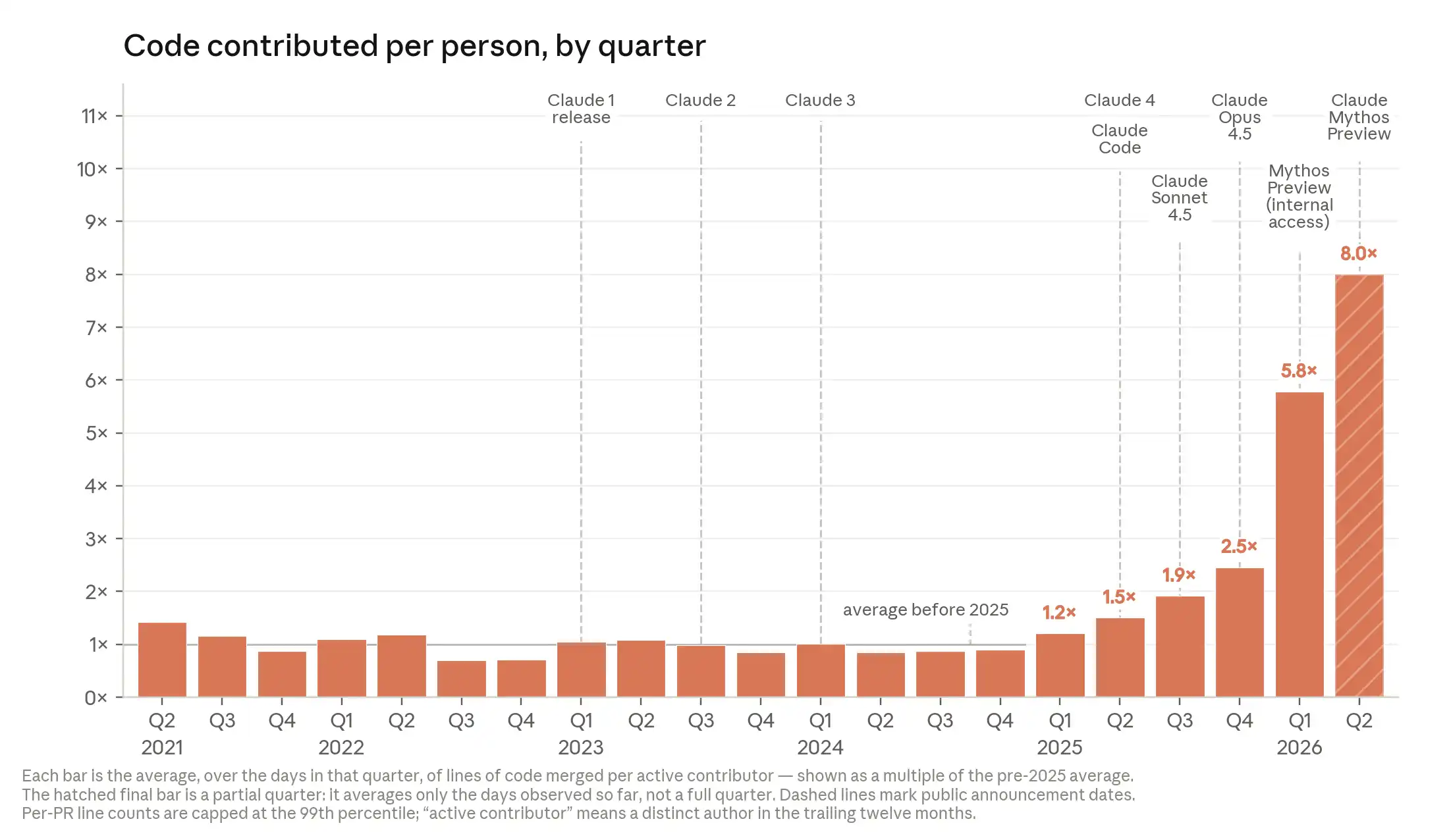
The first set of numbers pointed to a structural change: as of May 2026, over 80% of merged code in Anthropic's codebase was written by Claude. Two years ago, this number was in the low single digits. The same data also showed that in Q2 2026, the typical Anthropic engineer was merging 8 times more code per day than in 2024.

One can imagine the reaction of anyone not deeply tracking the AI industry reading these two numbers for the first time. But Anthropic itself acknowledged several important caveats in footnotes: leadership had publicly estimated that if scripts and experimental code were included, Claude-authored code exceeded 90%; 80% was a more conservative statistic for merged code; lines of code are "an imperfect metric" and might overestimate real productivity gains; the code attribution pipeline itself "has gaps."

The very writing of these footnotes is worth analyzing. Their existence ostensibly serves as honest concessions, but their actual function is to make the numbers in the main text appear to have undergone prudent self-filtering, thus gaining greater credibility. This is a two-tier structure in narrative engineering: the main text releases the signal, the footnotes provide the disclaimer.

The second set of numbers involved speed. On code optimization tasks, Claude Opus 4 achieved approximately a 3x speed-up effect in May 2025, which would take a skilled human researcher 4 to 8 hours to achieve. By April 2026, Claude Mythos Preview pushed this number to approximately 52x. The maximum duration for AI to independently complete tasks also doubled every four months, from 4 minutes in March 2024 to 12 hours in March 2026. The speed of doubling every four months itself constitutes a highly memorable point, easily spread with its implication of geometric progression.
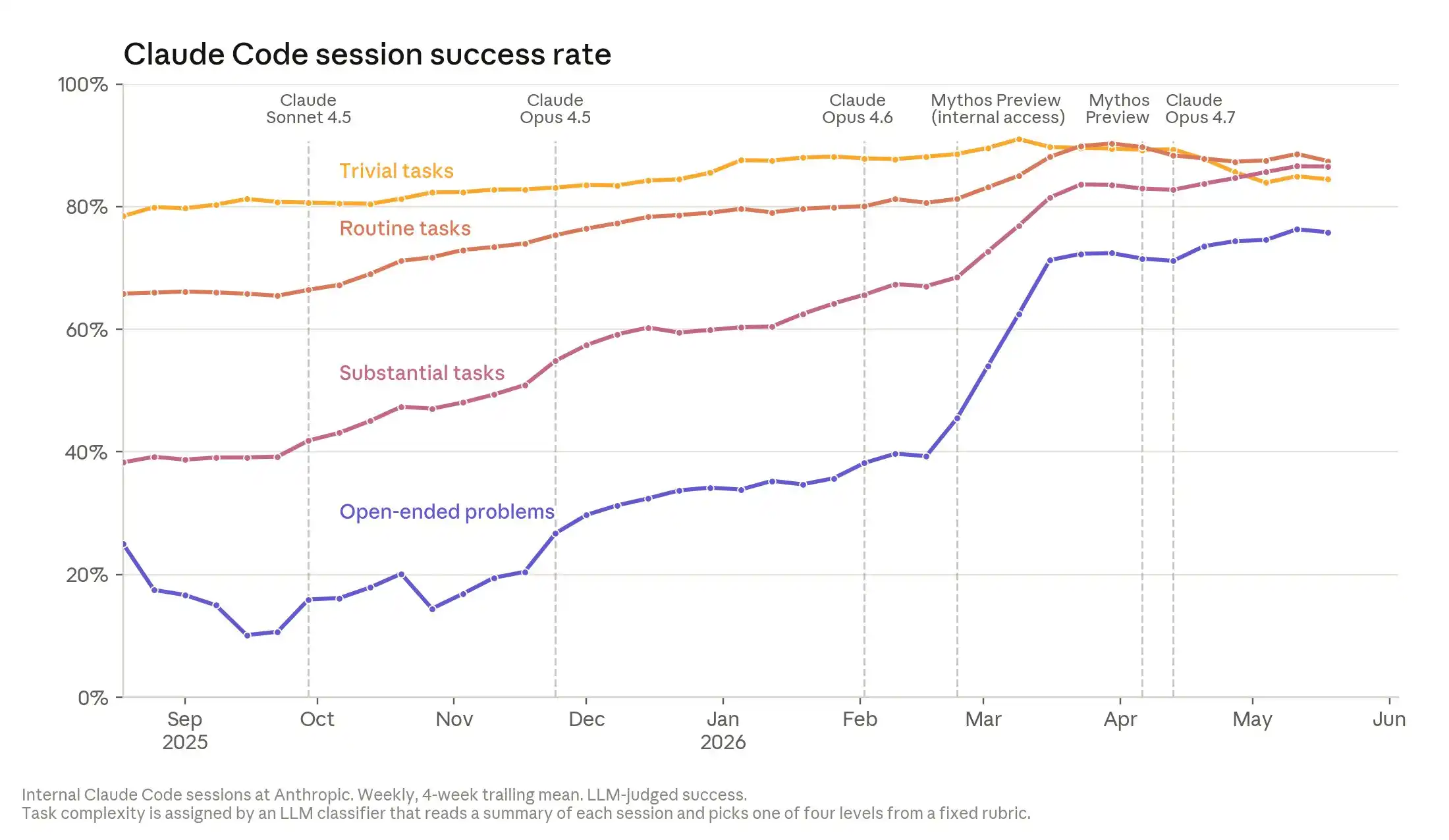
Another set of data came from an internal survey of 130 Anthropic research team employees in March 2026. The median respondent estimated that output using Mythos Preview was about 4 times that of not using AI. A footnote again pointed out that prior independent research by METR suggested developers may generally overestimate AI productivity gains. The same two-tier structure reappeared.

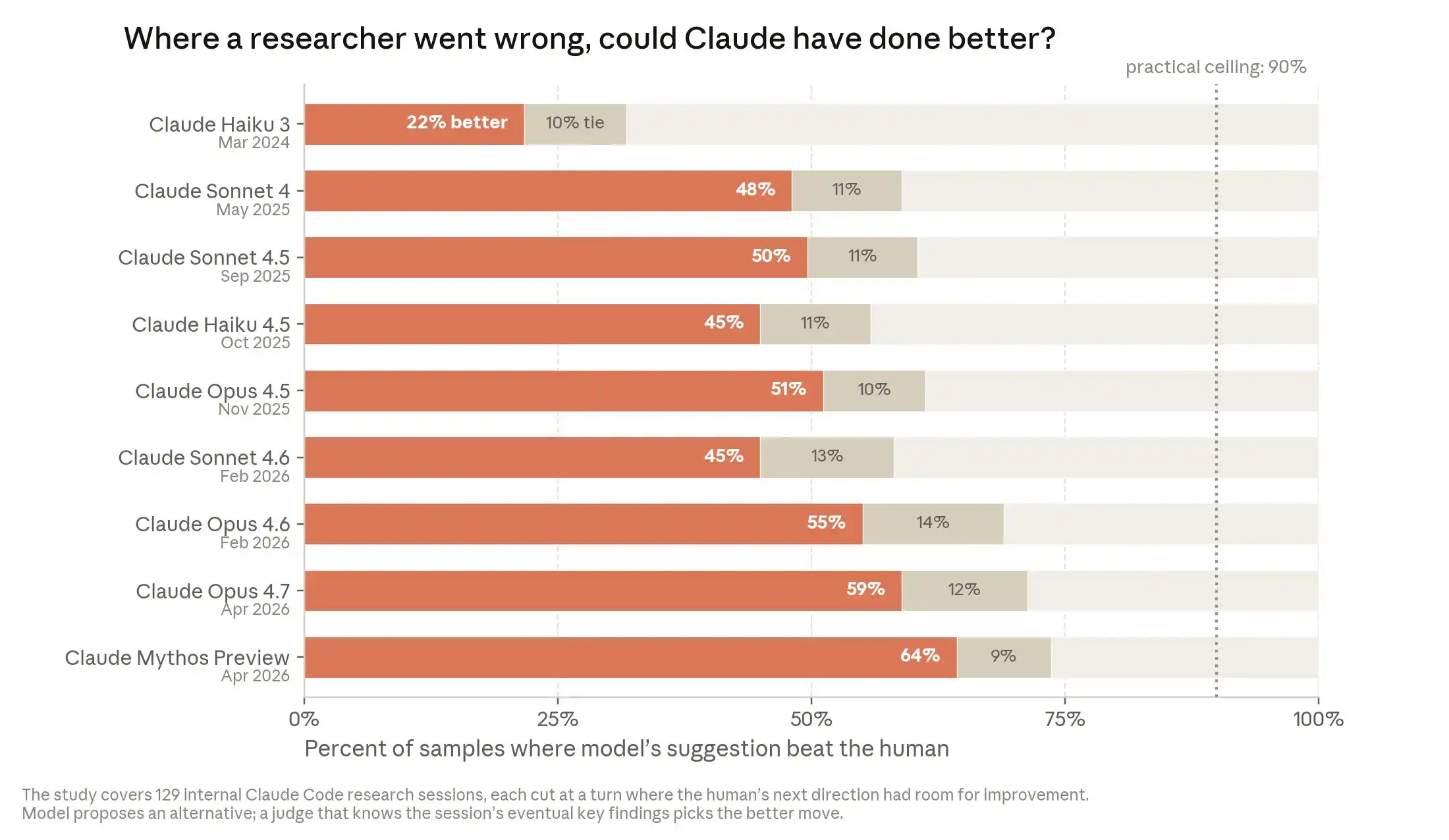
The third set of numbers pointed to AI approaching the boundary of human researcher judgment. In November 2025, Claude Opus 4.5 made better research direction choices than human researchers in 51% of cases. By April 2026, this number rose to 64%. With a sample size of 129 cases, Anthropic explained in a footnote that these were cases deliberately chosen where human choices had room for improvement.

Any single number taken out of context could be placed into different interpretive frameworks. But placed together, the direction is consistent: speed is increasing, the gap is narrowing, and all of this is happening inside Anthropic's own codebase and labs, not theoretical speculation on some external benchmark.

After listing this data, the article presented three future scenarios.

The first is trend stagnation, entering an S-curve plateau. Anthropic's phrasing: "we do not believe this is very likely."

The second is compound efficiency gains, where AI continues to replace humans in broader R&D aspects, but humans still set the direction and define success criteria. Anthropic assessed this as "evidence suggests we are likely heading toward this scenario."

The third is full recursive self-improvement, where AI autonomously designs, trains, and deploys successor systems more powerful than itself, with humans no longer in the loop. The wording is "plausible."

The arrangement order and tone allocation of these three scenarios form a complete narrative gradient. The first is downplayed, serving to accommodate skeptics; the second is anchored in "evidence," lending the article a rational veneer; the third, through "plausible" and conditional "if technological trends continue," pushes the boldest hypothesis to the edge of the reader's imagination without bearing the burden of proof for it.
At the very core of the entire article, Anthropic's stance is compressed into one sentence: "We are not there yet, and recursive self-improvement is not inevitable. But it may arrive faster than most institutions are prepared for."

From 'Willing to Pause' to 'A Unilateral Pause Would Only Let Reckless Actors Catch Up'

If the June 4th long article is a carefully framed snapshot, placing it on a timeline reveals a longer trajectory.

In 2023, Anthropic released its Responsible Scaling Policy (RSP). The core commitment of this policy document was: if model capabilities exceed the company's safety control capabilities, the company will pause training more powerful models. This was not a verbal statement, but an internal governance document with an assessment framework and trigger conditions. This document was once regarded by the AI safety community as an operational sample of "voluntary regulation."

In 2024, CEO Dario Amodei published a widely circulated article, suggesting the possibility of "powerful AI" arriving between 2027 and 2030. At that time, Anthropic still presented itself as an independent safety-minded entity, maintaining a restrained facade towards scale expansion and acceleration narratives.

On January 26, 2026, Amodei published a 38-page article "The Adolescence of Technology" on his personal website. It contained a judgment later repeatedly cited: "Because AI is now writing most of the code inside Anthropic, it is already substantially accelerating our progress toward building the next generation of AI systems. This feedback loop is gaining momentum month by month, and may be only 1 to 2 years away from the current generation of AI autonomously building the next generation." In the same article, he described the impending "powerful AI" as a "genius nation in a data center."

This was almost the starting point for Anthropic to systematically release the signal that a "self-improvement feedback loop is happening." And the timing of this blog post coincided with the company's transition from a $350 billion valuation to a higher valuation range.

Less than a month later, the turn came.

On February 25, 2026, CNN reported that Anthropic had revised its Responsible Scaling Policy, removing the core commitment to "pause training stronger models if capabilities exceed safety control abilities," replacing it with a non-binding "Frontier Safety Roadmap." In the same week, U.S. Secretary of Defense Pete Hegseth issued an ultimatum to Dario Amodei: withdraw the safety red line, or lose a $200 million Department of Defense contract.

The report quoted Anthropic's Chief Scientist Jared Kaplan's response to Time magazine: "We don't think stopping model training actually helps anyone... if competitors are sprinting at full speed." The phrasing in this response is noteworthy. "Doesn't help anyone" is not a technical argument, but a statement of stakeholder calculus. "If competitors are sprinting at full speed" is structurally identical in narrative framing to "a unilateral pause would only let the least cautious actors catch up": it replaces the original pause logic based on one's own safety capabilities with a speed logic based on competitor actions.

Anthropic still emphasized in the CNN report that it retained two red lines: not using AI systems to control weapons systems, and not using them for mass domestic surveillance. This point is important because it shows Anthropic did not abandon its safety stance wholesale, but made selective concessions and defenses across different safety dimensions. However, this selectivity itself is also a core clue in narrative strategy analysis: where it conceded and where it held firm delineates the recalibrated scale of safety.

On March 11, the Anthropic Institute was formally established, led by Jack Clark, positioned as a "public interest research institute." Less than two months later, on May 4, Clark posted the "60%" message.

Once juxtaposed, the signal density and release rhythm of this timeline are not random. From the personal article preview in January, to the policy revision in February, to the institute's establishment in March, to the founder's probability prediction in May, to the official long article release in June, this is a clearly paced, gradually escalating narrative pipeline. One cannot directly conclude "this was all pre-planned" from this, but the sequence itself constitutes a question analysts must confront: does this sense of rhythm indicate that Anthropic has already incorporated the "acceleration narrative" into its public communications management?

Hassabis's Deliberate Provocation

If only Anthropic had adjusted its messaging in the first half of 2026, analysts would have sufficient reason to focus on the internal decision logic of the enterprise. But DeepMind CEO Demis Hassabis made a directionally consistent adjustment almost simultaneously, making the "single enterprise case" argument untenable.

On January 20, at the Davos Forum, Hassabis still maintained his longstanding judgment: a 50% probability of AGI by 2030. Three weeks later, on February 18, at the India AI Impact Summit, he relented: "AGI could arrive within five years."

From May 20 to 22, at Google I/O, Hassabis said in his keynote that humanity stands at the "foothills of the singularity." Around the same time, OpenAI released GPT-5.3-Codex, stating the model "played a key role in its own creation process," specifically including assisting in debugging the training process, managing deployment, and analyzing evaluation results. The timing gap between the three leading labs was compressed to weeks.

After Google I/O, Hassabis gave an interview to Axios. This interview was later widely cited, with the most crucial line being his admission that using language like "foothills of the singularity" was "deliberately provocative," aimed at jolting governments, economists, and the public into recognizing the urgency of AI's accelerating development. He also adjusted his AGI timeline from "shortly after 2030" to "2029 is a real possibility," though still broadly expected around 2030, plus or minus a year.

Hassabis was more direct in an interview with The Seoul Economic Daily: "Five to ten years from now, when we look back at 2026 and 2027, we will say 'that was when we entered the AGI era.'"

The term "deliberately provocative" deserves careful consideration. It is a rare, first-hand confession by a principal actor about narrative intent. It acknowledges that at least some of his chosen phrasing is not a passive reflection of technical facts, but an actively chosen communication tool. This confession itself does not negate that he may also genuinely see a technical inflection point, but it explicitly lifts "narrative" from the shadow of "facts," making it an object that can be examined separately.

Hassabis's self-explanation of his phrasing opens a side door to interpreting this round of synchronized signals. His "deliberate provocation" and the "footnote disclaimers" in Anthropic's lengthy data argument exhibit the same amphibious posture: one hand pushes signals shocking enough to stir public opinion, the other retains a safe space to retreat to "this is just one possibility."

The Same Set of Data, Completely Different Interpretations

While Anthropic and DeepMind jointly constructed a narrative framework of "AI is accelerating its own evolution," external independent researchers offered alternative interpretations of the same set of data and phenomena. These interpretations are important not because any one side possesses ultimate truth, but because they reveal the interpretative range of the official narrative itself.

The sharpest response came from Eliezer Yudkowsky. He not only replied to Jack Clark but also continued to speak out on multiple occasions. A MindStudio blog recorded his complete stance: he used the Chernobyl RBMK reactor as an analogy for the safety design of current AI systems. The core argument of this analogy is that if control rods and accelerators are bound within the same system, attempting to slow down can actually cause the system to lose control faster.

Nathan Lambert of the Allen Institute for AI proposed the concept of "Lossy Self-Improvement" (LSI). His argument directly challenges the "accelerating flywheel" model: as systems become increasingly complex, each generational improvement process creates friction and loss, akin to signal attenuation over long-distance transmission. According to this logic, the improvements that made 80% or 90% AI-authored code possible cannot be infinitely replicated onto the next-generation system, because the next generation will face a more complex problem space, and the noise and errors in the AI's own output will amplify across generations.

Dean Ball, a senior fellow at the Foundation for American Innovation, offered a more direct linguistic framework, dimensionalizing Anthropic's data. He told IEEE Spectrum: "Maybe eventually they'll automate genius, but not next year. Next year they're automating drudgery." This distinction strikes at the core ambiguity of "80% of code written by AI." If AI automates the fixed-pattern parts of a codebase, batch parameter generation, or end-to-end pipeline configuration, then this work indeed corresponds to "drudgery" in software engineering contexts. The remaining 20% might contain architecture design, directional judgment, trade-offs based on incomplete information – these are the genius parts.

David Scott Krueger of the University of Montreal, as founder of the AI safety non-profit Evitable, proposed a pause trigger red line: "99% of code written by AI." He told IEEE Spectrum: "I think we may be crossing that line now." The tension between his framework and Anthropic's already loosened pause commitment is one of the most important structural contradictions in this round of narratives.

UBC computer scientist Jeff Clune, in an interview with IEEE Spectrum, stood in another direction. He said: "We are at an inflection point for recursive self-improvement systems." If his statement were validated, it would mean Yudkowsky's alarm bell rang at the right beat.

Four sets of voices, pointing in different directions, with even internal tension within the same direction. But their commonality lies in the fact that they do not rely on the official narrative framework; instead, they each offer independent judgments on the same set of phenomena based on their own methodologies. The diversity and conflict among these judgments themselves are the most powerful rebuttal to the notion that "any single narrative sufficiently covers the whole truth."

Coupling of Valuation Curves and Narrative Rhythm

In January 2026, Anthropic completed a funding round at a valuation of $350 billion. Investors included Microsoft and Nvidia. This number had been preemptively reported by some media by late 2025, but its formal announcement came right after Amodei published "The Adolescence of Technology."

In February, another $30 billion funding round completed, maintaining the valuation around $350 billion. In the same month, the safety policy was revised, removing the pause commitment. The Pentagon's $200 million contract threat landed.

In May, Reuters, The New York Times, and TechCrunch almost simultaneously reported that Anthropic had completed a $65 billion funding round, reaching a valuation of $965 billion. This number not only exceeded its own valuation two months prior but also surpassed OpenAI's $852 billion valuation from March 2026. The New York Times additionally cited Dario Amodei's remarks at a developer conference, stating the company's annualized revenue reached $30 billion, with him even joking that he "hopes this year's 80x revenue growth doesn't continue, because that would be insane."

On June 4, the Anthropic Institute published the "When AI builds itself" long article.

Lining up these time points is not to imply a precise causal arrow on a chart. Anyone claiming a causal relationship between these things must provide direct evidence. In the absence of internal decision records, no analyst can or should make such assertions.

On the other hand, it is equally unreasonable to not observe and record these correspondences at all. That an enterprise's valuation nearly tripled from $350 billion to $965 billion within five months, while undergoing a major safety policy shift, while constructing a narrative pipeline of "acceleration signals" led by an independent research institute, while its co-founder offered a 60% probability prediction – when all these events are densely compressed within six months, investors at least have the right to ask: To what extent do these signal releases serve the function of conveying the message "we are at the accelerating frontier" to the market?

This inquiry itself is the value of analysis. The answer may never be singular. But once the question is clearly posed, it cannot be easily withdrawn.

Global AI market funding reached $297 billion in Q1 2026, with the top five deals occupying a significant share of that total. At this level, all frontier labs face the same pressure: you need to convince investors that your technology curve will be steeper than your rivals'. Your risk warnings must also be loud enough so that when regulators finally step in to make rules, your voice is pre-embedded into the policy framework. Your narrative must also be attractive enough to make top researchers choose your lab, and alarming enough to maintain your remaining credibility within the safety community.

There are inherent contradictions among these demands. Anthropic's narrative adjustments in the first half of 2026 can be seen as a recalibration of the linguistic balance point among these conflicting demands. The weakening of safety commitments, the strengthening of acceleration signals, and the repeated use of the argument "we cannot unilaterally stop" collectively form a set of vectors pointing in the same direction.

The Signals Are Out, And Then

We must return to the core question: do these signals more resemble reflections of a technical inflection point, or rhetorical escalation aimed at capital and regulation?

Available public evidence does not allow for simply checking a box between the two options. Because the evidence used by both explanations is, in fact, the same set of data. The 80% code share, 52x speed-up, task duration doubling every four months can both support "an inflection point is approaching" and explain "we are communicating a trend perception our own technical staff have personally experienced to the market." The boundary between these is blurred.

But some facts are determinate, requiring no choosing of sides between interpretations.

First, Anthropic's narrative pivot completed in the first half of 2026 is not an isolated case. DeepMind's Hassabis made a directionally consistent, if differing in degree but essentially similar, adjustment almost in the same quarter. OpenAI's Sam Altman said at the India summit "the world is not ready," and in February 2026 released GPT-5.3-Codex, claiming it "played a key role in its own creation process." If this were only Anthropic releasing signals, perhaps analysis from an enterprise strategy perspective would suffice. But three leading labs simultaneously raising their voices within a dense few months constitutes an industry-level narrative shift.

Second, there exists a temporally traceable correspondence between the rhythm of these signal releases and the beats of financing, policy adjustments, and organizational restructuring. This correspondence itself needs to prove nothing; it only needs to be honestly presented. Once presented, each person's inherent methodology will determine what they think next.

Third, Anthropic itself still labels the status of the third scenario, "full recursive self-improvement," as "plausible," not "likely." This means that within the internal judgment framework of the company releasing this data, their acceleration narrative is not yet fully closed. The forces that compel them to habitually include qualifiers in academic papers and blog writing are still pulling the reins on their public phrasing.

Fourth, Hassabis's "deliberate provocation" confession confirms a mechanism long suspected but rarely admitted by the actors themselves: at least some leaders of frontier labs choose their phrasing with explicit communication objectives in mind. This necessitates that all interpretations of their pronouncements must simultaneously analyze two layers: the facts they claim, and the rhetorical strategy they employ in choosing those claims as a behavioral event in itself.

Those who carefully read Anthropic's data-filled article and those who only remember the two numbers "80% of code written by AI" and "52x acceleration" receive vastly different signal strengths. But in this matter, "how it is remembered" might be a more important object of analysis than "what was actually said."

This very article is itself a precise sample of the phenomenon it describes. It constructs a sense of impending acceleration using data, yet retains room for retreat through footnotes and qualifiers; it calls for global coordination and verifiable deceleration, yet has already withdrawn the pause commitment in a prior policy revision. This is not hypocrisy, nor simple inconsistency between words and actions. It is the narrative balancing act of an institution caught between technical uncertainty, commercial pressure, and public responsibility. And Hassabis's "deliberate provocation" confession precisely confirms from the side door that such balancing acts are now a consciously employed method among leading labs.

Domande pertinenti

QWhat is recursive self-improvement (RSI) in the context of AI, and why did Anthropic's co-founder's comments about its probability spark significant discussion?

ARecursive self-improvement (RSI) refers to an AI system's ability to not only optimize its outputs but also autonomously improve its own improvement processes, ultimately leading to the creation of successor systems more capable than itself. The discussion was ignited because Anthropic's co-founder, Jack Clark, publicly stated a 60% probability of RSI occurring by the end of 2028. This moved the concept from theoretical speculation to a near-term, quantified risk, prompting immediate and alarmed responses from figures like AI safety researcher Eliezer Yudkowsky.

QAccording to the article, what key data did Anthropic present in its June 4th post 'When AI builds itself' to argue that AI development is accelerating?

AAnthropic presented several key data points: 1) Over 80% of merged code in its codebase was written by Claude as of May 2026, up from low single digits two years prior. 2) Typical engineers merged 8 times more code daily in Q2 2026 compared to 2024. 3) Code optimization speed increased from a 3x acceleration with Claude Opus 4 to a 52x acceleration with Claude Mythos Preview. 4) The maximum duration of tasks AI could complete independently doubled every 4 months, reaching 12 hours by March 2026. 5) An internal survey showed a median 4x productivity increase using AI tools.

QHow did Anthropic's Responsible Scaling Policy (RSP) change in early 2026, and what was cited as a reason for this change?

AIn February 2026, Anthropic modified its Responsible Scaling Policy by removing the core commitment to pause training more powerful models if capabilities outpaced safety controls. This was replaced with a non-binding 'Frontier Safety Roadmap.' A key reason cited for the change, as articulated by Chief Scientist Jared Kaplan, was that a unilateral pause 'doesn't actually help anyone... if competitors are sprinting full speed ahead.' This shifted the rationale from an internal safety threshold to a competitive race dynamic.

QWhat does Demis Hassabis of DeepMind mean by calling his use of dramatic language like 'foothills of the singularity' a 'deliberate provocation'?

ADemis Hassabis described his dramatic language as a 'deliberate provocation' to acknowledge that his word choice was an active communication strategy, not just a passive reflection of technical facts. His stated goal was to create a sense of urgency among governments, economists, and the public regarding the accelerating pace of AI development. This admission highlights that the public statements from leading AI labs are carefully crafted narratives intended to achieve specific effects, alongside reporting perceived technical trends.

QWhat alternative interpretations or critiques did external researchers offer regarding Anthropic's data on AI self-improvement?

AExternal researchers offered several critiques: 1) Eliezer Yudkowsky used the Chernobyl RBMK reactor analogy, warning of a system where controls might accelerate rather than slow down a runaway process. 2) Nathan Lambert proposed 'Lossy Self-Improvement,' suggesting complexity and error amplification could limit indefinite acceleration. 3) Dean Ball argued that AI is automating 'grunt work,' not genius-level tasks. 4) David Scott Krueger suggested a stricter pause threshold (99% AI-written code) that Anthropic might be approaching. 5) Jeff Clune agreed a turning point was near. These views highlight the interpretative range and lack of consensus surrounding the same data.

Letture associate

Near Returns to the AI Stage: Transformation into a Public Chain Due to 'Payroll Difficulties,' Agent and Privacy Emerge as New Growth Narratives

NEAR Returns to AI Origins: From Payroll Struggles to Blockchain, Now Focusing on AI Agents and Privacy NEAR Protocol's journey began not with grand blockchain ambitions, but from a practical hurdle: its AI startup founders, including Transformer paper co-author Illia Polosukhin, couldn't efficiently pay international developers in 2017. This led them to pivot and build a high-performance, scalable blockchain. After years navigating various crypto narratives like sharding and cross-chain interoperability, NEAR is now leveraging its AI roots to re-enter the AI arena. A key driver is its "NEAR Intents" layer, which abstracts complex cross-chain transactions. Users simply state their goal (e.g., swap BTC for ETH), and a solver network finds the optimal route. This system has processed over $20B in cross-chain volume, generating significant fee revenue. A major growth area is private transactions via "Confidential Intents/Swaps," which hide trade details until settlement to protect against MEV and front-running. Remarkably, private swaps recently accounted for over 40% of NEAR's transaction volume, highlighting strong demand but also potential regulatory scrutiny. With its AI-founder pedigree, NEAR is positioning itself at the intersection of blockchain, AI agents, and privacy, aiming to become infrastructure for the emerging agent economy while navigating the challenges of its rapid adoption.

marsbit1 h fa

Near Returns to the AI Stage: Transformation into a Public Chain Due to 'Payroll Difficulties,' Agent and Privacy Emerge as New Growth Narratives

marsbit1 h fa

From Ethereum to AI's 'CROPS': What Exactly is This Set of 'Slow Variables' That Vitalik Repeatedly Emphasizes?

In recent discussions, Vitalik Buterin has frequently emphasized the concept of "CROPS," a framework defining core values for Ethereum's development. CROPS stands for Censorship Resistance, Capture Resistance, Open Source, Privacy, and Security. Initially outlined in the Ethereum Foundation's "EF Mandate," it represents a commitment to user sovereignty, ensuring that the network resists external control, remains open, protects privacy, and prioritizes security. The relevance of CROPS extends beyond Ethereum's foundational principles, becoming crucial in the context of AI integration. As AI agents begin handling wallet operations and automated transactions, the risk increases that users may cede control over their digital assets, privacy, and intentions to centralized AI service providers. A "CROPS AI" would therefore emphasize local execution where possible, privacy-preserving remote model calls (e.g., using zero-knowledge proofs), and transparent, verifiable processes to maintain user agency. Vitalik highlights a significant convergence between "CROPS Ethereum access layer" and "CROPS AI." Both address the same fundamental challenge: how users can access powerful services—be it blockchain data via RPCs or AI models—without exposing sensitive information or relinquishing ultimate control. This intersection points toward a future digital entry point that is more private, secure, and user-controlled. Ultimately, CROPS is not merely an abstract ideal but a practical guidepost. It steers development—from protocol resilience and wallet design to AI agent safety—towards a future where users retain self-sovereignty even as digital systems grow more complex and powerful. In an era of accelerating AI adoption, these "slow variables" of censorship resistance, openness, privacy, and security may define Ethereum's enduring value.

marsbit1 h fa

From Ethereum to AI's 'CROPS': What Exactly is This Set of 'Slow Variables' That Vitalik Repeatedly Emphasizes?

marsbit1 h fa

Silicon Valley 'Startup Guru' Steve Hoffman: Web3 + AI Could Be a Trap

Silicon Valley investor and "Godfather of Startups" Steve Hoffman warns that combining Web3 with AI is likely a trap, not a promising venture. In an interview, Hoffman argues that while AI is a foundational technology touching all industries, Web3 adds complexity, friction, and regulatory risk without solving mainstream consumer or business needs. He advises founders to focus on deep, specialized applications where startups can out-iterate giants, rather than on generic features easily replicated by large tech companies. Hoffman observes that Silicon Valley will lead foundational AI research, while China excels at rapid, large-scale application and commercialization, particularly in robotics. He stresses that AI-driven autonomous agents capable of collaborative, multi-step tasks are 2-4 years away, which will cause significant job displacement. The solution is not to slow AI but to redesign business models around human-AI collaboration and reform social systems like education and retraining. For startups, Hoffman recommends focusing on vertical, expertise-heavy domains to build defensibility. He sees major opportunities in AI fraud detection and cybersecurity. Key founder mindsets include systemic thinking over feature-focus, relentless customer centricity, building adaptive teams, and deeply understanding AI's capabilities and limits. Hoffman is also leading a non-profit initiative to establish university centers aimed at training future leaders in responsible, human-value-aligned AI innovation.

marsbit2 h fa

Silicon Valley 'Startup Guru' Steve Hoffman: Web3 + AI Could Be a Trap

marsbit2 h fa

Token Inefficient, Economy Tokenless

The article "Tokens Aren't Economical, Economics Aren't Tokenized" analyzes a pivotal shift in the AI industry from a technology-driven narrative to one dominated by capital efficiency. It highlights two concurrent trends: a severe capital shortage due to the exorbitant and recurring costs of compute (e.g., OpenAI's high burn rate) and a wave of corporate spin-offs where major tech companies are separating their AI units (like Kuaishou's Kling and Baidu's Kunlunxin). The core argument is that AI's "anti-internet" business model, where user growth increases costs rather than profits, has created a disconnect between high valuations and actual cash flow. Spin-offs address this by allowing AI assets to be valued independently. Within a parent company, they are seen as cost centers, but as standalone entities, they are priced based on their growth potential and scarcity in the primary market, leading to massive valuation premiums (e.g., Kling's estimated value tripling post-spin-off). The industry is at an inflection point, moving from "model worship" to "value realization." The competition is evolving from a pure compute (GPU) race to a broader focus on systemic efficiency and full-stack engineering (involving CPUs and orchestration) to achieve viable commercialization. The year 2026 is framed as a critical moment where the industry must definitively answer how to economically translate AI capability into tangible business value, reshaping the sector's future power structure.

marsbit2 h fa

Token Inefficient, Economy Tokenless

marsbit2 h fa

Trading

Spot
Futures

Articoli Popolari

Cosa è $S$

Comprendere SPERO: Una Panoramica Completa Introduzione a SPERO Mentre il panorama dell'innovazione continua a evolversi, l'emergere delle tecnologie web3 e dei progetti di criptovaluta gioca un ruolo fondamentale nel plasmare il futuro digitale. Un progetto che ha attirato l'attenzione in questo campo dinamico è SPERO, denotato come SPERO,$$s$. Questo articolo mira a raccogliere e presentare informazioni dettagliate su SPERO, per aiutare gli appassionati e gli investitori a comprendere le sue basi, obiettivi e innovazioni nei domini web3 e crypto. Che cos'è SPERO,$$s$? SPERO,$$s$ è un progetto unico all'interno dello spazio crypto che cerca di sfruttare i principi della decentralizzazione e della tecnologia blockchain per creare un ecosistema che promuove l'impegno, l'utilità e l'inclusione finanziaria. Il progetto è progettato per facilitare interazioni peer-to-peer in modi nuovi, fornendo agli utenti soluzioni e servizi finanziari innovativi. Al suo interno, SPERO,$$s$ mira a responsabilizzare gli individui fornendo strumenti e piattaforme che migliorano l'esperienza dell'utente nello spazio delle criptovalute. Questo include la possibilità di metodi di transazione più flessibili, la promozione di iniziative guidate dalla comunità e la creazione di percorsi per opportunità finanziarie attraverso applicazioni decentralizzate (dApps). La visione sottostante di SPERO,$$s$ ruota attorno all'inclusività, cercando di colmare le lacune all'interno della finanza tradizionale mentre sfrutta i vantaggi della tecnologia blockchain. Chi è il Creatore di SPERO,$$s$? L'identità del creatore di SPERO,$$s$ rimane piuttosto oscura, poiché ci sono risorse pubblicamente disponibili limitate che forniscono informazioni dettagliate sul suo fondatore o fondatori. Questa mancanza di trasparenza può derivare dall'impegno del progetto per la decentralizzazione—un ethos che molti progetti web3 condividono, dando priorità ai contributi collettivi rispetto al riconoscimento individuale. Centrando le discussioni attorno alla comunità e ai suoi obiettivi collettivi, SPERO,$$s$ incarna l'essenza dell'empowerment senza mettere in evidenza individui specifici. Pertanto, comprendere l'etica e la missione di SPERO rimane più importante che identificare un creatore singolo. Chi sono gli Investitori di SPERO,$$s$? SPERO,$$s$ è supportato da una varietà di investitori che vanno dai capitalisti di rischio agli investitori angelici dedicati a promuovere l'innovazione nel settore crypto. Il focus di questi investitori generalmente si allinea con la missione di SPERO—dando priorità a progetti che promettono avanzamenti tecnologici sociali, inclusività finanziaria e governance decentralizzata. Queste fondazioni di investitori sono tipicamente interessate a progetti che non solo offrono prodotti innovativi, ma contribuiscono anche positivamente alla comunità blockchain e ai suoi ecosistemi. Il supporto di questi investitori rafforza SPERO,$$s$ come un concorrente degno di nota nel dominio in rapida evoluzione dei progetti crypto. Come Funziona SPERO,$$s$? SPERO,$$s$ impiega un framework multifunzionale che lo distingue dai progetti di criptovaluta convenzionali. Ecco alcune delle caratteristiche chiave che sottolineano la sua unicità e innovazione: Governance Decentralizzata: SPERO,$$s$ integra modelli di governance decentralizzati, responsabilizzando gli utenti a partecipare attivamente ai processi decisionali riguardanti il futuro del progetto. Questo approccio favorisce un senso di proprietà e responsabilità tra i membri della comunità. Utilità del Token: SPERO,$$s$ utilizza il proprio token di criptovaluta, progettato per servire varie funzioni all'interno dell'ecosistema. Questi token abilitano transazioni, premi e la facilitazione dei servizi offerti sulla piattaforma, migliorando l'impegno e l'utilità complessivi. Architettura Stratificata: L'architettura tecnica di SPERO,$$s$ supporta la modularità e la scalabilità, consentendo un'integrazione fluida di funzionalità e applicazioni aggiuntive man mano che il progetto evolve. Questa adattabilità è fondamentale per mantenere la rilevanza nel panorama crypto in continua evoluzione. Coinvolgimento della Comunità: Il progetto enfatizza iniziative guidate dalla comunità, impiegando meccanismi che incentivano la collaborazione e il feedback. Nutrendo una comunità forte, SPERO,$$s$ può affrontare meglio le esigenze degli utenti e adattarsi alle tendenze di mercato. Focus sull'Inclusione: Offrendo basse commissioni di transazione e interfacce user-friendly, SPERO,$$s$ mira ad attrarre una base utenti diversificata, inclusi individui che potrebbero non aver precedentemente interagito nello spazio crypto. Questo impegno per l'inclusione si allinea con la sua missione generale di empowerment attraverso l'accessibilità. Cronologia di SPERO,$$s$ Comprendere la storia di un progetto fornisce preziose intuizioni sulla sua traiettoria di sviluppo e sui traguardi. Di seguito è riportata una cronologia suggerita che mappa eventi significativi nell'evoluzione di SPERO,$$s$: Fase di Concettualizzazione e Ideazione: Le idee iniziali che formano la base di SPERO,$$s$ sono state concepite, allineandosi strettamente con i principi di decentralizzazione e focus sulla comunità all'interno dell'industria blockchain. Lancio del Whitepaper del Progetto: Dopo la fase concettuale, è stato rilasciato un whitepaper completo che dettaglia la visione, gli obiettivi e l'infrastruttura tecnologica di SPERO,$$s$ per suscitare interesse e feedback dalla comunità. Costruzione della Comunità e Prime Interazioni: Sono stati effettuati sforzi attivi di outreach per costruire una comunità di early adopters e potenziali investitori, facilitando discussioni attorno agli obiettivi del progetto e ottenendo supporto. Evento di Generazione del Token: SPERO,$$s$ ha condotto un evento di generazione del token (TGE) per distribuire i propri token nativi ai primi sostenitori e stabilire una liquidità iniziale all'interno dell'ecosistema. Lancio della Prima dApp: La prima applicazione decentralizzata (dApp) associata a SPERO,$$s$ è stata attivata, consentendo agli utenti di interagire con le funzionalità principali della piattaforma. Sviluppo Continuo e Partnership: Aggiornamenti e miglioramenti continui alle offerte del progetto, inclusi partnership strategiche con altri attori nello spazio blockchain, hanno plasmato SPERO,$$s$ in un concorrente competitivo e in evoluzione nel mercato crypto. Conclusione SPERO,$$s$ rappresenta una testimonianza del potenziale del web3 e delle criptovalute di rivoluzionare i sistemi finanziari e responsabilizzare gli individui. Con un impegno per la governance decentralizzata, il coinvolgimento della comunità e funzionalità progettate in modo innovativo, apre la strada verso un panorama finanziario più inclusivo. Come per qualsiasi investimento nello spazio crypto in rapida evoluzione, si incoraggiano potenziali investitori e utenti a ricercare approfonditamente e a impegnarsi in modo riflessivo con gli sviluppi in corso all'interno di SPERO,$$s$. Il progetto mostra lo spirito innovativo dell'industria crypto, invitando a ulteriori esplorazioni delle sue innumerevoli possibilità. Mentre il percorso di SPERO,$$s$ è ancora in fase di sviluppo, i suoi principi fondamentali potrebbero effettivamente influenzare il futuro di come interagiamo con la tecnologia, la finanza e tra di noi in ecosistemi digitali interconnessi.

75 Totale visualizzazioniPubblicato il 2024.12.17Aggiornato il 2024.12.17

Cosa è $S$

Cosa è AGENT S

Agent S: Il Futuro dell'Interazione Autonoma in Web3 Introduzione Nel panorama in continua evoluzione di Web3 e criptovalute, le innovazioni stanno costantemente ridefinendo il modo in cui gli individui interagiscono con le piattaforme digitali. Uno di questi progetti pionieristici, Agent S, promette di rivoluzionare l'interazione uomo-computer attraverso il suo framework agentico aperto. Aprendo la strada a interazioni autonome, Agent S mira a semplificare compiti complessi, offrendo applicazioni trasformative nell'intelligenza artificiale (AI). Questa esplorazione dettagliata approfondirà le complessità del progetto, le sue caratteristiche uniche e le implicazioni per il dominio delle criptovalute. Cos'è Agent S? Agent S si presenta come un innovativo framework agentico aperto, progettato specificamente per affrontare tre sfide fondamentali nell'automazione dei compiti informatici: Acquisizione di Conoscenze Specifiche del Dominio: Il framework apprende in modo intelligente da varie fonti di conoscenza esterne ed esperienze interne. Questo approccio duale gli consente di costruire un ricco repository di conoscenze specifiche del dominio, migliorando le sue prestazioni nell'esecuzione dei compiti. Pianificazione su Lungo Orizzonte di Compiti: Agent S impiega una pianificazione gerarchica potenziata dall'esperienza, un approccio strategico che facilita la suddivisione e l'esecuzione efficiente di compiti complessi. Questa caratteristica migliora significativamente la sua capacità di gestire più sottocompiti in modo efficiente ed efficace. Gestione di Interfacce Dinamiche e Non Uniformi: Il progetto introduce l'Interfaccia Agente-Computer (ACI), una soluzione innovativa che migliora l'interazione tra agenti e utenti. Utilizzando Modelli Linguistici Multimodali di Grandi Dimensioni (MLLM), Agent S può navigare e manipolare senza sforzo diverse interfacce grafiche utente. Attraverso queste caratteristiche pionieristiche, Agent S fornisce un framework robusto che affronta le complessità coinvolte nell'automazione dell'interazione umana con le macchine, preparando il terreno per innumerevoli applicazioni nell'AI e oltre. Chi è il Creatore di Agent S? Sebbene il concetto di Agent S sia fondamentalmente innovativo, informazioni specifiche sul suo creatore rimangono elusive. Il creatore è attualmente sconosciuto, il che evidenzia sia la fase embrionale del progetto sia la scelta strategica di mantenere i membri fondatori sotto anonimato. Indipendentemente dall'anonimato, l'attenzione rimane sulle capacità e sul potenziale del framework. Chi sono gli Investitori di Agent S? Poiché Agent S è relativamente nuovo nell'ecosistema crittografico, informazioni dettagliate riguardanti i suoi investitori e sostenitori finanziari non sono documentate esplicitamente. La mancanza di approfondimenti pubblicamente disponibili sulle fondazioni di investimento o sulle organizzazioni che supportano il progetto solleva interrogativi sulla sua struttura di finanziamento e sulla roadmap di sviluppo. Comprendere il supporto è cruciale per valutare la sostenibilità del progetto e il suo potenziale impatto sul mercato. Come Funziona Agent S? Al centro di Agent S si trova una tecnologia all'avanguardia che gli consente di funzionare efficacemente in contesti diversi. Il suo modello operativo è costruito attorno a diverse caratteristiche chiave: Interazione Uomo-Computer Simile a Quella Umana: Il framework offre una pianificazione AI avanzata, cercando di rendere le interazioni con i computer più intuitive. Mimando il comportamento umano nell'esecuzione dei compiti, promette di elevare le esperienze degli utenti. Memoria Narrativa: Utilizzata per sfruttare esperienze di alto livello, Agent S utilizza la memoria narrativa per tenere traccia delle storie dei compiti, migliorando così i suoi processi decisionali. Memoria Episodica: Questa caratteristica fornisce agli utenti una guida passo-passo, consentendo al framework di offrire supporto contestuale mentre i compiti si sviluppano. Supporto per OpenACI: Con la capacità di funzionare localmente, Agent S consente agli utenti di mantenere il controllo sulle proprie interazioni e flussi di lavoro, allineandosi con l'etica decentralizzata di Web3. Facile Integrazione con API Esterne: La sua versatilità e compatibilità con varie piattaforme AI garantiscono che Agent S possa adattarsi senza problemi agli ecosistemi tecnologici esistenti, rendendolo una scelta attraente per sviluppatori e organizzazioni. Queste funzionalità contribuiscono collettivamente alla posizione unica di Agent S all'interno dello spazio crittografico, poiché automatizza compiti complessi e multi-fase con un intervento umano minimo. Man mano che il progetto evolve, le sue potenziali applicazioni in Web3 potrebbero ridefinire il modo in cui si svolgono le interazioni digitali. Cronologia di Agent S Lo sviluppo e le tappe di Agent S possono essere riassunti in una cronologia che evidenzia i suoi eventi significativi: 27 Settembre 2024: Il concetto di Agent S è stato lanciato in un documento di ricerca completo intitolato “Un Framework Agentico Aperto che Usa i Computer Come un Umano”, mostrando le basi per il progetto. 10 Ottobre 2024: Il documento di ricerca è stato reso pubblicamente disponibile su arXiv, offrendo un'esplorazione approfondita del framework e della sua valutazione delle prestazioni basata sul benchmark OSWorld. 12 Ottobre 2024: È stata rilasciata una presentazione video, fornendo un'idea visiva delle capacità e delle caratteristiche di Agent S, coinvolgendo ulteriormente potenziali utenti e investitori. Questi indicatori nella cronologia non solo illustrano i progressi di Agent S, ma indicano anche il suo impegno per la trasparenza e il coinvolgimento della comunità. Punti Chiave su Agent S Man mano che il framework Agent S continua a evolversi, diversi attributi chiave si distinguono, sottolineando la sua natura innovativa e il potenziale: Framework Innovativo: Progettato per fornire un uso intuitivo dei computer simile all'interazione umana, Agent S porta un approccio nuovo all'automazione dei compiti. Interazione Autonoma: La capacità di interagire autonomamente con i computer attraverso GUI segna un passo avanti verso soluzioni informatiche più intelligenti ed efficienti. Automazione di Compiti Complessi: Con la sua metodologia robusta, può automatizzare compiti complessi e multi-fase, rendendo i processi più veloci e meno soggetti a errori. Miglioramento Continuo: I meccanismi di apprendimento consentono ad Agent S di migliorare dalle esperienze passate, migliorando continuamente le sue prestazioni e la sua efficacia. Versatilità: La sua adattabilità attraverso diversi ambienti operativi come OSWorld e WindowsAgentArena garantisce che possa servire un'ampia gamma di applicazioni. Man mano che Agent S si posiziona nel panorama di Web3 e delle criptovalute, il suo potenziale per migliorare le capacità di interazione e automatizzare i processi segna un significativo avanzamento nelle tecnologie AI. Attraverso il suo framework innovativo, Agent S esemplifica il futuro delle interazioni digitali, promettendo un'esperienza più fluida ed efficiente per gli utenti in vari settori. Conclusione Agent S rappresenta un audace passo avanti nell'unione tra AI e Web3, con la capacità di ridefinire il modo in cui interagiamo con la tecnologia. Sebbene sia ancora nelle sue fasi iniziali, le possibilità per la sua applicazione sono vaste e coinvolgenti. Attraverso il suo framework completo che affronta sfide critiche, Agent S mira a portare le interazioni autonome al centro dell'esperienza digitale. Man mano che ci addentriamo nei regni delle criptovalute e della decentralizzazione, progetti come Agent S giocheranno senza dubbio un ruolo cruciale nel plasmare il futuro della tecnologia e della collaborazione uomo-computer.

533 Totale visualizzazioniPubblicato il 2025.01.14Aggiornato il 2025.01.14

Cosa è AGENT S

Come comprare S

Benvenuto in HTX.com! Abbiamo reso l'acquisto di Sonic (S) semplice e conveniente. Segui la nostra guida passo passo per intraprendere il tuo viaggio nel mondo delle criptovalute.Step 1: Crea il tuo Account HTXUsa la tua email o numero di telefono per registrarti il tuo account gratuito su HTX. Vivi un'esperienza facile e sblocca tutte le funzionalità,Crea il mio accountStep 2: Vai in Acquista crypto e seleziona il tuo metodo di pagamentoCarta di credito/debito: utilizza la tua Visa o Mastercard per acquistare immediatamente SonicS.Bilancio: Usa i fondi dal bilancio del tuo account HTX per fare trading senza problemi.Terze parti: abbiamo aggiunto metodi di pagamento molto utilizzati come Google Pay e Apple Pay per maggiore comodità.P2P: Fai trading direttamente con altri utenti HTX.Over-the-Counter (OTC): Offriamo servizi su misura e tassi di cambio competitivi per i trader.Step 3: Conserva Sonic (S)Dopo aver acquistato Sonic (S), conserva nel tuo account HTX. In alternativa, puoi inviare tramite trasferimento blockchain o scambiare per altre criptovalute.Step 4: Scambia Sonic (S)Scambia facilmente Sonic (S) nel mercato spot di HTX. Accedi al tuo account, seleziona la tua coppia di trading, esegui le tue operazioni e monitora in tempo reale. Offriamo un'esperienza user-friendly sia per chi ha appena iniziato che per i trader più esperti.

1.1k Totale visualizzazioniPubblicato il 2025.01.15Aggiornato il 2026.06.02

Come comprare S

Discussioni

Benvenuto nella Community HTX. Qui puoi rimanere informato sugli ultimi sviluppi della piattaforma e accedere ad approfondimenti esperti sul mercato. Le opinioni degli utenti sul prezzo di S S sono presentate come di seguito.

活动图片