Uncovering the 'God of Investment Research' Behind Citrini: Perpetual Substack Chart-Topper, a Single Report Evaporated Trillions from US Stocks

marsbitPubblicato 2026-06-18Pubblicato ultima volta 2026-06-18

Introduzione

Revealing the "Research God" Behind Citrini: A Non-Finance Founder Shaking Up Markets Citrini, an independent research firm consistently ranked #1 on Substack's finance charts with nearly 250,000 subscribers, has gained significant attention in the current bull market. Its founder, James van Geelen, holds dual degrees in biology and psychology from UCLA, with a background as an emergency medical technician and a healthcare entrepreneur before founding Citrini. The firm is known for its deep, narrative-driven analyses focusing on long-term "super trends" like AI, geopolitics, and macro policy. Citrini made headlines in February with its report "The 2028 Global Intelligence Crisis," a thought experiment on AI's potential societal impact. Despite being labeled a scenario analysis, it triggered a widespread sell-off in software and related stocks, briefly wiping hundreds of billions from the US market. Other notable reports include an on-the-ground analysis of the Strait of Hormuz and accurate calls on the copper foil industry's importance for AI/semiconductors. Geelen champions "second-order thinking," focusing on the indirect consequences of events. His investment style is thematic and often contrarian, seeking opportunities others miss. Citrini operates with a founder-driven, anonymous elite team model, recently adding specialists in macroeconomics and semiconductor analysis. The firm also manages a model portfolio, Citrindex, which has reportedly achieved over 200% cumulat...

Original | Odaily Planet Daily (@OdailyChina)

Author | Wenser(@wenser2010 )
In this bull market for US stocks, besides the white-haired stock god "Serenity" active in public discourse as an individual, another independent investment research firm named Citrini has garnered significant attention—consistently ranking first in Substack's finance category with nearly 250,000 subscribers.

In February of this year, Citrini's publication of "The 2028 Global Intelligence Crisis" once triggered a "sell-off in US software stocks," exacerbating panic psychology surrounding Silicon Valley's unemployment wave. In April, the "Strait of Hormuz Research Report" penned by Citrini's Analyst#3 after an on-site visit generated strong external reactions, cutting through the layers of mist obscuring the true face of this conflict's critical point. Recently, Citrini's semiconductor analyst Jukan accurately highlighted the importance of copper foil in the AI and semiconductor industries, sparking a new wave of investment fervor.

Behind this investment research firm, however, is a founder without a traditional finance background: James van Geelen. Holding dual degrees in Biology and Psychology from UCLA, he has worked as an emergency medical technician, founded a healthcare company, and later ventured into the investment world, now hailed as the "God of Investment Research." In this issue, Odaily Planet Daily will unveil James's cross-border legend.

Citrini Founder: A Narrative Master with "Second-Order Thinking"

Mentioning Citrini, those in the crypto space might have first noticed this research account from a post this May, on the eve of Cerebras (CBRS)'s IPO, where he mentioned "fund managers conducting price discovery in advance on Trade.xyz (within the Hyperliquid ecosystem)." This tweet was later confirmed by a retweet from Trade.xyz founder Shokun.

Citrini: The "Whistleblower to Traditional Finance" for Hyperliquid and Trade.xyz

It is no exaggeration to say that, as a research account that once published the viral article "The 2028 Global Intelligence Crisis," Citrini's radiating influence on traditional financial circles is evident.

Its high regard for the Hyperliquid ecosystem and Trade.xyz's role in pre-market stock pricing has also brought crypto market RWA platforms, pre-market stock contract platforms, and on-chain stock trading platforms into the view of many, to some extent fueling this year's "RWA asset frenzy in US stocks."
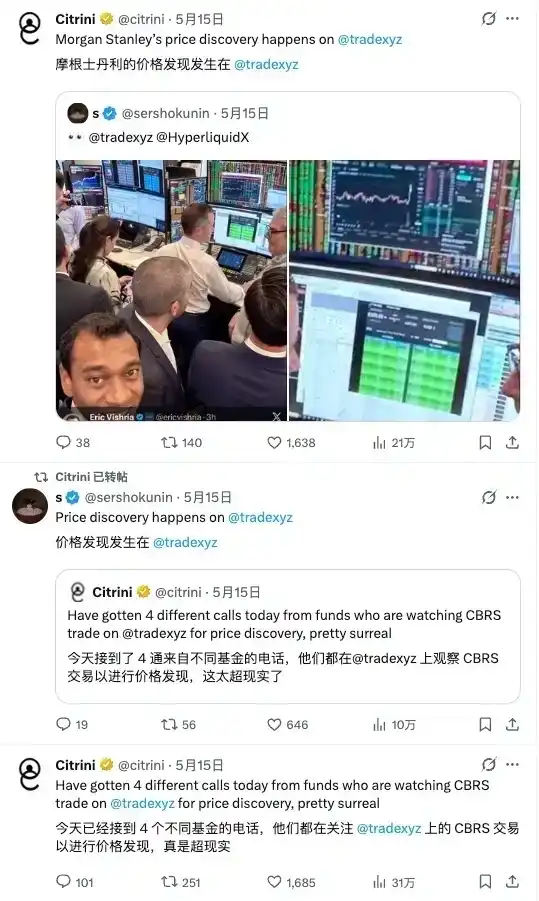
In a sense, Citrini can be considered a bellwether sending "warning signals" to traditional financial circles—it is using accurate information to warn traditional financial markets that previously unnoticed crypto players are setting their sights like barbarians on the "big cake" of traditional finance.

And behind Citrini is a founder who believes in "second-order thinking" and "long-termism"—James van Geelen.

Diverse Persona: Double Major in Biology & Psychology, Emergency Medical Practitioner, "AI Panic Whistleblower"

The 33-year-old James van Geelen (hereinafter Geelen) probably never imagined that an "AI discussion thread" could trigger the rapid evaporation of hundreds of billions of dollars in market value from US stock markets; earlier, his professional resume wasn't even remotely related to AI.

Public information shows Geelen graduated from the prestigious UCLA, earning dual degrees in Biology and Psychology during his studies. He also worked as an Emergency Medical Technician and Paramedic in downtown Los Angeles. Prestigious education and emergency medical experience shaped his character: pursuit of efficiency and adeptness at planning. As he himself said—"If you don't have a plan, you'll have a terrible life." Additionally, he prides himself as a "musical prodigy," though he doesn't have any notable works to show for it.

According to Geelen's original plan, he should have become a life-saving doctor, but by chance, he instead embarked on an entrepreneurial path: first founding a healthcare company and selling it to a private equity fund, successfully breaking free from the "prestigious school-job-professional manager" cycle; then founding the current Citrini.

Another noteworthy point, as mentioned by him in a 2023 Odd Lots podcast, is that he also co-founded one of the earliest medical marijuana dispensaries in Connecticut. From this, one can see he is far from the "proper doctor" perceived as rigid and rule-following.

In 2018, with some startup capital, Geelen began his personal investment career under the name Citrinitas Capital, capturing early opportunities in AI (like Nvidia) and GLP-1 weight-loss drugs (like Ozempic/Wegovy).

In 2023, Geelen formally founded Citrini Research, committed to "cross-asset, multi-dimensional thinking for investment analysis," providing in-depth reports on thematic stock investing and global macro trades. It quickly grew into a top creator in the finance field on the Substack platform. (Odaily Planet Daily Note: It offers both individual and institutional subscription models.)

On May 31, 2023, the model investment portfolio Citrindex, built on personal research, was formally launched with an annual subscription fee of $1250. Statistics show the portfolio has achieved cumulative returns exceeding 200%, with monthly gains repeatedly outperforming the S&P 500.

In March 2024, he boldly predicted Trump would win the election. In July 2025, amid the turmoil over former Fed Chair Powell's departure, he loudly advised over 50,000 subscribers to "buy two-year US Treasuries and short ten-year US Treasuries" to hedge policy risks.

In December 2025, according to PitchBook information, Citrini completed a seed funding round of approximately $5.05 million. With only about 10 employees, the company remains privately held.

Then, in February of this year, he co-authored with Alap Shah, who comes from a traditional finance background, that earth-shaking report for US markets: "The 2028 Global Intelligence Crisis." Although he repeatedly emphasized the report was merely a "thought experiment," a scenario assumption rather than a predictive analysis, the phenomena mentioned—"mass white-collar unemployment, declining consumer spending, economic contraction (Ghost GDP)"—still triggered panic and concern in capital markets, leading to significant declines in delivery, payment, and software stocks. Among them, IBM's stock price on February 23 recorded its largest single-day drop since 2025; American Express and Blackstone Group fell over 8%, the entire software stock sector dropped nearly 5%, while stocks of companies like DoorDash, Uber, Mastercard, Visa, Capital One, and Apollo Global Management Inc. fell up to 3%. Multiple US stock sectors were caught in the selling wave, with the Dow Jones once dropping over 800 points. Alap Shah later publicly stated his investment stance was "talking down while going long," meaning shorting companies they believe will be disrupted by AI while holding semiconductor tech stocks benefiting from AI.

It is no exaggeration to say that Citrini's single report directly caused the US stock market to "bleed profusely" for a time, evaporating hundreds of billions of dollars in market value overnight, triggering follow-up reports from overseas media like Bloomberg and The Wall Street Journal.

On April 6 this year, Citrini team's "Analyst #3" (code name Analyst#3) personally went to the critical strategic point in the US-Iran conflict—the Strait of Hormuz for research, disclosing many little-known frontline observations, revealing on the ground the specific operational model of Iran's "toll booth" in the Strait, and providing a series of counterintuitive conclusions, such as: Regardless of how the situation develops, shipping volume through the Strait will gradually increase; Iran does not wish to close the Strait of Hormuz. First, Strait shipping volume will continue to rise. Second, a diplomatic-style "toll booth"—surprisingly, transit order in the Strait is actually very regulated. Third, the paradox of escalation—even if ground operations commence, shipping volume through the Strait may still continue to increase. Fourth, realignment of power structures, not a decisive victory. This conflict is not a simple "two-party confrontation" but a multi-party game. Geographical disputes within great power games are also key subjects within Citrini's research "range."

When asked why he named the company "citrinitas," Geelen replied:"The naming inspiration comes from financial titan George Soros's 'The Alchemy of Finance.' This is actually a stage in alchemy, but what most people don't know is that in this transitional stage, lead begins to transform into gold, but hasn't fully become gold yet." This is also his favorite time to "make a difference"—seeing the birth of "gold" before others notice the change in lead.

Investment Style: Second-Order Thinking, Narrative-Driven, Reverse Scenario

As for Citrini's investment style, thanks to its cross-border experience and diverse persona, it highly advocates "second-order thinking."

As Geelen himself said:"Most investors only focus on the ball itself, but I focus more on where the ball will bounce next."
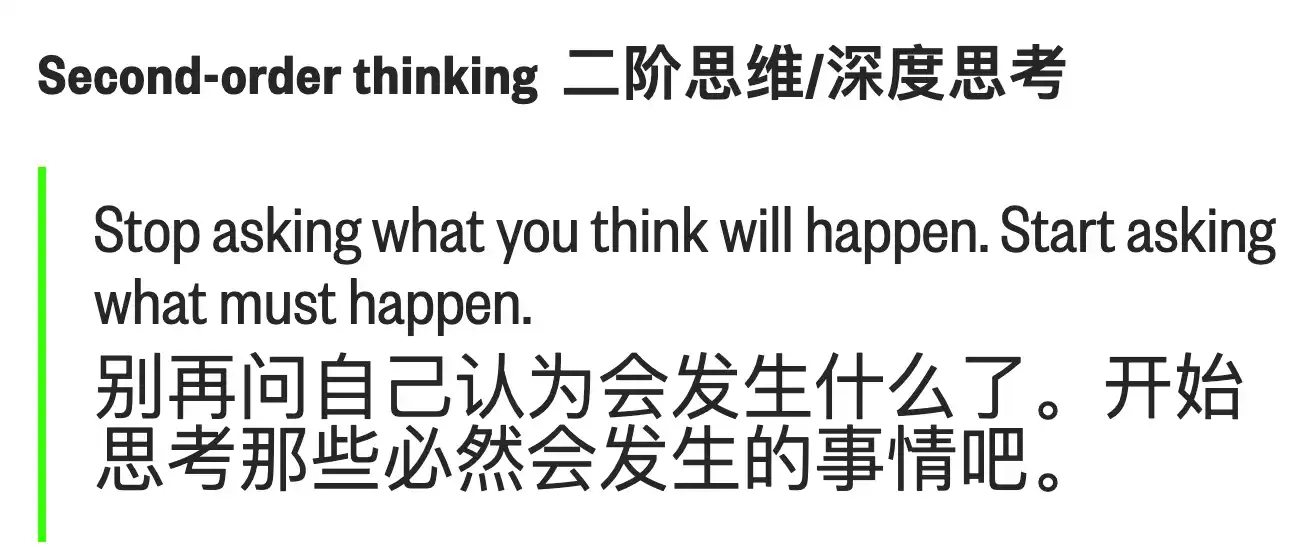
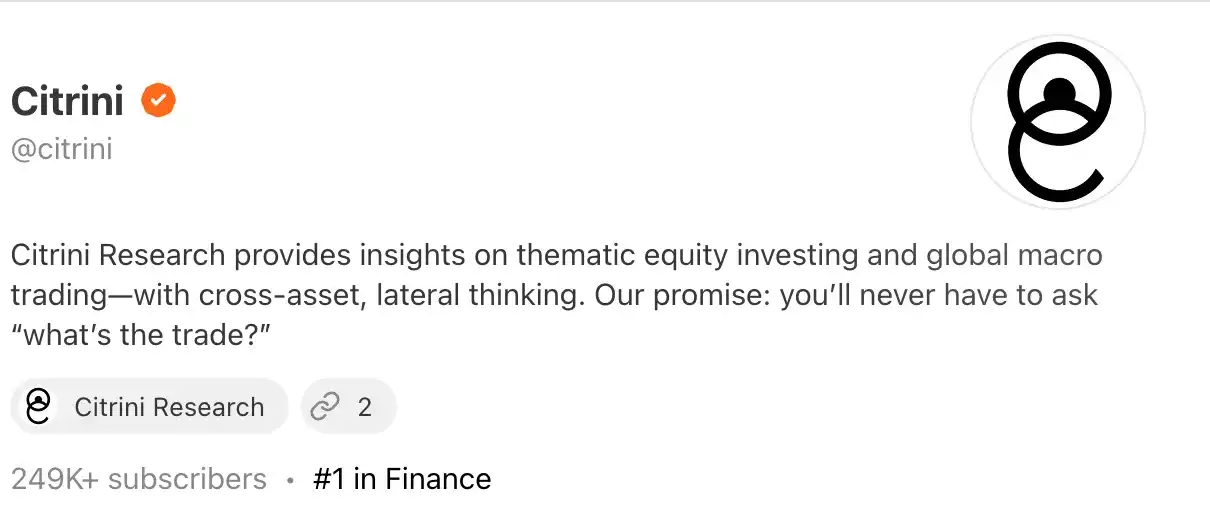
Judging from Citrini's past content and public information, this investment research firm focuses on long-term "super trends," such as AI, robotics, energy demand, fiscal policy, geopolitics, modern warfare, etc. Additionally, the firm is dedicated to providing actionable "bundled investment references" and tactical macro trade ideas, with analysis leaning towards long-term structural changes rather than short-term trades. In its Substack homepage bio, we can see its emphasis on practicality, stating: "You (the reader) will no longer need to ask 'what's the trade?'"
Furthermore, Citrini often uses "scenario assumptions" to help readers understand second/third-order effects. Geelen once mentioned: "Don't always think about what you think will happen. Instead, think about what is bound to happen. How will the market's reaction change the actual situation? What will be the secondary effects? What are the obstacles keeping a certain trend going? Where will capital flow to overcome these obstacles?" Previously, during the collapse of Silicon Valley Bank in March 2023, he boldly purchased overnight funding rate call options, easily reaping nearly 50x returns. Last December, before the US initiated military action in Venezuela, he shared insights on investment opportunities in Venezuelan sovereign bonds.

This year, Citrini has successively absorbed several independent analysts, including macro analyst Nick Reece, South Korean semiconductor industry analyst @jukan05, and AI chip industry analyst @zephyr_z9, to some extent filling gaps in industry details, technical processes, and directional changes.Currently, this investment research firm still maintains a founder-driven + anonymous elite team collaborative production model.


Crypto di tendenza

Domande pertinenti

QWho is the founder of Citrini Research and what are some key aspects of his background?

AThe founder of Citrini Research is James van Geelen. He holds dual degrees in Biology and Psychology from UCLA. His background includes working as an emergency medical technician, founding a healthcare company, and co-founding one of Connecticut's early medical cannabis dispensaries. He is described as a non-finance professional who entered the investment world later in his career.

QWhat major report did Citrini publish in February that significantly impacted the stock market, and what was its claimed effect?

AIn February, Citrini published a report titled 'The 2028 Global Intelligence Crisis'. While presented as a 'thought experiment', its discussion of potential mass white-collar unemployment and economic contraction triggered a panic sell-off in the US stock market. The report is cited as causing software stocks to fall nearly 5%, leading to a single-day drop of over 800 points in the Dow Jones and evaporating hundreds of billions of dollars in market value.

QAccording to the article, what is a core investment philosophy or style emphasized by James van Geelen and Citrini?

AA core investment philosophy emphasized by James van Geelen and Citrini is 'second-order thinking'. This involves focusing not just on immediate events, but on the subsequent consequences and knock-on effects of those events. Geelen analogizes it to looking not at the ball itself, but where the ball will bounce next.

QWhat was a key finding from Citrini's April 2025 on-the-ground research report regarding the Strait of Hormuz?

AA key finding from Citrini's April 2025 on-the-ground 'Strait of Hormuz Research Report' was that, contrary to common perception, Iran does not wish to close the Strait of Hormuz. The report described Iran's operation there more like a diplomatic 'toll booth', with shipping traffic being orderly and actually expected to increase regardless of geopolitical developments.

QWhat is the origin and meaning behind the name 'Citrini' for the research firm?

AThe name 'Citrini' is inspired by the financial term 'citrinitas' from George Soros's book *The Alchemy of Finance*. In alchemy, 'citrinitas' represents a transitional stage where lead begins to turn into gold but is not fully transformed. Geelen chose it to symbolize the firm's focus on identifying the early transformation of an asset or trend into something valuable ('gold') before others notice the change in the 'lead'.

Letture associate

NVIDIA CPU Advances, China's RISC-V Responds: Semiconductor Deep Dive - Part Four

NVIDIA is set to launch its new Vera AI data center CPU in China as early as August, with high pricing. While this move offers a new option, it highlights China's continued dependence on foreign-controlled Arm architecture. In response, the Chinese semiconductor industry is increasingly turning to RISC-V as a strategic alternative for achieving high-performance computing autonomy. The article explores the concept of the "impossible triangle" in CPU development—balancing prosperity, control, and autonomy—and posits that RISC-V's open-source, modular nature offers a unique path to achieving all three. While RISC-V is already dominant in embedded systems, the focus is now shifting to data centers and AI workloads. China has become a global hotspot for RISC-V development, driven by AI-driven compute demand, supply chain concerns from export controls, cost benefits of open-source, and strong policy support. Multiple Chinese companies have reportedly crossed the key performance threshold of 15 SPECint per GHz, a benchmark for entering the high-performance CPU club. Progress extends beyond single-core benchmarks. Companies are developing complete computing subsystems, including commercial-grade coherent network-on-chip (NoC) technology and server processors with up to 40 cores that strictly adhere to the RVA23 standard to ensure software compatibility. Real-world applications are emerging in areas like video transcoding and edge AI. However, significant challenges remain. The RISC-V ecosystem faces fragmentation, immature toolchains and verification processes, and gaps in single-core performance and energy efficiency compared to mature x86 and Arm architectures. The formidable software moat, epitomized by NVIDIA's CUDA, is a long-term hurdle. In conclusion, while RISC-V cannot immediately replace offerings like NVIDIA's Vera, it represents a viable long-term path for China to develop a self-sufficient, high-performance CPU ecosystem. The journey is acknowledged to be long and arduous, requiring sustained effort to overcome technical and ecosystem challenges.

marsbit3 h fa

NVIDIA CPU Advances, China's RISC-V Responds: Semiconductor Deep Dive - Part Four

marsbit3 h fa

My Coding Betting Dashboard is Profiting, but Polymarket is Truly Not a Good Place for 'Arbitrage'

The author built a custom monitoring dashboard for Polymarket, a prediction market platform, and tested it with $1,600, achieving over 30% returns. However, the core argument is that Polymarket is not a good venue for traditional arbitrage. The dashboard has two main sections: a "Portfolio Dashboard" for tracking active positions with key metrics like total capital, P&L, and a risk-control module using a tier system (T1, T2, T3), and an "Opportunity Watchlist" for monitoring markets. The article details a critical structural trap in binary markets: a bet with a high perceived probability of success still carries a 100% loss risk if wrong. The author's T1/T2/T3 system is designed to manage this by limiting position sizes based on conviction and time horizon, emphasizing that high confidence should not equal high concentration. A key insight is the danger of "pseudo-diversification"—betting on different markets driven by the same underlying variable. The author concludes that Polymarket offers few true low-risk, arbitrage opportunities. It is instead a high-risk environment where wins can create a false sense of mastery, leading to large losses. The platform is better viewed as a training ground for honing judgment through disciplined, framework-driven betting rather than a reliable income source. The tools help transform intuition into structured, rule-based decisions to mitigate the risk of catastrophic errors.

marsbit6 h fa

My Coding Betting Dashboard is Profiting, but Polymarket is Truly Not a Good Place for 'Arbitrage'

marsbit6 h fa

WeChat AI Card Hands-On Guide: Has the AI Shopping Era Arrived?

**"WeChat AI Card" Practical Test Guide: Has the Era of AI Shopping Arrived?** WeChat has officially launched the "AI Exclusive Card," a feature integrated into its Workbuddy AI assistant. This card is designed to handle payments for AI-initiated purchases. Our hands-on test reveals it's not yet a tool for fully autonomous AI shopping, but rather a controlled payment layer for AI agents. The AI Card functions as an isolated sub-wallet within WeChat Pay. Users must bind the card and transfer funds into it from their main wallet. Crucially, every transaction requires explicit user confirmation via smartphone scan; AI cannot spend autonomously. Currently accessible through the Workbuddy agent, the card targets specific digital consumption scenarios: purchasing paid content (reports, data), calling paid APIs/tools, and subscribing to services. Its design prioritizes security and control by separating funds and mandating approval for each payment. We tested a real-world scenario: ordering bubble tea via Workbuddy using a "Meituan Life Assistant" skill. The process encountered multiple hurdles: high "skill" usage costs (exceeding daily free credits), and most importantly, while a payment was successfully initiated, the AI purchased an incorrect product (a mismatched group-buy coupon instead of the desired drink). This highlights the current limitation: the **AI Card only solves the payment step**. The broader challenge lies in the **AI agent's execution chain**—accurately understanding intent, navigating third-party platforms, selecting the right product, and ensuring proper fulfillment. The payment succeeded, but the purchase failed to meet the user's need. In conclusion, the WeChat AI Exclusive Card is a cautious, early-step experiment in AI commerce. It provides a secure, user-controlled payment method for agent interactions but is not yet capable of reliable, end-to-end complex purchases. For now, it's best used for low-value, low-risk digital services with careful user verification at each step. The vision of AI handling complete shopping tasks remains a work in progress.

marsbit8 h fa

WeChat AI Card Hands-On Guide: Has the AI Shopping Era Arrived?

marsbit8 h fa

Trading

Spot
Futures

Articoli Popolari

Come comprare T

Benvenuto in HTX.com! Abbiamo reso l'acquisto di Threshold Network Token (T) semplice e conveniente. Segui la nostra guida passo passo per intraprendere il tuo viaggio nel mondo delle criptovalute.Step 1: Crea il tuo Account HTXUsa la tua email o numero di telefono per registrarti il tuo account gratuito su HTX. Vivi un'esperienza facile e sblocca tutte le funzionalità,Crea il mio accountStep 2: Vai in Acquista crypto e seleziona il tuo metodo di pagamentoCarta di credito/debito: utilizza la tua Visa o Mastercard per acquistare immediatamente Threshold Network TokenT.Bilancio: Usa i fondi dal bilancio del tuo account HTX per fare trading senza problemi.Terze parti: abbiamo aggiunto metodi di pagamento molto utilizzati come Google Pay e Apple Pay per maggiore comodità.P2P: Fai trading direttamente con altri utenti HTX.Over-the-Counter (OTC): Offriamo servizi su misura e tassi di cambio competitivi per i trader.Step 3: Conserva Threshold Network Token (T)Dopo aver acquistato Threshold Network Token (T), conserva nel tuo account HTX. In alternativa, puoi inviare tramite trasferimento blockchain o scambiare per altre criptovalute.Step 4: Scambia Threshold Network Token (T)Scambia facilmente Threshold Network Token (T) nel mercato spot di HTX. Accedi al tuo account, seleziona la tua coppia di trading, esegui le tue operazioni e monitora in tempo reale. Offriamo un'esperienza user-friendly sia per chi ha appena iniziato che per i trader più esperti.

415 Totale visualizzazioniPubblicato il 2024.12.10Aggiornato il 2026.06.02

Come comprare T

Discussioni

Benvenuto nella Community HTX. Qui puoi rimanere informato sugli ultimi sviluppi della piattaforma e accedere ad approfondimenti esperti sul mercato. Le opinioni degli utenti sul prezzo di T T sono presentate come di seguito.

活动图片