An AI Version of the 'Subprime Crisis'? A Hidden Debt of $1.8 Trillion is Accumulating in the Shadows Amid the Frenzy

marsbitPubblicato 2026-06-15Pubblicato ultima volta 2026-06-15

Introduzione

Amidst the AI infrastructure construction boom, a massive debt expansion is forming, with the most dangerous portion remaining off-balance sheets. Morgan Stanley research reveals approximately $1.8 trillion in off-balance-sheet exposures, including nearly $1 trillion in purchase commitments and over $800 billion in non-active lease contracts. These future cash outflows are not recorded as liabilities. The leverage of hyperscale cloud companies has surged from 0.9x to 1.8x in just two quarters. Private credit firms like Apollo and Blackstone are shifting leverage into the supply chain through complex, opaque SPV (Special Purpose Vehicle) financing structures. Global AI-related bond issuance has skyrocketed, with annual volume projected to exceed $570 billion. However, capital expenditure growth is outpacing revenue and free cash flow. Major cloud providers may see free cash flow approach zero or turn negative in 2026. A significant 'depreciation cliff' looms as vast amounts of current capital spending, recorded as 'construction in progress,' have yet to begin depreciating, artificially inflating current profit margins. Future depreciation could severely pressure earnings. The core risk is identified as a series of timing mismatches, not an immediate solvency crisis. Investment is racing ahead of monetization, leverage is being obscured, and accounting classifications hinder comparability. The entire financing structure faces a fundamental stress test if AI commercialization ...

Amid the frenzy of AI infrastructure construction, an unprecedented debt expansion is quietly taking shape—with its most dangerous portion never appearing on any balance sheet.

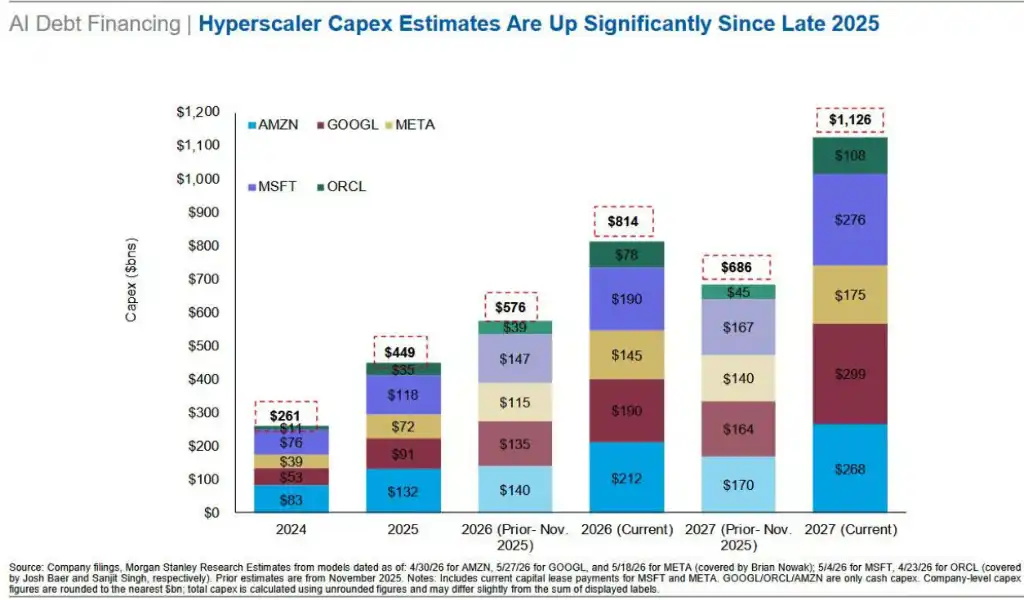
Goldman Sachs's latest report predicts that capital expenditures for hyperscale cloud companies will reach $1.1 trillion to $1.4 trillion by 2027, far exceeding market consensus. However, according to an in-depth study by Morgan Stanley, this already staggering figure is just the tip of the iceberg.
Nearly $1 trillion in purchase commitments, over $800 billion in unactivated lease contracts, and tens of billions of dollars in supplier financing arrangements collectively constitute an off-balance-sheet exposure of approximately $1.8 trillion—these liabilities exist outside the balance sheet but genuinely lock in future cash outflows.

The market has not yet fully priced in these risks.

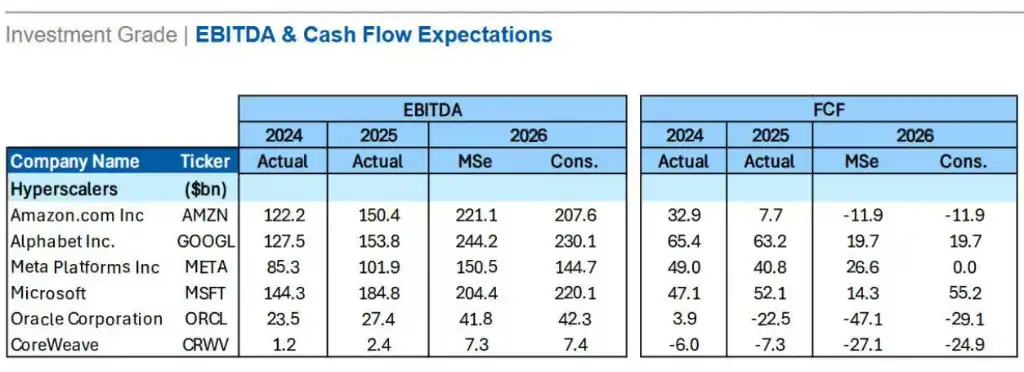
Morgan Stanley warns that the leverage ratio of hyperscale cloud companies has surged from 0.9x to 1.8x in just two quarters, with capital expenditure growth continuing to outpace revenue and free cash flow growth, while the real impact of depreciation pressure has yet to arrive.

Meanwhile, private credit firms represented by Apollo and Blackstone are transferring leverage to the supply chain level through SPVs (Special Purpose Vehicles), creating a highly circular and difficult-to-penetrate financing structure. If AI commercialization falls short of expectations or enterprise customers shift en masse to cheaper alternatives, the fragility of the entire financing chain will be exposed.

Debt Issuance Frenzy: AI Has Become the Biggest Variable in Public Markets

According to Morgan Stanley's latest "AI Debt Financing Tracker Report," as of the end of May 2026, the scale of global AI-related bond issuance has reached $236 billion, a surge of 357% compared to the same period in 2025.

Morgan Stanley expects the total issuance of AI debt to exceed $570 billion for the full year, with the pace accelerating further in the second half of the year as capital expenditure financing needs are concentrated.
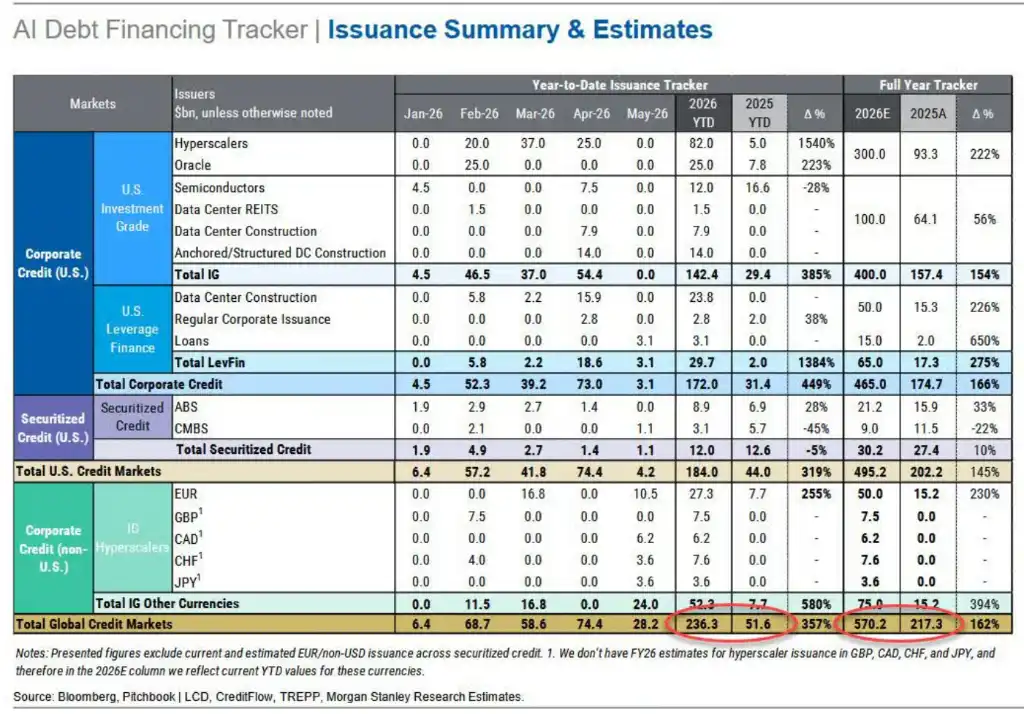
In April alone, AI-related bond issuance exceeded $74 billion, hitting a new high for the year, with project financing structures (for data center construction) accounting for 85% of high-yield bond supply and 40% of investment-grade bond supply. Meanwhile, the five hyperscale cloud companies—Amazon, Meta, Google, Microsoft, and Oracle—now account for 4% of the entire investment-grade bond index.

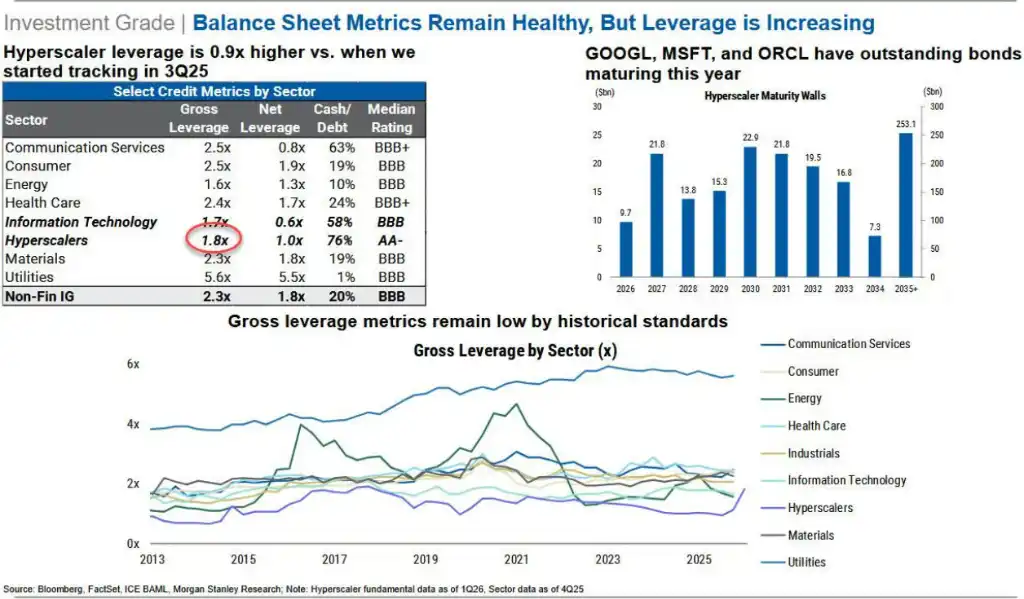
In terms of leverage, the gross leverage ratio for hyperscale cloud companies has risen from 0.9x in the third quarter of 2025 to the current 1.8x, increasing by approximately 0.3x per quarter, already surpassing the leverage level of the entire energy industry.
Morgan Stanley points out that, affected by supply pressure, related credit spreads have drifted from the AA range to the A range and may widen further. Meta's credit spread is currently wider than the CDX IG benchmark.

Regarding free cash flow, Morgan Stanley predicts that Amazon and Meta's free cash flow in 2026 will approach zero or even turn negative, at which point incremental financing will almost entirely rely on new debt.
$1.8 Trillion Off-Balance-Sheet Exposure: Invisible Liabilities, Locked-in Cash Outflows

Todd Castagno from Morgan Stanley's Global Valuation, Accounting & Tax team notes in the report that focusing solely on capital expenditure numbers would severely underestimate the true financial commitments of the AI construction cycle. Beyond the disclosed capital expenditures, there are three key types of off-balance-sheet exposure:

Purchase commitments of approximately $982 billion. The total value of long-term purchase contracts by hyperscale cloud companies and Nvidia is close to $1 trillion. Under accounting standards, these obligations are not recorded as liabilities until goods are delivered, unless the company expects a contract loss. Therefore, nearly $1 trillion in future cash outflows currently do not appear as liabilities on any balance sheet.

Notably, Nvidia's own inventory and purchase obligations have risen to about 32% of consensus revenue forecasts for fiscal year 2027, far above the historical range of 15% to 20%, indicating that supply chain commitment risks are extending to chip suppliers.

Unactivated lease commitments of approximately $822 billion. Over $800 billion in lease contracts have been signed but not yet activated and are not included in current lease liabilities. Additionally, arrangements such as variable lease payments, renewal options, and residual value guarantees also exist outside the balance sheet.
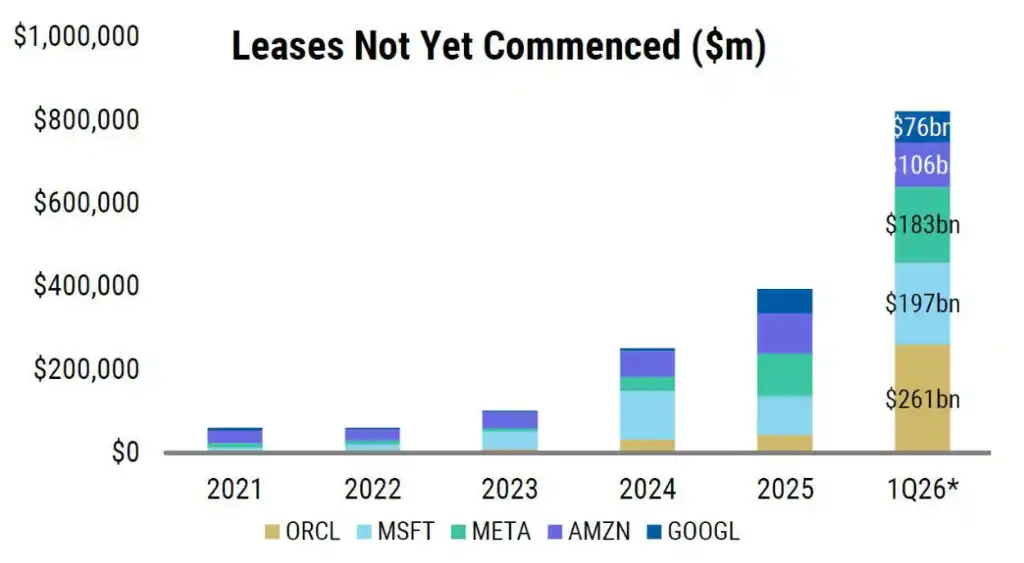
Morgan Stanley estimates that if finance leases were included in the calculation, Microsoft's capital expenditure-to-sales ratio would jump from 33%/50% (fiscal 2026/2027) to 44%/64%, while Oracle's could rise from 76%/115% to 101%/189%.

Unpaid capital expenditures in accounts payable of approximately $110 billion. The days payable outstanding (DPO) of hyperscale cloud companies have significantly lengthened—Oracle's increased by 370% year-on-year, Meta's by 73%, Microsoft's by 69%—meaning the entire supply chain is effectively financing AI construction, with suppliers bearing the liquidity pressure that should be carried by the buyers.

SPVs and Circular Financing: Leverage Moves to the Shadows

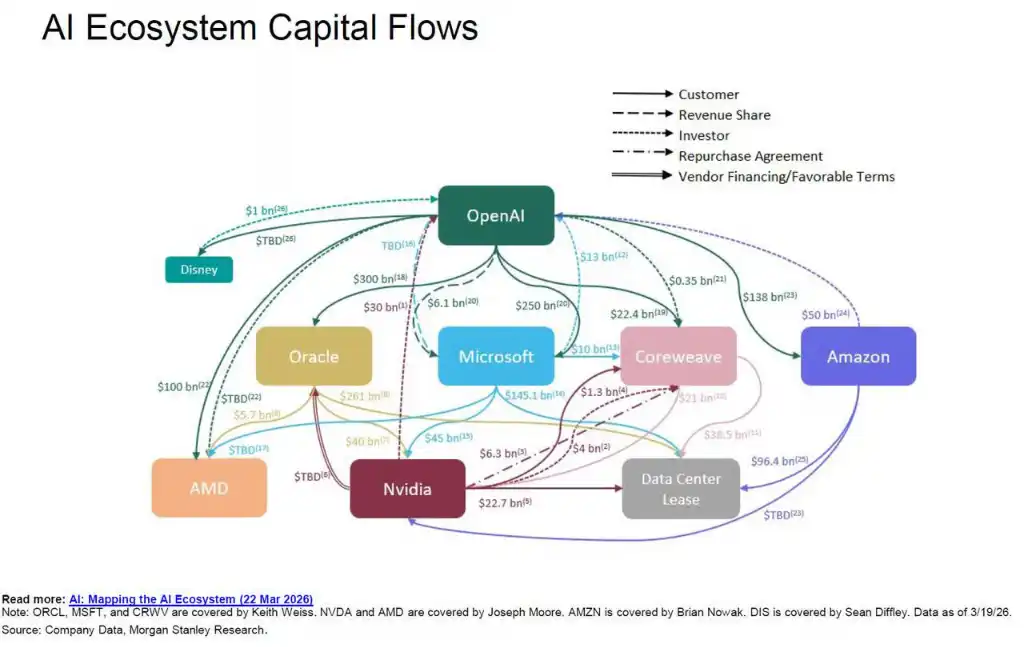
Another core dimension of off-balance-sheet risk is the circular financing structure built through SPVs.

A $35 billion "chip-collateralized" private credit deal completed this week by Apollo and Blackstone for Anthropic vividly illustrates the logic of this model:

Broadcom provides backing for this SPV; Anthropic uses the raised funds to purchase Google chips manufactured by Broadcom, with Google holding a 14% stake in Anthropic; Morgan Stanley, which arranged the deal, simultaneously provides loans to the investors participating in the transaction.

Morgan Stanley's AI ecosystem financing correlation map shows multiple circular relationships—customer, investor, supplier financing, and repurchase—among OpenAI, Oracle, Nvidia, Microsoft, CoreWeave, AMD, and Amazon. The same funds circulate repeatedly among a few key entities, with SPVs being the core tool enabling this circulation.
It is reported that Athene, the insurance subsidiary of Apollo, is particularly active in this structure—raising funds by selling annuities to retirees and then injecting the capital into SPVs to participate in AI infrastructure financing.

This model shifts leverage from the visible balance sheets of hyperscale cloud companies to suppliers and the private credit ecosystem, making the true systemic risk exposure difficult for external observers to identify and aggregate.

Depreciation Cliff and Monetization Gap: The Delayed Shock

Current financial data exhibits systematic optimism bias. A large amount of capital expenditure is currently booked as "construction in progress" (CIP) and has not yet begun to depreciate, artificially inflating reported profit margins and underestimating future expense pressure.

The CIP balances of Oracle, Meta, and Google have grown by approximately 200%, 90%, and 55% year-on-year, respectively.
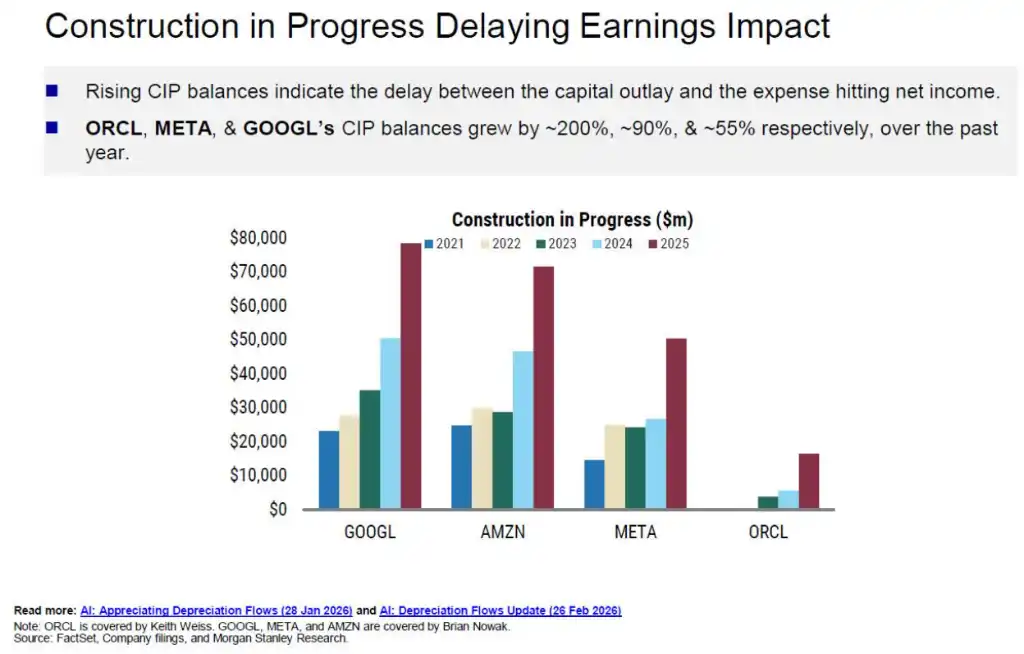
Once these assets gradually transition to depreciation, the impact will be concentrated.

Morgan Stanley predicts that the cumulative depreciation for Microsoft, Oracle, Meta, and Google over the next three years will exceed $520 billion. Taking Oracle as an example, depreciation as a percentage of revenue could rise from the current 7% to 28% in fiscal year 2028; Meta's could rise from 9% to 19%.

In this context, the only path to maintaining profit margins is for revenue to grow significantly in sync—yet the upward revisions to revenue forecasts currently lag far behind the upward revisions to capital expenditure forecasts.

Data shows that consensus capital expenditure forecasts for Google for 2026 have been raised by 139% compared to a year ago, while Meta's and Amazon's were raised by 85% and 81%, respectively. Oracle saw the largest increase, at 175%.

Meanwhile, revisions to revenue forecasts are noticeably lagging, revealing a clear structural mismatch where capital expenditure is outpacing commercialization.

Furthermore, over $2 trillion in remaining performance obligations (RPO) is highly concentrated in a few large, long-term contracts, presenting significant counterparty concentration risk—if any major participant in this circular system encounters problems, it could trigger a chain reaction.

Timing Mismatch Rather Than an Immediate Solvency Crisis

Morgan Stanley concludes that these risks do not currently constitute an imminent solvency crisis but rather a series of overlapping timing mismatches and information disclosure gaps: depreciation pressure is deferred, capital expenditure outpaces monetization, leverage shifts to suppliers and the private credit layer, and the comparability of capital intensity between different companies is significantly undermined by accounting classification differences.

Hyperscale cloud companies are clearly aware of the limited window of current market sentiment and are seizing the opportunity to maximize financing scale.

Goldman Sachs analyst Ryan Hammond points out that if AI infrastructure investment scales to 2% to 3% of GDP, analogous to historical construction cycles of railways and the automotive industry, capital expenditures could reach $1.1 trillion by 2027. In an extreme scenario, considering the cash flow of hyperscale cloud companies and the capacity of the investment-grade credit market, the upper limit might reach $1.4 trillion.

However, all of this hinges on the ability of large language models (LLMs) to continue increasing token pricing and maintain sufficient enterprise customer stickiness. A growing number of enterprises are turning their attention to AI products with comparable performance but significantly lower prices.

Should a structural shift occur on the demand side, the meticulously constructed financing system of today will face a fundamental stress test.


Domande pertinenti

QWhat is the estimated scale of the off-balance-sheet exposure that is building up in the AI infrastructure boom, according to the article?

AThe total off-balance-sheet exposure is approximately $1.8 trillion, comprising nearly $1 trillion in purchase commitments, over $800 billion in non-activated lease contracts, and over $100 billion in supplier financing arrangements.

QHow has the leverage ratio of hyper-scale cloud companies changed recently, and what is it compared to?

AThe gross leverage ratio of hyper-scale cloud companies has surged from 0.9x in Q3 2025 to the current 1.8x, increasing by approximately 0.3x per quarter. This level has already exceeded the leverage of the entire energy sector.

QWhat are the three main types of off-balance-sheet commitments identified in the Morgan Stanley report?

AThe three main types are: 1) Purchase commitments of approximately $982 billion, 2) Non-activated lease commitments of about $822 billion, and 3) Unpaid capital expenditures within accounts payable, estimated at $110 billion.

QWhat is the core mechanism described for shifting leverage into the shadows of the AI ecosystem?

AThe core mechanism is the use of Special Purpose Vehicles (SPVs) to build circular financing structures. This transfers leverage from the visible balance sheets of hyper-scale cloud companies to suppliers and the private credit ecosystem, making systemic risk exposure difficult to observe.

QWhat is the primary nature of the financial risk highlighted by Morgan Stanley regarding the AI investment cycle?

AThe primary risk is not an imminent solvency crisis, but a series of timing mismatches and information gaps. These include deferred depreciation pressure, capital expenditures outpacing monetization progress, leverage shifting to suppliers and private credit, and a lack of comparability in capital intensity due to accounting differences.

Letture associate

The DeepSeek Financing Story

DeepSeek's financing round, totaling approximately 3 billion USD, concluded recently, revealing details about the process and key investors. The round was initiated around April with strict initial terms: a minimum commitment of 5 billion RMB, no syndication, and a pure RMB structure. These were later relaxed, with the minimum ticket size reduced to 1.5 billion RMB. A pivotal four-hour online investor meeting in mid-May served as the primary interaction for many backers with DeepSeek's founder, Liang Wenfeng. Despite not being a naturally eloquent speaker, Liang's philosophy deeply resonated. He consistently emphasized the company's singular focus on AGI (Artificial General Intelligence), the principle of "less is more," extreme caution in spending, and the paramount importance of team stability. His notable quotes included describing the team as "ordinary people doing extraordinary things" and stating that "AGI is a big enough thing; everything else is just process." The final investor list featured 10 entities, but underlying fund structures indicate participation from nearly 100 institutions and individuals. Notable lead investors include Monolith Capital (increasing its commitment from 1.5 to 3 billion RMB), Zhenxingu Capital, IDG Capital, and state-affiliated investors like Guozhitou. Conspicuously absent were major firms like Sequoia China and Hillhouse Capital, despite earlier speculation about their involvement. A core condition set by Liang Wenfeng for all investors, whether corporate or venture capital, was a strict prohibition against poaching DeepSeek employees or encouraging them to leave to start ventures. The financing process highlighted DeepSeek's unexpected openness to external capital, surprising many in the investment community. The company's low-profile nature, combined with its ambitious AGI vision and principled approach, fostered a sense of reverence among participating investors, many of whom were reluctant to discuss the deal publicly, preferring to maintain its discreet and purposeful ethos.

链捕手8 min fa

The DeepSeek Financing Story

链捕手8 min fa

The DeepSeek Fundraising Story

"The DeepSeek Funding Story: Insights from the $2.15 Billion Round" This article details behind-the-scenes narratives from DeepSeek's recent massive funding round. Key highlights include the legendary four-hour online investor meeting where CEO Liang Wenfeng, despite not being a charismatic speaker, impressed attendees with his focus on AGI and team stability. He emphasized the philosophy of "ordinary people doing extraordinary things" and a steadfast commitment to solely advancing intelligence. The fundraising process, initiated in April, saw initial demands for a minimum investment of 5 billion RMB, no syndication, and a pure RMB structure. These terms were later adjusted to a 1.5 billion RMB minimum to accommodate more investors. A notable absence was the lack of participation from major VC firms Sequoia China and Hillhouse Capital, despite early rumors, making IDG the only established VC in the final lineup. The investor list, while showing 10 entities, actually involved nearly 100 underlying institutions and individuals upon closer examination. Significant participants included Monolith Capital, which doubled its commitment to 3 billion RMB, and Zhenxingu Capital, an unexpected entrant. Liang Wenfeng's paramount condition for all investors was a strict agreement not to poach DeepSeek employees. The article reflects on DeepSeek's unexpected openness to funding and the mix of strategies—synergy, insight, brand alignment, and persistence—that secured investors a stake. The overarching sentiment among participants is one of pride and a shared belief in DeepSeek's potential to become a landmark Chinese company, driven by a profound sense of purpose in the AGI race.

marsbit10 min fa

The DeepSeek Fundraising Story

marsbit10 min fa

DAT Companies Take on Side Businesses

The article details the strategic shifts of Digital Asset Treasury (DAT) companies amid a prolonged market downturn. Initially popularized by firms like MicroStrategy, the DAT model—where companies hold cryptocurrencies on their balance sheets—has faced significant pressure as crypto ETFs eroded their investment thesis and bear markets strained finances. Key players are adapting in several ways. Some, like ETHzilla, have abandoned the model entirely. Others are pivoting towards becoming active, revenue-generating participants in the crypto ecosystem rather than passive holders. This evolution is taking two main paths: 1. **Transformation into Institutional Crypto Asset Managers:** Companies like SharpLink Gaming and GameSquare are leveraging their holdings to generate yield, moving beyond simple storage. They employ strategies like 100% ETH staking or using machine learning to optimize DeFi yields, positioning themselves as platforms offering institutional-grade crypto yield products. 2. **Becoming Blockchain Infrastructure Operators:** This is prominent in the Solana ecosystem. Firms like DeFi Development and SOL Strategies are acquiring validator businesses, issuing liquid staking tokens (e.g., dfdvSOL, fwdSOL), and integrating them into DeFi protocols. They generate fee-based revenue from these operations, building network effects. The article notes that successful转型 hinges on building operational expertise and defensible business models around crypto assets, such as technical advantages or deep ecosystem integration. However, these new paths carry risks like smart contract vulnerabilities or ecosystem dependence. Ultimately, this collective shift signals a maturation phase for the DAT movement. It highlights that in crypto, sustainable value is increasingly tied to active participation, cash flow generation, and providing real utility, rather than speculative capital allocation alone.

Foresight News13 min fa

DAT Companies Take on Side Businesses

Foresight News13 min fa

The Fate of Digital Banks: A Fancy App Can't Match a Banking License

**Title:** The Fate of Digital Banks: A Fancy App is No Match for a Banking License **Summary:** The article argues that digital-only "neobanks" have struggled to achieve profitability, with 76% still operating at a loss. Their core mistake was focusing on offering low-fee checking accounts, which generate minimal revenue from interchange fees. The fundamental profit engine of banking is **credit**—lending money and earning interest—a business largely restricted to licensed entities. Successful neobanks like **Nubank** and **Revolut** only became profitable by pivoting to become full-scale lenders, using their sleek apps as mere customer acquisition tools. Others, like **Chime**, suffered for years relying solely on transaction fees before embracing lending. The piece highlights the systemic risks of depending on third-party infrastructure, exemplified by the **Synapse** bankruptcy which froze millions in user funds. The only reliable safeguard is a **banking license**, which provides direct regulatory oversight and control over assets. This realization is now dawning in the cryptocurrency sector. Major firms like Paxos, Circle, and Crypto.com are actively seeking **national trust charters** from the OCC to legitimize their operations and escape dependency on traditional banking partners. Companies like **SoFi** have completed the evolution from fintech to licensed bank to stablecoin issuer. While DeFi has grown in secured lending, **unsecured lending** remains minuscule due to the lack of real-world identity and legal recourse for defaults on blockchain. Truly scaling credit likely requires a banking license. The conclusion is stark: despite promises of disruption, surviving digital banks have simply replicated the age-old banking model—profiting from interest on loans. A user-friendly interface changes the experience, but not the essential economics. In the end, a banking license is not an option but a necessity for sustainable operation.

marsbit23 min fa

The Fate of Digital Banks: A Fancy App Can't Match a Banking License

marsbit23 min fa

Trading

Spot
Futures
活动图片