The Battle for Global Asset Pricing Power: Starting from $500 Billion in Trading Volume

marsbitPubblicato 2026-08-25Pubblicato ultima volta 2026-08-25

Introduzione

Summary: The battle for global asset pricing is intensifying as crypto-based derivatives platforms like Trade.xyz, built on Hyperliquid, challenge traditional financial markets. These platforms operate 24/7, allowing trading of perpetual contracts linked to assets like oil, stock indices, and even pre-IPO companies like SpaceX. During events like Middle East conflicts when traditional oil markets are closed, these on-chain markets continue price discovery, generating over $500 billion in volume since late 2023. Supported by figures like former President Trump and backed by firms like Paradigm, the sector seeks U.S. regulatory approval to offer pre-IPO perpetuals, arguing they improve price discovery ahead of public listings. However, challenges remain: extreme leverage has caused volatile liquidations (e.g., a SpaceX contract briefly implied a $3 trillion valuation), and established players like CME oppose regulatory moves seen as favoring crypto derivatives. While liquidity and first-mover advantage give Trade.xyz an edge, experts warn of risks like weekend market crashes spilling into traditional finance. The rise of these markets forces regulators and Wall Street to confront a new, borderless, always-on trading reality.

Authors: Ryan Weeks, Spe Chen, Muyao Shen, Bloomberg News

Compiled by: Jiahuan, ChainCatcher

On the last Saturday of February this year, when the US and Israel launched airstrikes on Iran, the world's major oil markets were closed, but crude oil prices did not stop fluctuating.

On Trade.xyz, built on the crypto exchange Hyperliquid, traders were buying and selling a chain-based oil derivative throughout the weekend. By the time traditional futures markets reopened, on-chain traders had already spent hours pricing in the potential impact of the conflict.

For decades, modern financial markets have operated around a common architecture: recognized trading venues, fixed trading hours, and benchmark prices that serve as references for other markets. Crypto markets have shattered this convention. They operate 24/7, easily cross borders, and are increasingly filling the gaps left when traditional exchanges are closed.

Trade.xyz is a prime example of testing how far this change can go.

With a team of only about a dozen people, this startup has launched perpetual contracts linked to crude oil, precious metals, stock indices, and pre-IPO companies like SpaceX in less than a year. Since its launch last October, these markets have generated approximately $500 billion in trading volume, accounting for over 99% of the total trading activity in Hyperliquid's third-party market system, HIP-3.

This achievement has led Trade.xyz and Hyperliquid to pursue a bigger goal. They are lobbying US regulators to allow pre-listing perpetual contracts into the US market, arguing that such products can lead to more adequate price discovery before a company officially goes public, thereby modernizing the traditional IPO process.

Currently, Hyperliquid operates outside the US and is not formally open to US traders, a restriction that also applies to Trade.xyz.

However, Hyperliquid seems to have won over an important ally. Crypto-friendly President Trump, whose family is also widely involved in related businesses, said last week that regulators were studying how to bring Hyperliquid into the US market.

Unlike traditional futures contracts that settle on a fixed date, perpetual contracts have no expiration. Investors can hold positions long-term without repeatedly rolling expiring contracts into new ones. These products may also offer extremely high leverage, with some platforms allowing investors to borrow $100 for every $1 invested.

Walter Li, a former ETF trader at RBC who now manages a personal trading portfolio primarily through Trade.xyz, said, "There's always going to be a bull market somewhere."

He added that if a popular asset class hasn't yet been brought onto the blockchain, Trade.xyz can build a market for it.

Bloomberg's analysis of Trade.xyz contracts during the US-Iran conflict shows that during relatively calm periods, these contracts largely tracked traditional oil prices; when traditional markets were closed, they could also reflect trader sentiment in real-time.
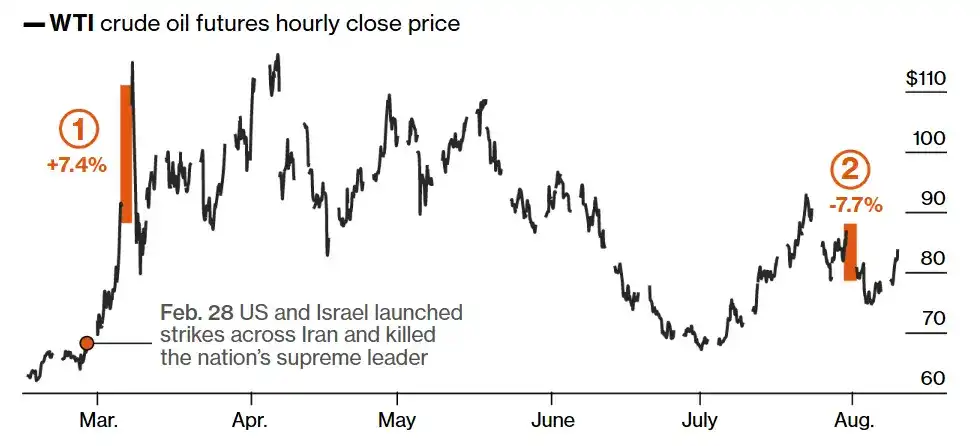
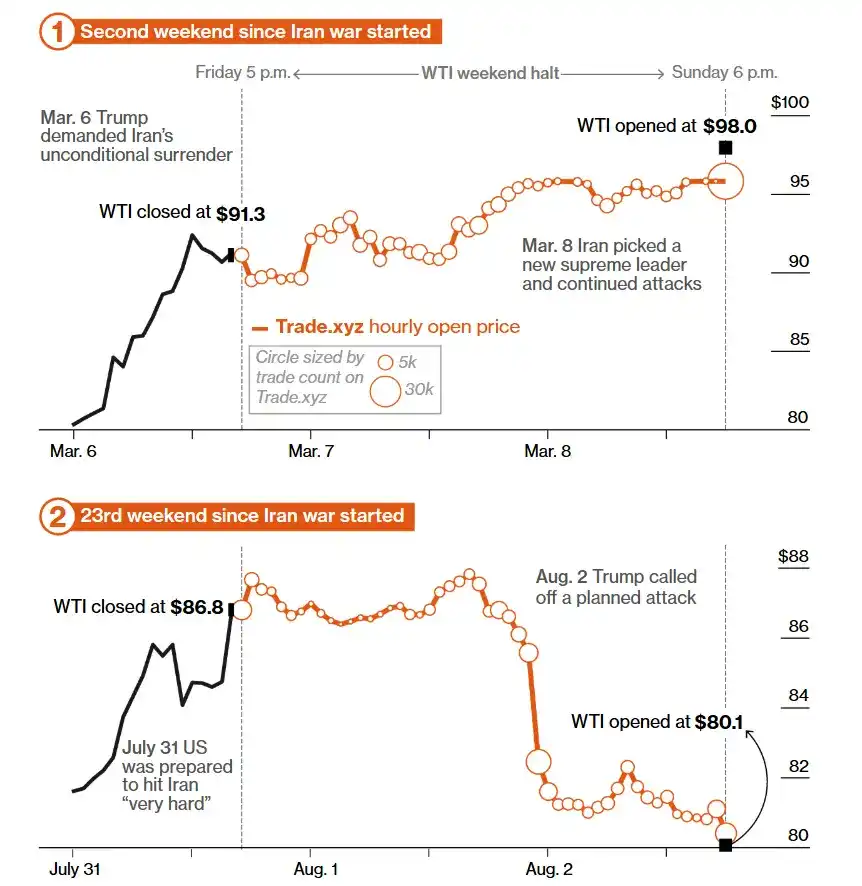
However, during some of the most turbulent periods of the conflict, the price changes in Trade.xyz contracts were smaller than the fluctuations that occurred after traditional markets reopened.

Trade.xyz uses a mechanism called "price discovery boundaries" to limit extreme price changes during periods of high volatility. As the market matures, the platform has gradually relaxed these limits.

A Trade.xyz spokesperson said the purpose of this mechanism is to allow market price discovery while preventing weekend markets from being manipulated.

The participants and sources of liquidity in these weekend contracts differ from the traditional crude oil futures markets used for comparison. Several professional oil traders said they view these contracts as indicators of market sentiment, but not necessarily as predictive tools for the reopening price of Brent or West Texas Intermediate crude.

Trade.xyz was developed by Unit Labs, whose team members mostly use pseudonyms. People familiar with the matter revealed that Unit Labs received investment from venture capital firm Paradigm over a year ago. Spokespersons for both Unit Labs and Paradigm declined to comment on the deal.

Today, Trade.xyz's business has deeply penetrated traditional financial markets.

In March of this year, Trade.xyz and S&P Global launched what they called the first formally authorized perpetual contract linked to the S&P 500 index. The open interest for this product is currently around $450 million. Trade.xyz also offers perpetual contracts tracking the Nasdaq 100 index.

The largest markets on HIP-3 were all developed by Trade.xyz, linked to the S&P 500 index, SK Hynix stock, and gold, with a combined open interest value of approximately $1.2 billion.

The Regulatory Challenge of 24/7 Trading

Before Hyperliquid launched the HIP-3 system, perpetual contracts linked to assets like stocks already existed, but HIP-3 has significantly accelerated the shift towards globally distributed, 24/7 trading.

Yesha Yadav, a professor at Vanderbilt University Law School specializing in digital asset research, said that Wall Street regulators, once accustomed to markets trading only on weekdays, must now "confront the possibility of liquidity migrating to other markets and price discovery occurring in offshore markets, especially during traditional market closures."

Collins Belton, COO and General Counsel of Unit Labs, said at an industry conference in July that this emerging field is dealing with an administration that is "very willing to be supportive." He originally expected more concerns from institutions and regulators.

This has also put regulators in conflict with CME Group, the world's largest derivatives exchange.

In June, CME sued the US Commodity Futures Trading Commission and its Chairman, Michael Selig, because a guidance issued by the commission was seen as paving the way for US platforms to launch crypto perpetual contracts.

The CFTC issued a statement at the time calling the lawsuit "baseless."

SpaceX's Pre-Listing Pricing Experiment

Compared to oil contracts, pre-IPO company contracts fill a different kind of market gap.

Companies like SpaceX do not have continuously traded public share prices before listing. Their valuations are typically only gauged by different rounds of financing and secondary market trades, which can be months apart.

The perpetual contracts launched by Trade.xyz and its competitors do not grant traders ownership of the underlying company's stock. Since these companies are not yet public, there are no publicly traded securities that can provide an anchor for contract prices through direct arbitrage.

The function of these contracts is to publicly reflect traders' judgment of a company's value before it goes public.

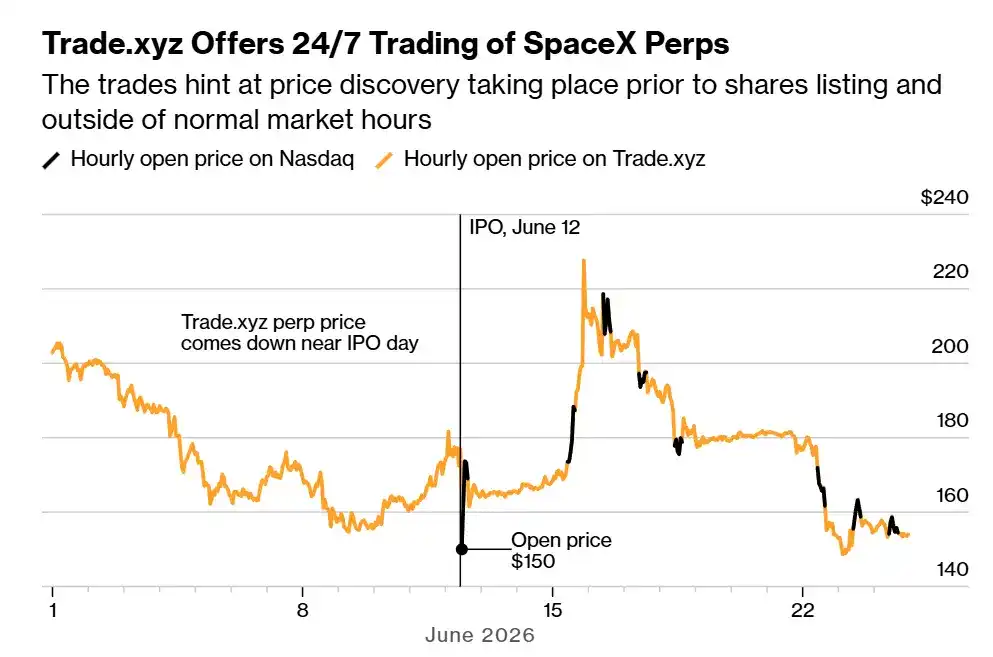
So far, Trade.xyz's pre-listing perpetual contracts have largely accurately predicted the opening performance of the related stocks. In several major listings this year, including SpaceX and SK Hynix, these contracts indicated in advance that the stock price at the start of trading would be higher than the offering price set by the underwriting banks.

David Schamis, CEO of Hyperliquid Strategies, which focuses on accumulating Hyperliquid's native token, said:

"A group of market participants who have never actually seen the stock of this company had a judgment on the opening price that was closer to the actual result than the underwriting syndicate that spent two weeks promoting the deal."

In a letter dated August 18 to US Securities and Exchange Commission Secretary Vanessa Countryman, Trade.xyz and a lobbying group associated with Hyperliquid cited the previous performance of pre-listing perpetual contracts, arguing that such products could provide public market signals before a company goes public, thereby improving the IPO pricing process.
High Leverage Amplifies Abnormal Volatility

Extremely high leverage has also quickly exposed problems in this emerging market.

In mid-June, a few days after SpaceX stock began trading, a short squeeze occurred in the Trade.xyz perpetual contract linked to this Musk-owned rocket and satellite company, momentarily pushing its implied valuation to $3 trillion, surpassing Amazon or Microsoft at the time.

As a result, over $50 million in short positions were automatically liquidated.

About a month later, the same market mechanism caused an abnormally large reverse fluctuation in the Trade.xyz perpetual contract linked to SK Hynix.

After the contract fell 20%, holders were forced to close nearly $60 million in long positions. Previously, SK Hynix stock had fallen up to 30% in pre-market trading. This drop was triggered by a single-share trade on the Nextrade market that executed at a price suspected to be anomalous.

Trade.xyz stated it would compensate for losses caused by the abnormal price fluctuation portion of the SK Hynix incident.

The platform said: "In the future, we will further refine our pricing system to handle extreme events."

Liquidity as a Competitive Moat

To open a perpetual contract market on Hyperliquid, the operator must stake 500,000 HYPE tokens, currently worth about $39 million.

Some early entrants have shut down. Meanwhile, new competitors backed by institutions like Multicoin Capital and Hyperion DeFi are targeting markets where Trade.xyz does not yet dominate.

Skew, backed by Hyperion, plans to focus on developing pricing data that is "not easily replicable." Hyunsu Jung, CEO of Hyperion, said this will be the platform's point of differentiation.

However, Trade.xyz's liquidity remains a difficult barrier to cross. This advantage stems from launching new markets earlier and having lower fee levels than competitors.

Although Trade.xyz perpetual contracts' total trading volume reached $107 billion in July this year, data aggregated by DefiLlama shows that, at current levels, their annualized revenue is only about $27 million.

Pratik Kala, Portfolio Manager at digital asset hedge fund Apollo Crypto, said:

"I don't even look at other markets. The most important thing is liquidity, and liquidity in other markets is very poor. If I wanted to place an order for even $500,000, the bid-ask spread would widen immediately."

Yadav said that a potential risk brought by Trade.xyz's rapid development is that large-scale liquidations like those seen in the SpaceX and SK Hynix perpetual contracts could, in the future, transmit to traditional markets.

In the worst-case scenario, a market crash occurring over the weekend could plunge institutions also holding traditional financial assets into a "balance sheet crisis."

She said: "Come Monday morning, will they still have sufficient funds to continue trading in the traditional markets? That's the potential danger that may emerge in the future."

In contrast, former ETF trader Walter Li is more worried about missing trading opportunities while he sleeps.

He said he used ChatGPT to design a monitoring system to scan market activity on Trade.xyz. When activity in any 24/7 traded perpetual contract picks up, the system sends him an alert.

"If you set up the right monitoring system and truly know what you're looking for, you don't need to be at your trading desk all the time."


Domande pertinenti

QWhat is the main disruptive change that crypto markets, as exemplified by Trade.xyz, introduce to the traditional financial system according to the article?

ACrypto markets, as exemplified by Trade.xyz, operate 24/7, easily cross national borders, and are increasingly filling the gaps left when traditional exchanges are closed. This challenges the conventional financial architecture of recognized venues, fixed trading hours, and benchmark prices.

QWhat specific event is used in the article to illustrate how Trade.xyz allows trading outside traditional market hours?

ADuring the airstrikes on Iran by the US and Israel in late February, while major global oil markets were closed, traders on Trade.xyz were able to buy and sell an on-chain oil derivative throughout the weekend, pricing in the potential impact of the conflict hours before traditional futures markets reopened.

QWhat is one of the larger ambitions that Trade.xyz and Hyperliquid are pursuing, as mentioned in the article?

AThey are lobbying US regulators to allow pre-IPO perpetual contracts into the US market, arguing that these products could enable better price discovery before a company's formal listing and modernize the traditional IPO process.

QWhat significant risk does Professor Yesha Yadav highlight regarding the rapid growth of platforms like Trade.xyz?

AShe highlights the risk that large-scale liquidations, like those seen in the SpaceX and SK Hynix perpetual contracts, could spill over into traditional markets. In a worst-case scenario, a weekend market crash could put institutions holding traditional financial assets into a 'balance-sheet crisis,' potentially leaving them without sufficient funds to trade when traditional markets reopen on Monday.

QAccording to the article, what is a key competitive barrier for new entrants trying to challenge Trade.xyz's dominance on Hyperliquid?

ATrade.xyz's established liquidity is a key competitive barrier that is difficult for new entrants to overcome. This advantage comes from launching new markets earlier and having lower fee levels than competitors. A fund manager quoted in the article stated that other markets have very poor liquidity, making even moderately sized trades difficult due to wide bid-ask spreads.

Letture associate

U.S. Aims at Iran's Crypto Sector Due to Oil Payments Exceeding $100 Billion

The U.S. Treasury Department has expanded sanctions on Iran to target its digital asset sector, citing over $100 million in cryptocurrency payments allegedly used to facilitate Iranian oil sales. The Treasury’s Office of Foreign Assets Control (OFAC) announced new sectoral sanctions covering digital assets, technology, gold, aviation, and shipping, alongside sanctions against nearly 60 entities, individuals, and vessels linked to nuclear, missile, cyber, and oil networks. The move allows OFAC to sanction foreign persons and firms operating in or supporting Iran’s crypto sector, which the Treasury stated is increasingly used as a "tool of choice" to circumvent sanctions, including by the Islamic Revolutionary Guard Corps (IRGC). Specific targets include Ukrainian broker Ivan Obukhov and his UAE-registered firm Foscom FZE, accused of processing over $100 million in crypto payments to facilitate oil sales for the IRGC’s Quds Force. This follows recent U.S. actions against Iran-linked crypto exchanges, including sanctions against UK-based Zedcex and Zedxion in January, four Iranian exchanges including Nobitex in June, and exchanges Shelbit and Aban Tether in August. Unlike previous targeted sanctions, the new measures establish a framework to penalize broader involvement in Iran’s crypto sector, significantly expanding OFAC’s authority under Executive Order 13902. Designated persons’ U.S.-linked property will be blocked, and foreign banks facilitating significant transactions for them may face U.S. account restrictions.

cryptonews.ru33 min fa

U.S. Aims at Iran's Crypto Sector Due to Oil Payments Exceeding $100 Billion

cryptonews.ru33 min fa

Conversation with Charles Zhang: Amidst the AI Frenzy, Why Pursue 'Anti-Efficiency' Content?

Dialogue with Charles Zhang: In the Era of AI's Sprint, Why Create "Anti-Efficiency" Content Standing out among China's early internet pioneers, Charles Zhang, founder and CEO of Sohu, maintains a distinct personal identity. He keeps a consistent public presence and embodies traits of high-energy individuals: sleeping only 4-5 hours daily, running 5km or marathons, and hosting frequent offline tech forums and dialogues with Nobel laureates. He has shifted focus from external business expansion to internal self-reconstruction, adhering to his own pace. "People aren't afraid of being busy; the busier you are, the better your health. Having nothing to do can lead to emotional issues and poor health." Marking the 10th anniversary of his live-streamed "Charles Zhang's English Class," he recently took it offline for a real-world classroom session. Following this, he discussed the course's decade-long journey, Sohu Video's content ecosystem, and the value of content in the AI era. **Pen and Mouth Diligence: A Class Against Instant Mastery** His English class began in August 2016 on "Qianfan Live." He spends about 40 minutes daily preparing, reviewing dozens of news headlines, reading five in detail, and selecting three for the lesson. Over ten years, he has completed over 2000 live sessions totaling more than 110,000 minutes, with over 52 million views. Initially, the stream was a way to "talk more" and combat emotional struggles. He started by repeating after TV news anchors, then moved to live-streaming with the launch of Qianfan Live. It was 40% for personal emotional regulation ("like a monk chanting sutras"), 30% to deliver authentic news, and 30% to promote the new platform. This daily "ritual" helped him overcome depression, leading to what he calls his "peak life state." From a product perspective, it was counter-intuitive—launched without prior market research or growth strategies, based on the founder's personal need that resonated with users. Yet, his content creation follows a strict routine. The decade of covering geopolitics, economics, tech, health, and society has built a vast "knowledge compound interest" system. In an age of AI summaries and algorithmic content, Zhang insists on "hard work": meticulous reading, handwritten notes, and manually created teaching materials, refusing AI-generated content. The English class is now a fixed daily rhythm; preparing for his weekly physics class requires a full day of solitary deduction on a blackboard. In his live streams, Zhang positions himself as a "content creator," not a CEO or teacher. He sees physics as extreme brain training and English as a "sensor" to understand the world. This explains why a top entrepreneur persists for a decade in seemingly "unprofessional" pursuits—it's the information input and psychological healing method he found during a low point. It's fundamentally an "anti-efficiency" commitment. He believes the meaning of reading lies in finding community and spiritual support, not just fleeting conversation points. For today's media, he states: "Reading news isn't the goal. As humans with many confusions, we need reference points, to find a group, find kindred spirits, or seek support and spiritual nourishment. Large language models can't satisfy these starting points; they only give you information." This offers solace and a value defense for media professionals impacted by AI summaries. **"Don't Think Earth Stops Turning Because AI Arrived"** A content creator expressed anxiety: after feeding their article to AI, it produced a more comprehensive, profound version, making their work feel valueless. Zhang responded with an analogy: "Carrots from the market, with a bit of soil, not glossy, taste delicious and flavorful. Tomatoes forced by chemical fertilizer have no taste at all." He sees AI giving world content a "plastic feel," but acknowledges its significant role in improving information access efficiency, especially in physics and social science research where he often queries AI for quick professional answers. The key, Zhang stresses, is that the outside world still needs to guide our perspective. LLMs provide "information," while the outside world offers "viewpoints." He cares deeply about *what* that external viewpoint is and *how* someone thinks about an issue. "Don't think the Earth stops turning because AI arrived," he analyzes. AI currently replaces rule-based work, noting significant impact on the software industry with many programmers laid off as even less experienced people can now write decent code. However, AI cannot yet replace arts, social sciences, emotions, and creative content. "Hollywood remains thriving, producing great works. Oscars will continue, Nobel Literature Prizes will still be awarded—all by real people, with works conceived by real people." While wary of AI, Zhang isn't anti-technology and is open to its applications. Sohu itself has launched AI assistants. In Sohu's AI practice, Zhang defines his role as a "large language model corpus provider." He believes LLM training is inseparable from human-original content as its data foundation, so original content retains irreplaceable value. "The era of self-media indeed offers everyone new ways to discover their strengths and achieve growth." He suggests every young person should consider self-media. Most importantly, the bottom line of content creation should be "authenticity." If using AI avatars, they must be clearly labeled; not doing so and misleading viewers wastes their time, especially when people still prefer real human content. Behind AI's sprint lie unavoidable realities. As AI quickly provides seemingly perfect answers, people grow accustomed to accepting "summarized" results, omitting processes of questioning, deduction, and trial-and-error, leading to a decline in deep thinking. Zhang's "anti-efficiency" practice with his two live-streamed classes is his answer to AI's狂奔: In an algorithm-driven era chasing ultimate efficiency, don't expect AI to fill inner voids. Read books, speak in front of a camera, sweat on a running track, and build connections with real people.

marsbit43 min fa

Conversation with Charles Zhang: Amidst the AI Frenzy, Why Pursue 'Anti-Efficiency' Content?

marsbit43 min fa

Trading

Spot
活动图片