The US Office of the Comptroller of the Currency has affirmed that national banks can intermediate cryptocurrency trades as riskless principals without holding the assets on their balance sheets, a move that brings traditional banks a step closer to offering regulated crypto brokerage services.
In an interpretive letter released on Tuesday, the regulator said banks may act as principals in a crypto trade with one customer while simultaneously entering an offsetting trade with another, a structure that mirrors riskless principal activity in traditional markets.
“Several applicants have discussed how conducting riskless principal crypto-asset transactions would benefit their proposed bank’s customers and business, including by offering additional services in a growing market,” notes the document.
According to the OCC, the move would allow customers “to transact crypto-assets through a regulated bank, as compared to non-regulated or less regulated options.”
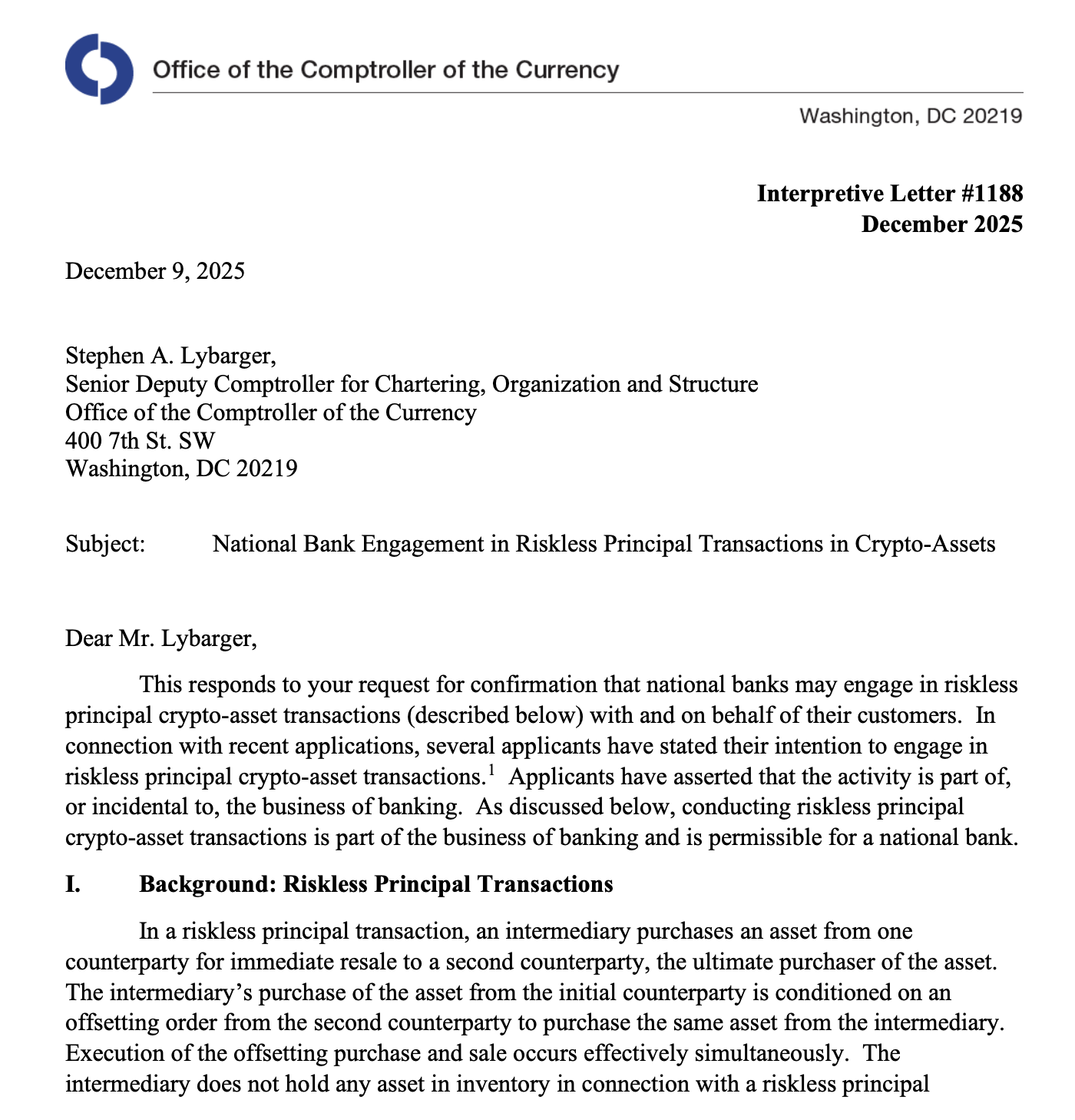
The letter also reiterates that banks must confirm the legal permissibility of any crypto activity and ensure it aligns with their chartered powers. Institutions are expected to maintain procedures for monitoring operational, compliance and market risks.
“The main risk in riskless principal transactions is counterparty credit risk (in particular, settlement risk),” reads the letter, adding that “managing counterparty credit risk is integral to the business of banking, and banks are experienced in managing this risk.”
The agency’s guidance cites 12 U.S.C. § 24, which permits national banks to conduct riskless principal transactions as part of the “business of banking.” The letter also draws a distinction between crypto assets that qualify as securities, noting that riskless principal transactions involving securities were already clearly permissible under existing law.
The OCC’s interpretive letter — a nonbinding guidance that outlines the agency’s view of which activities national banks may conduct under existing law — was issued a day after the head of the OCC, Jonathan Gould, said crypto firms seeking a federal bank charter should be treated the same as traditional financial institutions.
According to Gould, the banking system has the “capacity to evolve,” and there is “no justification for considering digital assets differently” than traditional banks, which have offered custody services “electronically for decades.”
Related: Trump’s national security strategy is silent on crypto, blockchain
From ‘Choke Point 2.0’ to pro-crypto policy
Under the Biden administration, some industry groups and lawmakers accused US regulators of pursuing an “Operation Choke Point 2.0” approach that increased supervisory pressure on banks and firms interacting with crypto.
Since President Trump took office in January after pledging to support the sector, the federal government has moved in the opposite direction, adopting a more permissive posture toward digital asset activity.
Magazine: Quantum attacking Bitcoin would be a waste of time: Kevin O’Leary