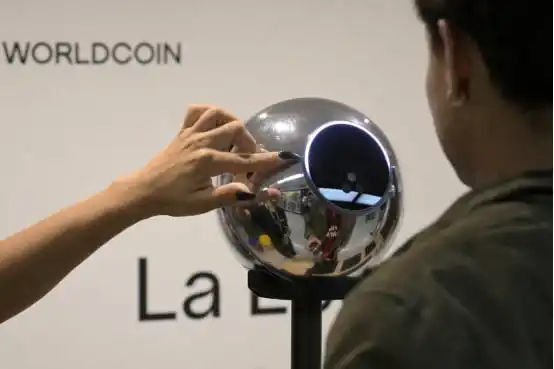
Claude to Mandate "Face-Scan ID Verification", No ID No Service Starting July?

链捕手Pubblicato 2026-06-15Pubblicato ultima volta 2026-06-15

Introduzione

Anthropic, the creator of Claude AI, has sent privacy policy update emails to users, signaling a significant shift. The key change, effective July 8, is the potential requirement for consumer-level users (Free, Pro, Max plans) to verify their age or identity. This verification would be conducted through the third-party service Persona, involving uploading a government-issued photo ID and taking a live selfie for comparison. Anthropic states this data is for security purposes only, will not be used for model training, and is processed by Persona, not stored on its own servers. The update also clarifies data handling for Claude's new capabilities: when performing multi-step tasks or connecting to third-party apps, user data may flow between Anthropic and those external services. Additionally, more information may be collected from users who participate in Anthropic research. This move is seen as a major step towards establishing accountability as AI agents become more powerful and autonomous, capable of executing complex, real-world tasks. It follows previous enforcement actions, like the banning of the "Fable 5" account, and indicates a broader industry trend toward stricter user identification and safety measures. The verification is expected to apply in specific scenarios, particularly as users engage Claude in more complex agentic workflows.

Author: New Zhiyuan

Anthropic is in the headlines again!

In recent days, many Claude users opened their email to find a message from Anthropic. The title seemed innocuous - "Privacy Policy Update Notification". But the content left them stunned:

"We may ask you to verify your age or identity."
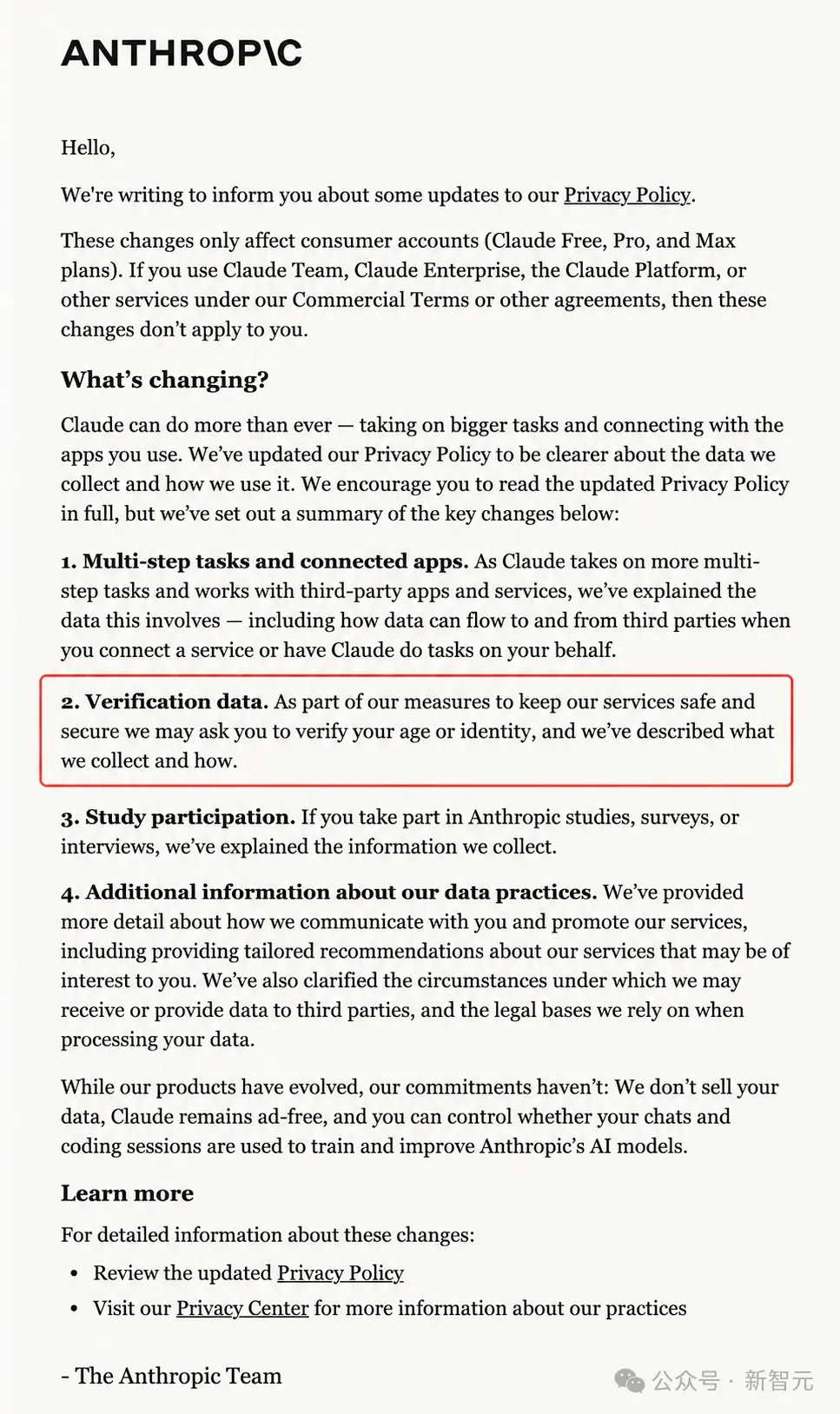
Someone shared a screenshot of the email on X, and the comments exploded. According to the email content, starting July 8th, Claude will likely start asking for your ID. Has Anthropic's real-name verification finally arrived?
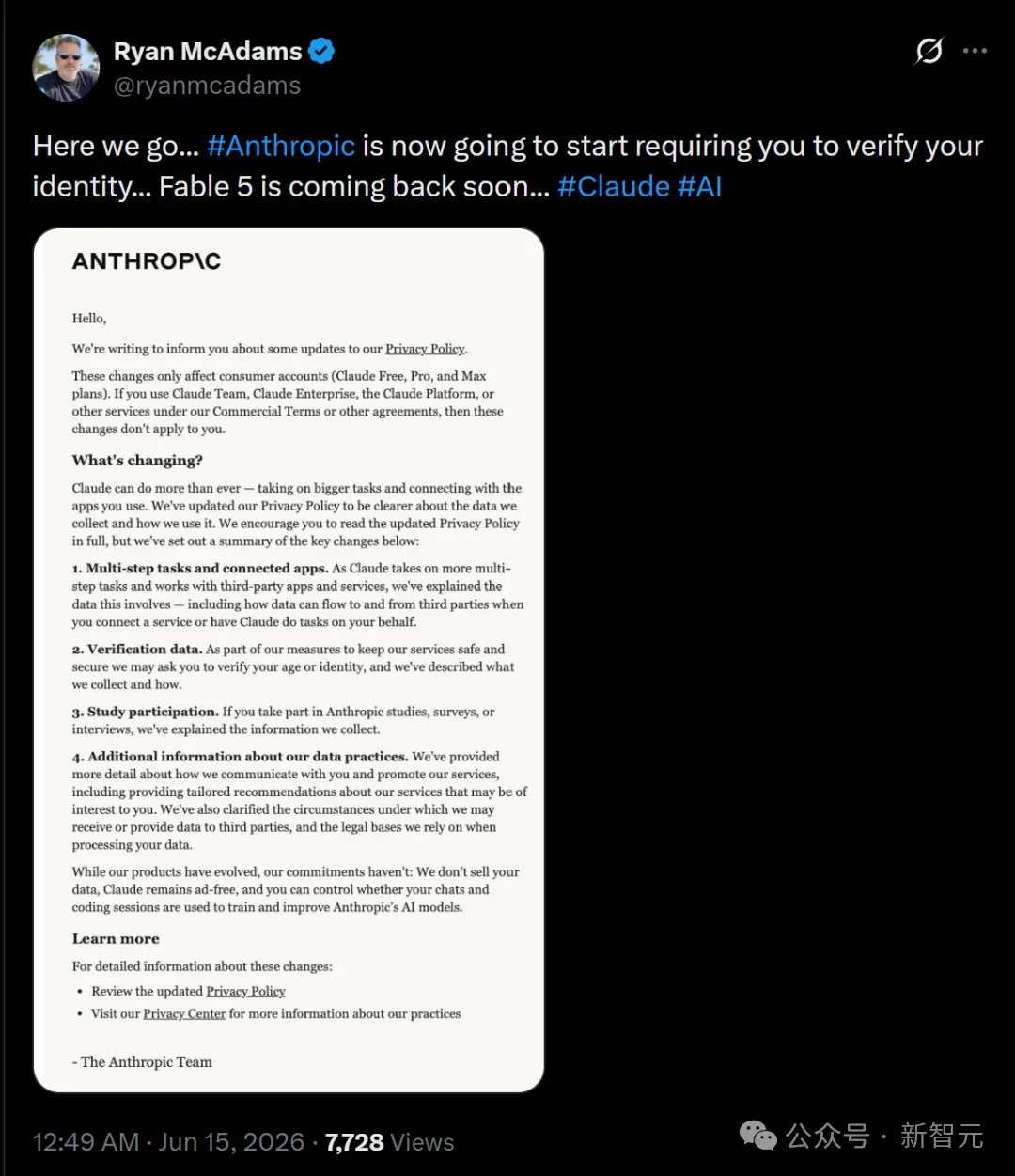
Anthropic Suddenly Announces, Is Real-Name Verification Really Coming?

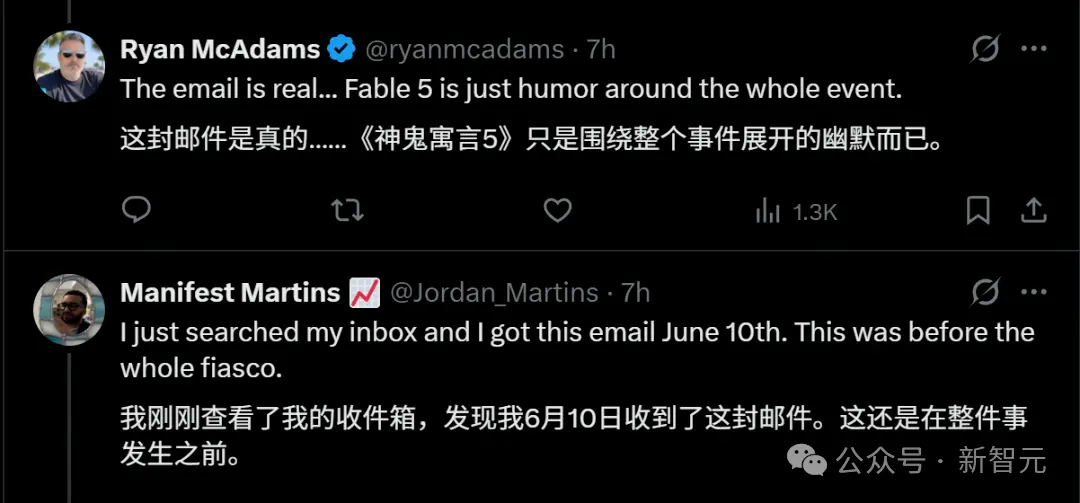
On June 10th, many Claude users' inboxes received an email from Anthropic.
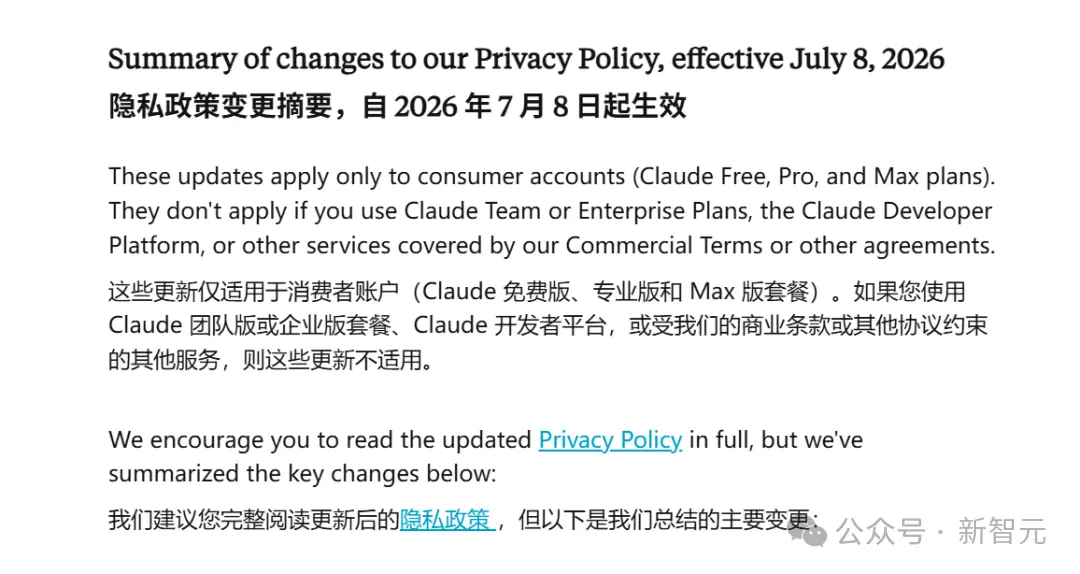
The email mentions that starting July 8th, Anthropic may ask users to verify their age or identity, citing the reason as "enhancing security." More interestingly, some found they just received this email today, while their other accounts hadn't received it at all before, suggesting it might be a batch rollout or an A/B test.

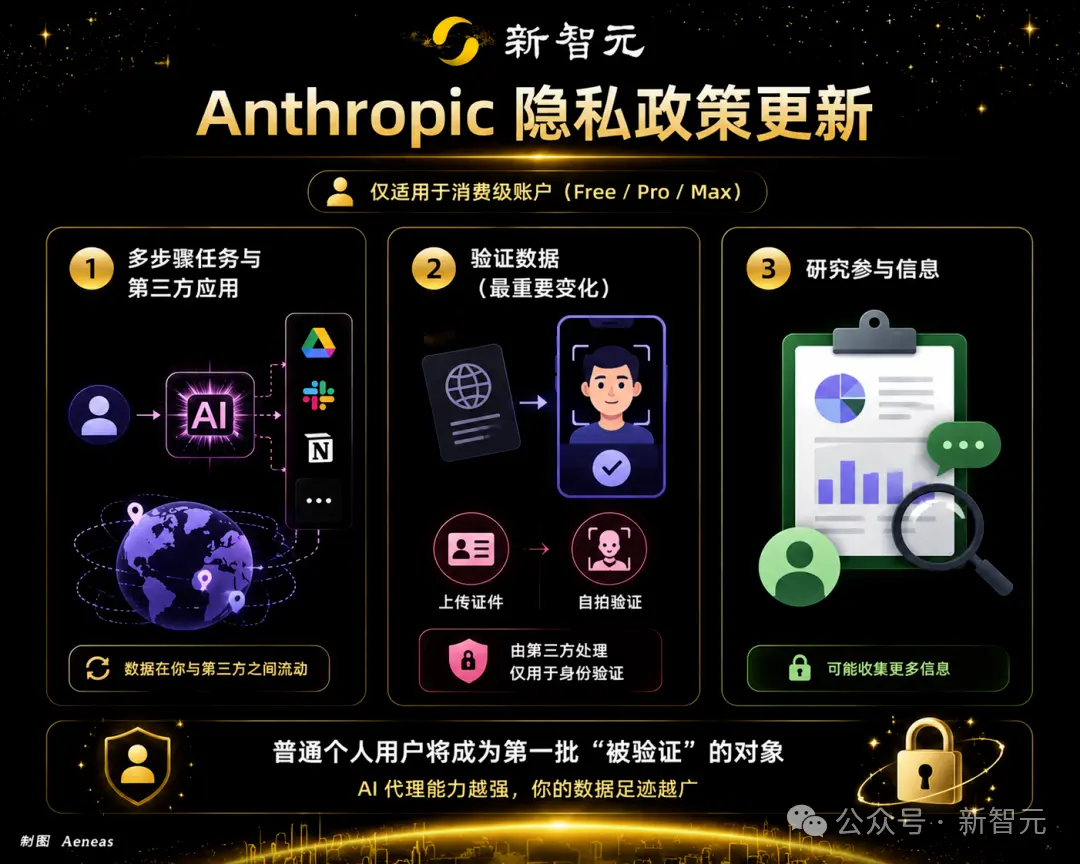
According to the officially updated privacy policy in the email, there are three core changes:
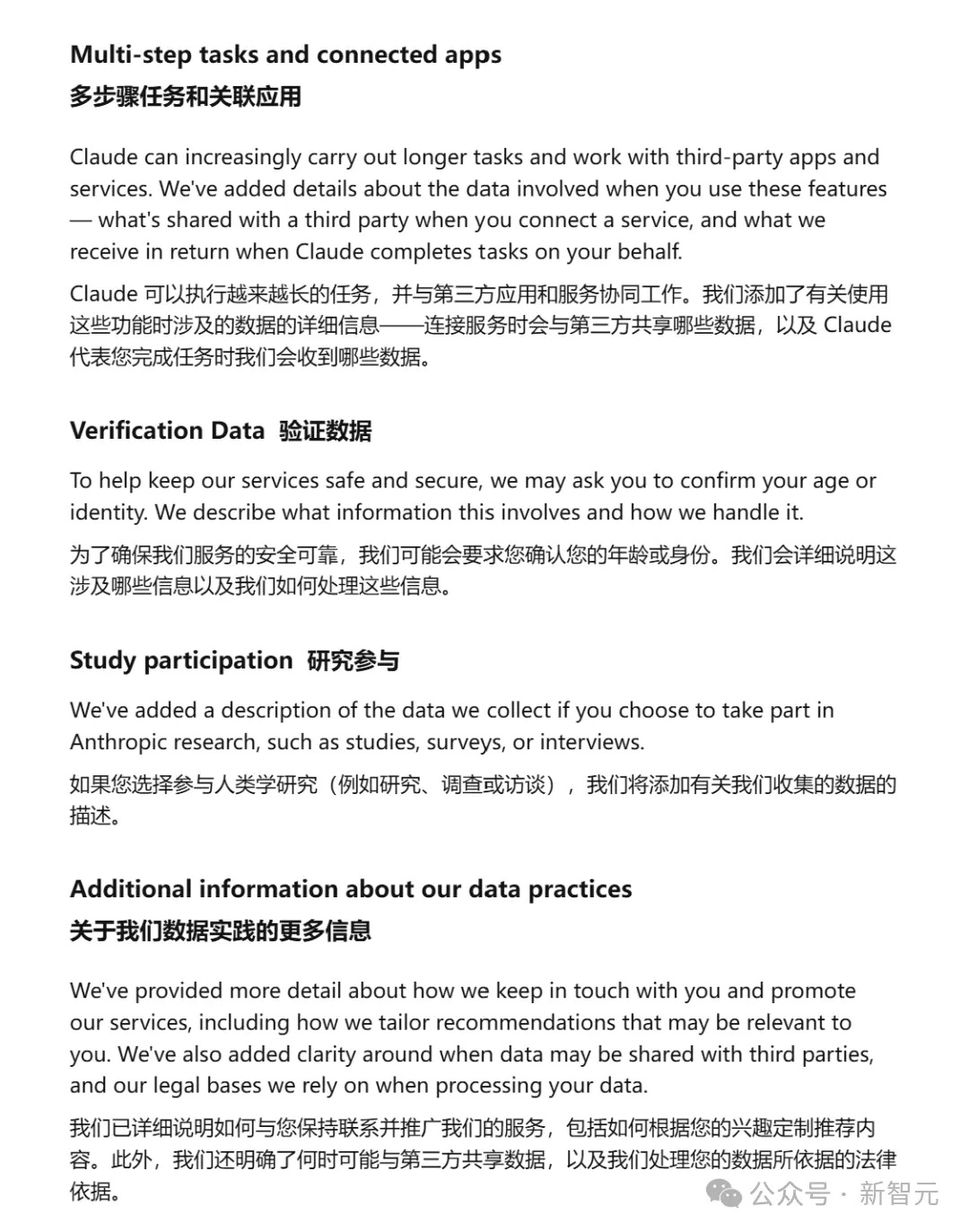
1. Data Flow for Multi-Step Tasks and Third-Party Apps

As Claude's capabilities improve, it can perform multi-step tasks on behalf of users (like helping you plan a full trip: checking flights, booking hotels, arranging itineraries), and can also connect to third-party apps (like Google Drive, Slack, Notion, etc.).

Moreover, your data no longer stays solely on Anthropic's servers. Anthropic explicitly states in the updated privacy policy: When you connect a service or have Claude perform tasks for you, data can flow between you and third parties.

This means your conversation content, uploaded files, and even your commands may leave Anthropic's servers and enter third-party app processing pipelines. For ordinary users, the more powerful the AI's "agentic capabilities," the broader your data footprint becomes.

2. Verification Data (Core Change)

This is the most impactful part of this update. The policy text reads:

As part of our efforts to maintain the security and reliability of our services, we may ask you to verify your age or identity. We are explaining here what information we collect and how.

How will verification be done?

According to Anthropic's official support page, verification will be conducted through the third-party service Persona. The specific process includes:

  • Uploading a government-issued, photo ID document (passport, driver's license, ID card, etc.)

  • Taking a real-time selfie (for comparison with the ID photo)

Anthropic attempts to reassure users, emphasizing that this data is only used to confirm identity, and will not be used for model training; data will not be stored on Anthropic's own servers (handled by Persona); and the entire process is only for specific security and compliance scenarios.

Nevertheless, this notification still shocked the user base. On platform X, one user shared an email screenshot with the caption: "Received on June 10th, thought it was just a regular update at the time... looking back now, terrifying to contemplate." Another user joked: They said they need to verify identity, so is Fable 5 coming back?
3. Research Participation Information

If you participate in Anthropic's research surveys or interviews, they will collect more information.
⚠️ Important Note:

The above three changes apply only to consumer accounts (Free, Pro, Max). Business customers (Team, Enterprise) are not affected. This means ordinary individual users will be the first batch to undergo "verification."

Anthropic explains on its official support page: Identity verification was previously only used in specific scenarios targeting minors, violators, or accounts in unsupported regions. In the future, as agent tasks become more complex, the scope of verification will gradually expand.

Identity verification is not something Anthropic is doing for the first time. Previously, when dealing with minor protection, violators, and accounts in some unsupported regions, similar verification methods have been used. The difference is that this time, the wording and scope are more explicit, and they specifically highlighted one sentence—in the future, as Agent tasks become increasingly complex, verification scenarios may continue to expand.

Many heavy Agent users worry: in the future, when using Claude to run automated tasks, will there be constant pop-ups asking for face scans? Currently, the official has not provided more detailed trigger conditions; after July 8th, there will likely be more specific explanations.

AI's "Wild West Era" Is Coming to an End

Thinking back to the recent uproar over the "Fable 5 Ban" incident, everything seems to have been foreshadowed.

When the Fable 5 account was banned by the authorities for crossing safety red lines, it shocked everyone. Many thought it might be a one-off disciplinary action for an extreme case, but now it appears that Fable 5's downfall is not an isolated incident, but rather a prelude to a comprehensive tightening by Anthropic and even the entire AI industry.

As AI's capabilities evolve from a "chat companion tool" to an "all-powerful agent" capable of operating third-party applications and executing complex tasks, the authorities will never allow another Fable 5 to run wild beyond legal boundaries.

The so-called "real-name system" and "face-scan verification" mark that on the eve of the full-scale explosion of AI Agents, major players must establish an unbreakable accountability tracing mechanism in advance. Once AI causes trouble while booking tickets, editing files, or even executing more complex business commands on your behalf, the platform must know exactly which real-life "person" is giving the orders behind the screen.

From July 8th onward, every time you attempt to have Claude help you complete multi-step complex tasks, it might be accompanied by a pop-up: Please upload your ID document.

Anthropic's message reveals—winter is coming. From now on, face-scan verification and account purging will likely become the norm for the AI industry in 2026.

In another month, when using Claude, one must be prepared to hold up their ID at any moment.

References:

  • https://x.com/ryanmcadams/status/2066201356034011370?s=20

  • https://privacy.claude.com/en/articles/10301952-updates-to-our-privacy-polic

Domande pertinenti

QWhat is the main announcement Anthropic made to its users regarding Claude's privacy policy, and what change is expected starting July 8th?

AAnthropic announced an update to Claude's privacy policy, notifying users that starting July 8th, the company may require them to verify their age or identity to enhance security. This verification would be conducted through the third-party service Persona and could involve uploading a government-issued photo ID and taking a live selfie.

QAccording to the article, what are the three key changes outlined in the updated privacy policy?

AThe three key changes are: 1) Clarification on how user data flows during multi-step tasks and interactions with third-party apps connected to Claude. 2) The introduction of identity and age verification for users. 3) Clarification on the collection of information for users participating in Anthropic's research programs, such as surveys and interviews.

QWhich group of Claude users will primarily be affected by the new identity verification requirement?

AThe new identity verification requirement will primarily affect consumer-level accounts, including Free, Pro, and Max plans. Business customers using Team or Enterprise plans are not impacted by this change.

QWhat is the stated reason Anthropic is implementing identity verification, and how does the company claim to handle the collected data?

AAnthropic states the reason for implementing identity verification is to enhance the safety and reliability of its services. The company claims the data will only be used to confirm identity, not for model training. The verification process is handled by the third-party service Persona, and the data is not stored on Anthropic's own servers.

QHow does the article connect this policy change to the broader trend in the AI industry, specifically mentioning the 'Fable 5' incident?

AThe article suggests this policy change is part of a broader industry-wide tightening of regulations. It connects it to the 'Fable 5' incident, where an account was banned for safety violations, implying that as AI agents like Claude become capable of performing complex, multi-step tasks, companies must establish clear accountability and traceability to prevent misuse, marking the end of a more 'wild' era for AI.

Letture associate

SharpLink CEO: How to Understand Ethereum Developers Just Exceeded 1 Million?

SharpLink CEO reflects on the milestone of Ethereum surpassing 1 million historical developers, emphasizing that this figure represents the largest pool of technical talent ever assembled around an open, permissionless blockchain network. While approximately 232,000 developers remain active, the key question for the crypto industry is not which chain is fastest, but where the best builders choose to build long-term. Ethereum's advantage lies in a decade-long accumulation of infrastructure, standards, tools, liquidity, and a cohesive culture, making it the default operating system for programmable finance. This developer base is tackling complex challenges: the Glamsterdam upgrade aims to enhance scalability while preserving core principles; synchronous composability seeks to unify Rollup ecosystems; and significant efforts are underway for post-quantum security. Ethereum's deeper network effects stem from composability and shared standards (like the EVM and Solidity), creating a flywheel of more developers, tools, and liquidity. Three reinforcing strengths cement Ethereum's lead: credible neutrality (secured by ~900k validators), a modular architecture with interconnected Rollups, and a culture that attracts top researchers. The ecosystem is consolidating as the trusted coordination layer for internet-native finance, favored by large institutions valuing security and liquidity. The future of Ethereum is being built by this global community of founders and architects.

链捕手15 min fa

SharpLink CEO: How to Understand Ethereum Developers Just Exceeded 1 Million?

链捕手15 min fa

A Clod of Chinese Soil Chokes Two Japanese Giants

"Chinese Soil Chokes Japanese Giants" The production of a key electronic specialty gas, tungsten hexafluoride (WF6), vital for manufacturing AI chips, was halted by two leading Japanese producers—Kanto Denka and Central Glass. Their shutdown was not due to a technological failure but a sudden, critical shortage of a raw material they had long taken for granted: ultra-high-purity (6N-grade) tungsten powder, which is almost entirely sourced from China. Following a quiet Chinese export announcement in January 2026, tungsten powder shipments to Japan dropped to zero for months. Despite frantic efforts, Japanese companies found no viable alternative; imported powder was three times more expensive and lacked the required purity. Their existing stockpiles were exhausted by mid-2026. WF6 is essential for depositing tungsten into the microscopic contact holes of High Bandwidth Memory (HBM) chips, which are crucial for advanced processors like those from Nvidia. While Japanese firms had mastered producing ultra-pure WF6 gas, their entire supply chain relied on China's 6N tungsten powder—a dependency now revealed as a fatal vulnerability. China's dominance in this "soil" results from decades of painstaking R&D by companies like Xiamen Tungsten and China Tungsten & Hightech. They overcame immense technical hurdles, such as separating chemically similar molybdenum from tungsten, to achieve mass production of the world's purest tungsten powder. With their primary suppliers gone, Kanto Denka and Central Glass announced a permanent halt to WF6 production starting July 1, 2026. This immediately created a supply crisis for major semiconductor manufacturers like Samsung and SK Hynix, forcing them to urgently seek and certify new Chinese suppliers for WF6 itself. The reversal marks a dramatic shift: China has moved from exporting low-value raw materials to controlling the high-purity foundation of a critical global tech supply chain, upending a long-established industrial hierarchy.

marsbit46 min fa

A Clod of Chinese Soil Chokes Two Japanese Giants

marsbit46 min fa

Without Tencent, What's Left for Suiyuan?

The article centers on the crucial question posed in the title: what is Seyond Technology really worth if its dominant customer, Tencent, were to stop purchasing its AI chips? As the last of China's "Four AI Chip Dragons" to secure approval for a public listing, Seyond's IPO filing reveals a profound and controversial dependency. In 2025, 74.9% to over 80% of its revenue came from Tencent. The piece argues that this extreme customer concentration is not merely a vulnerability but a strategic outcome of China's AI industry evolution. It contrasts Seyond's path with its peers (Moore Thread, Biren Technology, and MetaX), noting that while others raced to market with ambitious stories, Seyond focused first on securing and delivering for a major client. Its explosive revenue growth—with Q1 2026 up 1474.85% year-on-year—is driven by concentrated orders from Tencent, which itself faces massive, escalating AI compute demands for products like its Yuanbao and Hunyuan models. The relationship is framed as a deliberate, symbiotic cultivation of a supply chain. As both a major shareholder (20.26%) and primary client, Tencent is actively fostering Seyond to build a controllable, stable alternative to NVIDIA, similar to how global tech giants historically nurtured key suppliers. The high switching costs—involving software stacks and deployed systems—create a deep "ecological moat" for Seyond within Tencent's ecosystem. The analysis positions the AI chip landscape in three tiers: NVIDIA as the global leader, Huawei's Ascend as the state-backed player, and commercial firms like Seyond competing for market orders. Seyond is increasingly seen as "Tencent's compute foundation," with its product roadmap closely aligned with the tech giant's needs. The conclusion is that the industry's metric for success is shifting from fundraising and technical specs to real orders, delivery capability, and ecosystem binding. Seyond's value, therefore, lies not just in its chips but in holding a massive, multi-year procurement order from China's largest internet company—a tangible asset arguably more telling than any technical whitepaper in the current climate. The core insight is that for domestic chips, the ultimate challenge isn't just catching up technologically with NVIDIA, but earning the trust, scenarios, and recurring orders from a major anchor client.

marsbit1 h fa

Without Tencent, What's Left for Suiyuan?

marsbit1 h fa

Trading

Spot
Futures

Articoli Popolari

Come comprare ID

Benvenuto in HTX.com! Abbiamo reso l'acquisto di SPACE ID (ID) semplice e conveniente. Segui la nostra guida passo passo per intraprendere il tuo viaggio nel mondo delle criptovalute.Step 1: Crea il tuo Account HTXUsa la tua email o numero di telefono per registrarti il tuo account gratuito su HTX. Vivi un'esperienza facile e sblocca tutte le funzionalità,Crea il mio accountStep 2: Vai in Acquista crypto e seleziona il tuo metodo di pagamentoCarta di credito/debito: utilizza la tua Visa o Mastercard per acquistare immediatamente SPACE IDID.Bilancio: Usa i fondi dal bilancio del tuo account HTX per fare trading senza problemi.Terze parti: abbiamo aggiunto metodi di pagamento molto utilizzati come Google Pay e Apple Pay per maggiore comodità.P2P: Fai trading direttamente con altri utenti HTX.Over-the-Counter (OTC): Offriamo servizi su misura e tassi di cambio competitivi per i trader.Step 3: Conserva SPACE ID (ID)Dopo aver acquistato SPACE ID (ID), conserva nel tuo account HTX. In alternativa, puoi inviare tramite trasferimento blockchain o scambiare per altre criptovalute.Step 4: Scambia SPACE ID (ID)Scambia facilmente SPACE ID (ID) nel mercato spot di HTX. Accedi al tuo account, seleziona la tua coppia di trading, esegui le tue operazioni e monitora in tempo reale. Offriamo un'esperienza user-friendly sia per chi ha appena iniziato che per i trader più esperti.

196 Totale visualizzazioniPubblicato il 2024.12.12Aggiornato il 2026.06.02

Come comprare ID

Discussioni

Benvenuto nella Community HTX. Qui puoi rimanere informato sugli ultimi sviluppi della piattaforma e accedere ad approfondimenti esperti sul mercato. Le opinioni degli utenti sul prezzo di ID ID sono presentate come di seguito.

活动图片