US Government Suddenly Halts Anthropic's Strongest Model, "Quasi-IPO Stock Price" Plunges 3.7% Overnight

marsbitPubblicato 2026-06-15Pubblicato ultima volta 2026-06-15

Introduzione

U.S. Government Halts Anthropic's Top AI Models, 'Pre-IPO' Price Drops 3.7% On June 12, the U.S. government ordered Anthropic to shut down access to its two most powerful AI models, Claude Fable 5 and Claude Mythos 5, citing national security concerns. The directive, issued by the Department of Commerce, required Anthropic to block access for all foreign nationals, leading the company to disable the models globally for all users. Anthropic strongly opposed the move, arguing the government's basis was a "narrow jailbreak vulnerability" and warning that applying such a standard industry-wide would effectively halt all frontier model deployments. The news impacted Anthropic's implied valuation in speculative markets. The Anthropic perpetual contract on Hyperliquid fell approximately 3.7% to around $1,627, down from highs above $1,800 following the models' release. Unauthorized tokenized products linked to Anthropic on Solana also saw significant declines. The models, launched just days earlier on June 9, represented a major capability leap for Anthropic. Fable 5 was its first public release of a "Mythos"-tier model above its flagship Claude Opus. The shutdown creates an ironic situation for Anthropic, a company founded on "AI safety" principles, and adds uncertainty to its ongoing IPO preparations. The company is actively engaging with regulators to resolve what it calls a "misunderstanding" and restore service.

Author: Claude, Deep Tide TechFlow

Deep Tide Introduction: Citing national security concerns, the US government on June 12th suddenly ordered Anthropic to shut down its two strongest AI models, Fable 5 and Mythos 5. Impacted by this, the Hyperliquid perpetual contract tracking its expected IPO valuation fell by 3.7% to around $1,627 on Saturday, significantly retreating from the post-model-launch high of over $1,800. Anthropic publicly expressed strong opposition, stating that the government demanded a recall based solely on an oral briefing of a "narrow jailbreak vulnerability," and warned that applying such a standard across the entire industry "would essentially halt all new model deployments from frontier model providers."

A company founded on "AI safety" is now forced to shut down its strongest products by a government safety order.

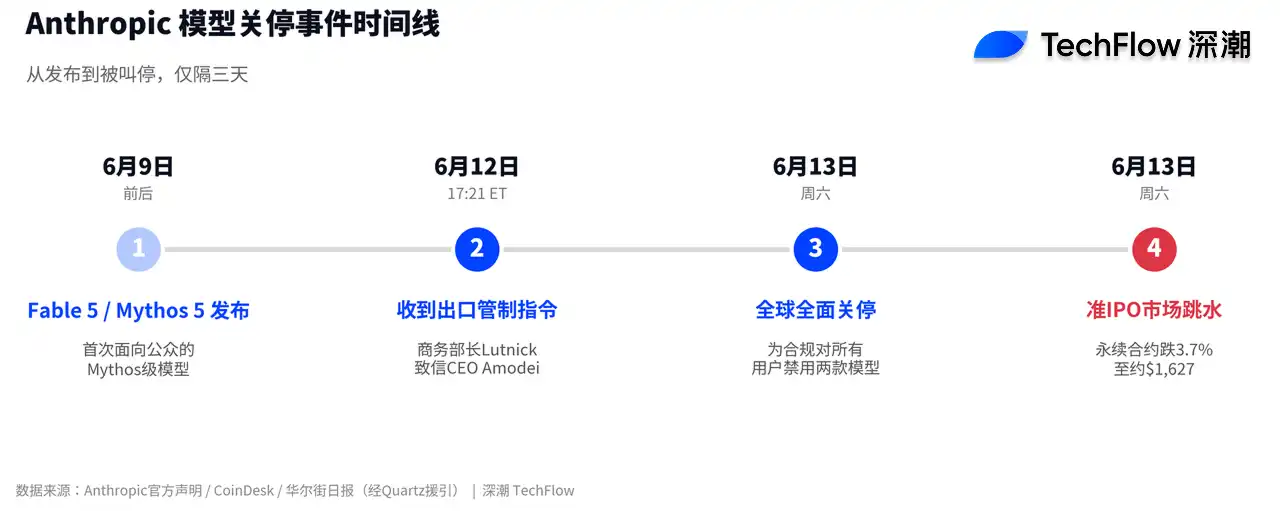
According to reports from CoinDesk and other media outlets, on June 12th (Friday) afternoon, the US government issued an export control directive to Anthropic, requiring it to suspend all access to Claude Fable 5 and Claude Mythos 5 for foreign nationals—whether inside or outside the US, including the company's own foreign employees. Unable to implement selective restrictions without affecting compliance, Anthropic simply disabled these two models for all users globally; other Claude models remain unaffected. In a statement, Anthropic clearly stated its disagreement with the government's rationale, calling it "a misunderstanding," and is working to restore access as soon as possible.
Directive Cites National Security, One Letter Triggers Full Shutdown

According to The Wall Street Journal (as cited by Quartz), US Commerce Secretary Howard Lutnick sent a letter to Anthropic CEO Dario Amodei outlining the relevant restrictions. Anthropic revealed that the company received the directive at 5:21 PM (Eastern Time) that day, but the letter did not provide specific details of the national security concerns.

Anthropic stated that, to its understanding, the government believes it has discovered a method to bypass or "jailbreak" Fable 5. Company executives explained that the cited vulnerability involves a narrow prompt engineering technique used to make the model review pre-existing, minor software bugs in code, emphasizing that similar outputs can be easily obtained from competitor models like OpenAI's without any special evasion tactics.

Anthropic's wording in its statement was unusually direct: "We are complying with a legal directive from the government and removing access to Fable 5 and Mythos 5 for all users. But we disagree that discovering a narrow potential jailbreak vulnerability should constitute grounds for recalling a commercial model already deployed to hundreds of millions of people." The company warned that if this standard were applied across the industry, it "would essentially halt all new model deployments from frontier model providers."

The company also noted that, as of now, the government has only provided oral evidence—no written documentation, technical report, or formal disclosure through established channels—and promised to publish further technical analysis within 24 hours to illustrate the limited nature of the issue.

Quasi-IPO Market Reacts Instantly, Hyperliquid Perpetual Contract Plunges

The reason this regulatory news became a financial event is that Anthropic is not yet publicly listed, and the crypto market has already built a "shadow pricing" venue for it.

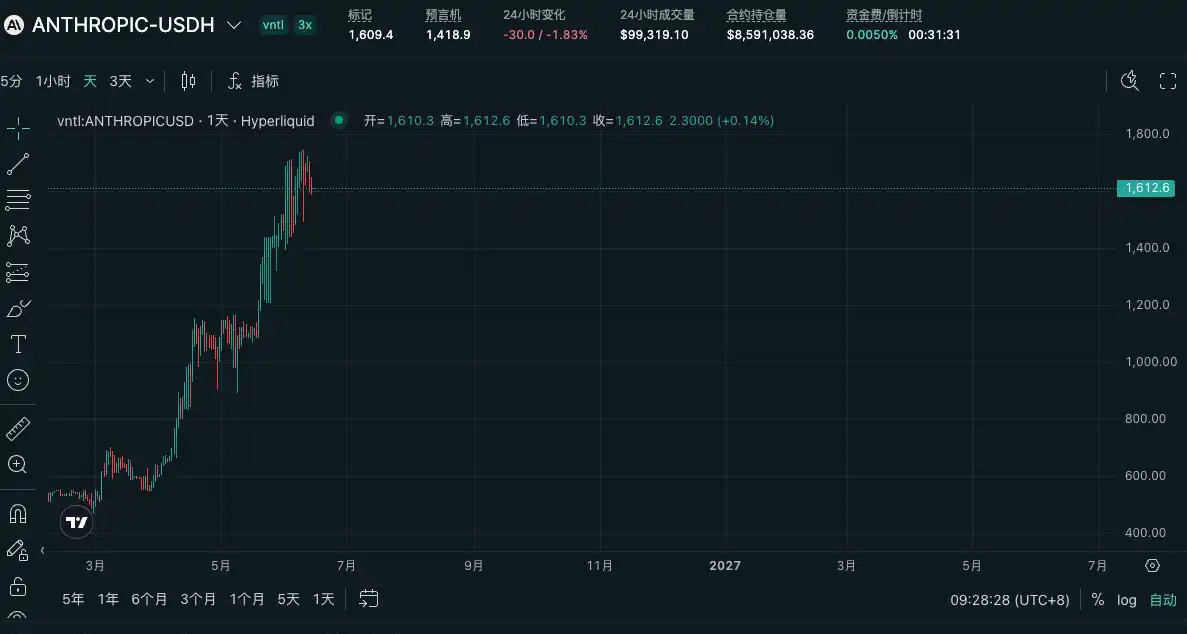
According to CoinDesk, the Anthropic perpetual contract on Hyperliquid fell about 3.7% to around $1,627 on Saturday. In the days following the Fable 5 launch, the contract had been trading near its all-time highs above $1,800. The contract's open interest is approximately $8.6 million. While this volume is small relative to larger proxy instruments for the private market, it represents a notable signal for a company that has yet to file for an IPO.

The contract's price roughly corresponds to an implied valuation for Anthropic in the trillions of dollars—a price of $1,638 equals an implied valuation of about $1.638 trillion. Within 24 hours of the news breaking, the contract's 24-hour trading volume was approximately $190,000, with a funding rate of 0.0056%.
The impact was not limited to the contract market. According to Bitcoin.com, the ANTHROPIC token issued by Prestocks on the Solana blockchain—which claims to provide spot-like exposure through a Special Purpose Vehicle (SPV) structure—fell 9.11% in 24 hours to $655.32, and the total value locked in the related liquidity pool shrank 18.09% to about $126,000. It should be noted that Anthropic has previously publicly warned that any unauthorized tokenization or derivatives claiming to offer exposure to its equity may be considered invalid, and the aforementioned products are not endorsed by or affiliated with Anthropic.

Shut Down Just Days After Launch, Fable 5 Was a Milestone

The two halted models were released just days ago.

According to multiple reports, Fable 5 and Mythos 5 were launched around June 9th and were seen as a significant leap forward in capabilities for software engineering, scientific reasoning, vision tasks, and long-context handling. Fable 5 marked Anthropic's first public release of a model at the Mythos level—a tier positioned above the original flagship Opus. The two models are built on the same underlying architecture, primarily differing in output control: Fable 5 has a built-in classifier for intercepting responses in high-risk areas like cybersecurity, while Mythos 5 is available to a separately vetted, trusted user group.

As summarized by MarkTechPost, Fable 5's classifier is a separate AI system designed to identify potential misuse. When queries touch on areas like cybersecurity, biochemistry, or model distillation, processing falls back to Claude Opus 4.8, with users notified of the fallback each time; the trigger rate is less than 5%. Notably, Mythos 5 was also supporting critical cybersecurity defense work through projects like Project Glasswing—raising the question of whether the temporary disablement might actually hinder infrastructure protection.

The Safety Narrative Backfires, Adding Uncertainty to IPO Process

For Anthropic, the awkwardness of this incident lies in its timing and logic.

TechCrunch reported the story under the headline "Anthropic’s safety warnings may have just backfired"—it's a bitter pill to swallow for a company that has built its entire corporate identity on "responsible AI development" to now be ordered to shut down its strongest models based solely on an oral briefing. And the company has publicly voiced this discontent.

This controversy coincides with a sensitive period as Anthropic advances its IPO preparations. The company recently confidentially submitted registration documents, joining the ranks of major AI players planning public listings. Although tools like Hyperliquid have relatively thin liquidity, the contract's decline reflects investor caution regarding its near-term valuation and listing path. Such sudden regulatory actions add new variables to an already uncertain IPO process.

Anthropic stated it is actively communicating to resolve the matter and restore service as soon as possible, viewing the directive as "based on a misunderstanding." The ultimate outcome of this incident may influence the future dynamics between regulators and innovators, and even shape how export rules and safety assessments apply to evolving AI technology.


Domande pertinenti

QWhy did the US government order Anthropic to shut down its two strongest AI models, Fable 5 and Mythos 5?

AThe US government ordered Anthropic to shut down the models due to national security concerns. Specifically, the government reportedly possesses a method for 'jailbreaking' or bypassing the Fable 5 model's safety restrictions using a specific prompt technique related to reviewing minor software defects in code.

QWhat was the financial impact of this shutdown on Anthropic's 'shadow' valuation?

AThe shutdown caused the price of the Anthropic perpetual contract on Hyperliquid, a crypto-based proxy for its pre-IPO valuation, to drop approximately 3.7% to around $1,627. This represented a decline from its recent highs above $1,800 following the models' release, translating to a fall in its implied multi-trillion dollar valuation.

QHow did Anthropic respond to the government's directive?

AAnthropic complied with the order by shutting down global access to Fable 5 and Mythos 5 but publicly expressed strong opposition. The company called it a 'misunderstanding,' disagreed that a narrow potential jailbreak vulnerability warranted recalling a widely deployed commercial model, and warned that applying this standard broadly would essentially halt all new model deployments by frontier AI providers.

QWhat are Fable 5 and Mythos 5, and when were they released?

AFable 5 and Mythos 5 are Anthropic's two most advanced AI models, representing a significant leap in capabilities for software engineering, scientific reasoning, visual tasks, and long-context handling. They were released publicly around June 9, 2026. Fable 5 is the first publicly available model in the new top-tier 'Mythos' category, while Mythos 5 offers less restrictive output control for vetted users.

QHow does this incident relate to Anthropic's identity and its IPO plans?

AThe incident is particularly ironic and challenging for Anthropic, as the company's core identity is built on 'responsible AI development' and safety. Being forced to shut down its flagship product on safety grounds is seen as a form of narrative backlash. Furthermore, this regulatory action introduces new uncertainty during a sensitive period as Anthropic is reportedly preparing for its initial public offering (IPO).

Letture associate

19 New Decacorns in Half a Year: Why is the Primary Market Chasing 'Certainty'?

In the first half of 2026, China’s primary market saw a notable increase in unicorns, adding 19 new companies each valued over 100 billion RMB, particularly in sectors like embodied AI and large language models (LLMs). Firms such as Galaxy General, Zibian, and ZhiPingFang even surpassed 200 billion RMB valuations within months. Moonshot AI's valuation surged from around $10 billion to $35 billion by July 2026, with a pre-IPO target of $50 billion. This concentration of capital into a few "certain" sectors highlights a market shift. The driving force is not a general abundance of capital but a chase for "certainty"—primarily clearer exit pathways like imminent IPOs. Companies with defined public listing timelines attract intense investment despite higher valuations, as they reduce exit uncertainty for investors. Secondary market valuations of listed peers also serve as new anchors, boosting the perceived value of private companies in similar fields, though this creates dependency on public market sentiment. Another form of certainty comes from the expectation of rising valuations in subsequent funding rounds. The investment logic has shifted in some cases from assessing long-term fundamental value to betting on the next round attracting higher prices. This dynamic is also seen in deep-tech areas like nuclear fusion, where firms like NeoFusion secured a 10.6 billion RMB valuation despite early commercial stages, driven by scarcity and strategic bets. However, this trend signals a risk transfer: technical uncertainties remain but are temporarily masked by valuation inflation. As valuations climb—50 billion to 200 billion or 500 billion RMB—companies face increasing pressure to demonstrate real revenue, profit, and sustainable business models. The danger lies not in the rise of unicorns itself, but if valuations become detached from value creation and rely merely on the expectation of future funding or exits. Ultimately, the surge reflects investors seeking perceived safety in shorter-term exit certainty and transactional momentum, rather than a renewed appetite for risk. The true test will come when the market inevitably refocuses on fundamentals, questioning how many of today’s high valuations are backed by genuine economic value.

marsbit18 min fa

19 New Decacorns in Half a Year: Why is the Primary Market Chasing 'Certainty'?

marsbit18 min fa

Just Now, Sam Altman Blasts Dario Amodei as 'Anti-Human', Secret Model Exposed the Same Day

Just now, Sam Altman strongly criticized Dario (Amodei, co-founder of Anthropic), denouncing his "doomsday marketing" as "anti-human dictator rhetoric." This came alongside the accidental exposure of OpenAI's next-generation model, codenamed "gpt-nathree," hinting at the imminent release of GPT-6 Astra. The leak occurred when an OpenAI employee's public GitHub commit mentioned the codename. Combined with previous leaks of "gpt-mewfour," it suggests these are iterative checkpoints for OpenAI's upcoming agent model, Astra. Astra is known for multi-agent collaboration and long-duration task handling, having reportedly solved previously unsolved mathematical problems. Meanwhile, two new Anthropic model codenames, "claude-marshmallow-eap" and "claude-melon-eap," were also exposed but are believed to be iterations of the Claude 5 series, not a new flagship. In a wide-ranging podcast interview, Altman admitted he was wrong about the speed of AI-driven disruption, acknowledging societal inertia slows adoption. He fiercely criticized rivals' marketing that simultaneously promises immense benefits (like curing cancer) and warns of existential risk, calling it a dangerous "benevolent dictator" narrative that seeks to concentrate power. He emphasized that people are the ultimate purpose of AI. Altman also revealed OpenAI's unconventional, consensus-defying path: spending four and a half years in the "dark" without a public product before ChatGPT's breakthrough, driven by scaling laws rather than early customer feedback. He concluded that even with superintelligent AI, genuine human connection will remain irreplaceably valuable.

marsbit58 min fa

Just Now, Sam Altman Blasts Dario Amodei as 'Anti-Human', Secret Model Exposed the Same Day

marsbit58 min fa

The 'Saving U.S. Treasuries' Baton Pass: Bessent Fumbled Last Week, This Week It's Wash's Turn

"Rescuing US Treasuries" Relay: After Bessent's Miss, All Eyes Are on Walsh Last week, US Treasury Secretary Bessent's announcement to at least double long-term Treasury buybacks failed to sustainably lower yields, which quickly rebounded. The market response saw a drop in the dollar alongside surges in gold and Bitcoin, interpreted as a "pressure release valve" for anxiety. The focus now shifts to Fed Chairman Walsh's upcoming Jackson Hole speech. Markets are highly sensitive to his message, seeking clarity on the Fed's policy response to stubborn inflation and worsening fiscal conditions. Analysts warn that a lack of new guidance could disappoint markets and worsen the sell-off in long-dated bonds. Analysts question the scale of Bessent's operations, noting they are too small relative to the overall debt market and do not constitute quantitative easing. A key issue is the Fed's massive holdings of long-term bonds, which distorts the market. With the Fed holding low-yielding short-term bonds that are losing money relative to its policy rate, discussion is growing around a potential Fed-led "Operation Twist." This would involve selling short-term bonds to buy long-term ones, aiming to lower long-end yields without expanding the balance sheet. The upcoming PCE inflation data will set the stage for Walsh's speech. However, the window for action is narrowing amid political pressures. A critical threshold is the 30-year yield at 5%; holding above it could increase stress on the dollar and leveraged sectors. Overall, the article suggests that without coordinated Fed action to anchor inflation expectations, Treasury interventions may ultimately fail, with investors increasingly looking to assets like gold as hedges.

marsbit1 h fa

The 'Saving U.S. Treasuries' Baton Pass: Bessent Fumbled Last Week, This Week It's Wash's Turn

marsbit1 h fa

Hyperliquid's Compliance Journey: From Permissionless to Permissioned via HIP-3

Hyperliquid’s Compliance Path: From Permissionless to Permissioned HIP-3 Hyperliquid currently blocks U.S. access because its permissionless, on-chain infrastructure conflicts with U.S. market structure laws, which restrict futures trading to registered exchanges, clearinghouses, and brokers. Through its Hyperliquid Policy Center (HPC), the project is advocating for regulatory modernization, proposing that regulated entities be allowed to build products on HyperCore (its exchange and clearing layer) while fulfilling their compliance obligations. The platform’s modular stack separates roles like a traditional exchange (DCM), clearinghouse (DCO), and broker (FCM), but reconstructs them on-chain with code. This enables permissionless access, self-custody, and 24/7 global trading, but clashes with U.S. rules requiring KYC, specific margin models, and custodial arrangements. To resolve this, HPC is engaging with U.S. regulators (CFTC, SEC) to seek clarity that deploying on-chain software does not itself trigger licensing, and to establish exemptions allowing non-custodial wallets to route users to regulated derivatives. Recent political signals suggest openness to this approach. On the technical side, Hyperliquid Labs has introduced permissioned HIP-3 deployers on testnet. These allow regulated entities to launch markets, perform KYC, and whitelist compliant users. While these create separate order books, whitelisted market makers can bridge liquidity between them, ensuring deep, shared liquidity across the same L1. Features like payload-based “PA” permissions enable DEX-level account controls (e.g., reduce-only orders), mirroring traditional broker authorities. The strategy is not to open the native, permissionless front-end to U.S. users, but to position Hyperliquid as neutral infrastructure that U.S. regulated firms can use while meeting their legal duties. This paves a compliant path for U.S. investor access while preserving the protocol’s core, permissionless nature.

marsbit1 h fa

Hyperliquid's Compliance Journey: From Permissionless to Permissioned via HIP-3

marsbit1 h fa

Trading

Spot
活动图片