Token Watch, Based on RootData, Launches Interactive Relationship Graph for Projects, Investors, and Key Figures

marsbitPubblicato 2026-07-27Pubblicato ultima volta 2026-07-27

Introduzione

Token Watch, operated by Token Post, has launched a new "Interactive Relationship Graph" feature. This tool visually maps the connections between cryptocurrency projects listed on the Korean Won market, their investors, and key individuals. The graph allows users to explore investment backgrounds, see which investors co-invest in other projects, and track the past and present affiliations of core team members. Key features include the ability to filter by project, investor, or person, and to view different relationship types: general investment, lead investment, current affiliation, and past affiliation. A focus mode lets users isolate connections within two degrees of a selected node for clearer analysis. The graph is designed to help users identify co-investors, frequent VC partnerships, investor overlap between competing projects, and recurring key figures across the ecosystem. The underlying data for investors and individuals is sourced from RootData, with some verification by the Token Post editorial team. The web-based tool is available in both Korean and English. Token Watch emphasizes that the information is for reference and analysis purposes only and does not constitute investment advice.

Author: Han Jae-ho

The cryptocurrency asset data platform "Token Watch," operated by Token Post, has unveiled an "Interactive Relationship Graph" feature that allows users to see the interconnected structure between projects, investors, and key figures at a glance.

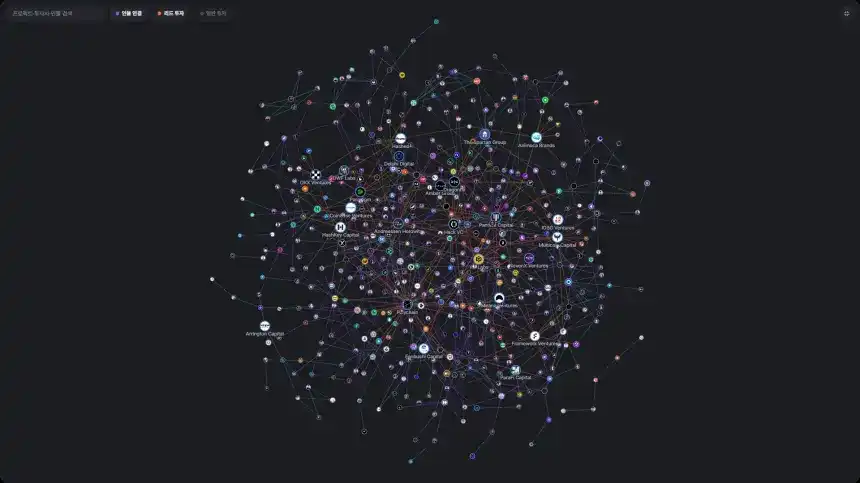
This newly added relationship graph is a function that visually displays how investors and key individuals are connected, centering on cryptocurrency asset projects listed in the Korean won market. Users can not only check the investment background of a single project but also explore other projects participated in by the same investor and the past and present affiliations of individuals within the same screen.


Currently, the relationship graph shows the top 30 investors by portfolio and key figures confirmed across multiple projects. Users can directly search for projects, investors, or individuals, or filter by type to extract only the desired relationships.

The connecting lines are divided into ▲ General Investment ▲ Lead Investor ▲ Current Affiliation ▲ Past Affiliation. Through this classification, users can confirm not only which investors participated in a specific project but also who led the investment round, and the organizations with which key figures are currently or were previously associated.
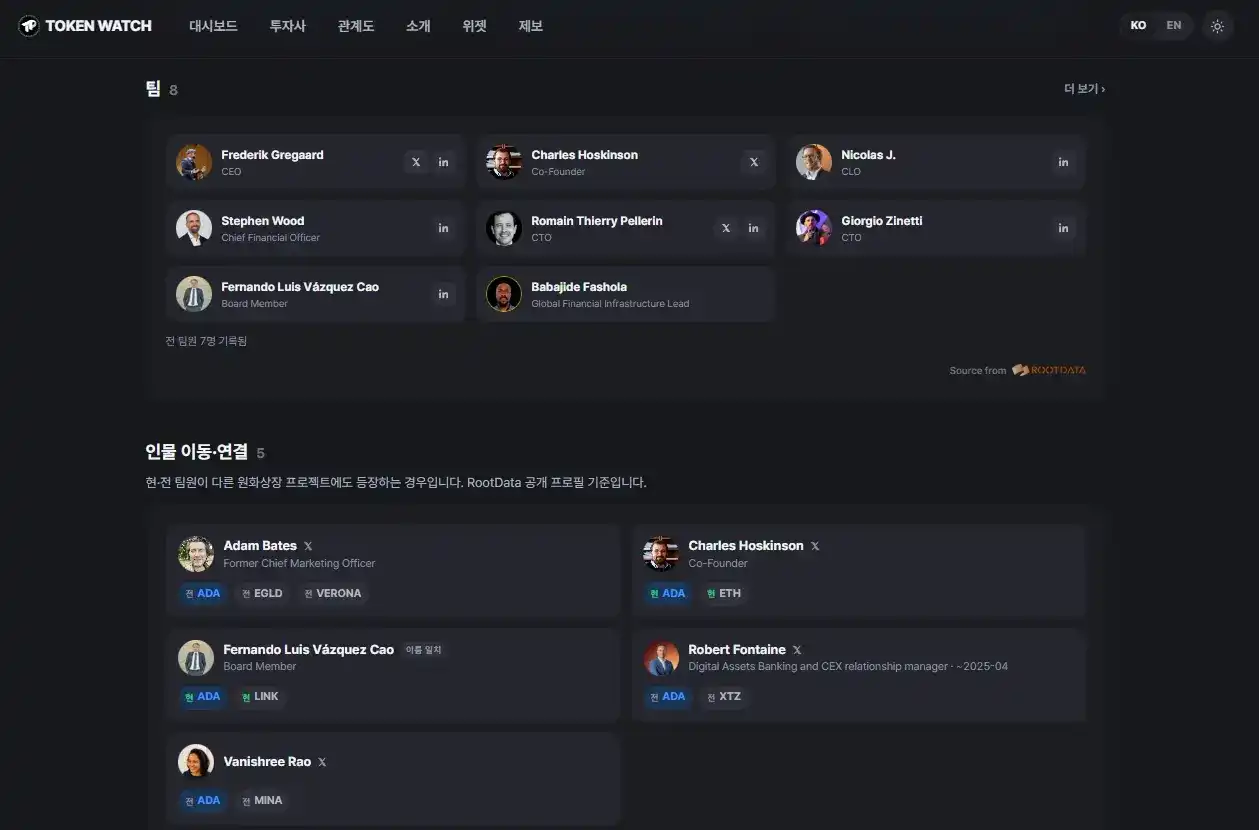
For example, selecting a specific project will display the investors in that project and related individuals. Conversely, with an investor as the center, users can view that investor's portfolio of Korean won-listed projects and co-investment relationships with other investors.

After clicking on a node, using the "View Centered on This Node" function allows users to keep only connections within two degrees of separation from the selected object. Even when the overall network appears complex, this enables quick focus on a specific project or investor, narrowing down to the core relationships. The feature also supports node dragging and screen zooming.

With this relationship graph, Token Watch moves beyond simple investor lists, allowing users to three-dimensionally explore the capital and human networks within the cryptocurrency asset market.


This feature can be used to grasp information that was difficult to confirm previously with just a project's published investor logos, such as:

  • Co-investors

  • Frequent VC co-investor combinations

  • Investor overlap between competing projects

  • Core individuals recurring across multiple projects

Particularly for investors, it can serve as a reference to verify the background of projects of interest; for journalists and researchers, it can be a tool for interviews and analysis to uncover hidden commonalities between projects; and for industry professionals and business developers, it can be used to examine connection paths between projects, investors, and key figures.
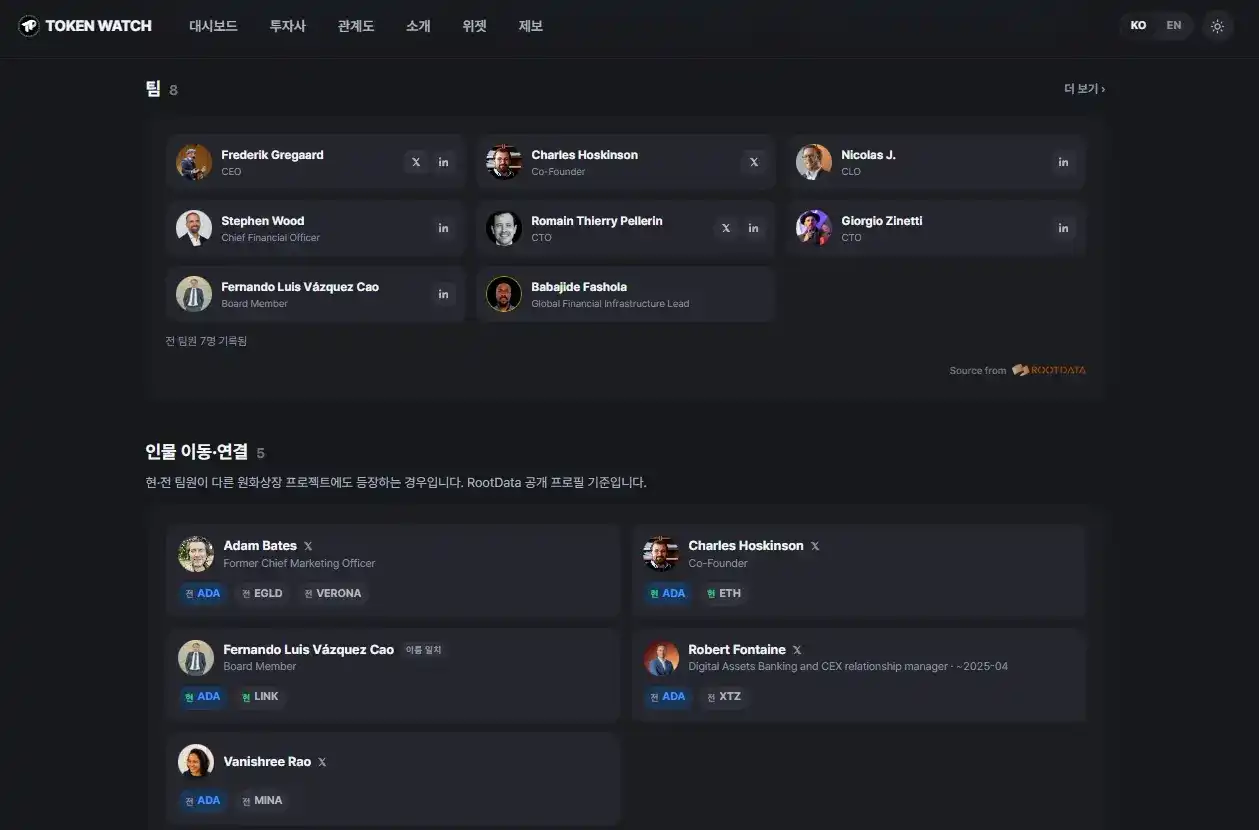
The investor and individual data used in the relationship graph is based on RootData, and some information (such as whether a project has responded) is based on records from the Token Post editorial department. Regarding individual relationships, to reduce erroneous connections of the same person, associations are made only when X account IDs match or two or more full names match.

The Token Watch relationship graph requires no additional installation and can be used directly on the web, supporting both Korean and English interfaces.

A representative from Token Post stated: "To understand a cryptocurrency asset project, one must not only look at price and listing information but also understand which capital and individuals are connected behind the project. We will continue to optimize the relationship graph so that dispersed investment and individual information can be explored intuitively."

Simultaneously, Token Watch states that the information displayed in the relationship graph may differ from the actual latest status due to variations in collection and verification timing. All data is for reference only and does not constitute investment advice.


This article is written based on market data and chart analysis and does not constitute investment advice for specific projects.

Crypto di tendenza

Domande pertinenti

QWhat is the main function of the 'Interaction Relationship Map' feature launched by Token Watch?

AToken Watch launched an 'Interaction Relationship Map' feature that visually displays the interconnected structure between cryptocurrency projects, their investors, and key personnel. It allows users to see investment backgrounds, explore other projects funded by the same investor, and track the past and present affiliations of core individuals.

QWhat types of relationship lines are distinguished in the Token Watch Relationship Map?

AThe relationship lines in the map are categorized into four types: General Investment, Lead Investment, Current Affiliation, and Former Affiliation. This categorization helps users understand not only who invested in a project but also who led the investment round and the past/current organizational ties of key people.

QBased on which data provider is the investor and personnel information in the Relationship Map primarily built?

AThe investor and personnel data used in the Relationship Map is based on the data platform RootData. Additional information, such as whether a project has responded to inquiries, is based on records from the Token Post editorial team.

QWhat practical uses does the article list for the new Relationship Map feature?

AThe article lists several practical uses for the feature: identifying co-investors, spotting frequently co-investing VC combinations, observing investor overlap between competing projects, and recognizing key personnel who appear across multiple projects. It serves as a reference for investors, a research tool for journalists, and a way for professionals to explore connection paths.

QHow does the feature handle privacy and data accuracy according to the article?

ATo reduce incorrect links for individuals, connections are only made when X (formerly Twitter) accounts match or when two or more full names are identical. Token Watch also notes that the information may differ from the latest actual status due to collection and verification timing, and all data is for reference only, not constituting investment advice.

Letture associate

Just Now, Peking University Alumna Lilian Weng Announces Resignation: The Best 'Alignment' in the AI Era Is Taking Care of Yourself

Lilian Weng, a Peking University alumnus and former OpenAI executive, has announced her departure from Thinking Machines Lab, the AI startup she co-founded with ex-OpenAI CTO Mira Murati 20 months ago. Her resignation comes shortly after the company released its first open-source model, Inkling. In her farewell message, Weng cited health reasons as the primary factor, stating that the past seven months involved more illness than any other period in her life. The intense pressure and guilt of being unable to work during critical periods, like the Inkling launch, became unsustainable. She expressed that she could not continue in a role where she felt unable to give her full effort. Weng joined OpenAI in 2018, contributing to projects like the Dactyl robotic hand and later building the Safety Systems team from scratch. She is also widely known for her influential technical blog, Lil'Log. Her departure follows a period of high expectations and challenges for Thinking Machines, which secured a record $20 billion seed round at a $120 billion valuation in 2025 but has since seen fluctuations in its valuation and the departure of other key co-founders. Weng emphasized that she remains passionate about AI but needs a more predictable and defined role without the relentless pressure of a co-founder. Her exit highlights the immense personal toll and speed of competition in the AI industry, where the drive for progress often clashes with human limits. Her decision underscores that stepping back to prioritize well-being can be an act of courage.

marsbit19 min fa

Just Now, Peking University Alumna Lilian Weng Announces Resignation: The Best 'Alignment' in the AI Era Is Taking Care of Yourself

marsbit19 min fa

Crypto.com, Backed by Citadel Securities, Transfers XYO and XL1 into Regulated Custody

Crypto.com, with backing from Citadel Securities, has placed XYO and XL1 tokens into regulated custody. This move provides eligible institutions and high-net-worth clients with a regulated mechanism for storing, managing, and exchanging these tokens without first having to transfer assets onto an exchange. The custody structure utilizes segregated MPC wallets managed by a bankruptcy-remote entity, with private keys secured via multi-party computation. Clients benefit from cold storage, audit trails, and direct access to Crypto.com's institutional liquidity while their assets are custodied, removing the operational step of pre-trade transfers. Company leadership positioned this as a strategic step to provide "unmatched security and seamless liquidity" for digital asset organizations, and to protect and scale the XYO ecosystem. The partnership builds on an existing relationship since XYO's initial listing on the exchange. This development follows Citadel Securities' $400 million investment in Crypto.com and comes as the company expands its regulatory standing, having received conditional approval to establish a national trust bank. For institutional investors, this custody agreement addresses a key barrier by demonstrating that smaller market-cap assets like XYO and XL1 can be held under the same regulatory and security standards as larger tokens. XYO operates a large DePIN network generating real-world data for AI and robotics, with XL1 handling its blockchain transactions and infrastructure.

cryptonews.ru2 h fa

Crypto.com, Backed by Citadel Securities, Transfers XYO and XL1 into Regulated Custody

cryptonews.ru2 h fa

Less Than Two Weeks Left — Bitcoin's BIP-110 Countdown Begins as Miner Support Grows Ahead of Decisive Moment

The BIP-110 activation process for Bitcoin, which proposes a temporary soft fork to limit specific data-heavy transaction types (like Ordinals inscriptions), is entering its critical final phase. As of July 27, 2026, there are roughly 1,790 blocks remaining until the mandatory signaling window begins at block 961,632 (estimated for August 9). Starting then, nodes enforcing BIP-110 will reject blocks not signaling for the proposal. While support from miners has grown from below 1% to around 3% recently, it remains concentrated among smaller pools and independent miners, with major pools like Foundry, Antpool, ViaBTC, and F2Pool largely not signaling. Foundry's stance is particularly decisive, as it holds a large share of the network's hashrate and has tied its signaling to a client vote. Without a major pool's shift, widespread activation is unlikely. If the current low signaling levels persist after the window opens, nodes enforcing BIP-110 will follow a slower, minority chain, potentially creating a chain split from the majority chain followed by legacy (e.g., Bitcoin Core) nodes. This activation mechanism differs from past soft forks like SegWit, resembling the 2017 UASF BIP-148 more closely. Proponents argue BIP-110 is necessary to curb spam-like data transactions that increase node costs and distort fee markets, framing opposition as a contentious hard fork. Critics, however, view the activation method as a radical overreaction to a minor issue. The final outcome in the coming two weeks hinges on whether a major pool switches support, if major exchanges clarify their chain preference, and how miners actually behave once the mandatory window is open.

cryptonews.ru2 h fa

Less Than Two Weeks Left — Bitcoin's BIP-110 Countdown Begins as Miner Support Grows Ahead of Decisive Moment

cryptonews.ru2 h fa

Trading

Spot

Articoli Popolari

Come comprare DATA

Benvenuto in HTX.com! Abbiamo reso l'acquisto di DATA Network (DATA) semplice e conveniente. Segui la nostra guida passo passo per intraprendere il tuo viaggio nel mondo delle criptovalute.Step 1: Crea il tuo Account HTXUsa la tua email o numero di telefono per registrarti il tuo account gratuito su HTX. Vivi un'esperienza facile e sblocca tutte le funzionalità,Crea il mio accountStep 2: Vai in Acquista crypto e seleziona il tuo metodo di pagamentoCarta di credito/debito: utilizza la tua Visa o Mastercard per acquistare immediatamente DATA NetworkDATA.Bilancio: Usa i fondi dal bilancio del tuo account HTX per fare trading senza problemi.Terze parti: abbiamo aggiunto metodi di pagamento molto utilizzati come Google Pay e Apple Pay per maggiore comodità.P2P: Fai trading direttamente con altri utenti HTX.Over-the-Counter (OTC): Offriamo servizi su misura e tassi di cambio competitivi per i trader.Step 3: Conserva DATA Network (DATA)Dopo aver acquistato DATA Network (DATA), conserva nel tuo account HTX. In alternativa, puoi inviare tramite trasferimento blockchain o scambiare per altre criptovalute.Step 4: Scambia DATA Network (DATA)Scambia facilmente DATA Network (DATA) nel mercato spot di HTX. Accedi al tuo account, seleziona la tua coppia di trading, esegui le tue operazioni e monitora in tempo reale. Offriamo un'esperienza user-friendly sia per chi ha appena iniziato che per i trader più esperti.

124 Totale visualizzazioniPubblicato il 2026.07.01Aggiornato il 2026.07.01

Come comprare DATA

Discussioni

Benvenuto nella Community HTX. Qui puoi rimanere informato sugli ultimi sviluppi della piattaforma e accedere ad approfondimenti esperti sul mercato. Le opinioni degli utenti sul prezzo di DATA DATA sono presentate come di seguito.

活动图片