Ethereum vs. Bitcoin: Is ETH’s 5% Q3 rally the start of a structural rotation?

ambcryptoPubblicato 2026-07-12Pubblicato ultima volta 2026-07-12

Introduzione

The article examines whether Ethereum's (ETH) recent 5% Q3 rally against Bitcoin (BTC) signals a lasting capital rotation or is merely another short-term move. Historically, ETH has struggled to sustain outperformance; a strong 2025 Q3 rally was largely reversed, suggesting temporary rotations as capital flowed back to Bitcoin. Currently, Bitcoin dominance is testing a key resistance level, hinting at a possible shift back toward BTC. However, on-chain and institutional data present a counter-narrative. Ethereum ETFs have attracted significant net inflows this month, outperforming Bitcoin ETFs. A key catalyst is Robinhood's new Layer 2 network, which uses ETH for gas and settlement. Data shows a nearly 10x weekly surge in ETH bridged to this chain, indicating growing ecosystem activity and ETH demand. While it's premature to confirm a structural shift, the rally appears increasingly supported by fundamentals—including institutional inflows, rising Layer 2 adoption, and stronger on-chain metrics—rather than just market rotation. If these trends persist, the current ETH/BTC breakout could signal the beginning of a broader capital move into Ethereum during Q3.

Ethereum [ETH] has historically struggled to sustain its outperformance against Bitcoin.

On the technical front, ETH/BTC last posted a strong quarterly rally in Q3 2025, surging 53%, marking its biggest quarterly gain since Q2 2021. However, sellers erased 50% of those gains as the rally lost momentum. This suggests the rotation was temporary, as capital continued to flow into Bitcoin.

Against this backdrop, the ratio’s 5% rally so far in Q3 appears too early to confirm a sustained rotation from Bitcoin into Ethereum. At the same time, Bitcoin dominance is once again pushing toward the key 60% resistance level, gaining 1.5% in July and signaling that capital may already be rotating back into Bitcoin.
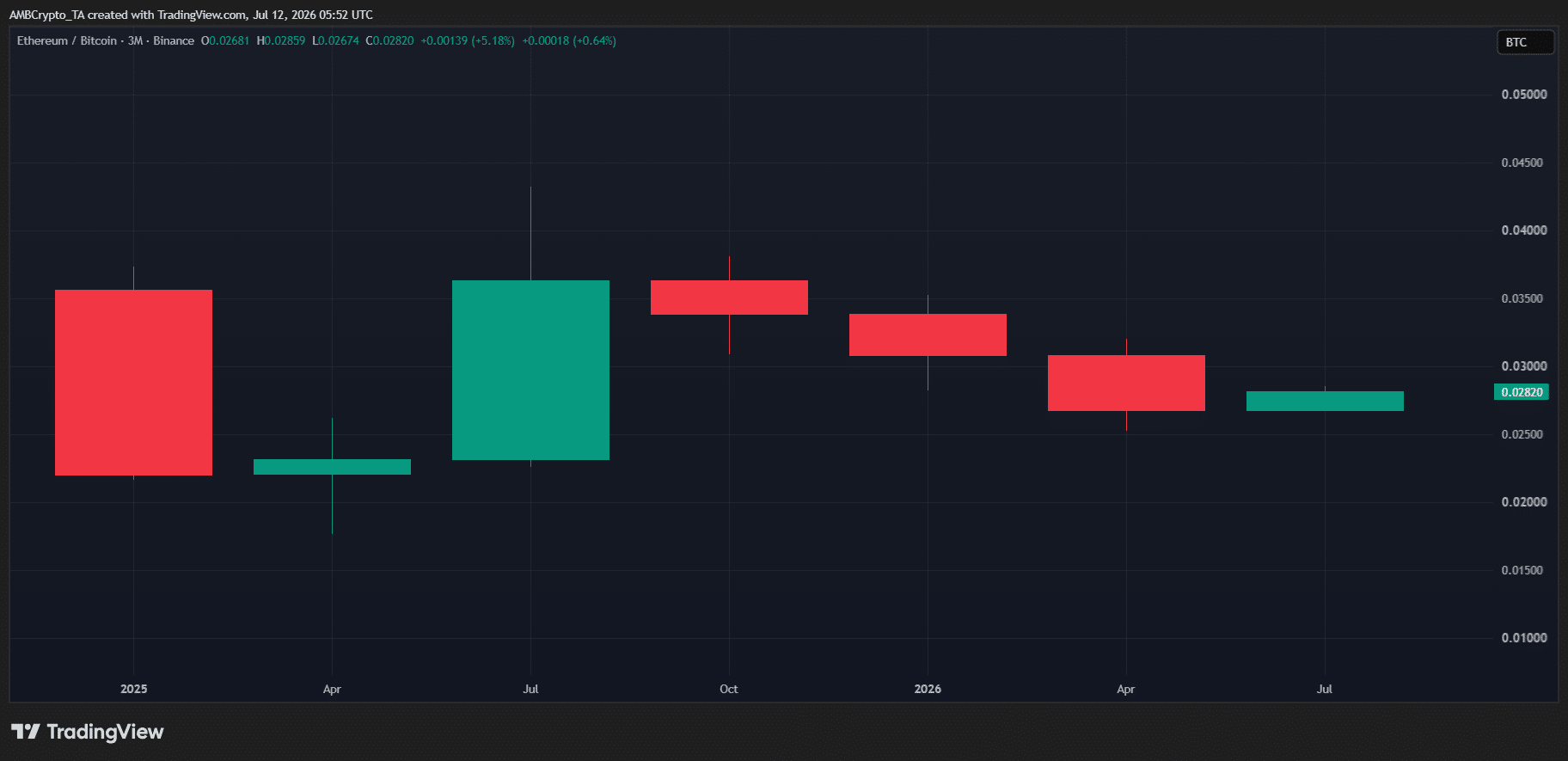
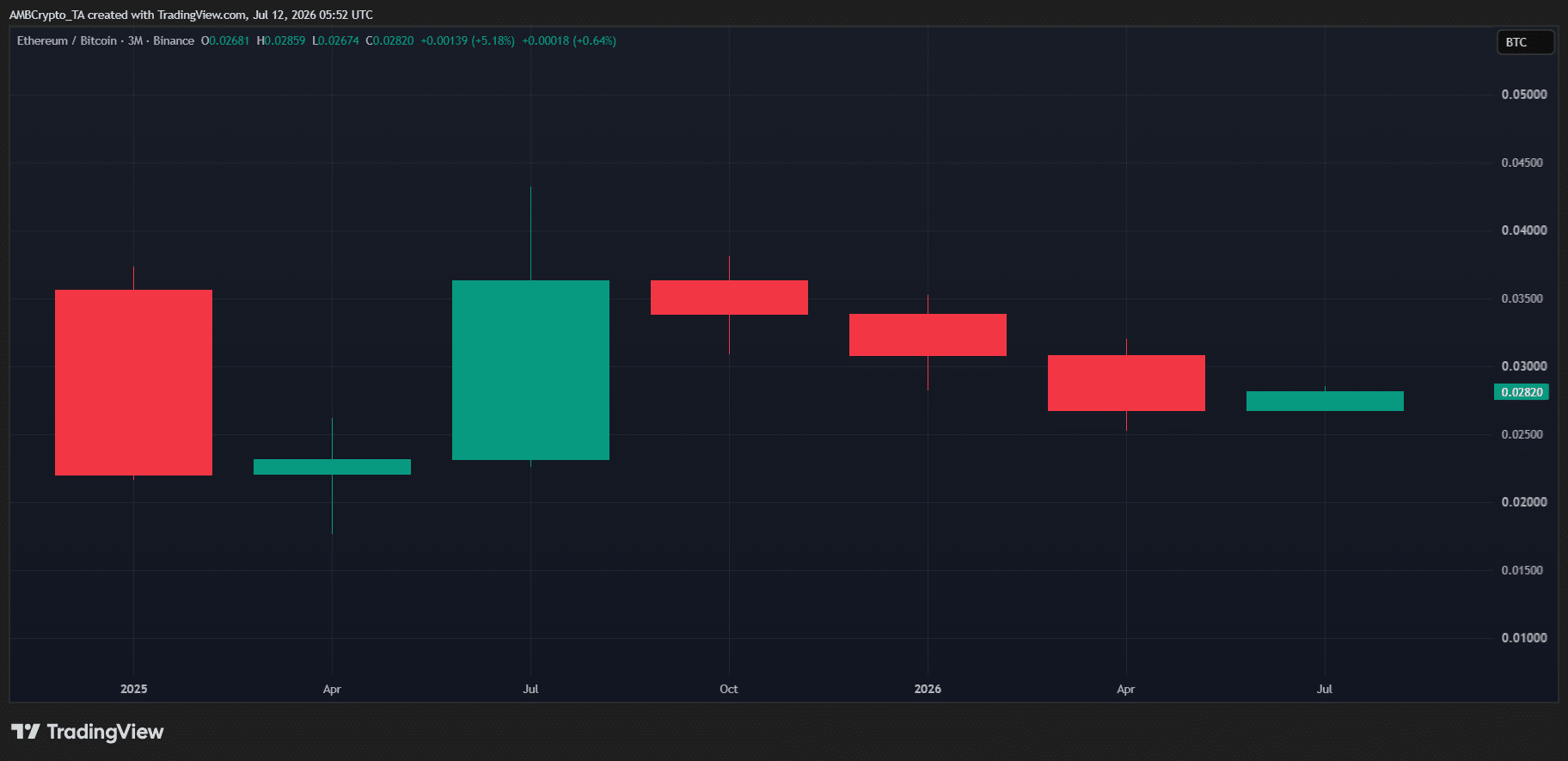
Source: TradingView (ETH/BTC)

That said, Eric Trump’s recent post on X points in the opposite direction, supporting Ethereum’s rally.

Meanwhile, the on-chain data tells a similar story. Ethereum’s outperformance against Bitcoin [BTC] isn’t happening in isolation. Institutional positioning continues to back the move, with Ethereum ETFs attracting over $128 million in net inflows so far this month, outperforming Bitcoin. Meanwhile, Ethereum’s DATs are recovering, adding further support to Ethereum’s recent strength.

With that said, it may be too early to write off the current ETH/BTC uptrend as just another short-term rotation. The bigger question is whether smart money is positioning ahead of a structural shift that the broader market has yet to price in.

Ethereum’s latest catalyst puts the ETH/BTC ratio in the spotlight

A key catalyst may be reinforcing the institutional rotation into Ethereum.

Tom Lee pointed to Robinhood’s recently unveiled Layer 2 chain as a major differentiator, calling it a breakout product that has already generated more volume than many established DEXs. More importantly, the network uses ETH as its native gas token, and settles on Ethereum Layer 1. As activity on the chain grows, each transaction feeds back into Ethereum’s ecosystem, strengthening the long-term demand case for ETH.

The on-chain data backs this up. As the chart below shows, the amount of ETH bridged from Ethereum Layer 1 to the Robinhood Chain has jumped nearly 10x over the past week, surpassing $100 million. That suggests users are actively moving liquidity into Robinhood’s Layer 2 ecosystem, with ETH emerging as the network’s core asset for gas, settlement, and on-chain activity.
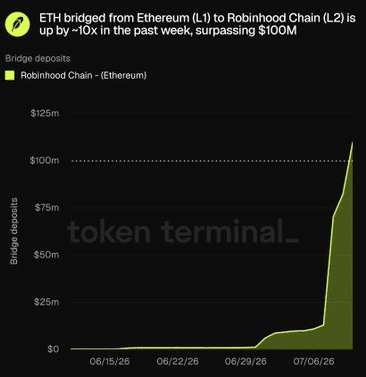
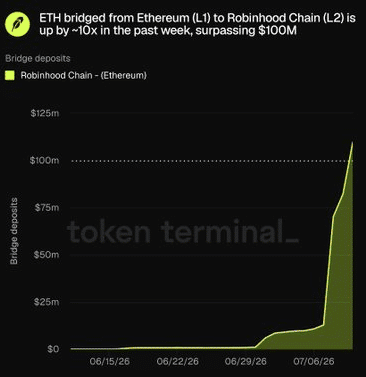
Source: Token Terminal

In this context, Ethereum’s outperformance against Bitcoin may be more than just another rotation.

Instead, the move looks increasingly driven by improving fundamentals, as institutional inflows, growing Layer 2 activity, and rising on-chain demand continue to strengthen Ethereum’s long-term investment case. If that trend holds, the ETH/BTC breakout could be the first sign of a broader capital rotation into Ethereum through Q3.


Final Summary

  • Ethereum’s rally against Bitcoin is backed by ETF inflows, stronger on-chain activity, and Robinhood’s Layer 2 ecosystem.
  • If these trends continue, the ETH/BTC breakout could signal a broader shift of capital into Ethereum in Q3.

Crypto di tendenza

Domande pertinenti

QBased on the article, what evidence suggests that Ethereum's recent outperformance against Bitcoin might be more than just a short-term rotation?

AThe evidence includes substantial institutional support with Ethereum ETFs attracting over $128 million in net inflows, strong growth in on-chain activity and fundamentals like the recovery of DATs, and a key catalyst in Robinhood's Layer 2 chain, which uses ETH as its native gas token and has seen a 10x increase in bridged ETH value. These factors point to improving fundamentals driving the move.

QWhat technical pattern in the ETH/BTC ratio from Q3 2025 does the article use as a cautionary example for the current rally?

AThe article notes that in Q3 2025, the ETH/BTC ratio surged 53%, its biggest quarterly gain since Q2 2021, but sellers later erased 50% of those gains as momentum faded. This historical example suggests such strong rallies can be temporary if capital flows back into Bitcoin.

QAccording to the on-chain data mentioned, what significant change occurred regarding ETH on the Robinhood Chain recently?

AThe amount of ETH bridged from Ethereum Layer 1 to the Robinhood Chain jumped nearly 10 times over the past week, surpassing $100 million. This indicates users are actively moving liquidity into Robinhood's Layer 2 ecosystem, establishing ETH as the core asset for gas, settlement, and activity on that network.

QWhat conflicting signal does the article present that might challenge the idea of a sustained capital rotation from Bitcoin to Ethereum?

AThe article points out that Bitcoin dominance is pushing toward the key 60% resistance level, having gained 1.5% in July. This signals that capital may already be rotating back into Bitcoin, which contradicts the narrative of a sustained shift towards Ethereum.

QWhat does Tom Lee, cited in the article, identify as a major differentiator and catalyst for Ethereum?

ATom Lee identifies Robinhood's recently unveiled Layer 2 chain as a major differentiator, calling it a breakout product that has already generated more volume than many established DEXs. Crucially, it uses ETH as its native gas token and settles on Ethereum Layer 1, strengthening ETH's long-term demand case as activity grows.

Letture associate

Apple Sues OpenAI Sparking Feud, Musk Slams Altman for Fraud, Altman Retorts with 'Space Data Center' Boast

Apple Sues OpenAI as Musk-Altman Feud Escalates The public feud between Elon Musk and OpenAI CEO Sam Altman intensified, coinciding with their respective AI companies launching flagship models in the same week, highlighting fierce competition. On July 11, Musk posted on X, accusing Altman of taking "fraud to the next level" regarding OpenAI's commercial practices. Altman fired back, sarcastically suggesting Musk was the one selling "short-term space datacenter" concepts to public market investors. Musk countered with allegations that Altman "stole an open-source AI charity" and, amid Apple's recent lawsuit, "stole all of Apple's phone tech." He mockingly referenced Altman needing a "parole officer's" approval to travel. This exchange occurred against the backdrop of a significant legal development: Apple filed a lawsuit against OpenAI in a California federal court, alleging the AI company deliberately solicited Apple employees to leak confidential information on unreleased products to aid its own hardware plans. Apple demands OpenAI cease this activity, destroy proprietary materials, and redesign upcoming products. OpenAI responded, stating it has no interest in other companies' trade secrets and remains focused on innovation. This lawsuit could profoundly impact their two-year partnership where OpenAI provides key tech for Apple Intelligence and Siri. The rivalry extended to product releases. OpenAI launched GPT-5.6, while Musk's SpaceXAI unveiled Grok 4.5. Both are positioned as AI agents capable of multi-step tasks. GPT-5.6 is noted for strengths in broad reasoning, business workflows, and cybersecurity. Grok 4.5 is highlighted for higher efficiency in autonomous programming and developer workflows, with lower usage costs than GPT-5.6, though OpenAI's model reportedly still leads in areas like abstract reasoning. The differing strengths offer distinct choices for enterprises and developers based on their specific needs.

marsbit1 h fa

Apple Sues OpenAI Sparking Feud, Musk Slams Altman for Fraud, Altman Retorts with 'Space Data Center' Boast

marsbit1 h fa

Robinhood Chain's Success Proves Ethereum is Not Dead

Robinhood Chain's success demonstrates that Ethereum's L1+L2 model is thriving, not dying. Traditional crypto projects often focused on token sales and chose infrastructure to maximize token value. However, real-world businesses building cash-based products make different, pragmatic choices. When launching its chain, Robinhood chose Ethereum as its base layer and built a custom L2 using Arbitrum technology. It uses Ethereum blobs for data availability, ETH for gas, and relies on Ethereum for security. This mirrors Coinbase's earlier decision to build Base as an Ethereum L2. These are not ideological choices but sound business decisions driven by needs for security, liquidity, control, and predictable economics. The shift in the industry is from "token-centric" models to "cash business" models. Real companies serving broad user bases prioritize risk reduction, product improvement, and profit. For them, blockchain is infrastructure. The Ethereum L1+L2 "barbell" structure is ideal: the highly decentralized, neutral, and liquid L1 for settlement and security, combined with customizable, high-performance L2s for execution. This trend is positive for Ethereum and ETH. As more real businesses build on it, ETH becomes more integrated, distributed, and useful, strengthening its network effects and monetary premium. Robinhood's path—starting on an existing L2 and graduating to a dedicated one—is likely to become a standard playbook, proving the enduring utility of Ethereum's layered architecture for serious commercial adoption.

Odaily星球日报2 h fa

Robinhood Chain's Success Proves Ethereum is Not Dead

Odaily星球日报2 h fa

Tencent Heavily Invests in an IPO

"Tencent-Backed DPU Unicorn Leopard Cloud Intelligence Files for IPO on Shenzhen's ChiNext Board" Leopard Cloud Intelligence, a Shenzhen-based developer of Data Processing Unit (DPU) chips, has officially applied for an IPO on the ChiNext Board, aiming to become China's first publicly listed DPU company. Founded in August 2020 by Dr. Xiaoyang Xiao, a Stanford PhD graduate and serial entrepreneur who previously co-founded chip company RMI (acquired by Broadcom), the company focuses on the high-growth DPU sector. Its development accelerated following NVIDIA's formal introduction of the DPU concept in late 2020. The company has developed China's first high-performance, general-purpose programmable DPU SoC chip, boasting 400Gbps network bandwidth and claiming significant performance improvements and power savings over traditional solutions. Financially, Leopard Cloud's revenue grew exponentially from RMB 170,000 in 2023 to RMB 370 million in 2025, yet it remains unprofitable with substantial net losses. Its IPO application utilizes ChiNext's recently introduced fourth set of listing standards, which emphasize R&D and market valuation over short-term profitability. Tencent is the company's most significant backer and largest shareholder, holding a 19.78% stake after participating in multiple funding rounds. Other prominent investors include Sequoia Capital China, Shenzhen Capital Group, Five Dimensions Capital, and various government-guided funds from Shenzhen and Hangzhou. Pre-IPO, the company was valued at over RMB 14 billion. This listing is seen as a milestone for Shenzhen's semiconductor industry, complementing the recent successful IPO review of Yuexin Semiconductor (a Guangzhou-based wafer manufacturer) and signaling a wave of high-end hardware technology companies from the Greater Bay Area going public on the ChiNext Board.

marsbit2 h fa

Tencent Heavily Invests in an IPO

marsbit2 h fa

Trading

Spot

Articoli Popolari

Cosa è BITCOIN

Comprendere HarryPotterObamaSonic10Inu (ERC-20) e la sua posizione nel mondo delle criptovalute Negli ultimi anni, il mercato delle criptovalute ha assistito a un aumento della popolarità delle meme coin, catturando l'interesse non solo dei trader, ma anche di coloro che cercano coinvolgimento comunitario e valore di intrattenimento. Tra questi token unici c'è HarryPotterObamaSonic10Inu (ERC-20), un progetto intrigante che mescola riferimenti culturali nel tessuto delle criptovalute. Questo articolo esplora gli aspetti chiave di HarryPotterObamaSonic10Inu, analizzando i suoi meccanismi, l'etica guidata dalla comunità e il suo coinvolgimento con il panorama crittografico più ampio. Che cos'è HarryPotterObamaSonic10Inu (ERC-20)? Come suggerisce il suo nome, HarryPotterObamaSonic10Inu è una meme coin costruita sulla blockchain di Ethereum, classificata secondo lo standard ERC-20. A differenza delle criptovalute tradizionali che possono enfatizzare l'utilità pratica o il potenziale investimento, questo token prospera grazie al valore di intrattenimento e alla forza della sua comunità. Il progetto mira a creare un ambiente in cui gli utenti coinvolti possono riunirsi, condividere idee e partecipare ad attività ispirate a diversi fenomeni culturali. Una caratteristica notevole di HarryPotterObamaSonic10Inu è la zero tassa sulle transazioni. Questo elemento allettante tende a incoraggiare il trading e il coinvolgimento della comunità, privo di costi aggiuntivi che possono scoraggiare i trader di piccole dimensioni. L'offerta totale della moneta è fissata a un miliardo di token, un numero che segna la sua intenzione di mantenere una circolazione sostanziale all'interno della comunità. Creatore di HarryPotterObamaSonic10Inu (ERC-20) Le origini di HarryPotterObamaSonic10Inu sono avvolte in un certo mistero; i dettagli sul creatore rimangono sconosciuti. Lo sviluppo di questo token non presenta un team identificabile o un piano esplicito, cosa non rara nel settore delle meme coin. Invece, il progetto è emerso organicamente, con il suo progresso fortemente dipendente dall'entusiasmo e dalla partecipazione della sua comunità. Investitori di HarryPotterObamaSonic10Inu (ERC-20) Per quanto riguarda investimenti esterni e finanziamenti, HarryPotterObamaSonic10Inu rimane ambiguo. Il token non elenca alcuna fondazione di investimento conosciuta o un sostegno organizzativo significativo. Invece, la linfa vitale del progetto è la sua comunità di base, che informa la sua crescita e sostenibilità attraverso azioni collettive e coinvolgimento nello spazio crittografico. Come funziona HarryPotterObamaSonic10Inu (ERC-20)? In quanto meme coin, HarryPotterObamaSonic10Inu opera principalmente al di fuori delle strutture tradizionali che governano spesso il valore degli asset. Ci sono diversi aspetti distintivi che definiscono il funzionamento del progetto: Transazioni senza tasse: Senza costi fiscali sulle transazioni, gli utenti possono comprare e vendere liberamente il token senza preoccuparsi di costi nascosti. Coinvolgimento della comunità: Il progetto prospera sull'interazione della comunità, sfruttando le piattaforme social per creare entusiasmo e facilitare il coinvolgimento. Discussioni, condivisione di contenuti e coinvolgimento sono elementi cruciali che aiutano ad espandere la sua portata e a favorire la lealtà tra i sostenitori. Nessuna utilità pratica: Va notato che HarryPotterObamaSonic10Inu non offre un'utilità concreta all'interno dell'ecosistema finanziario. Piuttosto, è classificato come un token principalmente per attività di intrattenimento e comunitarie. Riferimento culturale: Il token incorpora astutamente elementi della cultura pop per attirare interesse, collegandosi a appassionati di meme e seguaci delle criptovalute. HarryPotterObamaSonic10Inu esemplifica come le meme coin operino in modo diverso rispetto ai progetti di criptovalute più tradizionali, entrando nel mercato come costrutti sociali innovativi piuttosto che come asset utilitari. Cronologia di HarryPotterObamaSonic10Inu (ERC-20) La storia di HarryPotterObamaSonic10Inu è segnata da diversi traguardi notevoli: Creazione: Il token è emerso da un meme virale, catturando l'immaginazione di molti appassionati di criptovalute. Le date di creazione specifiche non sono disponibili, sottolineando la sua crescita organica. Inserimento negli scambi: HarryPotterObamaSonic10Inu ha fatto il suo ingresso in vari scambi, consentendo un accesso e un trading più facili da parte della comunità. Iniziative di coinvolgimento della comunità: Attività in corso volte a migliorare l'interazione della comunità, comprese gare, campagne sui social media e generazione di contenuti da parte di fan e sostenitori. Piani di espansione futura: La tabella di marcia del progetto include il lancio di una collezione NFT, merchandising e un sito di eCommerce relativo ai suoi temi culturali, coinvolgendo ulteriormente la comunità e cercando di aggiungere più dimensioni al suo ecosistema. Punti chiave su HarryPotterObamaSonic10Inu (ERC-20) Natura guidata dalla comunità: Il progetto dà priorità al contributo collettivo e alla creatività, garantendo che il coinvolgimento degli utenti sia al centro del suo sviluppo. Classificazione come meme coin: Rappresenta l'epitome delle criptovalute basate sull'intrattenimento, distinguendosi dai veicoli d'investimento tradizionali. Nessuna affiliazione diretta con Bitcoin: Nonostante la somiglianza nel nome del ticker, HarryPotterObamaSonic10Inu è distintivo e non ha alcuna relazione con Bitcoin o altre criptovalute consolidate. Focus sulla collaborazione: HarryPotterObamaSonic10Inu è progettato per creare uno spazio per la collaborazione e la condivisione di storie tra i suoi detentori, fornendo un canale per la creatività e il legame comunitario. Prospettive future: L'ambizione di espandersi oltre il suo presupposto iniziale verso NFT e merchandising delinea un percorso per il progetto per potenzialmente entrare in strade più mainstream all'interno della cultura digitale. Poiché le meme coin continuano a catturare l'immaginazione della comunità crittografica, HarryPotterObamaSonic10Inu (ERC-20) si distingue per i suoi legami culturali e il suo approccio centrato sulla comunità. Anche se potrebbe non adattarsi al modello tipico di un token orientato all'utilità, la sua essenza risiede nella gioia e nella camaraderia coltivate tra i suoi sostenitori, evidenziando la natura in evoluzione delle criptovalute in un'epoca sempre più digitale. Con la continuazione dello sviluppo del progetto, sarà importante osservare come le dinamiche della comunità influenzano la sua traiettoria nel panorama in continuo cambiamento della tecnologia blockchain.

1.8k Totale visualizzazioniPubblicato il 2024.04.01Aggiornato il 2024.12.03

Cosa è BITCOIN

Come comprare BTC

Benvenuto in HTX.com! Abbiamo reso l'acquisto di Bitcoin (BTC) semplice e conveniente. Segui la nostra guida passo passo per intraprendere il tuo viaggio nel mondo delle criptovalute.Step 1: Crea il tuo Account HTXUsa la tua email o numero di telefono per registrarti il tuo account gratuito su HTX. Vivi un'esperienza facile e sblocca tutte le funzionalità,Crea il mio accountStep 2: Vai in Acquista crypto e seleziona il tuo metodo di pagamentoCarta di credito/debito: utilizza la tua Visa o Mastercard per acquistare immediatamente BitcoinBTC.Bilancio: Usa i fondi dal bilancio del tuo account HTX per fare trading senza problemi.Terze parti: abbiamo aggiunto metodi di pagamento molto utilizzati come Google Pay e Apple Pay per maggiore comodità.P2P: Fai trading direttamente con altri utenti HTX.Over-the-Counter (OTC): Offriamo servizi su misura e tassi di cambio competitivi per i trader.Step 3: Conserva Bitcoin (BTC)Dopo aver acquistato Bitcoin (BTC), conserva nel tuo account HTX. In alternativa, puoi inviare tramite trasferimento blockchain o scambiare per altre criptovalute.Step 4: Scambia Bitcoin (BTC)Scambia facilmente Bitcoin (BTC) nel mercato spot di HTX. Accedi al tuo account, seleziona la tua coppia di trading, esegui le tue operazioni e monitora in tempo reale. Offriamo un'esperienza user-friendly sia per chi ha appena iniziato che per i trader più esperti.

4.1k Totale visualizzazioniPubblicato il 2024.12.12Aggiornato il 2026.06.02

Come comprare BTC

Cosa è $BITCOIN

ORO DIGITALE ($BITCOIN): Un'Analisi Completa Introduzione all'ORO DIGITALE ($BITCOIN) L'ORO DIGITALE ($BITCOIN) è un progetto basato su blockchain che opera sulla rete Solana, con l'obiettivo di combinare le caratteristiche dei metalli preziosi tradizionali con l'innovazione delle tecnologie decentralizzate. Sebbene condivida un nome con Bitcoin, spesso definito “oro digitale” a causa della sua percezione come riserva di valore, l'ORO DIGITALE è un token separato progettato per creare un ecosistema unico all'interno del panorama Web3. Il suo obiettivo è posizionarsi come un asset digitale alternativo valido, anche se i dettagli riguardanti le sue applicazioni e funzionalità sono ancora in fase di sviluppo. Cos'è l'ORO DIGITALE ($BITCOIN)? L'ORO DIGITALE ($BITCOIN) è un token di criptovaluta esplicitamente progettato per l'uso sulla blockchain di Solana. A differenza di Bitcoin, che fornisce un ruolo di stoccaggio di valore ampiamente riconosciuto, questo token sembra concentrarsi su applicazioni e caratteristiche più ampie. Aspetti notevoli includono: Infrastruttura Blockchain: Il token è costruito sulla blockchain di Solana, nota per la sua capacità di gestire transazioni ad alta velocità e a basso costo. Dinamiche di Offerta: L'ORO DIGITALE ha un'offerta massima fissata a 100 quadrilioni di token (100P $BITCOIN), sebbene i dettagli riguardanti la sua offerta circolante siano attualmente non divulgati. Utilità: Sebbene le funzionalità precise non siano esplicitamente delineate, ci sono indicazioni che il token potrebbe essere utilizzato per varie applicazioni, potenzialmente coinvolgendo applicazioni decentralizzate (dApp) o strategie di tokenizzazione degli asset. Chi è il Creatore dell'ORO DIGITALE ($BITCOIN)? Attualmente, l'identità dei creatori e del team di sviluppo dietro l'ORO DIGITALE ($BITCOIN) rimane sconosciuta. Questa situazione è tipica tra molti progetti innovativi nel settore blockchain, in particolare quelli allineati con la finanza decentralizzata e i fenomeni delle meme coin. Sebbene tale anonimato possa favorire una cultura guidata dalla comunità, intensifica le preoccupazioni riguardo alla governance e alla responsabilità. Chi sono gli Investitori dell'ORO DIGITALE ($BITCOIN)? Le informazioni disponibili indicano che l'ORO DIGITALE ($BITCOIN) non ha alcun sostenitore istituzionale noto o investimenti di venture capital prominenti. Il progetto sembra operare su un modello peer-to-peer incentrato sul supporto e sull'adozione della comunità piuttosto che su percorsi di finanziamento tradizionali. La sua attività e liquidità si trovano principalmente su exchange decentralizzati (DEX), come PumpSwap, piuttosto che su piattaforme di trading centralizzate consolidate, evidenziando ulteriormente il suo approccio di base. Come Funziona l'ORO DIGITALE ($BITCOIN) Le meccaniche operative dell'ORO DIGITALE ($BITCOIN) possono essere elaborate in base al suo design blockchain e alle caratteristiche della rete: Meccanismo di Consenso: Sfruttando il proof-of-history (PoH) unico di Solana combinato con un modello di proof-of-stake (PoS), il progetto garantisce una validazione efficiente delle transazioni contribuendo all'alta performance della rete. Tokenomics: Sebbene meccanismi deflazionistici specifici non siano stati dettagliati ampiamente, l'ampia offerta massima di token implica che potrebbe soddisfare microtransazioni o casi d'uso di nicchia che devono ancora essere definiti. Interoperabilità: Esiste il potenziale per l'integrazione con l'ecosistema più ampio di Solana, inclusi vari piattaforme di finanza decentralizzata (DeFi). Tuttavia, i dettagli riguardanti integrazioni specifiche rimangono non specificati. Cronologia degli Eventi Chiave Ecco una cronologia che evidenzia traguardi significativi riguardanti l'ORO DIGITALE ($BITCOIN): 2023: Il dispiegamento iniziale del token avviene sulla blockchain di Solana, contrassegnato dal suo indirizzo di contratto. 2024: L'ORO DIGITALE guadagna visibilità poiché diventa disponibile per il trading su exchange decentralizzati come PumpSwap, consentendo agli utenti di scambiarlo contro SOL. 2025: Il progetto assiste a un'attività di trading sporadica e a un potenziale interesse per impegni guidati dalla comunità, sebbene non siano state documentate partnership significative o avanzamenti tecnici fino ad ora. Analisi Critica Punti di Forza Scalabilità: L'infrastruttura sottostante di Solana supporta alti volumi di transazioni, il che potrebbe migliorare l'utilità di $BITCOIN in vari scenari di transazione. Accessibilità: Il potenziale basso prezzo di trading per token potrebbe attrarre investitori al dettaglio, facilitando una partecipazione più ampia grazie a opportunità di proprietà frazionata. Rischi Mancanza di Trasparenza: L'assenza di sostenitori, sviluppatori o di un processo di audit pubblicamente noti potrebbe generare scetticismo riguardo alla sostenibilità e all'affidabilità del progetto. Volatilità del Mercato: L'attività di trading è fortemente dipendente dal comportamento speculativo, il che può comportare una significativa volatilità dei prezzi e incertezze per gli investitori. Conclusione L'ORO DIGITALE ($BITCOIN) emerge come un progetto intrigante ma ambiguo all'interno dell'evolvente ecosistema di Solana. Sebbene tenti di sfruttare la narrativa dell'“oro digitale”, la sua partenza dal ruolo consolidato di Bitcoin come riserva di valore sottolinea la necessità di una chiara differenziazione della sua utilità e struttura di governance. L'accettazione e l'adozione future dipenderanno probabilmente dall'affrontare l'attuale opacità e dalla definizione più esplicita delle sue strategie operative ed economiche. Nota: Questo rapporto comprende informazioni sintetizzate disponibili a ottobre 2023, e potrebbero essersi verificati sviluppi oltre il periodo di ricerca.

137 Totale visualizzazioniPubblicato il 2025.05.13Aggiornato il 2025.05.13

Cosa è $BITCOIN

Discussioni

Benvenuto nella Community HTX. Qui puoi rimanere informato sugli ultimi sviluppi della piattaforma e accedere ad approfondimenti esperti sul mercato. Le opinioni degli utenti sul prezzo di BTC BTC sono presentate come di seguito.

活动图片