Elizabeth Warren Presses OCC Over UAE Stake in World Liberty Application

TheNewsCryptoPubblicato 2026-02-27Pubblicato ultima volta 2026-02-27

Introduzione

In a Senate Banking Committee hearing, Senator Elizabeth Warren questioned OCC Comptroller Jonathan Gould about the bank charter application for World Liberty, a company linked to former President Donald Trump. Warren raised concerns over a recent report alleging a UAE official secretly acquired a 49% stake in the company, which would require full disclosure under OCC rules. She argued that undisclosed foreign ownership poses national security and conflict of interest risks and could undermine public trust in financial regulations. Gould declined to discuss specific applications but assured that standard regulatory procedures would be followed. Warren requested access to unredacted documents for verification and insisted the application should be rejected if foreign ownership was not properly disclosed.

Senator Elizabeth Warren has questioned the head of the Office of the Comptroller of the Currency (OCC) in the Senate Banking Committee hearing about the bank charter application, which is linked to President Donald Trump’s World Liberty. The exchange mainly focuses on the proper disclosure of the company’s foreign ownership in its application to become a regulated U.S. bank.

Warren on UAE Stake’s

Warren referred to a recent report claiming that a UAE official secretly acquired a 49% stake in the World Liberty before the return of Trump. Under OCC rules, any shareholders holding 10% or more of the company applying for a bank charter must be fully disclosed. Warren asked the comptroller, Jonathan Gould, whether a large foreign stake was properly reported in the application.

Jonathan declined to discuss the details of any pending applications. He stated that the OCC would follow its normal regulatory procedures when reviewing the filing. Warren requested access to the unredacted application documents so the Senate Committee could verify compliance.

Warren argued that if the reported foreign ownership is not fully disclosed, then the application should be rejected. The senator raised national security and the conflict of interest concerns, saying that the foreign ownership of a U.S. bank tied to a sitting president could create a serious risk. She also warns that approving the charter without the proper transparency could damage the public trust in financial regulations.

Gould rejected the claims of political influence and maintained that the OCC would treat the application like any other. Lawmakers remain divided on how to regulate crypto companies seeking traditional banking licenses, particularly when foreign investors are involved.

Highlighted Crypto News:

MetaMask Card Goes Live in the U.S., Enabling Crypto Payments with On-Chain Rewards

TagsCryptocurrencyElizabeth Warren

Domande pertinenti

QWhat did Senator Elizabeth Warren question the head of the OCC about in the Senate Banking Committee hearing?

AShe questioned him about the bank charter application linked to President Donald Trump's World Liberty, specifically focusing on the proper disclosure of the company's foreign ownership.

QAccording to the report Warren cited, what stake did a UAE official secretly acquire in World Liberty?

AA UAE official secretly acquired a 49% stake in World Liberty before the return of Donald Trump.

QWhat is the OCC's rule regarding the disclosure of shareholders in a bank charter application?

AOCC rules require that any shareholders holding 10% or more of the company applying for a bank charter must be fully disclosed.

QWhat two main concerns did Senator Warren raise regarding the undisclosed foreign stake?

AShe raised concerns about national security and the potential for a conflict of interest, stating that foreign ownership of a U.S. bank tied to a sitting president could create a serious risk.

QHow did Comptroller Jonathan Gould respond to Warren's request for details and her concerns about political influence?

AHe declined to discuss the details of any pending applications, stated the OCC would follow its normal regulatory procedures, and rejected the claims of political influence, maintaining the application would be treated like any other.

Letture associate

AI Agents Are About to Take Market Share from Visa

Artificial intelligence agents are poised to disrupt Visa's business model by bypassing the traditional credit card interchange fee structure. Unlike humans, AI agents are purely rational: they don't accumulate rewards, seek fraud protection, or desire premium cards. Their sole objective is to complete transactions at the lowest cost, fastest speed, and with minimal fees. This shift threatens the 2-3% interchange fees that underpin Visa’s $500 billion valuation, as these fees essentially tax human irrationality—something agents lack. Recent developments, such as the launch of Tempo (a high-volume stablecoin settlement blockchain), the Machine Payment Protocol (enabling autonomous micro-payments), and Visa’s own command-line payment tool for AI, indicate a rapid move toward agent-driven commerce. While current transaction volumes remain small, infrastructure is being built to support machine-to-machine payments that avoid card networks. Major players like Stripe, Mastercard, and Circle are investing heavily in this space. Visa network’s distribution advantage relies on human behavior—consumer trust and merchant acceptance—a cycle that doesn’t apply to agents. They optimize for efficiency, not brand loyalty. Although widespread consumer adoption is still emerging, the infrastructure for agent-commerce is advancing quickly, starting with micro-payments for AI services. The fundamental challenge is that interchange fees are a tax on human psychology, and agents are purely rational actors.

marsbit1 h fa

AI Agents Are About to Take Market Share from Visa

marsbit1 h fa

Polymarket Smart Money Panorama: 26 Long-Term Trackable Addresses (Categorized by Sector)

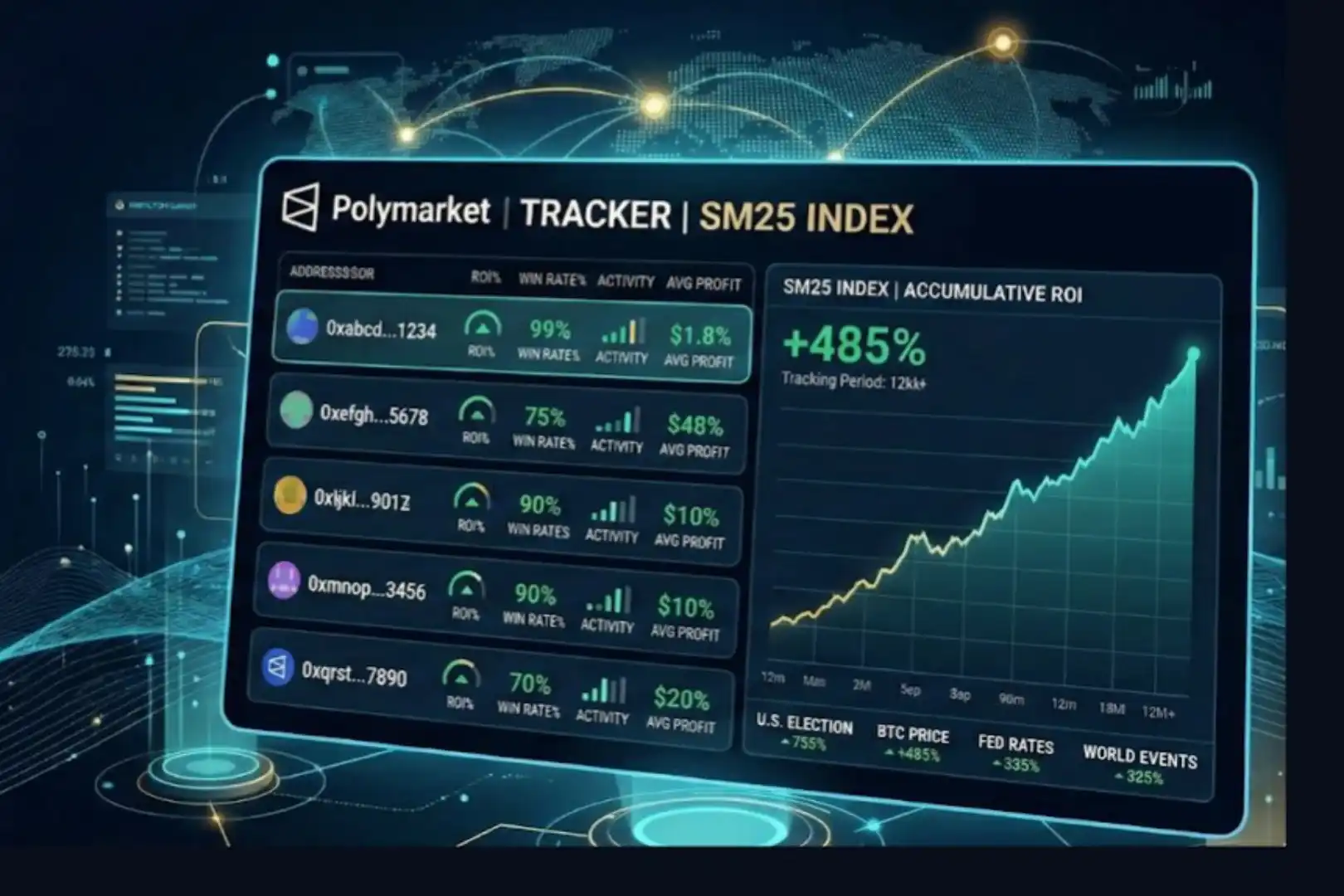
This article profiles 26 high-performing "smart money" addresses on Polymarket, categorized by their expertise in five distinct prediction market sectors. The selection criteria focused on proven Profit and Loss (PNL), a diversified winning structure (not reliant on a single bet), and high transaction volume to distinguish informed speculation from arbitrage. The addresses are broken down as follows: * **Politics & Geopolitics (5 addresses):** Experts in long-cycle macro events like Fed rates, US elections, and Middle Eastern geopolitics. They often bet against consensus (NO) in low-probability markets, achieving high ROI. * **Weather (6 addresses):** Specialists in temperature prediction markets for specific cities. Strategies range from high-frequency, small bets across thousands of markets to focused, high-conviction wagers. * **Tech (5 addresses):** Focused on Big Tech and AI product timelines (e.g., Google, OpenAI). They typically target high-probability outcomes or use a high-volume, low-cost approach on undervalued options. * **Culture (5 addresses):** Experts in movie box office results and Twitter-related markets. Strategies include betting on high-probability outcomes or taking contrarian, high-odds positions in low-probability markets. * **Sports (5 addresses):** Specialists in specific leagues like UFC, Soccer, and Tennis. They excel at identifying mispriced odds, often in medium-probability markets, and hold positions until settlement. A key warning is emphasized: a trader's success is often not transferable across sectors. An expert in sports may perform poorly in politics. The article advises followers to only mirror trades within a trader's proven area of expertise to avoid losses from their cross-sector ventures. All addresses are for reference only and not financial advice, as prediction markets carry significant risk of capital loss.

marsbit1 h fa

Polymarket Smart Money Panorama: 26 Long-Term Trackable Addresses (Categorized by Sector)

marsbit1 h fa

Trading

Spot
Futures
活动图片