Charles Hoskinson Blasts Ripple For Backing Bill That Could Crush Competition

bitcoinistPubblicato 2026-03-31Pubblicato ultima volta 2026-03-31

Introduzione

Cardano founder Charles Hoskinson has sharply criticized Ripple and its CEO Brad Garlinghouse for supporting proposed U.S. legislation that would classify most new tokens as securities by default. Hoskinson argues this approach would harm competition, protect established players like Ripple through exemptions, and remove legal protections for DeFi and open-source developers. He warns the bill replicates the SEC’s aggressive regulatory stance and could expose software creators to unreasonable liability. Hoskinson also addressed the XRP community, clarifying that his criticism targets Ripple’s lobbying—not the token itself—and contrasted Ripple’s “mammoth premine” with Cardano’s more distributed token distribution.

Cardano founder Charles Hoskinson used a lengthy weekly livestream to level one of his sharpest recent attacks at Ripple, arguing that the company is backing legislation that could entrench incumbents, weaken DeFi protections, and make it harder for new crypto projects to compete.

The core of Hoskinson’s complaint was not aimed at XRP holders, but at what he described as Ripple’s policy posture in Washington and the behavior of CEO Brad Garlinghouse. In Hoskinson’s telling, Ripple is pushing for rules that would classify new tokens as securities by default while benefiting from carve-outs that would leave larger, established players in a stronger position.

Hoskinson Takes Aim At Ripple Over Competition Fight

Hoskinson said Garlinghouse was “trying to pass a bill that makes everything by default a security until proven otherwise,” calling that framework a non-starter for the broader market. He argued that such an approach would effectively recreate the kind of regulatory pressure that former SEC Chair Gary Gensler brought to the sector, only this time through legislation supported by industry actors rather than enforcement alone.

“He’s trying to pass a bill that makes everything by default a security until proven otherwise, which was the treatment Gary Gensler inflicted on his own ecosystem,” Hoskinson said. “It’s a non-starter, because he knows that he’s going to get an exemption and it reduces competition. So, [expletive] the whole industry. It’s bad behavior.”

That argument sat at the center of a wider rant about market structure, lobbying, and what Hoskinson sees as crypto’s growing willingness to trade open competition for regulatory protection. He said he had already laid out “four different attack vectors” the SEC could use if such a bill were enacted, and warned that the damage would not stop with token issuers.

According to Hoskinson, the proposal would also leave open-source developers exposed by stripping out protections for DeFi builders. “The bill also removed all developer protections for DeFi developers,” he said. “Who takes care of the Tornado Cash people and these other people writing open-source software? We can’t live in a space where you have transitive unlimited liability.”

He extended that point with one of the livestream’s longer analogies, arguing that holding software developers liable for downstream use of their code would amount to a category error. “You write code and people you’ve never met use that code in places you’ve never been to and you’re held absolutely liable for that,” Hoskinson said. “That’s equivalent to you writing a book, someone reads the book and murders somebody based on a character in your book and then you get charged with murder. It’s basically the same thing.”

Hoskinson also took aim at what he described as the XRP community’s reflexive defense of Ripple whenever he criticizes the company. He said there is “no path for people to listen to the content” of his argument because any criticism of Garlinghouse is treated as an attack on XRP itself. He pushed back on that framing by noting that he publicly supported Ripple when the SEC sued the company years ago, but said that did not obligate him to back its current lobbying goals.

“Guys, I did support you when you got sued by the Securities Exchange Commission,” he said. “There’s videos of me. You can pull them up from years ago where I said it was the wrong decision.”

From there, Hoskinson shifted into one of crypto’s oldest fault lines: token distribution. He argued that Ripple had no need for outside help in its legal fight because the organization “gave themselves a mammoth premine,” saying the company already had the resources to defend itself and pursue acquisitions. He contrasted that with Cardano, saying, “I didn’t give myself 70% of the ADA supply.”

At press time, XRP traded at $1.35.
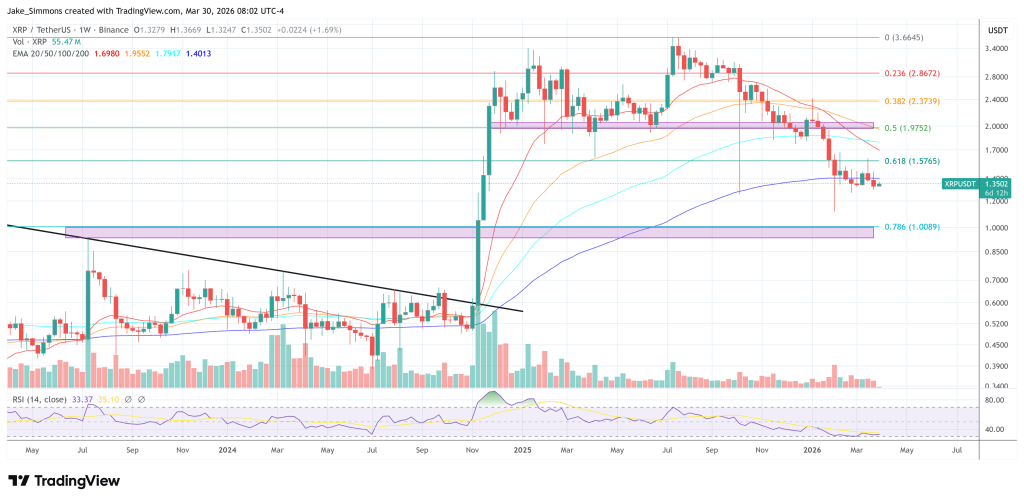
XRP falls below the 200-week EMA again, 1-week chart | Source: XRPUSDT on TradingView.com

Domande pertinenti

QWhat is Charles Hoskinson's main criticism against Ripple in this article?

ACharles Hoskinson criticizes Ripple for backing legislation that would classify new tokens as securities by default, which he believes would entrench incumbents, weaken DeFi protections, reduce competition, and benefit established players like Ripple through exemptions.

QAccording to Hoskinson, what negative consequences would the proposed bill have for DeFi developers?

AHoskinson states the bill would remove developer protections for DeFi builders, exposing open-source developers to 'transitive unlimited liability' where they could be held liable for how others use their code, similar to holding an author responsible if someone committed murder after reading their book.

QHow does Hoskinson contrast Cardano's token distribution with Ripple's?

AHoskinson contrasts the two by stating that Ripple 'gave themselves a mammoth premine' of XRP, giving them ample resources, while emphasizing 'I didn't give myself 70% of the ADA supply' for Cardano.

QWhat does Hoskinson say about the XRP community's response to his criticism of Ripple?

AHoskinson says the XRP community has a reflexive defense mechanism where any criticism of Ripple CEO Brad Garlinghouse is treated as an attack on XRP itself, making it difficult for people to actually listen to the content of his arguments.

QWhat historical support does Hoskinson mention he provided to Ripple, and how does it relate to his current stance?

AHoskinson mentions he publicly supported Ripple years ago when the SEC sued the company, calling it 'the wrong decision,' but clarifies that this past support does not obligate him to back Ripple's current lobbying efforts for what he considers anti-competitive legislation.

Letture associate

Rhythm X Zhihu Co-host Web4.0 Theme Event: When AI Agent Takes Over On-Chain Permissions

Most discussions about Web 4.0 miss the point. The real question is not whether it is a marketing trend, but rather: who is gaining control over the underlying permissions of the internet? Historically, each iteration of the web has involved a transfer of authority downward: Web 1.0 was read-only; Web 2.0 allowed users to write but platforms owned the data; Web 3.0 enabled true ownership through on-chain assets and private keys. Web 4.0 continues this trend, but the transfer is not to users—it is to AI Agents. The current infrastructure is human-centric, designed around human limitations like attention span and memory. But AI Agents don’t need intuitive UIs, password resets, or sleep. This creates a core tension: an internet built for humans is now being used by entities without human constraints. Two key shifts are underway: the decline of traditional front-end interfaces (replaced by API-driven machine communication) and the replacement of human-centric identity systems (like passwords) with granular, on-chain permissions. A critical enabler is crypto infrastructure. AI can make rapid decisions but lacks independent payment channels and asset sovereignty. Crypto fills this gap. Platforms like Hyperliquid offer 24/7 markets, ideal for non-stop Agent operation. When Agents control wallets and private keys, they can both decide and execute—forming complete economic entities. The real narrative of Crypto × AI isn’t just buzzword synergy—it’s the convergence of complementary infrastructures. The deeper shift is not which products will succeed, but how the rules of economic systems will change when AI becomes a primary on-chain participant, operating at scale and speed beyond human capability.

marsbit22 min fa

Rhythm X Zhihu Co-host Web4.0 Theme Event: When AI Agent Takes Over On-Chain Permissions

marsbit22 min fa

Embodied Intelligence Breakthrough: Amap Fully Open-Sources Universal Robot Base Model ABot-M0

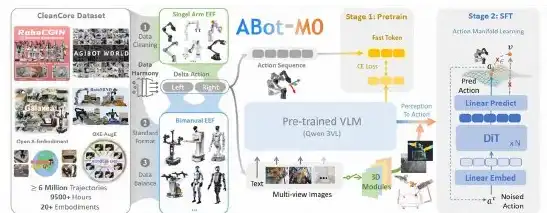
Embodied Intelligence Breakthrough: AutoNavi Open-Sources Universal Robot Base Model ABot-M0 AutoNavi has announced the full open-source release of ABot-M0, the world's first unified architecture-based embodied manipulation base model. This model is designed to enable "one general brain to adapt to multiple forms of robots," aiming to break down barriers between heterogeneous hardware and accelerate the adoption of embodied intelligence in industrial and household settings. ABot-M0 demonstrated exceptional performance in industry tests, achieving a task success rate of 80.5% on the Libero-Plus benchmark—a nearly 30% improvement over the previous benchmark, Pi0. It also set new state-of-the-art records on benchmarks like Libero and RoboCasa. The open-source release addresses long-standing challenges in the field, such as data isolation and deployment difficulties, by providing resources across three key dimensions: - **Data:** The UniACT dataset, the largest of its kind, with over 6 million real operation trajectories and full data pipeline tools. - **Algorithm:** The model architecture and training framework, featuring innovative components like Action Manifold Learning (AML) and a dual-stream perception architecture. - **Model:** End-to-end pre-trained models and a complete toolchain for out-of-the-box deployment, significantly lowering the barrier to adaptation. According to AutoNavi's ABot-M0 technical lead, this open-source initiative aims to build a bridge between academic research and industrial application, enabling robots of various forms to possess a smart, reliable, and universal "brain."

marsbit1 h fa

Embodied Intelligence Breakthrough: Amap Fully Open-Sources Universal Robot Base Model ABot-M0

marsbit1 h fa

Will Middle Management Be Replaced by AI? What Will the Future Company Structure Look Like

The article explores whether AI will eliminate middle management and reshape future corporate structures. It traces the historical evolution of organizations—from Roman military units to modern corporations—showing how hierarchical systems emerged to manage information flow under the constraint of limited "span of control." Middle management, matrix structures, and bureaucratic systems were all solutions to coordination challenges in information-scarce environments. AI, however, challenges this foundational premise. By enabling real-time modeling, understanding, and distribution of information, AI could replace human-centric coordination mechanisms. Examples like the AI firm "Moon Dark Side" illustrate radical experiments: no departments, titles, or traditional KPIs, with co-founders directly managing large teams and AI agents handling tasks from data processing to code generation. Block (founded by Jack Dorsey) is presented as a case study in building an "intelligent company." This model relies on two core components: a "company world model" (a real-time understanding of internal operations via digital traces) and a "customer world model" (built from real behavioral data, especially financial transactions). An intelligence layer uses these models to dynamically combine capabilities (e.g., payments, lending) to serve customers proactively, without pre-defined product roadmaps. In this structure, traditional roles shift. Middle managers are replaced by a system that handles coordination, while humans focus on individual contributions (ICs), direct responsibility (DRIs), or player-coach roles. The organization becomes flatter, faster, and more adaptive. The article concludes that AI is not just a tool for efficiency but a transformative force that could redefine organizational design, moving companies from human-led hierarchies to system-driven intelligence.

marsbit1 h fa

Will Middle Management Be Replaced by AI? What Will the Future Company Structure Look Like

marsbit1 h fa

Trading

Spot
Futures
活动图片