Lummis: The CLARITY Act mechanism "is not working" as the Senate drags its feet

cryptonews.ruPubblicato 2026-07-31Pubblicato ultima volta 2026-07-31

Introduzione

U.S. Senator Cynthia Lummis has argued that the current regulatory framework for digital assets is inadequate, harming industry, investors, and regulators alike. She is urgently pushing for the Senate to pass the Digital Asset Market Clarity Act (H.R. 3633/CLARITY Act) before the August recess, warning the current momentum for the bill is a unique opportunity this decade. The legislation aims to divide oversight between the SEC and CFTC. Time is running out, as the Senate must act before its August 8th recess. Delays would push the debate to September, further squeezing the legislative calendar before the midterm elections. Forecasting platforms now estimate only a 30% chance of the bill becoming law in 2026, a sharp drop from over 80% in February. Passage requires 60 votes, meaning at least seven Democrats must join Republicans, a task complicated by Democratic opposition. Key objections from figures like Senator Elizabeth Warren center on concerns the bill could weaken oversight of decentralized finance (DeFi) and consumer protection, potentially endangering the financial system. Over 200 crypto industry organizations, including Coinbase and Ripple, are lobbying for a vote, arguing continued uncertainty drives innovation and jobs overseas. Lummis contends the bill's custody and disclosure rules are precisely the consumer protections needed to close existing loopholes. The bill's fate now hinges on whether Senate Majority Leader John Thune schedules a vote this week or de...

Today, Lummis argued, stating that the existing set of rules regulating digital assets satisfies no one it affects, namely companies operating in this sphere, ordinary asset holders, and agencies tasked with combating fraud. In recent days, the senator has repeatedly spoken in the Senate to pressure colleagues regarding the bill and told journalists she plans to continue talking about it as the voting deadline approaches.
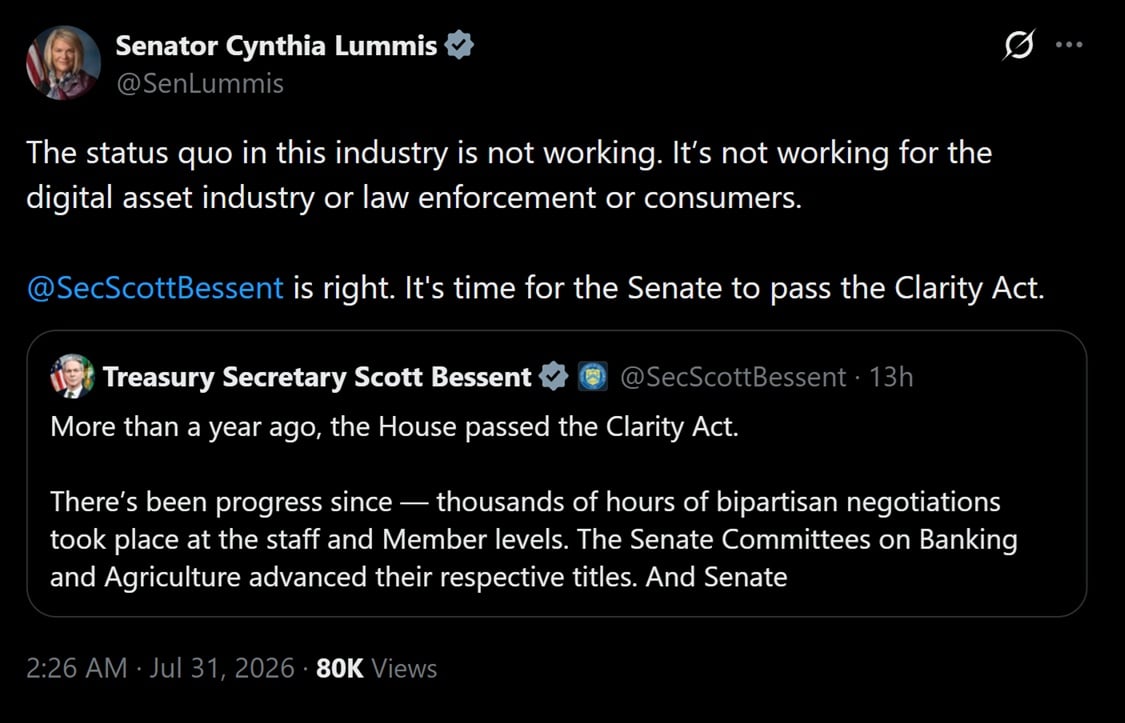
Image Source: X

The Digital Asset Market Clarity Act, officially designated as H.R. 3633, provides for the division of oversight over digital assets between the Securities and Exchange Commission (SEC) and the Commodity Futures Trading Commission (CFTC). Lummis separately warned that the current momentum with which the bill is advancing "will not be repeated again in this decade," noting that further delays will result in the bill not being passed this year.

She also framed the essence of the confrontation in more concrete terms, telling colleagues that prolonged debates could leave cryptocurrency custody rules unprotected just as the industry is increasingly penetrating the sphere of traditional finance.

Time is Running Out

The Senate is scheduled to begin its August recess on August 8th, and Majority Leader John Thune has not yet allocated time for the bill to be debated in the Senate. If lawmakers do not reach a decision by this deadline, discussion will only resume in September, further shrinking the already diminishing legislative window before the midterm elections.

This deadline pressure is reflected in prediction markets: forecasting platforms currently estimate the probability of CLARITY becoming law in 2026 at approximately 30%, significantly lower than the figure of over 80% recorded in February. Passing the bill in the Senate requires 60 votes. Republicans control 53 seats, meaning at least seven Democrats must vote for it for passage—a task that has proven difficult due to unresolved objections within the Democratic caucus.

What is Holding Up the Vote

Beyond the ethics provisions governing cryptocurrency ownership by federal officials, which Senate negotiators are working on separately, opponents have expressed concern about how the bill approaches decentralized finance (DeFi) protocols and whether its consumer protection provisions go far enough. Senator Elizabeth Warren argues that the bill would weaken oversight to the point of jeopardizing the financial system as a whole—a position she has reiterated since the committee vote in May.

Cryptocurrency industry associations have also strongly opposed the delay: over 200 organizations, including Coinbase, Ripple, Kraken, and Circle, are urging Senate leadership to bring the bill for a vote, arguing that the ongoing uncertainty is driving innovation and jobs overseas while leaving American consumers without clear protection.

Lummis directly linked the urgency of considering the bill to consumer protection measures, arguing that the bill's requirements for asset custody and disclosure are necessary precisely because existing legislation contains loopholes that bad actors could exploit.

However, with Senate floor time for the bill still not scheduled and only a few days remaining before the parliamentary recess ends, the bill's fate now hinges on whether Thune allocates time for its consideration this week or postpones it until the fall session. Reconvening in September would keep the CLARITY bill on the agenda but would push the final vote closer to the midterm election campaign season, when legislative activity typically slows down even further.


Domande pertinenti

QAccording to Senator Lummis, why is the CLARITY Act's mechanism 'not working'?

AAccording to Senator Lummis, the mechanism of the CLARITY Act is 'not working' because the Senate is delaying the legislative process, with Majority Leader John Thune not yet scheduling time for its floor consideration, leading to a high risk it won't pass this year.

QWhich two regulatory bodies would oversee digital assets under the proposed CLARITY Act (H.R. 3633)?

AUnder the proposed Digital Asset Market Clarity Act (H.R. 3633), oversight of digital assets would be divided between the Securities and Exchange Commission (SEC) and the Commodity Futures Trading Commission (CFTC).

QWhat is the estimated current probability of the CLARITY Act becoming law in 2026, according to betting platforms, and why has it dropped significantly?

ABetting platforms currently estimate the probability of the CLARITY Act becoming law in 2026 is about 30%, a significant drop from over 80% in February. The drop is due to the legislative delay and the shrinking window for action before the August recess and midterm elections.

QWhat are two key concerns raised by opponents, like Senator Elizabeth Warren, regarding the CLARITY bill?

AOpponents like Senator Elizabeth Warren have raised concerns that the bill's approach to decentralized finance (DeFi) protocols is problematic and that its consumer protection provisions are insufficient. Warren specifically argues it would weaken oversight enough to endanger the overall financial system.

QWhat consequence does Senator Lummis warn about if the CLARITY Act is further delayed?

ASenator Lummis warns that further delays will result in the bill not passing this year. She also cautions that prolonged debates could leave rules for cryptocurrency custody unprotected just as the industry increasingly integrates with traditional finance.

Letture associate

Coldcard Hardware Wallet Hacked: 594 Bitcoin Withdrawn in 25 Minutes

The Coldcard hardware wallet has been compromised, with hackers stealing approximately 594.5 Bitcoin (~$40 million) from 500 addresses in just 25 minutes. The root cause was a critical software bug, undetected for five years, which disabled the device's secure chip for generating true random numbers. This led to the creation of private keys based on predictable data like the processor's serial number, drastically reducing cryptographic security. The attackers exploited this offline by brute-forcing possible seed phrases, finding active addresses on the public ledger, and signing transactions. Initially, Coinkite (Coldcard's maker) claimed only older models were at risk but later admitted all devices running the compromised firmware were vulnerable. CEO Rodolphe Novak (NVK) apologized but ruled out financial compensation for affected users. To secure funds, owners must urgently update their firmware to specific safe versions, generate a completely new seed phrase on the updated device, and transfer all assets to new addresses created with that new seed. While a BIP-39 passphrase can help, it does not replace this migration process. Other Coinkite products like TAPSIGNER were not affected. This incident underscores that even specialized hardware requires rigorous, independent code audits, especially for cryptographic functions. It parallels past failures, like a 2006 OpenSSL bug in Debian, and raises questions about whether automated code analysis can ever fully replace human scrutiny in critical security areas.

cryptonews.ru45 min fa

Coldcard Hardware Wallet Hacked: 594 Bitcoin Withdrawn in 25 Minutes

cryptonews.ru45 min fa

Trading

Spot
活动图片