Did Jane Street 'Manipulate' BTC? Deconstructing the AP System and Understanding the Pricing Power Game Behind the ETF Creation and Redemption Mechanism

marsbitPubblicato 2026-02-28Pubblicato ultima volta 2026-02-28

Introduzione

The article investigates allegations that Jane Street Capital manipulated Bitcoin prices by exploiting the ETF creation and redemption mechanism. It clarifies that the issue is not unique to Jane Street but stems from structural features of the Authorized Participant (AP) system common to all Bitcoin ETFs, including those from major firms like JPMorgan, Goldman Sachs, and Citadel. APs hold a unique regulatory exemption under Reg SHO, allowing them to create and redeem ETF shares without typical short-selling constraints like borrowing costs or hard deadlines. This creates a potential conflict: while market inefficiencies (e.g., ETF trading below NAV) should naturally attract arbitrageurs to correct prices, APs—who control the arbitrage pipeline—may delay arbitrage to profit elsewhere, such as in derivatives markets. The shift to in-kind (rather than cash) creations/redemptions further reduced structural buying pressure on Bitcoin spot markets. The core problem is not deliberate price suppression by any single AP but a systemic flaw: the AP framework, designed for traditional finance, may undermine price discovery integrity for Bitcoin. The article concludes by questioning whether existing regulatory frameworks are suitable for an asset class predicated on decentralization.

Author: Eddie Xin, Chief Analyst at OSL Group

"They were fcking us the whole time".

This expletive, circulating on Reddit and CT (Crypto Twitter) following the lawsuit, alongside an epic short squeeze with a liquidation scale exceeding $240 billion, directed the market's fury at the same target: Jane Street Capital.

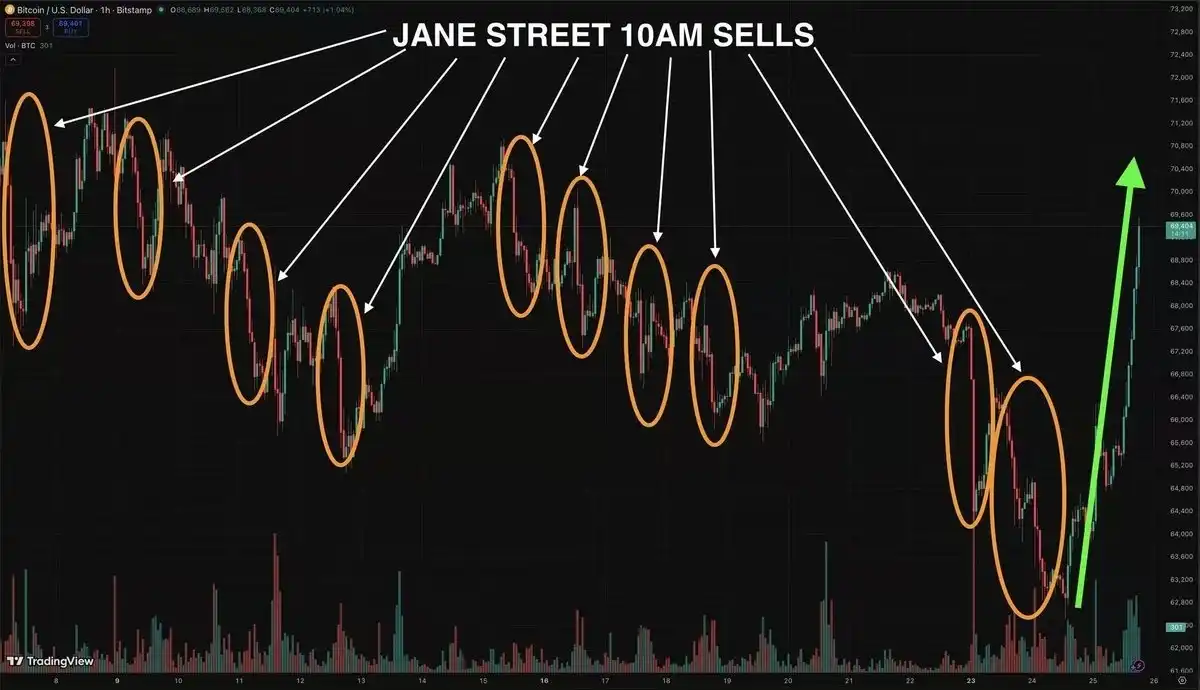
At 10 AM, the liquidity low point in the Asian market for the past few months, the tip of the iceberg was finally revealed with the U.S. Department of Justice's complaint. It all stemmed from Jane Street Capital, a top-tier market maker founded in 2000, which was accused of executing a months-long 'sleight of hand' in the spot and derivative order books by means of targeted ETF arbitrage in the market, utilizing the spot ETF creation and redemption mechanism.

It wasn't until a legal complaint pushed this controversy into the public eye that discussions around the ETF arbitrage mechanism and price discovery structure rapidly heated up, triggering a violent market rebound and an epic short squeeze with a liquidation scale exceeding $240 billion.

But was Jane Street truly the culprit that pressed the suppression button? This is a question worth at least $10 billion.
I. Did Jane Street Really Suppress the BTC Price?

This question deserves an accurate answer. The most important thing to understand first is that this isn't just a question about Jane Street.

It's a question about the structural characteristics of the Bitcoin ETF framework, which applies equally to every Authorized Participant (AP) in the ecosystem. For BlackRock's IBIT alone, this list includes Jane Street Capital, JPMorgan, Macquarie, Virtu Americas, Goldman Sachs, Citadel Securities, Citigroup, UBS, and ABN Amro.

The role of these institutions is deeply misunderstood by the outside world, even among experienced industry veterans, and this misunderstanding deserves to be corrected before drawing any conclusions.

The first thing to understand about APs is that they occupy a marginal exception within the regulatory framework of Reg SHO (the SEC's rule on naked short selling). For instance, Reg SHO requires short sellers to locate shares (locate the stock) before shorting, but APs are exempted due to their contractual right to participate in creations and redemptions.

While this sounds procedural, its practical consequences are significant. It means any AP can create shares at will—no borrowing costs, no capital commitment traditionally associated with short selling, and aside from commercially reasonable timeframes, no hard deadline to close the position.

This is the gray area: a regulatory exemption designed for orderly ETF market making is, structurally, indistinguishable from regulatory arbitrage with an unmatched duration. This exemption is not unique to any single company. It is a prerequisite for membership in the AP club.

II. What Does This AP Exemption Mean?

Normally, if IBIT is trading below its Net Asset Value (NAV), you would expect arbitrage buyers to step in, redeem shares for bitcoin, and close the discount. But any AP *is* that arbitrage buyer; they control the pipeline. This means their incentive to close this discount is different from that of a third-party trading desk without creation/redemption rights.

It sounds complex, but a simple analogy makes it clearer:

First Layer: What is Normal 'Closing the Discount'?

Imagine there's a blind box on the market (this is the IBIT ETF). Everyone knows the blind box contains a real bitcoin voucher worth $100 (this is the NAV). But today, due to market panic, the blind box is priced at $95.

Following normal logic, smart merchants (arbitrage buyers) would frantically buy the blind box for $95, then go to the official source to open it, exchange it for the $100 bitcoin, sell it, and pocket the $5 difference.

And precisely because everyone is buying the blind boxes for arbitrage, the price of the blind box is quickly pushed up by buying pressure, returning to $100. This is called "closing the discount".

Second Layer: The AP with the 'Monopoly Channel'

But in the real world of Bitcoin ETFs, ordinary trading firms and retail investors are not qualified to go to the official source to "open the blind box" (i.e., they lack creation/redemption rights). Only a few privileged Wall Street investment banks (APs) in the entire market can do this. That is, APs monopolize the only channel to exchange ETFs for real bitcoin (they control the pipeline).

Third Layer: Why Don't APs Play by the Arbitrage Rules?

If it were an ordinary third-party merchant, seeing this $5 risk-free spread, they would act immediately. But APs are different; they calculate a more shrewd account: "Since only I can open the blind box, why should I hurry? If I intentionally don't pull the price back to $100, but instead use the current illusion of a low $95 price to go short or long in another casino (like the bitcoin futures market), I might make $20!"

In summary: The market originally has an automatic correction mechanism (if the price falls too much, someone will buy for arbitrage and push the price up). However, because the "only switch" to execute this correction mechanism is held by the APs, and the APs find that "not correcting, maintaining the discount" allows them to make more money elsewhere, they have no incentive to pull the price back to normal levels.

Retail investors suffer waiting for the arbitrage army to save the price, unaware that the only arbitrage army (the APs) is right next door, using this spread to make money in other markets.

III. The Problem Isn't Jane Street, It's the AP Structure

IBIT's short exposure could in principle be hedged by going long bitcoin spot, but this is not mandatory, as long as the chosen instrument maintains a tight correlation.

The obvious alternative is BTC futures, especially given their capital efficiency. This effectively means that if the hedging instrument is futures rather than spot, then the spot is never actually bought. And because the natural arbitrage buyer chooses not to buy spot, this discount cannot be closed through the natural arbitrage mechanism.

It's worth noting that the spot/futures basis is itself the domain of the entire basis trading community, which works to keep this relationship tight. But every separation between the hedging instrument and the underlying asset introduces impure basis risk (dirty basis risk), and this risk compounds throughout the structure—and it is under stress conditions that basis risk is where market dislocation appears.

The final piece of the puzzle involves the recently SEC-approved in-kind creation and redemption. Under the previous cash-only regime, APs were required to deliver cash to the fund, and then the custodian used this cash to buy bitcoin spot. This buying action was a structural regulator—it mechanically forced the purchase of spot as a consequence of creation.

In-kind creation/redemption completely eliminates this. Now any AP can deliver bitcoin directly, and the timing and counterparty for its source can be chosen at its own discretion: OTC desks, negotiated pricing, minimizing market impact.

The broadest interpretation of this flexibility is that an AP could maintain derivative positions aimed at capturing funding rate or volatility profits during the time between establishing a short and completing the in-kind delivery—all while ensuring each individual step still fits the definition of legitimate AP activity.

And this is precisely the crux of the problem. The beginning looks like normal market making, and the end looks like normal market making. It is the middle process that is difficult to clearly categorize. This is not an indictment of any single company. Every AP on the IBIT list, and by extension every AP for every Bitcoin ETF, operates within the same structural framework, enjoys the same exemptions, and therefore possesses the same theoretical capability. Whether any of them exercised this capability in a manner that verges on coordinated activity is a question that falls squarely within the purview of the "surveillance sharing agreements" the SEC required upon ETF approval.

Whether these agreements are sufficient to capture behavior that simultaneously spans spot, futures, and ETF markets (even including cross-border trading venues) remains a truly open question.

In a nutshell, Jane Street is just in the spotlight. The real problem is buried deep in the underlying architecture of the Bitcoin ETF, designed by Wall Street veterans. No specific AP is explicitly suppressing the bitcoin price. What the AP structure can suppress is the integrity of the price discovery mechanism itself, which may have far more profound implications than the former.

Therefore, the question truly worth asking is not whether a specific company is the villain, but whether a regulatory framework built for 20th-century traditional finance is suitable for hosting an emerging 21st-century asset whose "value lies in being free from control by regulatory agencies".

This is perhaps the tuition fee the crypto market must pay to enter the "era of big institutions." After all, while we crave the liquidity irrigation from Wall Street, we do not wish to passively accept the black-box games they construct using regulatory exemptions.

This is not just the answer about Jane Street, but the ultimate question of the Bitcoin ETF era.

Domande pertinenti

QWhat is the core allegation against Jane Street Capital in relation to Bitcoin ETFs?

AJane Street Capital is accused of exploiting the creation and redemption mechanism of Bitcoin ETFs to conduct arbitrage between spot and derivative markets, using a regulatory exemption that allows them to potentially suppress price discovery rather than correct market inefficiencies.

QWhat is an Authorized Participant (AP) in the context of Bitcoin ETFs, and what special privilege do they hold?

AAn Authorized Participant (AP) is a large financial institution, like Jane Street or J.P. Morgan, that has the exclusive right to create and redeem ETF shares. They hold a key regulatory exemption from Reg SHO, allowing them to create shares without first locating the stock, which eliminates borrowing costs and hard deadlines associated with traditional short selling.

QWhy might an AP choose not to arbitrage a price discrepancy between an ETF and its Net Asset Value (NAV)?

AAn AP might choose not to arbitrage a discount because they control the only mechanism to correct it. They can profit more by maintaining the discrepancy and using it to execute strategies in derivative markets (like futures) to earn funding rates or volatility profits, rather than simply closing the gap for a smaller, immediate gain.

QHow did the shift from cash-only to in-kind creation and redemption for Bitcoin ETFs change the market dynamics?

AThe shift to in-kind creation removed a structural market stabilizer. Under the cash-only model, APs had to deliver cash to the fund, which forced the custodian to buy Bitcoin spot, supporting its price. With in-kind creation, APs can deliver Bitcoin directly from sources like OTC desks, giving them more flexibility and eliminating the forced spot market purchases.

QAccording to the article, what is the fundamental problem, and is it specific to Jane Street?

AThe fundamental problem is not specific to Jane Street but is a structural issue inherent in the Bitcoin ETF framework. The regulatory exemptions and arbitrage mechanisms granted to all APs can suppress the integrity of the price discovery process itself, raising questions about whether a traditional financial regulatory framework is suitable for a decentralized asset like Bitcoin.

Letture associate

Trading

Spot
Futures

Articoli Popolari

Cosa è BITCOIN

Comprendere HarryPotterObamaSonic10Inu (ERC-20) e la sua posizione nel mondo delle criptovalute Negli ultimi anni, il mercato delle criptovalute ha assistito a un aumento della popolarità delle meme coin, catturando l'interesse non solo dei trader, ma anche di coloro che cercano coinvolgimento comunitario e valore di intrattenimento. Tra questi token unici c'è HarryPotterObamaSonic10Inu (ERC-20), un progetto intrigante che mescola riferimenti culturali nel tessuto delle criptovalute. Questo articolo esplora gli aspetti chiave di HarryPotterObamaSonic10Inu, analizzando i suoi meccanismi, l'etica guidata dalla comunità e il suo coinvolgimento con il panorama crittografico più ampio. Che cos'è HarryPotterObamaSonic10Inu (ERC-20)? Come suggerisce il suo nome, HarryPotterObamaSonic10Inu è una meme coin costruita sulla blockchain di Ethereum, classificata secondo lo standard ERC-20. A differenza delle criptovalute tradizionali che possono enfatizzare l'utilità pratica o il potenziale investimento, questo token prospera grazie al valore di intrattenimento e alla forza della sua comunità. Il progetto mira a creare un ambiente in cui gli utenti coinvolti possono riunirsi, condividere idee e partecipare ad attività ispirate a diversi fenomeni culturali. Una caratteristica notevole di HarryPotterObamaSonic10Inu è la zero tassa sulle transazioni. Questo elemento allettante tende a incoraggiare il trading e il coinvolgimento della comunità, privo di costi aggiuntivi che possono scoraggiare i trader di piccole dimensioni. L'offerta totale della moneta è fissata a un miliardo di token, un numero che segna la sua intenzione di mantenere una circolazione sostanziale all'interno della comunità. Creatore di HarryPotterObamaSonic10Inu (ERC-20) Le origini di HarryPotterObamaSonic10Inu sono avvolte in un certo mistero; i dettagli sul creatore rimangono sconosciuti. Lo sviluppo di questo token non presenta un team identificabile o un piano esplicito, cosa non rara nel settore delle meme coin. Invece, il progetto è emerso organicamente, con il suo progresso fortemente dipendente dall'entusiasmo e dalla partecipazione della sua comunità. Investitori di HarryPotterObamaSonic10Inu (ERC-20) Per quanto riguarda investimenti esterni e finanziamenti, HarryPotterObamaSonic10Inu rimane ambiguo. Il token non elenca alcuna fondazione di investimento conosciuta o un sostegno organizzativo significativo. Invece, la linfa vitale del progetto è la sua comunità di base, che informa la sua crescita e sostenibilità attraverso azioni collettive e coinvolgimento nello spazio crittografico. Come funziona HarryPotterObamaSonic10Inu (ERC-20)? In quanto meme coin, HarryPotterObamaSonic10Inu opera principalmente al di fuori delle strutture tradizionali che governano spesso il valore degli asset. Ci sono diversi aspetti distintivi che definiscono il funzionamento del progetto: Transazioni senza tasse: Senza costi fiscali sulle transazioni, gli utenti possono comprare e vendere liberamente il token senza preoccuparsi di costi nascosti. Coinvolgimento della comunità: Il progetto prospera sull'interazione della comunità, sfruttando le piattaforme social per creare entusiasmo e facilitare il coinvolgimento. Discussioni, condivisione di contenuti e coinvolgimento sono elementi cruciali che aiutano ad espandere la sua portata e a favorire la lealtà tra i sostenitori. Nessuna utilità pratica: Va notato che HarryPotterObamaSonic10Inu non offre un'utilità concreta all'interno dell'ecosistema finanziario. Piuttosto, è classificato come un token principalmente per attività di intrattenimento e comunitarie. Riferimento culturale: Il token incorpora astutamente elementi della cultura pop per attirare interesse, collegandosi a appassionati di meme e seguaci delle criptovalute. HarryPotterObamaSonic10Inu esemplifica come le meme coin operino in modo diverso rispetto ai progetti di criptovalute più tradizionali, entrando nel mercato come costrutti sociali innovativi piuttosto che come asset utilitari. Cronologia di HarryPotterObamaSonic10Inu (ERC-20) La storia di HarryPotterObamaSonic10Inu è segnata da diversi traguardi notevoli: Creazione: Il token è emerso da un meme virale, catturando l'immaginazione di molti appassionati di criptovalute. Le date di creazione specifiche non sono disponibili, sottolineando la sua crescita organica. Inserimento negli scambi: HarryPotterObamaSonic10Inu ha fatto il suo ingresso in vari scambi, consentendo un accesso e un trading più facili da parte della comunità. Iniziative di coinvolgimento della comunità: Attività in corso volte a migliorare l'interazione della comunità, comprese gare, campagne sui social media e generazione di contenuti da parte di fan e sostenitori. Piani di espansione futura: La tabella di marcia del progetto include il lancio di una collezione NFT, merchandising e un sito di eCommerce relativo ai suoi temi culturali, coinvolgendo ulteriormente la comunità e cercando di aggiungere più dimensioni al suo ecosistema. Punti chiave su HarryPotterObamaSonic10Inu (ERC-20) Natura guidata dalla comunità: Il progetto dà priorità al contributo collettivo e alla creatività, garantendo che il coinvolgimento degli utenti sia al centro del suo sviluppo. Classificazione come meme coin: Rappresenta l'epitome delle criptovalute basate sull'intrattenimento, distinguendosi dai veicoli d'investimento tradizionali. Nessuna affiliazione diretta con Bitcoin: Nonostante la somiglianza nel nome del ticker, HarryPotterObamaSonic10Inu è distintivo e non ha alcuna relazione con Bitcoin o altre criptovalute consolidate. Focus sulla collaborazione: HarryPotterObamaSonic10Inu è progettato per creare uno spazio per la collaborazione e la condivisione di storie tra i suoi detentori, fornendo un canale per la creatività e il legame comunitario. Prospettive future: L'ambizione di espandersi oltre il suo presupposto iniziale verso NFT e merchandising delinea un percorso per il progetto per potenzialmente entrare in strade più mainstream all'interno della cultura digitale. Poiché le meme coin continuano a catturare l'immaginazione della comunità crittografica, HarryPotterObamaSonic10Inu (ERC-20) si distingue per i suoi legami culturali e il suo approccio centrato sulla comunità. Anche se potrebbe non adattarsi al modello tipico di un token orientato all'utilità, la sua essenza risiede nella gioia e nella camaraderia coltivate tra i suoi sostenitori, evidenziando la natura in evoluzione delle criptovalute in un'epoca sempre più digitale. Con la continuazione dello sviluppo del progetto, sarà importante osservare come le dinamiche della comunità influenzano la sua traiettoria nel panorama in continuo cambiamento della tecnologia blockchain.

515 Totale visualizzazioniPubblicato il 2024.04.01Aggiornato il 2024.12.03

Cosa è BITCOIN

Come comprare BTC

Benvenuto in HTX.com! Abbiamo reso l'acquisto di Bitcoin (BTC) semplice e conveniente. Segui la nostra guida passo passo per intraprendere il tuo viaggio nel mondo delle criptovalute.Step 1: Crea il tuo Account HTXUsa la tua email o numero di telefono per registrarti il tuo account gratuito su HTX. Vivi un'esperienza facile e sblocca tutte le funzionalità,Crea il mio accountStep 2: Vai in Acquista crypto e seleziona il tuo metodo di pagamentoCarta di credito/debito: utilizza la tua Visa o Mastercard per acquistare immediatamente BitcoinBTC.Bilancio: Usa i fondi dal bilancio del tuo account HTX per fare trading senza problemi.Terze parti: abbiamo aggiunto metodi di pagamento molto utilizzati come Google Pay e Apple Pay per maggiore comodità.P2P: Fai trading direttamente con altri utenti HTX.Over-the-Counter (OTC): Offriamo servizi su misura e tassi di cambio competitivi per i trader.Step 3: Conserva Bitcoin (BTC)Dopo aver acquistato Bitcoin (BTC), conserva nel tuo account HTX. In alternativa, puoi inviare tramite trasferimento blockchain o scambiare per altre criptovalute.Step 4: Scambia Bitcoin (BTC)Scambia facilmente Bitcoin (BTC) nel mercato spot di HTX. Accedi al tuo account, seleziona la tua coppia di trading, esegui le tue operazioni e monitora in tempo reale. Offriamo un'esperienza user-friendly sia per chi ha appena iniziato che per i trader più esperti.

2.7k Totale visualizzazioniPubblicato il 2024.12.12Aggiornato il 2025.03.21

Come comprare BTC

Cosa è $BITCOIN

ORO DIGITALE ($BITCOIN): Un'Analisi Completa Introduzione all'ORO DIGITALE ($BITCOIN) L'ORO DIGITALE ($BITCOIN) è un progetto basato su blockchain che opera sulla rete Solana, con l'obiettivo di combinare le caratteristiche dei metalli preziosi tradizionali con l'innovazione delle tecnologie decentralizzate. Sebbene condivida un nome con Bitcoin, spesso definito “oro digitale” a causa della sua percezione come riserva di valore, l'ORO DIGITALE è un token separato progettato per creare un ecosistema unico all'interno del panorama Web3. Il suo obiettivo è posizionarsi come un asset digitale alternativo valido, anche se i dettagli riguardanti le sue applicazioni e funzionalità sono ancora in fase di sviluppo. Cos'è l'ORO DIGITALE ($BITCOIN)? L'ORO DIGITALE ($BITCOIN) è un token di criptovaluta esplicitamente progettato per l'uso sulla blockchain di Solana. A differenza di Bitcoin, che fornisce un ruolo di stoccaggio di valore ampiamente riconosciuto, questo token sembra concentrarsi su applicazioni e caratteristiche più ampie. Aspetti notevoli includono: Infrastruttura Blockchain: Il token è costruito sulla blockchain di Solana, nota per la sua capacità di gestire transazioni ad alta velocità e a basso costo. Dinamiche di Offerta: L'ORO DIGITALE ha un'offerta massima fissata a 100 quadrilioni di token (100P $BITCOIN), sebbene i dettagli riguardanti la sua offerta circolante siano attualmente non divulgati. Utilità: Sebbene le funzionalità precise non siano esplicitamente delineate, ci sono indicazioni che il token potrebbe essere utilizzato per varie applicazioni, potenzialmente coinvolgendo applicazioni decentralizzate (dApp) o strategie di tokenizzazione degli asset. Chi è il Creatore dell'ORO DIGITALE ($BITCOIN)? Attualmente, l'identità dei creatori e del team di sviluppo dietro l'ORO DIGITALE ($BITCOIN) rimane sconosciuta. Questa situazione è tipica tra molti progetti innovativi nel settore blockchain, in particolare quelli allineati con la finanza decentralizzata e i fenomeni delle meme coin. Sebbene tale anonimato possa favorire una cultura guidata dalla comunità, intensifica le preoccupazioni riguardo alla governance e alla responsabilità. Chi sono gli Investitori dell'ORO DIGITALE ($BITCOIN)? Le informazioni disponibili indicano che l'ORO DIGITALE ($BITCOIN) non ha alcun sostenitore istituzionale noto o investimenti di venture capital prominenti. Il progetto sembra operare su un modello peer-to-peer incentrato sul supporto e sull'adozione della comunità piuttosto che su percorsi di finanziamento tradizionali. La sua attività e liquidità si trovano principalmente su exchange decentralizzati (DEX), come PumpSwap, piuttosto che su piattaforme di trading centralizzate consolidate, evidenziando ulteriormente il suo approccio di base. Come Funziona l'ORO DIGITALE ($BITCOIN) Le meccaniche operative dell'ORO DIGITALE ($BITCOIN) possono essere elaborate in base al suo design blockchain e alle caratteristiche della rete: Meccanismo di Consenso: Sfruttando il proof-of-history (PoH) unico di Solana combinato con un modello di proof-of-stake (PoS), il progetto garantisce una validazione efficiente delle transazioni contribuendo all'alta performance della rete. Tokenomics: Sebbene meccanismi deflazionistici specifici non siano stati dettagliati ampiamente, l'ampia offerta massima di token implica che potrebbe soddisfare microtransazioni o casi d'uso di nicchia che devono ancora essere definiti. Interoperabilità: Esiste il potenziale per l'integrazione con l'ecosistema più ampio di Solana, inclusi vari piattaforme di finanza decentralizzata (DeFi). Tuttavia, i dettagli riguardanti integrazioni specifiche rimangono non specificati. Cronologia degli Eventi Chiave Ecco una cronologia che evidenzia traguardi significativi riguardanti l'ORO DIGITALE ($BITCOIN): 2023: Il dispiegamento iniziale del token avviene sulla blockchain di Solana, contrassegnato dal suo indirizzo di contratto. 2024: L'ORO DIGITALE guadagna visibilità poiché diventa disponibile per il trading su exchange decentralizzati come PumpSwap, consentendo agli utenti di scambiarlo contro SOL. 2025: Il progetto assiste a un'attività di trading sporadica e a un potenziale interesse per impegni guidati dalla comunità, sebbene non siano state documentate partnership significative o avanzamenti tecnici fino ad ora. Analisi Critica Punti di Forza Scalabilità: L'infrastruttura sottostante di Solana supporta alti volumi di transazioni, il che potrebbe migliorare l'utilità di $BITCOIN in vari scenari di transazione. Accessibilità: Il potenziale basso prezzo di trading per token potrebbe attrarre investitori al dettaglio, facilitando una partecipazione più ampia grazie a opportunità di proprietà frazionata. Rischi Mancanza di Trasparenza: L'assenza di sostenitori, sviluppatori o di un processo di audit pubblicamente noti potrebbe generare scetticismo riguardo alla sostenibilità e all'affidabilità del progetto. Volatilità del Mercato: L'attività di trading è fortemente dipendente dal comportamento speculativo, il che può comportare una significativa volatilità dei prezzi e incertezze per gli investitori. Conclusione L'ORO DIGITALE ($BITCOIN) emerge come un progetto intrigante ma ambiguo all'interno dell'evolvente ecosistema di Solana. Sebbene tenti di sfruttare la narrativa dell'“oro digitale”, la sua partenza dal ruolo consolidato di Bitcoin come riserva di valore sottolinea la necessità di una chiara differenziazione della sua utilità e struttura di governance. L'accettazione e l'adozione future dipenderanno probabilmente dall'affrontare l'attuale opacità e dalla definizione più esplicita delle sue strategie operative ed economiche. Nota: Questo rapporto comprende informazioni sintetizzate disponibili a ottobre 2023, e potrebbero essersi verificati sviluppi oltre il periodo di ricerca.

99 Totale visualizzazioniPubblicato il 2025.05.13Aggiornato il 2025.05.13

Cosa è $BITCOIN

Discussioni

Benvenuto nella Community HTX. Qui puoi rimanere informato sugli ultimi sviluppi della piattaforma e accedere ad approfondimenti esperti sul mercato. Le opinioni degli utenti sul prezzo di BTC BTC sono presentate come di seguito.

活动图片