77% of Americans Consider Cryptocurrency in Retirement Plans Risky: Survey

cryptonews.ruPubblicato 2026-08-26Pubblicato ultima volta 2026-08-26

Introduzione

A National Institute on Retirement Security survey reveals that 77% of Americans consider cryptocurrency in workplace retirement plans risky, with 46% calling it "very risky." 53% oppose employers offering crypto as an investment option. This skepticism coincides with heightened retirement anxiety, as 80% see a U.S. retirement crisis. Rising living costs and debt hinder savings efforts for many. Despite public wariness, the U.S. government has moved to expand access to alternative assets like crypto in 401(k) plans. In May 2025, the Department of Labor (DOL) rescinded guidance urging "extreme caution" on crypto, adopting a neutral stance. President Trump's August 2025 executive order further promoted access to digital assets in retirement plans, directing the DOL and SEC to review facilitating regulations. Subsequently, the DOL reversed its 2021 guidance that discouraged 401(k) fiduciaries from considering alternative investments. In March 2026, it proposed rules, including safe harbors, for including such assets, requiring fiduciaries to evaluate fees, liquidity, and valuation. The proposal faced opposition from lawmakers like Senators Sanders and Warren, who cited crypto's volatility and insufficient investor protections.

More than three-quarters of Americans consider cryptocurrency in workplace retirement plans to be risky, as concerns about retirement security intensify across the United States, according to the results of a new survey by the National Institute on Retirement Security.

The survey found that 77% of Americans consider cryptocurrency in workplace retirement plans to be risky, with 46% calling it very risky, and 53% oppose employers offering cryptocurrency as an investment option.

Distrust of cryptocurrency is growing against the backdrop of 80% of respondents stating there is a U.S. retirement crisis, up from 67% in 2020, and 61% expressed concern about achieving financial security in retirement.

The rising cost of living is also negatively impacting retirement savings: 68% said it's becoming harder to prepare for retirement, and 77% reported that debt is preventing them from saving enough.

The survey was conducted by Greenwald Research from October 24 to November 14, 2025, and covered 1,203 Americans aged 25 and older, with the results weighted for age, gender, and income.
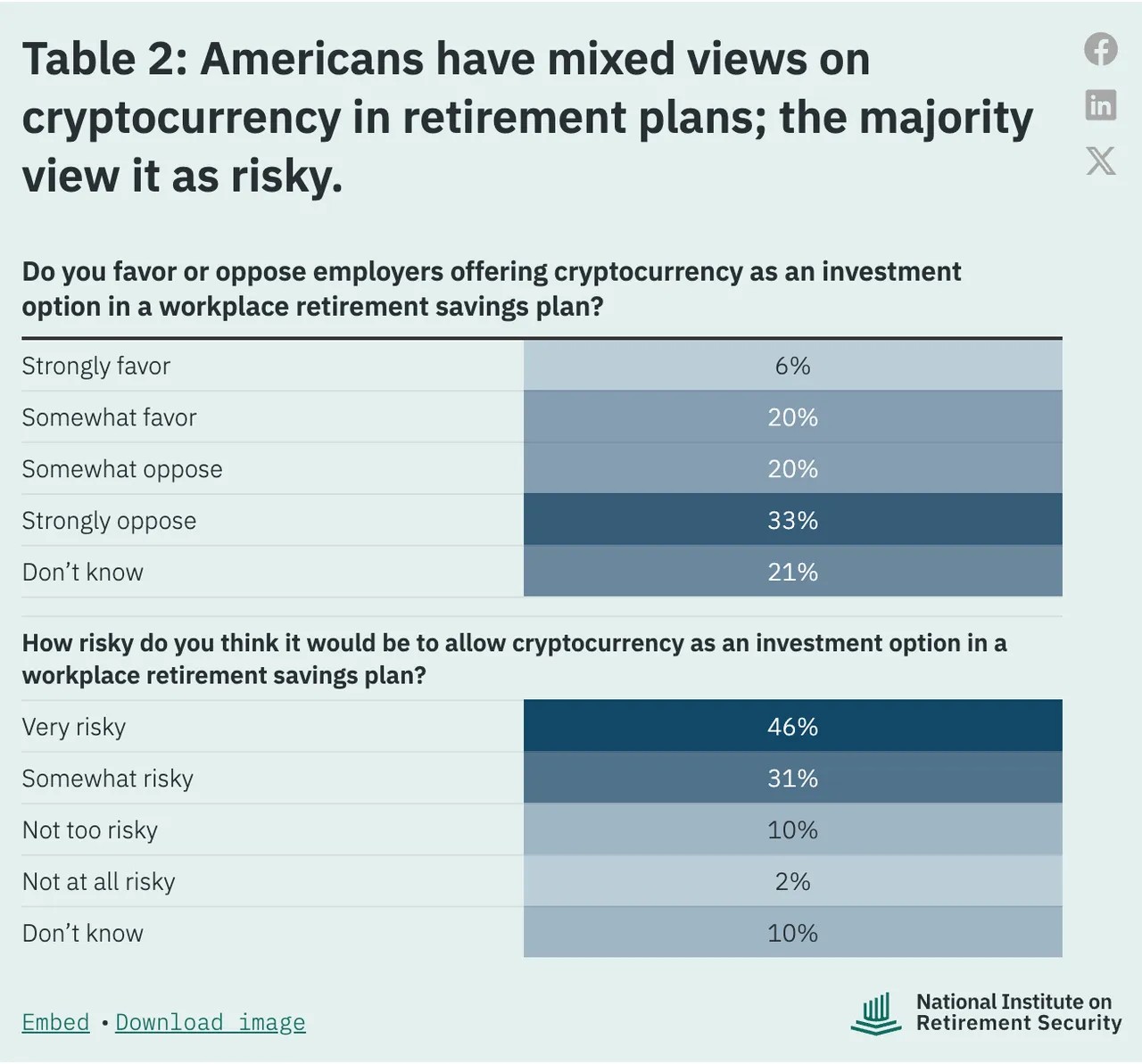
American attitudes towards cryptocurrency in retirement plans. Source: National Institute on Retirement Security

Related Topic: Bernstein Predicts Bitcoin Will Recover to $125,000 by End of 2026 Ahead of Cycle Peak

US Authorities Take Steps to Expand Access to Alternative Assets in 401(k) Plans

While the report shows that Americans generally consider cryptocurrency risky for retirement savings, the Trump administration and federal regulators have taken steps to expand access to alternative assets in retirement accounts, further involving cryptocurrency and other non-traditional investments in the retirement savings discussion.

In May 2025, the U.S. Department of Labor rescinded guidance that had urged 401(k) plan fiduciaries to exercise "extreme caution" when considering cryptocurrency investments, returning to a neutral approach that neither approves nor discourages including cryptocurrency in retirement plan investment lineups.

On August 7, 2025, President Donald Trump signed an executive order aimed at expanding access to alternative assets in defined contribution retirement plans, including investment vehicles that hold digital assets, and instructed the Department of Labor and the U.S. Securities and Exchange Commission (SEC) to consider regulatory changes to facilitate access to them.
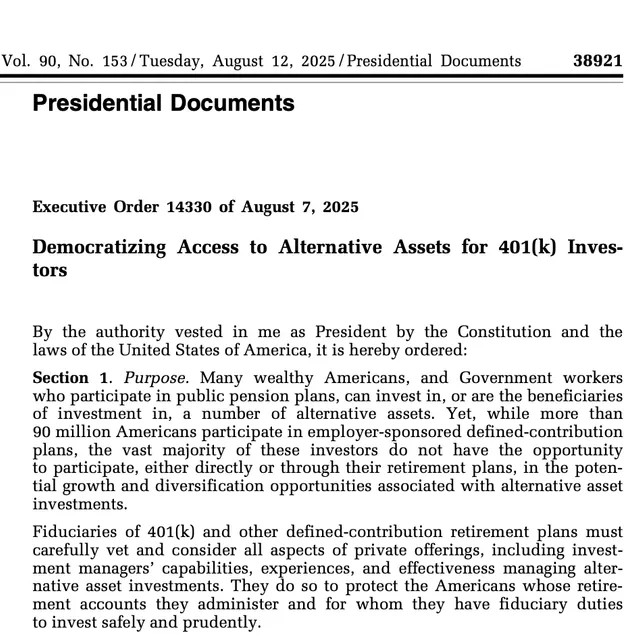
Trump's executive order on expanding access to alternative assets in 401(k) plans. Source: Federal Register

A few days later, the Department of Labor rescinded its 2021 guidance, which had discouraged 401(k) plan fiduciaries from considering alternative assets, stating that investment decisions should be evaluated based on a neutral, principled approach.

Later, in March 2026, the Department of Labor proposed rules defining how 401(k) plan fiduciaries can include alternative assets in investment lineups, including safe harbor provisions designed to reduce litigation risks by mandating consideration of factors such as fees, liquidity, valuation, and returns.

The proposal has faced resistance from lawmakers: Senators Bernie Sanders and Elizabeth Warren, along with Representative Bobby Scott, called on the Department of Labor in June to withdraw it, citing cryptocurrency volatility and what they described as insufficient investor protections.

Magazine: Proposed SEC crypto rules unlikely to trigger a new ICO boom

Domande pertinenti

QAccording to the survey, what percentage of Americans consider cryptocurrency in workplace retirement plans risky?

AAccording to the survey by the National Institute on Retirement Security, 77% of Americans consider cryptocurrency in workplace retirement plans risky.

QWhat steps has the Trump administration taken regarding access to alternative assets in retirement plans?

AIn August 2025, President Donald Trump signed an executive order aimed at expanding access to alternative assets in defined contribution retirement plans. This included investment vehicles holding digital assets and directed the Department of Labor and the SEC to consider regulatory changes to facilitate such access.

QWhat did the Department of Labor propose in March 2026 regarding 401(k) plans and alternative assets?

AIn March 2026, the Department of Labor proposed rules defining how 401(k) plan fiduciaries can include alternative assets in investment menus. The proposal included safe harbor provisions intended to reduce litigation risks, mandating consideration of factors such as fees, liquidity, valuation, and returns.

QWhich lawmakers opposed the Department of Labor's proposal on alternative assets in retirement plans, and what were their concerns?

AThe proposal was opposed by Senators Bernie Sanders and Elizabeth Warren, along with Representative Bobby Scott. They called for the Department of Labor to withdraw the proposal, citing cryptocurrency volatility and what they described as insufficient investor protections.

QWhat significant change did the Department of Labor make in May 2025 regarding cryptocurrency in 401(k) plans?

AIn May 2025, the U.S. Department of Labor rescinded guidance that had urged 401(k) plan fiduciaries to exercise 'extreme caution' when considering cryptocurrency investments. It returned to a neutral approach that neither approves nor discourages the inclusion of cryptocurrency in retirement plan investment menus.

Letture associate

How 5G Will Be Launched in Russia: The Digital Ministry's Proposal and the Roadmap to 2035

Russia's Ministry of Digital Development has proposed a plan for launching 5G networks. It allows the "Big Four" mobile operators (Beeline, Megafon, MTS, T2) to deploy 5G on existing 4G/LTE base stations and frequencies, and will allocate them the new 4.63–4.99 GHz band. A key element is "technological neutrality," permitting the use of foreign equipment until September 2026. The new 4.63–4.99 GHz band is intended for more advanced services and industrial applications. However, a phased transition to Russian-made base stations will begin in 2027, with a target of at least 50% domestic equipment by 2030. The rollout timeline aims for 5G in cities with over 1 million people by the end of 2027, expanding to 84 cities by 2035. Initial "5G Ready" service, operating over existing infrastructure, will offer minimal speed improvements. Significant speed gains (4-10x over LTE) will require the new band and corresponding equipment. The plan addresses long-standing regulatory delays, including the military's hold on the global standard 3.4–3.8 GHz band. This forced Russia to adopt the 4.63–4.99 GHz range, overlapping with a Chinese band, making Chinese equipment a potential transitional solution. The success of the rollout will depend on equipment supply and the pace of production localization, while a challenge lies in smartphone compatibility with this non-standard frequency band.

cryptonews.ru1 h fa

How 5G Will Be Launched in Russia: The Digital Ministry's Proposal and the Roadmap to 2035

cryptonews.ru1 h fa

The Federal Reserve Bank of Dallas Announces a Colossal $700 Billion Allocation! How Will This Affect Bitcoin?

The Federal Reserve Bank of Dallas warns that the growing adoption of tokenized deposits in the banking sector could pose unforeseen risks to the financial system. Tokenized deposits, which transfer traditional bank deposits to blockchain infrastructure, offer features like instant settlement and programmable payments. While issued by regulated banks and maintaining deposit characteristics, they could enable customers to move funds between banks much faster in search of higher yields. This would significantly weaken banks' liquidity management and lending capacity. The Fed's analysis estimates that an increase in deposit interest rate sensitivity by 10% could reduce the interest rate risk banks can bear by approximately $700 billion over ten years. Similarly, a 10% shortening of the average deposit maturity could reduce the banking system's capacity to convert deposits into loans by about $580 billion. This acceleration of deposit movement could force banks to rely on more expensive wholesale funding, increasing borrowing costs for consumers and businesses and potentially making traditional banks resemble non-bank financial institutions. While the report does not directly address Bitcoin, the described shifts could have long-term implications. Firstly, the tokenization of deposits by banks could promote institutional adoption of blockchain-based financial infrastructure, indirectly legitimizing digital asset classes like Bitcoin. Secondly, faster-moving deposits and resulting higher funding costs could increase the price of liquidity in the financial system. This could create near-term headwinds for risk assets, including Bitcoin, due to tighter financial conditions and potential selling pressure. The report concludes that widespread adoption of this technology could impact many areas, from payment systems to monetary policy transmission mechanisms.

cryptonews.ru1 h fa

The Federal Reserve Bank of Dallas Announces a Colossal $700 Billion Allocation! How Will This Affect Bitcoin?

cryptonews.ru1 h fa

Trading

Spot
活动图片