Author: Bao Yilong
SK Hynix's Q2 operating profit hit a record high, yet still fell short of analyst expectations, further deepening market concerns over whether AI chip demand can sustain high valuations.
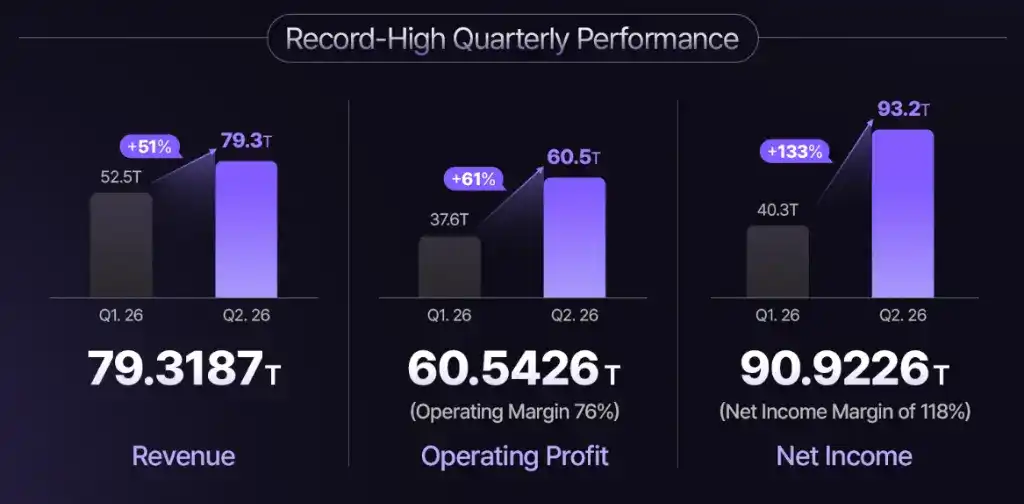
After the U.S. market closed on July 28, SK Hynix released its Q2 earnings report, with operating profit soaring 557% year-on-year to 60.5 trillion won, and revenue increasing 257% to 79.3 trillion won, both metrics setting new quarterly records.
However, both figures missed analyst expectations. The market had previously forecast operating profit at approximately 64.2 trillion won and revenue at around 83.9 trillion won.
Regarding demand outlook, SK Hynix maintains an optimistic view. SK Hynix stated it has finalized long-term agreements with about 10 customers and continues to negotiate with other major industry clients to enhance operational efficiency and strengthen mid- to long-term business stability and sustainable growth foundations.
Since June this year, SK Hynix has lost over $500 billion in market capitalization, with a one-month slide at its deepest point erasing about 45% of its stock value. Following the earnings release, SK Hynix ADRs fell more than 5% after-hours, and its local Korean shares fell 4.5% pre-market.
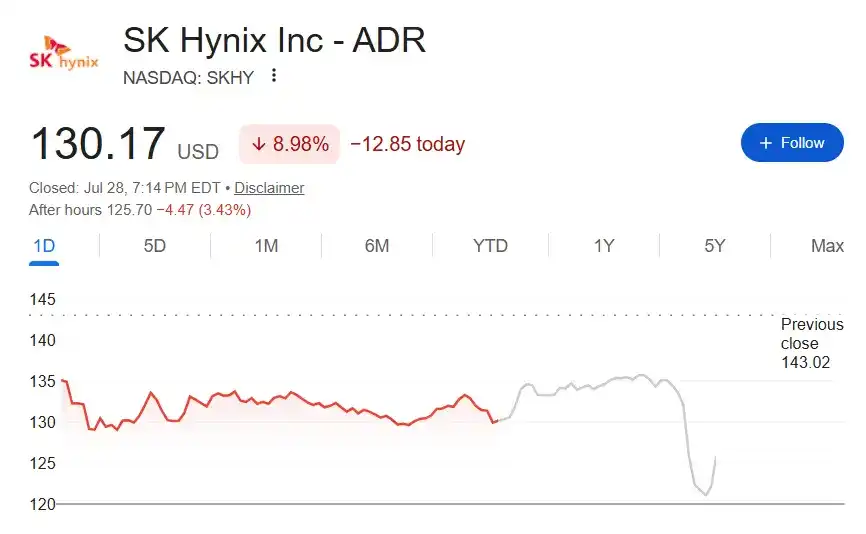
In absolute numbers, SK Hynix's Q2 almost epitomizes the memory industry's super cycle.
In Q2, the company's revenue was 79.3187 trillion won, an increase of about 257% from 22.232 trillion won a year earlier, and also up over 50% from 52.5763 trillion won in Q1. Operating profit was 60.5426 trillion won, a 557% increase from 9.2129 trillion won a year ago, and up about 61% from 37.6103 trillion won in Q1.
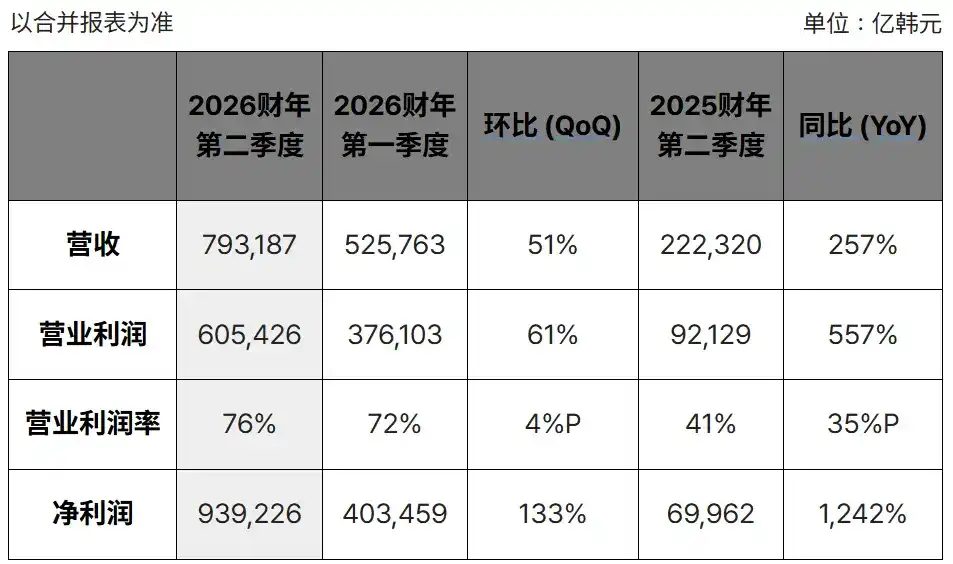
Profitability was even more remarkable. The Q2 operating margin reached 76.3%, up from 71.5% in Q1.
Data shows the company's Q2 gross margin reached 83%. This indicates that the prices and demand for high-value-added products like AI server memory, HBM, and eSSD have propelled SK Hynix to extremely high-profit levels.
Net profit even reached 93.9226 trillion won, with a net margin of 118%. However, this figure is not entirely from core operations, as it was significantly boosted by one-time investment gains.
In Q2, the company recognized non-operating income of 62.166 trillion won from the partial sale of its stake in Kioxia, bringing pre-tax profit to 122.7084 trillion won. This led to a substantial year-on-year increase in net profit, but its sustainability is weaker than operating profit.
SK Hynix's failure to meet market expectations this time stems from three structural factors.
First, the high proportion of HBM (High Bandwidth Memory) sales actually limits profit growth potential. The main driver of the sharp increase in profits across the semiconductor industry currently comes from the surge in prices of traditional commodity memory. SK Hynix's higher exposure to HBM means it benefits relatively less from this trend.
Second, memory price increases slowed significantly in Q2. According to SK Hynix, Q2 sequential price increases for commodity DRAM were about 30%, and for NAND flash in the mid-range of the 50% to 60% band, both lower than the approximately 60% for DRAM and 70% for NAND in Q1.
Third, long-term supply agreements (LTAs) signed with major customers locked in sales prices, weakening the earnings elasticity from spot price increases.
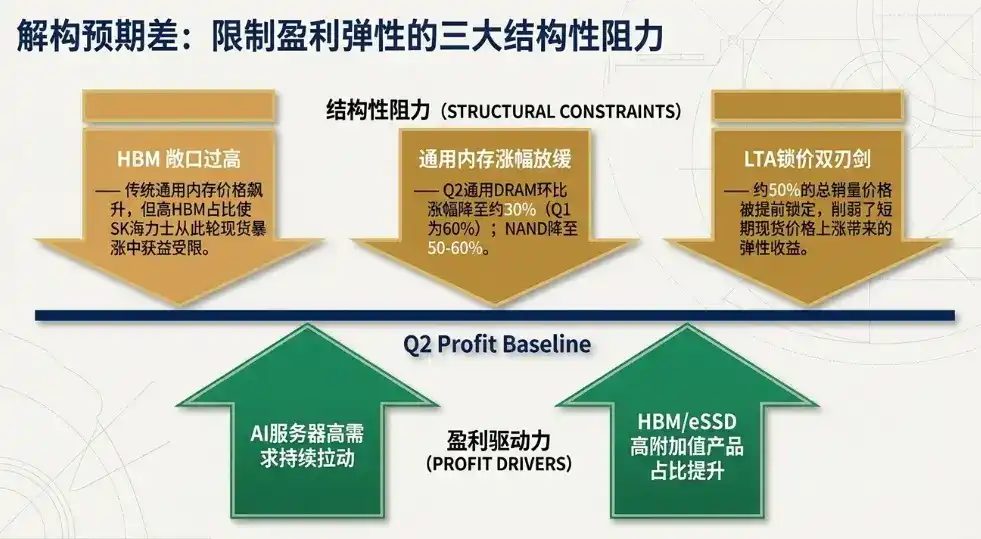
Reports citing informed sources revealed that SK Hynix has locked in roughly 50% of its total sales volume through long-term agreements. The company stated it has now completed long-term contract negotiations with about 10 customers and received additional supply requests from multiple large tech companies.
Josh Gilbert, Chief Analyst at eToro for APAC and the Middle East, pointed out:
When you are the dominant supplier of the high-bandwidth memory that powers Nvidia's chips, the AI boom directly reflects on your profit statement. This means the market is unlikely to focus solely on the headline numbers; the more critical question is whether the profit margins and guidance can justify the recent stock performance.
Beyond HBM, the NAND business is also benefiting from the recovery cycle.
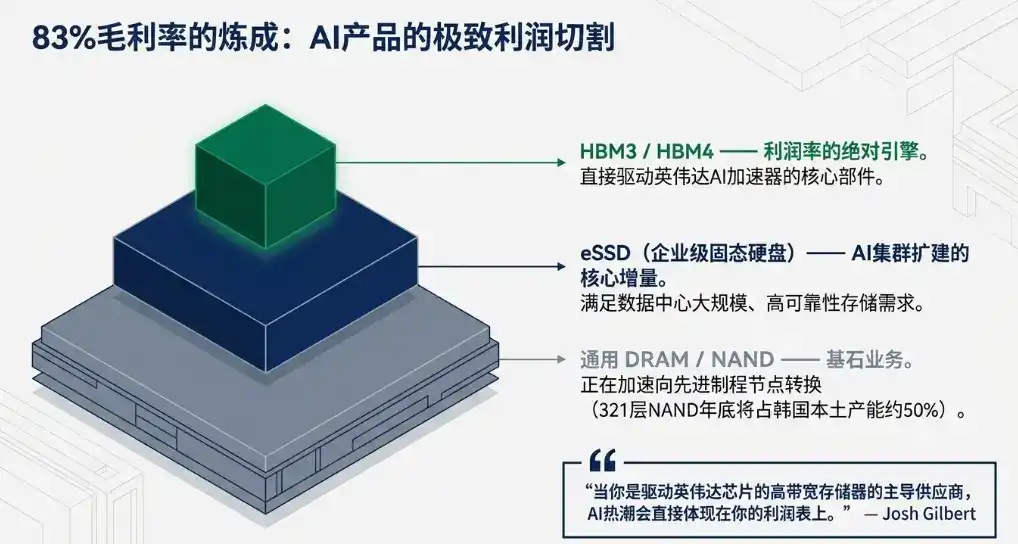
The company said that for NAND, it is accelerating the transition to advanced process nodes to strengthen its high-capacity, high-performance product portfolio. The 321-layer product has become the highest contributor to total production, and the company plans to expand its share of domestic Korean capacity to about 50% by year-end.
Enterprise SSDs remain a significant growth driver. AI data centers require not only HBM and server DRAM but also large-scale, high-performance, high-reliability storage devices. As cloud providers and large tech companies expand AI clusters, eSSD demand is strengthening concurrently, helping SK Hynix improve the quality of its NAND product mix.
This is also what distinguishes this memory cycle from previous ones: past upturns were often driven by consumer electronics like smartphones and PCs, whereas current AI server demand simultaneously drives DRAM, HBM, and eSSD, making supply tightness more structural.
Financially, SK Hynix's Q2 cash flow improved notably.
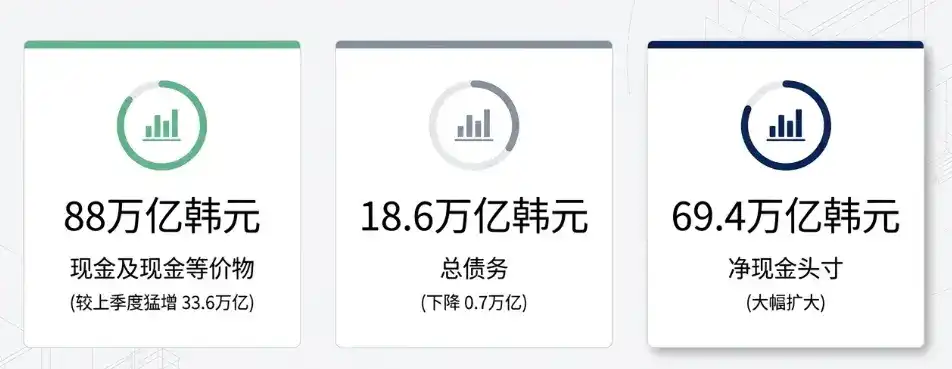
As of the end of Q2, the company's cash and cash equivalents reached 88 trillion won, an increase of 33.6 trillion won from the previous quarter; total debt decreased by 0.7 trillion won to 18.6 trillion won, and the net cash position expanded to 69.4 trillion won.
The company stated that thanks to record profits and cash generation, financial flexibility has significantly enhanced.
However, strong demand also implies greater capital expenditure pressure. SK Hynix expects 2026 capital expenditures to reach the upper end of the 40 to 50 trillion won range. The company is accelerating the mass production timeline for M15X and preparing to rapidly expand capacity once the Yongin Phase 1 cleanroom becomes operational in early 2027.
Additionally, the company mentioned medium- to long-term investment plans including the P&T7 advanced packaging facility, M17 NAND production base, and new semiconductor clusters.
These projects will be advanced in phases based on customer demand and investment efficiency. For investors, the key question will be whether SK Hynix can maintain capital expenditure discipline and avoid excessive supply expansion eroding margins in the next phase while AI demand remains robust.