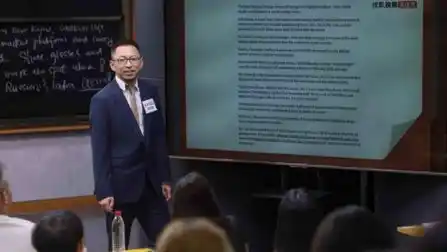
This scene rivals Unitree's listing—
It has been learned by Investing Frontier that XPeng Group has officially announced that its humanoid robotics business has signed equity financing agreements with multiple investors. The round is led by IDG Capital, with participation from Gaorong Capital, and also secured support from strategic investors Tencent and Alibaba.
It is worth mentioning that this round marks the first financing for XPeng's robotics business. The financing amount exceeds $9 billion (approximately ¥65 billion), with a post-investment valuation exceeding $63 billion (approximately ¥430 billion). This single-handedly sets a new record for the largest single round of private equity financing in China's embodied AI industry. In comparison, Unitree Technology's final IPO fundraising total was approximately ¥60.99 billion.
This time, He Xiaopeng is personally taking the helm—he is not only the founder of XPeng Motors but is also currently the CEO of XPeng's robotics business. Under his leadership, XPeng's humanoid robotics started in 2020 and has already become a super unicorn with its first financing round.
The timing is quite delicate—just days ago, Unitree Technology debuted on the STAR Market as the "first humanoid robotics stock." A major battle in China's embodied AI sector is unfolding.
¥430 Billion Valuation, Breaking the Record
Alibaba and Tencent Have Arrived
More investment details have emerged.
XPeng Group's announcement shows that the transaction entity, Pxing, has a pre-money valuation of $50 billion and a post-money valuation of $63 billion. Among them, a wholly-owned subsidiary of XPeng Group intends to invest $200 million to subscribe for 98.6752 million Series A preferred shares; investors including IDG Capital, Gaorong Capital, Alibaba, and Tencent intend to invest a total of $600 million to subscribe for 296 million Series A preferred shares; the management subscription party, an affiliated entity wholly controlled by He Xiaopeng and Gu Hongdi, intends to invest a total of $100 million to subscribe for 49.3376 million ordinary shares.
For the four external investors, this investment in XPeng Robotics represents one of the largest single disclosed investments each has made in the embodied AI field: IDG Capital invested ¥2.1 billion, while Gaorong Capital, Alibaba, and Tencent each invested ¥720 million.
The announcement also indicates that Pxing can issue additional Series A preferred shares to extra investors within four months of signing the share purchase agreement, raising up to $15 million.
According to the announcement, while introducing this round of financing, XPeng Group and Pxing will implement and complete the Pxing spin-off plan within an agreed period. This involves transferring certain business assets, intellectual property, and personnel related to the robotics business, which are not yet held by Pxing, to Pxing.
Furthermore, the timeline for the capitalization of XPeng's robotics business is becoming clearer. The announcement discloses that if Pxing fails to complete a qualified IPO within seven years after the initial investment closing, investors have the right, under certain conditions, to require Pxing, its significant subsidiaries, or XPeng Group to redeem the relevant shares.
XPeng Group stated in the announcement that this round of financing allows the value of Pxing and the robotics business to be better reflected, attracts robotics-specialized capital distinct from automotive business investors, alleviates the financial burden on XPeng Group with substantial funds, and the participation of renowned international institutional investors will enhance Pxing's image among potential customers, suppliers, and strategic partners.
From IDG Capital's perspective, XPeng's humanoid robot represents the leading level of China's humanoid robotics industry and possesses the capability to compete globally with leading overseas enterprises. XPeng has achieved a full-stack proprietary layout covering edge AI chips, physical AI large models, and complete hardware, boasting industry-leading edge computing power, training computing power, and a high-quality data closed-loop system. Additionally, the robotics business can generate significant strategic synergies with the smart car and autonomous driving businesses. "We believe that with its advantages across the entire chain from core technology R&D and mass production to globalization, XPeng will become a leading enterprise driving the industry towards the large-scale application stage."
Gaorong Capital similarly stated that humanoid robots are transitioning from demonstrating mobility capabilities to achieving stable mass production and creating value in real-world scenarios. XPeng IRON, with its highly anthropomorphic product form and automotive-grade safety standards, enters real commercial scenarios, serving both as an interactive medium close to humans and a crucial entry point for acquiring real-world data. It holds the potential to drive the continuous operation of the 'mass production—data—model—application' flywheel. "XPeng is systematically transferring the full-stack R&D capabilities, supply chain, and manufacturing system accumulated over more than a decade in smart electric vehicles to robotics, laying a solid foundation for the industrialization of humanoid robots."
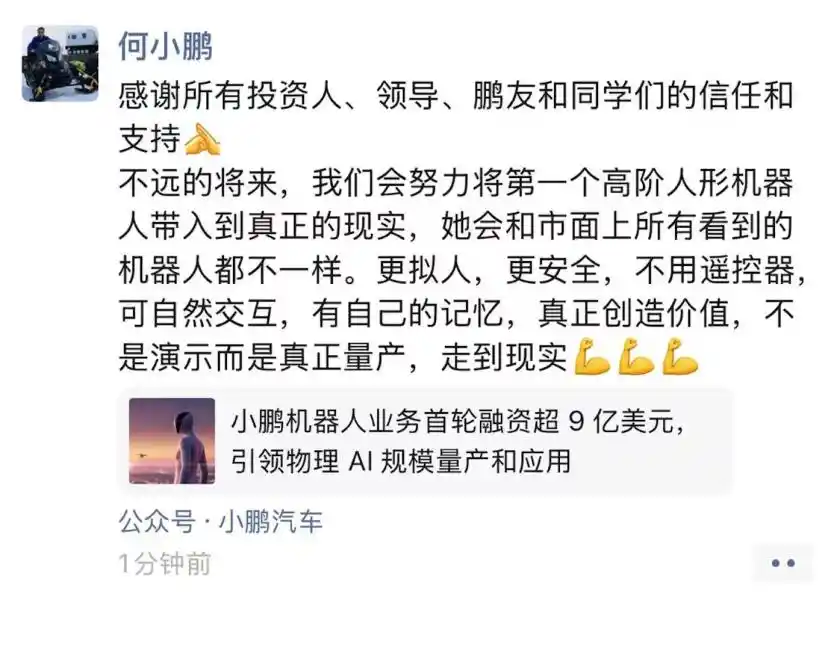
After leading XPeng's humanoid robotics to this milestone, He Xiaopeng expressed profound emotions. He wrote on his WeChat Moments, "In the not-too-distant future, we will strive to bring the first advanced humanoid robot into reality. She will be different from all the robots currently seen on the market."
He Xiaopeng Personally Takes Charge
Robot Capable of Catwalk to be Mass-Produced This Year
XPeng's foray into robotics started much earlier than the public imagined.
It is reported that He Xiaopeng's interest in robotics began as early as 2016. He conducted serious annual research into the robotics direction and once had a long conversation with Wang Xingxing, founder of Unitree.
It wasn't until 2020 that He Xiaopeng decided to act. Introduced by Xiaomi founder Lei Jun, he acquired "Dogotix" founded by Zhao Tongyang and established "Pxing Intelligence" to explore XPeng's robotics business. Later, in September 2023, XPeng Motors acquired the remaining 74.82% stake in Pxing Intelligence for $98.96 million, making Pxing an official robotics division of XPeng Motors. In October of the same year, XPeng's first bipedal humanoid robot, the PX5, was unveiled.
Why such dedication to robotics development? He Xiaopeng has repeatedly emphasized publicly that the greatest value of AI lies in "changing the physical world." In his view, smart electric vehicles are the precursor to robots. Autonomous driving technology solves "minor brain problems" like "movement and balance," accumulating crucial experience for humanoid robots.
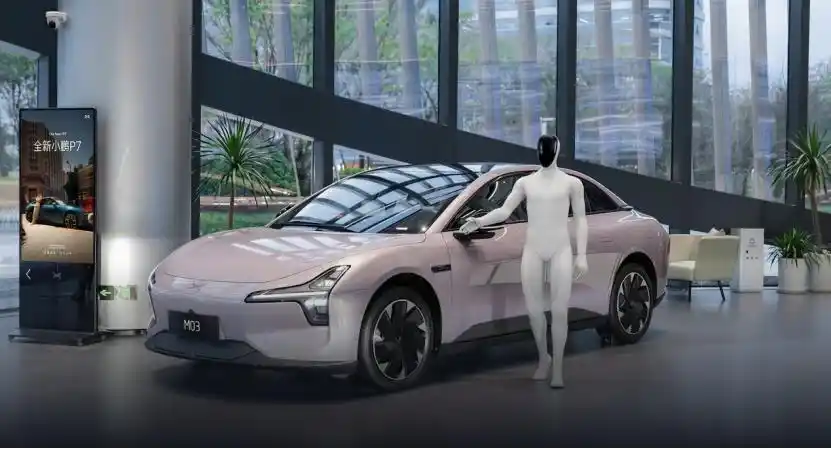
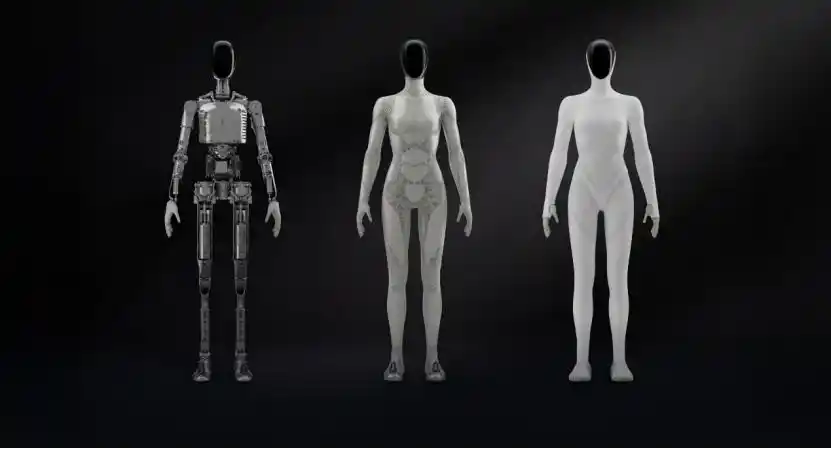
The moment that truly captivated the entire internet occurred at the XPeng Tech Day in November 2025, where the new generation humanoid robot IRON was officially unveiled. Designed with a 1:1 human proportion, it was capable of a catwalk-style walking posture, sparking widespread online discussion. Some netizens even suspected "a real person was hidden inside."
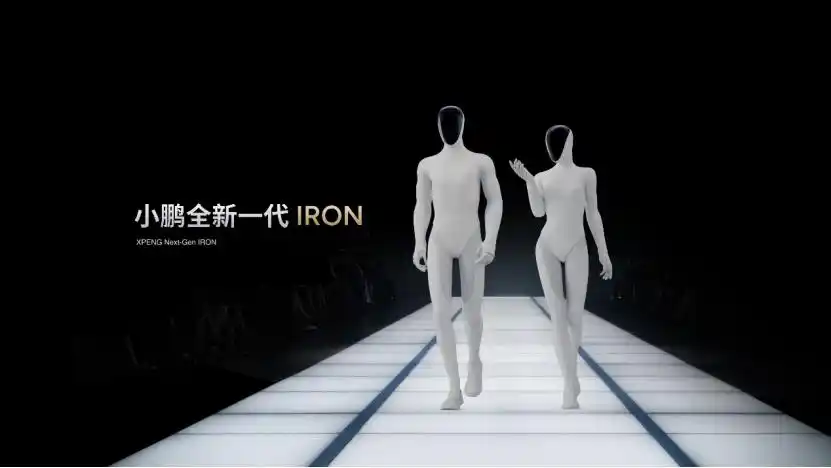
In terms of hardware, the XPeng IRON boasts industry-leading anthropomorphic posture and design, featuring the first full-coverage flexible lattice structure that balances aesthetics and safety. It has 76 degrees of freedom overall, with 21 degrees of freedom in a single hand. Furthermore, XPeng Robotics has independently designed and developed an AI-native hardware platform and all core components for embodied intelligence, including chips, controllers, motion modules, and dexterous hands. Leveraging its established smart electric vehicle R&D and manufacturing system, it aims to achieve automotive-grade quality and large-scale mass production and delivery capabilities.
In terms of intelligence, the XPeng IRON is equipped with three Turing AI chips, delivering an effective computing power of up to 2250 TOPS. The XPeng Physical AI large model is successfully deployed on the edge, enabling it to autonomously complete complex work tasks without remote operation, while ensuring low-latency inference and data security.
Entering 2026, XPeng Robotics accelerated its industrialization pace. In February, the company began constructing the industry's first full-chain mass production base for humanoid robots. In June, He Xiaopeng announced that in addition to serving as Group CEO, he would personally take on the role of CEO for the robotics business. He stated candidly that the XPeng humanoid robot IRON is standing on the threshold of mass production and delivery, comparable to the stage XPeng Motors was at eight years ago, just before completing the launch of its first car, the G3.
According to plan, the XPeng IRON will enter the mass production phase by the end of 2026, starting its commercial application in XPeng's stores and campuses, and will be officially launched and delivered to markets in China and overseas in 2027.
It is worth noting that Pxing remains in a phase of continuous investment, reporting net losses of ¥87 million in 2024 and ¥369 million in 2025. As of the end of March 2026, its net liabilities were approximately ¥447 million, and it has yet to disclose scaled product revenue or external orders.
However, He Xiaopeng remains confident. He stated during the earnings call that the technological barriers for high-level general-purpose robots are extremely high, and high-quality supply is scarce. Therefore, the revenue and gross profit contribution throughout the lifecycle of each IRON unit, including hardware sales and sustained revenue from software AI model capability upgrades, will be significantly higher than the current average selling price and gross profit per vehicle in the automotive business.
Interestingly, He Xiaopeng holds another super unicorn—XPeng AeroHT. Also founded in 2020, XPeng AeroHT focuses on the R&D of intelligent electric flying cars. According to He Xiaopeng, XPeng AeroHT's global orders for the Land Aircraft Carrier have reached 7,000 units, and it has the potential to set a world record for annual sales of manned flying vehicles.
In March this year, XPeng AeroHT completed a new round of equity financing of nearly $200 million, with investors including Hillhouse Ventures, Sequoia Capital China, Gaorong Capital, and Fortune Capital. This brings XPeng AeroHT's total historical equity financing to approximately $1 billion.
During this period, Bloomberg reported that XPeng AeroHT was working with J.P. Morgan and Morgan Stanley on its IPO preparations. XPeng AeroHT responded at the time, emphasizing its current focus on product R&D and mass production delivery, with no other information to share.
It seems likely that He Xiaopeng will once again stand on the stage for an IPO bell-ringing ceremony.
Automakers Jumping In Collectively
Life-and-Death Battle for Chinese Robots Begins
The real elimination race has begun.
Last week, Unitree Technology officially listed on the Shanghai Stock Exchange's STAR Market, becoming the "first humanoid robotics stock" on the A-share market, with its market capitalization briefly reaching nearly ¥450 billion on the first day.
However, Unitree's stock price began to decline the next trading day, and its latest market cap has fallen below ¥250 billion. This "rollercoaster" performance completely shattered the last layer of window dressing in the embodied AI track: before this, startups could rely on technical demonstrations and conceptual proposals to secure financing; after this, the capital market wants to see revenue, mass production, and a commercialization path.
This means the window of opportunity for humanoid robotics startups is rapidly narrowing. For automotive giants, however, this has become the best time to collectively enter the field.
Among them, Tesla is undoubtedly the most aggressive player. Tesla Vice President Tao Lin publicly stated that the Optimus humanoid robot will officially commence large-scale mass production by the end of 2026, with the Fremont factory's long-term annual capacity target set at 1 million units. To this end, the former Model S/X production line at the factory has been converted into an exclusive Optimus production line, scheduled to officially start production in July-August.
Turning our perspective back to China—in February this year, GAC Group officially incubated the humanoid robotics company Huilun Technology and unveiled its fourth-generation robot, the GoMate Mini. Then, in mid-August, Huilun Technology announced the completion of over ¥100 million in financing, jointly invested by CRRC Guochuang Fund, CMB International, Sichuan Science and Technology Innovation, and other institutions.
Such cases are emerging: at the end of March, Changan established Tianshu Intelligent Robotics Company, launching the humanoid robot prototype "Xiao'an"; Li Auto revealed during its Q1 earnings call that its humanoid robot product has been approved for R&D; BYD's commercial service humanoid robot "Xiao Di" was announced in August at the "Di Space" in Zhengzhou; at the same time, news emerged that Chery Automobile's Mojia Robot had started IPO preparations; and at the recently concluded 2026 World Robot Conference, FAW Group, Dongfeng Motor, and Xiaomi Group all showcased their new generation humanoid robots......
Li Xiang, founder of Li Auto, once judged, "In the next 3-5 years, competition in the mid-to-high-end smart car sector will essentially be competition in embodied intelligence. From a market structure perspective, whether it's automakers with initial revenues reaching the hundred-billion-yuan level or larger-scale auto manufacturers, they will all enter the embodied intelligent robotics track."
Previously, a founder of an embodied AI unicorn candidly stated in a conversation with Investing Frontier, "Embodied companies are worried about automakers entering the field because they have ready-made technology and production lines. It's essentially a dimensional reduction strike."
The reason for this concern is self-evident. For startups, the current market landscape seems somewhat suffocating. The competitors they face are no longer peers on the same starting line but automotive giants with cash reserves of tens of billions, complete supply chain systems, large-scale manufacturing capabilities, and global sales networks.
After all, there is significant overlap in the technological systems of automobiles and robots, and this technological homology provides an inherent advantage for automakers. The proprietary chips, large models, perception systems, control systems, and operating systems required for smart cars also form the core technological foundation for general-purpose humanoid robots. Technological capabilities validated in mass-produced vehicles can be directly advanced to humanoid robots.
More importantly, the industrialization capabilities of the automotive industry provide crucial support for robot mass production. The large-scale manufacturing experience, supply chain management systems, and quality control standards from smart cars can be directly applied to robot production.
Thus, automakers don't need to start from scratch when making robots, and car factories themselves are ideal testing and deployment scenarios for humanoid robots.
At present, the final outcome of this elimination race remains unpredictable, but one thing is certain: every player on the track has no way back.
This article is from the WeChat public account "Investing Frontier" (ID: pedaily2012), author: Liu Bo.