Source: Hashrate Heart
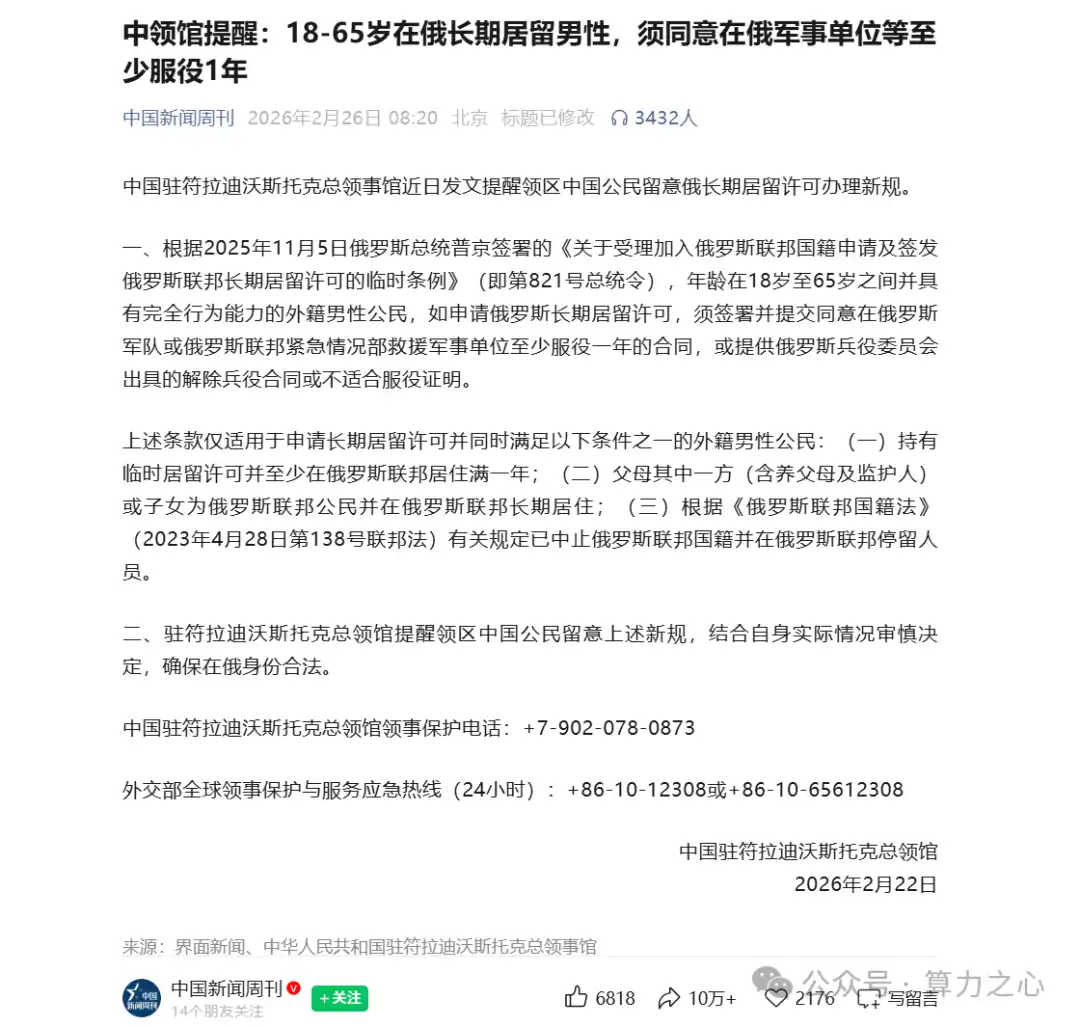
On February 23, 2025, the Chinese Consulate in Russia once again reminded Chinese citizens in Russia to pay attention to Presidential Decree No. 821 signed by Putin.
This decree presents a very real "deadly dilemma" for Chinese miners in Russia:
Either give up their residency status or enlist in the military first.
To stay and earn rubles legally, one might first have to pass through a conflict zone.
The decree is clear:
Foreign males aged 18 to 65 who wish to apply for long-term Russian residence permits must agree to serve for at least one year in Russian military units or similar.
Once, miners went to Siberia for cheap electricity, but now, before their mining rigs have even paid for themselves, they might first be treated as "expendable material."
Now, can those gold rushers, along with their computing power worth tens of millions, make a clean getaway?
I. The Compliance Dead End: To Be Legal, Enlist First
Many miners who ventured to Russia thought they were just transnational money-makers, distant from the front-line gunfire.
But since last year, a targeted net for foreign miners has been quietly cast.
Step one, "Lure them out."
Russia formally legalized cryptocurrency mining in 2024, once seen as a paradise by miners.
But the condition was:
Individuals or enterprises with high electricity consumption must join the official "Miner Registry," fully disclosing wallet addresses and income.
Failure to report would result in heavy fines and equipment confiscation.
This move forced all miners wanting to earn stable money legally to voluntarily submit their names and details.
Once the information was handed over, the next step followed naturally.
Step two, "Identity Lockdown."
As a foreigner, to legally register for large-scale mining,
you must have a Russian long-term residence permit or a registered address within Russia.
And this is precisely the most perilous trap in the entire scheme.
Step three, "Strike the Fatal Blow"
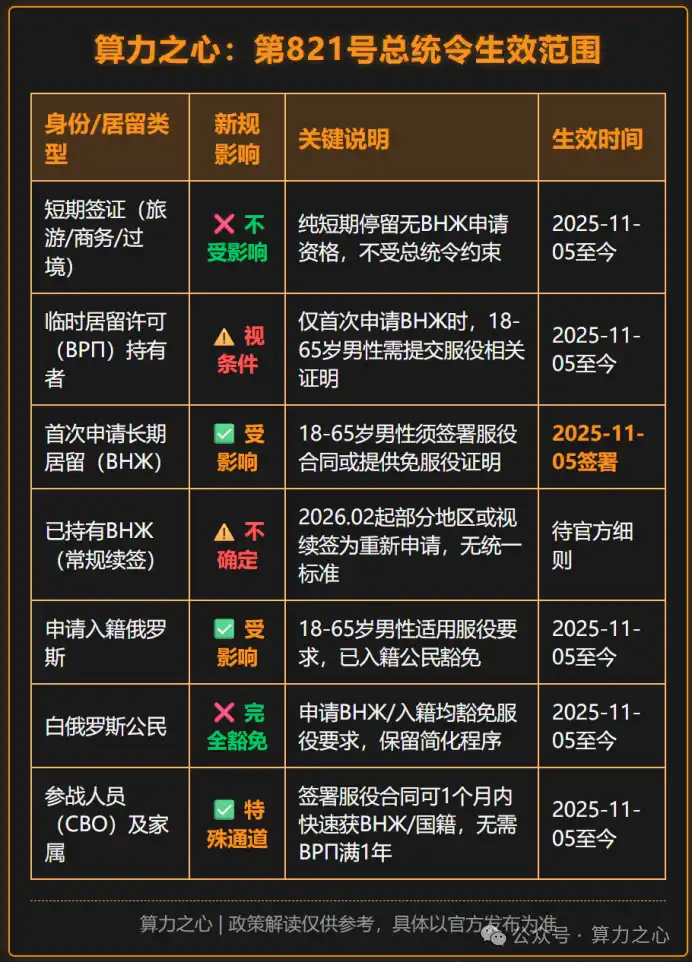
In 2025, with the implementation of Russian Presidential Decree No. 821, the rules for applying for long-term residence permits changed completely.
Either submit a Russian military service contract or provide proof of being unfit for service.
This move directly targets the large number of foreign male mining industry workers in Russia—
those who originally hoped to register as individual entrepreneurs or companies to obtain long-term residence now find that path blocked.
The loop is now closed.
To mine legally, you must register with real names;
To register, you must secure a residence permit;
To get the residence permit, you must be ready to go to the front lines at any time.
First, use the bait of legalization to draw you out, then use heavy penalties to force compliance, and finally, use a residence permit to precisely wash you into a potential source of soldiers.
You thought you were going to mine Bitcoin with machines, but in the eyes of the wartime machine, you are the "mine."
II. The Countdown for Proxy Holdings and "Visa Runs"
If obtaining long-term residence is risky, can one operate in the gray area on a business visa as a "guerrilla"?
The answer is no, this path is being completely sealed off.
In the past, many miners exploited loopholes by "exiting every 90 days" or even finding locals to hold mining farms on their behalf.
But starting in 2025, Russia has dealt several heavy blows, targeting people, behavior, and assets one by one.
First, immigration control came down hard on people.
The "Controlled Persons Registry" effective in February 2025 is very precise.
Once a visa has issues, bank accounts are instantly controlled, with very low limits even for daily expenses.
More critically, police can detain and initiate deportation procedures within 48 hours without court approval.
Using a business visa for mining is illegal work, making one a potential target for removal at any time.
Next, the legal characterization of the behavior changed.
According to the draft amendment to the Criminal Law in December 2025, illegal mining could face up to 5 years imprisonment and huge fines.
What was once at most a violation is now a criminal offense.
The gray area's room for survival is being squeezed out inch by inch by legal条文.
Then assets were targeted.
In February 2026, Putin further signed a new law giving courts the authority to directly confiscate mining equipment and Bitcoin involved in cases.
Nasdaq-listed company The9 once said: Russia might "in specific circumstances implement nationalization and confiscation of foreign enterprise assets."
In Russia, it doesn't matter whose name the machines are under; if they are suspected of being illegal, they will be confiscated.
Besides, you can't hide them.
Since late 2024, the Russian power grid has built an "integrated air-and-ground" detection network.
In the air, thermal imaging drones pinpoint locations; on the ground, AI smart meters monitor in real-time; at the terminal, smart algorithms proactively identify.
In Dagestan alone, 73 cases of electricity theft for mining were uncovered from January to November 2025, causing losses of 85.7 million rubles.
People, behavior, assets, hiding places—all four paths are blocked.
The window for discreet mining by exploiting visa loopholes is closing.
III. The State Machine Wants Energy, Not Hashrate
Taking a step back, even if one secures identity and survives the risks of proxy holdings, there's not enough electricity for mining in Russia anymore.
After China's mining crackdown in 2021, Siberia, Russia, with its natural low temperatures and electricity costing just a few cents, became a sanctuary for global miners.
Russia's largest mining company, BitRiver, started here, managing 175,000 mining rigs at its peak.
In those years, with electricity and courage, money followed.
But the grid couldn't handle it.
By the end of 2024, the mining army consumed 1.5% of Russia's national electricity, pushing grids in many areas to the brink of overload.
Aging infrastructure needs maintenance, people's heating cannot be cut off—in Russia's non-natural gasified regions, electric heating is the most affordable way to stay warm in winter. Thus, these "big electricity consumers" naturally became the first targets.
Starting in 2025, bans landed intensively.
Multiple districts in the North Caucasus and Siberia were completely cut off or subject to seasonal power restrictions. Even BitRiver couldn't withstand it.
However, what broke it wasn't the Bitcoin price, but a combination of judicial debt collection, account freezes, and regional power limits.
As for foreign miners without local connections,
under the triple whammy of "identity threshold (military contract + controlled persons registry) + energy control + asset confiscation,"
they will only be the first to be sacrificed.
The window of野蛮生长 (wild growth) relying on cheap electricity and courage has closed.
In the face of hardline policies, hashrate is just code that can be unplugged at any time.
When everyone withdrew from China in 2021, they were betting on the same thing:
Remote places with loose regulation, alive as long as there's electricity.
Four years later, reality has given another answer.
You can outrun one country's regulation, but you can't outrun another country's conscription order.
In the story of global miner migration, the Russian chapter is coming to an end.
For those people and machines that haven't withdrawn yet, the time window left for them is running out.