Hong Kong Aims to Act as Global Connector Between Crypto and Traditional Finance

TheNewsCryptoPubblicato 2026-02-02Pubblicato ultima volta 2026-02-02

Introduzione

Hong Kong lawmaker Johnny Ng emphasizes that the city is positioning itself as a global connector between cryptocurrency and traditional finance, rather than competing directly with other nations. He argues that crypto is not a zero-sum game and should function as an interconnected global system. Hong Kong’s advantages include its common law system, English-language courts, and free capital flow, which help build a regulated and trusted crypto environment. The city also leverages the Greater Bay Area, collaborating with hubs like Shenzhen and Macau to combine fundraising and regulatory expertise with technological innovation. Recent efforts include inviting global crypto firms, such as Coinbase, to establish operations in Hong Kong and introducing clearer custody and OTC trading rules to better integrate crypto with institutional and corporate finance.

Johnny Ng, a Hong Kong lawmaker and a strong supporter of Web3 and digital assets, says that Hong Kong is not trying to “Beat” other countries in crypto; instead, it can act as a global connector between crypto markets and traditional finance across the U.S., Europe, and China.

Ng says that crypto should not be treated as the Zero sum game, meaning Crypto doesn’t belong to one country and is global, which works best when it is connected. He also stated that Hong Kong’s goal is to link East and West, Crypto startups and traditional banks, and innovation and regulations.

Why Hong Kong has a strong advantage

According to him, Hong Kong already has the strong advantages of a common law system that the global investors could understand and the English language court, trusted by the international businesses, with a free movement of money in and out of the city. This helps Hong Kong to build a crypto market that is regulated, safer, and accepted by the global financial institutions.

A key part of Hong Kong’s strategy involves the Greater Bay Area, which connects cities and Chinese hubs such as Shenzhen and Macau. Ng explained that Hong Kong helps to raise money and handle rules, whereas these main cities turn ideas into real products, which makes the region powerful.

Inviting the global crypto firms
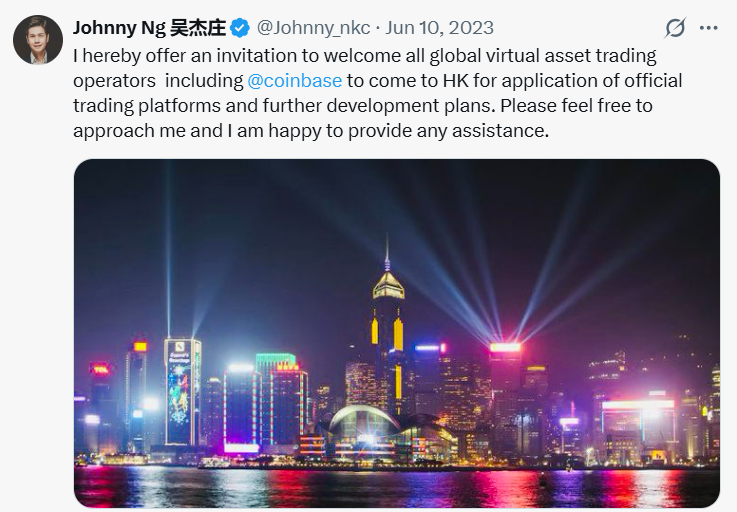
Ng pointed out that Vitalik Buterin spent a lot of time in Hong Kong during Ethereum’s early stages, which shows that the region has long supported blockchain innovations. In 2023, during the period of strict enforcement by the U.S. regulations, he invited the major crypto companies like Coinbase to operate in Hong Kong.

In 2026, Hong Kong plans to introduce clearer custody rules and regulate OTC crypto trading with larger trading limits for professional investors. Ng says that the next phase is about the infrastructure, and these steps aim to make crypto work smoothly with real businesses and large investors.

Highlighted Crypto News:

XRP Slides Below $1.60 Amid Broader Crypto Market Pullback

TagsBlockchainCryptoHongKong

Domande pertinenti

QWhat role does Hong Kong aim to play in the global crypto market according to Johnny Ng?

AHong Kong aims to act as a global connector between crypto markets and traditional finance, linking East and West, crypto startups and traditional banks, and innovation and regulations.

QWhat advantages does Hong Kong have in building a regulated crypto market?

AHong Kong has a common law system, English language courts trusted by international businesses, and free movement of money, which help build a regulated, safer crypto market accepted by global financial institutions.

QHow does the Greater Bay Area contribute to Hong Kong's crypto strategy?

AThe Greater Bay Area connects cities like Shenzhen and Macau, where Hong Kong handles fundraising and regulations while these cities turn ideas into real products, making the region powerful.

QWhat did Johnny Ng do in 2023 regarding global crypto companies?

AIn 2023, during strict U.S. regulations, Johnny Ng invited major crypto companies like Coinbase to operate in Hong Kong.

QWhat regulatory steps is Hong Kong planning for 2026 to support crypto integration?

AIn 2026, Hong Kong plans to introduce clearer custody rules and regulate OTC crypto trading with larger limits for professional investors to make crypto work smoothly with real businesses and large investors.

Letture associate

Claiming 'KYC-Free Global Payments', Inevitable Shutdown Within 6 Months

Cryptocurrency cards marketed as "No-KYC global payment" solutions are fundamentally unsustainable and inevitably face shutdown within 6 months due to structural and regulatory realities. These cards rely on exploiting corporate card programs, where a company undergoes business verification (KYB) to issue cards to "employees" without individual KYC. However, Visa and Mastercard's strictly regulated networks mandate that all end-users must be identifiable. When these projects gain traction and transaction volume increases, they attract scrutiny from card networks or issuing banks. Compliance reviews quickly identify the misuse of the corporate card model, leading to account freezes, project termination, and often frozen user funds. Users are attracted to these cards due to privacy concerns or lack of access, but they bear significant risks. Legally, users are not bank customers; their funds are controlled by the company holding the master account, offering no deposit insurance or consumer protection. When projects collapse, users face frozen balances and difficult refund processes. Legitimate alternatives exist, such as low-limit prepaid cards or gift cards purchased with crypto, but they operate within strict boundaries. The only structurally honest path to sustainable no-KYC payments lies outside the Visa/Mastercard duopoly, by building crypto-native networks that integrate directly with payment acquirers, though this approach is more complex and less common. Ultimately, any card bearing a Visa or Mastercard logo that promises high limits without KYC is built on a temporary and fragile foundation destined to fail.

比推6 min fa

Claiming 'KYC-Free Global Payments', Inevitable Shutdown Within 6 Months

比推6 min fa

The Darkness Before Dawn: Crypto in 2026 = The Internet in 2002

"DeFi Cheetah argues that the current despair in crypto, marked by high-profile departures like Kyle Samani's shift to AI, is deceptive. The industry is at a critical inflection point, witnessing a rise of "fintech wrappers"—products from traditional finance (like bank-issued stablecoins or tokenized assets) that merely leverage blockchain for efficient settlement while retaining the old, rent-seeking intermediary structures. These wrappers, comparable to "Western Union with private keys," fail to capture value on-chain and fragment liquidity, representing an IT upgrade rather than true crypto innovation. Drawing a parallel to the dot-com bust of 2002, the author contends that just as early internet companies were merely "newspaper wrappers," today's fintech wrappers are placing old finance onto new rails. The real revolution will be built by those who embrace crypto's native properties: a global state instead of siloed databases, atomic composability instead of API integrations, and permissionless liquidity instead of walled gardens. The consensus view that blockchains are merely asset ledgers is where alpha is not found. The current downturn is a filter. The true builders who remain will focus on constructing what cannot exist on private servers, leveraging trustless coordination, permissionless access, and composability to solve problems legacy systems cannot. The work of building the sovereign internet is just beginning."

marsbit35 min fa

The Darkness Before Dawn: Crypto in 2026 = The Internet in 2002

marsbit35 min fa

Trading

Spot
Futures
活动图片