Crypto Bets On Argentina Inflation Stoke Fears Of Insider Trading On Polymarket

bitcoinistPubblicato 2026-03-17Pubblicato ultima volta 2026-03-17

Introduzione

Argentinian authorities have ordered a nationwide blockade of the crypto prediction platform Polymarket, enforced by regulators and internet providers, following a court ruling that deemed it an unlicensed gambling operation. The move comes after allegations of insider trading emerged when suspicious betting activity occurred just before the release of official inflation data in February. Argentina follows Colombia as the second Latin American country to ban the platform, reflecting a broader global trend of regulators treating prediction markets as gambling rather than financial tools. This could fragment liquidity and push users into less regulated markets.

Argentinian authorities have ordered a full national blockade of Polymarket after it predicted inflation data.

An Authoritarian Crypto Ban?

Argentinian outlets reported this Monday that a court ruling in Buenos Aires ordered a nationwide blockade of Polymarket, one of the largest crypto prediction market platforms globally. The blockade will be enforced via the Ente Nacional de Comunicaciones (ENACOM) and local internet service providers (ISPs), in addition to its removal from Apple and Google app stores. The restriction goes as far as affecting already signed up Polymarket users, another local outlet claims.

Buenos Aires Lottery Regulators (Lotería de la Ciudad de Buenos Aires and the Cámara Argentina de Casinos y Bingos) argue that Polymarket is operating as an unlicensed online gambling platform, not just a neutral "prediction market". This led to a case being brought by the City's Special Prosecutor's Office for Gambling (FEJA) and presided over by Judge Susana Parada.

The Public Prosecutor's Office explained that despite the blocking order having already been issued, the implementation depends on ENACOM notifying all ISP's so the companies can cut off access. Therefore, the full and final implementation will most likely be gradual.

A "Degen Casino" That Played With The Country's Inflation

This drastic ruling follows a suspicious trading scandal in the inflation market back in February, where odds moved around fifteen minutes before INDEC released official CPI data, raising allegations of insider trading by politically connected actors.

The local media has echoed the "degen casino" narrative, arguing that these markets let users place peso‐linked wagers on macro data, elections and high‐profile political outcomes without any Argentine license or KYC/age checks. Clarín claims that, in Polymarket, "it all comes down to betting money on a question that can be answered with a yes or a no":

Polymarket presents itself as a prediction market, but in practice it's a way to bet on almost anything that emerged during the pandemic and gained popularity during the election campaign between Donald Trump and Kamala Harris, when the tycoon began promoting these markets because they gave him better results than the polls: 55.5% were literally betting on him.

A Global Trend

Despite some claims that place Argentina as the first country in the region to implement such measures, the truth is that last year Colombia became the first country in Latin America to ban Polymarket. Coljuegos, Colombian gambling regulators, declared the platform ilegal in September 2025 and, similarly to the Argentinian ban, instructed their ISPs to block access to it.

It its worth noting that prediction markets had become a popular way for global crypto traders to price political risk, inflation paths and macro events in real time, often anticipating official data. In line with this, this is not the first clash between Polymarket's and regulatory entities. Besides Colombia, other earlier blocks or investigations have been registered in France, Taiwan and Singapore, in addition to the US regulatory pressure over unregistered derivatives and gambling concerns.

Argentina's move reinforces a growing trend of regulators increasingly treating crypto prediction platforms as gambling first and market infrastructure second, which could fragment liquidity and push activity into friendlier jurisdictions or darker venues.
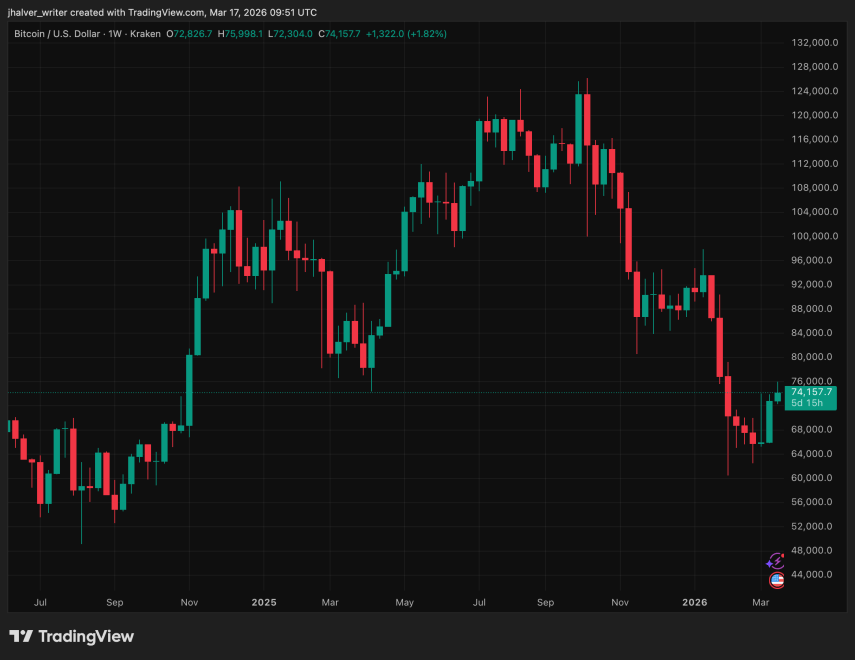
BTC's price trends reaches $74K on the daily chart, the highest since January. Source: BTCUSD on Tradingview

Cover image from Perplexity, BTCUSD chart from Tradingview

Domande pertinenti

QWhy did Argentinian authorities order a national blockade of Polymarket?

AArgentinian authorities ordered a national blockade of Polymarket because they argue it is an unlicensed online gambling platform, not just a neutral prediction market, following a suspicious trading scandal involving inflation data.

QWhat was the suspicious trading activity on Polymarket related to in Argentina?

AThe suspicious trading activity was related to Argentina's inflation data, where odds moved around fifteen minutes before the official CPI data was released by INDEC, raising allegations of insider trading.

QWhich other Latin American country banned Polymarket before Argentina?

AColombia became the first country in Latin America to ban Polymarket, declaring the platform illegal in September 2025 and instructing ISPs to block access.

QHow does Polymarket present itself versus how it is viewed by regulators?

APolymarket presents itself as a prediction market, but regulators view it as an unlicensed online gambling platform that allows users to place wagers on events without proper licensing or KYC/age checks.

QWhat global trend does Argentina's move against Polymarket reinforce?

AArgentina's move reinforces a growing trend of regulators treating crypto prediction platforms as gambling first and market infrastructure second, which could fragment liquidity and push activity into friendlier jurisdictions.

Letture associate

Meta Spent $90 Billion to Close the Metaverse, $2 Billion to Let AI Live in Your Computer

Meta spent $90 billion to build the metaverse, only to shut down its flagship VR platform, Horizon Worlds, on June 15. The virtual world, launched in 2021 with great fanfare, failed to attract a meaningful user base despite massive investment. Its closure marks a symbolic end to Meta’s ambitious—and costly—bet on the metaverse, which accumulated nearly $90 billion in losses over seven years. Simultaneously, Meta is aggressively pivoting to AI. It acquired AI startup Manus for $2 billion, which recently launched a desktop version allowing AI to operate directly on users' local machines—reading files, running apps, and executing commands. In contrast to the metaverse’s weak adoption, Manus reached one million paid users within eight months. The shift is stark: Meta is cutting 20% of its workforce—around 15,000 jobs—and reallocating nearly its entire $115–135 billion capital expenditure budget toward AI infrastructure. This abrupt turn reflects industry-wide FOMO (fear of missing out) on AI, similar to the metaverse hype half a decade ago. Companies like Block, Shopify, and Amazon are also slashing jobs to fund AI investments. While Meta faces internal challenges—including delayed AI models and executive departures—its drastic realignment underscores a broader trend: the consensus has shifted from virtual worlds to ambient AI. The question remains whether this new bet will prove more sustainable than the last.

marsbit28 min fa

Meta Spent $90 Billion to Close the Metaverse, $2 Billion to Let AI Live in Your Computer

marsbit28 min fa

SpaceX Holds Nasdaq at the Negotiating Table, Hyperliquid Has Already Flipped the Table

Summary: The article examines the shifting power dynamics in global capital markets, driven by the rise of private funding and decentralized finance (DeFi). It begins by contrasting the 1971 launch of Nasdaq's electronic system with the current landscape, where companies like SpaceX can demand unprecedented concessions—such as accelerated inclusion in major indices—as a condition for their public listing. This reflects a fundamental change: massive private capital from funds like SoftBank's Vision Fund now allows firms like Revolut ($75B valuation) and Stripe ($159B valuation) to delay or de-prioritize IPOs, as they no longer rely on public markets for primary funding. However, public listing remains crucial for employee liquidity and VC exits. A new, critical motivator is the immense, stable capital from passive index funds. With passive assets now exceeding active management in the U.S., inclusion in indices like the Nasdaq 100 guarantees perpetual, non-discretionary buying pressure. SpaceX's negotiation for fast-track index inclusion highlights this strategic leverage. Simultaneously, traditional exchanges face disruption from DeFi. The piece cites Hyperliquid, a decentralized exchange with 2025 volumes (~$3T) double that of Coinbase. Its growth in tokenized traditional assets (e.g., S&P 500 perpetual contracts) and 24/7 trading attracts professional traders, eroding the monopolies of institutions like NYSE and Nasdaq. In response, NYSE's parent ICE is investing in crypto platforms (e.g., OKX, Polymarket), acknowledging that future competition may come from DeFi protocols, not just rival exchanges. The conclusion is that the market structure is layering: old systems adapt (Nasdaq changing rules, ICE investing in crypto) while new, decentralized infrastructures grow, creating a future where the most powerful companies may not need to "knock on the door" of traditional exchanges at all.

marsbit41 min fa

SpaceX Holds Nasdaq at the Negotiating Table, Hyperliquid Has Already Flipped the Table

marsbit41 min fa

Trading

Spot
Futures
活动图片