Altcoin Rally Feast: Has the Long-Awaited Bull Market Begun? Here's the Latest Situation

cryptonews.ruPubblicato 2026-08-22Pubblicato ultima volta 2026-08-22

Introduzione

Amid Bitcoin surpassing $77,000, altcoins have staged a significant rally. Zcash ($ZEC) surged 47.1% in 24 hours to $827.02 before stabilizing about 35% higher. Bitcoin Cash (BCH) rose 31.4%, Cardano (ADA) gained 19%, Dogecoin (DOGE) and others saw gains around 17-18%, with Stellar (XLM), Chainlink (LINK), and Hyperliquid (HYPE) also posting double-digit increases. The overall market is trending upwards, with Bitcoin near $77,300, Ethereum above $2,430, and XRP up nearly 14%. Analyst Gautam Chhugani from Bernstein attributed Bitcoin's strength to the U.S. Treasury's decision to increase its long-term bond buyback ceiling from $2 billion to $4 billion per session, a move aimed at easing pressure from high bond yields driven by inflation and geopolitical tensions. This shift in liquidity conditions may have reduced selling pressure on Bitcoin and cryptocurrencies, supporting the broader market rally. Market capitalizations for major assets have risen significantly, with Zcash exceeding $13 billion and Dogecoin near $15.9 billion.

Against the backdrop of Bitcoin surpassing the $77,000 mark in the cryptocurrency market, altcoins have also shown significant gains. Zcash ($ZEC) has been one of the assets to benefit most from the overall positive market sentiment, while many major altcoins have seen double-digit price increases.

According to CoinGecko data, over the past 24 hours, $ZEC has risen by 47.1%, reaching $827.02. Despite subsequent pullbacks, it is still trading about 35% higher today.

During the same period, Bitcoin Cash (BCH) increased by 31.4%, reaching $299.49, and Canton (CC) rose by 20.4% to $0.1223. Cardano (ADA) gained 19% to $0.2563, while Dogecoin (DOGE) and WhiteBIT Coin (WBT) both increased by approximately 17.7%.

Stellar (XLM) shares grew by 16.2%, Chainlink (LINK) by 13.3%, and Hyperliquid (HYPE) by 11.9%, reaching $81.50.

Overall, the market is showing an upward trend. Bitcoin is trading around $77,300, and Ethereum has climbed above $2,430. XRP is showing a daily gain of nearly 14%, while Solana and BNB are also in positive territory.

According to the latest data, the market capitalization of $ZEC has exceeded $13 billion, with a 24-hour trading volume reaching about $2.6 billion. Dogecoin's market cap is around $15.9 billion, and Hyperliquid's is approximately $19.7 billion.
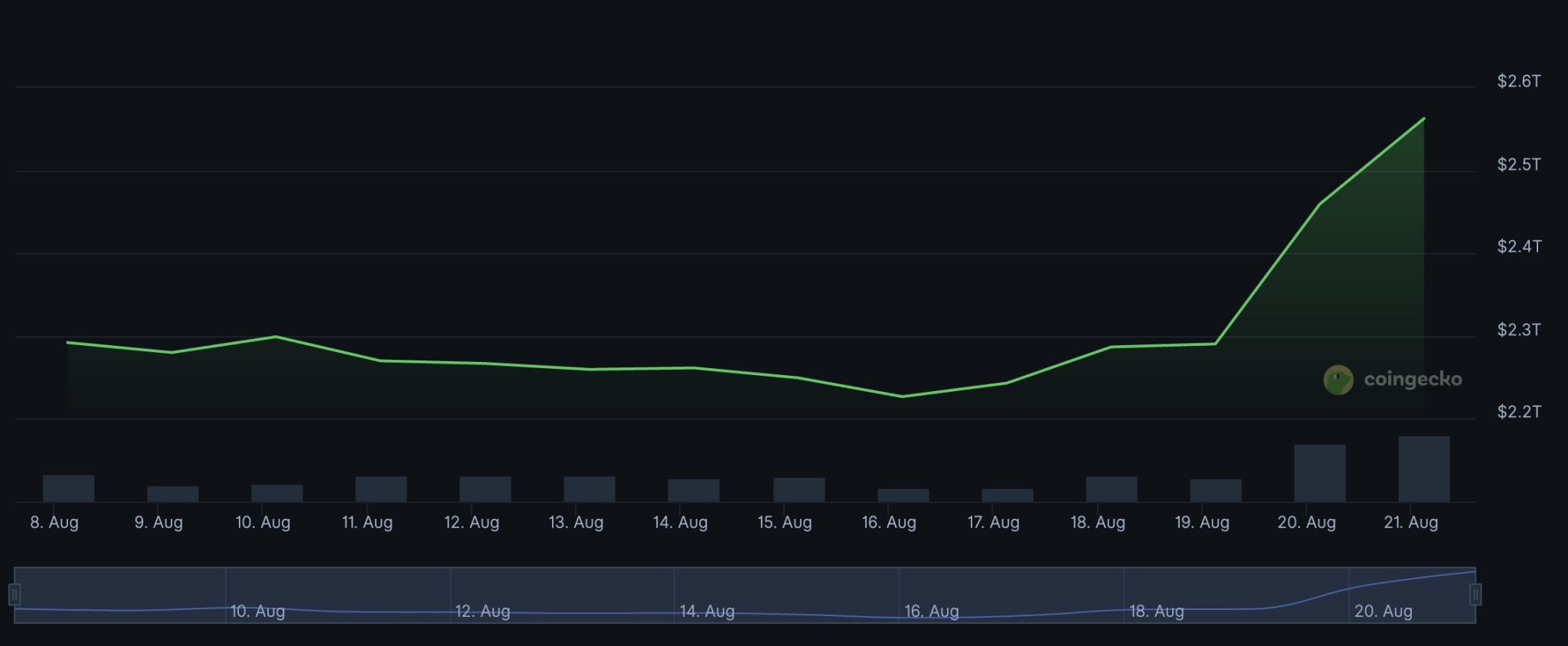
This chart shows the change in the total market capitalization of the cryptocurrency market over the past two weeks.

Bernstein strategist Gautam Chhugani stated that the strong rise in Bitcoin was triggered by the U.S. Treasury Department's decision to increase bond buyback volumes on the long end of the yield curve. Chhugani noted that Bitcoin has historically responded positively to liquidity expansion, while the recent indifference in the cryptocurrency market was due to tightening financial conditions following the conflict with Iran, increased inflationary risks, and the strong performance of artificial intelligence and chip manufacturing company stocks, which have attracted a significant portion of liquidity.

This week, the U.S. Treasury Department unexpectedly decided to increase the maximum size of long-term bond buyback operations from $2 billion to $4 billion per session. This program will buy back 10-, 20-, and 30-year Treasury bonds after benchmark bond yields reached their highest levels in 20 years due to persistent inflation and energy price pressures related to the war.

The change in liquidity conditions may have helped alleviate selling pressure on Bitcoin and other cryptocurrencies, thereby supporting the overall market rally.

*This is not investment advice.

Domande pertinenti

QAccording to the article, which altcoin saw the largest price increase in the 24-hour period mentioned?

AAccording to the data from CoinGecko in the article, Zcash (ZEC) saw the largest price increase, rising 47.1% in the 24-hour period, reaching $827.02.

QWhat reason does strategist Gautam Chhugani give for Bitcoin's recent strong rise?

AGautam Chhugani attributes Bitcoin's strong rise to the U.S. Treasury Department's decision to increase the buyback volumes for bonds on the long-term part of the yield curve. Historically, Bitcoin has responded positively to liquidity expansion.

QWhat recent action did the U.S. Treasury Department take regarding bond buybacks, and what was its potential impact on crypto?

AThe U.S. Treasury Department unexpectedly increased the maximum volume of long-term bond buyback operations from $2 billion to $4 billion per session. This change in liquidity conditions likely helped reduce selling pressure on Bitcoin and other cryptocurrencies, supporting the overall market rally.

QWhat are the approximate market capitalization and 24-hour trading volume for Zcash ($ZEC) mentioned in the article?

AThe article states that Zcash's (ZEC) market capitalization surpassed $13 billion, and its 24-hour trading volume reached approximately $2.6 billion.

QWhich major cryptocurrencies, besides Bitcoin, are mentioned as currently trading in positive territory?

ABesides Bitcoin, the article mentions Ethereum trading above $2,430, XRP with nearly a 14% daily increase, and Solana and BNB also being in positive territory.

Letture associate

Grayscale Report: Financial Privacy in the AI Era, Why Zcash Should Not Be Overlooked?

Title: Grayscale Report: Financial Privacy in the AI Era – Why Zcash Should Not Be Overlooked The article argues that privacy is a fundamental, not niche, attribute of functional money. It highlights that technological shifts, like the rise of AI and stablecoins, are driving a new wave of public focus on financial privacy. Zcash, a decentralized digital currency similar to Bitcoin but with built-in privacy via zero-knowledge proofs, is positioned to address this need. Unlike transparent blockchains, Zcash offers users the option to conduct "shielded" transactions that hide sender, receiver, and amount while remaining verifiable. The report details Zcash's evolution, noting key upgrades that improved usability and security. It points to rising on-chain usage of privacy features as evidence of real demand. Currently, ZEC holds a minimal share (~0.4%) of the total crypto market cap. Grayscale suggests this reflects a market assumption that privacy is a marginal concern. The investment thesis hinges on a potential market re-evaluation: if privacy is recognized as a core monetary feature in an era of enhanced surveillance, Zcash's current valuation represents significant upside potential. Key risks discussed include regulatory challenges, historical trusted setup concerns for older pools (mitigated by newer protocols), quantum computing threats, and execution risks associated with future technical upgrades. The conclusion is that while the future scale of private digital currency is uncertain, the market currently prices in little chance of its value increasing substantially, presenting a potential opportunity for investors.

marsbit1 h fa

Grayscale Report: Financial Privacy in the AI Era, Why Zcash Should Not Be Overlooked?

marsbit1 h fa

Vitalik Moves to Local Mixing as Obfuscation Series Reaches Third Stage

Ethereum co-founder Vitalik Buterin published the third part of his series on cryptographic obfuscation, focusing on a method called "local mixing." This method abandons lattices and elliptic curves in favor of ideas borrowed from hash function design. Buterin described local mixing as a "completely different way of cryptography," free from elliptic curves, prime factorization, and lattices, making it more akin to symmetric cryptography used in everyday encryption. The process begins with a circuit of logic gates like XOR, AND, and NOT. It undergoes a pipeline that ensures a correct output while obscuring any trace of the internal logic. Key steps include adding reversibility, strengthening, mechanization, mixing, and finally obfuscation. The mixing step scatters extra logic gates and shuffles their arrangement. Reversibility is foundational, allowing gates to be rewritten as other reversible gates with similar behavior. Buterin acknowledged local mixing is a "wild and risky undertaking," lying on the "graveyard of failed attempts at white-box cryptography." However, its proponents argue it needs more research effort and a willingness to accept higher overhead costs. Buterin suggested AI could accelerate its development. He called obfuscation the "final boss of cryptography," with the most complex constructions having runtimes exceeding the universe's age. The article concludes by explaining obfuscation's utility: it can encrypt a program so it still functions with normal inputs and outputs while hiding the code. Combined with blockchain, this moves toward a "trusted third party that requires no trust," enabling applications like private, collusion-resistant voting without relying on a trusted committee.

cryptonews.ru1 h fa

Vitalik Moves to Local Mixing as Obfuscation Series Reaches Third Stage

cryptonews.ru1 h fa

Trading

Spot
活动图片