Trump-Linked Panel Examines Stablecoin Proposal For Postwar Gaza

bitcoinistPubblicato 2026-02-23Pubblicato ultima volta 2026-02-23

Introduzione

Officials advising former President Donald Trump's "Board of Peace" are exploring the potential use of a US dollar-backed stablecoin to help rebuild Gaza's economy after the war with Israel. The proposal, still in early stages, would involve Gulf Arab and Palestinian companies with digital currency experience. Supporters argue a digital currency could reduce Hamas's access to physical cash and lessen dependence on Israeli control over currency flows. However, concerns have been raised that a separate Gaza digital system might deepen the economic divide with the West Bank by hindering easy payments between the two regions. The regulatory framework remains undecided, and the idea is currently exploratory.

Officials advising President Donald Trump’s US‐led “Board of Peace” are examining whether a dollar‐backed stablecoin could play a role in rebuilding Gaza’s shattered economy.

Gaza Stablecoin Plans

The idea, first reported by the Financial Times, is still in its early stages. Five individuals briefed on the talks said conversations about introducing a stablecoin remain preliminary, and key details have yet to be finalized.

Even so, the concept is being considered as part of a broader plan to revive economic life in the Palestinian enclave after two years of war between Israel and Hamas that left much of Gaza’s financial system crippled.

One person familiar with the project said the proposed stablecoin would be pegged to the US dollar and would likely involve Gulf Arab and Palestinian companies experienced in digital currency infrastructure.

According to the report, the Board of Peace and the 14‐member National Committee for the Administration of Gaza (NCAG) would ultimately determine the regulatory framework and access rules governing any stablecoin system, though “nothing definitive” has been agreed upon.

Potential Benefits And Risks

Supporters of the Gaza stablecoin initiative argue that reducing reliance on physical cash could limit the ability of Hamas to generate revenue. Another individual familiar with the talks described the goal as an effort to “dry Gaza from cash so Hamas can’t generate any.”

Advocates also contend that expanding digital payments would allow commerce to continue without being overly dependent on Israeli authorities’ control over currency flows into the territory.

However, others involved in the discussions have voiced concerns that a Gaza‐specific digital system could inadvertently deepen the economic divide between Gaza and the West Bank.

“It will be much more difficult to maintain economic links between Gaza and the West Bank if they have no means of easy payment between the two,” one person familiar with the talks said. “Gaza would be almost like a self‐contained economy. That would be a concern.” For now, the stablecoin proposal remains an exploratory concept.

The 1D chart shows the total crypto market cap dropping on Monday to $2.23 trillion. Source: TOTAL on TradingView.com

Featured image from OpenArt, chart from TradingView.com

Domande pertinenti

QWhat is the main purpose of the stablecoin proposal being examined for postwar Gaza?

AThe main purpose is to play a role in rebuilding Gaza's shattered economy and to reduce reliance on physical cash, which could limit Hamas's ability to generate revenue.

QWhich US-led advisory group is examining the stablecoin proposal for Gaza?

AOfficials advising President Donald Trump's US-led 'Board of Peace' are examining the stablecoin proposal.

QWhat is the proposed peg for the Gaza stablecoin and which entities might be involved in its infrastructure?

AThe proposed stablecoin would be pegged to the US dollar and would likely involve Gulf Arab and Palestinian companies experienced in digital currency infrastructure.

QWhat is one potential risk of implementing a Gaza-specific digital currency system mentioned in the article?

AOne potential risk is that it could inadvertently deepen the economic divide between Gaza and the West Bank by making it difficult to maintain economic links and easy payments between the two regions.

QWhat is the current status of the stablecoin proposal according to the report?

AThe stablecoin proposal is still in its early stages, conversations remain preliminary, key details are not finalized, and it is described as an exploratory concept with nothing definitive agreed upon.

Letture associate

BlackRock and Citadel Are Aggressively 'Sweeping Goods': What Fundamental Changes Have Occurred in the Logic of TradFi Entering DeFi?

Traditional finance (TradFi) giants like BlackRock, Citadel Securities, and Apollo Global Management are now directly purchasing DeFi governance tokens (UNI, ZRO, MORPHO), signaling a strategic shift beyond mere equity investments or pilot programs. This move is primarily about securing access to and aligning with the infrastructure they plan to use for tokenizing and distributing their products on-chain, rather than making broad portfolio bets on DeFi assets. Key drivers include improved custody/operational infrastructure and greater regulatory clarity, such as the upcoming repeal of SAB 121 and potential market structure legislation like the CLARITY Act. While this represents a structural change in institutional engagement, the token price impact has been muted due to weak market conditions and a lack of direct value capture mechanisms for most tokens. For governance tokens to function more like strategic equity, clearer value accrual (e.g., fee switches), reduced VC selling pressure, and enhanced regulatory certainty are needed. Concerns about governance centralisation exist, but increased professional participation could improve oversight. More TradFi firms, particularly those building tokenized products (e.g., Fidelity, Franklin Templeton), are expected to follow, focusing on blue-chip protocols in stablecoins, RWAs, and trading infrastructure.

marsbit33 min fa

BlackRock and Citadel Are Aggressively 'Sweeping Goods': What Fundamental Changes Have Occurred in the Logic of TradFi Entering DeFi?

marsbit33 min fa

Two Paths, One Destination

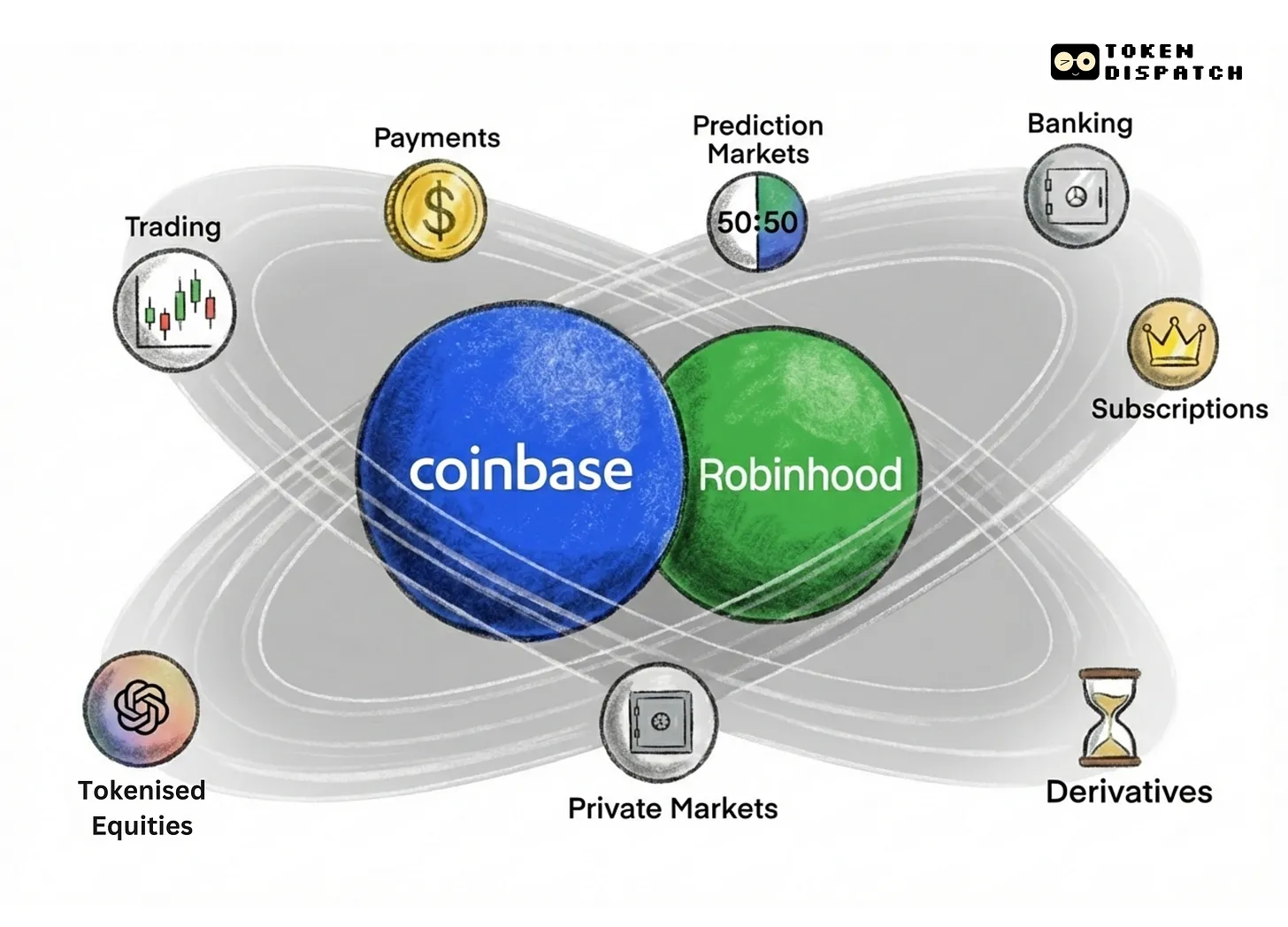
Coinbase and Robinhood, despite recent earnings misses, are undergoing significant transformations that diverge from simplistic narratives tied to crypto performance. Both are systematically diversifying their revenue streams to reduce cyclical dependency. Coinbase’s subscription and service revenue reached $2.8B in 2025, 5.5x its 2021 peak. It now holds 12% of global crypto assets and is expanding into derivatives (via the Deribit acquisition), prediction markets, and institutional services, partnering with major banks and asset managers like BlackRock. Its long-term goal is to become a foundational settlement layer for on-chain finance. Robinhood’s growth is highlighted by a 27% YoY increase in ARPU to $191, driven largely by its prediction markets—its fastest-growing product line, generating $300M in annualized revenue. Other key drivers include options trading and subscription services. The company is also expanding into banking and private market access through Robinhood Ventures, aiming to capture a share of generational wealth transfer. Though they started from opposite ends—Coinbase in crypto, Robinhood in traditional equities—both are converging toward the same vision: a financial super-app for retail users. They are now competing directly in emerging areas like prediction markets, tokenization, and private market access, with the goal of deepening user financial integration and becoming indispensable platforms.

marsbit42 min fa

Two Paths, One Destination

marsbit42 min fa

Trading

Spot
Futures
活动图片