Iran Turns To USDT, Acquiring $507 Million To Defend Its Currency

bitcoinistPubblicato 2026-01-23Pubblicato ultima volta 2026-01-23

Introduzione

Iran's central bank acquired at least $507 million in Tether (USDT) in 2025 to defend its currency, the rial, and evade sanctions, according to blockchain analysis by Elliptic. The funds, a conservative estimate, were used to add dollar-linked liquidity to local crypto markets and support international trade. Transactions were initially routed through Iran's largest exchange, Nobitex, before shifting to cross-chain bridges and decentralized exchanges after increased scrutiny. In June 2025, Tether froze $37 million in USDT from wallets linked to the bank, demonstrating a key vulnerability. This case highlights how state actors use stablecoins to bypass traditional banking restrictions, while creating a public, traceable record of their activities.

Iran’s central bank quietly built up a large stash of Tether’s USDT last year as the rial struggled and trade with the outside world grew harder. The move turned parts of the crypto ledger into a public trail of a policy that would normally be private.

Central Bank’s Crypto Moves

According to a blockchain analysis by Elliptic, the Central Bank of Iran acquired at least $507 million in USDT over 2025, a figure the firm treats as a conservative minimum because it only counts wallets it could tie to the bank with high confidence.

Reports say much of the buying happened in the spring months of 2025 and that payments were routed through channels that included Emirati dirhams and public blockchains. Those stablecoins were then used in local crypto markets to add dollar-linked liquidity and help slow the rial’s slide.

How The Money Flowed

Elliptic’s tracing shows an early flow of USDT into Nobitex, Iran’s biggest crypto exchange, where the coins could be swapped into rials and fed into the market. After a breach and growing scrutiny in mid-2025, other paths were used, including cross-chain bridges and decentralized exchanges, to move and convert funds.
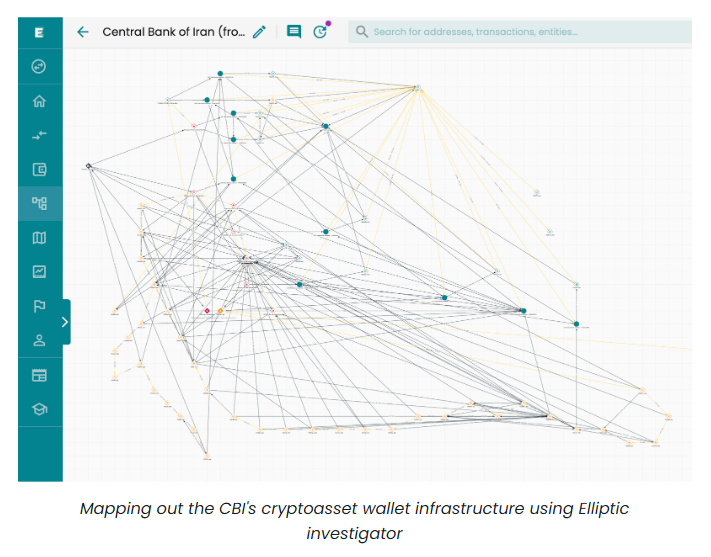
Source: Elliptic

A Freeze And A Warning

That open ledger also left the transactions visible to outside observers. On June 15, 2025, Tether blacklisted several wallets linked to the central bank and froze about $37 million in USDT, showing that stablecoins can be cut off when issuers or regulators step in. That intervention narrowed some options for on-chain liquidity.

Total crypto market cap currently at $2.99 trillion. Chart: TradingView

This episode matters for two reasons. First, it shows how a state institution can use stablecoins to gain access to dollar value when normal banking routes are closed.

Second, it highlights a weakness: if a private issuer can freeze balances, those reserves are not the same as cash held in hard foreign accounts.

Trade, Sanctions, And A New Tool

Reports note the purchases likely served a twin goal — to smooth domestic exchange rates and to help settle trade with partners who avoid direct dollar banking.

The method is blunt. It gives a way to move value, but it also creates new points of control and exposure that can be tracked on public ledgers.

Analysts will be watching how regulators and stablecoin issuers respond. They will also track whether other countries under pressure turn to similar mixes of centralized and decentralized tools.

The public tracing of these flows makes it harder to hide big moves, even when actors try to obscure them across chains and exchanges.

Featured image from Unsplash, chart from TradingView

Domande pertinenti

QHow much USDT did Iran's central bank acquire in 2025 according to Elliptic's analysis?

AIran's central bank acquired at least $507 million in USDT in 2025.

QWhat was the primary purpose of Iran acquiring such a large amount of USDT?

AThe primary purpose was to add dollar-linked liquidity to the local market to help slow the Iranian rial's slide and to potentially settle trade with partners avoiding direct dollar banking.

QWhich crypto exchange was initially used to swap the acquired USDT into Iranian rials?

AThe initial flow of USDT was into Nobitex, Iran's biggest crypto exchange, to be swapped into rials.

QWhat action did Tether take on June 15, 2025, regarding Iran's activities?

AOn June 15, 2025, Tether blacklisted several wallets linked to the Iranian central bank and froze about $37 million in USDT.

QWhat are the two main reasons why this episode is significant according to the article?

AFirst, it shows how a state institution can use stablecoins to access dollar value when normal banking routes are closed. Second, it highlights the weakness that a private issuer can freeze balances, making these reserves not the same as cash held in hard foreign accounts.

Letture associate

Gold Surpasses $5,000 First, When Will the Crypto Market Reverse?

The article discusses the outcome of a popular prediction on Polymarket from October last year: "First to $5,000: Gold or ETH?". While Ethereum had once approached $4,800 with high market confidence, gold ultimately surged past $5,100 per ounce on January 26, whereas Ethereum remained stagnant between $2,800 and $3,000. The rise in gold is attributed to macro factors including concerns over U.S. fiscal health, geopolitical tensions, and inflation-driven capital flight toward safe-haven assets. Institutional sentiment has turned strongly bullish, with banks like OCBC and Goldman Sachs raising their gold price targets. Meanwhile, tokenized gold products have seen record investment inflows. In contrast, the crypto market has faced significant outflows, with Bitcoin and Ethereum ETFs recording substantial withdrawals. Bitcoin has fallen 30% from its peak, and Ethereum is down around 40%. Analysts like Peter Brandt have turned bearish, citing completed bear channels. However, the article suggests that crypto’s downturn may be temporary—a phase in capital rotation toward safety. Once gold’s momentum slows or macro risks ease, capital may return to deeply oversold crypto assets. Bitcoin shows classic bottoming signals, including peak realized losses, while Ethereum’s high staking ratio reflects long-term confidence. The potential appointment of a crypto-friendly Fed chair could also boost the market. The piece concludes that gold’s rally may have further to go, and crypto investors may need to wait for a rotation signal before a sustained rebound occurs.

marsbit52 min fa

Gold Surpasses $5,000 First, When Will the Crypto Market Reverse?

marsbit52 min fa

Trading

Spot
Futures
活动图片