The Logic Behind Circle's $50 Billion Valuation: The Market Only Sees USDC, But Overlooks the Payment Network

marsbitPubblicato 2026-08-20Pubblicato ultima volta 2026-08-20

Introduzione

Circle's $50 billion valuation logic: The market sees only USDC but overlooks its payment network. While Circle is perceived as a simple stablecoin issuer, its potential as a full-stack monetary platform is undervalued. The article argues Circle's moat is deeper than recognized, with first-mover advantages in liquidity and network effects making its position hard to challenge. The stablecoin market is projected to grow at 40% CAGR, surpassing $1 trillion by 2030, with Circle well-positioned to capture significant share. Competitors like the Open Standard (OUSD) alliance face significant hurdles in governance and aligned incentives. Currently valued at $18 billion (6.7x P/S), Circle's revenue is heavily tied to interest income. However, its expanding payment network (showing explosive growth) and Arc chain could diversify revenue streams. By 2030, with $40B in interest income, $4B from payments, and $5B from Arc, total revenue could approach $50B. A re-rating to a 10x multiple on more diversified, less rate-sensitive revenue could justify a $500 billion market cap.

Author: Artemis Analytics

Compiled by: Deep Tide TechFlow

Deep Tide Introduction: The market views Circle as merely a stablecoin issuer, but the potential of its payment network and full-stack currency platform is far from being priced in. This article deconstructs Circle's moat and the scenario for a $50 billion market capitalization, serving as a key reference for investors focused on the stablecoin and payment sectors.
Last week, we invited ARK Invest's Lorenzo Valente on our podcast to discuss why Circle is undervalued by the market. This week's Thesis continues this line of thought.

Argument: The market believes Circle's moat is weak, stablecoins are homogeneous commodities, and consortia like Open Standard will capture the majority share. We believe Circle's moat is deeper and harder to breach than the market perceives, and its first-mover advantage is undervalued.

Core drivers:

Stablecoins will grow at a 40% CAGR, exceeding $1 trillion by 2030.

The market shows a winner-take-all dynamic in terms of liquidity and network effects, making it difficult for alliances like OUSD to steal share.

The market prices Circle as a stablecoin issuer, not a full-stack currency platform.

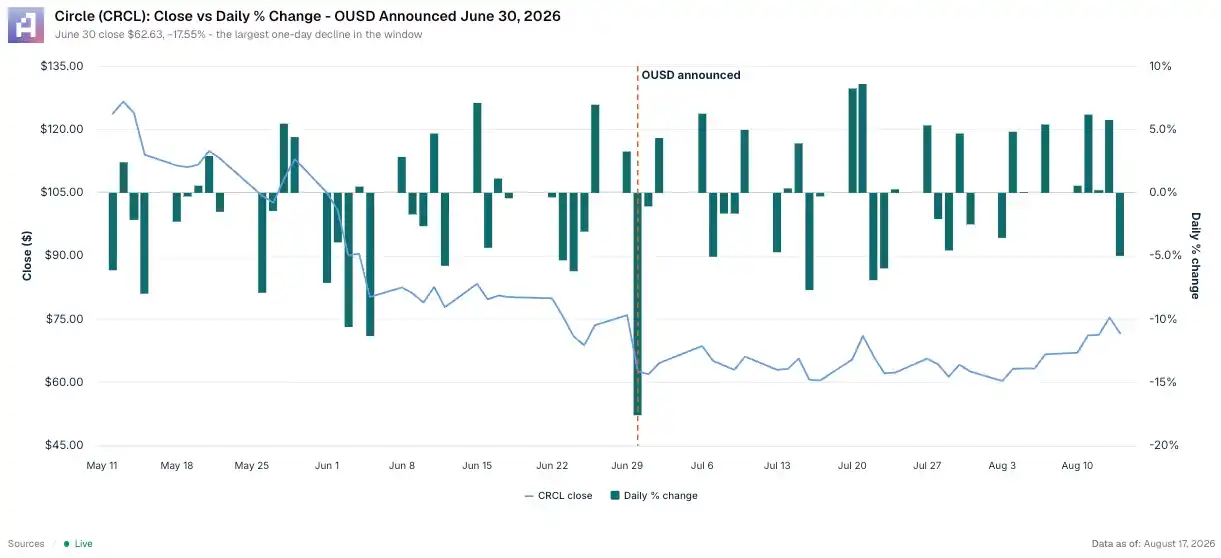
Circle's second-worst trading day in history occurred when Open Standard was announced. This is a consortium-backed stablecoin supported by over 140 companies, including Stripe, Visa, Mastercard, and Google, among others. The stock fell 17% after the news. The market's reaction is telling: Stripe will rally the troops, overthrow the Circle/Tether duopoly, and distribute stablecoin revenue proportionally to consortium members. This news drove CRCL's price near its all-time low.
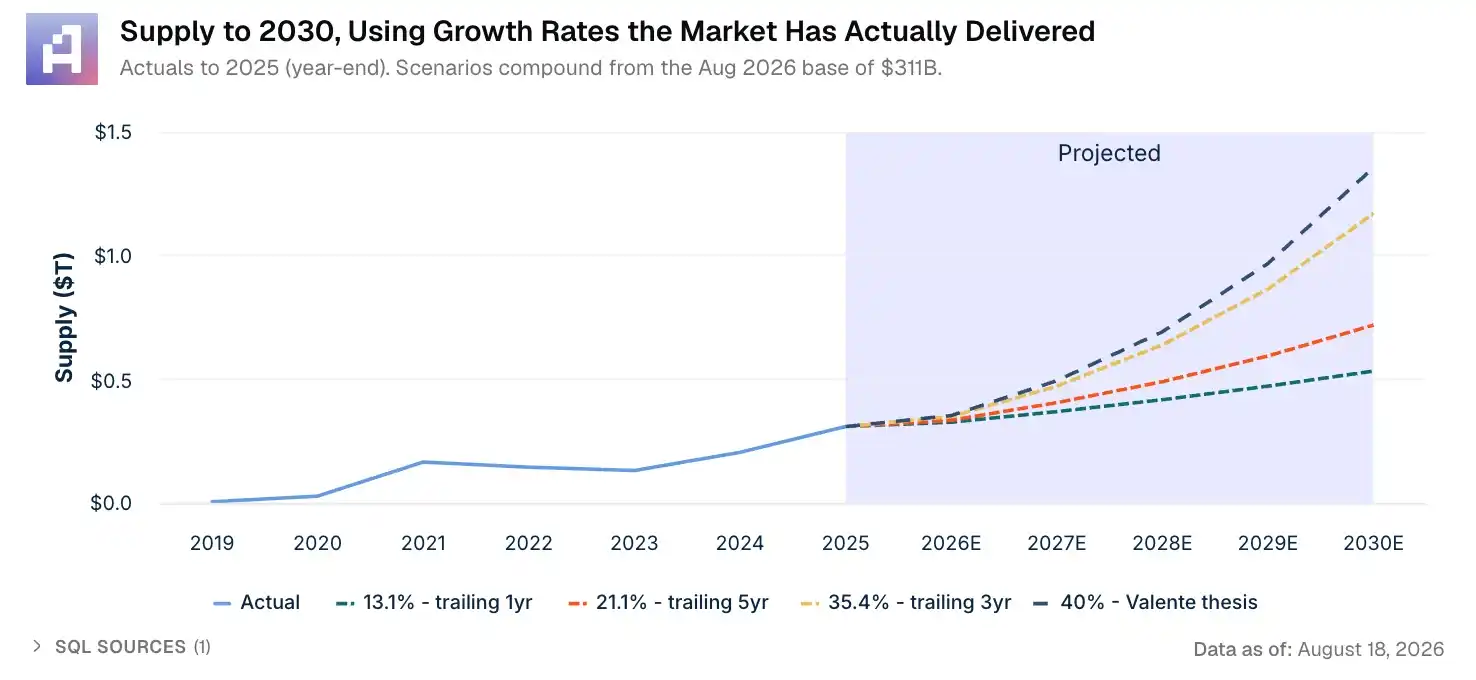
Stablecoin Growth

We believe many investors don't think stablecoins will reach $1 trillion by 2030. They might point to stagnant growth. However, stablecoin supply has decoupled from crypto prices for the first time ever. Despite crypto prices falling 50-70% from recent highs, stablecoin supply has remained flat, indicating it has become its own category. If stablecoin supply continues to grow at the rate of the past 3 years, global supply will exceed $1 trillion by 2030.
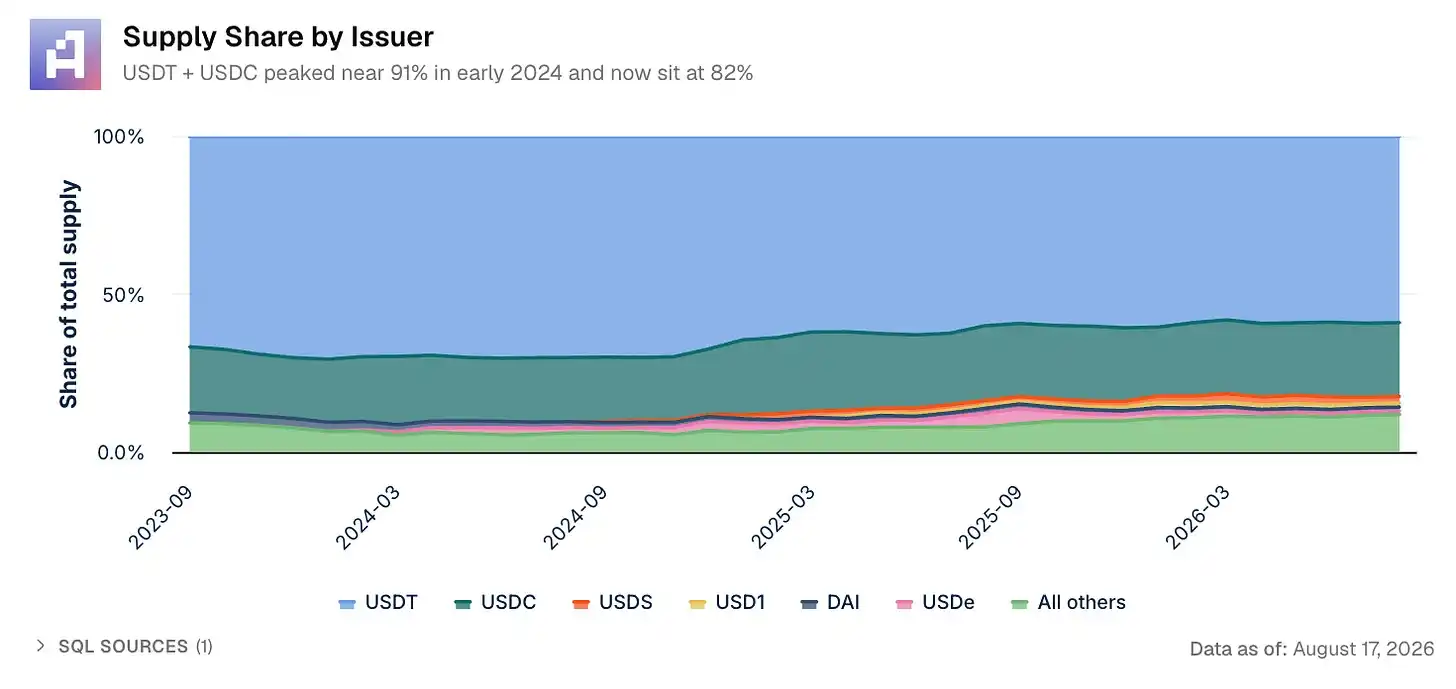
Winner-Take-All Stablecoin Market, Liquidity and Network Effects are Crucial

Over the past few years, dozens of issuers have tried to dismantle the Circle/Tether duopoly. Despite hundreds of stablecoins being issued now, these two giants still command over 80% of the supply share. The first-mover advantage gained by these players is extremely difficult to overcome. Building liquidity from scratch across chains, applications, and exchanges is hard, and Circle is far ahead of challengers.
Looking Specifically at OUSD

The market clearly views OUSD as a significant threat to Circle's business. However, history shows that consortia rarely succeed. A successful consortium requires:

Aligned incentives among members – OUSD achieves this to some extent through interest income distribution.

Clear governance – Open Standard appears weak here, with several announced "partners" revealing they were not consulted and have not yet made commitments.

Existential pressure – I don't think most institutions yet see stablecoins as a matter of survival, though Stripe may be the exception.

Therefore, based on current information, Open Standard meets roughly only one-third of the necessary conditions.

Circle is Priced as a Stablecoin Issuer, Not a Full-Stack Currency Platform

The market views Circle merely as the issuer of USDC. It underestimates Circle's revenue, which is almost entirely interest income subject to Federal Reserve policy.

In reality, Circle is building a full-stack currency product for the future of the internet. At its core, it's a technology company.

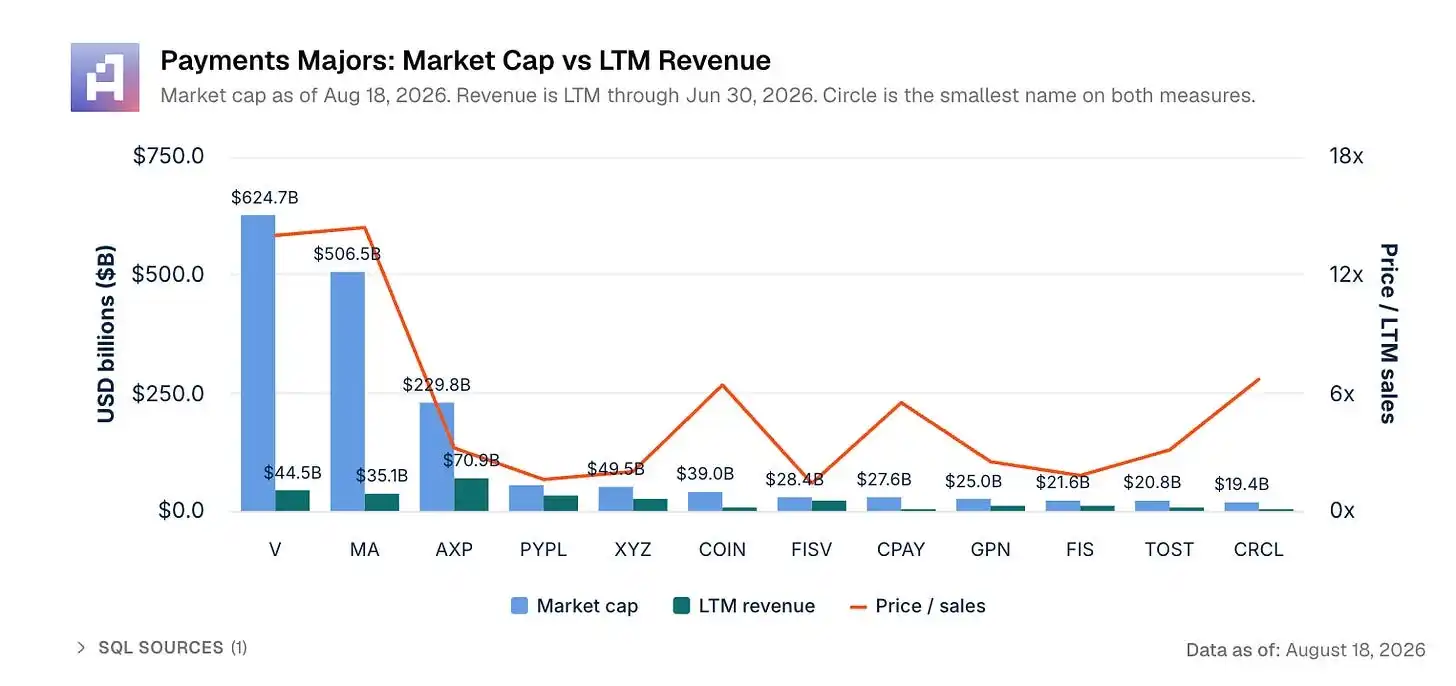
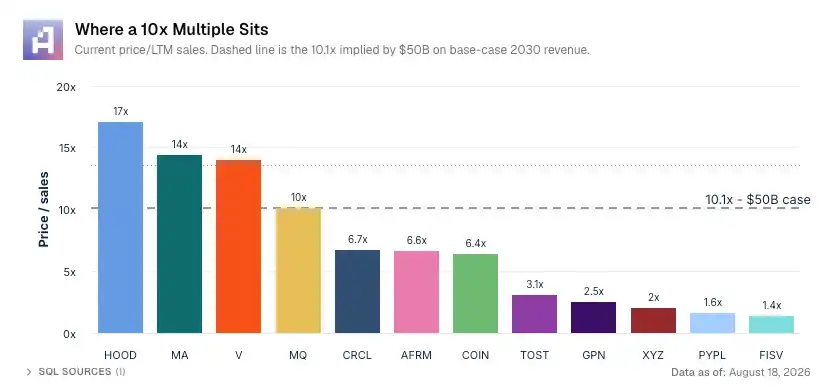
Circle's valuation compared to payment peers. There is a clear gap between credit card networks and other companies. If Circle builds the next-generation, full-stack payment system, its market cap and valuation would be closer to credit card networks, charging basis points on transaction volume, rather than relying on float.
Envisioning a $50 Billion Circle

Today, Circle's annualized revenue is approximately $2.8 billion, with a valuation of $18 billion, a P/S ratio of 6.7x—far below payment networks (14x) and high-growth fintechs like HOOD (17x). Its valuation multiple is almost identical to COIN's, which is primarily viewed as a crypto exchange.

The market sees Circle as a company tied to the crypto cycle, with rate-sensitive revenue. Circle will shed this label and its fragile revenue structure, allowing for a higher valuation multiple—10x is conservative and reasonable.

If our prediction is correct and, as we assume, liquidity and network effects create a strong moat, with stablecoin supply reaching $1 trillion by 2030, USDC share at 20%, and interest rates at 2%, CRCL could generate $4 billion in interest income.

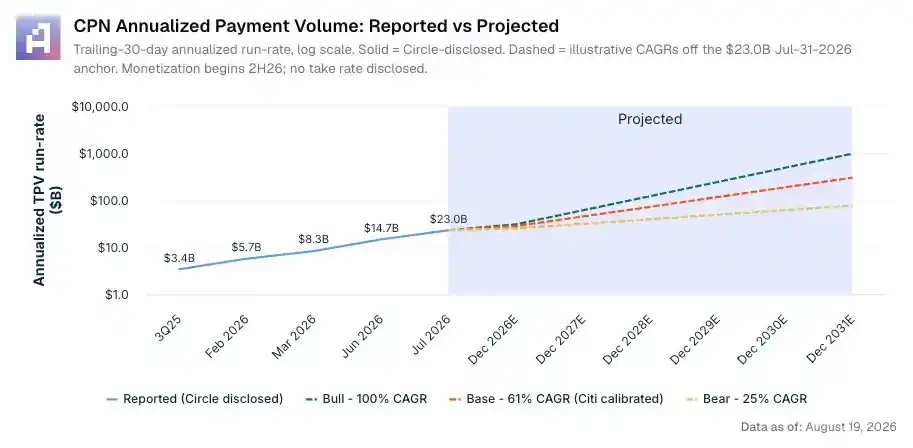
In terms of revenue diversification, Circle's key growth products are gaining momentum, such as the Circle Payments Network. Despite persistent low crypto prices and flat stablecoin supply, transaction volume on the Circle Payments Network is growing at an explosive pace, with the latest disclosed annualized volume as of July 2026 reaching $23 billion—up 6.8x year-over-year (admittedly from a small base) and 70% quarter-over-quarter. If growth stays at a 60-65% CAGR, transaction volume would reach approximately $200 billion by 2030. At a 20 basis point take rate, this would generate an additional $400 million in revenue.
Looking at the Arc chain, if it reaches the scale of Tron (another stablecoin-focused chain), Arc would generate $500 million in fees.

The above estimates bring CRCL's revenue close to $5 billion, with 20% coming from the rapidly growing payment/settlement-related business lines. This mix gives investors reason to assign a higher valuation multiple. Combining the above revenue growth and multiple expansion, we get $5 billion multiplied by 10 equals $50 billion. A $50 billion market cap for CRCL is not a fantasy.


Domande pertinenti

QWhat are the three main factors that the author believes support Circle's strong moat and undervalued position?

A1. The stablecoin market will grow at a 40% CAGR, exceeding $1 trillion by 2030. 2. The market exhibits winner-takes-most dynamics due to liquidity and network effects, making it hard for competitors like the Open Standard alliance to gain share. 3. The market prices Circle as a mere stablecoin issuer, not as a full-stack monetary platform with a high-growth payment network.

QWhy does the author argue that the stablecoin market is a winner-takes-most environment, and how does this benefit Circle?

AThe author argues that achieving deep liquidity across multiple blockchains, applications, and exchanges is a massive hurdle. Circle's first-mover advantage has allowed it to build this critical liquidity and network effect, creating a significant barrier for new entrants like the Open Standard alliance, which would have to build liquidity from scratch.

QAccording to the article, what are the three key requirements for a successful consortium like the Open Standard (OUSD), and how does OUSD currently measure up?

AThe three requirements are: 1. Aligned incentives among members. 2. Clear governance. 3. A sense of existential pressure for members. The author states that based on current information, Open Standard only meets about one-third of these necessities, citing weak governance and lack of commitment from some announced 'partners' as key weaknesses.

QWhat is the core difference between how the market currently values Circle and how the author believes it should be valued?

AThe market currently values Circle as a stablecoin issuer whose revenue is primarily interest income tied to Federal Reserve policy, giving it a low, cyclical valuation multiple similar to a crypto exchange like Coinbase. The author argues Circle should be valued as a high-growth, full-stack monetary platform and payment network, deserving a valuation multiple closer to established payment networks, which trade at higher revenue multiples.

QWhat are the key revenue projections and assumptions that lead the author to a potential $50 billion valuation for Circle by 2030?

AThe author's $50B valuation scenario assumes: 1. $1T total stablecoin supply by 2030, with USDC holding a 20% share and generating $4B in interest income at a 2% yield. 2. Circle Payments Network growing at a 60-65% CAGR to $200B in transaction volume, generating an additional $400M in revenue at a 20 bps take rate. 3. The Arc blockchain generating $500M in fees if it scales to Tron's size. This totals ~$5B in diversified revenue, which at a conservative 10x multiple (justified by its growing payment business mix) yields a $50B valuation.

Letture associate

Institutions Have Already Bought the Dip: Is Bitcoin at $70,000 the Start of a Bull Run or a Local Top?

Institutional Investors Piled into Bitcoin Ahead of Rally: Is $70K a New Bull Market Start or Local Top? Bitcoin surged past $70,000 following pro-crypto remarks from former U.S. President Donald Trump on August 20. However, institutional investors had been accumulating exposure in Q2 2026, even as the price fell. 13F filings reveal that while total Bitcoin ETF holdings declined, institutional holdings increased by 7.5%, reaching a record 44.2% share of ETF assets. Key institutional moves include Jane Street increasing its Bitcoin ETF and MicroStrategy (MSTR) exposure by over $800 million, BlackRock adding ~$290 million in Bitcoin-related holdings (MSTR, its own IBIT ETF, and ASST), and JPMorgan boosting its IBIT position by $85.6 million. UBS significantly increased its call option exposure on IBIT. Notably, Paul Tudor Jones's fund reversed a multi-quarter selling trend to add IBIT shares. Market opinions are divided post-rally. The "bear market over" camp includes F2Pool's co-founder declaring the bear market ended, Strive's CEO citing a favorable macro backdrop for Bitcoin, and Standard Chartered targeting $100,000 by year-end. Conversely, the "not yet bottomed" camp includes CZ stating the super cycle hasn't arrived, CryptoQuant analysts warning of elevated retail demand often preceding local tops, and analysis from VanEck and Glassnode suggesting on-chain data shows a prolonged "capitulation phase" is still unfolding, indicating current price strength may be a relief rally rather than a definitive trend reversal.

Odaily星球日报13 min fa

Institutions Have Already Bought the Dip: Is Bitcoin at $70,000 the Start of a Bull Run or a Local Top?

Odaily星球日报13 min fa

Viewpoint: A $4 Billion Buyback Can Fix Liquidity, But Not U.S. Fiscal Health

On August 19, the U.S. Treasury announced it would increase its maximum single-operation buyback size for long-term bonds from $2 billion to at least $4 billion, aiming to improve market liquidity. This move initially led to a pullback in long-term yields, such as the 30-year Treasury yield which had recently hit a 2007 high near 5.34%, sparking talk of potential "Treasury support." However, an opposing perspective argues this is merely a temporary fix. While buybacks can enhance trading conditions for older, less-liquid bonds, they do not address the underlying fiscal pressures. The Treasury's actions are a form of debt management, not monetary stimulus like QE; the funds used for buybacks ultimately come from cash balances or new borrowing. They do not reduce the government's overall financing needs. The core issue is growing fiscal supply. With the federal deficit reaching a record $432 billion in July 2026 and cumulative deficits already surpassing the prior fiscal year's total, the market faces a massive wave of new debt issuance. The recent surge in long-term yields may reflect a repricing of this persistent fiscal risk and the associated term premium, rather than just a liquidity shortage. Furthermore, demand-side challenges loom. Foreign holdings of U.S. Treasuries have recently declined, and if official demand weakens, the market will rely more on price-sensitive private investors, potentially requiring higher yields to clear future auctions. In essence, the Treasury can use buybacks to soothe market "trading problems," but it cannot buy away the nation's "fiscal problem." The key factors to watch will be the appetite at long-term bond auctions, the trajectory of the fiscal deficit, and whether higher yields can sustainably attract buyers. Without improvement in these areas, the yield relief provided by the $4 billion buyback expansion is likely just a short-term buffer.

marsbit23 min fa

Viewpoint: A $4 Billion Buyback Can Fix Liquidity, But Not U.S. Fiscal Health

marsbit23 min fa

Trading

Spot
活动图片