Rumor has it that the next-generation GPT-6 is coming this week!

Just yesterday, OpenAI's "Godfather" Tibo personally leaked that Codex will integrate with the most powerful Astra model.
As soon as the news broke, the entire internet erupted instantly, with people's anticipation soaring.
Even on Polymarket, the probability of OpenAI releasing the next-generation Astra this week skyrocketed to 52%.
Who would have thought that today, the Astra internal checkpoint codenamed "mewfour" was leaked again.
GPT-6, on Thursday?
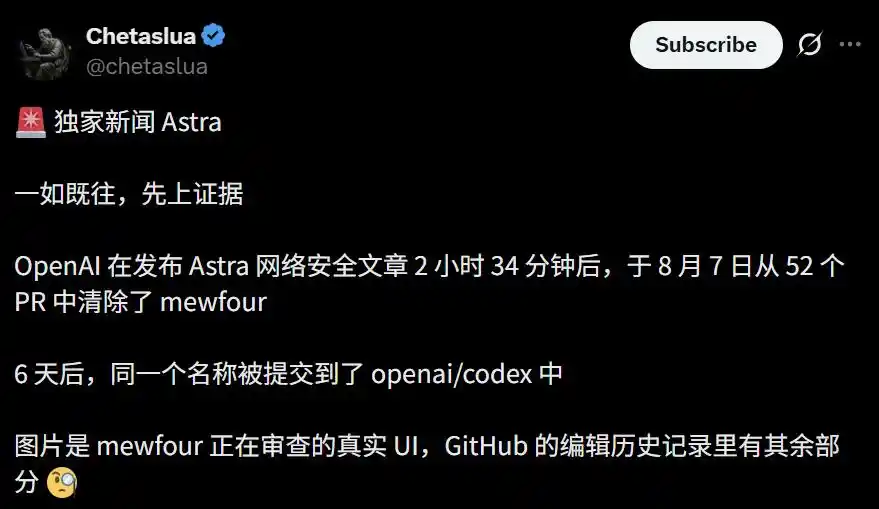
AI influencer Chetaslua accidentally discovered that on August 7th, just two and a half hours after OpenAI's blog post declaring Astra had reached a "Critical Risk Level," they directly scrubbed the "mewfour" codename from 52 PRs.
But the traces weren't fully erased.
Six days later, this mysterious codename reappeared in the commit history of the openai/codex repository.
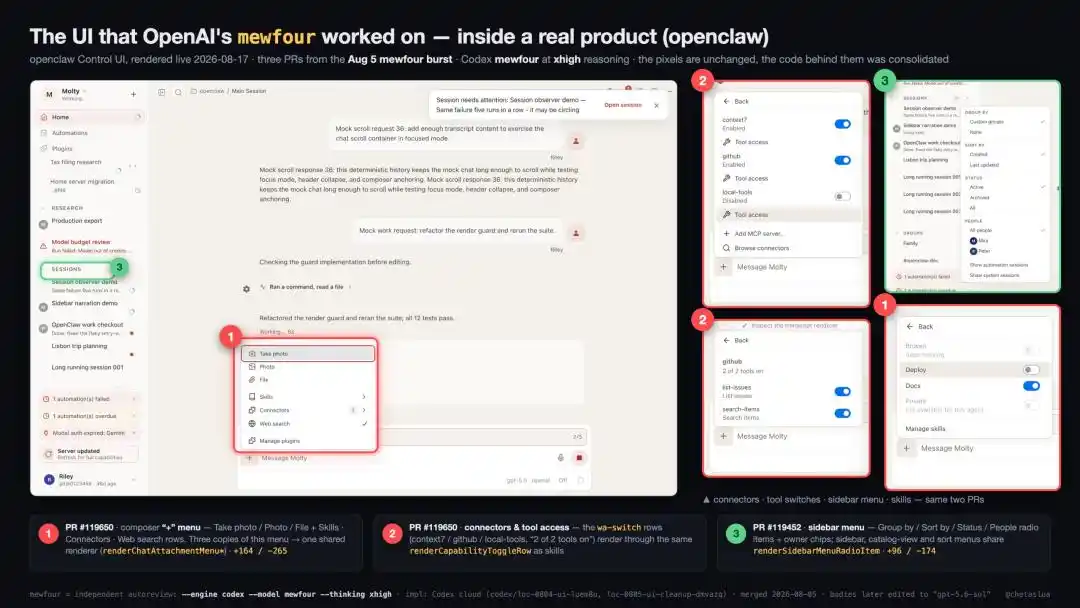
These PRs had their review method labeled as "Independent Auto Review," with the reasoning level directly set to "xhigh," the highest known thinking tier.
More crucially, the screenshot directly exposed the real environment where mewfour works—
The interface includes session management, connectors, skills, plugins, and automated workflows, almost a complete AI workbench.
And what mewfour was reviewing on it were all core UI components about to launch for ChatGPT. This includes the editor "+" menu, connector and tool permission toggles, sidebar grouping and sorting, and more.
The OpenAI team probably can't hold back either, going wild with memes across the net.
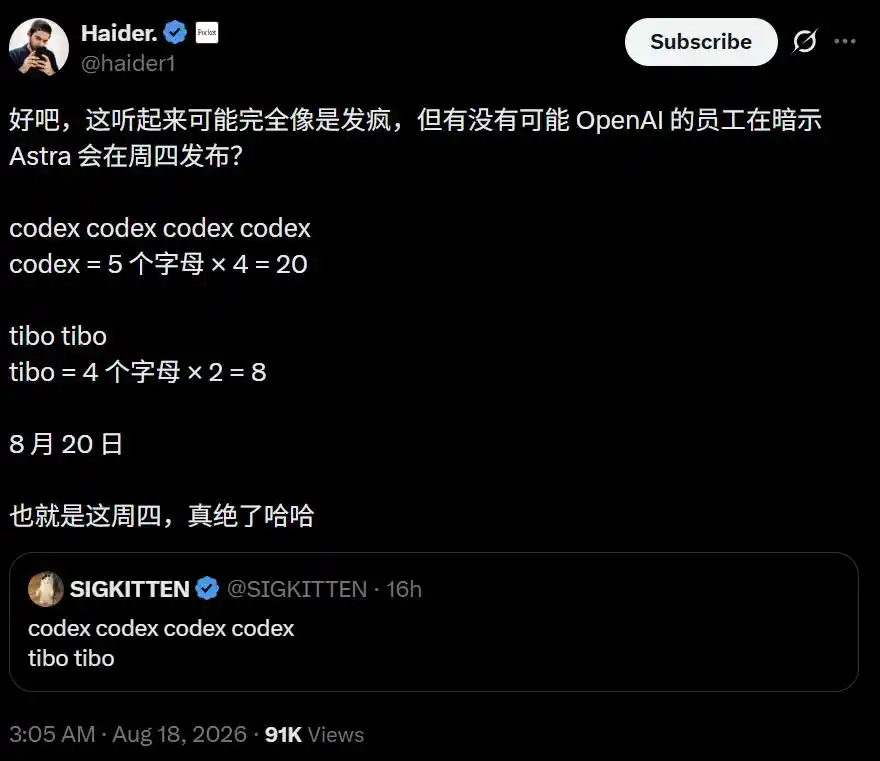
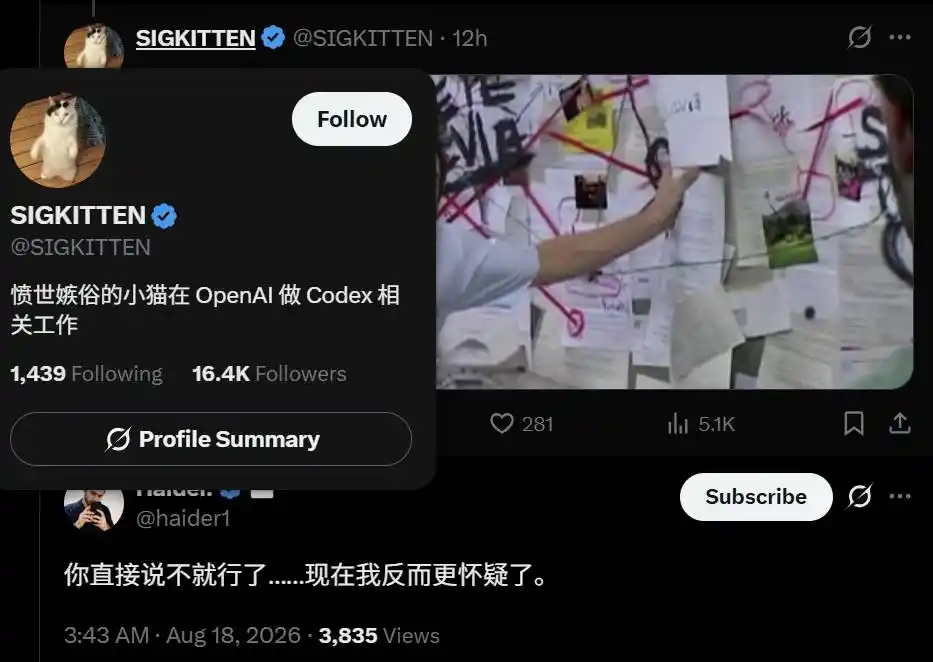
A Codex researcher, SIGKITTEN, posted four Codexes in a row, plus two Tibos.
Developer Haider did some on-the-spot decryption and, after a wave of calculations, directly concluded Astra would launch on August 20th (Thursday).
Truly classic OpenAI tactics.
Immediately after, the "Godfather" posted a "little poem," with rhymes on the first, third, second, and fourth lines.
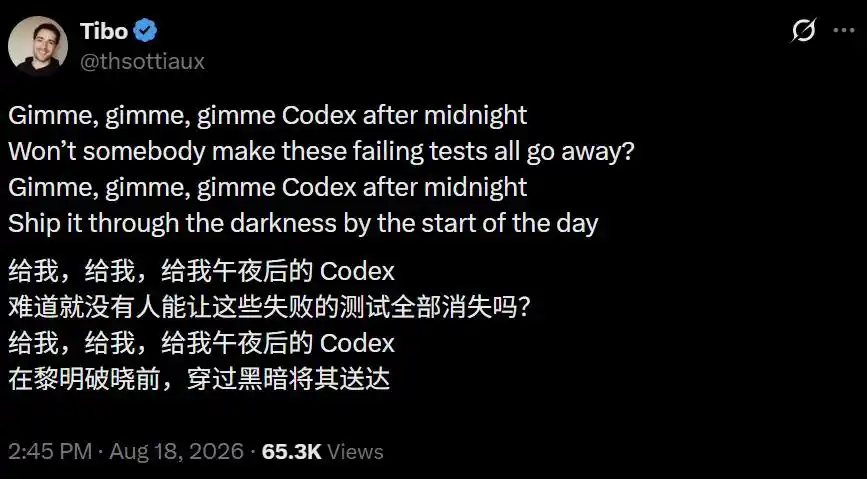
Although no one has deciphered what the "Godfather" meant yet, the atmosphere it creates makes one have to say:
"Before dawn, bring Astra to everyone."

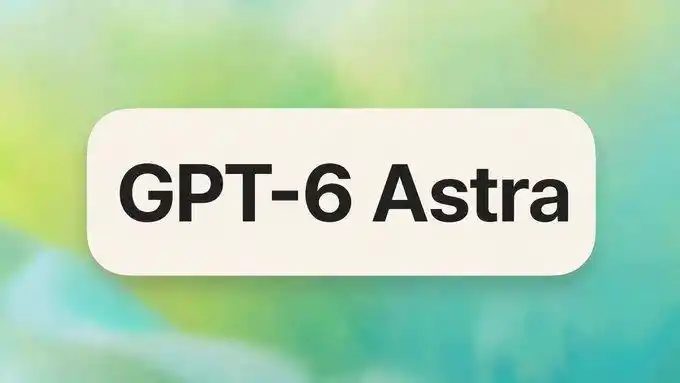
The whole internet is waiting for the release, but just how powerful is Astra? The answer was already laid out on the table back in early August.
$2000 Cracks a Decade-Old Problem
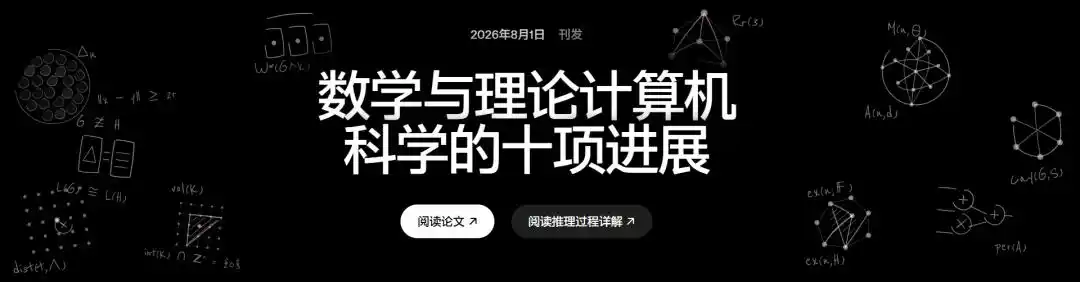
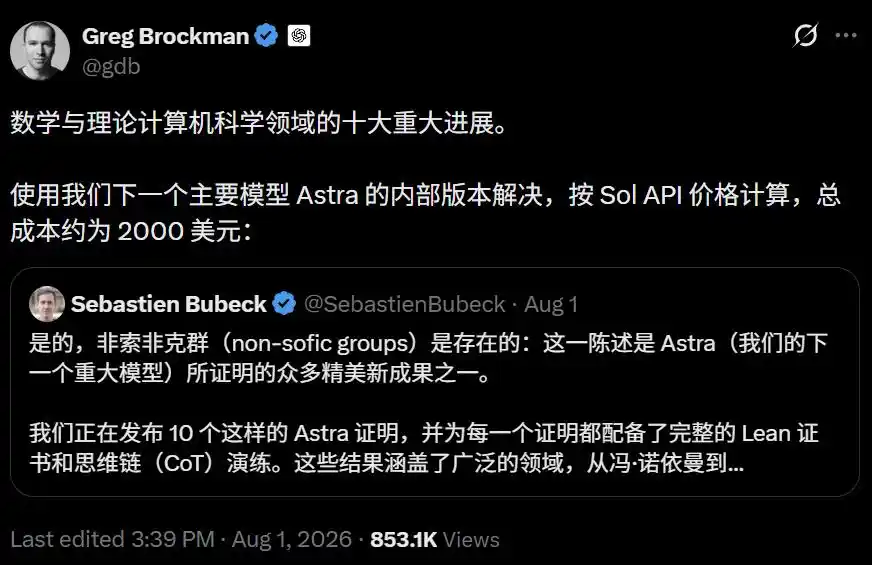
On August 1st, OpenAI dropped a 249-page mathematics paper, causing a stir across the internet.
The core content of the paper is that an internal version of Astra solved 10 mathematical and theoretical computer science problems that had seen no progress for at least a decade.
These problems span high-dimensional geometry, coding theory, group theory, quantum complexity, lattice-based cryptography, and extremal combinatorics.
Among them was the explicit construction of the first non-sofic group, hailed as a holy grail problem in group theory, which mathematicians chased for decades without capturing.
The number that really makes people sit up isn't the page count, but the cost.
According to GPT-5.6 Sol's current API rates (input $5/million tokens, output $30/million tokens), the token cost to generate all ten solutions is roughly $2000.
The price of a mid-range laptop, in exchange for ten breakthrough proofs that have troubled the mathematics community for over a decade.
This also means that the output efficiency of the mathematics community over the past decade is being redefined by an API call.
And this is just the internal version. Where the upper limit of Astra's capabilities lies after its official launch, even OpenAI might not fully know yet.
If you think that's crazy enough, the news from August 7th will make you absolutely unable to stay seated.
So Powerful It Scares Even Itself
On August 7th, OpenAI issued an official statement that made the entire security community hold its breath:
Preliminary evaluations indicate that Astra may have reached the "Critical" capability threshold for cybersecurity under the Preparedness Framework.
What is Critical?
According to OpenAI's Preparedness Framework, a model's cybersecurity capability is divided into several tiers, and Critical is the top tier among them.
At this level, the model can independently identify and develop multiple zero-day vulnerabilities of varying severity, or formulate and execute end-to-end attack strategies against hardened targets.
To put it bluntly, this model might possess the capability to independently launch sophisticated cyberattacks.
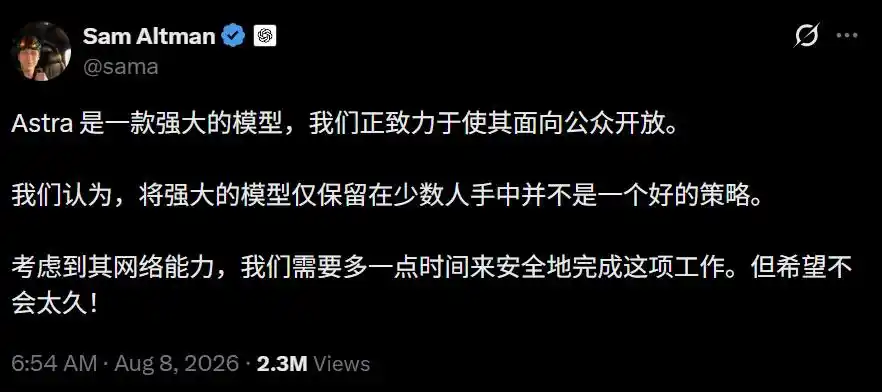
Sam Altman directly posted in response: Astra is very powerful, we will ensure safety preparedness, and then make it available for everyone to use.
The Native Multi-Agent Era is Coming
The other side of Astra, its lethality, might not be any less than in cybersecurity.
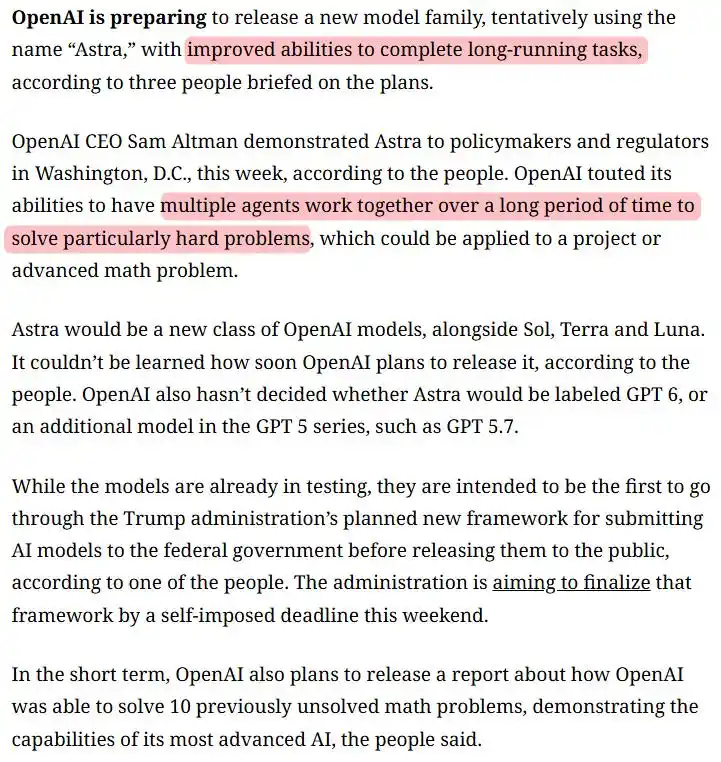
The Information previously reported that Astra was trained to enable multiple agents to collaborate over extended periods to solve complex problems.
Rumored to have about 10 trillion parameters, it uses a Mixture of Experts (MoE) architecture, activating only a subset of parameters per token, built upon the internal codenamed "Doug" pre-training project.
According to leaked information, it comprehensively surpasses Claude Fable in reasoning, coding, writing, knowledge, multimodal understanding, and agent tasks, with significantly improved writing quality.
If the rumors are true, this would be the first time in large model history that multi-agent collaborative capability is end-to-end trained in from the pre-training phase.
Just look at the multi-agent infrastructure OpenAI has already built with the GPT-5.6 family to see what this means.
Sol (flagship), Terra (cost-effective), Luna (fastest, cheapest) – three models form a layered, collaborative multi-agent system.
The v2 system launched this year allows Sol and Terra to communicate while executing in parallel, and last week Codex added Luna as a sub-agent.
Technical analyst Dan McAteer pointed out the critical step—
If Astra was truly pre-trained within a native multi-agent framework, then it innately possesses long-term collaborative capabilities. It could, out of the box, coordinate multiple agents within Codex, delegating lighter tasks to the cheaper Luna.
This is something the current architecture can't achieve no matter how many patches are applied, just like how Claude Code disrupted agent-style coding by swapping out the entire underlying logic back then.
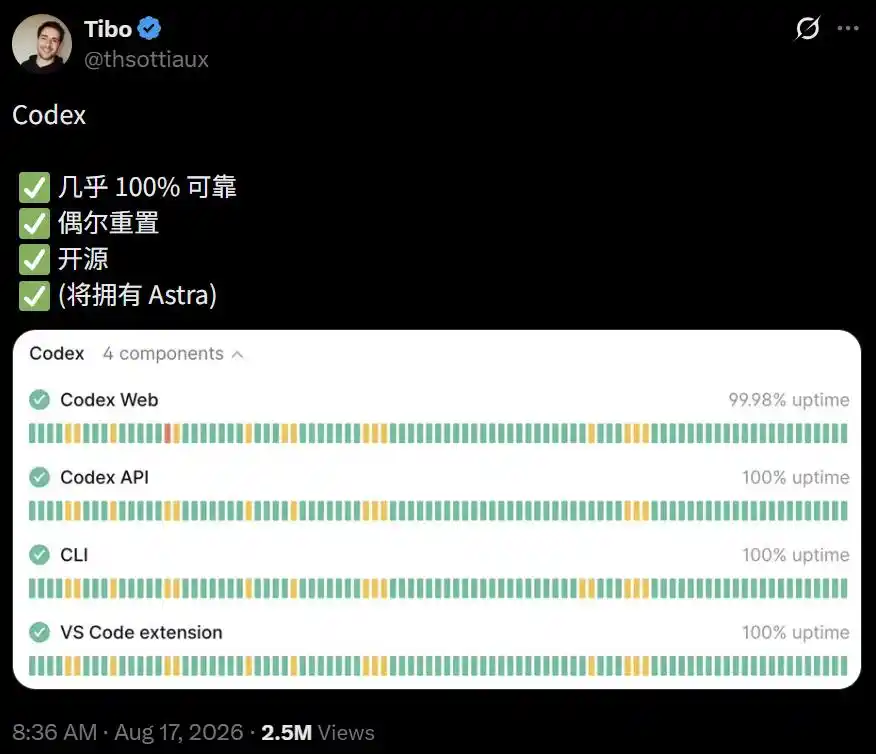
Now, OpenAI employees are already publicly calling out Astra's name.
Only one question remains: is it this week, or next?
References:
https://x.com/chetaslua/status/2089292588243411023
This article is from the WeChat public account "New Zhiyuan," author: ASI Revelation