STRC Trading at Significant Discount, mNAV Falls Below Break-Even, Strategy's Valuation Logic Has Been Rewritten

Foresight NewsPubblicato 2026-06-26Pubblicato ultima volta 2026-06-26

Introduzione

Title: STRC Deeply Discounted, mNAV Falls Below Break-even, Strategy's Valuation Logic Redefined The recent volatility in MSTR and STRC highlights the need to reassess the core business model of Bitcoin reserve companies. These entities function more like leveraged, single-asset banks rather than software/tech firms. Consequently, they should be valued using banking metrics, not based on their total Bitcoin holdings. The key valuation metric is mNAV (market net asset value), akin to a price-to-book ratio. It compares the company's market capitalization to the equity value of its Bitcoin holdings after deducting all senior debt and preferred equity (like STRC). As of June 24, Strategy's mNAV was 1.10x. The focus should be on "net Bitcoin per share" (the Bitcoin claim per share after senior claims) and its growth rate, equivalent to a bank's book value and return on assets. Given STRC's 19% discount to its $100 par value (yielding 14.2%), issuing new MSTR equity at the current price to buy more Bitcoin is inefficient. It slightly dilutes the widely watched "total Bitcoin per share" metric while providing minimal improvement to the more critical "net Bitcoin per share." The article analyzes four potential uses for $1 billion in new equity: 1. **Buy Bitcoin:** Least effective. Improves net Bitcoin per share only marginally while diluting total Bitcoin per share. 2. **Repurchase STRC:** Most effective for balance sheet repair. The discount creates immediate value, increasing...


Author: Khing Oei

Compiled by: Chopper, Foresight News


Recently, the markets for MSTR and STRC have experienced significant volatility. We should look beyond short-term price fluctuations and revisit the underlying logic: Bitcoin reserve companies are essentially single-asset, leveraged holding entities, with a business model closer to that of a bank rather than a software technology company.


From a valuation perspective, the market would never price a bank based solely on its total assets. A bank's loan assets are prioritized for repayment by depositors and debt holders, with common shareholders only entitled to residual equity. Therefore, the core valuation metric for banks is the price-to-book ratio (P/B), which is the value of shareholders' equity after deducting senior debt from total assets. This is also the primary reference metric for investment bank and brokerage analysts.


For Bitcoin reserve companies, the equivalent P/B metric is mNAV: it equals the company's market capitalization divided by the equity net asset value, where equity net asset value refers to Bitcoin reserves minus debt and preferred stock senior to common shares. As of the previous close, Strategy's mNAV was 1.10x. (Translator's Note: The "previous close" data mentioned in this article refers to June 24th data.) The underlying per-share fundamental is the net Bitcoin per share—the actual amount of Bitcoin owned per share after settling priority claims. This is equivalent to the per-share book value denominated in Bitcoin. The industry-wide focus—the per-share Bitcoin growth rate—represents the return on this book value. For a capital management company, this is almost equivalent to an earnings metric.


This set of metrics is not my invention; it simply applies the traditional bank financial analysis framework to a Bitcoin balance sheet:


  • Market cap per unit of equity / Net asset value = Price-to-Book Ratio
  • Net Bitcoin holding per share = Book value per share
  • Bitcoin holding growth per share = Return on book assets


This is the valuation logic common to all leveraged financial institutions and is fully applicable to these Bitcoin reserve companies.


MSTR closed yesterday at $94.13 per share, below the total net Bitcoin value per share of $143.76, resulting in a rough total net value multiple of only 0.65x. Viewed solely through this lens, the stock trades at nearly a one-third discount to its Bitcoin asset value, making a stock issuance to buy more Bitcoin seem dilutive. However, after deducting the approximately 40% of Bitcoin equity occupied by debt and preferred stock, the current stock price represents 1.1 times the Bitcoin assets actually held by common equity. The two perspectives lead to completely opposite conclusions, and the banking valuation framework is the correct benchmark, which also determines how the company should use any new capital raised at present.


Simulating Four Use Cases for $1 Billion in New Capital


Assuming a $1 billion equity issuance at the current stock price, we simulate the effects of four potential uses for the funds: 1) Increase Bitcoin holdings; 2) Repurchase STRC; 3) Boost cash reserves; 4) A 50/50 split between repurchasing STRC and boosting cash reserves. The issuance price is $94.13 per share; yesterday's STRC closing price was $80.84, a 19% discount to its par value, translating to an actual annualized yield of 14.2%. For every $1 spent on repurchases, $1.24 of STRC at par value can be retired, simultaneously eliminating the 11.5% perpetual dividend.
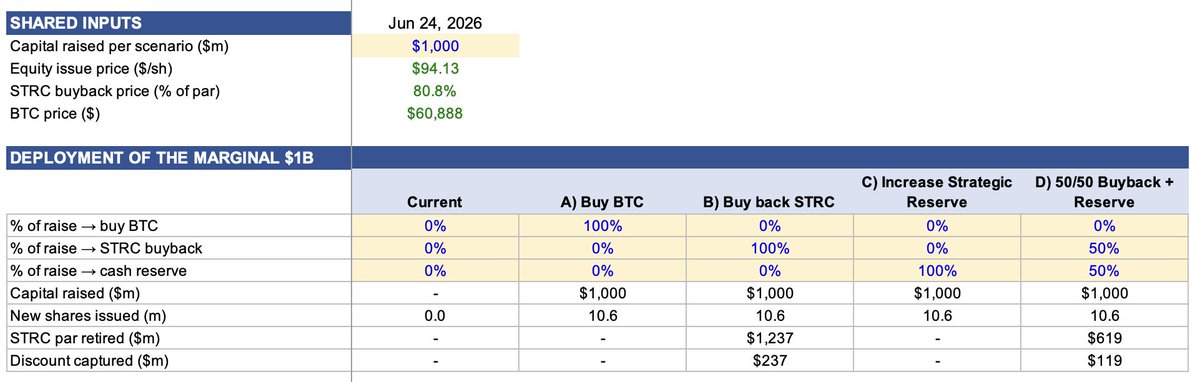


Impact of the Four Scenarios on the Balance Sheet


Three of the four scenarios do not increase Bitcoin holdings; they only adjust the structure of the senior claims layer:


Repurchase STRC: Buying back at a 19% discount, $1 billion can retire $1.24 billion of STRC at par value. Annual preferred stock dividend payments decrease from $1.711 billion to $1.569 billion.

Boost Cash Reserves: Cash reserves increase from $1.4 billion to $2.4 billion, with dividend payments unchanged.

50/50 Split Scenario: Cash increases to $1.9 billion, dividend payments decrease to $1.640 billion, and $619 million of STRC at par value is retired.

Increase Bitcoin Holdings: The only scenario that increases Bitcoin reserves, raising total holdings from 847,363 BTC to 863,787 BTC. This is also the weakest choice for improving core metrics.
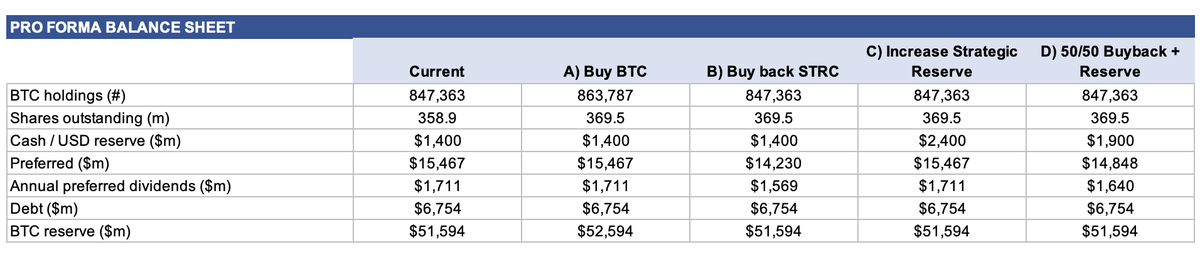


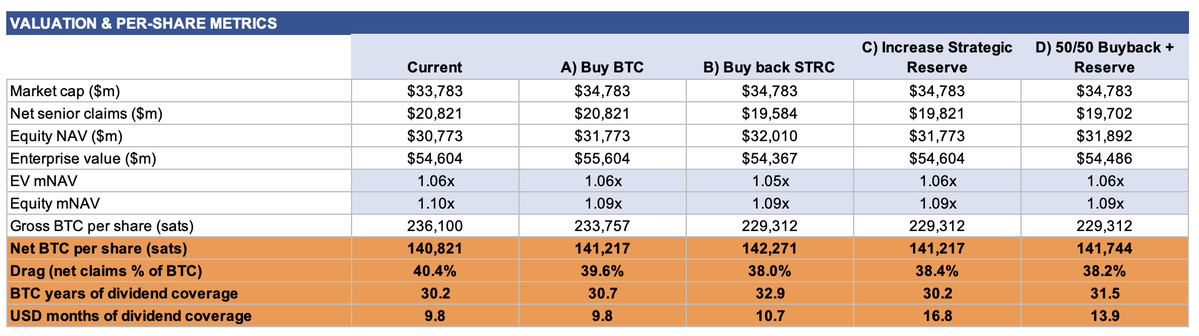
Calculating total Bitcoin value per share, all four scenarios show dilution. Even if you use the entire $1 billion to purchase Bitcoin, the per-share value decreases from 236,100 satoshis to 233,757 satoshis; in the three scenarios where stock is issued but no Bitcoin is purchased, the per-share value drops even further to 229,312 satoshis. Based on this, you would conclude: the company should do nothing.


However, in terms of net Bitcoin value per share, every option results in an increase:


  • Repurchase STRC: Net Bitcoin per share rises to 142,271 satoshis (+1.0%). Debt-to-assets ratio decreases from 40.4% to 38.0%. This provides the strongest balance sheet repair.
  • 50/50 Split Scenario: Net Bitcoin per share becomes 141,744 satoshis, with a debt-to-assets ratio of 38.2%. Cash coverage for debt service is significantly enhanced.
  • Purely Boosting Cash Reserves or Increasing Bitcoin Holdings: Both result in 141,217 satoshis per share, showing the smallest increase.


The logic for Bitcoin purchases being the least effective is clear. You are issuing stock at 1.1 times net asset value but purchasing assets at 1 times net asset value. This only slightly increases net Bitcoin per share while diluting the widely followed total Bitcoin holdings metric. In contrast, repurchasing STRC at a discount creates immediate value.


The market's current key concern is the dividend cash coverage in months. Strategy currently has $1.4 billion in cash reserves and annual STRC dividend payments of $1.711 billion, meaning cash covers only 9.8 months of dividends:


  • Increase Bitcoin Holdings: Coverage remains at 9.8 months.
  • Repurchase STRC: Improves to 10.7 months.
  • Purely Boost Cash Reserves: Significantly improves to 16.8 months.
  • 50/50 Split Scenario: Improves to 13.9 months.


This is another core banking metric: the liquidity coverage ratio. No one pays attention during loose funding cycles, but during funding contractions, it becomes crucial for corporate survival. The fact that STRC is trading below par is a direct signal of market funding channel tightening.


Company's Own Financial Data Also Confirms This Conclusion


The above analysis is not a subjective judgment; Strategy's Q1 earnings report provides the same break-even threshold. According to the company's own framework, selling MSTR to buy Bitcoin only increases Bitcoin per share when mNAV is above 1.22x. At the current multiple of 1x, such a move directly erodes value by 48 basis points. The company's current EV is 1.06x and mNAV is 1.10x, both below its internal break-even line.


The two core assumptions behind the company's conventional expansion path have now completely failed. Previously, it was assumed that STRC could be issued at par normally and that cash reserves could cover 1.5 years of dividends. Now, STRC trades at $81 and cannot be issued at par, and cash reserves cover less than 10 months of dividends.


What Should Strategy Do?


Within the current valuation range, issuing new equity and deploying the capital into channels that tangibly optimize core financial metrics is key. Both boosting cash reserves and repurchasing STRC at a discount can increase net Bitcoin per share, reduce the debt burden, and repair the market's concern over liquidity coverage. The 50/50 split scenario can achieve all these objectives simultaneously.


Continuing to add Bitcoin at present would only optimize the superficial metrics widely followed by the public, while neglecting the core balance sheet risk of the company carrying $15 billion in priority debt amidst tightening funding channels.


Investors focused solely on the total Bitcoin holdings metric miss the positive feedback loop. Repurchasing STRC directly supports token buy-side pressure and signals confidence in liquidity safety. Once market panic subsides, STRC prices should recover toward the $100 par value; price appreciation corresponds to lower yields, and the current high yield of 14.2% would continue to narrow. A complete positive cycle thus forms: repairing the balance sheet → STRC price recovery → dividend yield declines → the previously closed channel for par-value issuance reopens.


The STRC discount is not something that can only be passively waited out for repair; the current deep discount represents the lowest-cost capital the company can access and is key to restarting other funding channels.


To evaluate Bitcoin reserve companies, one should apply banking valuation standards: price-to-book ratio, per-share book value, and debt servicing capacity under stress environments.


Crypto di tendenza

Domande pertinenti

QWhat is the core valuation framework proposed by the author for Bitcoin reserve companies like Strategy, and why is it applicable?

AThe author proposes applying a traditional bank valuation framework. The core logic is that these companies are leveraged holders of a single asset (Bitcoin), similar to banks. The key valuation metric is the Price-to-Book ratio, represented as mNAV (market NAV), which is the company's market capitalization divided by its equity net asset value (Bitcoin reserves minus priority debt and preferred stock). This framework is applicable because it focuses on the residual equity value for common shareholders after satisfying priority claims, which is the standard way to value leveraged financial institutions.

QAccording to the author's analysis, what is the least effective use of $1 billion in new equity capital for Strategy at the current valuation, and why?

AUsing the new capital to buy more Bitcoin is the least effective option. The logic is that the company would be issuing equity at a price of 1.1x its net asset value (mNAV) but buying an asset (Bitcoin) priced at 1x its underlying value. This results in only a minimal increase in the key metric of 'Net Bitcoin per share' while diluting the more widely watched 'Total Bitcoin per share' metric. In contrast, using the capital to repurchase discounted STRC preferred shares creates immediate value by reducing debt burden and dividend obligations.

QWhat are the two core assumptions of Strategy's original expansion plan that the author states have now failed?

AThe two failed core assumptions are: 1) That STRC (the company's preferred shares) could be issued continuously at its $100 par value. Currently, it trades at a 19% discount ($81), closing this funding channel. 2) That the company's cash reserves would be sufficient to cover 1.5 years of dividend payments on those preferred shares. Currently, the cash covers less than 10 months of dividends, indicating a liquidity coverage problem.

QWhat positive feedback loop does the author describe as a potential outcome if Strategy uses new capital to repurchase STRC shares?

AThe positive feedback loop is: Repairing the balance sheet by repurchasing discounted STRC → This action supports STRC's market price → As STRC's price rises toward its $100 par value, its dividend yield falls → The previously closed channel for issuing new STRC at par value reopens. This cycle allows the company to improve its financial health and regain access to lower-cost capital.

QWhat key banking metric does the author highlight as crucial during periods of financing tightening, and what is Strategy's current situation regarding this metric?

AThe author highlights 'Liquidity Coverage' or specifically the 'Cash Dividend Coverage Months' as a crucial banking metric during financing tightening. It measures how many months of dividend payments (for priority securities like STRC) the company's cash reserves can cover. Strategy's current cash reserve of $1.4 billion covers only 9.8 months of its $1.711 billion annual STRC dividend, signaling potential liquidity stress in a tighter funding environment.

Letture associate

Airwallex's Pivot: From Dismissing Stablecoins a Year Ago to Making High-Profile Investments Today

Airwallex, a major cross-border payments fintech, has made a notable strategic shift by leading a seed round investment in Metal, a tokenized financial settlement network. This move is significant given that Airwallex founder Jack Zhang was a prominent critic of stablecoins just a year prior, arguing they failed to reduce costs for mainstream currency corridors and lacked clear utility. The investment targets Metal, a Layer-1 blockchain designed for the tokenization and settlement of assets like stocks, bonds, and stablecoins, aiming for the institutional market. Metal's team includes veterans from Ren Protocol and Meta's Diem project. For Airwallex, this partnership integrates tokenized finance into its global payments network, providing a new settlement layer. Despite his company's investment, Zhang maintains a distinction, stating his skepticism toward "cryptocurrencies" remains, while classifying regulated, asset-backed stablecoins as a separate category. This stance reflects a broader trend of traditional finance (TradFi) cautiously engaging with crypto infrastructure. Companies like Stripe, Mastercard, and major banks are similarly exploring stablecoin payments and tokenization networks, recognizing their potential in emerging markets and 24/7 settlement. The article concludes that Airwallex's investment is less a change of belief and more a strategic necessity to secure a position in the evolving landscape of digital asset settlement, where stablecoins are becoming a key interface for global finance.

marsbit32 min fa

Airwallex's Pivot: From Dismissing Stablecoins a Year Ago to Making High-Profile Investments Today

marsbit32 min fa

Spicy Review|Is the "Most Emotionally Valuable" Post Here? Could STRC Be the Next LUNA?

Here is an English summary of the article (under 1500 characters): This article from the spicy commentary series "LaPing" covers three key stories in the crypto world for the week. First, during a sharp market downturn in June where BTC fell over 20%, a Reddit post on r/Cryptocurrency rallying against "Fear, Uncertainty, and Doubt (FUD)" went viral. The comment section became a hub for retail traders to share memes and encouragement, with many advocating holding (HODLing) through the volatility, embodying the "be fearful when others are greedy" mantra. Second, it examines the situation with STRG (Strategy's perpetual preferred stock), which has "de-pegged," trading around $76 vs. its $100 face value, a ~25% discount. The concern is whether Michael Saylor's company, MicroStrategy, can sustain the $1.2 billion annual dividend payment, given its ~$1.4 billion cash reserve. While analysts note STRG is fundamentally different from the catastrophic LUNA collapse—as Saylor isn't obligated to pay the dividend—risks remain. If MicroStrategy's (MSTR) common stock investors feel their capital is being prioritized for STRG dividends, it could hurt MSTR demand. Third, the article analyzes the online persona of "Chuan Mu," a trader famous for turning $500 into $1 million during the 2023 ORDI inscription boom and again with short positions in 2025. An analysis of his 1,828 tweets reveals his success stems from a top-down analytical framework, asking systemic questions like "Where will the bottleneck be in the AI supply chain?" rather than chasing individual pumps. His investments migrated from crypto-linked stocks to AI infrastructure plays like SK Hynix and Samsung. However, the piece also notes criticism that he has occasionally "pumped" assets and sold positions without notifying followers, creating a contradictory public image. The weekly recap highlights themes of community sentiment during bear markets, financial instrument risks, and the complex realities of following influential online traders.

Foresight News1 h fa

Spicy Review|Is the "Most Emotionally Valuable" Post Here? Could STRC Be the Next LUNA?

Foresight News1 h fa

Trading

Spot

Articoli Popolari

Cosa è DOGE M

Doge Matrix ($doge m): La Nuova Razza di Criptovaluta Guidata dalla Comunità Introduzione Nel panorama in continua evoluzione delle criptovalute, nuovi progetti emergono costantemente, ciascuno con l'obiettivo di catturare l'interesse di investitori ed appassionati. Uno degli ultimi ingressi in questo dominio è Doge Matrix, rappresentato dal simbolo ticker $doge m. Questo progetto ha attirato attenzione grazie alle sue radici nella popolare cultura dei meme che circonda Dogecoin, stabilendo il suo posto all'interno dello spazio web3. Questo articolo mira a fornire un'analisi completa di Doge Matrix, coprendo la sua panoramica, il creatore, gli investitori, la funzionalità, la cronologia e gli aspetti notevoli. Cos'è Doge Matrix ($doge m)? Doge Matrix è un progetto di criptovaluta guidato dalla comunità che apparentemente si basa sull'ampio appeal di Dogecoin, una valuta digitale nota per il suo mascotte Shiba Inu e le sue origini nei meme. Sebbene gli obiettivi generali di Doge Matrix non siano ampiamente definiti, è caratterizzato da un impegno a sfruttare il coinvolgimento e il supporto della comunità. A differenza delle criptovalute tradizionali che spesso enfatizzano l'utilità o il valore intrinseco attraverso tecnologie sottostanti, Doge Matrix si posiziona all'interno di uno spazio che abbraccia il fenomeno culturale delle criptovalute, particolarmente attraente per coloro che risuonano con l'etica degli asset basati sui meme. Attraendo i punti di forza della comunità di Dogecoin, Doge Matrix opera come parte di un ecosistema più ampio, invitando alla partecipazione e all'impegno degli utenti che condividono un interesse per le criptovalute e il panorama digitale. Chi è il Creatore di Doge Matrix ($doge m)? L'identità del creatore di Doge Matrix rimane sconosciuta. Questa mancanza di trasparenza non è un evento raro nello spazio delle criptovalute, dove alcuni progetti vengono lanciati senza rivelare le identità dei loro fondatori. L'assenza di informazioni riguardanti il team fondatore può sollevare domande tra i potenziali investitori sulla responsabilità e la direzione del progetto. Chi sono gli Investitori di Doge Matrix ($doge m)? Al momento, non ci sono informazioni pubblicamente disponibili che dettagliano gli investitori o le fondazioni di investimento che supportano Doge Matrix. Il progetto sembra fare affidamento principalmente sul supporto della comunità piuttosto che su investimenti istituzionali. Questo modello si allinea con la natura guidata dalla comunità dell'iniziativa, favorendo un ambiente in cui la direzione del progetto è plasmata dai suoi partecipanti piuttosto che essere dettata da un selezionato gruppo di finanziatori. Come Funziona Doge Matrix ($doge m)? I dettagli riguardanti i meccanismi operativi di Doge Matrix sono piuttosto vaghi, riflettendo una tendenza più ampia di progetti nello spazio delle meme coin in cui le funzionalità innovative non sono sempre chiaramente articolate. Tuttavia, Doge Matrix sembra essere progettato per sfruttare l'ecosistema esistente delle criptovalute incoraggiando la partecipazione degli utenti mentre attinge ai riferimenti culturali familiari associati a Dogecoin. Le sue potenzialmente uniche caratteristiche derivano dalle interazioni della comunità piuttosto che dai progressi tecnologici, enfatizzando esperienze condivise e collaborazione tra i detentori di token. Sebbene le esatte innovazioni non siano state esplicitamente delineate, il progetto sembra creare uno spazio in cui i membri della comunità possono impegnarsi, condividere idee e promuovere il potenziale del progetto. Cronologia di Doge Matrix ($doge m) Riflettendo sulla cronologia del progetto, emergono eventi notevoli che hanno definito il suo percorso fino ad ora: 25 Novembre 2024: Doge Matrix ha raggiunto il suo valore massimo storico, segnando un traguardo significativo nella sua storia iniziale. 1 Gennaio 2025: Al contrario, Doge Matrix ha toccato il suo valore minimo storico, illustrando la volatilità spesso associata alle criptovalute, specialmente nelle prime fasi del ciclo di vita di un progetto. In Corso: Il progetto continua ad essere attivamente scambiato e supportato dalla sua comunità, sebbene specifici traguardi o obiettivi futuri debbano ancora essere divulgati. Punti Chiave su Doge Matrix ($doge m) Focus sulla Comunità Al centro di Doge Matrix c'è un impegno per il coinvolgimento della comunità. Il progetto prospera sulla premessa della collaborazione e degli obiettivi condivisi tra i suoi membri, enfatizzando l'importanza dello sforzo collettivo. A differenza dei progetti centralizzati che spesso hanno una struttura di leadership definita, Doge Matrix attualmente mostra un approccio più fluido alla governance, dove la voce di ogni membro della comunità conta. Volatilità Il mercato delle criptovalute è noto per la sua volatilità, e Doge Matrix non fa eccezione. La sua storia dei prezzi riflette fluttuazioni significative tra valori alti e bassi, il che è tipico di molte nuove criptovalute ma sottolinea i rischi associati all'investimento in token emergenti. Mancanza di Informazioni Dettagliate Una delle caratteristiche più sorprendenti di Doge Matrix è la scarsità di informazioni dettagliate riguardanti le sue fondamenta tecnologiche e i meccanismi operativi. Questa ambiguità richiede che i potenziali investitori conducano un'accurata due diligence prima di impegnarsi con il progetto. Conclusione In sintesi, Doge Matrix ($doge m) illustra una nuova ondata di progetti di criptovaluta che si basano fortemente sul coinvolgimento della comunità e sulla rilevanza culturale. Sebbene manchi di alcuni dettagli—come una leadership chiara, obiettivi definiti e funzionalità dettagliate—il progetto è riuscito a generare interesse all'interno della comunità crypto, sfruttando l'appello consolidato della cultura dei meme. Come per qualsiasi investimento nello spazio delle criptovalute, comprendere i rischi intrinseci e condurre una ricerca approfondita è essenziale per i potenziali partecipanti. Doge Matrix si erge come un promemoria della natura dinamica, a volte imprevedibile, dell'industria crypto, caratterizzata da un'evoluzione costante e dall'entusiasmo per le iniziative guidate dalla comunità.

396 Totale visualizzazioniPubblicato il 2025.02.03Aggiornato il 2025.02.03

Cosa è DOGE M

Cosa è $M

Comprendere Mantis ($M): Una Nuova Era nell'Interoperabilità Cross-Chain Nel panorama in continua evoluzione del Web3 e delle criptovalute, nuovi progetti si sforzano di offrire soluzioni innovative mirate a migliorare l'esperienza dell'utente e ad ampliare le possibilità funzionali all'interno dell'ecosistema finanziario decentralizzato. Uno di questi progetti che sta attirando attenzione è Mantis ($M), un protocollo pionieristico fondato sui principi dell'interoperabilità cross-chain e dei pagamenti basati sull'intento. Questo articolo esplora gli aspetti essenziali di Mantis, inclusa la sua funzionalità principale, i creatori, il supporto agli investimenti, le caratteristiche innovative e le tappe fondamentali. Che cos'è Mantis ($M)? Mantis è descritto come un protocollo di regolamento dell'intento multi-dominio che semplifica le interazioni cross-chain, consentendo agli utenti di eseguire transazioni finanziarie complesse su varie piattaforme blockchain senza soluzione di continuità. Il protocollo opera attraverso tre livelli principali: Espressione dell'Intento: Gli utenti possono articolare i loro obiettivi di transazione utilizzando un linguaggio naturale facilitato dal DISE LLM, un avanzato modello di linguaggio AI. Ad esempio, un utente potrebbe esprimere il desiderio di scambiare Ethereum (ETH) con Solana (SOL) con una tolleranza di slippage specifica dell'1%. Esecuzione: Questo livello impiega una rete di risolutori che competono per soddisfare gli intenti degli utenti. Le transazioni vengono eseguite utilizzando meccanismi come la Coincidenza dei Desideri (CoWs) e le Aste sul Flusso degli Ordini (OFAs), che garantiscono che le richieste degli utenti siano soddisfatte in modo ottimale. Regolamento: Sfruttando il protocollo di Comunicazione Inter-Blockchain (IBC), Mantis consente transazioni atomic cross-chain, permettendo agli utenti di operare su varie catene supportate, tra cui Ethereum, Solana e Cosmos. Mantis è progettato per introdurre generazione di rendimento nativa per asset inattivi, impiegando prove crittografiche per mantenere l'integrità delle transazioni durante l'intero processo. Creatori e Team di Sviluppo Mantis è stato concepito dalla Composable Foundation, un'organizzazione orientata alla ricerca nota per il suo focus sulle soluzioni di interoperabilità blockchain. Questa fondazione collabora con istituzioni accademiche di prestigio, tra cui l'Università di Harvard e l'Università di Lisbona, contribuendo a sforzi di ricerca e sviluppo estesi che informano l'architettura e la funzionalità di Mantis. L'impegno della Composable Foundation a promuovere l'innovazione nello spazio blockchain posiziona Mantis come una soluzione robusta per la crescente domanda di interoperabilità tra più reti blockchain. Investitori e Supporto Sebbene i dettagli specifici sugli investitori individuali non siano stati resi pubblici, Mantis gode di un sostegno sostanziale da parte di vari enti, tra cui: Sovvenzioni ecosistemiche da catene abilitate IBC, che supportano la crescita e l'integrazione del protocollo all'interno degli ecosistemi finanziari decentralizzati. Partnership strategiche con fornitori di infrastrutture che migliorano le capacità di rete e le strategie di distribuzione di Mantis. Finanziamenti attraverso il tesoro della Composable Foundation, garantendo un supporto finanziario sostenuto per lo sviluppo continuo e i costi operativi. Questi sforzi collaborativi riflettono un consenso tra le parti interessate sull'importanza di migliorare la funzionalità cross-chain e il potenziale utilizzo delle innovazioni infrastrutturali di Mantis. Innovazioni Chiave Mantis si distingue attraverso diverse innovazioni pionieristiche che migliorano la sua funzionalità e utilità: Intenti Agnostici alla Catena: Gli utenti possono avviare transazioni da qualsiasi catena supportata mentre si regolano su un'altra. Questa flessibilità potenzia gli utenti, aumentando l'interazione tra diverse piattaforme. Interfaccia Potenziata dall'AI: L'integrazione del DISE LLM consente agli utenti di condurre operazioni DeFi complesse utilizzando un linguaggio naturale, semplificando così le interazioni e rendendo la tecnologia blockchain accessibile a un pubblico più ampio. Cattura MEV Cross-Domain: Mantis crea un mercato interno per il valore massimamente estraibile (MEV) attraverso competizioni tra risolutori. Questo approccio innovativo consente una maggiore efficienza e estrazione di valore in transazioni complesse. Strato di Regolamento Modulare: Il protocollo supporta vari metodi di verifica, comprese le prove a conoscenza zero e i rollup ottimistici, fornendo un framework versatile che può adattarsi alle tecnologie blockchain emergenti. Cronologia Storica Lo sviluppo di Mantis è contrassegnato da diverse tappe fondamentali che tracciano la sua traiettoria e crescita: | Anno | Tappa | |————|————————————————————————| | 2022 | Sviluppo del concetto iniziale all'interno della divisione di ricerca della Composable Foundation. | | Q3 2024 | Lancio del testnet con capacità di bridging tra Solana ed Ethereum. | | Q1 2025 | Evento di Generazione di Token (TGE) previsto insieme al lancio della mainnet. | | Q2 2025 | Integrazione attesa del DISE LLM e espansione delle capacità cross-chain. | | 2025 H2 | Supporto pianificato per oltre 15 catene attraverso ulteriori aggiornamenti IBC. | Questa cronologia delinea l'evoluzione di Mantis, dalle discussioni concettuali all'implementazione attiva e alle fasi di crescita future. Strategia di Crescita dell'Ecosistema La strategia di Mantis per la crescita dell'ecosistema include diverse iniziative progettate per incoraggiare la partecipazione degli utenti e il coinvolgimento degli sviluppatori: Sistema di Crediti: Gli utenti possono guadagnare crediti del protocollo fornendo liquidità e partecipando a programmi di referral. Questi crediti sono riscattabili per incentivi futuri, promuovendo una comunità utente robusta. Kit di Sviluppo Software Modulare (SDK): Questo toolkit consente agli sviluppatori di creare applicazioni basate su modelli guidati dall'intento utilizzando l'infrastruttura di Mantis, promuovendo così l'innovazione all'interno del suo ecosistema. Modello di Governance: Man mano che il protocollo matura, i detentori di token $M avranno voce in capitolo nella governance del protocollo, consentendo loro di votare su aggiornamenti e modifiche proposti, migliorando così il coinvolgimento della comunità e la decentralizzazione. Mantis rappresenta un significativo avanzamento nel campo dell'architettura cross-chain. Integrando senza soluzione di continuità algoritmi AI avanzati con un robusto framework di regolamento, Mantis cerca di affrontare i problemi di frammentazione all'interno degli ecosistemi multi-chain. Il suo approccio innovativo prioritizza il miglioramento delle esperienze degli utenti, mantenendo i principi fondamentali di decentralizzazione e sicurezza, stabilendo un nuovo standard per l'interoperabilità futura delle tecnologie blockchain. Man mano che Mantis continua il suo percorso di crescita e implementazione, promette di essere un progetto da seguire da vicino nel competitivo panorama del Web3 e della finanza decentralizzata. Con il suo focus sul superamento dei confini e sull'elevazione del coinvolgimento degli utenti, Mantis è destinato a diventare una parte integrante dei futuri sviluppi nel campo delle criptovalute.

52 Totale visualizzazioniPubblicato il 2025.03.18Aggiornato il 2025.03.18

Cosa è $M

Come comprare M

Benvenuto in HTX.com! Abbiamo reso l'acquisto di MemeCore (M) semplice e conveniente. Segui la nostra guida passo passo per intraprendere il tuo viaggio nel mondo delle criptovalute.Step 1: Crea il tuo Account HTXUsa la tua email o numero di telefono per registrarti il tuo account gratuito su HTX. Vivi un'esperienza facile e sblocca tutte le funzionalità,Crea il mio accountStep 2: Vai in Acquista crypto e seleziona il tuo metodo di pagamentoCarta di credito/debito: utilizza la tua Visa o Mastercard per acquistare immediatamente MemeCoreM.Bilancio: Usa i fondi dal bilancio del tuo account HTX per fare trading senza problemi.Terze parti: abbiamo aggiunto metodi di pagamento molto utilizzati come Google Pay e Apple Pay per maggiore comodità.P2P: Fai trading direttamente con altri utenti HTX.Over-the-Counter (OTC): Offriamo servizi su misura e tassi di cambio competitivi per i trader.Step 3: Conserva MemeCore (M)Dopo aver acquistato MemeCore (M), conserva nel tuo account HTX. In alternativa, puoi inviare tramite trasferimento blockchain o scambiare per altre criptovalute.Step 4: Scambia MemeCore (M)Scambia facilmente MemeCore (M) nel mercato spot di HTX. Accedi al tuo account, seleziona la tua coppia di trading, esegui le tue operazioni e monitora in tempo reale. Offriamo un'esperienza user-friendly sia per chi ha appena iniziato che per i trader più esperti.

484 Totale visualizzazioniPubblicato il 2025.07.02Aggiornato il 2026.06.02

Come comprare M

Discussioni

Benvenuto nella Community HTX. Qui puoi rimanere informato sugli ultimi sviluppi della piattaforma e accedere ad approfondimenti esperti sul mercato. Le opinioni degli utenti sul prezzo di M M sono presentate come di seguito.

活动图片