While Peers Shift to AI, This $2 Billion Crypto VC Firm Plans to Raise an Additional $150 Million to Double Down on Crypto

marsbitPubblicato 2026-08-26Pubblicato ultima volta 2026-08-26

Introduzione

Cryptocurrency investment firm RockawayX, managing around $20 billion, is raising a $150 million liquidity fund while its peers shift focus to AI. This move follows its acquisition of crypto hedge fund Relayer Capital, whose founder Austin Barack will lead the new fund targeting undervalued tokens and crypto stocks. Relayer's strong performance, with ~70% returns this year driven by positions in assets like Hyperliquid (up 219%) and Venice AI (up 1006%), underpins the strategy. The expansion contrasts with other VCs but aligns with RockawayX's broader push beyond venture capital, including entering crypto treasury management earlier in 2024. The firm is also involved in ongoing legal disputes related to a failed merger attempt with Solana firm Solmate.

Author:Nina Bambysheva

Compiled by: Deep Tide TechFlow

Deep Tide's Insight: While crypto venture capital peers are moving their focus to AI and robotics, RockawayX is doubling down on crypto through its acquisition of Relayer Capital and is raising funds for a new $150 million fund. Relayer's approximate 70% return this year, along with strong positions in projects like Hyperliquid and Venice AI, provides the confidence for this contrarian expansion. This reflects that some crypto-native capital has refocused on liquid assets ahead of the market rebound, which deserves investors' attention.

According to sources familiar with the matter, RockawayX, a Prague-based digital asset investment firm managing approximately $2 billion in assets, is seeking $150 million for a new liquidity opportunities fund following its acquisition of crypto hedge fund Relayer Capital.

The sources said that Austin Barack, founder of Relayer and a former partner at crypto investment firm CoinFund, will remain at RockawayX to lead this fund. The fund will invest in "undervalued tokens and crypto-related stocks."

This move might have seemed contrarian before the recent crypto market rally. Over the past week, Bitcoin, Ethereum, and Solana have all surged more than 20%. Meanwhile, several prominent crypto VCs have expanded their investment scope to include artificial intelligence, robotics, and other technologies. These include San Francisco-based Paradigm and Framework Ventures.

However, Relayer's performance likely helped convince these early Solana backers to deepen their commitment to this track by acquiring the fund. Sources indicated that Relayer holds positions in hot projects such as the perp exchange Hyperliquid and the decentralized AI platform Venice AI. Their respective tokens have risen by 219% and 1006% this year. This has driven Relayer's year-to-date returns to around 70%, significantly outperforming Bitcoin, Ethereum, and Solana. The Hyperliquid token's market cap is about $18 billion, and the Venice AI token is valued at over $800 million.

This acquisition is the latest step in RockawayX's expansion from traditional venture capital into broader areas. In February this year, the company entered the crypto treasury management business through another acquisition. A treasury is a non-custodial smart contract that pools user funds and deploys them into yield-generating strategies. Since then, these treasuries have attracted over $200 million in deposits.

This expansion follows the collapse of its planned merger with Solana treasury company Solmate. In June, RockawayX's investment vehicle, RBCH Ltd., sued board members of Solmate in a New York state court. RBCH Ltd., the largest external shareholder of Solmate, alleged self-dealing and other misconduct by the board. Solmate had previously separately sued RockawayX and its CEO over the failed acquisition talks. It accused the company of providing "misleading financial statements" and engaging in "fraudulent activities" that harmed its valuation. RockawayX denied the allegations, calling them retaliatory. Both cases are still pending.


Domande pertinenti

QWhat is RockawayX doing that goes against the current trend in the crypto venture capital space?

AWhile many crypto venture capital firms are shifting their focus towards AI and robotics, RockawayX is doubling down on crypto. They are seeking to raise $150 million for a new fund after acquiring the crypto hedge fund Relayer Capital.

QWhy was RockawayX confident in expanding its crypto investments despite the market conditions?

ARockawayX's confidence stemmed from the strong performance of the newly acquired Relayer Capital fund. Relayer reportedly achieved a return of about 70% this year, driven by positions in high-performing assets like Hyperliquid and Venice AI, which significantly outperformed major cryptocurrencies.

QWhat type of investments will the new $150 million fund managed by Austin Barack focus on?

AThe new $150 million liquidity opportunities fund, to be managed by Austin Barack, will focus on investing in "undervalued tokens and crypto-related stocks."

QApart from venture capital, what other business area has RockawayX recently expanded into?

ABeyond traditional venture capital, RockawayX expanded into crypto treasury management earlier this year through an acquisition. These non-custodial smart contract vaults have since attracted over $200 million in deposits.

QWhat legal disputes is RockawayX currently involved in?

ARockawayX is involved in two ongoing lawsuits. Its investment vehicle, RBCH Ltd., sued Solmate's board members for alleged self-dealing. Separately, Solmate sued RockawayX and its CEO over a failed merger, alleging misleading financials and fraudulent activity. RockawayX denies these claims as retaliatory.

Letture associate

Bitcoin Is Ready for "Parabolic Growth". Is Altseason Upon Us?

Amid a general market uptrend, experts are discussing the potential start of an 'altcoin season', where major cryptocurrencies could outpace Bitcoin's growth. This follows Bitcoin surpassing $81,000, predictions of a new bull market, and a capital shift from AI stocks toward Bitcoin and gold. Since August 17th, the crypto market has risen over 22%, primarily driven by Bitcoin (BTC) and Ethereum (ETH), which gained 25% and 30% respectively, reaching highs last seen in May. Analysts suggest the Bitcoin bear cycle has ended, anticipating a historically strong rally, with renewed institutional demand for cryptocurrency ETFs. BitMEX founder Arthur Hayes, in a recent interview, declared the start of a new bull market, predicting Bitcoin could quickly reach "hundreds of thousands" of dollars. Market observers interpret this as an expectation for 'parabolic growth.' Signs of a bull market revival include Bitcoin ETFs re-entering the top 10 most-traded ETFs, displacing some AI-focused funds. Analysts at CryptoQuant note capital is flowing from Bitcoin into riskier altcoins, with their bull market indicators showing the most optimistic signals since October 2025. However, the reality is more nuanced. The current surge is a rebound from yearly lows; Bitcoin's price is still down nearly 40% from its October peak. The Altcoin Season Index has dropped to 39 from 67 in early August, and Bitcoin's dominance remains around 60%, indicating investor focus is still on Bitcoin rather than altcoins. Experts predict the market is entering a phase where project fundamentals and real revenue, rather than speculation, will increasingly determine asset value.

cryptonews.ru10 min fa

Bitcoin Is Ready for "Parabolic Growth". Is Altseason Upon Us?

cryptonews.ru10 min fa

$120 Million Vanishes Overnight! Crypto's 'Steadiest Giant' Stumbles in South America

Summary: Tether's $120 million Bitcoin mining venture in Uruguay, initiated in May 2023, was abruptly shut down in July 2025 when the national power utility UTE cut off electricity. The project, developed in partnership with local firm Microfin in Florida province, was touted as a model for leveraging the country's nearly 98% renewable energy grid. The collapse stemmed from a fundamental contract dispute over electricity supply. Tether interpreted the agreed power volume as a "minimum guaranteed supply," expecting to request more as the mining operation expanded. UTE, however, viewed it as a "strict maximum cap." This disagreement led to frequent power curtailments for the 24/7 mining facility, causing significant revenue loss from lost computing power. Following the 2025 election of left-wing President Yamandú Orsi and a management change at UTE, negotiations broke down. Microfin stopped paying electricity bills in May 2025, formally notified UTE of contract termination in June, and did not attend a final meeting where UTE presented a revised contract. By the July 25 power cut, Microfin's debt approached $5 million. The operation ceased, laying off 30 of its 38 local staff, with all outstanding debts settled by December 2025. The failure highlights key risks for heavy-asset overseas investments: Uruguay's green energy proved not to be cheap energy, especially after the 2024 Bitcoin halving squeezed industry profits. Furthermore, political changes can swiftly alter utility company policies, undermining the long-term regulatory stability critical for such projects. While financially absorbable for Tether, the incident underscores that operational success depends on unambiguous contracts and genuine cost advantages, not just technological scale.

marsbit35 min fa

$120 Million Vanishes Overnight! Crypto's 'Steadiest Giant' Stumbles in South America

marsbit35 min fa

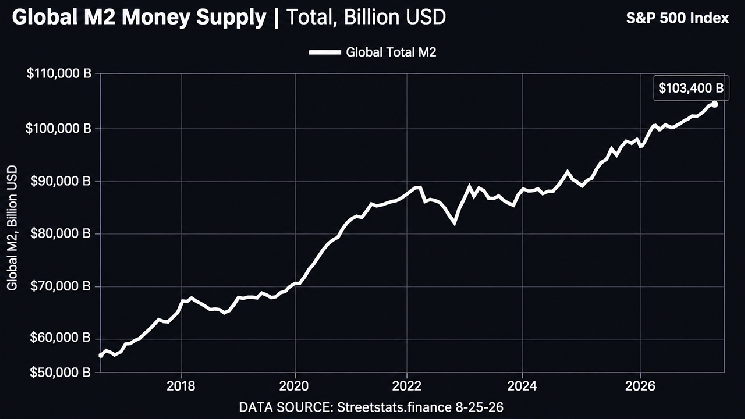
Is Bitcoin Price Lagging? Record Global M2 Money Supply Could Be a Springboard for BTC's Rise

Bitcoin Price Lagging? Record Global Money Supply M2 Could Springboard BTC Growth The global money supply (M2) is expanding rapidly, similar to global debt. The US M2, representing all money circulating in its economy, has reached a record $23.16 trillion. Combined with figures from major economies like the Eurozone, China, and Japan, the global M2 is approximately $103 trillion. Some estimates, however, place it closer to $195 trillion. This surge in liquidity is significant because excess capital often seeks higher returns in assets like precious metals, stocks, and cryptocurrencies. Bitcoin's recent price surge above $81,000 has brought the global M2 metric back into focus. Following a sharp rise in early August after a US Treasury bond buyback announcement, BTC still trades about 37% below its October 2025 all-time high exceeding $126,000. This gap presents a potential "catch-up" trade thesis. Bitcoin's fixed supply of 21 million contrasts with governments' ability to print fiat currency, making scarce assets like BTC attractive if monetary expansion continues. Historically, Bitcoin's bull cycles in 2017-2018 and 2020-2021 coincided with M2 expansion and increased liquidity. Over the past year, the correlation seemed broken as M2 grew while Bitcoin's price fell sharply from its peak. Observers believe fresh dollars may have remained locked in cash-favorable investments. Some, like Ash Crypto, now suggest a long-awaited alignment between Bitcoin and M2 may be starting, especially as a weakening US Dollar Index this month has seen assets like gold and Bitcoin surge. A softer dollar pressures cash havens and prompts holders to act. While record M2 doesn't guarantee higher Bitcoin prices, a sustained influx of liquidity, a weak dollar, and capital flowing into alternative assets could trigger a catch-up rally sooner than expected. However, changes in these conditions could lead to the opposite outcome.

cryptonews.ru1 h fa

Is Bitcoin Price Lagging? Record Global M2 Money Supply Could Be a Springboard for BTC's Rise

cryptonews.ru1 h fa

Trading

Spot
活动图片