Original | Odaily Planet Daily (@OdailyChina)
Author | Ethan (@ethanzhang_web3)
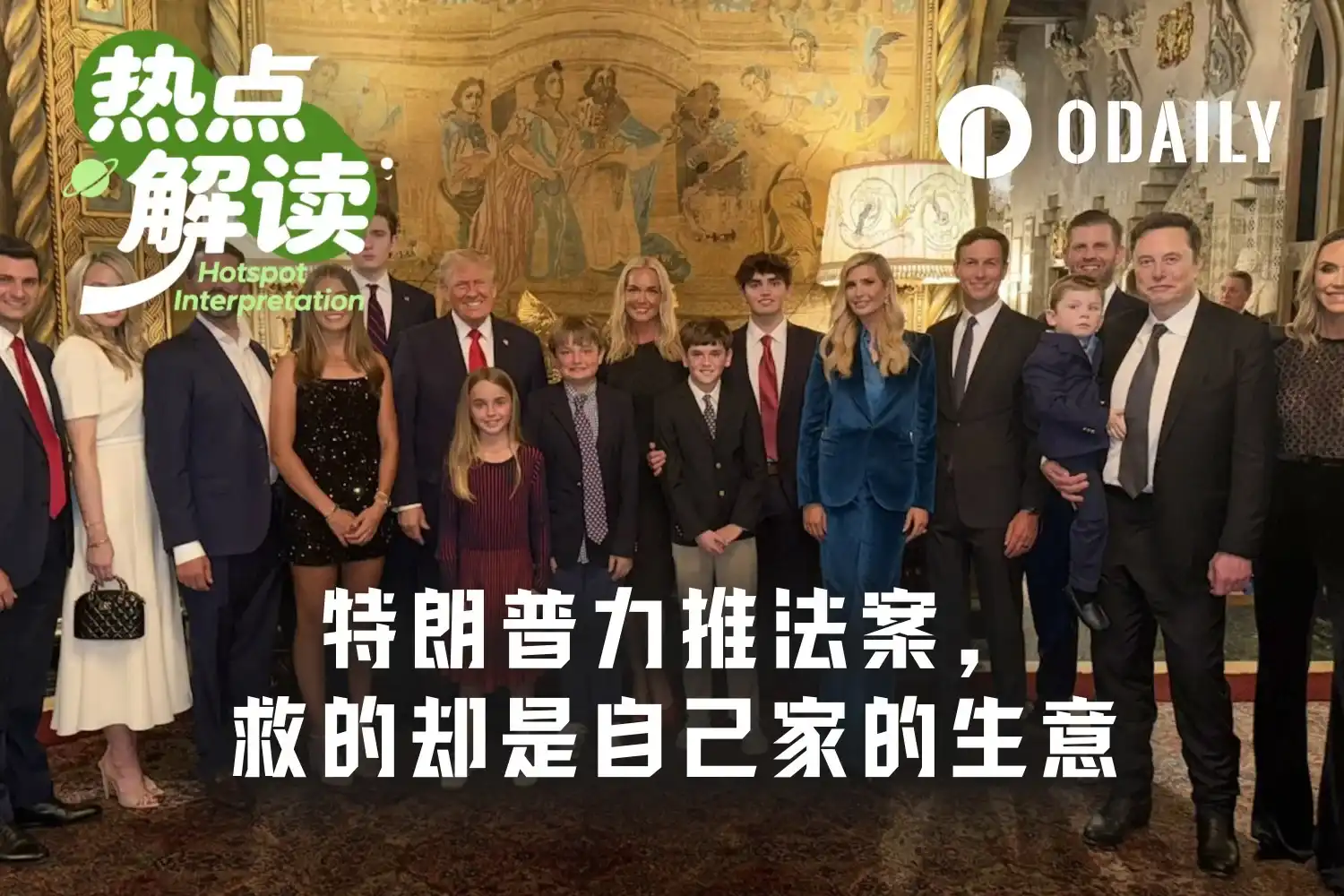
On March 4, Trump posted on Truth Social, specifically criticizing the banking industry for threatening and undermining the GENIUS Act. He urged Congress to expedite the crypto market structure bill and warned that if the framework is not implemented soon, the U.S. would cede its advantage in the crypto field to other countries. The wording was intense, the tone urgent, resembling a defender speaking out for the industry.
But if you know that the Trump family's World Liberty Financial (WLFI) is the issuer of the stablecoin USD1, the meaning of this statement becomes much more nuanced. One of the most direct beneficiaries of the GENIUS Act is precisely the family business of the person sitting in the White House who sent this tweet.
This is not the first time. Since Trump returned to the White House in January 2025, his crypto empire has never been truly separated from his presidential identity. Two hats have always been worn by the same person—just in the past few weeks, the overlap between them has become harder to ignore than ever.
On one side, the family project USD1 suffered a coordinated attack in late February, briefly depegging. The WLFI team subsequently transferred a large number of tokens to centralized exchanges for two consecutive days, with on-chain signals sparking market speculation. On the other side, the President himself is charging ahead in Washington for stablecoin legislation, launching a frontal counterattack against the banking lobby's阻击.
These two lines are running simultaneously, converging on the same family, the same period, and the same issue. This is what is truly interesting about Trump's crypto story right now.
The Stress Test of USD1
In March 2025, World Liberty Financial officially launched USD1, a stablecoin pegged 1:1 to the US dollar, with reserve assets consisting of short-term U.S. Treasury bonds, U.S. dollar deposits, and cash equivalents. It is custodied by the crypto custody firm BitGo, with monthly reserve attestation reports provided by the accounting consultancy Crowe. In terms of design framework, it follows the regulatory compliance route, unlike those offshore stablecoins with opaque reserves and questionable transparency.
The market entry timing was precise. Just as discussions around the GENIUS Act were heating up and market expectations for compliant stablecoins were rising, USD1 debuted with a distinct posture: I am the dollar, I am compliant, I have the presidential family's endorsement. In May 2025, the Abu Dhabi sovereign fund MGX announced a strategic investment in Binance using $2 billion worth of USD1. This transaction overnight propelled USD1 from a new face in the crypto circle to a player that cannot be ignored in the global stablecoin landscape.
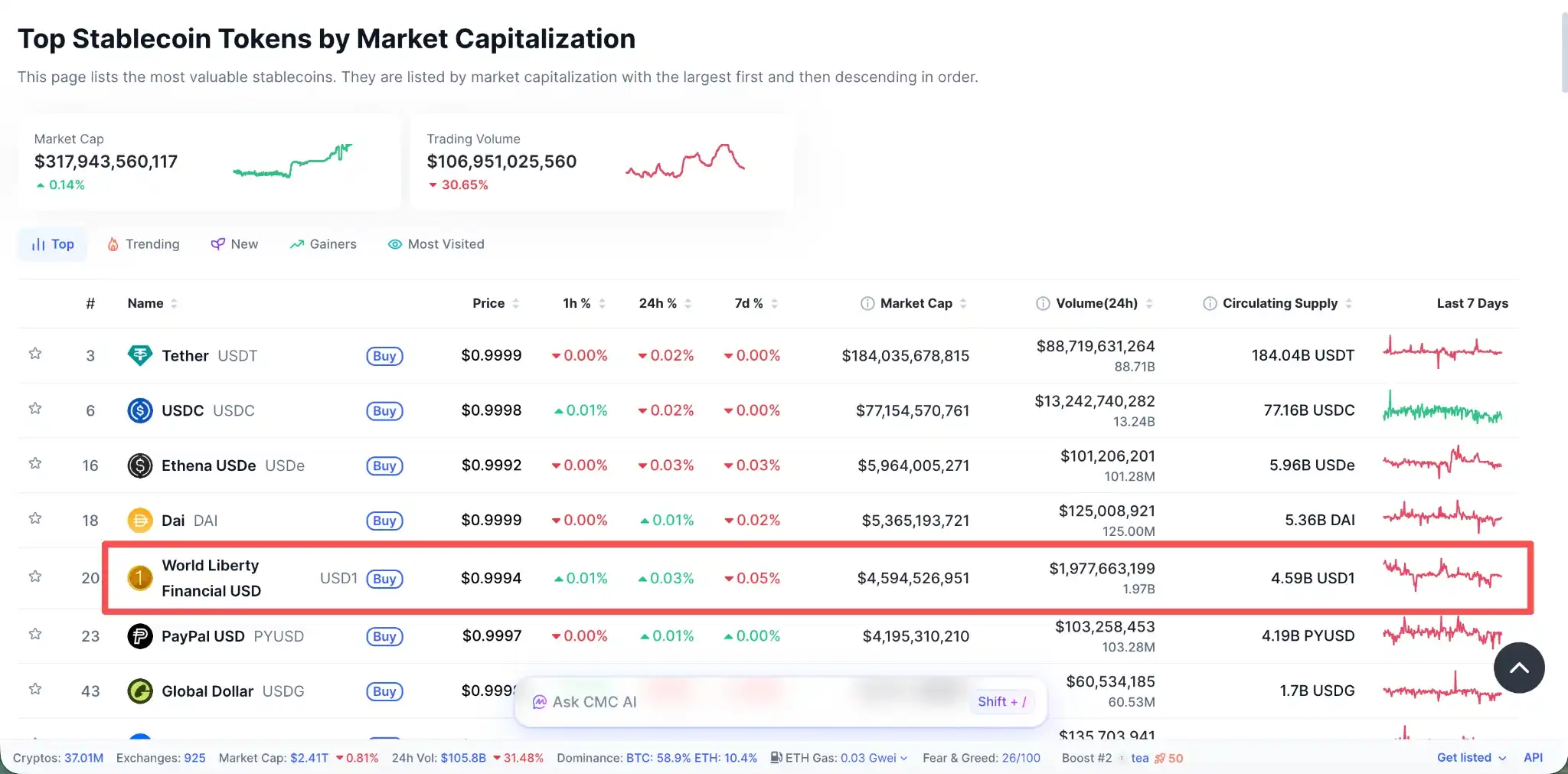
By March 2026, USD1's circulating market capitalization had reached approximately $4.5 billion, firmly ranking among the top five global stablecoins. But behind this scale, some details are noteworthy: According to research by data analysis platform Kaiko, over half of USD1's liquidity on PancakeSwap comes from market maker wallets associated with the WLFI team, rather than genuine market trading demand; its monthly active user base in U.S. dollar terms still lags orders of magnitude behind established players like USDT and USDC. Political endorsement is the strongest marketing resource, but it cannot replace real market depth.
On February 23, 2026, a sudden stress test broke this delicate balance.
That morning, USD1 briefly depegged, its price falling to $0.994, a deviation of about 0.6% from the $1 peg. WLFI immediately issued an alert on platform X, characterizing the fluctuation as a multi-point coordinated attack: attackers had hacked the social media accounts of several WLFI co-founders, hired KOLs to spread panic information on a large scale, and simultaneously opened short positions on WLFI token, attempting to profit from the artificially created chaos.
WLFI spokesperson David Wachsman later told the media that the project's engineering and security teams successfully defended against the coordinated attack from multiple directions, and the day's events precisely proved that USD1's design is robust and can be relied upon under any conditions. USD1 subsequently recovered to around $0.998, with the 1:1 redemption mechanism playing its anchoring role, avoiding a deeper crisis of confidence.
From the outcome, this attack was indeed unsuccessful. But from the context, this attack occurred at a highly sensitive time—just days before, WLFI had just held a high-profile crypto summit at Trump's Mar-a-Lago estate, attended by government officials, traditional bank executives, and former Binance CEO CZ.
Although the depegging was brief, it exposed a structural problem: political endorsement can bring market capitalization, but it may not necessarily bring resilience. When a stablecoin's biggest selling point is the president's family name, any attack targeting that name simultaneously becomes an attack on the stablecoin.
Is the Team Starting to Dump?
About ten days after the attack, another set of on-chain data emerged, further expanding the market's room for interpretation.
On-chain analysis showed that starting March 4, WLFI transferred a large number of WLFI tokens to centralized exchanges over two consecutive days: On the first day, approximately 146.4 million WLFI tokens were transferred to OKX and Bitget, worth about $15.4 million at the time; on the second day, about 16.71 million more were transferred to OKX, worth about $1.74 million. The two transfers totaled approximately 163.1 million tokens, with a total value exceeding $17 million.
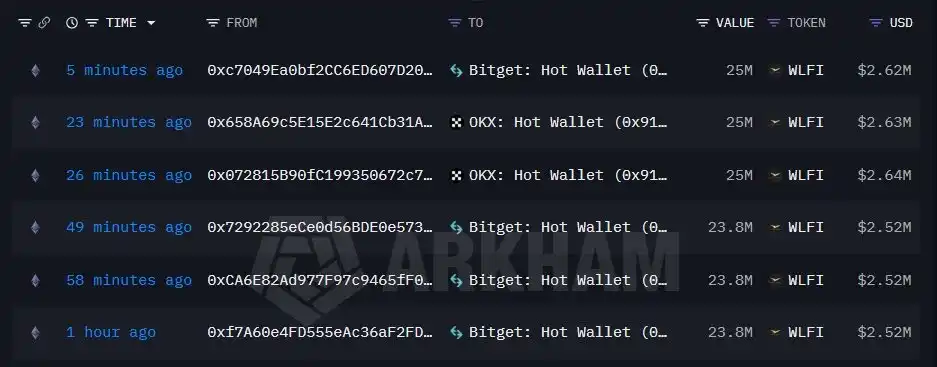
In the on-chain world, transferring tokens to centralized exchanges is often seen as a high-signal-strength behavior, usually hinting at potential selling intentions. Although not all transferred tokens are immediately liquidated, the action itself is enough to spark associations and vigilance among market participants, especially against the backdrop of a project facing multiple pressures.
This association seems particularly plausible at the current juncture. The USD1 stablecoin had just experienced a brief depegging event on February 23, 2026, with its price once falling to about $0.994, even touching $0.98 at some moments. Although the price recovered to nearly $0.998 within hours, the event had already intensified external doubts about the WLFI project's stability.
Simultaneously, political controversies surrounding WLFI remain unresolved—the U.S. House of Representatives launched an investigation on February 4, 2026, demanding WLFI provide records of ownership, fund flows, governance documents, and details of board changes, focusing directly on the transaction where UAE Abu Dhabi royal family member Sheikh Tahnoon bin Zayed Al Nahyan, through his controlled company Aryam Investment 1, secretly acquired about 49% of WLFI's equity for $500 million (signed on January 16, 2025, four days before Trump's second inauguration), with a deadline of March 1, 2026. Additionally, Senators Elizabeth Warren and Andy Kim, emphasizing national security risks and potential conflicts of interest, requested the Treasury's CFIUS to review the transaction on February 13.
It is worth noting that WLFI has not issued any public statement regarding these on-chain transfers. This silence itself has become part of the market's interpretation.
Of course, another interpretation is equally valid: The project is proactively arranging CEX liquidity at a strategic level for subsequent market operations; or, this is a predetermined liquidity management action in the token economic design, unrelated to the external environment. Neither narrative can be completely ruled out, which is the most tricky aspect of on-chain data—it provides facts, but not intent.
However, according to WLFI's operating agreement, entities controlled by the Trump family are entitled to 75% of the project's profit share. Trump's holding entity, DT Marks Defi LLC, holds about 60% of WLFI's equity, and Trump family members and their affiliates were allocated about 22.5 billion WLFI tokens. Any market movement of these tokens is not just a financial decision at the project level, but also an asset realization path for this family in the crypto market.
Currently, WLFI's token price has fallen more than 50% from its historical high. At this node, any large-scale transfer action is inevitably re-examined against the backdrop of this decline.
The President's Other Battle in Washington
On March 4, Trump posted on Truth Social, more urgently worded than usual. He specifically criticized the banking industry for threatening and undermining the GENIUS Act, demanded that Congress expedite the crypto market structure bill, and warned that if the U.S. acts slowly, its crypto advantage will be ceded to other countries.
This rhetoric is not unfamiliar—packaging domestic policy disputes as great power competition, painting the resisting party as traitors. Trump has used it many times, and it works every time.
He is speaking up for the industry, and he is also speaking up for himself. It's just that these two things are wrapped up in the same sentence.
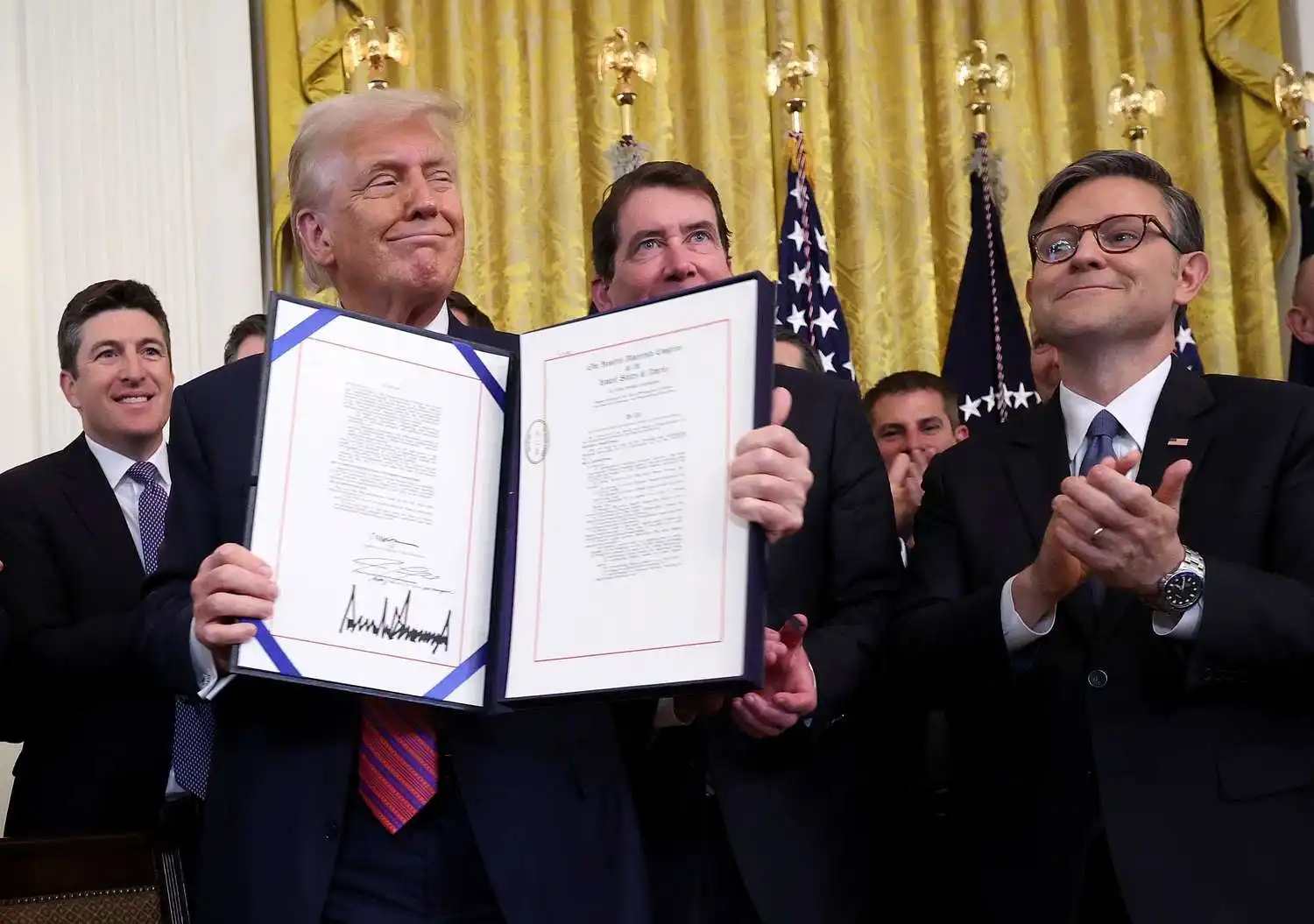
The GENIUS Act itself is not complicated. It is the first bill in U.S. history to establish a federal regulatory framework for stablecoin issuance, clarifying issuance qualifications, reserve requirements, and anti-money laundering obligations. Signed into law after multiple rounds of revisions in 2025, its direction is good, but the devil is in the details.
The banking lobby focused on one clause: whether stablecoins can offer yields to holders. The logic is straightforward—if stablecoins can pay interest, why would ordinary people keep their money in banks? Deposit outflow is the result the banking industry least wants to see. So the lobbying groups became active, pushing for amendments to the relevant clauses, while extending this resistance to another crypto legislation, the CLARITY Act, creating a bundle: if you want stablecoin legislation, you must first agree to my conditions.
Trump's reaction was to directly骂 (scold) the banking industry on social media. This posture reveals a signal: The legislative process is not going smoothly. A truly confident of success doesn't need to pressure by posting. His need to post indicates that the chips on the negotiating table are not enough.
But what truly complicates this game is not the resistance from the banking industry, but a blank space in the text of the GENIUS Act.
This law has no clauses restricting the President or his family members from profiting from stablecoin issuance. This空白 (blank space) caused controversy during the legislative process, with some senators attempting to add relevant prohibition clauses, but they were ultimately not included. Thus, a peculiar structure emerged: A President is both the promoter of legislation and a potential beneficiary of that legislation, and may also exercise veto power because the legislative content affects his own interests—this logical闭环 (closed loop) is perhaps the deepest underlying tone of this Washington game.
Conclusion: The Intersection of Two Lines
Place the above three events on the same timeline: February 23, USD1 depegged due to a coordinated attack, then quickly recovered; several days after the attack, WLFI transferred large amounts of tokens to CEXs for two consecutive days; March 4, Trump posted on Truth Social, launching a frontal counterattack against the banking industry blocking the GENIUS Act.
These three events happened in less than two weeks. Although there is no simple causal relationship between them, the protagonist is the same family—the crypto empire of the current U.S. President Trump: On one side, the family project is facing real pressure in the market, whether from external attacks, opaque on-chain actions, or political investigations from Congress; on the other side, the President is using the greatest resources he can mobilize—the White House's discourse power and political credit—to protect the legislation crucial for stablecoins.
The intersection of these two lines is Trump himself. He is not switching between his businessman identity and presidential identity; he is fighting on two battlefields simultaneously, and these two battlefields point in the same direction: to let USD1 and WLFI survive, to let them gain legitimacy, scale, and profit under a regulatory framework he is personally promoting.
External质疑 (doubts) about this overlap have always existed and have明显升温 (clearly intensified) in early 2026. The investigation led by Representative Ro Khanna focuses on the transaction where the UAE royal family secretly acquired about 49% of WLFI's equity for $500 million, questioning fund flows, governance transparency, and potential national security risks—especially since, shortly after the UAE royal family's investment in WLFI, the Trump administration approved the export of hundreds of thousands of advanced chips to UAE's Tahnoun-owned enterprise G42, a decision that had previously been suspended on national security grounds.
The legal community has termed this transaction a potential constitutional violation (violating the constitutional clause prohibiting the President from receiving gifts from foreign governments). The White House's response is: Trump himself never participated in any WLFI transactions or decisions and has maintained distance from the company since taking office.
This statement may hold legally, but in reality, it describes an almost externally unverifiable state of isolation. When a presidential family's enterprise continuously appreciates through policy benefits, and the President himself continuously creates policy benefits for this industry, whether利益 (benefit) exists and whether关联 (connection) is established becomes a structural gray area.
The deeper question is not whether Trump broke the law, but whether the existing system has sufficient tools to deal with this new type of power-business overlap. Stablecoins are an industry highly dependent on regulatory clarity, and when the promoter of that regulatory clarity is itself a market participant, the very rule-making of the entire game becomes an issue that needs to be re-examined.
Trump's two hats are not a secret he刻意隐藏 (deliberately hides) now. They exist with a certain degree of openness, being continuously watched by the market, the media, and some members of Congress.
The reason it can continue to operate is precisely because the mechanisms that could theoretically constrain it—congressional legislation, presidential signing, regulatory rule-making—all have his hand present in every环节 (link). The constraint mechanism is held in the hands of the very person who needs to be constrained.