Bitcoin Begins an Independent Market Move: Is This a Rebound or a Reversal?

marsbitPubblicato 2026-07-07Pubblicato ultima volta 2026-07-07

Introduzione

Bitcoin has begun to show independent price action, rebounding from around $57,742 to surpass $60,000. This move was initially triggered by comments from Federal Reserve officials downplaying inflation risks and was subsequently amplified by weaker-than-expected U.S. employment data, which reduced expectations for further interest rate hikes. The rally was further fueled by a short squeeze, with approximately $281 million in short positions being liquidated as the price climbed. This created buying pressure and accelerated the upward move. Altcoins, particularly Ethereum and Solana, have also participated in the rally, indicating a broader, though not yet euphoric, risk-on sentiment returning to the crypto market. However, several key indicators suggest caution. The recovery is not yet a confirmed trend reversal. Despite the price rebound, the options market still shows a high premium for downside protection, implying traders remain wary. The short squeeze itself provides a temporary boost but requires sustained buying from spot markets, such as ETFs, to maintain momentum. Furthermore, Bitcoin's trajectory remains sensitive to macroeconomic data; any resurgence in inflation concerns or a shift to a more hawkish Fed stance could quickly reverse recent gains.

Federal Reserve Chair Kevin Warsh did not announce an interest rate cut. Regarding inflation, he stated that inflation expectations and inflation risks have moderated over the past few weeks. He simultaneously reaffirmed that the Fed will maintain its 2% inflation target.

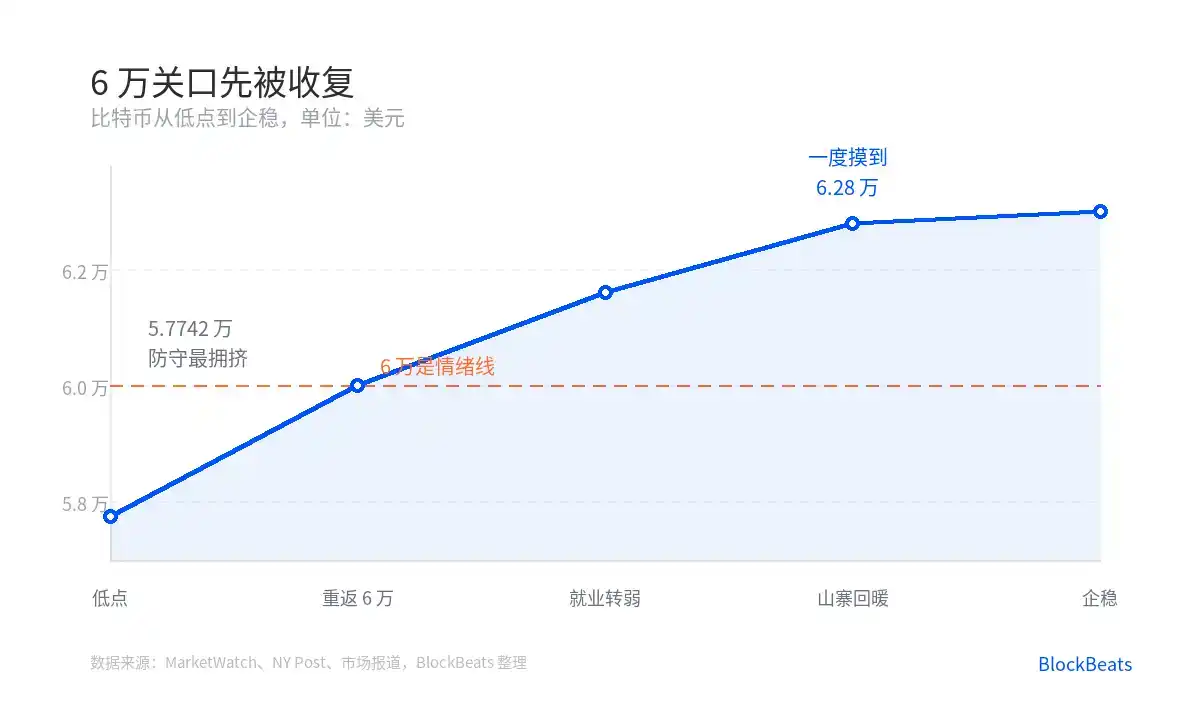
The latter part of his statement was not dovish, but the market first took the former part. Bitcoin quickly rebounded from its lows, once again approaching $60,000. Subsequently, weaker U.S. employment data continued to cool rate hike expectations, and the market movement evolved from "repair" into "relay."
Over the past few weeks, the market's greatest fear was that the Fed would continue to keep interest rates high, or even re-escalate tightening expectations. For Bitcoin, this is not an abstract macro judgment. The harder the interest rate expectations, the narrower the valuation space for risk assets, and the easier it is for leveraged positions to be liquidated first.

After Warsh downplayed inflation risks, the market first repriced "rate hike pressure." After weak employment data, this direction received another push. Bitcoin recovered from around $57,742 to above $60,000. While the price movement appears rapid, its essence is the market rolling back the previous round of panic trading.

On Deribit, traders concentrated on buying $50,000 put options. Open interest in gold perpetual futures reached a new high. A death cross also appeared on the technical charts. Several signals together indicate that the market is not simply bearish but is buying insurance against a decline.

This is different from an ordinary pullback. In an ordinary pullback, sellers simply want to exit. In a panic defense, traders simultaneously buy puts, purchase safe-haven assets, and reduce leverage. When the price touches a key level, liquidations amplify the volatility.
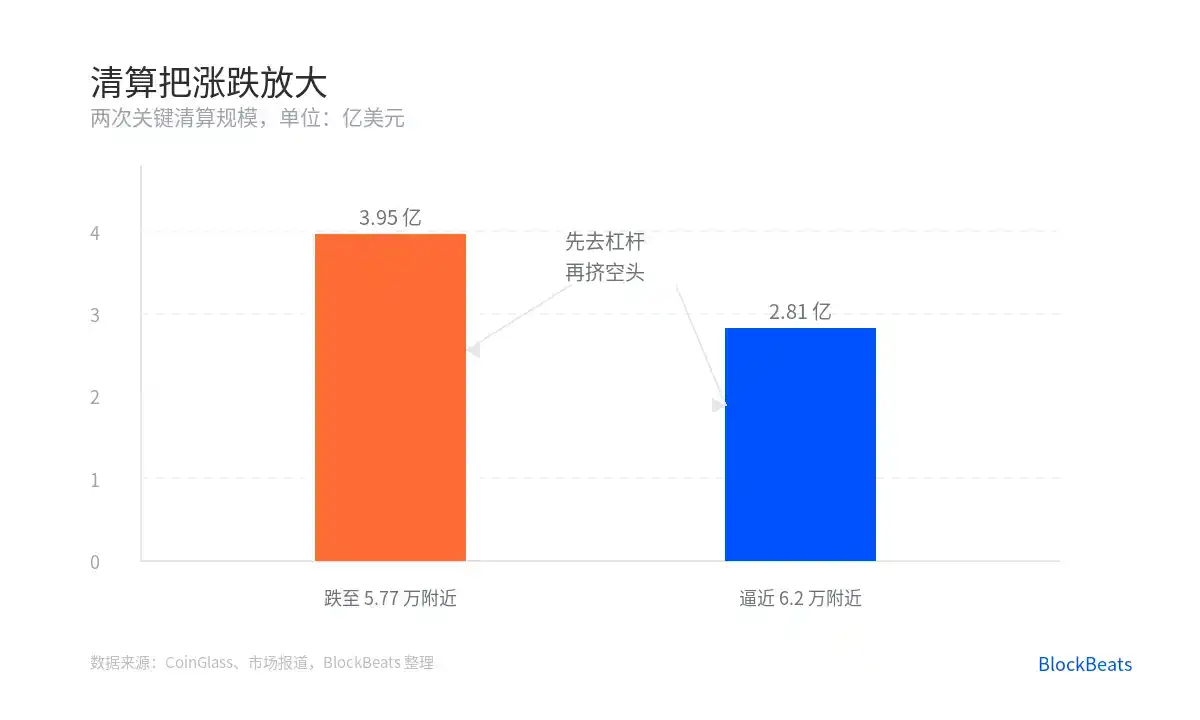
CoinGlass data shows that when Bitcoin fell near $57,700, it triggered approximately $395 million in liquidations. This figure indicates that the price decline was not solely driven by selling pressure but also by forced exits from leveraged positions.

After the forced exits, the market actually becomes more prone to a rebound.

The reason is straightforward. The previous decline liquidated some long leverage and pushed defensive sentiment to a high. When macro news marginally eased, the price only needed to return near a key level to make short sellers nervous. Short covering is essentially buying. The higher the price goes, the more it forces bearish positions to retreat.

This is the second layer of thrust. When Ethereum and Solana led the gains, Bitcoin once approached $62,000, liquidating approximately $281 million in bearish bets. This is not new-found belief but a reaction force from the position structure.

Therefore, this rebound cannot be attributed solely to one sentence from Warsh. A more accurate breakdown is into three stages.

First stage: Inflation risks were downplayed, easing market concerns about the Fed's path. Second stage: Weak employment data further pressured rate hike expectations downward. Third stage: Forced short covering pushed the spot price higher, faster.

If only looking at the first stage, the market movement can easily be interpreted as a "macro positive." If only looking at the third stage, one might mistakenly think it's a purely technical rebound. The real structure lies in both occurring within the same period. The macro provided the reason for prices to rise, while positioning provided the speed for prices to rise.

The reaction of altcoins also indicates this is not a single-coin market movement.

After Bitcoin reclaimed $60,000, Ethereum, Solana, and Dogecoin rose in sync. Ethereum subsequently led the gains among major cryptocurrencies, rising about 12% over the past week. When capital begins to spill over from Bitcoin to Ethereum and Solana, the market is no longer trading just "whether Bitcoin can hold."

The CoinMarketCap Altcoin Season Index rose to 52/100, the highest in three months. This level is微妙. It has just crossed the midpoint, indicating risk appetite has indeed returned, but it hasn't reached the stage of full altcoin frenzy.
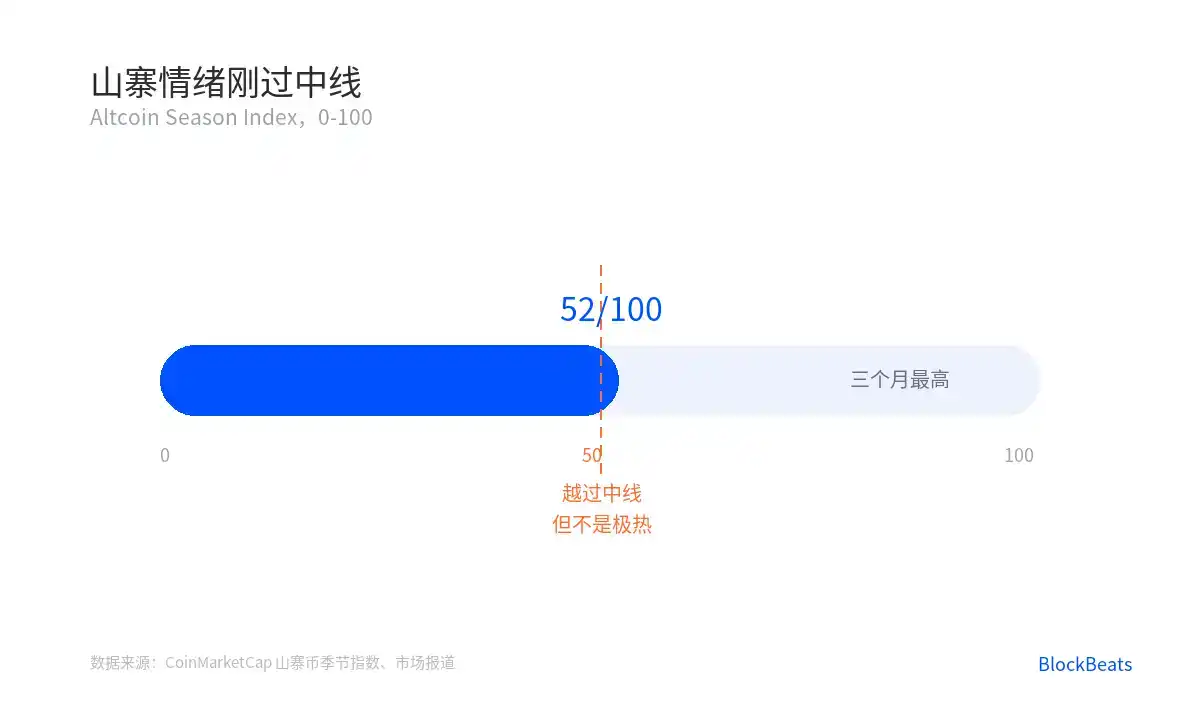
This is the first thing to note. Warming altcoin sentiment does not mean an altcoin season is confirmed.

A true altcoin season typically requires broader capital dispersion. What we're seeing now is more like the market first buying back large-cap, liquid tokens after Bitcoin stabilized. The fact that Ethereum and Solana are outperforming while some smaller coins remain weak is itself a signal.

The second thing is that the options market does not fully believe in the rebound.

The put-call skew for BTC and ETH still shows traders are willing to pay a higher price for downside protection. The price has rebounded, but insurance isn't cheap. This detail is colder than the spot price.

If traders truly believed the trend had reversed, put option premiums would typically decline faster. The current state is more like the spot market pulled the price back first, while the derivatives market hasn't put away its umbrella.

The third thing is that a short squeeze cannot continue indefinitely.

Short covering brings buying pressure, but this pressure is one-off. It can push prices up from congested lows but cannot alone sustain an entire trend. After the liquidations end, the market needs new spot buying to take over.

So what really matters next is not whether Bitcoin has breached a certain integer level, but who is still buying after it does. Spot ETF flows, stablecoin liquidity, and the strength of follow-through gains in Ethereum and Solana will be more informative than a single day's gain.

The fourth thing is that macro variables remain the same sword.

This rally benefited from declining inflation risks and weakening employment. Looked at the other way, if subsequent data points again to sticky inflation, or if Fed rhetoric turns hawkish again, the market will price it in reverse using the same logic. Bitcoin is not an asset detached from macroeconomics; it just reacts faster to changes in macro expectations.

The price has bounced back from excessive defensiveness, but true confirmation will come when the options market is willing to remove the insurance.


Crypto di tendenza

Domande pertinenti

QWhat were the three stages that led to Bitcoin's recent price rebound according to the article?

AStage 1: Fed Chair downplayed inflation risks, easing market concerns about the Fed's policy path. Stage 2: Weak U.S. employment data further pressured down interest rate hike expectations. Stage 3: Short positions were forced to cover, which amplified the upward price move.

QHow does the article describe the current state of the altcoin market, and what is a key indicator mentioned?

AThe altcoin market shows warming sentiment but is not in a confirmed altseason. The CoinMarketCap Altcoin Season Index has risen to 52/100, its highest in three months, indicating a return of risk appetite without widespread, euphoric buying across smaller altcoins. The article notes that liquidity is flowing primarily into large-cap tokens like Ethereum and Solana, while smaller coins remain weak.

QWhat does the behavior of the options market, regarding put-call skew, suggest about trader sentiment despite the price rebound?

AThe persistent put-call skew for BTC and ETH, where traders are still willing to pay a higher premium for put options (downside protection), suggests that the options market does not fully believe in the sustainability of the rebound. It indicates a cautious or defensive posture even as spot prices rise.

QWhat is the limitation of a price rally driven primarily by a short squeeze, as explained in the article?

AThe buying pressure from a short squeeze is one-time and finite. It can push the price out of a crowded low but cannot independently sustain a full trend. After the squeeze ends, the rally needs new spot buying (e.g., from ETFs, stablecoin inflows) to support it.

QWhat is the main macro variable that the article states Bitcoin's price is still sensitive to, and why?

AThe main macro variable is inflation data and the Federal Reserve's corresponding policy stance. The recent rally benefited from expectations of softer inflation and a less hawkish Fed. Conversely, the article warns that if future data points to persistent inflation or the Fed's rhetoric turns hawkish again, the market would re-price Bitcoin using the same logic in reverse. Bitcoin reacts quickly to changes in macro expectations but is not detached from them.

Letture associate

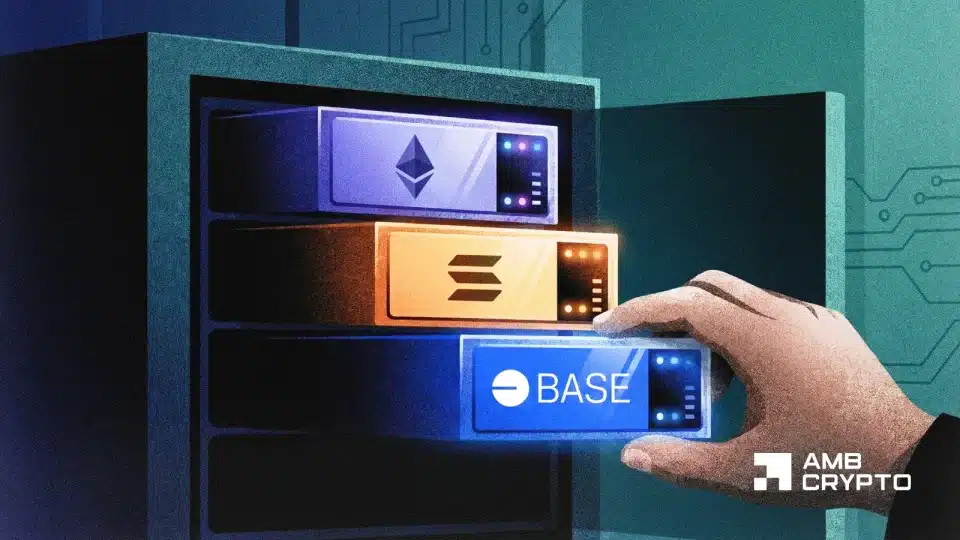
Why 2026 could redefine Ethereum, Solana, Base and Avalanche

Blockchain infrastructure is undergoing a major coordinated transformation, driven by institutional demand for reliability, compliance, and predictable settlement. Over $30 billion in Real-World Assets (RWA) on-chain has exposed network weaknesses. Major blockchains are responding with foundational upgrades, moving beyond incremental speed improvements. Ethereum's "Glamsterdam" upgrade, planned for H1 2026, will significantly increase gas limits and introduce features like PBS (pre-blocked state) for enhanced settlement and parallel execution. Solana's "Alpenglow," targeting a mainnet launch in H2 2026, focuses on reducing finality time dramatically and freeing network resources to improve reliability. Beyond speed, compliance is critical. Base's "Beryl" upgrade in Q3 2026 will introduce a standardized, regulatory-compliant token framework (B20). Avalanche's "Octane" upgrade aims to boost transaction processing and reduce costs for enterprise applications. Even Bitcoin is evolving with the potential activation of OP_CAT by late 2026/early 2027. The competition is shifting. While technical upgrades are widespread, institutions will ultimately allocate capital based on proven execution, operational resilience, and regulatory compatibility during market stress. Ethereum currently leads in tokenized assets, while networks like Base and Solana are strengthening their institutional offerings. The blockchain that best delivers reliable, compliant, and uninterrupted service is poised to attract the greatest share of future institutional capital.

ambcrypto11 min fa

Why 2026 could redefine Ethereum, Solana, Base and Avalanche

ambcrypto11 min fa

Tiger Research: Take RWA Tokenization Overseas First

This article discusses the strategic choices facing financial institutions in jurisdictions lacking mature regulatory frameworks for Real-World Asset (RWA) tokenization. With the market growing rapidly, institutions must choose between waiting for local legislation, using regulatory sandboxes, or—the recommended priority—expanding into overseas markets to gain early experience. Successfully launching cross-border RWA tokenization requires meticulous preparation across six key areas: establishing an overseas base (e.g., Hong Kong, Singapore, the U.S.), securing necessary licenses, defining the tokenized asset (with bonds being simpler than non-standard assets), defining the target investor scope, deciding on settlement currencies/payment flows, and designing operational requirements like custody and on-chain governance. The article outlines two primary strategic paths: a direct "onshore" path and a "native on-chain" path. The direct path involves setting up a legal entity and obtaining licenses in a mature jurisdiction like Hong Kong, Singapore, or the U.S., leveraging existing platforms (e.g., DigiFT, Securitize) for efficiency. The alternative native on-chain path involves partnering with compliant, decentralized platforms (e.g., Ondo, Plume Nest) that use structures like offshore SPVs to facilitate tokenization and access DeFi liquidity, offering speed and broader reach but with greater structural complexity. The core argument is that institutions should not wait for perfect domestic regulation. A detailed hypothetical case study illustrates the multi-step, 6-12 month process of launching an overseas tokenized bond. The key takeaway is that the essence of a tokenization business lies not in the technology but in successfully executing the entire sales and operational process. The market is moving forward, and the time to act is now.

marsbit22 min fa

Tiger Research: Take RWA Tokenization Overseas First

marsbit22 min fa

Trading

Spot

Articoli Popolari

Cosa è BITCOIN

Comprendere HarryPotterObamaSonic10Inu (ERC-20) e la sua posizione nel mondo delle criptovalute Negli ultimi anni, il mercato delle criptovalute ha assistito a un aumento della popolarità delle meme coin, catturando l'interesse non solo dei trader, ma anche di coloro che cercano coinvolgimento comunitario e valore di intrattenimento. Tra questi token unici c'è HarryPotterObamaSonic10Inu (ERC-20), un progetto intrigante che mescola riferimenti culturali nel tessuto delle criptovalute. Questo articolo esplora gli aspetti chiave di HarryPotterObamaSonic10Inu, analizzando i suoi meccanismi, l'etica guidata dalla comunità e il suo coinvolgimento con il panorama crittografico più ampio. Che cos'è HarryPotterObamaSonic10Inu (ERC-20)? Come suggerisce il suo nome, HarryPotterObamaSonic10Inu è una meme coin costruita sulla blockchain di Ethereum, classificata secondo lo standard ERC-20. A differenza delle criptovalute tradizionali che possono enfatizzare l'utilità pratica o il potenziale investimento, questo token prospera grazie al valore di intrattenimento e alla forza della sua comunità. Il progetto mira a creare un ambiente in cui gli utenti coinvolti possono riunirsi, condividere idee e partecipare ad attività ispirate a diversi fenomeni culturali. Una caratteristica notevole di HarryPotterObamaSonic10Inu è la zero tassa sulle transazioni. Questo elemento allettante tende a incoraggiare il trading e il coinvolgimento della comunità, privo di costi aggiuntivi che possono scoraggiare i trader di piccole dimensioni. L'offerta totale della moneta è fissata a un miliardo di token, un numero che segna la sua intenzione di mantenere una circolazione sostanziale all'interno della comunità. Creatore di HarryPotterObamaSonic10Inu (ERC-20) Le origini di HarryPotterObamaSonic10Inu sono avvolte in un certo mistero; i dettagli sul creatore rimangono sconosciuti. Lo sviluppo di questo token non presenta un team identificabile o un piano esplicito, cosa non rara nel settore delle meme coin. Invece, il progetto è emerso organicamente, con il suo progresso fortemente dipendente dall'entusiasmo e dalla partecipazione della sua comunità. Investitori di HarryPotterObamaSonic10Inu (ERC-20) Per quanto riguarda investimenti esterni e finanziamenti, HarryPotterObamaSonic10Inu rimane ambiguo. Il token non elenca alcuna fondazione di investimento conosciuta o un sostegno organizzativo significativo. Invece, la linfa vitale del progetto è la sua comunità di base, che informa la sua crescita e sostenibilità attraverso azioni collettive e coinvolgimento nello spazio crittografico. Come funziona HarryPotterObamaSonic10Inu (ERC-20)? In quanto meme coin, HarryPotterObamaSonic10Inu opera principalmente al di fuori delle strutture tradizionali che governano spesso il valore degli asset. Ci sono diversi aspetti distintivi che definiscono il funzionamento del progetto: Transazioni senza tasse: Senza costi fiscali sulle transazioni, gli utenti possono comprare e vendere liberamente il token senza preoccuparsi di costi nascosti. Coinvolgimento della comunità: Il progetto prospera sull'interazione della comunità, sfruttando le piattaforme social per creare entusiasmo e facilitare il coinvolgimento. Discussioni, condivisione di contenuti e coinvolgimento sono elementi cruciali che aiutano ad espandere la sua portata e a favorire la lealtà tra i sostenitori. Nessuna utilità pratica: Va notato che HarryPotterObamaSonic10Inu non offre un'utilità concreta all'interno dell'ecosistema finanziario. Piuttosto, è classificato come un token principalmente per attività di intrattenimento e comunitarie. Riferimento culturale: Il token incorpora astutamente elementi della cultura pop per attirare interesse, collegandosi a appassionati di meme e seguaci delle criptovalute. HarryPotterObamaSonic10Inu esemplifica come le meme coin operino in modo diverso rispetto ai progetti di criptovalute più tradizionali, entrando nel mercato come costrutti sociali innovativi piuttosto che come asset utilitari. Cronologia di HarryPotterObamaSonic10Inu (ERC-20) La storia di HarryPotterObamaSonic10Inu è segnata da diversi traguardi notevoli: Creazione: Il token è emerso da un meme virale, catturando l'immaginazione di molti appassionati di criptovalute. Le date di creazione specifiche non sono disponibili, sottolineando la sua crescita organica. Inserimento negli scambi: HarryPotterObamaSonic10Inu ha fatto il suo ingresso in vari scambi, consentendo un accesso e un trading più facili da parte della comunità. Iniziative di coinvolgimento della comunità: Attività in corso volte a migliorare l'interazione della comunità, comprese gare, campagne sui social media e generazione di contenuti da parte di fan e sostenitori. Piani di espansione futura: La tabella di marcia del progetto include il lancio di una collezione NFT, merchandising e un sito di eCommerce relativo ai suoi temi culturali, coinvolgendo ulteriormente la comunità e cercando di aggiungere più dimensioni al suo ecosistema. Punti chiave su HarryPotterObamaSonic10Inu (ERC-20) Natura guidata dalla comunità: Il progetto dà priorità al contributo collettivo e alla creatività, garantendo che il coinvolgimento degli utenti sia al centro del suo sviluppo. Classificazione come meme coin: Rappresenta l'epitome delle criptovalute basate sull'intrattenimento, distinguendosi dai veicoli d'investimento tradizionali. Nessuna affiliazione diretta con Bitcoin: Nonostante la somiglianza nel nome del ticker, HarryPotterObamaSonic10Inu è distintivo e non ha alcuna relazione con Bitcoin o altre criptovalute consolidate. Focus sulla collaborazione: HarryPotterObamaSonic10Inu è progettato per creare uno spazio per la collaborazione e la condivisione di storie tra i suoi detentori, fornendo un canale per la creatività e il legame comunitario. Prospettive future: L'ambizione di espandersi oltre il suo presupposto iniziale verso NFT e merchandising delinea un percorso per il progetto per potenzialmente entrare in strade più mainstream all'interno della cultura digitale. Poiché le meme coin continuano a catturare l'immaginazione della comunità crittografica, HarryPotterObamaSonic10Inu (ERC-20) si distingue per i suoi legami culturali e il suo approccio centrato sulla comunità. Anche se potrebbe non adattarsi al modello tipico di un token orientato all'utilità, la sua essenza risiede nella gioia e nella camaraderia coltivate tra i suoi sostenitori, evidenziando la natura in evoluzione delle criptovalute in un'epoca sempre più digitale. Con la continuazione dello sviluppo del progetto, sarà importante osservare come le dinamiche della comunità influenzano la sua traiettoria nel panorama in continuo cambiamento della tecnologia blockchain.

1.8k Totale visualizzazioniPubblicato il 2024.04.01Aggiornato il 2024.12.03

Cosa è BITCOIN

Come comprare BTC

Benvenuto in HTX.com! Abbiamo reso l'acquisto di Bitcoin (BTC) semplice e conveniente. Segui la nostra guida passo passo per intraprendere il tuo viaggio nel mondo delle criptovalute.Step 1: Crea il tuo Account HTXUsa la tua email o numero di telefono per registrarti il tuo account gratuito su HTX. Vivi un'esperienza facile e sblocca tutte le funzionalità,Crea il mio accountStep 2: Vai in Acquista crypto e seleziona il tuo metodo di pagamentoCarta di credito/debito: utilizza la tua Visa o Mastercard per acquistare immediatamente BitcoinBTC.Bilancio: Usa i fondi dal bilancio del tuo account HTX per fare trading senza problemi.Terze parti: abbiamo aggiunto metodi di pagamento molto utilizzati come Google Pay e Apple Pay per maggiore comodità.P2P: Fai trading direttamente con altri utenti HTX.Over-the-Counter (OTC): Offriamo servizi su misura e tassi di cambio competitivi per i trader.Step 3: Conserva Bitcoin (BTC)Dopo aver acquistato Bitcoin (BTC), conserva nel tuo account HTX. In alternativa, puoi inviare tramite trasferimento blockchain o scambiare per altre criptovalute.Step 4: Scambia Bitcoin (BTC)Scambia facilmente Bitcoin (BTC) nel mercato spot di HTX. Accedi al tuo account, seleziona la tua coppia di trading, esegui le tue operazioni e monitora in tempo reale. Offriamo un'esperienza user-friendly sia per chi ha appena iniziato che per i trader più esperti.

4.1k Totale visualizzazioniPubblicato il 2024.12.12Aggiornato il 2026.06.02

Come comprare BTC

Cosa è $BITCOIN

ORO DIGITALE ($BITCOIN): Un'Analisi Completa Introduzione all'ORO DIGITALE ($BITCOIN) L'ORO DIGITALE ($BITCOIN) è un progetto basato su blockchain che opera sulla rete Solana, con l'obiettivo di combinare le caratteristiche dei metalli preziosi tradizionali con l'innovazione delle tecnologie decentralizzate. Sebbene condivida un nome con Bitcoin, spesso definito “oro digitale” a causa della sua percezione come riserva di valore, l'ORO DIGITALE è un token separato progettato per creare un ecosistema unico all'interno del panorama Web3. Il suo obiettivo è posizionarsi come un asset digitale alternativo valido, anche se i dettagli riguardanti le sue applicazioni e funzionalità sono ancora in fase di sviluppo. Cos'è l'ORO DIGITALE ($BITCOIN)? L'ORO DIGITALE ($BITCOIN) è un token di criptovaluta esplicitamente progettato per l'uso sulla blockchain di Solana. A differenza di Bitcoin, che fornisce un ruolo di stoccaggio di valore ampiamente riconosciuto, questo token sembra concentrarsi su applicazioni e caratteristiche più ampie. Aspetti notevoli includono: Infrastruttura Blockchain: Il token è costruito sulla blockchain di Solana, nota per la sua capacità di gestire transazioni ad alta velocità e a basso costo. Dinamiche di Offerta: L'ORO DIGITALE ha un'offerta massima fissata a 100 quadrilioni di token (100P $BITCOIN), sebbene i dettagli riguardanti la sua offerta circolante siano attualmente non divulgati. Utilità: Sebbene le funzionalità precise non siano esplicitamente delineate, ci sono indicazioni che il token potrebbe essere utilizzato per varie applicazioni, potenzialmente coinvolgendo applicazioni decentralizzate (dApp) o strategie di tokenizzazione degli asset. Chi è il Creatore dell'ORO DIGITALE ($BITCOIN)? Attualmente, l'identità dei creatori e del team di sviluppo dietro l'ORO DIGITALE ($BITCOIN) rimane sconosciuta. Questa situazione è tipica tra molti progetti innovativi nel settore blockchain, in particolare quelli allineati con la finanza decentralizzata e i fenomeni delle meme coin. Sebbene tale anonimato possa favorire una cultura guidata dalla comunità, intensifica le preoccupazioni riguardo alla governance e alla responsabilità. Chi sono gli Investitori dell'ORO DIGITALE ($BITCOIN)? Le informazioni disponibili indicano che l'ORO DIGITALE ($BITCOIN) non ha alcun sostenitore istituzionale noto o investimenti di venture capital prominenti. Il progetto sembra operare su un modello peer-to-peer incentrato sul supporto e sull'adozione della comunità piuttosto che su percorsi di finanziamento tradizionali. La sua attività e liquidità si trovano principalmente su exchange decentralizzati (DEX), come PumpSwap, piuttosto che su piattaforme di trading centralizzate consolidate, evidenziando ulteriormente il suo approccio di base. Come Funziona l'ORO DIGITALE ($BITCOIN) Le meccaniche operative dell'ORO DIGITALE ($BITCOIN) possono essere elaborate in base al suo design blockchain e alle caratteristiche della rete: Meccanismo di Consenso: Sfruttando il proof-of-history (PoH) unico di Solana combinato con un modello di proof-of-stake (PoS), il progetto garantisce una validazione efficiente delle transazioni contribuendo all'alta performance della rete. Tokenomics: Sebbene meccanismi deflazionistici specifici non siano stati dettagliati ampiamente, l'ampia offerta massima di token implica che potrebbe soddisfare microtransazioni o casi d'uso di nicchia che devono ancora essere definiti. Interoperabilità: Esiste il potenziale per l'integrazione con l'ecosistema più ampio di Solana, inclusi vari piattaforme di finanza decentralizzata (DeFi). Tuttavia, i dettagli riguardanti integrazioni specifiche rimangono non specificati. Cronologia degli Eventi Chiave Ecco una cronologia che evidenzia traguardi significativi riguardanti l'ORO DIGITALE ($BITCOIN): 2023: Il dispiegamento iniziale del token avviene sulla blockchain di Solana, contrassegnato dal suo indirizzo di contratto. 2024: L'ORO DIGITALE guadagna visibilità poiché diventa disponibile per il trading su exchange decentralizzati come PumpSwap, consentendo agli utenti di scambiarlo contro SOL. 2025: Il progetto assiste a un'attività di trading sporadica e a un potenziale interesse per impegni guidati dalla comunità, sebbene non siano state documentate partnership significative o avanzamenti tecnici fino ad ora. Analisi Critica Punti di Forza Scalabilità: L'infrastruttura sottostante di Solana supporta alti volumi di transazioni, il che potrebbe migliorare l'utilità di $BITCOIN in vari scenari di transazione. Accessibilità: Il potenziale basso prezzo di trading per token potrebbe attrarre investitori al dettaglio, facilitando una partecipazione più ampia grazie a opportunità di proprietà frazionata. Rischi Mancanza di Trasparenza: L'assenza di sostenitori, sviluppatori o di un processo di audit pubblicamente noti potrebbe generare scetticismo riguardo alla sostenibilità e all'affidabilità del progetto. Volatilità del Mercato: L'attività di trading è fortemente dipendente dal comportamento speculativo, il che può comportare una significativa volatilità dei prezzi e incertezze per gli investitori. Conclusione L'ORO DIGITALE ($BITCOIN) emerge come un progetto intrigante ma ambiguo all'interno dell'evolvente ecosistema di Solana. Sebbene tenti di sfruttare la narrativa dell'“oro digitale”, la sua partenza dal ruolo consolidato di Bitcoin come riserva di valore sottolinea la necessità di una chiara differenziazione della sua utilità e struttura di governance. L'accettazione e l'adozione future dipenderanno probabilmente dall'affrontare l'attuale opacità e dalla definizione più esplicita delle sue strategie operative ed economiche. Nota: Questo rapporto comprende informazioni sintetizzate disponibili a ottobre 2023, e potrebbero essersi verificati sviluppi oltre il periodo di ricerca.

123 Totale visualizzazioniPubblicato il 2025.05.13Aggiornato il 2025.05.13

Cosa è $BITCOIN

Discussioni

Benvenuto nella Community HTX. Qui puoi rimanere informato sugli ultimi sviluppi della piattaforma e accedere ad approfondimenti esperti sul mercato. Le opinioni degli utenti sul prezzo di BTC BTC sono presentate come di seguito.

活动图片